Food Additives Banned in Other Countries But Legal in the United States

Table of Contents
- Potassium Bromate
- Brominated Vegetable Oil (BVO)
- Azodicarbonamide (ADA)
- BHA (Butylated Hydroxyanisole)
- rBGH/rBST (Recombinant Bovine Growth Hormone)
- Ractopamine
- Titanium Dioxide (E171)
- Artificial Food Dyes (with EU Warning Labels)
- Chlorine-Washed Chicken
- Atrazine
- Olestra/Olean
- Partially Hydrogenated Oils (Trans Fats)
- The Precautionary Principle and the US Approach
- Labels, Standards and State Laws
- The Bottom Line
- Key Research Papers
- Related Pages
- Connections
- Featured Videos
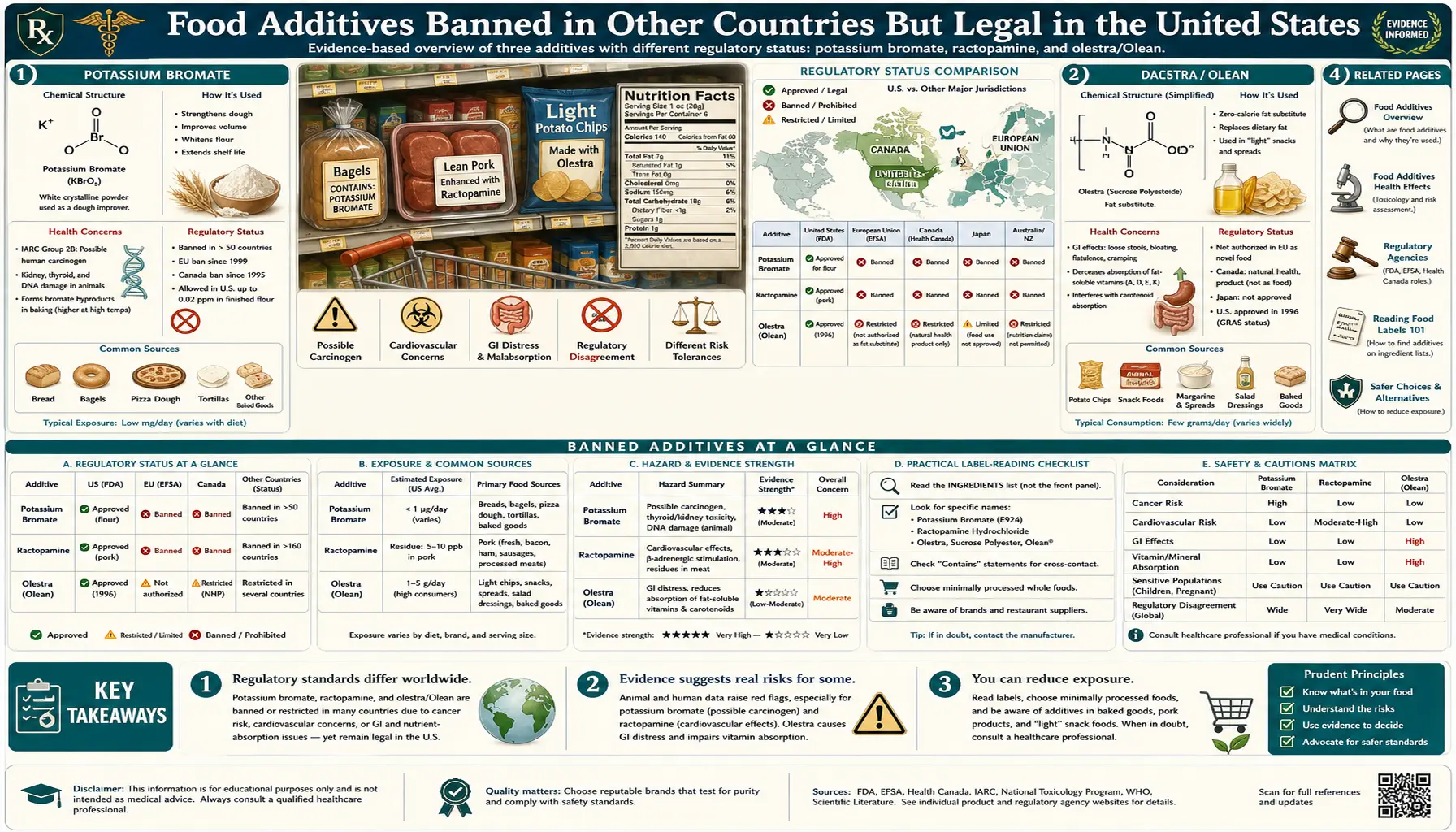
The United States permits a number of food additives, animal drugs, pesticides and processing practices that are banned, restricted or subject to warning labels elsewhere, most often in the European Union. Part of the difference is legal design. EU general food law (Regulation (EC) No 178/2002, Article 7) writes in a precautionary principle that allows provisional restrictions when harmful effects on health are possible but scientific uncertainty persists. US law also requires pre-market approval for new food additives, but substances that companies determine to be “generally recognized as safe” (GRAS) can enter food without FDA review, and withdrawing an existing approval has often taken decades — brominated vegetable oil, for example, was used under an “interim” authorization from 1970 until FDA revoked it in 2024.
The list keeps changing. Since 2023 FDA has removed partially hydrogenated oils from its regulations (2023), revoked brominated vegetable oil (2024), FD&C Red No. 3 (ordered January 2025, effective in food January 2027) and Orange B (2026), proposed revoking Citrus Red No. 2 (2026), opened post-market safety reviews of BHA and azodicarbonamide (2026), and proposed requiring companies to notify it of GRAS determinations (August 2026). Each entry below gives the status as of October 2026; the regulatory documents and studies are listed under Key Research Papers.
Potassium Bromate
- What it is: A chemical oxidizing agent (KBrO3) added to flour and bread dough to strengthen the dough, help it rise higher, and give the finished bread a white, fluffy appearance.
- Where it is found: White bread, rolls, buns, pizza dough and other baked goods made with bromated flour. On US labels it appears as “potassium bromate” or “bromated flour.” Federal standards allow up to 50 parts per million in bromated flour (21 CFR 137.155), and a separate rule allows its use in malting barley for beer and spirits (21 CFR 172.730).
- Status elsewhere: The International Agency for Research on Cancer (IARC) classifies potassium bromate as possibly carcinogenic to humans (Group 2B). In rats it causes kidney (renal cell) tumors, mesotheliomas of the peritoneum and thyroid follicular-cell tumors; the carcinogenic potential appears weak in mice and hamsters (Kurokawa 1990). It is not among the food additives authorised in the European Union.
- US status (October 2026): Still permitted; FDA has never revoked these uses. FDA's list of chemicals under review states that the agency worked with the baking industry's trade association to improve baking technology and testing so that the ingredient is used in a way that minimizes residual bromate. The same 1990 review reported that adverse effects were not evident in animals fed bread made from bromate-treated flour.
- State law: California's Food Safety Act (AB 418, signed 7 October 2023) prohibits food containing potassium bromate from 1 January 2027. Potassium bromate is also on California's Proposition 65 list of chemicals known to cause cancer.
- Health effects: In animals, kidney, peritoneal and thyroid tumors, with oxidative DNA damage (8-hydroxydeoxyguanosine) in the rat kidney. In people, potassium bromate taken by mouth is toxic to the kidney (Kurokawa 1990); effects at the residue levels found in bread have not been established.
Brominated Vegetable Oil (BVO)
- What it is: Vegetable oil chemically bonded with bromine atoms, used to keep citrus flavoring oils evenly suspended in drinks.
- Where it was found: Some citrus-flavored soft drinks and sports drinks. FDA's only authorization was as a stabilizer for flavoring oils in fruit-flavored beverages, at up to 15 parts per million.
- Status elsewhere: FDA's 2024 final rule notes that BVO is not permitted in beverages in Australia, the European Union, Japan and New Zealand, and that some BVO-containing products had already been reformulated to be sold in those markets.
- US status (October 2026): Banned. FDA concluded in 1970 that BVO could no longer be regarded as GRAS and allowed it on an interim basis while safety studies were done. On 3 July 2024 FDA published a final rule revoking the authorization because there is no longer a reasonable certainty of no harm (effective 2 August 2024, with a compliance date one year later). California's AB 418, signed in October 2023, had already scheduled a state ban for 1 January 2027.
- Health effects: An FDA-led 90-day rat feeding study (Woodling 2022) found thyroid follicular-cell hypertrophy at the higher doses, raised TSH, and dose-dependent accumulation of brominated fatty acids in the heart, liver and fat; FDA cited these results in its rule. A human case report describes severe bromism, with headache, fatigue, loss of coordination and memory loss, in a man drinking 2 to 4 liters a day of a BVO-containing cola; he recovered after hemodialysis (Horowitz 1997).
Azodicarbonamide (ADA)
- What it is: A synthetic chemical (C2H4N4O2) used as a flour bleaching agent and dough conditioner in bread, and as a foaming agent in plastics and rubber. Its industrial use in foamed products such as exercise mats earned it the nickname “the yoga mat chemical.”
- Where it is found: Some commercial breads, buns, tortillas, pastries and other baked goods. It appears on US labels as “azodicarbonamide”; its international (INS) number is 927a.
- Status elsewhere: Not authorised as a food additive in the European Union. Under EU chemical law it is classified as a respiratory sensitizer, and case reports describe occupational asthma in workers exposed to it (Kim 2004).
- US status (October 2026): Permitted at up to 45 parts per million in flour (21 CFR 172.806). In May 2026 FDA opened a post-market safety assessment and asked for data on its uses and safety (comments closed 13 July 2026); FDA's chemical-review list, updated 2 October 2026, shows that review still under way. ADA breaks down during baking; the breakdown products include semicarbazide and urethane (ethyl carbamate), which IARC classifies as probably carcinogenic to humans (Group 2A).
- Health effects: Respiratory sensitization and asthma in workers who handle the powder. Whether the small amounts of breakdown products in bread affect health has not been established.
BHA (Butylated Hydroxyanisole)
- What it is: A petroleum-derived synthetic antioxidant used to prevent fats and oils from going rancid.
- Where it is found: Some cereals, snack foods, chewing gum, shortenings, baked goods and dehydrated foods, as well as food packaging, cosmetics and animal feed.
- Status elsewhere: The EU authorises BHA (E 320) only in specified food categories with maximum levels, and EFSA re-evaluated it in 2011. In a 1983 Japanese study, BHA at 2% of the diet caused papillomas and squamous-cell carcinomas of the forestomach in rats (Ito 1983) — an organ humans do not have. The US National Toxicology Program has listed BHA as “reasonably anticipated to be a human carcinogen” since 1991.
- US status (October 2026): Listed by FDA as GRAS for use as a preservative when total antioxidants do not exceed 0.02% of the fat or oil content (21 CFR 182.3169). The FDA listing and the NTP listing come from different agencies answering different questions. In February 2026 FDA opened a post-market safety assessment of BHA in food and food-contact materials and requested data (comments closed 13 April 2026).
- Health effects: Forestomach tumors in rats, and forestomach papillomas in hamsters, in 1980s feeding studies. BHA and BHT are covered in more detail in the BHA and BHT article.
rBGH/rBST (Recombinant Bovine Growth Hormone)
- What it is: Recombinant bovine somatotropin, a genetically engineered growth hormone injected into dairy cows to raise milk yield. A meta-analysis by an expert panel of the Canadian Veterinary Medical Association, done at Health Canada's request, found increases of 11.3% in first-lactation cows and 15.6% in older cows, with considerable variation between studies (Dohoo 2003).
- Where it is found: Milk and dairy products from US herds that use it. USDA organic rules do not allow growth-promoting hormones in organic livestock.
- Status elsewhere: A 1999 Council Decision (1999/879/EC) prohibits placing BST on the market and administering it to dairy cows in the EU. It has not been approved for sale in Canada. The Canadian panel's review of randomized trials found that rbST raised the risk of clinical mastitis by about 25%, of a cow failing to conceive by about 40%, and of lameness by about 55% (Dohoo 2003).
- US status (October 2026): FDA approved rbST in 1993. FDA's February 1994 interim labeling guidance allows voluntary statements such as “from cows not treated with rbST” and suggests putting them in context, for example with the statement that no significant difference has been shown between milk from treated and untreated cows.
- Health effects: FDA scientists reported in 1990 that rbST treatment raises the concentration of insulin-like growth factor 1 (IGF-1) in milk, but concluded that the levels stay within the range found in human breast milk and that biologically significant amounts would not be absorbed (Juskevich 1990). Separately, a meta-analysis found higher circulating IGF-1 in people associated with modestly higher risk of prostate cancer and premenopausal breast cancer (Renehan 2004); whether milk from treated cows changes blood IGF-1 levels was not addressed by that analysis. The animal-health effects listed above (mastitis, lameness, fertility) are the best-documented ones.
Ractopamine
- What it is: A beta-agonist drug added to animal feed in the final weeks before slaughter to promote lean muscle growth, approved in the US for pigs, cattle and turkeys.
- Where it is found: Pork, beef and turkey from US animals fed it.
- Status elsewhere: The EU prohibits the use of beta-agonists to promote growth in farm animals (Council Directive 96/22/EC). In 2012 the Codex Alimentarius Commission, the UN food-standards body, adopted maximum residue limits for ractopamine by a very close vote rather than by consensus (Ni 2013).
- US status (October 2026): Permitted. FDA first approved ractopamine for pigs in 1999.
- Health effects: In a study of finishing pigs, ractopamine-fed animals were more active, harder to handle, and had higher heart rates and catecholamine levels during handling and transport (Marchant-Forde 2003). The human data reviewed by the FAO/WHO expert committee (JECFA) came from one study of six healthy male volunteers given single doses from 5 to 40 mg: heart rate and cardiac output rose with dose, and one man was withdrawn after the 25 mg dose because of adverse cardiac effects.
Titanium Dioxide (E171)
- What it is: A white pigment used to whiten and brighten foods. Food-grade titanium dioxide contains a fraction of nanoscale particles; EFSA reported that fewer than 50% of the particles by number are smaller than 100 nanometers.
- Where it is found: Candy, chewing gum, frosting, coffee creamer, white sauces, marshmallows and other white or brightly colored foods; also toothpaste, sunscreen and paint.
- Status elsewhere: In May 2021 the European Food Safety Authority concluded that a concern for genotoxicity (DNA strand breaks and chromosome damage) could not be ruled out and that E 171 “can no longer be considered as safe when used as a food additive”; it also concluded that absorption from the gut is low but particles may accumulate in the body. Commission Regulation (EU) 2022/63 of 14 January 2022 removed E 171 from the list of authorised food additives; it entered into force on 7 February 2022, with a transition period for foods already produced.
- US status (October 2026): Permitted as a color additive at up to 1% of the food's weight (21 CFR 73.575). A color additive petition filed on 14 April 2023 asks FDA to revoke the food listing; FDA says it is reviewing that petition and evaluates new information, including other regulators' actions, as it becomes available.
- Health effects: In rats given E 171 at human-relevant levels for 100 days, it promoted colon micro-inflammation, initiated preneoplastic lesions and fostered aberrant crypt growth in a chemically induced carcinogenesis model (Bettini 2017). EFSA's review found no adverse effects in general and organ toxicity studies up to 1,000 mg/kg body weight per day, but listed potential immunotoxicity, inflammation, neurotoxicity of nanoparticles and aberrant crypt foci as observations that may indicate adverse effects. No human studies of dietary exposure were available.
Artificial Food Dyes (with EU Warning Labels)
- What they are: Synthetic petroleum-derived colorants used to make food more visually appealing. The most common include Red 40 (Allura Red, E129), Yellow 5 (Tartrazine, E102), Yellow 6 (Sunset Yellow, E110), Blue 1 (Brilliant Blue, E133), Blue 2 (Indigo Carmine, E132) and Green 3 (Fast Green, E143). FDA has revoked the food authorization of Red No. 3 (Erythrosine, E127), effective 15 January 2027.
- Where they are found: Candy, cereal, snack foods, soft drinks, sports drinks, baked goods, ice cream, yogurt, salad dressings, medications and vitamins.
- EU warning labels: Since July 2010, EU law (Regulation (EC) No 1333/2008, Article 24 and Annex V) has required foods containing any of six colors — Sunset Yellow (E110), Quinoline Yellow (E104), Carmoisine (E122), Allura Red (E129), Tartrazine (E102) and Ponceau 4R (E124) — to state that the color “may have an adverse effect on activity and attention in children.” The requirement came after the 2007 Southampton trial (McCann et al., The Lancet), a randomized, double-blind, placebo-controlled crossover trial in 153 three-year-olds and 144 eight- and nine-year-olds. Drinks containing sodium benzoate plus one of two color mixes increased a global hyperactivity score: one mix in the three-year-olds, and both mixes in the older children who drank at least 85% of the drinks.
- US status (October 2026): No warning label is required. After a 2011 Food Advisory Committee review, FDA concluded that a causal relationship between certified color additives and hyperactivity in the general population of children had not been established. In April 2025 HHS and FDA announced a plan to phase out petroleum-based dyes that relies largely on industry action: a national standard and timeline, work with industry to eliminate the six remaining synthetic dyes (Blue 1 and 2, Green 3, Red 40, Yellow 5 and 6) by the end of 2026, and revocation of Citrus Red No. 2 and Orange B. FDA revoked the use of Orange B on sausage casings effective 8 September 2026 and proposed revoking Citrus Red No. 2 in July 2026, noting that both uses appeared to have been abandoned. FDA's chemical-review list shows the six main dyes under a “risk management action” (the phase-out); they remain listed as permitted color additives.
- Red No. 3: On 16 January 2025 FDA revoked the authorization of FD&C Red No. 3 in food (effective 15 January 2027) and in ingested drugs (effective 18 January 2028). The legal basis is the Delaney Clause, which bars a color additive found to induce cancer in animals: Red No. 3 causes thyroid tumors in male rats. FDA stated that the rat mechanism is of limited relevance to humans and that a human cancer risk at current exposure levels is unlikely. Objections stayed the order in February 2025; FDA lifted the stay on 5 August 2026 and confirmed both dates. California's AB 418 also prohibits Red No. 3 in food from 1 January 2027.
- Health effects: A 2012 meta-analysis found that restriction diets reduced ADHD symptoms (effect size g = 0.29) and that food colors had a small effect in parent reports (g = 0.18, falling to 0.12 after adjustment for publication bias); the effect was not reliable in studies confined to FDA-approved colors. The authors estimated that 8% of children with ADHD may have symptoms related to synthetic food colors (Nigg 2012).
Chlorine-Washed Chicken
- What it is: The practice of rinsing poultry carcasses with antimicrobial solutions — chlorine-based ones such as chlorine dioxide or acidified sodium chlorite, or others such as trisodium phosphate or peroxyacetic acid — near the end of processing to kill bacteria such as Salmonella and Campylobacter.
- Where it is found: Antimicrobial rinses are widely used in US poultry processing.
- Status elsewhere: EU hygiene rules (Regulation (EC) No 853/2004, Article 3(2)) allow only potable water to remove surface contamination from products of animal origin unless another substance has been approved. Chlorine-based poultry rinses have not been approved, so poultry treated this way cannot be marketed in the EU. The EU's position is usually framed not around chlorine residues on the meat but around requiring hygiene at every stage of production rather than relying on a final chemical step.
- US status (October 2026): USDA permits these antimicrobial treatments as part of pathogen-reduction programs. The issue featured prominently in US–UK trade discussions after Brexit.
- Health effects: Chlorine residues on the meat are generally described as minimal. The debate is about food-safety systems: whether an end-of-line wash is used in place of hygiene earlier in production.
Atrazine
- What it is: A triazine herbicide and one of the most widely used agricultural chemicals in the United States. Technically a pesticide rather than a food additive, it reaches people mainly through drinking water and crop residues.
- Where it is found: Corn and other treated crops, and drinking water, especially in corn-growing regions; it is among the pesticides most often detected in US water.
- Status elsewhere: Commission Decision 2004/248/EC of 10 March 2004 did not include atrazine among the EU's approved plant-protection substances and withdrew authorisations for products containing it, chiefly because of groundwater contamination.
- US status (October 2026): EPA continues to register atrazine, with highest use on field corn, sweet corn, sorghum and sugarcane. In July 2024 EPA revised its level of concern for aquatic ecosystems to 9.7 micrograms per liter and in December 2024 proposed updated mitigation measures; registration review is continuing. For public water systems, EPA lists granular activated carbon as a best available technology for removing atrazine (40 CFR 141.61).
- Health effects: Research led by Tyrone Hayes at UC Berkeley found hermaphroditic, demasculinized frogs after exposure to low, ecologically relevant doses (Hayes 2002), and complete feminization and chemical castration of male African clawed frogs (Hayes 2010). In people, a French birth cohort linked measurable atrazine in pregnant women's urine with fetal growth restriction (odds ratio 1.5) and small head circumference (1.7), but not with major birth defects (Chevrier 2011). The US Agricultural Health Study of 57,310 pesticide applicators found no consistent association between atrazine use and any cancer, with a suggestion of increased thyroid cancer based on small numbers (Freeman 2011).
Olestra/Olean
- What it is: A synthetic fat substitute made from sucrose and fatty acids (a sucrose polyester). Its molecules are too large to be digested or absorbed, so it passes through the body without contributing calories or fat.
- Where it is found: Fat-free snack chips, mainly in the late 1990s and early 2000s; its use has since declined.
- Status elsewhere: Olestra has not been authorised as a food ingredient in the European Union or Canada.
- US status (October 2026): FDA approved olestra for savory snacks in January 1996, with a required label statement that it may cause abdominal cramping and loose stools and inhibits the absorption of some vitamins and other nutrients. In August 2003, responding to the manufacturer's petition, FDA removed the requirement for that specific label statement. Regulations still require vitamins A, D, E and K to be added to olestra foods to compensate for reduced absorption (21 CFR 172.867); carotenoids are not on that list.
- Health effects: Two large randomized trials did not find more digestive symptoms overall with olestra chips: in a single-sitting trial of 1,123 moviegoers, 15.8% reported symptoms with olestra chips and 17.6% with regular chips (Cheskin 1998); in a 6-week home trial of 3,181 volunteers, the only difference was one more symptom-day of more frequent bowel movements with olestra (Sandler 1999). Olestra reduces the absorption of fat-soluble vitamins and carotenoids, which is why the vitamin-addition rule exists.
Partially Hydrogenated Oils (Trans Fats)
- What they are: Fats made by adding hydrogen to liquid vegetable oils to turn them solid or semi-solid. The process creates industrial trans fatty acids, which are strongly linked to cardiovascular disease.
- Where they were found: Margarine, shortening, fried foods, baked goods, snack foods, coffee creamers and many other processed foods.
- Restrictions elsewhere: In January 2004 Denmark became the first country to regulate the artificial trans fat content of foods, which nearly eliminated it from the Danish food supply (Restrepo 2016). Commission Regulation (EU) 2019/649, adopted 24 April 2019, limits trans fat other than that naturally present in animal fat to 2 grams per 100 grams of fat in food for consumers; non-compliant food could stay on the market until 1 April 2021.
- US status (October 2026): Banned. Trans fat labeling on the Nutrition Facts panel became mandatory in 2006. In June 2015 FDA determined that partially hydrogenated oils are no longer GRAS for any use in food, with a compliance date of 18 June 2018; in 2018 it extended the compliance dates for certain uses, and in 2023 it removed the remaining authorizations for PHOs from its regulations (effective 22 December 2023).
- Health effects: In a meta-analysis of 60 controlled trials, replacing trans fats with a mix of carbohydrates and unsaturated fats lowered the total-to-HDL cholesterol ratio almost twice as much as replacing saturated fats did (Mensink 2003). In a Chicago community cohort, higher trans-fat intake was associated with a higher risk of Alzheimer disease (relative risk 2.4 from the second fifth of intake; Morris 2003). The World Health Organization attributes more than 278,000 deaths a year worldwide to industrially produced trans fat.
The Precautionary Principle and the US Approach
Much of the difference between US and EU outcomes comes from how the two systems are designed.
The EU Precautionary Principle
EU general food law (Regulation (EC) No 178/2002, Article 7) allows provisional risk-management measures when the possibility of harmful effects on health has been identified but scientific uncertainty persists; the principle also appears in Article 191 of the Treaty on the Functioning of the European Union. In practice:
- Pre-market authorisation — A food additive may be used only once it is on the EU list of authorised additives (Regulation (EC) No 1333/2008), after an EFSA safety assessment.
- Action under uncertainty — Measures may be adopted pending a more complete risk assessment; they must be proportionate and reviewed within a reasonable period.
- Absence of evidence is not treated as proof of safety — Where data are missing or uncertain, an authorisation can be refused or withdrawn, as happened with titanium dioxide (E 171) in 2022.
- Re-evaluation — Older additives are re-evaluated by EFSA as new evidence emerges, and authorisations can be revoked.
The US Approach
US law (the 1958 Food Additives Amendment) also requires pre-market approval for new food additives, under a “reasonable certainty of no harm” standard. The differences critics point to lie elsewhere:
- Removing an approved substance — Revoking an existing authorization requires a formal rule or order and can take years; brominated vegetable oil lost its GRAS status in 1970 but stayed authorized on an interim basis until 2024.
- The GRAS pathway — Substances considered generally recognized as safe can be used without pre-market approval, and companies have not been required to tell FDA about their GRAS determinations. A 2011 review found that manufacturers and a trade association, rather than federal agencies, made the safety decisions for many substances now in food, without FDA review (Neltner 2011). In August 2026 FDA proposed a rule that would require GRAS notices to be submitted (comments due 9 December 2026).
- Who makes GRAS determinations — Of 451 GRAS notifications voluntarily sent to FDA from 1997 to 2012, 22.4% of the safety assessments were made by an employee of the additive manufacturer, 13.3% by an employee of a consulting firm it selected, and 64.3% by an expert panel selected by the manufacturer or its consulting firm (Neltner 2013).
- Post-market review — FDA maintains a public list of chemicals in food under review and, in 2026, opened formal post-market assessments of BHA and azodicarbonamide.
These regulatory differences are covered in more detail in US vs EU Food Safety Regulation Compared.
Labels, Standards and State Laws
- Ingredient lists — On US labels these substances appear by name: potassium bromate (or “bromated flour”), azodicarbonamide, BHA, titanium dioxide, and certified dyes such as Red 40 or Yellow 5, which must be identified individually.
- Organic standards — USDA organic rules prohibit giving organic livestock hormones for growth promotion or production (such as rbST) and synthetic medications other than for illness (7 CFR 205.238), and limit synthetic additives and pesticides to an approved National List.
- rbST-free claims — “From cows not treated with rbST” statements are voluntary; FDA's 1994 guidance suggests pairing them with a statement that no significant difference has been shown between milk from treated and untreated cows.
- Whole foods — Fresh fruit, vegetables, whole grains, legumes, nuts, seeds and unprocessed meats carry none of the added ingredients on this page; pesticide and animal-drug residues are a separate question.
- Drinking water — EPA lists granular activated carbon as a best available technology for removing atrazine in public water systems.
- Different recipes in different markets — Some products sold internationally are made with different ingredients where an additive is not permitted; FDA's 2024 BVO rule noted that BVO-containing drinks had been reformulated for markets that do not allow it.
- State law — California's Food Safety Act (AB 418, 2023) prohibits food containing brominated vegetable oil, potassium bromate, propylparaben or Red No. 3 from 1 January 2027.
The Bottom Line
US and EU rules differ less in whether new additives need approval than in how GRAS substances are handled, how readily existing approvals are re-examined, and how much scientific uncertainty is enough to act on. Several substances on this page have changed status in the US since 2023: partially hydrogenated oils (removed from the regulations, 2023), brominated vegetable oil (revoked, 2024), Red No. 3 (revoked, effective in food January 2027) and Orange B (revoked, 2026). BHA and azodicarbonamide are under FDA post-market review, and potassium bromate, titanium dioxide, rbST, ractopamine, chlorine-based poultry rinses, atrazine and olestra remain permitted as of October 2026.
For several of these substances the evidence of harm comes from animal studies or occupational exposure, and regulators have weighed the same data differently. Questions about individual health conditions belong with a clinician.
Key Research Papers
- Kurokawa Y, Maekawa A, Takahashi M, Hayashi Y (1990). Toxicity and carcinogenicity of potassium bromate — a new renal carcinogen. Environmental Health Perspectives 87:309-335 — PubMed PMID: 2269236
- Horowitz BZ (1997). Bromism from excessive cola consumption. Journal of Toxicology: Clinical Toxicology 35(3):315-320 — PubMed PMID: 9140329
- Woodling KA, Chitranshi P, Jacob CC, et al. (2022). Toxicological evaluation of brominated vegetable oil in Sprague Dawley rats. Food and Chemical Toxicology 165:113137 — PubMed PMID: 35588981
- Kim CW, Cho JH, Leem JH, et al. (2004). Occupational asthma due to azodicarbonamide. Yonsei Medical Journal 45(2):325-329 — PubMed PMID: 15119006
- Ito N, Fukushima S, Hagiwara A, Shibata M, Ogiso T (1983). Carcinogenicity of butylated hydroxyanisole in F344 rats. Journal of the National Cancer Institute 70(2):343-352 — PubMed PMID: 6571941
- Ito N, Fukushima S, Imaida K, et al. (1983). Induction of papilloma in the forestomach of hamsters by butylated hydroxyanisole. Gan 74(4):459-461 — PubMed PMID: 6628897
- Dohoo IR, Leslie K, DesCôteaux L, et al. (2003). A meta-analysis review of the effects of recombinant bovine somatotropin. 1. Methodology and effects on production. Canadian Journal of Veterinary Research 67(4):241-251 — PubMed PMID: 14620860
- Dohoo IR, DesCôteaux L, Leslie K, et al. (2003). A meta-analysis review of the effects of recombinant bovine somatotropin. 2. Effects on animal health, reproductive performance, and culling. Canadian Journal of Veterinary Research 67(4):252-264 — PubMed PMID: 14620861
- Juskevich JC, Guyer CG (1990). Bovine growth hormone: human food safety evaluation. Science 249(4971):875-884 — PubMed PMID: 2203142
- Renehan AG, Zwahlen M, Minder C, et al. (2004). Insulin-like growth factor (IGF)-I, IGF binding protein-3, and cancer risk: systematic review and meta-regression analysis. The Lancet 363(9418):1346-1353 — PubMed PMID: 15110491
- Marchant-Forde JN, Lay DC Jr, Pajor EA, et al. (2003). The effects of ractopamine on the behavior and physiology of finishing pigs. Journal of Animal Science 81(2):416-422 — PubMed PMID: 12643485
- Ni KJ (2013). Does science speak clearly and fairly in trade and food safety disputes? The search for an optimal response of WTO adjudication to problematic international standard-making. Food and Drug Law Journal 68(1):97-114 — PubMed PMID: 24640639
- Joint FAO/WHO Expert Committee on Food Additives (2004). Ractopamine (addendum). WHO Food Additives Series 53 — JECFA monograph (INCHEM)
- EFSA Panel on Food Additives and Flavourings (FAF), Younes M, Aquilina G, Castle L, et al. (2021). Safety assessment of titanium dioxide (E171) as a food additive. EFSA Journal 19(5):e06585 — PubMed PMID: 33976718
- Bettini S, Boutet-Robinet E, Cartier C, et al. (2017). Food-grade TiO2 impairs intestinal and systemic immune homeostasis, initiates preneoplastic lesions and promotes aberrant crypt development in the rat colon. Scientific Reports 7:40373 — PubMed PMID: 28106049
- McCann D, Barrett A, Cooper A, et al. (2007). Food additives and hyperactive behaviour in 3-year-old and 8/9-year-old children in the community: a randomised, double-blinded, placebo-controlled trial. The Lancet 370(9598):1560-1567 — PubMed PMID: 17825405
- Nigg JT, Lewis K, Edinger T, Falk M (2012). Meta-analysis of attention-deficit/hyperactivity disorder or attention-deficit/hyperactivity disorder symptoms, restriction diet, and synthetic food color additives. Journal of the American Academy of Child and Adolescent Psychiatry 51(1):86-97 — PubMed PMID: 22176942
- Hayes TB, Collins A, Lee M, et al. (2002). Hermaphroditic, demasculinized frogs after exposure to the herbicide atrazine at low ecologically relevant doses. Proceedings of the National Academy of Sciences USA 99(8):5476-5480 — PubMed PMID: 11960004
- Hayes TB, Khoury V, Narayan A, et al. (2010). Atrazine induces complete feminization and chemical castration in male African clawed frogs (Xenopus laevis). Proceedings of the National Academy of Sciences USA 107(10):4612-4617 — PubMed PMID: 20194757
- Chevrier C, Limon G, Monfort C, et al. (2011). Urinary biomarkers of prenatal atrazine exposure and adverse birth outcomes in the PELAGIE birth cohort. Environmental Health Perspectives 119(7):1034-1041 — PubMed PMID: 21367690
- Freeman LE, Rusiecki JA, Hoppin JA, et al. (2011). Atrazine and cancer incidence among pesticide applicators in the Agricultural Health Study (1994-2007). Environmental Health Perspectives 119(9):1253-1259 — PubMed PMID: 21622085
- Cheskin LJ, Miday R, Zorich N, Filloon T (1998). Gastrointestinal symptoms following consumption of olestra or regular triglyceride potato chips: a controlled comparison. JAMA 279(2):150-152 — PubMed PMID: 9440666
- Sandler RS, Zorich NL, Filloon TG, et al. (1999). Gastrointestinal symptoms in 3181 volunteers ingesting snack foods containing olestra or triglycerides: a 6-week randomized, placebo-controlled trial. Annals of Internal Medicine 130(4 Pt 1):253-261 — PubMed PMID: 10068382
- Restrepo BJ, Rieger M (2016). Denmark's policy on artificial trans fat and cardiovascular disease. American Journal of Preventive Medicine 50(1):69-76 — PubMed PMID: 26319518
- Mensink RP, Zock PL, Kester AD, Katan MB (2003). Effects of dietary fatty acids and carbohydrates on the ratio of serum total to HDL cholesterol and on serum lipids and apolipoproteins: a meta-analysis of 60 controlled trials. American Journal of Clinical Nutrition 77(5):1146-1155 — PubMed PMID: 12716665
- Morris MC, Evans DA, Bienias JL, et al. (2003). Dietary fats and the risk of incident Alzheimer disease. Archives of Neurology 60(2):194-200 — PubMed PMID: 12580703
- Neltner TG, Kulkarni NR, Alger HM, et al. (2011). Navigating the U.S. food additive regulatory program. Comprehensive Reviews in Food Science and Food Safety 10(6):342-368 — doi:10.1111/j.1541-4337.2011.00166.x
- Neltner TG, Alger HM, O'Reilly JT, et al. (2013). Conflicts of interest in approvals of additives to food determined to be generally recognized as safe: out of balance. JAMA Internal Medicine 173(22):2032-2036 — PubMed PMID: 23925593
Regulatory Documents
- FDA (2024). Revocation of Authorization for Use of Brominated Vegetable Oil in Food. Final rule, 89 FR 55040, 3 July 2024 — Federal Register
- FDA (2025). Color Additive Petition From Center for Science in the Public Interest, et al.; Request To Revoke Color Additive Listing for Use of FD&C Red No. 3 in Food and Ingested Drugs. Order, 90 FR 4628, 16 January 2025 — Federal Register
- FDA (2026). Response to objections and lifting of the stay on the FD&C Red No. 3 order. 91 FR 50475, 5 August 2026 — Federal Register
- FDA (2026). Revocation of the Color Additive Listing for Use of Orange B on Casings or Surfaces of Frankfurters and Sausages. 91 FR 46276, 23 July 2026 — Federal Register
- FDA (2026). Proposal To Revoke the Color Additive Listing for Use of Citrus Red No. 2 on the Skins of Mature Oranges. 91 FR 46330, 23 July 2026 — Federal Register
- FDA (2026). Butylated Hydroxyanisole (BHA); Request for Information. 91 FR 6227, 11 February 2026 — Federal Register
- FDA (2026). Azodicarbonamide (ADA); Request for Information. 91 FR 27060, 13 May 2026 — Federal Register
- FDA (2026). Substances Generally Recognized as Safe. Proposed rule, 91 FR 51834, 11 August 2026 — Federal Register
- FDA (2015). Final Determination Regarding Partially Hydrogenated Oils. 80 FR 34650, 17 June 2015 — Federal Register
- FDA (2023). Revocation of Uses of Partially Hydrogenated Oils in Foods. 88 FR 53764, 9 August 2023 — Federal Register
- FDA (2003). Food Additives Permitted for Direct Addition to Food for Human Consumption; Olestra (removal of the label statement). 68 FR 46364, 5 August 2003 — Federal Register
- FDA (1994). Interim Guidance on the Voluntary Labeling of Milk and Milk Products From Cows That Have Not Been Treated With Recombinant Bovine Somatotropin. 10 February 1994 — Federal Register
- FDA. List of Select Chemicals in the Food Supply Under FDA Review (updated 2 October 2026) — FDA
- HHS/FDA (22 April 2025). HHS, FDA to Phase Out Petroleum-Based Synthetic Dyes in Nation's Food Supply — FDA press announcement
- California Assembly Bill 418 (2023), the California Food Safety Act, Chapter 328, Statutes of 2023 — California Legislative Information
- Commission Regulation (EU) 2022/63 of 14 January 2022 as regards the food additive titanium dioxide (E 171) — EUR-Lex
- Commission Regulation (EU) 2019/649 of 24 April 2019 as regards trans fat — EUR-Lex
- Regulation (EC) No 1333/2008 on food additives, Article 24 and Annex V (labelling of six food colours) — EUR-Lex
- Council Decision 1999/879/EC of 17 December 1999 concerning the placing on the market and administration of bovine somatotrophin (BST) — EUR-Lex
- Council Directive 96/22/EC of 29 April 1996 on the prohibition of hormonal and thyrostatic substances and beta-agonists in stockfarming — EUR-Lex
- Commission Decision 2004/248/EC of 10 March 2004 concerning the non-inclusion of atrazine in Annex I to Directive 91/414/EEC — EUR-Lex
- Regulation (EC) No 853/2004 laying down specific hygiene rules for food of animal origin, Article 3(2) — EUR-Lex
- Regulation (EC) No 178/2002 (General Food Law), Article 7: precautionary principle — EUR-Lex
- US Environmental Protection Agency. Atrazine: registration review status — EPA
- World Health Organization. Trans fat fact sheet — WHO
Related Pages
Connections
- All Toxins
- US vs EU Food Safety
- Preservatives
- BHA and BHT
- Sodium Nitrite
- Food Additives
- Azodicarbonamide
- Potassium Bromate
- Brominated Vegetable Oil
- rBGH
- Ractopamine
- Titanium Dioxide
- Food Dyes
- Trans Fats
- Pesticides
- Cancer
- Asthma
- Milk
- Pork
- Dangerous Supplements — the same regulatory gap, applied to supplements.
- Banned Dyes
Featured Videos