Titanium Dioxide (E171): The Whitening Agent Banned in the EU
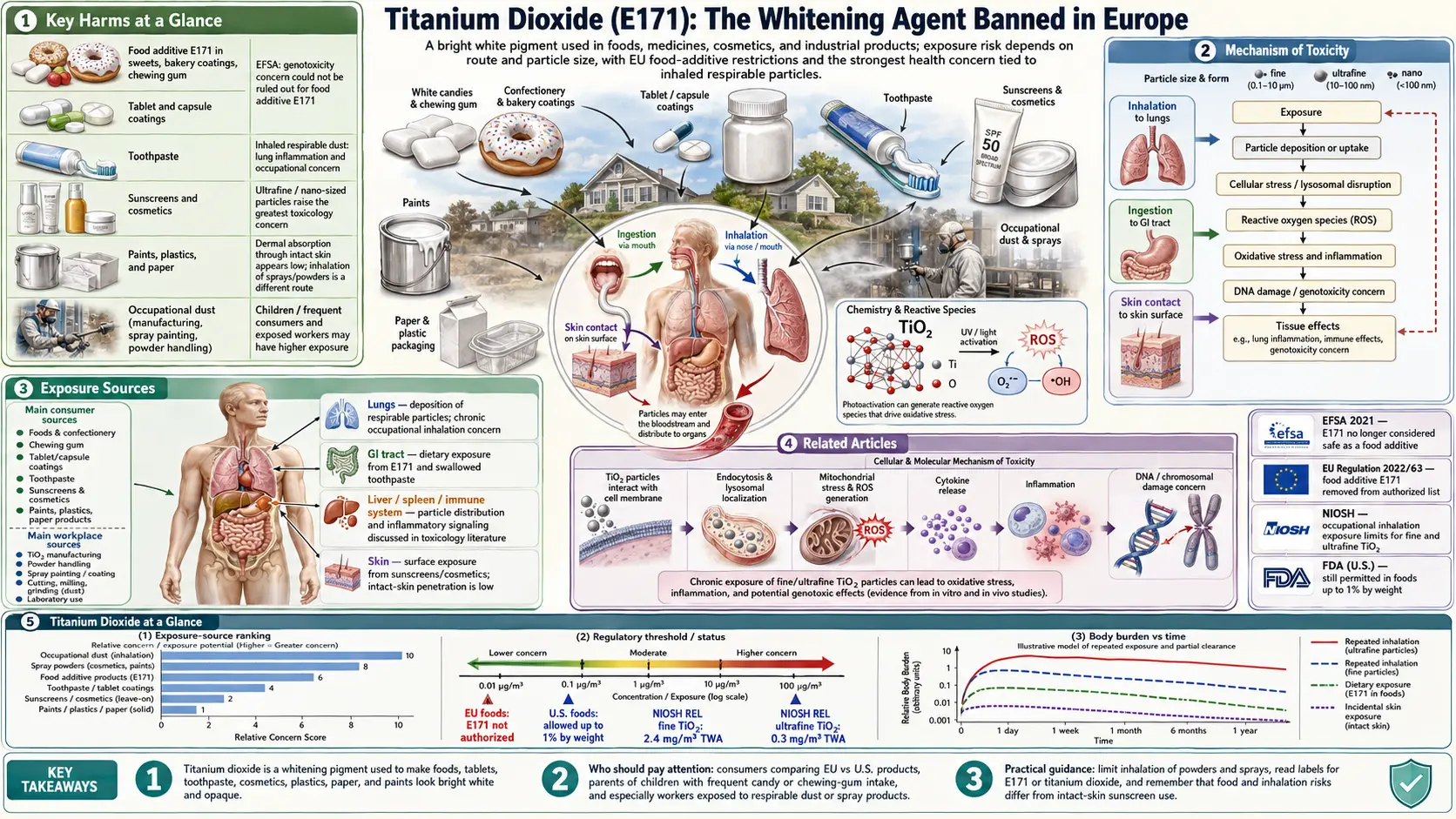
Titanium dioxide (E171) is a white pigment used to whiten and add opacity to foods such as candy, bakery products, coffee creamer and sauces, and to medicines, toothpaste and cosmetics. In May 2021 the European Food Safety Authority (EFSA) concluded that a concern for genotoxicity could not be ruled out and that E171 can no longer be considered safe as a food additive; Commission Regulation (EU) 2022/63 then removed it from the EU list of authorised food additives in 2022. In the United States it remains listed as a color additive permitted in food at up to 1% by weight, and, according to FDA, Health Canada, the UK Food Standards Agency and Food Standards Australia New Zealand have not agreed with EFSA's assessment.
Table of Contents
Key Findings at a Glance
- EFSA 2021: no longer considered safe as a food additive — a concern for genotoxicity (DNA strand breaks and chromosomal damage) could not be ruled out, so no safe intake level was set.
- EU withdrawal (2022) — Regulation (EU) 2022/63 entered into force on 7 February 2022; foods made under the old rules could be placed on the market until 7 August 2022. Use as a colour in medicines remains provisionally authorised.
- France acted before the EU — a French ministerial order of 17 April 2019 suspended the sale of foods containing E171 from 1 January 2020, renewed every year since.
- Other regulators disagree — FDA, Health Canada, the UK FSA and FSANZ have not agreed with EFSA's assessment; JECFA (FAO/WHO) concluded in 2023 that TiO2 added to food is safe, as FDA reports.
- Gut immune tissue — titanium dioxide particles are found in macrophages of human gut-associated lymphoid tissue, including Peyer's patches.
- Animal studies — in rats, 100 days of E171 promoted colon micro-inflammation and preneoplastic lesions (Bettini 2017); in mice, TiO2 nanoparticles worsened chemically induced colitis through the NLRP3 inflammasome (Ruiz 2017).
- Children's intake — Dutch and US exposure estimates found the highest intake per kilogram of body weight in young children, mainly from candy and, in the Dutch study, swallowed toothpaste.
1. Overview
Titanium dioxide (TiO2), designated E171 in the European food additive numbering system, is an inorganic compound used as a white colorant and opacifier in processed foods, pharmaceuticals, cosmetics and industrial products. FDA describes it as a synthetically produced white pigment manufactured from naturally occurring ores. According to the International Agency for Research on Cancer (IARC), pigment is made from ores containing ilmenite, rutile, anatase and leucoxene, which are converted to titanyl sulfate solution or titanium tetrachloride before being turned into pigment particles of the rutile or anatase crystal form.
Food-grade titanium dioxide is a mixture of particle sizes that includes a nanoscale fraction. EFSA reported that fewer than 50% of the constituent particles in E171, counted by number, have a smallest dimension below 100 nanometers, and that particles below 30 nm make up less than 1%. A 2012 analysis of food-grade TiO2 found about 36% of particles below 100 nm in at least one dimension (Weir 2012). Health Canada describes EFSA's conclusion as due mainly to uncertainties about the safety of TiO2 nanoparticles, and Regulation 2022/63 notes that EFSA took into account genotoxicity data on TiO2 nanoparticles.
Uses of titanium dioxide reported by regulators and researchers include:
- Confectionery: candies, sweets and chewing gum, the foods with the highest TiO2 content in a US analysis (Weir 2012)
- Bakery products: named by FDA, and "fine bakery wares" in the Dutch intake study (Rompelberg 2016)
- Coffee creamer and sauces: among the main dietary sources in the Dutch intake study
- Food supplements: included in the Dutch intake estimate
- Personal care products: toothpastes and some sunscreens contained 1% to more than 10% titanium by weight (Weir 2012)
- Pharmaceuticals: EMA describes it as mainly used in medicines as a colour and opacifier, frequently in oral solid and semi-solid dosage forms
Its usefulness as a pigment comes from its high refractive index: IARC lists values of 2.561 and 2.488 for anatase and 2.605–2.616 and 2.890–2.903 for rutile.
2. Regulatory History
Regulators reviewing the same evidence on titanium dioxide have reached different conclusions.
United States
FDA regulates titanium dioxide as a color additive under 21 CFR 73.575, which permits it "for coloring foods generally" provided the quantity does not exceed 1% by weight of the food, and exempts it from batch certification. FDA notes that there is no Generally Recognized as Safe (GRAS) provision for color additives, so TiO2 is not a GRAS substance; every color added to food needs a color additive regulation. A color additive petition filed on 14 April 2023 asks FDA to repeal the food listing in 21 CFR 73.575; FDA states that it is reviewing that petition and evaluates new information, including other regulators' actions, as it becomes available. FDA also states that it did not identify concerns related to potential genotoxicity in the data available, and that TiO2 did not cause cancer in National Toxicology Program carcinogenicity studies.
France — National Suspension (2020)
A French ministerial order (arrêté) dated 17 April 2019 suspended, for one year, the placing on the market of foodstuffs containing the additive E171, with effect from 1 January 2020. It followed an opinion of the French food safety agency ANSES which, as a 2020 question in the National Assembly describes it, could not remove the uncertainties about the safety of the additive in its nanoparticle form or set an acceptable daily intake. The order covered foods only; medicines, hygiene products and cosmetics were not included. According to France's national consumer institute (INC), the suspension has been renewed each year by further orders, most recently by an order of 12 December 2025 covering 2026, to prevent remaining stocks being sold in France after the EU withdrawal.
EFSA Opinion — 2021
EFSA published its updated safety assessment on 6 May 2021. The panel concluded that gastrointestinal absorption of TiO2 particles is low but that they may accumulate in the body; that general and organ toxicity studies showed no adverse effects with E171 up to 1,000 mg/kg body weight per day; and that no reproductive or developmental effects were seen up to 1,000 mg/kg body weight per day in an extended one-generation reproductive toxicity study. It listed potential immunotoxicity and inflammation with E171, potential neurotoxicity with TiO2 nanoparticles and potential induction of aberrant crypt foci as observations that may indicate adverse effects. On genotoxicity, it concluded that TiO2 particles can induce DNA strand breaks and chromosomal damage but not gene mutations, and that no particle-size cut-off for this effect could be identified. Its conclusion: "a concern for genotoxicity could not be ruled out, and given the many uncertainties, the Panel concluded that E 171 can no longer be considered as safe when used as a food additive."
EU Withdrawal — 2022
Commission Regulation (EU) 2022/63 of 14 January 2022, published in the Official Journal on 18 January 2022, removed E171 from the list of food additives authorised in foods. It entered into force on 7 February 2022. Under its transition rule, foods produced under the earlier rules could still be placed on the market until 7 August 2022 and could then stay on sale until their date of minimum durability or "use by" date. The regulation records that EFSA "did not identify an immediate health concern" and that the transition was allowed for that reason. Titanium dioxide was kept provisionally on the list for use as a colour in medicinal products, because the European Medicines Agency warned that a requirement to replace it would almost certainly cause significant medicine shortages; the Commission undertook to review that use within three years.
United Kingdom, Canada and Other Regulators
Great Britain did not follow the EU: the Food Standards Agency's list of approved additives still includes E171, marked "not permitted for use in Northern Ireland". Northern Ireland follows Regulation 2022/63, so TiO2 has not been permitted in food manufactured there since 7 February 2022, with the same transition ending on 7 August 2022.
Health Canada's Food Directorate carried out its own review and states that "there is no conclusive scientific evidence that the food additive TiO2 is a concern for human health." It reported that many studies raising concern used forms of TiO2 not acceptable for food or broke the material into smaller particles than found in food, and that its review found no evidence of cancer in long-term or lifetime studies of mice and rats given high concentrations of food-grade TiO2, no changes to DNA in various animal studies, and no adverse effects on reproduction, development or the immune, gastrointestinal or nervous systems in rats exposed from before conception to adulthood. It says it will revisit its position if new information becomes available.
FDA reports that the UK FSA, Health Canada and Food Standards Australia New Zealand (FSANZ) have not agreed with EFSA's assessment, and that the FAO/WHO Joint Expert Committee on Food Additives (JECFA) re-evaluated titanium dioxide in 2023 and concluded that TiO2 added to food is safe.
IARC Classification (Inhalation)
IARC classified titanium dioxide as Group 2B — possibly carcinogenic to humans (summary published in 2006; IARC Monographs Volume 93, 2010). It found inadequate evidence in humans and sufficient evidence in experimental animals, based on lung tumours in rats that inhaled titanium dioxide or were exposed intratracheally; studies using other routes of administration did not find excess tumours. IARC describes the assessment as concerning the carcinogenic hazard of these particles when inhaled, not dietary intake.
3. Mechanisms Studied
Research on how ingested titanium dioxide might cause harm has focused on its uptake into gut immune tissue, inflammation and DNA damage. Much of it comes from animal and cell studies.
Uptake From the Gut
EFSA concluded that absorption of TiO2 particles from the gut is low but that they may accumulate in the body. In a study of human volunteers with normal intestinal permeability given 100 mg of pharmaceutical/food-grade titanium dioxide by mouth, particles appeared in blood from about 2 hours, with a peak at 6 hours, showing that a fraction is absorbed (Pele 2015). In mice fed a diet containing food-grade TiO2, the epithelial microfold (M) cells of Peyer's patches funnelled the particles into immune cells, where they accumulated (Wills 2025).
Particles in Human Gut Immune Tissue
A 1996 study of human gut-associated lymphoid tissue found that macrophages at its base become loaded early in life with a dark pigment rich in aluminium, silicon and titanium, including 100–200 nm spheres of anatase titanium dioxide characteristic of the food additive; the pigment was present in all subjects studied (Powell 1996). A 2025 study identified immune cells in the subepithelial dome of human Peyer's patches as targets of food-grade TiO2; in mice with matching cellular exposure, the particles produced no measurable change in 92 signalling proteins and did not increase the inflammatory response to an oral Salmonella challenge (Wills 2025).
Reactive Oxygen Species and Barrier Function
In cultured human intestinal epithelial cells, TiO2 particles induced reactive oxygen species and increased the permeability of the cell layer (Ruiz 2017).
Genotoxicity and DNA Damage
EFSA concluded that TiO2 particles have the potential to induce DNA strand breaks and chromosomal damage, but not gene mutations. It found no clear correlation between the particles' physical and chemical properties and the results of in vitro or in vivo genotoxicity tests, stated that several modes of action may operate in parallel with unknown relative contributions, and could not determine whether a threshold applies. Health Canada and FDA note that some of these studies used forms of TiO2 not representative of the food additive, or routes of administration not relevant to diet.
NLRP3 Inflammasome Activation
In cultured human intestinal epithelial cells and macrophages, TiO2 particles triggered assembly of the NLRP3 inflammasome and release of interleukin (IL)-1β and IL-18. In mice with chemically induced (DSS) colitis, oral TiO2 nanoparticles worsened the colitis through a mechanism involving NLRP3 (Ruiz 2017).
4. Health Effects in Studies
Gut Microbiota
In mice fed TiO2 at 0.1% of the diet for 8 weeks, both E171 and TiO2 nanoparticles changed gut microbiota composition, raising Firmicutes and lowering Bacteroidetes, Bifidobacterium and Lactobacillus, with lower short-chain fatty acid levels and colonic inflammation; obese mice were more affected, and the treatment did not cause severe toxicity (Cao 2020). In another mouse study, food-grade TiO2 in drinking water had minimal effect on microbiota composition but altered bacterial metabolites, reduced expression of the colonic mucin 2 gene and was associated with colonic inflammation (Pinget 2019).
Intestinal Inflammation
In mice given 100 mg/kg body weight of TiO2 nanoparticles or microparticles by gavage for 10 days, inflammatory cytokines and CD4+ T cells increased in the small intestine, indicating a Th1-type inflammatory response (Nogueira 2012). In people, titanium levels in blood were higher in patients with ulcerative colitis who had active disease (Ruiz 2017); this does not show that TiO2 causes the disease. A pilot study of a diet low in calcium and microparticles reported improvement in ileal Crohn's disease (Lomer 2002), but a later multi-centre randomized trial in 83 patients with active Crohn's disease found that reducing dietary microparticles added no benefit to corticosteroid treatment (Lomer 2005).
Colon Lesions in Animal Studies
In rats given E171 at levels the authors describe as relevant to human intake, 100 days of treatment promoted colon micro-inflammation, initiated preneoplastic lesions and fostered the growth of aberrant crypt foci in a chemically induced carcinogenesis model; one week of exposure did not cause intestinal inflammation (Bettini 2017). In mice, intragastric E171 (5 mg/kg body weight, 5 days a week for 10 weeks) did not induce tumours on its own but caused dysplastic changes in the distal colon and increased tumour formation in a colitis-associated cancer model (Urrutia-Ortega 2016). EFSA noted that no appropriately designed study was available to investigate the potential carcinogenic effects of TiO2 nanoparticles, while Health Canada reported no evidence of cancer in long-term or lifetime studies of mice and rats given high concentrations of food-grade TiO2.
Immune System Effects
In the Bettini rat study, titanium was detected in immune cells of Peyer's patches after one week; E171 reduced regulatory T cells, which dampen inflammatory responses, an effect still seen after 100 days, and stimulated immune cells from the spleen showed sharply increased Th1/Th17 inflammatory responses. EFSA listed potential immunotoxicity and inflammation with E171 among observations that may indicate adverse effects.
Reproductive and Organ Effects
EFSA found no effects on reproductive or developmental toxicity up to 1,000 mg/kg body weight per day, the highest dose tested in an extended one-generation reproductive toxicity study. A Dutch risk assessment that modelled organ concentrations of TiO2 nanoparticles over time found a potential risk for the liver, ovaries and testes, and called for measurements in human organs and longer animal studies to refine the estimate (Heringa 2016).
5. Exposure Sources
Titanium dioxide enters the diet mainly through processed foods where it is used for its white colour and brightness:
Candy and Confectionery
- Candies, sweets and chewing gum had the highest TiO2 content of the foods tested in a US analysis (Weir 2012)
- Candy was among the main contributors to intake in the Dutch population (Rompelberg 2016)
Bakery Products, Creamers and Sauces
- Fine bakery wares, coffee creamer and sauces were among the main contributors in the Dutch intake study
- FDA names bakery products and candy as examples of foods that use it
Pharmaceuticals and Supplements
- Tablet and capsule coatings: EMA describes it as used frequently in many essential oral solid and semi-solid medicines
- Food supplements were included in the Dutch intake estimate
- In a US analysis, the titanium content of several high-consumption pharmaceuticals ranged from below the detection limit to 0.014 μg Ti/mg (Weir 2012)
Toothpaste
Toothpastes contained 1% to more than 10% titanium by weight in a US analysis (Weir 2012). In the Dutch study, swallowed toothpaste was one of the largest contributors to TiO2 intake in children aged 2–6.
Labelling
FDA states that in the United States TiO2 appears on ingredient labels as either "artificial color" or "colored with titanium dioxide", though it is not required to be listed by name. Not every white product contains it: the US analysis found that many white products contained titanium but that it was not a prerequisite for a white colour (Weir 2012).
6. Children's Exposure
Higher Intake per Kilogram
Exposure estimates put young children's intake highest per kilogram of body weight. In the Dutch population, mean long-term intake of TiO2 was 0.67 mg/kg body weight per day in children aged 2–6, compared with 0.17 mg/kg for people aged 7–69 and 0.06 mg/kg for people over 70; estimated mean intake of the nanoparticle fraction was 2.16, 0.55 and 0.19 μg/kg body weight per day for the same groups (Rompelberg 2016). A US exposure model also identified children as having the highest exposures, because sweets contain more TiO2 than other foods, and estimated a typical US adult exposure on the order of 1 mg Ti per kg body weight per day (Weir 2012).
Main Sources for Children
In the Dutch study, toothpaste (in young children only), candy, coffee creamer, fine bakery wares and sauces contributed most to intake.
Evidence on Development
EFSA found no reproductive or developmental effects up to 1,000 mg/kg body weight per day in its key reproductive study, and Health Canada reported no adverse effects on reproduction, development or the immune, gastrointestinal or nervous systems in rats exposed from before conception to adulthood.
7. Substitutes Studied
Studies since the EU withdrawal have examined other whitening and opacifying agents, including in tablet coatings:
Calcium Carbonate and Rice Starch
In a 2025 study of tablet film coatings, coatings based on hydroxypropyl methylcellulose that used calcium carbonate or rice starch instead of TiO2 showed colour stability comparable to TiO2; coatings based on polyvinyl alcohol changed colour under heat and humidity, more so with calcium carbonate than with TiO2 (Chuvalo-Abraham 2025). Calcium carbonate is authorised as a food colour in its own right (E170) on the UK FSA's list of approved additives.
Limits in Medicines
EMA advised that it should be technically possible to find alternatives to TiO2-containing coatings, but that feasibility was not confirmed and that reformulating each medicine could take several years. A 2025 review concluded that alternatives exist but may not provide the same benefits as TiO2, particularly in pharmaceuticals (Pokharkar 2025).
8. Related Articles
Key Research Papers
Key research papers and authoritative sources. Links resolve to DOI, PubMed, or the issuing agency.
- EFSA Panel on Food Additives and Flavourings (FAF), Younes M, Aquilina G, Castle L, et al. Safety assessment of titanium dioxide (E171) as a food additive. EFSA Journal. 2021;19(5):e06585. — doi:10.2903/j.efsa.2021.6585
- European Commission. Commission Regulation (EU) 2022/63 of 14 January 2022 amending Annexes II and III to Regulation (EC) No 1333/2008 of the European Parliament and of the Council as regards the food additive titanium dioxide (E 171). Official Journal of the European Union. 2022;L 11:1. — EUR-Lex
- Bettini S, Boutet-Robinet E, Cartier C, et al. Food-grade TiO2 impairs intestinal and systemic immune homeostasis, initiates preneoplastic lesions and promotes aberrant crypt development in the rat colon. Scientific Reports. 2017;7:40373. — doi:10.1038/srep40373
- Pele LC, Thoree V, Bruggraber SF, et al. Pharmaceutical/food grade titanium dioxide particles are absorbed into the bloodstream of human volunteers. Particle and Fibre Toxicology. 2015;12:26. — doi:10.1186/s12989-015-0101-9
- Urrutia-Ortega IM, Garduño-Balderas LG, Delgado-Buenrostro NL, et al. Food-grade titanium dioxide exposure exacerbates tumor formation in colitis associated cancer model. Food and Chemical Toxicology. 2016;93:20–31. — doi:10.1016/j.fct.2016.04.014
- Ruiz PA, Morón B, Becker HM, et al. Titanium dioxide nanoparticles exacerbate DSS-induced colitis: role of the NLRP3 inflammasome. Gut. 2017;66(7):1216–1224. — doi:10.1136/gutjnl-2015-310297
- Heringa MB, Geraets L, van Eijkeren JC, et al. Risk assessment of titanium dioxide nanoparticles via oral exposure, including toxicokinetic considerations. Nanotoxicology. 2016;10(10):1515–1525. — doi:10.1080/17435390.2016.1238113
- Lomer MC, Thompson RP, Powell JJ. Fine and ultrafine particles of the diet: influence on the mucosal immune response and association with Crohn's disease. Proceedings of the Nutrition Society. 2002;61(1):123–130. — doi:10.1079/PNS2001134
- Nogueira CM, de Azevedo WM, Dagli ML, et al. Titanium dioxide induced inflammation in the small intestine. World Journal of Gastroenterology. 2012;18(34):4729–4735. — doi:10.3748/wjg.v18.i34.4729
- Cao X, Han Y, Gu M, et al. Foodborne titanium dioxide nanoparticles induce stronger adverse effects in obese mice than non-obese mice: gut microbiota dysbiosis, colonic inflammation, and proteome alterations. Small. 2020;16(36):e2001858. — doi:10.1002/smll.202001858
- Rompelberg C, Heringa MB, van Donkersgoed G, et al. Oral intake of added titanium dioxide and its nanofraction from food products, food supplements and toothpaste by the Dutch population. Nanotoxicology. 2016;10(10):1404–1414. — doi:10.1080/17435390.2016.1222457
- IARC Working Group on the Evaluation of Carcinogenic Risks to Humans. Carbon Black, Titanium Dioxide, and Talc. IARC Monographs on the Evaluation of Carcinogenic Risks to Humans, Vol. 93. Lyon: International Agency for Research on Cancer; 2010. — IARC Publications
- Szakal C, Roberts SM, Westerhoff P, et al. Measurement of nanomaterials in foods: integrative consideration of challenges and future prospects. ACS Nano. 2014;8(4):3128–3135. — doi:10.1021/nn501108g
- Weir A, Westerhoff P, Fabricius L, et al. Titanium dioxide nanoparticles in food and personal care products. Environmental Science and Technology. 2012;46(4):2242–2250. — doi:10.1021/es204168d
- U.S. Food and Drug Administration. Code of Federal Regulations Title 21, Section 73.575: Titanium dioxide. — eCFR
- Powell JJ, Ainley CC, Harvey RS, et al. Characterisation of inorganic microparticles in pigment cells of human gut associated lymphoid tissue. Gut. 1996;38(3):390–395. — PubMed PMID: 8675092
- Pinget G, Tan J, Janac B, et al. Impact of the food additive titanium dioxide (E171) on gut microbiota-host interaction. Frontiers in Nutrition. 2019;6:57. — doi:10.3389/fnut.2019.00057
- Baan R, Straif K, Grosse Y, et al. Carcinogenicity of carbon black, titanium dioxide, and talc. Lancet Oncology. 2006;7(4):295–296. — PubMed PMID: 16598890
- Wills JW, Dabrowska A, Robertson J, et al. Immunocompetent cell targeting by food-additive titanium dioxide. Nature Communications. 2025;16(1):6067. — PubMed PMID: 40615368
- Lomer MC, Grainger SL, Ede R, et al. Lack of efficacy of a reduced microparticle diet in a multi-centred trial of patients with active Crohn's disease. European Journal of Gastroenterology and Hepatology. 2005;17(3):377–384. — PubMed PMID: 15716665
- Chuvalo-Abraham JCL, Harris D, Kang H, et al. Evaluating the color stability of titanium dioxide-free film coats under environmental and light stress. Pharmaceutical Development and Technology. 2025;30(4):441–449. — PubMed PMID: 40198327
- Pokharkar V, Chandak S, Pawar R, Khandke A. The implications of the EU ban on titanium dioxide: a comprehensive review of safety concerns and alternatives. Annales Pharmaceutiques Françaises. 2025;83(3):438–444. — PubMed PMID: 39549786
- U.S. Food and Drug Administration. Titanium Dioxide as a Color Additive in Foods (content current as of 4 March 2024). — FDA
- U.S. Food and Drug Administration. List of Select Chemicals in the Food Supply Under FDA Review (titanium dioxide entry). — FDA
- Health Canada. Titanium dioxide (TiO2) as a food additive: Current science report. — Government of Canada
- Food Standards Agency. Approved additives and E numbers (note on titanium dioxide in Northern Ireland). — GOV.UK
- Institut national de la consommation. 1er janvier 2026 : maintien de la suspension de commercialisation des denrées contenant l'additif E171 (dioxyde de titane - TiO2) (checked 29 December 2025; lists the arrêté of 17 April 2019 and its renewals). — INC
- WebLex. Additif E 171 : interdit ou suspendu ? 2 May 2019 (scope of the arrêté of 17 April 2019: foods only). — WebLex
- Assemblée nationale. Question écrite n° 27369: Dioxyde de titane et médicaments. Journal officiel, 10 March 2020, p. 1843. — Assemblée nationale
PubMed Topic Searches
Connections
- All Toxins
- Food Additives
- Food Dyes
- Banned Additives
- Crohn's Disease
- Ulcerative Colitis
- Carrageenan
- Polysorbate 80
- Inflammatory Bowel Disease
- Cancer
- Gut Brain Axis
- Oxidative Stress
- Calcium
- MSG
- Artificial Sweeteners
- Irritable Bowel Syndrome
- US vs EU Food Safety
- Food Dyes Banned Worldwide
- Heavy Metals in Cosmetics