BHA and BHT: Petroleum-Derived Preservatives in Your Food
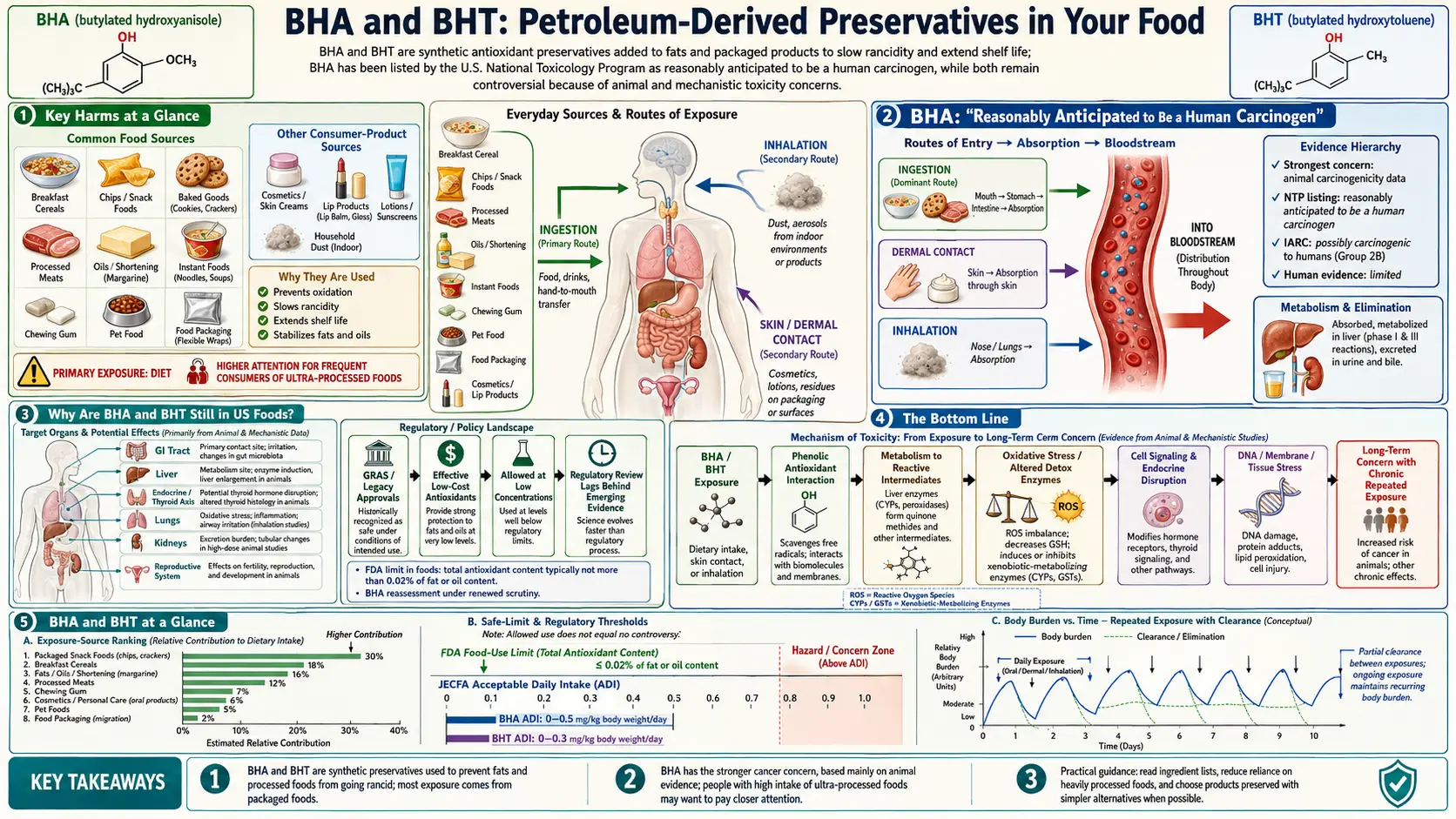
Butylated hydroxyanisole (BHA, E320) and butylated hydroxytoluene (BHT, E321) are synthetic antioxidant preservatives made from petrochemical starting materials and used in fats, oils and fat-containing foods, as well as in food packaging, animal feed, cosmetics and medicines. The US National Toxicology Program lists BHA as “reasonably anticipated to be a human carcinogen” on the basis of forestomach tumours in rodents, and IARC classifies it as Group 2B; BHT is in IARC Group 3 (not classifiable). Both remain permitted at set limits in the United States, the European Union and Japan, and in 2026 the US Food and Drug Administration (FDA) opened post-market safety assessments of both.
Table of Contents
- Key Findings at a Glance
- What Are BHA and BHT?
- Where They Are Found (Exposure Routes)
- BHA: Reasonably Anticipated Human Carcinogen
- BHT: What the Animal and Cell Studies Show
- Status Outside the US
- How BHA and BHT Are Regulated in the US
- Safety Thresholds & ADI
- How BHA and BHT Appear on Labels
- Key Research Papers
- Connections
- Featured Videos
Key Findings at a Glance
- BHA is listed by the US NTP as “reasonably anticipated to be a human carcinogen” (first listed 1991). IARC classifies BHA as Group 2B (possibly carcinogenic to humans), and California has listed it under Proposition 65 as causing cancer since 1990.
- Forestomach tumours – BHA fed at 0.5–2% of the diet, depending on the species, caused papillomas and squamous-cell carcinomas of the forestomach in rats and hamsters, and papillomas in mice. Humans have no forestomach, and EFSA’s 2011 re-evaluation judged these changes may no longer be relevant for human risk assessment.
- Human data – A Dutch cohort study of 120,852 adults found no significant association between usual dietary intake of BHA or BHT and stomach cancer.
- Hormone activity in cell tests – BHA was weakly estrogenic in mammalian cell screens, and BHA and BHT both acted as weak anti-androgens in reporter-cell assays.
- BHT in animals – High dietary doses reduced blood-clotting factors and caused haemorrhages in rats, caused kidney damage in mice, and enhanced tumour development in some animal models.
- Body fat – Both have been measured in human adipose tissue at low levels (0.01 ppm BHA, 0.12 ppm BHT in a Canadian study); animal studies showed no progressive accumulation over time.
- Under review in the US – FDA requested information on BHA in February 2026 and lists BHT among chemicals under review.
What Are BHA and BHT?
BHA (butylated hydroxyanisole, E320) and BHT (butylated hydroxytoluene, E321) are synthetic phenolic antioxidants. According to the NTP, BHA has been added to edible fats and fat-containing foods since 1947. Both are used to slow the oxidation of fats and oils, which causes rancidity — the unpleasant smell and taste that develops when fatty foods go stale. By donating hydrogen atoms to free radicals, BHA and BHT interrupt the chain reaction of lipid oxidation and extend the shelf life of products containing fats.
BHA is a waxy solid that is a mixture of two isomers: 3-tert-butyl-4-hydroxyanisole and 2-tert-butyl-4-hydroxyanisole; food-grade BHA is more than 85% of the 3-isomer. BHT is a crystalline solid with the chemical name 2,6-di-tert-butyl-4-methylphenol. Both are fat-soluble. They have been measured in human body fat at low levels — 0.01 ppm BHA and 0.12 ppm BHT in Canadian adipose tissue samples — and in rat and monkey feeding studies neither showed progressive accumulation over time.
Where Are BHA and BHT Found?
BHA and BHT are used in the food supply, in personal care products and in industrial products. Uses reported by the NTP and in US regulations include:
- Breakfast cereals — US regulations permit BHA and BHT in dry breakfast cereals at up to 50 ppm combined. Some cereals list BHT in the ingredients; others carry a statement such as “BHT added to packaging material to preserve freshness.”
- Snack foods and chips — The NTP lists potato chips, snack foods, nuts and nut products among the foods to which BHA is added.
- Chewing gum — Listed by the NTP among the uses of BHA.
- Butter, lard and vegetable oils — Added to prevent the fats from becoming rancid.
- Baked goods and sweets — BHA is used in baked and fried foods because it remains active at high temperatures.
- Dehydrated foods and dry mixes — Dehydrated potato products, dry mixes for beverages and desserts, and dried soups.
- Emulsion stabilizers for shortenings — Permitted at up to 200 ppm combined in US regulations.
- Meats — The NTP lists sausage, poultry and meat products.
- Beer — Listed by the NTP among foods to which BHA is added.
- Cosmetics and personal care products — A 1981 FDA survey found BHA in 3,217 of 21,279 cosmetic formulations, most often in lipstick and eye shadow.
- Rubber and petroleum products — BHA is used as an antioxidant in some rubber and petroleum products and stabilizes the petroleum wax coatings of food packaging.
- Animal feed — BHA is one of the main antioxidants used in feeds, where it slows the oxidation of vitamin A and fats.
- Pharmaceutical products — BHA is used as a preservative and antioxidant in some pharmaceutical preparations containing fats and oils.
BHA: "Reasonably Anticipated to Be a Human Carcinogen"
The US National Toxicology Program (NTP), part of the Department of Health and Human Services, lists BHA as “reasonably anticipated to be a human carcinogen” based on sufficient evidence of carcinogenicity in experimental animals. BHA was first listed in the Sixth Annual Report on Carcinogens (1991) and is still listed in the 15th edition. The NTP states that the epidemiological data are inadequate to evaluate the relationship between human cancer and BHA specifically.
The International Agency for Research on Cancer (IARC), part of the World Health Organization, classifies BHA as a Group 2B agent, meaning it is “possibly carcinogenic to humans” (IARC Monograph Volume 40, 1986). California added BHA to its Proposition 65 list of chemicals known to cause cancer on 1 January 1990, on the basis of the IARC classification.
Animal Study Evidence
- Forestomach tumours — In a two-year study, BHA at 2% of the diet significantly increased papillomas and squamous-cell carcinomas of the forestomach in F344 rats of both sexes; 0.5% increased forestomach hyperplasia, and tumours in other organs were not significantly increased (Ito 1983). All hamsters fed 1–2% BHA for 24 weeks developed forestomach papillomas (Ito 1983), and a 104-week study found papillomas and carcinomas in rats, hamsters and mice (Masui 1986). Humans do not have a forestomach.
- Other tissues — Since the original listing, the NTP notes one additional animal study, in which BHA fed to larval fish (Rivulus marmoratus) caused liver cancer in the adult fish.
- How regulators read the evidence — EFSA’s 2011 re-evaluation concluded that BHA does not raise concern for genotoxicity and that forestomach hyperplasia in rodents “may no longer be relevant for human risk assessment,” and raised its acceptable daily intake from 0.5 to 1.0 mg/kg body weight per day.
- Human evidence — In the Netherlands Cohort Study (120,852 men and women aged 55–69, 6.3 years of follow-up), mean intake was 105 micrograms per day of BHA and 351 of BHT, and no significant association with stomach cancer was found (Botterweck 2000). The NTP reports an estimated average US dietary intake of 4.3 mg of BHA per day in 1975.
Endocrine Activity
BHA has shown hormone-like activity in laboratory tests:
- Estrogenic activity — In mammalian cell screens, BHA was weakly estrogenic, less so than the environmental estrogen octylphenol; the authors stated that in-vivo studies would be needed before conclusions could be drawn (Jobling 1995).
- Anti-androgenic activity — In human androgen-receptor reporter cells, BHA partially inhibited activation by dihydrotestosterone (Schrader 2000), and a 2016 study found BHA to be a weak anti-androgen in MDA-kb2 cells (Pop 2016).
- Effects on developing animals — EFSA based its 2011 acceptable daily intake on a no-observed-adverse-effect level of 100 mg/kg body weight per day for growth retardation, increased mortality and behavioural effects in rat pups at higher doses.
BHT: What the Animal and Cell Studies Show
BHT has not been classified as a carcinogen: IARC places it in Group 3 (not classifiable as to its carcinogenicity to humans), and it is not listed in the NTP Report on Carcinogens. Both carcinogenic and anticarcinogenic properties have been reported for BHT in animal studies, depending on the model (Botterweck 2000; Witschi 1986).
Findings Associated with BHT
- Liver — Hepatocellular carcinomas were observed in male rats in long-term studies; EFSA’s 2012 re-evaluation concluded that BHT is not of concern for genotoxicity, that any carcinogenicity would have a threshold, and that its acceptable daily intake also covers these liver tumours.
- Reproduction and development — Two two-generation rat studies found a no-observed-adverse-effect level of 25 mg/kg body weight per day, which EFSA used to set its acceptable daily intake; the earlier EU Scientific Committee for Food based its ADI on thyroid, reproductive and blood effects in the rat.
- Hormone activity in cell tests — BHT partially inhibited androgen-receptor activation in human reporter cells (Schrader 2000) and was a weak anti-androgen in MDA-kb2 cells (Pop 2016).
- Blood clotting — Rats fed 1.2% BHT in the diet had falling levels of clotting factors II, VII, IX and X within days, and haemorrhages (Takahashi 1986). Mice and guinea pigs did not develop this clotting defect, but mice fed 1.35–5% BHT developed dose-related kidney damage (Takahashi 1992).
- Behaviour — The 2007 Southampton trial that found food additive mixtures increased hyperactivity in children tested artificial colours and the preservative sodium benzoate, not BHT (McCann 2007).
- Tumour promotion — Feeding 0.05–0.5% BHT enhanced spontaneous liver tumours in one mouse strain but not another, and its effect on lung and gut tumours depended on which carcinogen was used; the reviewer described strain differences and paradoxical dose responses as major open questions (Witschi 1986).
Antioxidant in Food, Different in the Body
BHT protects fats in food from oxidation, but its effects in the body depend on how it is metabolised. In rats, a BHT metabolite, BHT quinone methide, reduced clotting factors and caused haemorrhages, and the author proposed it as the active metabolite behind BHT-induced bleeding (Takahashi 1988). Activity as an antioxidant in a food or a test tube does not by itself show a health effect in a living organism.
Status Outside the US
BHA and BHT are permitted, with limits, in the major jurisdictions:
- Japan — Both butylated hydroxyanisole and butylated hydroxytoluene appear on Japan’s List of Designated Additives, the list of synthetic additives permitted in food.
- European Union — BHA (E 320) and BHT (E 321) are authorised under Regulation (EC) No 1333/2008 only in specified food categories with maximum levels. EFSA re-evaluated BHA in 2011 (ADI 1.0 mg/kg body weight per day) and BHT in 2012 (ADI 0.25 mg/kg). For BHT, EFSA noted that children’s exposure at the 95th percentile exceeded the ADI in some European countries (Finland and the Netherlands).
- California Food Safety Act (2023) — Assembly Bill 418 bans Red No. 3, potassium bromate, brominated vegetable oil and propylparaben in foods sold in California from 2027. BHA and BHT are not covered by the law.
- United States (federal) — FDA lists BHA and BHT as generally recognized as safe (GRAS) when total antioxidants do not exceed 0.02% of the fat or oil content of the food, and also permits them as food additives in specified foods at set limits (details below).
How BHA and BHT Are Regulated in the US
BHA is regulated by different US agencies for different purposes: the NTP listing is a hazard identification based on animal studies, while FDA’s rules set the conditions under which BHA and BHT may be used in food. Key points:
- GRAS listing — BHA (21 CFR 182.3169) and BHT (21 CFR 182.3173) are listed as GRAS for use in food when the total content of antioxidants is not over 0.02% of the fat or oil content, used in accordance with good manufacturing practice.
- Food additive regulations — 21 CFR 172.110 (BHA) and 172.115 (BHT) permit them in named foods at limits for BHA and BHT combined, such as 50 ppm in dry breakfast cereals and potato flakes, 200 ppm in emulsion stabilizers for shortenings, and (BHA only) 1,000 ppm in active dry yeast.
- Post-market review (2026) — In February 2026 FDA published a request for information on the uses and safety data of BHA in food and food-contact materials, to determine whether BHA remains safe under its current conditions of use; comments closed on 13 April 2026. FDA’s list of chemicals under review (updated 2 October 2026) shows BHA under scientific assessment and BHT at the review-of-information stage, with a request for information planned.
- Debate about GRAS — Critics of the GRAS system point to conflicts of interest: an analysis of 451 GRAS notifications submitted to FDA between 1997 and 2012 found that 22.4% of the safety assessments were made by an employee of the additive manufacturer, 13.3% by an employee of a consulting firm it selected, and 64.3% by an expert panel selected by the manufacturer or a consulting firm; none were made by a standing panel selected by a third party (Neltner 2013). That analysis concerned GRAS notifications in general, not BHA or BHT specifically.
Safety Thresholds & ADI
- JECFA ADI for BHA – 0–0.5 mg/kg body weight/day (latest evaluation 1989), based on proliferative changes in the rat forestomach.
- EFSA ADI for BHA – 1.0 mg/kg body weight/day (re-evaluation 2011).
- JECFA ADI for BHT – 0–0.3 mg/kg body weight/day (latest evaluation 1996).
- EFSA ADI for BHT – 0.25 mg/kg body weight/day (re-evaluation 2012), raised from the earlier EU figure of 0.05 mg/kg.
- US FDA – GRAS at total antioxidants up to 0.02% of the fat/oil content (21 CFR 182.3169, 182.3173); food-additive limits for specified foods in 21 CFR 172.110 and 172.115.
- EU – Regulation (EC) No 1333/2008 authorises BHA (E320) and BHT (E321) only in specified food categories, each with a maximum level.
- NTP classification (BHA) – “Reasonably anticipated to be a human carcinogen,” Report on Carcinogens.
- California Proposition 65 (BHA) – Listed as causing cancer, 1 January 1990.
How BHA and BHT Appear on Labels
- Ingredient lists — On US food labels they appear as “BHA,” “BHT,” “butylated hydroxyanisole” or “butylated hydroxytoluene.” Some packages carry a statement that BHT was added to the packaging material.
- Organic products — BHA and BHT are not on the USDA National List of synthetic substances allowed in organic processed foods (7 CFR 205.605), so they are not permitted as ingredients in certified organic foods.
- Tocopherols — Mixed tocopherols (vitamin E) are used as an alternative antioxidant preservative, and appear on labels as “mixed tocopherols”; the organic National List allows tocopherols derived from vegetable oil when rosemary extracts are not a suitable alternative.
- Rosemary extract — Another plant-derived antioxidant used in place of BHA and BHT.
- Shelf-stable fatty foods — Cereals, chips, crackers, snack foods, dry mixes and dehydrated potato products are among the food types in which these antioxidants are used.
- Cosmetics and personal care products — BHA and BHT are listed by name in cosmetic ingredient lists; lipstick and eye shadow were the products in which BHA was most often found in FDA’s 1981 survey.
Summary
BHA is listed by the US National Toxicology Program as reasonably anticipated to be a human carcinogen and by IARC as possibly carcinogenic to humans, on the basis of forestomach tumours in rats, hamsters and mice fed high doses. EFSA judged in 2011 that these forestomach findings may no longer be relevant to humans, and a large Dutch cohort found no association between usual intake and stomach cancer. In cell tests BHA is weakly estrogenic and anti-androgenic. BHT is not classified as a carcinogen; high doses affect blood clotting in rats and the kidneys in mice, and its effects on tumours vary between animal models.
Both remain permitted in the US, the EU and Japan within set limits. In 2026 FDA began post-market safety assessments of BHA and BHT; their outcome had not been published as of October 2026. Questions about individual exposure are for a clinician.
Key Research Papers
- National Toxicology Program. Butylated Hydroxyanisole (BHA). Report on Carcinogens, 15th Edition. NIEHS.
- IARC Monograph Vol. 40 (1986): Butylated hydroxyanisole (BHA) evaluated as Group 2B.
- EFSA Panel on Food Additives. Scientific Opinion on the re-evaluation of butylated hydroxytoluene (E 321) as a food additive. EFSA Journal. 2012;10(3):2588. — doi:10.2903/j.efsa.2012.2588
- FDA Food Additive Status List (includes BHA, BHT entries).
- EFSA Panel on Food Additives and Nutrient Sources added to Food (ANS) (2011). Scientific Opinion on the re-evaluation of butylated hydroxyanisole – BHA (E 320) as a food additive. EFSA Journal 9(10):2392 — doi:10.2903/j.efsa.2011.2392
- Ito N, Fukushima S, Hagiwara A, Shibata M, Ogiso T (1983). Carcinogenicity of butylated hydroxyanisole in F344 rats. Journal of the National Cancer Institute 70(2):343-352 — PubMed PMID: 6571941
- Ito N, Fukushima S, Imaida K, Sakata T, Masui T (1983). Induction of papilloma in the forestomach of hamsters by butylated hydroxyanisole. Gan 74(4):459-461 — PubMed PMID: 6628897
- Masui T, Hirose M, Imaida K, Fukushima S, Tamano S, Ito N (1986). Sequential changes of the forestomach of F344 rats, Syrian golden hamsters, and B6C3F1 mice treated with butylated hydroxyanisole. Japanese Journal of Cancer Research 77(11):1083-1090 — PubMed PMID: 3098717
- Botterweck AA, Verhagen H, Goldbohm RA, Kleinjans J, van den Brandt PA (2000). Intake of butylated hydroxyanisole and butylated hydroxytoluene and stomach cancer risk: results from analyses in the Netherlands Cohort Study. Food and Chemical Toxicology 38(7):599-605 — PubMed PMID: 10942321
- Conacher HB, Iverson F, Lau PY, Page BD (1986). Levels of BHA and BHT in human and animal adipose tissue: interspecies extrapolation. Food and Chemical Toxicology 24(10-11):1159-1162 — PubMed PMID: 3804117
- Jobling S, Reynolds T, White R, Parker MG, Sumpter JP (1995). A variety of environmentally persistent chemicals, including some phthalate plasticizers, are weakly estrogenic. Environmental Health Perspectives 103(6):582-587 — PubMed PMID: 7556011
- Schrader TJ, Cooke GM (2000). Examination of selected food additives and organochlorine food contaminants for androgenic activity in vitro. Toxicological Sciences 53(2):278-288 — PubMed PMID: 10696776
- Pop A, Drugan T, Gutleb AC, Lupu D, Cherfan J, Loghin F, Kiss B (2016). Individual and combined in vitro (anti)androgenic effects of certain food additives and cosmetic preservatives. Toxicology in Vitro 32:269-277 — PubMed PMID: 26812027
- Takahashi O (1986). Feeding of butylated hydroxytoluene to rats caused a rapid decrease in blood coagulation factors II (prothrombin), VII, IX and X. Archives of Toxicology 58(3):177-181 — PubMed PMID: 3964081
- Takahashi O (1988). 2,6-di-tert-butyl-4-methylene-2,5-cyclohexadienone (BHT quinone methide): an active metabolite of BHT causing haemorrhages in rats. Archives of Toxicology 62(4):325-327 — PubMed PMID: 3240097
- Takahashi O (1992). Haemorrhages due to defective blood coagulation do not occur in mice and guinea-pigs fed butylated hydroxytoluene, but nephrotoxicity is found in mice. Food and Chemical Toxicology 30(2):89-97 — PubMed PMID: 1555799
- Witschi HP (1986). Enhanced tumour development by butylated hydroxytoluene (BHT) in the liver, lung and gastro-intestinal tract. Food and Chemical Toxicology 24(10-11):1127-1130 — PubMed PMID: 3804115
- McCann D, Barrett A, Cooper A, et al. (2007). Food additives and hyperactive behaviour in 3-year-old and 8/9-year-old children in the community: a randomised, double-blinded, placebo-controlled trial. The Lancet 370(9598):1560-1567 — PubMed PMID: 17825405
- Neltner TG, Alger HM, O'Reilly JT, Krimsky S, Bero LA, Maffini MV (2013). Conflicts of interest in approvals of additives to food determined to be generally recognized as safe: out of balance. JAMA Internal Medicine 173(22):2032-2036 — PubMed PMID: 23925593
Regulatory Documents
- FDA (2026). Butylated Hydroxyanisole (BHA); Request for Information. 91 FR 6227, 11 February 2026 — Federal Register
- FDA. List of Select Chemicals in the Food Supply Under FDA Review (updated 2 October 2026) — FDA
- 21 CFR 172.110, BHA (food additive permitted for direct addition to food) — eCFR
- 21 CFR 172.115, BHT (food additive permitted for direct addition to food) — eCFR
- 21 CFR 182.3169, butylated hydroxyanisole (GRAS chemical preservative) — eCFR
- 21 CFR 182.3173, butylated hydroxytoluene (GRAS chemical preservative) — eCFR
- 7 CFR 205.605, nonagricultural substances allowed in organic processed products — eCFR
- Regulation (EC) No 1333/2008 on food additives, Annex II (E 320, E 321) — EUR-Lex
- California Office of Environmental Health Hazard Assessment. Proposition 65: Butylated hydroxyanisole (listed 1 January 1990) — OEHHA
- California Assembly Bill 418 (2023), the California Food Safety Act — California Legislative Information
- Japan Food Chemical Research Foundation. List of Designated Additives — FFCR
PubMed Topic Searches
- PubMed topic search: BHA butylated hydroxyanisole carcinogenicity
- PubMed topic search: BHT butylated hydroxytoluene toxicity
- PubMed topic search: BHA estrogenic endocrine disruption
- PubMed topic search: BHA forestomach tumor rat
- PubMed topic search: BHT tumor promoter liver
- PubMed topic search: tert-butylhydroquinone TBHQ safety
- PubMed topic search: phenolic antioxidant food genotoxicity
- PubMed topic search: mixed tocopherols natural antioxidant food preservation