Sodium Nitrite: The Processed Meat Preservative Linked to Cancer
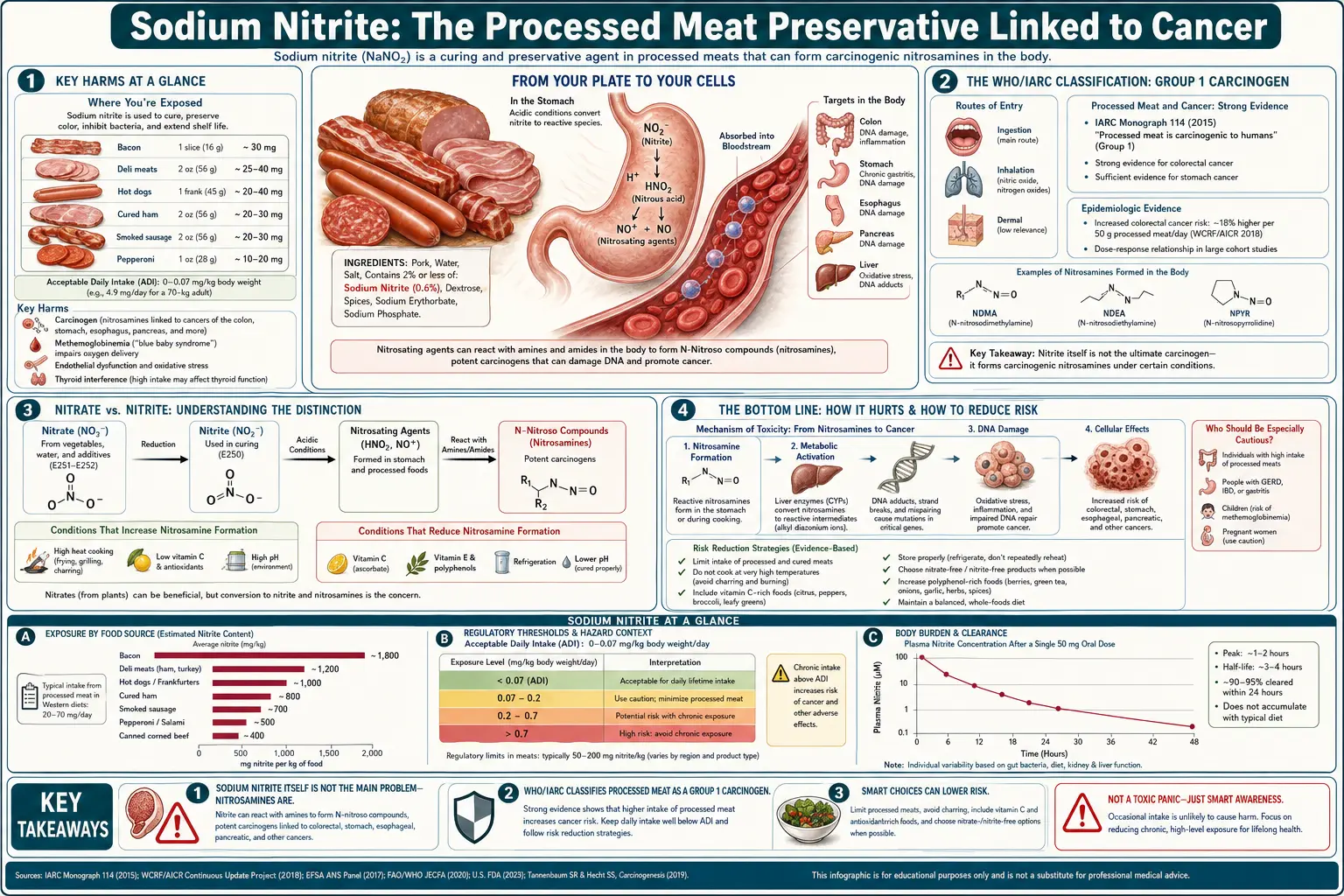
Sodium nitrite (NaNO2) is one of the most widely discussed food additives in the modern diet. It is used in most cured processed meats — bacon, hot dogs, deli meats, ham, sausages, pepperoni and jerky — where it inhibits the growth of Clostridium botulinum, the bacterium that makes botulinum toxin, fixes the pink cured colour and contributes to cured flavour. Nitrite can also react with amines and amides to form N-nitroso compounds (nitrosamines and nitrosamides), many of which are carcinogenic in animals. In 2015 the International Agency for Research on Cancer (IARC) classified processed meat as carcinogenic to humans (Group 1), on epidemiological evidence for colorectal cancer; IARC named N-nitroso compounds among the chemicals formed during meat processing, while stating that whether and how much they contribute to the cancer risk is unknown. In 2010 IARC had classified ingested nitrate or nitrite under conditions that result in endogenous nitrosation as probably carcinogenic to humans (Group 2A).
Table of Contents
- Key Harms at a Glance
- What Is Sodium Nitrite?
- Where It Is Found (Exposure Routes)
- How Nitrosamines Form: The Cancer Mechanism
- The IARC Classifications: Processed Meat and Nitrite
- Cancer Types Linked to Processed Meat and Nitrites
- Why Is Sodium Nitrite Still Used?
- The “Uncured” Labeling Question
- Nitrate vs. Nitrite: Understanding the Distinction
- Safety Thresholds & Regulatory Limits
- What Research Reports About Lowering Exposure
- The Global Perspective
- Key Research Papers
- Connections
- Featured Videos
Key Harms at a Glance
- Processed meat: Group 1 human carcinogen – IARC 2015, based on sufficient evidence for colorectal cancer. IARC places it in the same evidence category as tobacco smoking and asbestos, and states that this does not mean they are equally dangerous.
- Colorectal cancer – IARC’s experts concluded that each 50 g portion of processed meat eaten daily increases colorectal cancer risk by 18%.
- Nitrite with endogenous nitrosation: Group 2A – IARC 2010 classified ingested nitrate or nitrite under conditions that result in endogenous nitrosation as probably carcinogenic to humans.
- Nitrosamine formation – Nitrosamines form during frying of cured meat and from nitrite in the acidic stomach; nitrosamines are genotoxic alkylating agents that cause liver tumours in rodents.
- Stomach and pancreatic cancer – IARC saw an association between processed meat and stomach cancer but judged the evidence not conclusive; meta-analyses of prospective studies report higher stomach and pancreatic cancer risk with higher processed meat intake.
- Type 2 diabetes and other cancers (observational) – In the French NutriNet-Santé cohort, higher intake of additive sodium nitrite was associated with higher type 2 diabetes and prostate cancer incidence; no causal link can be established from these observational studies.
- Methemoglobinemia – Nitrite oxidizes hemoglobin to methemoglobin, which cannot carry oxygen. Infant cases have followed formula made with nitrate-contaminated well water, and medical examiners report rising numbers of deaths from intentional sodium nitrite ingestion.
- Children – EFSA (2017) found nitrite exposure from food additive use within its ADI for the general population, except for a slight exceedance in children at the highest percentile.
What Is Sodium Nitrite?
Sodium nitrite is an inorganic compound with the chemical formula NaNO2. It is a white to slightly yellowish crystalline powder that is highly soluble in water. In the food industry it is designated E250 and is used as both a preservative and a color fixative in cured meat products.
It is important to distinguish sodium nitrite from the closely related sodium nitrate (NaNO3, E251). Nitrate is less reactive, and bacteria gradually convert it to nitrite. Historically, nitrate salts (saltpeter) were the main curing agents; modern meat processing mostly adds nitrite directly because it acts faster and more predictably. Both can ultimately lead to the formation of N-nitroso compounds.
Where Is Sodium Nitrite Found?
- Bacon — Nitrite in bacon reacts with amines at frying temperatures to form volatile nitrosamines, chiefly N-nitrosopyrrolidine; fried bacon is among the processed meat products with the highest reported volatile nitrosamine levels.
- Hot dogs and frankfurters — Conventional hot dogs are typically cured with sodium nitrite.
- Deli meats and lunch meats — Ham, cured turkey, salami, bologna and other cured sliced meats sold at deli counters or pre-packaged commonly contain sodium nitrite.
- Ham — Both whole hams and sliced ham products are typically cured with sodium nitrite.
- Sausages — Cured and smoked sausages such as kielbasa and many frankfurter-style products contain sodium nitrite; fresh (uncured) sausages generally do not.
- Pepperoni and salami — These dry and semi-dry sausages are cured with nitrite and/or nitrate.
- Beef jerky and meat snacks — Many commercial jerky products use sodium nitrite for preservation and color.
- Canned meats — Products such as canned ham, corned beef and Vienna sausages are typically cured with nitrite.
- Smoked fish — US FDA rules (21 CFR 172.175) permit sodium nitrite in smoked, cured sablefish, salmon and shad (up to 200 ppm in the finished product) and in smoked, cured tunafish (up to 10 ppm).
How Nitrosamines Form: The Cancer Mechanism
The central health concern with sodium nitrite is less the compound itself than what it can become during cooking and inside the body. When nitrite reacts with amines or amides — nitrogen-containing compounds abundant in protein-rich foods such as meat — it forms N-nitroso compounds, including nitrosamines. This reaction occurs in two main settings:
During High-Temperature Cooking
Volatile nitrosamines form when nitrite-cured meats are fried or otherwise cooked at high temperatures. A US survey of retail bacon published in 1986 found N-nitrosopyrrolidine in fried bacon at 1 to 65 parts per billion (µg/kg), average 21, and total volatile nitrosamines up to 110 parts per billion. A 1989 comparison found about 11 ng/g of total nitrosamines in skillet-fried bacon and none detectable in bacon microwaved for 45 seconds per slice, although longer microwaving produced some N-nitrosopyrrolidine.
During Digestion
Nitrosation also happens inside the body. IARC’s 2010 evaluation describes an active nitrogen cycle in humans in which nitrate and nitrite are interconverted, and states that nitrosating agents arising from nitrite under acidic gastric conditions react readily with amines and amides to generate N-nitroso compounds, some of which are known carcinogens. In a controlled feeding study of 21 men, a high red meat diet and a heme iron supplement both raised fecal N-nitroso compounds, while inorganic iron did not.
Why Nitrosamines Are a Concern
Nitrosamines are alkylating agents: after metabolic activation by cytochrome P450 enzymes they form DNA alkylation adducts, which can cause mutations if not repaired. EFSA’s 2023 risk assessment describes the carcinogenic nitrosamines found in food as genotoxic and as inducing liver tumours in rodents. N-nitroso compounds have induced tumours in 39 animal species, according to a 1981 review.
The IARC Classifications: Processed Meat and Nitrite
In October 2015 the International Agency for Research on Cancer (IARC), the cancer agency of the World Health Organization, classified the consumption of processed meat as carcinogenic to humans (Group 1), based on sufficient evidence in humans that it causes colorectal cancer. Red meat was classified as probably carcinogenic to humans (Group 2A). Other Group 1 agents include tobacco smoking and asbestos.
The IARC Working Group of 22 experts from 10 countries considered more than 800 studies that investigated associations of more than a dozen types of cancer with red or processed meat consumption; the most influential evidence came from large prospective cohort studies. Its key findings included:
- Colorectal cancer — The experts concluded that each 50 g portion of processed meat eaten daily increases the risk of colorectal cancer by 18%. A 2011 meta-analysis of prospective studies reported the same relative risk, 1.18 per 50 g/day of processed meat.
- Stomach cancer — An association between processed meat and stomach cancer was also seen, but IARC judged the evidence not conclusive.
- Pancreatic and prostate cancer — IARC reported associations with pancreatic and prostate cancer for red meat, not for processed meat.
IARC emphasized that the Group 1 classification describes the strength of the evidence that processed meat causes cancer, not the size of the risk, and that processed meat is not equally dangerous as tobacco smoking. Its Q&A cites Global Burden of Disease estimates of about 34,000 cancer deaths per year worldwide attributable to diets high in processed meat, against about 1 million per year from tobacco smoking.
IARC’s earlier evaluation of nitrite itself (Monograph 94, 2010) found limited evidence in humans for the carcinogenicity of nitrite in food (associated with increased stomach cancer), sufficient evidence in experimental animals for nitrite in combination with amines or amides, and limited evidence in animals for nitrite on its own. Its overall evaluation: ingested nitrate or nitrite under conditions that result in endogenous nitrosation is probably carcinogenic to humans (Group 2A).
Cancer Types Linked to Processed Meat and Nitrites
Colorectal Cancer
The association between processed meat and colorectal cancer is the most extensively studied. Colorectal cancer was the third most commonly diagnosed cancer worldwide in 2022 and the second leading cause of cancer death (GLOBOCAN 2022). Mechanisms proposed in the research include:
- N-nitroso compounds — N-nitroso compounds formed from nitrite during processing or in the gut are alkylating agents that damage DNA.
- Heme iron — A 2011 review describes heme iron in meat as catalysing both the endogenous formation of N-nitroso compounds and the formation of cytotoxic and genotoxic aldehydes by lipid peroxidation; its meta-analysis found a relative risk of colon cancer of 1.18 for the highest versus lowest heme intake.
Stomach Cancer
A 2006 meta-analysis reported a relative risk of stomach cancer of 1.15 per 30 g/day of processed meat in cohort studies and 1.38 in case-control studies, and 1.37 for highest versus lowest bacon intake; the authors noted that confounding by other factors could not be ruled out. IARC judged the processed-meat evidence for stomach cancer not conclusive, and its 2010 nitrite evaluation linked nitrite in food with increased stomach cancer on limited evidence.
Pancreatic Cancer
A 2012 meta-analysis of 11 prospective studies in the British Journal of Cancer found a relative risk of pancreatic cancer of 1.19 for each 50 g/day increase in processed meat consumption.
NutriNet-Santé Cohort: Additive Nitrite, Cancer and Type 2 Diabetes
The French NutriNet-Santé cohort separated nitrite and nitrate from food additives from those occurring naturally in food and water. Among 101,056 adults (median follow-up 6.7 years), high consumers of additive nitrites, specifically sodium nitrite, had higher prostate cancer risk (hazard ratio 1.58); a similar but non-significant hazard ratio was seen for colorectal cancer, and no association was observed for natural sources. A 2026 analysis of 105,260 participants again associated sodium nitrite with prostate cancer (hazard ratio 1.32). For type 2 diabetes, a 2023 analysis of 104,168 adults found additive sodium nitrite associated with higher risk (hazard ratio 1.54, higher consumers vs non-consumers), and a 2026 analysis listed sodium nitrite among 12 preservatives associated with higher diabetes incidence. The authors state that no causal link can be established from this observational design.
Why Is Sodium Nitrite Still Used?
Several reasons are given for its continued use:
- Botulism prevention — Nitrite inhibits Clostridium botulinum, which produces botulinum toxin, one of the most lethal biological substances known. US rules allow reduced nitrite in bacon only when combined with other measures shown to prevent botulinum toxin production. Regulators and the meat industry argue that removing nitrite could raise botulism risk.
- Color — Nitrite reacts with myoglobin to form nitrosylmyoglobin, which gives cured meats their pink or red color; without it, cured meats turn grey-brown.
- Flavor — Nitrite contributes to the distinctive cured flavor of bacon, ham and other processed meats.
- Reformulation — Products made without nitrite generally differ in shelf life, appearance and taste, which affects the economics of reformulation.
- Regulatory history — In the United States, sodium and potassium nitrite used in curing red meat and poultry are covered by prior sanctions issued by the US Department of Agriculture (21 CFR 181.34), a status that predates the modern food-additive approval process.
The "Uncured" Labeling Question
Products labeled “uncured,” “no nitrites added” or “no nitrates added” are widely sold. Most use celery powder, celery juice or another vegetable ingredient high in nitrate, together with a nitrate-reducing starter culture that converts the nitrate to nitrite during processing — producing typical cured-meat properties.
- Residual nitrite is present — A 2007 analysis of retail uncured, no-nitrate/nitrite-added hams, bacons and frankfurters found residual nitrate and nitrite in all of them except two bacons (under 1 ppm nitrite).
- Amounts are hard to control — A 2007 review states that the amount of nitrite produced by this process cannot be measured analytically, and that labeling, standardized manufacturing and microbiological safety are open issues.
- Same chemistry — Nitrite from a vegetable source is the same nitrite ion as synthetic sodium nitrite and can take part in the same nitrosation reactions.
- Consumer perception — A 2019 review describes consumers rejecting conventional curing agents while accepting natural forms of the same constituents.
US labeling rules (9 CFR 317.17) require products made without added nitrate or nitrite, under the usual product name preceded by “Uncured,” to carry the statement “No Nitrate or Nitrite Added.” USDA’s regulatory agenda has listed a planned rule on “Changing the Labeling Requirements for Processed Products That Contain Nitrate or Nitrite.”
Nitrate vs. Nitrite: Understanding the Distinction
Nitrates (NO3-) and nitrites (NO2-) are related but distinct compounds:
- Nitrates are relatively stable compounds found naturally in vegetables (especially leafy greens, beets and celery), soil and water. IARC found inadequate evidence in humans for the carcinogenicity of nitrate in food or drinking water. Nitrate is converted in the body to nitrite and nitric oxide, which dilates blood vessels; a 2013 meta-analysis of 16 short crossover trials found inorganic nitrate and beetroot juice lowered systolic blood pressure by 4.4 mm Hg. High nitrate in well water used to make infant formula is, however, a recognized cause of infant methemoglobinemia.
- Nitrites are more reactive and are the direct precursor of nitrosating agents. Bacteria in the mouth and gut convert dietary nitrate to nitrite; sodium nitrite is added directly to processed meats.
- Context — Researchers point to the setting in which nitrite occurs. Vegetables supply vitamin C and polyphenols; ascorbate blocks nitrosation reactions in laboratory experiments. Processed meat supplies amines, amides and heme iron. In the NutriNet-Santé cohort, nitrite and nitrate from food additives were associated with some cancers while those from natural sources were not.
Safety Thresholds & Regulatory Limits
- Acceptable Daily Intake – JECFA (2002) set an ADI for nitrite of 0–0.07 mg/kg body weight/day; EFSA’s 2017 re-evaluation derived an ADI of 0.07 mg nitrite ion/kg body weight/day, based on increased methemoglobin levels in humans and animals.
- United States (USDA) – 9 CFR 424.21 limits nitrite in cured meat and poultry to no more than 200 ppm in the finished product (calculated as sodium nitrite) and prohibits nitrite in baby, junior and toddler foods. For bacon, 9 CFR 424.22 sets sodium nitrite at 120 ppm ingoing for pumped and immersion-cured bacon, with 550 ppm sodium ascorbate or erythorbate required in pumped bacon, and up to 200 ppm ingoing for dry-cured bacon.
- European Union (E 249–250) – Regulation (EU) 2023/2108 lowered the maximum amount of nitrites that may be added to most meat products from 150 to 80 mg/kg (55 mg/kg for sterilised meat products, previously 100), applying from 9 October 2025, and added maximum residual levels from all sources.
- Methemoglobinemia – Formula made with nitrate-contaminated well water is a well-known risk factor for infant methemoglobinemia, which can progress rapidly to coma and death if not recognized and treated. Case series from Ontario and New York describe rising numbers of deaths from intentional sodium nitrite ingestion since about 2019.
- Nitrosamines – EFSA’s 2023 assessment of carcinogenic nitrosamines in food used a margin-of-exposure approach rather than a tolerable intake, because they are genotoxic carcinogens. It concluded that the margin of exposure at high (95th percentile) exposure is highly likely to be below 10,000 for all age groups, which raises a health concern, and identified meat and meat products as the main contributing food category.
What Research Reports About Lowering Exposure
- Amount eaten — IARC states that colorectal cancer risk increases with the amount of processed meat consumed; for an individual the risk remains small.
- “Uncured” products — Products labeled “uncured” or “no nitrites added” typically contain nitrite formed from vegetable nitrate, as described above.
- Cooking method — In the 1989 bacon study, microwaving for 45 seconds per slice produced no detectable nitrosamines, while skillet frying did.
- Vitamin C — Ascorbate blocked the formation of N-nitroso compounds in laboratory experiments (1972); US rules require 550 ppm sodium ascorbate or erythorbate in pumped bacon.
- Products without nitrite or nitrate — Meat products made with no nitrite or nitrate source exist; they lack the cured color and, unless otherwise preserved, US labels must state “Not Preserved—Keep Refrigerated.”
- Fresh meat — Fresh-cooked meats and fresh (uncured) sausages contain no added nitrite.
- Children — EFSA’s 2017 opinion found a slight exceedance of the nitrite ADI from food additives in children at the highest percentile of exposure.
Decisions about diet and health belong with a clinician.
The Global Perspective
Sodium nitrite remains a permitted curing agent in the United States and the European Union because of its role in botulism prevention, but limits differ:
- European Union — Lowered its maximum added nitrite levels for meat products in 2023 (applying from October 2025) and set maximum residual levels, citing EFSA’s nitrite and nitrosamine assessments and the aim of keeping nitrosamine levels as low as possible while ensuring microbiological safety.
- Denmark — The European Commission (Decision (EU) 2021/741) approved for a limited period Denmark’s request to keep more stringent national provisions with lower maximum nitrite levels for certain meat products.
- United States — Nitrite limits for cured meat and bacon are set by USDA (9 CFR 424.21 and 424.22) and for smoked fish by FDA (21 CFR 172.175).
The Bottom Line
Sodium nitrite prevents botulism and gives cured meat its color and flavor, and it can also form N-nitroso compounds, many of which are carcinogenic. IARC classifies processed meat as carcinogenic to humans (Group 1) for colorectal cancer — the same evidence category as tobacco smoking, though not the same level of risk — and ingested nitrite under conditions that result in endogenous nitrosation as probably carcinogenic (Group 2A). IARC’s experts concluded that each 50 g of processed meat eaten daily increases colorectal cancer risk by 18%. Observational data from the NutriNet-Santé cohort link additive sodium nitrite with type 2 diabetes and prostate cancer. “Uncured” and “no nitrites added” products typically contain nitrite derived from vegetable sources.
Key Research Papers
The following sources underpin the claims on this page. Links resolve to PubMed, the publisher DOI or the agency document.
- Bouvard V, Loomis D, Guyton KZ, Grosse Y, Ghissassi FE, Benbrahim-Tallaa L, et al. (IARC Monograph Working Group). Carcinogenicity of consumption of red and processed meat. Lancet Oncology. 2015;16(16):1599-1600. — doi:10.1016/S1470-2045(15)00444-1 · PubMed PMID: 26514947
- Chan DS, Lau R, Aune D, Vieira R, Greenwood DC, Kampman E, Norat T. Red and processed meat and colorectal cancer incidence: meta-analysis of prospective studies. PLoS One. 2011;6(6):e20456. — PubMed PMID: 21674008
- IARC Press Release No. 240 (2015): IARC Monographs evaluate consumption of red meat and processed meat.
- WHO Q&A on the carcinogenicity of red meat and processed meat.
- IARC Monographs Q&A on the carcinogenicity of the consumption of red meat and processed meat (Volume 114).
- IARC Working Group on the Evaluation of Carcinogenic Risks to Humans. Ingested Nitrate and Nitrite, and Cyanobacterial Peptide Toxins. IARC Monographs on the Evaluation of Carcinogenic Risks to Humans, Vol. 94. Lyon: IARC; 2010. Chapter 6, Evaluation and Rationale. — NCBI Bookshelf NBK326535
- Grosse Y, Baan R, Straif K, Secretan B, El Ghissassi F, Cogliano V; WHO International Agency for Research on Cancer Monograph Working Group. Carcinogenicity of nitrate, nitrite, and cyanobacterial peptide toxins. Lancet Oncology. 2006;7(8):628-629. — PubMed PMID: 16900606
- Larsson SC, Orsini N, Wolk A. Processed meat consumption and stomach cancer risk: a meta-analysis. Journal of the National Cancer Institute. 2006;98(15):1078-1087. — PubMed PMID: 16882945
- Larsson SC, Wolk A. Red and processed meat consumption and risk of pancreatic cancer: meta-analysis of prospective studies. British Journal of Cancer. 2012;106(3):603-607. — PubMed PMID: 22240790
- Bray F, Laversanne M, Sung H, Ferlay J, Siegel RL, Soerjomataram I, et al. Global cancer statistics 2022: GLOBOCAN estimates of incidence and mortality worldwide for 36 cancers in 185 countries. CA: A Cancer Journal for Clinicians. 2024;74(3):229-263. — PubMed PMID: 38572751
- Chazelas E, Pierre F, Druesne-Pecollo N, Esseddik Y, Szabo de Edelenyi F, Agaesse C, et al. Nitrites and nitrates from food additives and natural sources and cancer risk: results from the NutriNet-Santé cohort. International Journal of Epidemiology. 2022;51(4):1106-1119. — PubMed PMID: 35303088
- Srour B, Chazelas E, Druesne-Pecollo N, Esseddik Y, de Edelenyi FS, Agaësse C, et al. Dietary exposure to nitrites and nitrates in association with type 2 diabetes risk: results from the NutriNet-Santé population-based cohort study. PLoS Medicine. 2023;20(1):e1004149. — PubMed PMID: 36649248
- Hasenböhler A, Javaux G, Payen de la Garanderie M, de Edelenyi FS, Yvroud-Hoyos P, Agaësse C, et al. Intake of food additive preservatives and incidence of cancer: results from the NutriNet-Santé prospective cohort. BMJ. 2026;392:e084917. — PubMed PMID: 41500678
- Hasenböhler A, Javaux G, Payen de la Garanderie M, Szabo de Edelenyi F, Bourhis L, Agaësse C, et al. Associations between preservative food additives and type 2 diabetes incidence in the NutriNet-Santé prospective cohort. Nature Communications. 2026;16(1):11199. — PubMed PMID: 41501013
- EFSA Panel on Food Additives and Nutrient Sources added to Food (ANS). Re-evaluation of potassium nitrite (E 249) and sodium nitrite (E 250) as food additives. EFSA Journal. 2017;15(6):e04786. — PubMed PMID: 32625504
- EFSA Panel on Contaminants in the Food Chain (CONTAM). Risk assessment of N-nitrosamines in food. EFSA Journal. 2023;21(3):e07884. — PubMed PMID: 36999063
- Fahrer J, Christmann M. DNA alkylation damage by nitrosamines and relevant DNA repair pathways. International Journal of Molecular Sciences. 2023;24(5):4684. — PubMed PMID: 36902118
- Bogovski P, Bogovski S. Animal species in which N-nitroso compounds induce cancer. International Journal of Cancer. 1981;27(4):471-474. — PubMed PMID: 7275353
- Canas BJ, Havery DC, Joe FL Jr, Fazio T. Current trends in levels of volatile N-nitrosamines in fried bacon and fried-out bacon fat. Journal of the Association of Official Analytical Chemists. 1986;69(6):1020-1021. — PubMed PMID: 3804941
- Miller BJ, Billedeau SM, Miller DW. Formation of N-nitrosamines in microwaved versus skillet-fried bacon containing nitrite. Food and Chemical Toxicology. 1989;27(5):295-299. — PubMed PMID: 2744660
- Lee HS. Literature compilation of volatile N-nitrosamines in processed meat and poultry products – an update. Food Additives & Contaminants: Part A. 2019;36(10):1491-1500. — PubMed PMID: 31393816
- Cross AJ, Pollock JR, Bingham SA. Haem, not protein or inorganic iron, is responsible for endogenous intestinal N-nitrosation arising from red meat. Cancer Research. 2003;63(10):2358-2360. — PubMed PMID: 12750250
- Bastide NM, Pierre FH, Corpet DE. Heme iron from meat and risk of colorectal cancer: a meta-analysis and a review of the mechanisms involved. Cancer Prevention Research. 2011;4(2):177-184. — PubMed PMID: 21209396
- Mirvish SS, Wallcave L, Eagen M, Shubik P. Ascorbate-nitrite reaction: possible means of blocking the formation of carcinogenic N-nitroso compounds. Science. 1972;177(4043):65-68. — PubMed PMID: 5041776
- Sindelar JJ, Cordray JC, Olson DG, Sebranek JG, Love JA. Investigating quality attributes and consumer acceptance of uncured, no-nitrate/nitrite-added commercial hams, bacons, and frankfurters. Journal of Food Science. 2007;72(8):S551-S559. — PubMed PMID: 17995620
- Sebranek JG, Bacus JN. Cured meat products without direct addition of nitrate or nitrite: what are the issues? Meat Science. 2007;77(1):136-147. — PubMed PMID: 22061404
- Rivera N, Bunning M, Martin J. Uncured-labeled meat products produced using plant-derived nitrates and nitrites: chemistry, safety, and regulatory considerations. Journal of Agricultural and Food Chemistry. 2019;67(29):8074-8084. — PubMed PMID: 31299152
- Siervo M, Lara J, Ogbonmwan I, Mathers JC. Inorganic nitrate and beetroot juice supplementation reduces blood pressure in adults: a systematic review and meta-analysis. Journal of Nutrition. 2013;143(6):818-826. — PubMed PMID: 23596162
- Knobeloch L, Salna B, Hogan A, Postle J, Anderson H. Blue babies and nitrate-contaminated well water. Environmental Health Perspectives. 2000;108(7):675-678. — PubMed PMID: 10903623
- Hickey TBM, MacNeil JA, Hansmeyer C, Pickup MJ. Fatal methemoglobinemia: a case series highlighting a new trend in intentional sodium nitrite or sodium nitrate ingestion as a method of suicide. Forensic Science International. 2021;326:110907. — PubMed PMID: 34298207
- Bloom J, Sharpe A, Nulman S, Monday K, Marraffa JM, Stayton C, et al. Comparing confirmed sodium nitrite suicide deaths with poison center surveillance estimates. JAMA Network Open. 2024;7(9):e2434192. — PubMed PMID: 39312240
- US Code of Federal Regulations. 9 CFR 424.21 (use of food ingredients and sources of radiation) and 9 CFR 424.22 (certain other permitted uses, including nitrite in bacon). — eCFR 9 CFR 424.21 · eCFR 9 CFR 424.22
- US Code of Federal Regulations. 9 CFR 317.17 (labeling of cured products; “Uncured” and “No Nitrate or Nitrite Added”). — eCFR 9 CFR 317.17
- US Code of Federal Regulations. 21 CFR 172.175 (sodium nitrite in smoked, cured fish) and 21 CFR 181.34 (prior sanctions for nitrite in meat curing). — eCFR 21 CFR 172.175 · eCFR 21 CFR 181.34
- US Department of Agriculture. Semiannual Regulatory Agenda, Fall 2021 (entry: Changing the Labeling Requirements for Processed Products That Contain Nitrate or Nitrite). Federal Register document 2021-27969. — Federal Register 2021-27969
- European Commission. Commission Regulation (EU) 2023/2108 of 6 October 2023 amending Annex II to Regulation (EC) No 1333/2008 and the Annex to Regulation (EU) No 231/2012 as regards food additives nitrites (E 249–250) and nitrates (E 251–252). — EUR-Lex: Regulation (EU) 2023/2108
PubMed Topic Searches
- PubMed topic search: sodium nitrite nitrosamine carcinogenesis
- PubMed topic search: processed meat colorectal cancer cohort
- PubMed topic search: N-nitroso compounds gastric cancer
- PubMed topic search: heme iron N-nitroso colon
- PubMed topic search: processed meat pancreatic cancer meta-analysis
- PubMed topic search: nitrite methemoglobinemia infant
- PubMed topic search: ascorbate nitrosamine inhibition cured meat
- PubMed topic search: celery powder nitrite uncured