Cancer
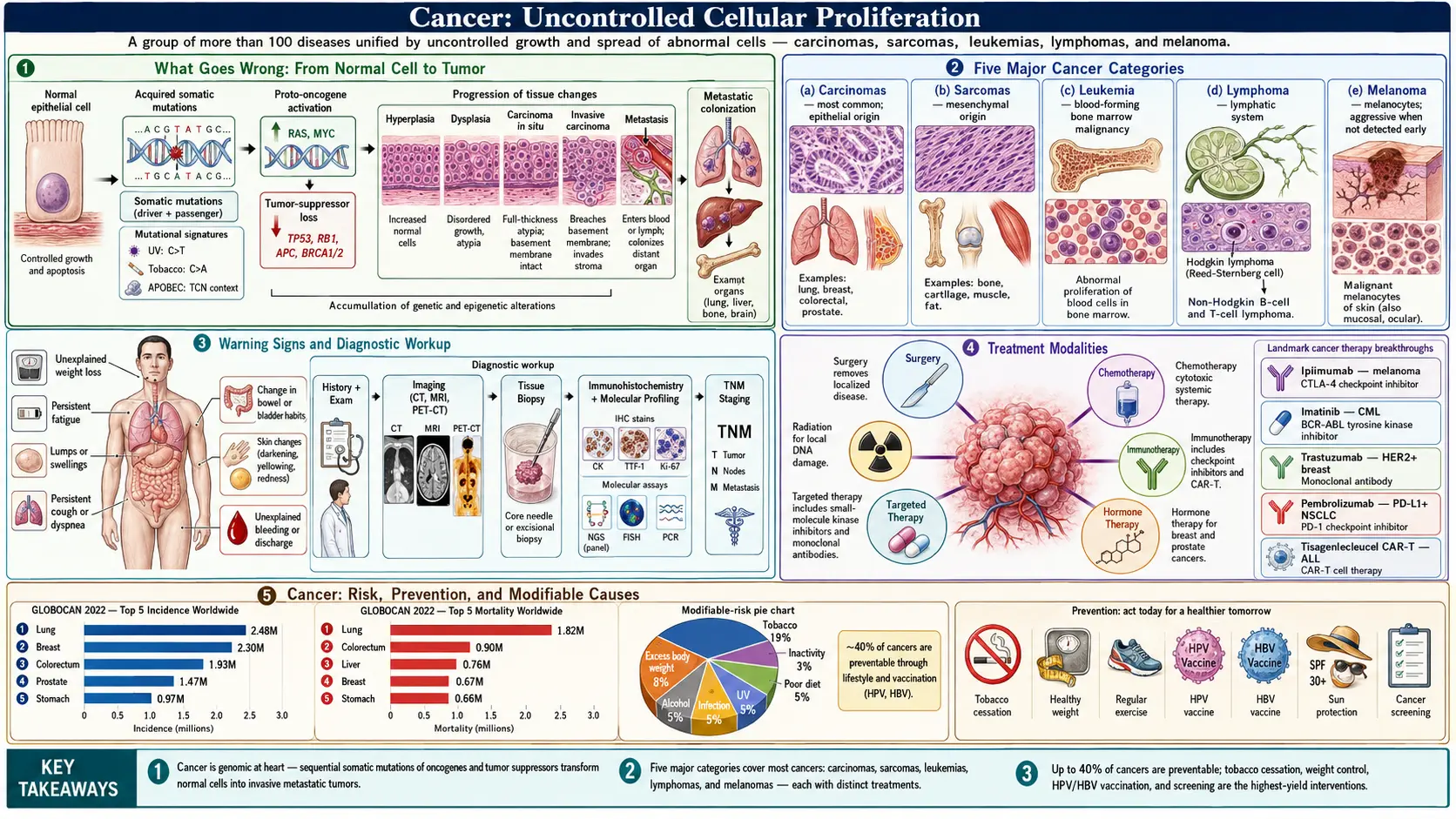
Table of Contents
- What is Cancer?
- Types of Cancer
- Staging and Grading: What the Numbers Mean
- Symptoms of Cancer
- Risk Factors
- Screening: What Works, and Its Real Numbers
- Prevention Strategies
- Treatment Options
- Nutrition and Supplements During Cancer
- Red Flags and Practical Questions to Ask
- Complications of Cancer
- Key Research Papers
- Connections
- Featured Videos
What is Cancer?
Cancer is a group of diseases characterized by the uncontrolled growth and spread of abnormal cells in the body. If not controlled, it can result in serious health complications and death.
Not one disease, and the difference matters
"Cancer" is more like the word "infection" than like the word "measles". Breast cancer and leukaemia have about as much in common as pneumonia and athlete's foot — both are caused by cells escaping normal control, but the biology, the treatment and the outlook differ enormously. Even within a single organ, two tumours that look identical under a microscope can behave completely differently depending on which molecular switches are stuck. That is why modern treatment increasingly depends on testing the tumour rather than only naming the organ.
What actually goes wrong
Your body replaces billions of cells a day, and every division is a chance to miscopy DNA. Cells have layered protections against this: brakes that stop division when something is wrong (tumour suppressor genes), accelerators that are only supposed to fire on demand (oncogenes), proofreading machinery that repairs copying errors, a counter that limits how many times a cell can divide, and a self-destruct programme for cells too damaged to fix.
Cancer is what happens when enough of those layers fail in the same cell line. Think of a car with a stuck accelerator, cut brake cables, a disabled warning light and a driver who will not pull over. One failure alone is usually survivable — the other systems compensate. It generally takes several accumulated faults over years, which is why cancer risk rises so steeply with age: it is a numbers game played over a long time.
Cancer biology is conventionally organised around a set of capabilities a normal cell must acquire to become malignant — sustained growth signalling, evasion of growth suppressors, resistance to cell death, unlimited replication, the ability to build its own blood supply, invasion and metastasis, altered metabolism, and the ability to hide from the immune system [1]. That framework is useful to a patient for one reason above all: each capability is a separate target. Chemotherapy attacks division. Anti-angiogenic drugs attack the blood supply. Immunotherapy strips away the hiding. It explains why treatment is so often a combination.
The two words that decide almost everything
Benign tumours grow where they started and stay put. They can still cause harm by pressing on something important, but they do not invade or spread. Malignant tumours invade surrounding tissue and can travel — and travel is what kills. A tumour confined to its organ of origin is usually removable; the same tumour once it has seeded the liver, lungs, bone or brain generally is not.
One more distinction worth carrying: metastatic cancer keeps the name of where it started. Breast cancer that has spread to bone is metastatic breast cancer, not bone cancer, and it is treated with breast-cancer drugs. See Metastatic Cancers.
The global scale is large and rising with population growth and ageing: an estimated 20 million new cases and 9.7 million deaths worldwide in 2022 across 36 cancer types in 185 countries [2].
Types of Cancer
1. Carcinomas
- Most common type: Originates in the skin or tissues that line or cover internal organs.
- Examples include: Breast cancer, lung cancer, colorectal cancer.
- Roughly 8 or 9 in 10 cancers are carcinomas, because epithelial tissues are the ones that divide constantly and face the outside world — the gut lining, the airway, the skin.
2. Sarcomas
- Begins in connective tissues such as bones, cartilage, fat, muscle, or blood vessels.
- Uncommon, biologically diverse, and disproportionately affecting younger people. Because they are rare, treatment at a specialist sarcoma centre measurably improves outcomes — this is one of the cancers where where you are treated matters most. See Sarcoma.
3. Leukemia
- Cancer of the blood-forming tissues, including the bone marrow.
- Leads to abnormal blood cells being produced and entering the bloodstream.
- Because it is already circulating, there is nothing to cut out — treatment is drug-based from the start. Acute leukaemias develop over days to weeks and are emergencies; chronic ones can be watched for years without treatment. See Leukemia.
4. Lymphomas
- Cancer of the lymphatic system: Includes lymph nodes, spleen, and other organs.
- Main types: Hodgkin lymphoma and non-Hodgkin lymphoma.
- Classically presents as a painless, persistent swollen node, often with fever, drenching night sweats and unexplained weight loss. Several lymphomas are among the most curable cancers there are, even when widespread. See Lymphoma.
5. Melanoma
- Begins in the melanocytes: Cells that produce the pigment melanin, commonly in the skin.
- Highly aggressive if not detected early.
- Caught early it is usually cured by excision alone. The change to watch for is a mole that is changing — asymmetry, an irregular border, more than one colour, a diameter over about 6 mm, or evolution over weeks to months. A new mole after 40, or one that stands out as different from all your others, deserves a look.
6. Myeloma and other blood cancers
- Multiple myeloma arises from plasma cells in the marrow and presents with bone pain, fractures, anaemia, kidney impairment and high calcium. It is not curable in most cases but is now often controlled for many years. See Multiple Myeloma.
Staging and Grading: What the Numbers Mean
These two words get confused constantly, and they answer different questions.
Stage answers "how far has it gone?" Most solid tumours use the TNM system: T for the size and local extent of the tumour, N for whether lymph nodes are involved and how many, M for whether it has spread to distant sites. These combine into stages I to IV. Roughly: stage I is small and confined, stage II larger or locally deeper, stage III involving regional lymph nodes, stage IV spread to distant organs.
Grade answers "how aggressive does it look?" A pathologist scores how abnormal the cells appear and how fast they are dividing. Low grade means the cells still resemble the tissue they came from and are dividing slowly; high grade means they look wild and divide fast. A low-stage, high-grade tumour and a high-stage, low-grade tumour are genuinely different problems.
Then there is the molecular profile, which increasingly matters more than either. Hormone receptor and HER2 status in breast cancer, EGFR and ALK in lung cancer, KRAS and mismatch-repair status in colorectal cancer, BRAF in melanoma — these determine whether a targeted drug or immunotherapy is available at all. If nobody has mentioned molecular or genomic testing of your tumour, it is a fair question to ask, because a treatable mutation that is never looked for is a treatment never offered.
On survival statistics. Five-year survival figures describe large groups of people diagnosed years ago, treated with what was available then. They are averages over a wide spread of ages, general health, stages and molecular subtypes, and they cannot tell you what will happen to you. They are useful for understanding a disease in general and unreliable as personal prediction — and in fast-moving areas such as melanoma and lung cancer, published figures often lag the treatments now in use.
Symptoms of Cancer
Symptoms vary depending on the type and location of the cancer, but common signs may include:
- Unexplained weight loss
- Persistent fatigue
- Unusual lumps or swellings
- Persistent cough or difficulty breathing
- Changes in bowel or bladder habits
- Changes in the skin: Darkened, yellowed, or red areas
- Unexplained bleeding or discharge
The word that matters is "persistent"
Almost every symptom on that list is far more often caused by something harmless. A cough is usually a virus. A lump is usually a cyst. Blood in the stool is usually haemorrhoids. What shifts the probability is persistence and change — a symptom that does not settle over three or more weeks, or that is steadily getting worse, in someone in whom it is new.
Some rough thresholds that are genuinely used in practice:
- Any cough lasting more than three weeks, particularly in a current or former smoker, or any coughing of blood at all.
- Unexplained weight loss of more than about 5% of body weight over six months without trying.
- A change in bowel habit lasting more than about six weeks, or any rectal bleeding in someone over 50, or new iron-deficiency anaemia in a man or a postmenopausal woman — which is bowel cancer until proven otherwise.
- Any bleeding after menopause. Always abnormal, always worth investigating.
- Blood in the urine, even once, even painless. Especially painless.
- Difficulty swallowing that is progressing, or that feels like food sticking.
- A hard, fixed, painless lump anywhere — painlessness is more concerning than pain, not less.
- Drenching night sweats with fever and weight loss.
- Painless jaundice — yellow eyes without pain.
Two things worth saying plainly. Early cancer is frequently completely symptom-free, which is the entire reason screening exists. And pain is a late symptom for most cancers, so waiting until something hurts is waiting too long.
Risk Factors
- Age: Risk increases with age — the single biggest factor, and the one nobody can change.
- Genetics: Family history of cancer can increase risk.
- Lifestyle factors: Such as smoking, excessive alcohol consumption, poor diet, and lack of physical activity.
- Exposure to carcinogens: Includes chemicals, radiation, and certain viruses.
- Chronic inflammation: Can contribute to the development of cancer.
- Obesity: Linked to at least a dozen cancers including bowel, postmenopausal breast, endometrial, kidney, liver, pancreas and oesophagus — and much less widely known than the smoking link.
- Infections: A substantial share of cancers worldwide are infection-related and therefore preventable — HPV (cervical, anal, throat), hepatitis B and C (liver), Helicobacter pylori (stomach), Epstein–Barr virus, and HIV indirectly.
- Radiation: Ultraviolet from sun and sunbeds; and, at higher exposures, ionising radiation including radon gas in some homes.
On alcohol, because the message has changed
Alcohol is a recognised cause of cancer of the mouth, throat, oesophagus, liver, bowel and breast, and the risk begins at low intakes rather than only with heavy drinking — the breast-cancer association in particular is present at levels many people consider moderate. This has become clearer over the past decade and has not filtered through into general awareness in the way the tobacco message did.
On family history — what actually raises concern
Most cancer is not inherited. Inherited syndromes account for a minority of cases, but identifying them changes screening and sometimes prevention for a whole family. The patterns that warrant a conversation about genetic counselling are: cancer diagnosed unusually young (breast or bowel under 50); the same cancer in several close relatives; more than one primary cancer in one person; certain specific combinations such as breast and ovarian, or bowel and endometrial; male breast cancer; and Ashkenazi Jewish ancestry with a family history of breast, ovarian or pancreatic cancer.
Screening: What Works, and Its Real Numbers
Screening looks for cancer in people with no symptoms. It saves lives, and it is oversold in both directions — so here are actual trial results rather than slogans.
Bowel cancer. The NordICC trial randomly invited 84,585 people to screening colonoscopy or usual care. Over 10 years the risk of colorectal cancer was 0.98% in the invited group versus 1.20% in usual care — an 18% relative reduction; the number needed to invite to prevent one cancer was 455. Death from colorectal cancer was 0.28% versus 0.31%, which did not reach statistical significance, and all-cause mortality was identical [3]. Note that only 42% of those invited actually attended, which dilutes the intention-to-screen result substantially. Stool-based tests (FIT) are a less invasive alternative with good evidence and are what many national programmes use.
Lung cancer. The NELSON trial screened high-risk current and former smokers with low-dose CT. At 10 years, lung-cancer mortality was 2.50 versus 3.30 deaths per 1,000 person-years, a rate ratio of 0.76 — roughly a quarter fewer lung-cancer deaths [4]. If you have a significant smoking history, asking whether you qualify for CT screening is one of the highest-yield questions on this page.
Cervical cancer. HPV vaccination works, and the population data are now mature. In a Swedish nationwide study, the cumulative incidence of invasive cervical cancer was 47 per 100,000 among vaccinated women versus 94 per 100,000 among unvaccinated. After full adjustment the incidence rate ratio was 0.12 among those vaccinated before age 17, against 0.47 for those vaccinated at 17 to 30 [5]. Earlier is dramatically better. Cervical screening remains necessary even after vaccination.
The honest caveats that apply to all screening. False positives cause anxiety and lead to further tests that carry their own risks. Overdiagnosis is real: some screen-detected cancers would never have caused harm in that person's lifetime, yet once found they are usually treated, with all the treatment's side effects and none of its benefit. And a normal screening result is not a guarantee — a new symptom between screening rounds still needs investigating. None of this is a reason to skip screening; it is a reason to understand what you are agreeing to.
Prevention Strategies
- Healthy diet: Emphasize vegetables, fruit, legumes and whole grains.
- Avoid tobacco: Smoking is a leading cause of cancer, particularly lung cancer.
- Limit alcohol intake: Excessive consumption increases the risk of certain cancers.
- Protect skin from the sun: Reduces the risk of skin cancer.
- Regular physical activity: Helps maintain a healthy weight and reduces cancer risk.
- Vaccination: HPV vaccination prevents cervical and several other cancers [5]; hepatitis B vaccination prevents a major cause of liver cancer.
- Treat the infections that cause cancer: eradicating Helicobacter pylori reduces stomach cancer risk; curing hepatitis C reduces liver cancer risk.
Physical activity, with a number attached
A pooled analysis of 1.44 million adults across 12 cohorts examined leisure-time physical activity against 26 cancer types. Higher activity was associated with lower risk of 13 of the 26, including oesophageal adenocarcinoma, liver, lung, kidney, gastric cardia, endometrial, myeloid leukaemia, myeloma, colon, head and neck, rectal, bladder and breast cancer [6]. These are observational associations rather than proof of cause, but the consistency across cancer types and cohorts is striking, and the behaviour is beneficial regardless.
Food, plainly
No single food prevents cancer, and any source claiming otherwise is selling something. What the evidence supports is a whole-food pattern: vegetables and fruit at most meals; legumes several times a week — lentils, chickpeas, black beans; whole grains rather than refined, including oats, barley and brown rice; nuts and olive oil; fish; and much less processed meat, which is classified as a cause of colorectal cancer, less red meat generally, and much less alcohol and sugary drink. Fibre from whole plant foods has reasonably consistent support for lower bowel-cancer risk.
Treatment Options
- Surgery: Removal of the tumor and surrounding tissues.
- Chemotherapy: Use of drugs to kill or slow the growth of cancer cells.
- Radiation therapy: High doses of radiation to target and kill cancer cells.
- Immunotherapy: Boosts the body’s natural defenses to fight cancer.
- Targeted therapy: Focuses on specific genes or proteins involved in cancer growth.
- Hormone therapy: Used for cancers that are driven by hormones (e.g., breast or prostate cancer).
What each one is actually doing
- Surgery remains the main route to cure for solid tumours that have not spread. "Clear margins" means the pathologist found normal tissue all the way around the removed piece.
- Chemotherapy poisons dividing cells. It is not selective, which is exactly why its side effects fall on your other fast-dividing tissues — hair follicles, gut lining, bone marrow. That is the whole explanation for hair loss, mouth ulcers, nausea and low blood counts, and it is why those effects reverse when treatment stops. Given before surgery it is called neoadjuvant, and shrinking a tumour first can turn an inoperable one operable; given after, adjuvant, aimed at cells too few to see.
- Radiation damages DNA in a precisely defined volume. Modern delivery is far more conformal than a generation ago, and side effects are largely confined to whatever normal tissue sits in the beam.
- Targeted therapy blocks a specific molecular fault — which is why the tumour has to be tested first. Where a target is present these drugs can work dramatically well, usually with different and often milder side effects than chemotherapy. Resistance commonly develops over time, which is why later-generation drugs exist.
- Immunotherapy mostly works by removing the brakes the tumour has applied to your own T cells (checkpoint inhibitors), or by re-engineering T cells to recognise the cancer (CAR-T). It has transformed the outlook in melanoma and some lung, kidney and bladder cancers. Its side effects are different in kind: the unbraked immune system can attack the thyroid, bowel, liver, lungs, skin or pituitary. Those reactions can appear months after treatment, so any new symptom should be reported to the oncology team rather than to an unconnected clinician who may not think of it.
- Hormone therapy starves hormone-driven cancers of their fuel; it is often taken for five to ten years, and adherence over that time is a real and under-discussed problem.
Two things patients should know about the system, not the science
Ask about clinical trials. Trials are not a last resort for when nothing works; many test a new option alongside standard treatment as first-line therapy, and participants receive close monitoring. Availability depends heavily on which centre you attend.
Ask about palliative care early — and note that palliative care is not hospice and not giving up. It is specialist management of symptoms, pain and side effects alongside active treatment, and studies of early integration have shown better quality of life. Waiting until the end wastes what it is best at.
A second opinion is standard practice for a serious diagnosis and is not an insult to anyone. For rare cancers, treatment volume at a centre is associated with outcomes.
Nutrition and Supplements During Cancer
This is where patients are targeted most aggressively, so the evidence deserves stating plainly, including where it points the wrong way.
High-dose antioxidant supplements can increase cancer risk
The intuition that antioxidants must prevent cancer has been tested and failed, sometimes badly. In the SELECT trial, 35,533 healthy men were randomized to vitamin E, selenium, both, or placebo. Vitamin E significantly increased the risk of prostate cancer — 620 cases versus 529 on placebo, hazard ratio 1.17, an absolute increase of 1.6 cases per 1,000 person-years [7].
Similarly, beta-carotene supplements given to smokers and asbestos-exposed workers in the CARET trial increased lung cancer and mortality, and the elevated risk persisted for years after the supplements were stopped [8]. These are not small caveats; they are trials stopped for harm.
There is also a specific concern that high-dose antioxidants taken during chemotherapy or radiotherapy could blunt treatments that work partly by generating oxidative damage. The evidence is not settled, which is precisely why supplements should be disclosed to and discussed with the oncology team rather than taken quietly.
What is genuinely worth attending to
- Enough protein and calories. Unintentional weight and muscle loss during treatment predicts worse tolerance of chemotherapy and worse outcomes. This is the opposite of the common instinct to "starve the cancer" — restrictive diets during active treatment more often weaken the patient than the tumour. Ask for a referral to an oncology dietitian.
- Whole foods over supplements. Eggs, fish, poultry, meat, legumes, nuts, dairy, vegetables, fruit and whole grains including brown rice. Small frequent meals when appetite is poor.
- Correcting a measured deficiency — iron, B12, vitamin D — is different from taking supplements speculatively, and is reasonable.
- Food safety matters when blood counts are low: avoid unpasteurised dairy, raw eggs, raw shellfish and undercooked meat during periods of neutropenia.
Herb–drug interactions are a real hazard here
St John's wort accelerates the breakdown of a long list of cancer drugs and can drop them to ineffective levels — it is one of the clearest herbal contraindications in oncology. Grapefruit juice does the reverse for some drugs, raising levels. High-dose turmeric, fish oil, ginkgo and garlic all have mild antiplatelet effects that matter around surgery or low platelet counts. Give your oncology team a complete list of everything you take, including things you consider natural or trivial. The risk is not that they will disapprove; it is that an unrecognised interaction quietly makes the treatment stop working.
Where a therapy is genuinely unproven, this site says so rather than omitting it. Being told honestly that something has weak evidence is more useful than being told nothing, and it leaves the decision with you.
Red Flags and Practical Questions to Ask
Seek urgent medical care during cancer treatment for:
- Fever of 38°C (100.4°F) or above while on chemotherapy. This is neutropenic sepsis until proven otherwise, it can kill within hours, and it needs antibiotics urgently — not an appointment next week. Most units issue a card with a 24-hour number; carry it.
- Uncontrolled bleeding or unusual bruising, which may mean very low platelets.
- New severe back pain with leg weakness, numbness, or bladder or bowel changes — possible spinal cord compression, an emergency where hours determine whether someone walks again.
- Sudden severe breathlessness or chest pain — cancer substantially raises the risk of blood clots.
- Confusion, extreme thirst and constipation together — possible high calcium, which is treatable.
- Persistent vomiting or inability to keep fluids down.
- Any new symptom on immunotherapy, including diarrhoea, rash, or breathlessness — immune-related reactions are treatable when caught early and dangerous when not.
Questions worth asking at the first appointments
- What exactly is the diagnosis — the type, the stage and the grade — and can I have it in writing?
- Has the tumour had molecular or genomic testing, and does it change my options?
- Is the goal of this treatment cure, control, or comfort? (Ask directly. It is the single most clarifying question there is, and it is often left unspoken.)
- What are the side effects, which are temporary and which permanent, and how will they affect work, fertility and daily life?
- Are there clinical trials I am eligible for, here or elsewhere?
- What happens if I choose not to have this treatment?
- Who do I call, day or night, if something goes wrong?
Bring someone with you and let them take notes, or ask to record the conversation. People retain very little of what is said in the appointment where they are told they have cancer, and that is normal rather than a failing.
Complications of Cancer
- Metastasis: Spread of cancer cells to other parts of the body.
- Organ damage: Can result from tumors growing and disrupting normal function.
- Weakened immune system: Certain cancers and treatments can lower immunity.
- Chronic pain: Associated with advanced cancer stages.
- Emotional impact: Can lead to stress, anxiety, and depression.
- Blood clots: Cancer and its treatments substantially raise the risk of deep vein thrombosis and pulmonary embolism.
- Cachexia: Progressive loss of muscle and weight that does not reverse with eating alone, and which independently worsens outcomes.
- Late effects of treatment: Heart damage from certain chemotherapies and chest radiation, nerve damage causing lasting numbness and tingling, infertility, thyroid failure, cognitive changes, and a small increased risk of a second cancer years later. These are why survivorship care plans exist, and why long-term follow-up is not just reassurance.
Two things deserve saying at the end. Cancer pain is usually controllable, and it is under-treated far more often than it is over-treated; fear of opioid dependence is not a good reason to accept unrelieved pain in this setting. And psychological support is part of treatment, not an optional extra — depression and anxiety are common, they are treatable, and treating them improves how people cope with everything else.
Key Research Papers
Historical Background
Cancer has been documented since ancient Egypt, with the earliest known description found in the Edwin Smith Papyrus (c. 1600 BCE). The term "cancer" derives from the Greek physician Hippocrates (c. 460-370 BCE), who used the words "carcinos" and "carcinoma." Modern oncology advanced dramatically with Rudolf Virchow's cellular pathology theory in the 1850s and Sidney Farber's pioneering chemotherapy work in 1947.
This list was rebuilt after an audit found that nine of the twelve DOI links previously shown here resolved to an unrelated paper — several to Global Burden of Disease reports, one to a paper on epigenetic therapy, one to a paper about shadowy genome islands. Every citation below was verified live against its own PubMed record — authors, journal, year and title all checked against the source.
- Hanahan D. Hallmarks of Cancer: New Dimensions. Cancer Discov. 2022;12(1):31-46 — PubMed PMID: 35022204 · doi:10.1158/2159-8290.CD-21-1059
- Bray F, Laversanne M, Sung H, et al. Global cancer statistics 2022: GLOBOCAN estimates of incidence and mortality worldwide for 36 cancers in 185 countries. CA Cancer J Clin. 2024;74(3):229-263 — PubMed PMID: 38572751 · doi:10.3322/caac.21834
- Bretthauer M, Løberg M, Wieszczy P, et al. Effect of Colonoscopy Screening on Risks of Colorectal Cancer and Related Death. N Engl J Med. 2022;387(17):1547-1556 — PubMed PMID: 36214590 · doi:10.1056/NEJMoa2208375
- de Koning HJ, van der Aalst CM, de Jong PA, et al. Reduced Lung-Cancer Mortality with Volume CT Screening in a Randomized Trial. N Engl J Med. 2020;382(6):503-513 — PubMed PMID: 31995683 · doi:10.1056/NEJMoa1911793
- Lei J, Ploner A, Elfström KM, et al. HPV Vaccination and the Risk of Invasive Cervical Cancer. N Engl J Med. 2020;383(14):1340-1348 — PubMed PMID: 32997908 · doi:10.1056/NEJMoa1917338
- Moore SC, Lee IM, Weiderpass E, et al. Association of Leisure-Time Physical Activity With Risk of 26 Types of Cancer in 1.44 Million Adults. JAMA Intern Med. 2016;176(6):816-25 — PubMed PMID: 27183032 · doi:10.1001/jamainternmed.2016.1548
- Klein EA, Thompson IM Jr, Tangen CM, et al. Vitamin E and the risk of prostate cancer: the Selenium and Vitamin E Cancer Prevention Trial (SELECT). JAMA. 2011;306(14):1549-56 — PubMed PMID: 21990298 · doi:10.1001/jama.2011.1437
- Goodman GE, Thornquist MD, Balmes J, et al. The Beta-Carotene and Retinol Efficacy Trial: incidence of lung cancer and cardiovascular disease mortality during 6-year follow-up after stopping beta-carotene and retinol supplements. J Natl Cancer Inst. 2004;96(23):1743-50 — PubMed PMID: 15572756 · doi:10.1093/jnci/djh320
PubMed Topic Searches
The following PubMed topic searches surface the current peer-reviewed literature on Cancer. Each link opens a live PubMed query; results update as new papers are indexed.
- PubMed: Search: cancer hallmarks
- PubMed: Search: cancer staging TNM
- PubMed: Search: cancer screening
- PubMed: Search: chemotherapy cancer
- PubMed: Search: immunotherapy checkpoint inhibitor
- PubMed: Search: cancer targeted therapy
- PubMed: Search: cancer genomics precision medicine
- PubMed: Search: cancer biomarkers circulating tumor DNA
- PubMed: Search: radiation oncology
- PubMed: Search: cancer epidemiology incidence
- PubMed: Search: cancer prevention lifestyle
- PubMed: Search: cancer cachexia
Connections
- Oncology
- Tumor Markers — what cancer blood tests can and cannot say
- Leukemia
- Lymphoma
- Metastatic Cancers
- Sarcoma
- Multiple Myeloma
- Thyroid Cancer
- Turmeric
- Vitamin D3
- Green Tea
- Turkey Tail Mushroom
- Reishi Mushroom
- Chaga Mushroom
- Selenium
- Selenium and Cancer Prevention — selenoprotein biology, the NPC and SELECT trials, evidence across prostate/colorectal/lung cancers, and the U-shaped dose-response curve.
- Coffee and Cancer Prevention
- Aspirin and Cancer Prevention
- Fatigue
- Vitamin C
- Garlic
- Lung Cancer
- Breast Cancer
- Colorectal Cancer
- Prostate Cancer
- Pancreatic Cancer
- Skin Cancer
- Ovarian Cancer
- Cervical Cancer
- Liver Cancer
- Stomach Cancer
- Esophageal Cancer
- Kidney Cancer
- Endometrial Cancer
- Bishop & Varmus: cancer genes are our own genes — the 1976 discovery that oncogenes are corrupted copies of normal cellular genes, and the foundation of every targeted cancer drug
- Helicobacter pylori — an infection-caused cancer risk that eradication reduces
- Probiotics
- Pesticides