Azodicarbonamide (ADA): The Yoga Mat Chemical in Bread
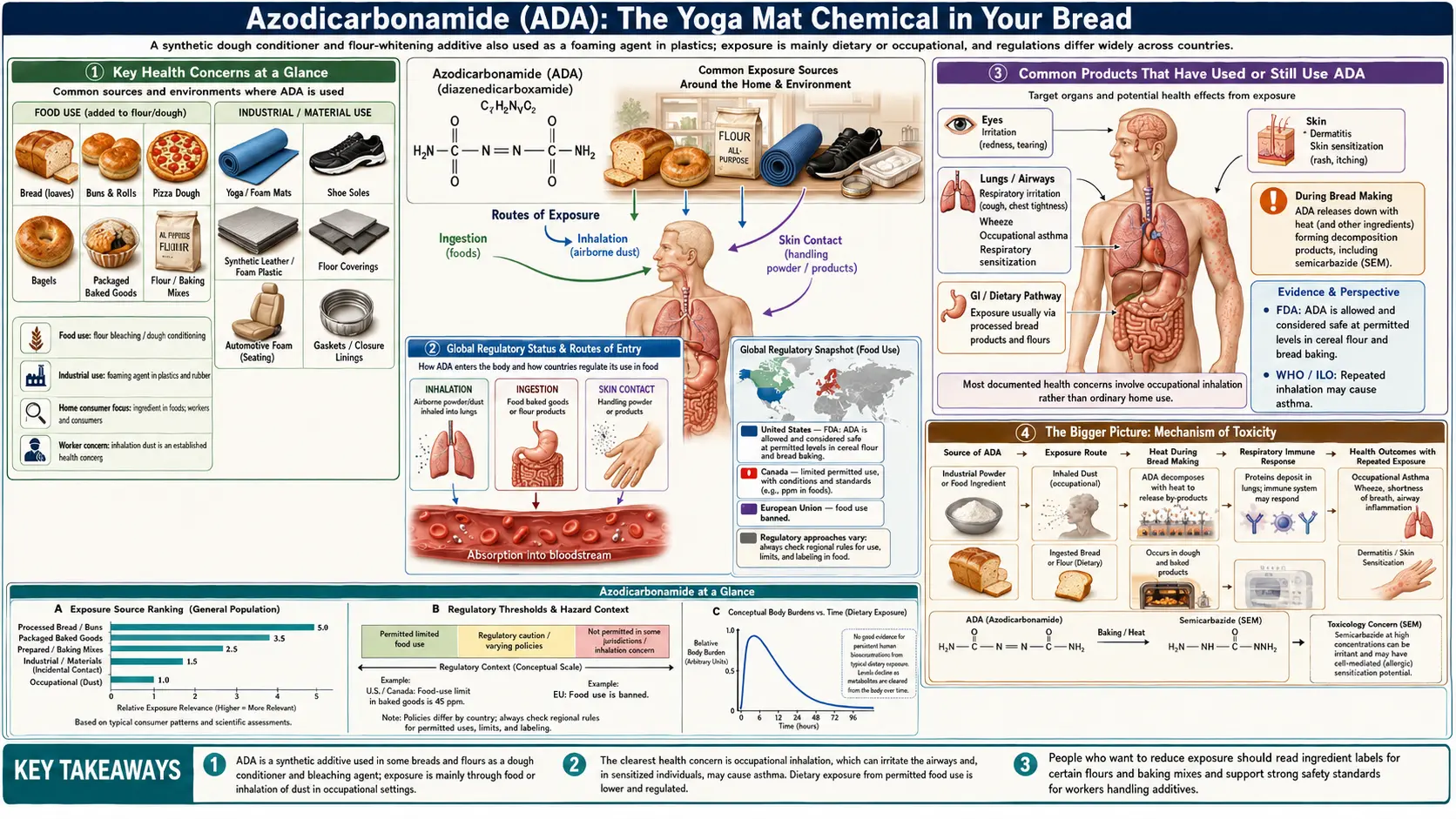
Azodicarbonamide, commonly abbreviated as ADA, is a synthetic chemical that the United States permits as an aging and bleaching ingredient in cereal flour and as a dough conditioner in bread baking, at up to 45 parts per million of the flour (21 CFR 172.806). Industrially it is a blowing agent: when heated it decomposes and releases gases that foam plastics and rubber, which is the origin of its nickname, “the yoga mat chemical.” In May 2026 the FDA opened a post-market safety assessment of ADA. It is not on the European Union’s list of authorised food additives, nor on the approved-additive lists for England, Wales and Northern Ireland or in the Australia New Zealand Food Standards Code.
In bread dough ADA is converted to biurea, and baking produces small amounts of semicarbazide (SEM) and urethane (ethyl carbamate). The International Agency for Research on Cancer (IARC) classifies ethyl carbamate as probably carcinogenic to humans (Group 2A). The evidence on semicarbazide is weaker: the FDA reported in 2014 that at high levels it increased tumors in female mice but not in male mice or in rats, and IARC places it in Group 3 (not classifiable as to carcinogenicity in humans). The FDA’s 2026 request for information asks specifically for data on semicarbazide and ethyl carbamate in foods made with ADA.
Table of Contents
- Key Health Concerns at a Glance
- What Is Azodicarbonamide?
- Health Concerns
- Decomposition Products
- Respiratory Health Effects
- Other Health Concerns
- Global Regulatory Status
- The FDA’s 2014 Questions and Answers
- Foods in Which ADA Is Permitted
- Alternatives to ADA in Baking
- Where ADA Is and Is Not Found
- The Bigger Picture
- Key Research Papers
- Connections
- Featured Videos
Key Health Concerns at a Glance
- Breakdown products formed in baking — Baking ADA-treated dough produces semicarbazide and ethyl carbamate. IARC classifies ethyl carbamate as Group 2A (“probably carcinogenic to humans”) and semicarbazide as Group 3 (not classifiable).
- Occupational asthma — An international assessment by the WHO’s International Programme on Chemical Safety (IPCS, 1998) concluded that ADA is a human asthmagen and that there is a risk to health under occupational exposure conditions. In one factory that made ADA, 28 of 151 workers (18.5%) reported asthma after exposure to its dust.
- Mixed genotoxicity results — Semicarbazide damaged DNA in a test-tube study in the presence of copper and raised micronucleus counts in rat bone marrow (without a dose-response pattern), but was negative in a mouse micronucleus test; a 2005 review described its genotoxicity in vitro as limited and largely prevented by metabolic enzymes.
- Hormonal and developmental effects in young rats — In juvenile rats given 40 to 140 mg/kg of semicarbazide a day for 28 days, females showed delayed vaginal opening and lower serum estrogen, and tissue changes were seen in the thyroid and ovary even at the lowest dose.
- Regulatory status — ADA is not on the food-additive lists of the European Union, Great Britain, or Australia and New Zealand; the United States permits it at up to 45 ppm in flour, and the FDA opened a post-market safety assessment in May 2026.
- Exposure data are thin — The 1998 IPCS assessment could not evaluate exposure of the general public for lack of data; the FDA’s 2026 request asks manufacturers for use levels, residue levels of breakdown products, and biomonitoring data.
- Alternatives exist — The FDA stated in 2014 that ADA is not necessary to make bread and that approved alternative ingredients are available; in one baking study, enzymes performed as well as or better than chemical oxidizers in most cases.
- Workplace precautions — The international chemical safety card for ADA lists local exhaust or breathing protection and protective clothing for handling the powder. In food, exposure is to the compounds ADA forms in dough and during baking rather than to the dust.
What Is Azodicarbonamide?
- Chemical identity — azodicarbonamide (CAS No. 123-77-3; NH2CON=NCONH2) is a synthetic chemical that exists as a yellow-orange crystalline solid, described on its chemical safety card as orange-red crystals or yellow powder. It is made by reacting dihydrazine sulfate with urea under high temperature and pressure (IPCS 1998).
- Function in bread — US regulations authorize ADA as an aging and bleaching ingredient in cereal flour and as a dough conditioner in bread baking. In dough it acts as a redox (oxidizing) agent: such agents change the dough’s free sulfhydryl content and the bread’s volume, and less ADA was needed when dough was mixed in oxygen-enriched air (Beghin 2022).
- Function in industrial products — as a blowing agent, ADA decomposes under heat into gases, mainly nitrogen, carbon monoxide, ammonia and carbon dioxide, that expand the polymer into foam (Kupczewska-Dobecka 2024). Uses connected to food include plastic gaskets in metal lids for glass jars and bottle-cap liners; in the US it is also authorized in sealing gaskets for food containers, rubber articles intended for repeated use, and foamed plastics.
- Two different reactions — in foam production, heat breaks ADA down into gases. In bread dough, ADA is converted to biurea when water is added, and semicarbazide appears only after baking (Noonan 2008).
Health Concerns
Decomposition Products
Most of the health questions about ADA in food concern the compounds it forms. FDA researchers found that ADA turns into biurea once water is added to the dough, and that semicarbazide forms from biurea during baking rather than during mixing or proofing (Noonan 2008).
- Semicarbazide (SEM) — dry heating of ADA-treated flour at 150–200 °C produced semicarbazide at up to 0.2 mg/kg, with similar levels in the crusts of bread made from such flour (Becalski 2004). US commercial bread products listing ADA among their ingredients contained 10 to 1,200 parts per billion (Noonan 2005), and 11 Canadian bakery products ranged from undetectable to 560 ng/g, sometimes varying more than tenfold between batches of the same product (Becalski 2006). On cancer, the FDA reported in 2014 that high levels of semicarbazide increased tumors in female mice but not in male mice or in rats, at levels far above estimated human exposure from bread. A 2005 review described the cancer studies as of limited quality, with a questionable weak effect in mice at high doses and no effect in rats, and noted IARC’s Group 3 classification (Nestmann 2005). In 2003 the European Food Safety Authority’s panel concluded that semicarbazide has weak carcinogenic activity in laboratory animals and weak genotoxicity in vitro, but that it was not possible to say whether it poses a cancer risk to humans.
- Urethane (ethyl carbamate) — IARC classifies ethyl carbamate as probably carcinogenic to humans (Group 2A, 2010), on sufficient evidence in experimental animals; in mice given it orally it increased tumors of the lung, liver blood vessels and lymphatic system, among other sites. In UK baking trials, ADA at 45 mg/kg significantly increased ethyl carbamate in bread and toast, while 20 mg/kg (normal commercial use) produced only small increases (Dennis 1997a). Commercial breads labelled as made with ADA had a mean of 66% more ethyl carbamate than untreated bread (Dennis 1997b). In FDA work, 45 mg/kg ADA raised ethyl carbamate in commercially prepared bread by 1–3 µg/kg, and adding ascorbic acid with ADA gave smaller increases (Cañas 1997).
- Biurea — the main product of ADA in dough. The 1998 IPCS assessment found that early animal studies using biurea showed no tumor-causing or anti-fertility effects; repeated high oral doses of ADA itself (above 200 mg/kg body weight a day) caused kidney inflammation with crystalline deposits in several species.
Respiratory Health Effects
- Occupational asthma — the IPCS assessment (1998) based its conclusion that ADA is a human asthmagen on bronchial challenge studies and on health evaluations of employees where ADA is made or used. In a 1980 survey of 151 workers exposed to ADA dust during its manufacture, 28 (18.5%) without previous asthma reported late-onset asthma after exposure; removal from exposure ended the symptoms, while 7 of 13 sensitised workers who stayed exposed for three months developed prolonged airway hyperreactivity (Slovak 1981). A 2004 case report describes occupational asthma confirmed by specific inhalation challenge (Kim 2004). A 2024 review found that most studies concern workers making ADA or using it as a blowing agent in plastics, and that no safe concentration for workers has been identified (Kupczewska-Dobecka 2024).
- Respiratory irritation — the international chemical safety card for ADA states that it irritates the eyes and the respiratory tract and lists cough, headache, shortness of breath, sore throat and wheezing as symptoms of inhalation. The IPCS noted that ADA did not irritate the respiratory tract in experimental animals.
- Skin sensitization — the IPCS found indications that ADA may induce skin sensitization, and the safety card states that repeated or prolonged skin contact may cause dermatitis.
- A disputed classification — a 2017 review argued that the evidence for ADA as a respiratory allergen is less than persuasive (Arts 2017); occupational physicians replied in 2018 with further evidence supporting the classification (Suojalehto 2018).
Other Health Concerns
- Hormonal effects in animals — in juvenile rats given 40, 75 or 140 mg/kg of semicarbazide a day for 28 days, females showed delayed vaginal opening at all doses and dose-related falls in serum estrogen, and the authors described semicarbazide as acting as an endocrine disrupter (Maranghi 2010).
- Effects on developing organs in animals — in the same dose range, juvenile rats showed lack of cartilage mineralization, changes in behavior, and tissue changes in organs including the thyroid, ovary, thymus and spleen, with thyroid and ovary effects at 40 mg/kg (Maranghi 2009). In a 70-day study, 60 mg/kg a day increased liver and spleen weights, lowered thymus and testis weights in males, and changed sperm counts and motility; the no-observed-adverse-effect level was 30 mg/kg a day (Malashetty 2022).
- Exposure — the IPCS (1998) could not evaluate how much ADA the general public is exposed to, for lack of data. The FDA’s 2026 request asks for residue levels of ADA’s breakdown products in food, biomonitoring data, and information on groups with high dietary exposure.
Global Regulatory Status
Where ADA Is Not Permitted in Food
- European Union — ADA is not on the EU’s Union list of authorised food additives (Annex II to Regulation (EC) No 1333/2008, as set out by Regulation (EU) No 1129/2011), so it cannot be used as a food additive there. Separately, the EU suspended ADA as a blowing agent in plastic food-contact materials from 2 August 2005 (Commission Directive 2004/1/EC), citing the precautionary principle, after semicarbazide was found at up to 25 µg/kg in foods packed in glass jars, highest in baby foods. An expert group commissioned by EFSA judged the risk to infants and adults “probably very small,” while EFSA’s panel called the presence of semicarbazide in baby food undesirable.
- United Kingdom — ADA does not appear on the Food Standards Agency’s list of approved additives for England, Wales and Northern Ireland (June 2026), which follows assimilated Regulation (EU) 1333/2008. In 1997 UK researchers described 45 mg/kg as the UK statutory limit for ADA (Dennis 1997a); by 1998 the IPCS reported that its former use as a flour improver in the United Kingdom and Ireland was no longer permitted.
- Australia and New Zealand — ADA does not appear in the Australia New Zealand Food Standards Code’s schedules of substances permitted as food additives (Schedules 15 and 16) or as processing aids (Schedule 18).
- Elsewhere — FDA researchers described ADA as commonly used as a flour additive and dough conditioner in the United States and Canada (Noonan 2008).
US FDA Position
- Approved food additive — the FDA permits ADA as a food additive for use as an aging and bleaching ingredient in flour and as a dough conditioner at levels up to 45 parts per million (ppm) of the flour (21 CFR 172.806). It is an approved food additive, not a GRAS substance; the FDA states it is not aware of any prior sanction or GRAS conclusion for ADA.
- Post-market review (2026) — in May 2026 the FDA opened a post-market safety assessment of ADA and asked for data on its uses and safety (comments closed 13 July 2026); the FDA’s list of chemicals under review, updated 2 October 2026, shows that review still under way. ADA remains permitted while it continues.
- The FDA’s earlier conclusion — in 2014 the FDA stated that it approved ADA on the basis of a review of safety studies, including multi-year feeding studies, and that it considered ADA safe at the permitted levels. Its 2026 notice says that while it previously concluded the authorized uses to be safe, new information may require reconsideration.
The FDA’s 2014 Questions and Answers
In 2014 the FDA published a set of frequently asked questions on ADA (last updated 20 June 2014). Its main points:
- Ongoing review — the FDA was collecting data on semicarbazide levels in baked goods sold in the US and planned to reassess consumer exposure from bread products to decide whether regulatory action was needed.
- Diet — based on the science, the FDA was not recommending that consumers change their diets because of exposure to ADA or semicarbazide.
- Necessity — the FDA stated that ADA is not necessary to make bread and that approved alternative ingredients are available.
- Other uses — the FDA noted that ADA is also authorized as a blowing agent in sealing caps for food containers, that in 2005 EFSA concluded the semicarbazide levels found in foods packed in glass jars and bottles were not of concern for human health but noted that exposure should be limited where possible, and that the European Union banned this use.
Foods in Which ADA Is Permitted
- Flour — the US standards of identity for flour and whole wheat flour list ADA as an optional ingredient used in accordance with 21 CFR 172.806; flour treated with a bleaching ingredient must be labelled “Bleached.”
- Bread, rolls and buns — the US standard for bread, rolls and buns permits ADA up to 0.0045 part per 100 parts of flour, including any ADA already in the flour (21 CFR 136.110).
- Measured in commercial products — semicarbazide has been measured in US commercial bread products that list ADA among their ingredients (Noonan 2005) and in Canadian bakery products (Becalski 2006).
- Current use — the FDA’s 2026 request asks manufacturers for the food categories in which ADA is used, typical and maximum use levels, market share, and information on any authorized uses that have been abandoned.
- Food packaging — in the US, ADA is also authorized in closures with sealing gaskets for food containers, rubber articles for repeated use, and foamed plastics.
Alternatives to ADA in Baking
The FDA stated in 2014 that ADA is not necessary to make bread and that approved alternative ingredients are available. Ingredients and methods described in regulations and baking studies include:
- Ascorbic acid (vitamin C) — the US flour standard permits ascorbic acid as a dough conditioner at up to 200 parts per million (21 CFR 137.105), and it is on the EU list as E 300. It acts after conversion to dehydroascorbic acid, and it still increased bread volume in dough mixed under reduced oxygen (Beghin 2022).
- Enzymes — in a study of five Canadian spring wheat cultivars, glucose oxidase and fungal xylanase performed as well as or better than the oxidizers ascorbic acid and ADA in most cases (Tozatti 2020). The US flour standard also permits fungal alpha-amylase.
- Mixing — oxygen worked into dough during mixing oxidizes free sulfhydryl groups, increasing dough strength and bread volume (Beghin 2022).
- Calcium peroxide — permitted in US bread, rolls and buns within a combined limit with bromates and iodates (21 CFR 136.110); it is not on the EU list of authorised additives.
- DATEM (diacetyl tartaric acid esters of mono- and diglycerides) — a synthetic emulsifier affirmed as GRAS in the US (21 CFR 184.1101) and authorised in the EU as E 472e.
Where ADA Is and Is Not Found
- Ingredient labels — in the US every ingredient added to flour and bread must be declared on the label, and ADA appears as “azodicarbonamide.”
- Organic products — ADA is not on the USDA National List of nonagricultural substances allowed in products labelled “organic” or “made with organic” ingredients (7 CFR 205.605), and the non-organic ingredients of a product labelled “organic” must come from that list (7 CFR 205.301).
- European and British products — ADA is not authorised as a food additive in the EU or on Great Britain’s approved-additive list, so bread made under those rules does not contain it as an additive.
The Bigger Picture
ADA is one of several substances that regulators have weighed differently. The EU suspended its use in plastic food-contact materials in 2005 under the precautionary principle, even though its experts judged the risk probably very small, and ADA is not on the EU’s food-additive list. The FDA concluded in 2014 that ADA is safe at the permitted levels, and in 2026 began reassessing it, noting that new information may require reconsideration.
Many of the open questions concern exposure rather than hazard. The 1998 IPCS assessment could not estimate how much ADA the general public consumes, and the FDA’s 2026 request asks for residue levels of semicarbazide and ethyl carbamate in foods, biomonitoring data, and groups with high exposure. The human studies reviewed by the IPCS concerned only asthma and skin sensitization in workers.
The FDA’s post-market safety assessment of ADA, opened in May 2026, was still under way in October 2026. While it continues, ADA remains permitted in US flour at up to 45 ppm, and its presence in a product is shown on the ingredient label.
Key Research Papers
The studies and regulatory documents below are the sources for the statements on this page.
Semicarbazide and Urethane (Ethyl Carbamate)
- Wang Y, Chan W (2016). Automated In-Injector Derivatization Combined with High-Performance Liquid Chromatography-Fluorescence Detection for the Determination of Semicarbazide in Fish and Bread Samples. Journal of Agricultural and Food Chemistry 64(13):2802-8 — PubMed PMID: 26985968
- Noonan GO, Begley TH, Diachenko GW (2008). Semicarbazide formation in flour and bread. Journal of Agricultural and Food Chemistry 56(6):2064-7 — PubMed PMID: 18303820
- Noonan GO, Warner CR, Hsu W, et al. (2005). The determination of semicarbazide (N-aminourea) in commercial bread products by liquid chromatography-mass spectrometry. Journal of Agricultural and Food Chemistry 53(12):4680-5 — PubMed PMID: 15941299
- Becalski A, Lau BP, Lewis D, et al. (2004). Semicarbazide formation in azodicarbonamide-treated flour: a model study. Journal of Agricultural and Food Chemistry 52(18):5730-4 — PubMed PMID: 15373416
- Becalski A, Lau BP, Lewis D, et al. (2006). Semicarbazide in Canadian bakery products. Food Additives and Contaminants 23(2):107-9 — PubMed PMID: 16449051
- Dennis MJ, Massey RC, Ginn R, et al. (1997). The effect of azodicarbonamide concentrations on ethyl carbamate concentrations in bread and toast. Food Additives and Contaminants 14(1):95-100 — PubMed PMID: 9059588
- Dennis MJ, Massey RC, Ginn R, et al. (1997). The contribution of azodicarbonamide to ethyl carbamate formation in bread and beer. Food Additives and Contaminants 14(1):101-8 — PubMed PMID: 9059589
- Cañas BJ, Diachenko GW, Nyman PJ (1997). Ethyl carbamate levels resulting from azodicarbonamide use in bread. Food Additives and Contaminants 14(1):89-94 — PubMed PMID: 9059587
- Nestmann ER, Lynch BS, Musa-Veloso K, et al. (2005). Safety assessment and risk-benefit analysis of the use of azodicarbonamide in baby food jar closure technology: putting trace levels of semicarbazide exposure into perspective--a review. Food Additives and Contaminants 22(9):875-91 — PubMed PMID: 16192074
- Hirakawa K, Midorikawa K, Oikawa S, et al. (2003). Carcinogenic semicarbazide induces sequence-specific DNA damage through the generation of reactive oxygen species and the derived organic radicals. Mutation Research 536(1-2):91-101 — PubMed PMID: 12694749
- Vlastos D, Moshou H, Epeoglou K (2010). Evaluation of genotoxic effects of semicarbazide on cultured human lymphocytes and rat bone marrow. Food and Chemical Toxicology 48(1):209-14 — PubMed PMID: 19819287
- Abramsson-Zetterberg L, Svensson K (2005). Semicarbazide is not genotoxic in the flow cytometry-based micronucleus assay in vivo. Toxicology Letters 155(2):211-7 — PubMed PMID: 15603915
- Maranghi F, Tassinari R, Lagatta V, et al. (2009). Effects of the food contaminant semicarbazide following oral administration in juvenile Sprague-Dawley rats. Food and Chemical Toxicology 47(2):472-9 — PubMed PMID: 19110027
- Maranghi F, Tassinari R, Marcoccia D, et al. (2010). The food contaminant semicarbazide acts as an endocrine disrupter: Evidence from an integrated in vivo/in vitro approach. Chemico-Biological Interactions 183(1):40-8 — PubMed PMID: 19788891
- Malashetty V, Deshpande R, Patil S (2022). Seventy-Day Toxicity Study in Juvenile Sprague-Dawley Rats with Semicarbazide (SEM) from Weaning to Sexual Maturity. Journal of Toxicology 2022:5059761 — PubMed PMID: 35910536
- IARC (2010). Alcohol Consumption and Ethyl Carbamate. IARC Monographs on the Evaluation of Carcinogenic Risks to Humans, Volume 96 (ethyl carbamate: Group 2A) — IARC Publications
- IARC Monographs — Identification of Carcinogenic Hazards to Humans (urethane is classified Group 2A in Vol 96)
Occupational Asthma and Respiratory Sensitization
- Slovak AJ (1981). Occupational asthma caused by a plastics blowing agent, azodicarbonamide. Thorax 36(12):906-9 — PubMed PMID: 7336369
- Kim CW, Cho JH, Leem JH, et al. (2004). Occupational asthma due to azodicarbonamide. Yonsei Medical Journal 45(2):325-9 — PubMed PMID: 15119006
- Arts J, Kimber I (2017). Azodicarbonamide (ADCA): A reconsideration of classification as a respiratory sensitiser. Regulatory Toxicology and Pharmacology 89:268-278 — PubMed PMID: 28734852
- Suojalehto H, Malo JL, Cullinan P (2018). The classification of azodicarbonamide (ADCA) as a respiratory sensitiser; adding to the weight of evidence. Regulatory Toxicology and Pharmacology 94:330-331 — PubMed PMID: 29337191
- Kupczewska-Dobecka M, Konieczko K, Jurewicz J (2024). Effect of occupational exposure to ADCA on the incidence of allergic respiratory reactions – a literature review [in Polish]. Medycyna Pracy 75(5):455-473 — PubMed PMID: 39512099
- International Programme on Chemical Safety (1998). Azodicarbonamide. Concise International Chemical Assessment Document 16 (includes International Chemical Safety Card 0380). World Health Organization — IPCS INCHEM
Baking Function and Alternatives
- Beghin AS, Ooms N, Hooyberghs K, et al. (2022). The influence of varying levels of molecular oxygen on the functionality of azodicarbonamide and ascorbic acid during wheat bread making. Food Research International 161:111878 — PubMed PMID: 36192912
- Tozatti P, Hopkins EJ, Briggs C, et al. (2020). Effect of chemical oxidizers and enzymatic treatments on the baking quality of doughs formulated with five Canadian spring wheat cultivars. Food Science and Technology International 26(7):614-628 — PubMed PMID: 32279537
Regulatory Assessments
- FDA (2026). Azodicarbonamide (ADA); Request for Information. 91 FR 27060, 13 May 2026 — Federal Register
- FDA. List of Select Chemicals in the Food Supply Under FDA Review (content current as of 2 October 2026) — FDA
- FDA (2014). Frequently Asked Questions on Azodicarbonamide (ADA), page last updated 20 June 2014 — archived FDA page
- 21 CFR 172.806 — Azodicarbonamide — eCFR
- 21 CFR 136.110 — Bread, rolls, and buns — eCFR
- 21 CFR 137.105 — Flour — eCFR
- 21 CFR 184.1101 — Diacetyl tartaric acid esters of mono- and diglycerides — eCFR
- 7 CFR 205.605 — Nonagricultural (nonorganic) substances allowed as ingredients in or on processed products labeled as “organic” — eCFR
- 7 CFR 205.301 — Product composition — eCFR
- Commission Directive 2004/1/EC of 6 January 2004 as regards the suspension of the use of azodicarbonamide as blowing agent. OJ L 7, 13.1.2004, p. 45 — EUR-Lex
- Commission Regulation (EU) No 1129/2011 establishing a Union list of food additives (Annex II to Regulation (EC) No 1333/2008) — EUR-Lex
- EFSA Panel on Food Additives, Flavourings, Processing Aids and Materials in Contact with Food (2005). Opinion related to Semicarbazide in food. EFSA Journal 3(6):219 — doi:10.2903/j.efsa.2005.219
- Food Standards Agency (2026). Approved additives and E numbers (England, Wales and Northern Ireland) — GOV.UK
- Australia New Zealand Food Standards Code — Schedule 15, Substances that may be used as food additives — Federal Register of Legislation
- Australia New Zealand Food Standards Code — Schedule 16, Types of substances that may be used as food additives — Federal Register of Legislation
- Australia New Zealand Food Standards Code — Schedule 18, Processing aids — Federal Register of Legislation
- European Food Safety Authority (EFSA) — semicarbazide risk assessments
- FDA Food Additive Status List
External Authoritative Resources
- Center for Science in the Public Interest (CSPI) — Chemical Cuisine guide to food additives
- IARC Monographs on the Identification of Carcinogenic Hazards to Humans
- European Food Safety Authority (EFSA)
- NTP Report on Carcinogens (National Toxicology Program)