Ractopamine: The Livestock Growth Drug Banned in the EU and China
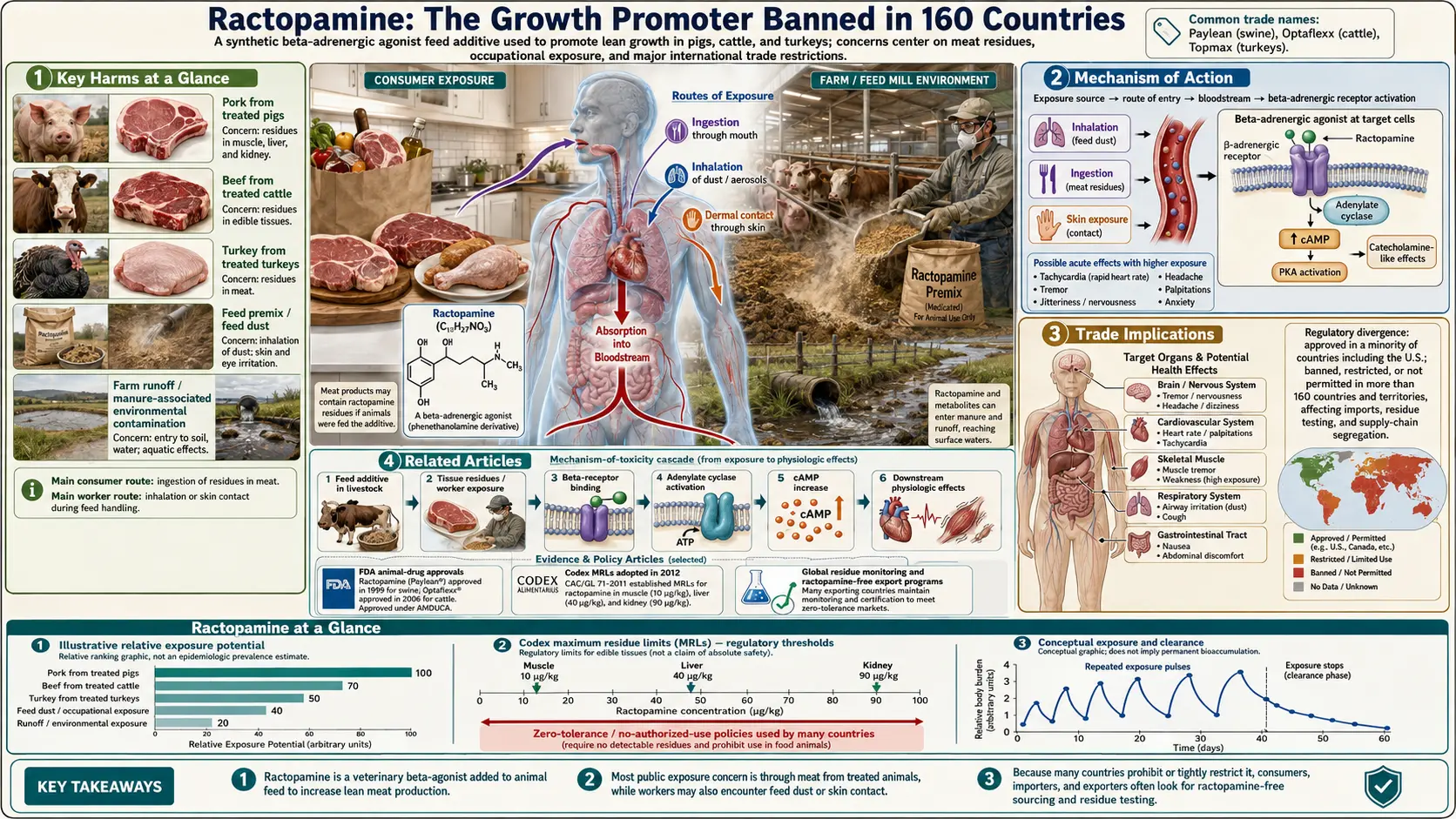
Ractopamine hydrochloride is a synthetic beta-adrenergic agonist (a phenethanolamine, the drug family that also includes some asthma medicines) that is mixed into the feed of finishing pigs, cattle and turkeys in some countries during the last weeks before slaughter. It shifts the animal's metabolism away from fat deposition and toward lean muscle, a process known as nutrient repartitioning. In the United States the FDA approved it for finishing swine as of December 22, 1999, for cattle fed in confinement for slaughter as of June 13, 2003, and for finishing turkeys as of November 12, 2008, according to the approval notices published in the Federal Register. The European Union prohibits beta-agonists for growth promotion, and China's Ministry of Agriculture has banned ractopamine as a growth promoter. When the Codex Alimentarius Commission adopted international maximum residue limits for ractopamine in July 2012, it did so by a secret-ballot vote of 69 to 67, with 7 abstentions.
Table of Contents
Key Harms at a Glance
- Cardiovascular effects at drug-level doses — in the only human dosing study, six healthy young men took single oral doses of 5 to 40 mg. At 15, 25 and 40 mg, heart rate rose by about 20, 30 and 50 beats per minute and cardiac output by about 35%, 55% and 90%; one volunteer was withdrawn before the 40 mg dose because of a sensation of a racing, pounding heart (as summarized by EFSA in 2009). These doses are far above residue levels in meat; the open question is what low, repeated exposure does in sensitive people.
- A contested safety basis — JECFA, the FAO/WHO expert committee, set its acceptable daily intake (0–1 μg per kg of body weight per day) from that six-person, open-label study. The European Food Safety Authority's feed-additives panel concluded in 2009 that the study could not be taken as a basis for an acceptable daily intake, so no residue limits could be proposed.
- Groups the EFSA panel identified as potentially at higher risk — people with cardiovascular disease, children, and people with certain beta-receptor gene variants. The panel noted that beta-agonists rarely cause significant arrhythmias in people without heart disease, but that people with coronary artery disease or pre-existing arrhythmias are at much greater risk.
- Residues in meat and offal — in a pig study, residues one day after the last dose were highest in kidney and liver and were not detected in muscle. Market testing in Taiwan found ractopamine at 1–10 μg/kg in 43 beef samples of US origin, all within Taiwan's limit.
- Animal welfare — the US label must state that ractopamine "may increase the number of injured, lame, and/or fatigued pigs during marketing" and that hyperactivity, anxiety and aggression have been reported in pigs fed it; cattle labeling reports agitation and decreased feed consumption.
- How widely it is banned — the figure "banned in 160 countries" is widely repeated, but no official count was found in primary documents. At the 2012 Codex session, delegations opposing the residue limits said two-thirds of the world's population lived in countries where ractopamine was not authorized, while one delegation in favor said 26 countries were using it.
1. Overview
- Drug class — EFSA classifies ractopamine hydrochloride as a phenethanolamine beta-adrenoceptor agonist. A 2026 veterinary review describes it as acting primarily on beta-1 receptors. The same broad class includes salbutamol (albuterol), an asthma medicine, and clenbuterol, a beta-agonist with stronger effects that has been used illegally as a growth promoter in the United States, China and the European Union.
- Products and sponsor — ractopamine is sold under separate trade names for swine, cattle and turkeys; the original US approvals were all held by a single animal-health company, which submitted the safety and effectiveness data reviewed by the FDA.
- Mechanism of growth effect — beta-agonists act through the cAMP–protein kinase A signaling pathway and shift energy use from fat deposition toward lean tissue growth, so treated animals put on more muscle and less fat.
- Production effects reported in pig trials — in a trial of 96 pigs fed 10 mg/kg for 28 days, ractopamine lowered fat measurements, increased loin muscle area and dressing percentage, improved feed efficiency, and produced less tender pork. In a trial of 228 lean gilts, 10 ppm for the final 4 weeks increased daily gain, feed efficiency, final weight and predicted carcass lean, and lowered intramuscular fat. An earlier trial of 128 pigs found a shift toward larger white muscle fibers and higher shear values (tougher meat).
- FDA approvals — NADA 140-863 (finishing swine) approved as of December 22, 1999; NADA 141-221 (cattle fed in confinement for slaughter, last 28 to 42 days on feed) approved as of June 13, 2003; NADA 141-290 (finishing turkeys) approved as of November 12, 2008.
- How it is used — it is mixed into feed rather than injected. The current federal regulation (21 CFR 558.500) provides for 4.5 to 9 g per ton of feed in finishing swine of at least 150 lb for the last 45 to 90 lb of gain before slaughter, and 8.2 to 24.6 g per ton in cattle during the last 28 to 42 days on feed. Labeling must state that it is not for use in animals intended for breeding.
2. Regulatory History
United States: Approval and Label Changes
- Basis of approval — each Federal Register approval notice states that the basis of approval is discussed in a freedom-of-information summary of the safety and effectiveness data submitted by the sponsor.
- US safety limits — the FDA's acceptable daily intake for total ractopamine residues is 1.25 μg per kg of body weight per day. US tolerances (21 CFR 556.570) are 0.15 ppm in swine liver and 0.05 ppm in swine muscle; 0.09 ppm in cattle liver and 0.03 ppm in cattle muscle; and 0.45 ppm in turkey liver and 0.1 ppm in turkey muscle.
- Label cautions added after approval — a supplemental approval of June 1, 2001 (published in 2002) added a caution that pigs fed the drug "are at an increased risk for exhibiting the downer pig syndrome." A 2006 supplement lowered the approved swine range to 4.5 to 9 g per ton and added that ractopamine "may increase the number of injured and/or fatigued pigs during marketing." The current regulation also requires the statement that "no increased benefit has been shown" above 4.5 g per ton in swine.
- Residue monitoring — the USDA Food Safety and Inspection Service publishes its residue testing results through the National Residue Program.
European Union Ban
- EU Directive 96/22/EC — this 1996 Council Directive prohibits giving beta-agonists to farm animals, except for specified therapeutic uses (such as inducing tocolysis in cows at calving, and in horses and pets), and prohibits importing animals or meat from animals given such substances. It predates ractopamine's US approval and has since been amended by Directives 2003/74/EC and 2008/97/EC.
- EFSA's 2009 opinion — asked by the European Commission to assess the JECFA evaluation, EFSA's feed-additives panel concluded that the human study could not be taken as a basis to derive an acceptable daily intake and that "consequently no proposal for MRLs could be made." The panel also judged that the safety factor JECFA applied did not sufficiently account for higher-risk groups. On cancer, the panel concluded that ractopamine is not mutagenic and is not likely to present a carcinogenic risk to consumers.
China
- Ban on use as a growth promoter — China's Ministry of Agriculture banned salbutamol and ractopamine as growth promoters, and residue-screening methods continue to be developed for pork. A 2023 wastewater study across 31 Chinese cities still detected ractopamine in 4.7% of 339 samples.
- Position at Codex — after the 2012 Codex vote, China's delegation expressed disappointment that the issue was not resolved by consensus, restated its opposition to the residue limits, and recorded its reservation.
Russia
- Import restrictions — Russia, China and the European Union ban the use of beta-agonists and the import of meat containing beta-agonist residues, according to a 2023 review of national residue rules. The Russian Federation's delegation strongly opposed the 2012 Codex limits. A 2017 paper examined the challenges this creates for meat produced for export to the European Union and Russia.
Taiwan
- Residue limits — a 2012 review lists ractopamine in pork among Taiwan's major food-safety episodes of the preceding decade and notes the role of mass media in such episodes. According to a 2023 Taiwanese study, ractopamine residues have been allowed in imported beef since 2012 and in imported pork (including offal and fat) since 2021, with a limit of 10 ppb. The same study reports that in 2021, border inspectors found ractopamine residues of 1–10 μg/kg in 190 of 476 sampled batches of US beef, and one batch above the limit (20 μg/kg).
Codex Alimentarius: The 2012 Vote
- JECFA evaluation — JECFA evaluated ractopamine at its 40th, 62nd (2004) and 66th (2006) meetings. The 62nd meeting set an acceptable daily intake of 0–1 μg/kg body weight from a no-effect level of 67 μg/kg in the six-volunteer study and a safety factor of 50 (10 for individual variability, and 5 more for sensitive individuals and the small sample). The draft limits were 10 μg/kg in muscle, 40 μg/kg in liver, 90 μg/kg in kidney and 10 μg/kg in fat, for cattle and pigs.
- The 2012 vote — at its 35th session in Rome (July 2–7, 2012) the Commission first voted by secret ballot, 68 to 64 with 4 abstentions, to hold a vote at all, then adopted the limits by secret ballot, 69 to 67 with 7 abstentions. Opponents cited the lack of consensus and unanswered safety questions, including residues in pig lung tissue; supporters cited JECFA's three evaluations and the need for an international standard for checking imports.
- Reactions recorded in the report — China, Norway and the European Union stated their opposition, and Kenya, Egypt, Turkey, Croatia, Iran, Switzerland and the Russian Federation recorded reservations; the United States welcomed the adoption while saying that standards adopted by vote should remain a rare exception. The European Union stated that its own legislation would remain in place.
- Significance — delegations favoring adoption pointed to the status of Codex standards under the World Trade Organization's Agreement on Sanitary and Phytosanitary Measures, which is why the vote matters in trade disputes over ractopamine-fed meat.
3. Mechanism of Action
The pharmacology of ractopamine explains both its intended effects in animals and the possible effects of residues in people who eat meat from treated animals.
- Beta-adrenergic receptor agonism — ractopamine activates beta-adrenergic receptors, part of the sympathetic nervous system. Beta-1 receptors are concentrated in the heart and kidney; beta-2 receptors are found in the smooth muscle of the airways, blood vessels, uterus and gut, as well as in skeletal muscle and fat tissue.
- Relation to asthma medicines — ractopamine belongs to the same broad pharmacological family as salbutamol (albuterol). Because this family affects the heart, its cardiovascular effects are central to the safety debate.
- Cardiovascular effects — beta-1 activation in the heart raises heart rate and the force of contraction. EFSA's panel noted that tachycardia and dilation of blood vessels seen in dog studies matched the drug's expected pharmacological action. The food-safety question is whether residues in meat are large enough to produce such effects, particularly in people with heart disease.
- Muscle fibers — in pigs fed ractopamine, the share of white (fast-twitch) muscle fibers rose, the share of intermediate fibers fell, and both fiber types grew larger.
- Fat breakdown — beta-receptor stimulation in fat tissue promotes the release of stored fatty acids, which helps explain the leaner carcasses of treated animals.
- Metabolism and clearance — a 1998 review of beta-agonists in livestock found that those with hydroxylated aromatic rings are broken down only by conjugation and have relatively short plasma half-lives, while those with halogenated rings have long half-lives. EFSA found that ractopamine is metabolized in similar ways in pigs, cattle, laboratory animals and humans, and describes its residues as free ractopamine plus its glucuronide conjugates.
4. Health Effects
Cardiovascular Effects in Humans
- Known pharmacology — EFSA's panel notes that in people without heart disease, beta-agonists rarely cause significant arrhythmias or myocardial ischemia, but that people with coronary artery disease or pre-existing arrhythmias are at much greater risk, and that the risk is also higher in people taking MAO inhibitors or tricyclic antidepressants.
- The single human study — an open-label trial in six healthy male volunteers (ages 19 to 26) who received placebo and oral doses of 5, 10, 15, 25 and 40 mg, 48 hours apart. It measured heart rate, blood pressure and echocardiographic and Doppler measures of heart function, plus blood levels after the 40 mg dose. No adverse events occurred at 0, 5 or 10 mg; after 15 to 40 mg there were nine reports of a sensation of increased heart rate and five of heart pounding, and one subject was withdrawn before the 40 mg dose. Systolic blood pressure rose with dose; diastolic pressure did not change.
- EFSA's critique — EFSA notes that the study was designed as a preliminary dose-finding study, not to define a no-effect level; that it was not blinded; and that with six subjects it had less than 20% power to detect a 10% change in cardiac output. The panel concluded that the lowest dose (5 mg) "cannot be definitely considered a no-effect dose." It also noted that the volunteers' mean age was 23.5 and that children are more sensitive to beta-adrenergic substances.
- Other assessments — a 1998 review concluded that residues of beta-agonists with low oral potency, short half-lives and rapid elimination in properly treated animals would not likely represent a credible risk to consumers, unlike residues of illegally used compounds with long half-lives. A 2023 Taiwanese dietary-exposure study found hazard quotients below 1 for ractopamine in imported beef at the residue levels measured.
Label Warnings and Adverse-Event Findings
- Swine — the drug's labeling has carried cautions since 2001 about downer (non-ambulatory) pigs, and the current required wording states that use "may increase the number of injured, lame, and/or fatigued pigs during marketing."
- Cattle — current cattle labeling must state that "behavioral signs such as agitation and decreased feed consumption have been reported." A 2014 analysis found the risk of death 75 to 90% higher in cattle groups given beta-agonists than in controls, combining randomized trial data on ractopamine with observational data on another beta-agonist, zilpaterol; it called the increased mortality a previously unquantified adverse drug event.
Beta-Agonist Food Poisoning Reports
- Reported outbreaks — a 2013 case report describes 12 people in Taiwan treated in an emergency department after a shared meal, with nausea, vomiting, palpitations, facial flushing, tremor, headache and low blood potassium. Clenbuterol and salbutamol, not ractopamine, were found in their urine. The authors note that such poisonings are rarely encountered, and the earlier foodborne poisonings they cite involved clenbuterol, a beta-agonist with stronger effects than ractopamine.
5. Residues in Meat
Ractopamine residues are found in meat from treated animals. The disagreements are about testing, residue levels, and whether those levels pose a risk to consumers.
- Tissue distribution — in pigs given ractopamine for 28 days, residues one day after the last dose were highest in kidney (12.49 ng/g), then liver (7.21 ng/g), heart and brain, and were not detected in muscle; residues were mostly undetectable by day 8. The Taiwanese market study likewise reports that offal is more likely than muscle to retain ractopamine.
- Codex limits — the limits adopted in 2012 are 10 μg/kg in muscle, 40 μg/kg in liver, 90 μg/kg in kidney and 10 μg/kg in fat, for both cattle and pigs.
- Withdrawal period — the current US regulation (21 CFR 558.500) sets no pre-slaughter withdrawal period for ractopamine, so animals may be fed it up to slaughter. EFSA notes that the residue limits were calculated from tissue residues at a 12-hour withdrawal, which it describes as practical zero withdrawal.
- Market testing — of 1,415 beef and pork samples bought in New Taipei City between 2019 and 2023, all met Taiwan's rules; 43 US-origin beef samples carried ractopamine at 1–10 μg/kg (average 3.3 μg/kg).
- US testing — residue testing of US meat is reported through the USDA Food Safety and Inspection Service's National Residue Program.
6. Trade Implications
Ractopamine is at the center of long-running trade disputes. Exporting countries that allow it treat import bans as trade barriers; importing countries that ban it frame them as consumer protection.
- Codex and the WTO — supporters of the 2012 Codex limits stressed the status of Codex standards under the WTO Agreement on Sanitary and Phytosanitary Measures, and warned that a lack of international standards could disrupt trade. Opponents argued that a standard for a substance banned in many countries could damage Codex's credibility.
- European Union — the European Union stated at Codex that, because ractopamine is used only for growth promotion and EFSA had found the data insufficient, it could not support an international standard for it, and that its own ban would stay in place.
- China and Russia — both oppose ractopamine use and ban imports of meat containing beta-agonist residues, which shapes access for meat from countries that allow it.
- Taiwan — Taiwan allows ractopamine residues within a 10 ppb limit in imported beef (since 2012) and imported pork (since 2021).
- How many countries ban it — the often-quoted figure of 160 countries was not found in any primary source. Figures in the record include: two-thirds of the world's population living where ractopamine was not authorized (opponents at Codex, 2012); 26 countries using it (one delegation at Codex, 2012); and approval in the United States and 26 other countries (a 2013 case report).
7. Animal Welfare
Animal-welfare findings come from controlled studies, from the drug's required label wording, and from reviews.
- Behavior and stress in pigs — in a 2003 study, 24 groups of three gilts were fed 10 ppm ractopamine or a control diet for 4 weeks. Ractopamine-fed pigs were more active and alert in the first two weeks, were harder to move and handle, had higher heart rates in the presence of an unfamiliar person and during transport, and had higher circulating catecholamines. Cortisol did not differ. The authors concluded that ractopamine made the pigs potentially more susceptible to handling and transport stress.
- Required label wording — the current regulation requires swine labeling to state that ractopamine "may increase the number of injured, lame, and/or fatigued pigs during marketing" and that "behavioral signs such as hyperactivity, anxiety, and aggression have been reported."
- Non-ambulatory pigs — a 2017 review, several of whose authors were employees of the drug's manufacturer, says anecdotal reports of more non-ambulatory pigs at US packing plants led to the label caution and to the 2006 dose change. It summarizes later research as showing minimal effects on mortality, lameness and home-pen behavior, inconsistent effects on aggression, more difficult handling above 5 mg/kg, and more stress responses and non-ambulatory pigs under aggressive handling, especially at 20 mg/kg.
- Cattle — cattle labeling reports agitation and decreased feed consumption, and the 2014 analysis described above found higher mortality in cattle given beta-agonists, with the largest effect generally in warmer months.
8. Alternatives
Wherever beta-agonists are prohibited for growth promotion, as in the European Union, meat is produced without them.
- Production for markets that ban it — meat exported to the European Union, China or Russia has to come from animals raised without ractopamine, a requirement examined in a 2017 paper on export production.
- Feed additives studied as substitutes — in a 2022 Brazilian trial of 140 finishing pigs, pigs fed ractopamine had the best performance, but pigs fed a plant-based (phytogenic) compound with minerals gained more weight than controls and produced softer, less pale pork than the ractopamine group.
- Dose information on the label — US swine labeling states that no increased benefit has been shown above 4.5 g per ton of feed.
9. Related Articles
Key Research Papers
Key research papers, government dossiers, and authoritative sources. Links resolve to DOI, PubMed, or the official agency document.
- US Food and Drug Administration. NADA 140-863 Original Approval. Center for Veterinary Medicine; December 22, 1999. Final rule: New Animal Drugs for Use in Animal Feeds; Ractopamine Hydrochloride. Federal Register. 2000;65(17):4111–4112. 65 FR 4111
- US Food and Drug Administration. NADA 141-221 Approval. Center for Veterinary Medicine; approved June 13, 2003. Final rule: New Animal Drugs; Ractopamine. Federal Register. 2003;68:54658–54660. 68 FR 54658 (Editorial note: this entry previously gave NADA 141-204 and August 22, 2003; the Federal Register notice gives NADA 141-221, approved June 13, 2003.)
- EFSA Panel on Additives and Products or Substances used in Animal Feed (FEEDAP). Safety evaluation of ractopamine. EFSA Journal. 2009;7(4):1041. — doi:10.2903/j.efsa.2009.1041 (Editorial note: this entry previously gave doi:10.2903/j.efsa.2009.1244, which resolves to an unrelated EFSA health-claim opinion.)
- Joint FAO/WHO Expert Committee on Food Additives (JECFA). Evaluation of certain veterinary drug residues in food: sixty-second report. WHO Technical Report Series 925. Geneva: WHO; 2004. (Editorial note: this entry previously cited WHO Technical Report Series 966 (2012) with a link that no longer resolves; the 2004 report of the 62nd meeting, which set the ractopamine ADI, is the one listed in EFSA's 2009 opinion.)
- Codex Alimentarius Commission. Report of the Thirty-fifth Session, FAO Headquarters, Rome, Italy, July 2–7, 2012. REP12/CAC. FAO/WHO; 2012. REP12/CAC (archived PDF)
- Marchant-Forde JN, Lay DC Jr, Pajor EA, Richert BT, Schinckel AP. The effects of ractopamine on the behavior and physiology of finishing pigs. J Anim Sci. 2003;81(2):416–422. — doi:10.2527/2003.812416x
- Carr SN, Rincker PJ, Killefer J, Baker DH, Ellis M, McKeith FK. Effects of different cereal grains and ractopamine hydrochloride on performance, carcass characteristics, and fat quality in late-finishing pigs. J Anim Sci. 2005;83(1):223–230. — doi:10.2527/2005.831223x
- Council of the European Union. Council Directive 96/22/EC concerning the prohibition on the use in stockfarming of certain substances having a hormonal or thyrostatic action and of beta-agonists. Official Journal of the European Communities. 1996;L 125:3–9. EUR-Lex 31996L0022
- Lawrence BV, Schinckel AP, Adeola O, Cera K. Impact of ractopamine on pig growth performance and indices of physiological well-being. J Anim Sci. 2002;80(10):2690–2696. (Editorial note: no record matching this citation was found in PubMed or Crossref; nothing on this page relies on it.)
- Aalhus JL, Schaefer AL, Murray AC, Jones SD. The effect of ractopamine on myofibre distribution and morphology and their relation to meat quality in swine. Meat Sci. 1992;31(4):397–409. — doi:10.1016/0309-1740(92)90023-w
- Weber TE, Richert BT, Belury MA, Gu Y, Enright K, Schinckel AP. Evaluation of the effects of dietary fat, conjugated linoleic acid, and ractopamine on growth performance, pork quality, and fatty acid profiles in genetically lean gilts. J Anim Sci. 2006;84(3):720–732. — doi:10.2527/2006.843720x
- Smith DJ. The pharmacokinetics, metabolism, and tissue residues of beta-adrenergic agonists in livestock. J Anim Sci. 1998;76(1):173–194. — doi:10.2527/1998.761173x
- Huang B, Du X, Li Y, Yu A, Xu L. Residues of ractopamine and clenbuterol in swine tissues and their implication for food safety. Food Chem. 2013;141(3):2116–2122. (Editorial note: no record matching this citation was found in PubMed or Crossref, and the DOI previously linked here, 10.1016/j.foodchem.2013.05.006, belongs to an unrelated paper on human glioma cells; nothing on this page relies on it.)
- Gonzalez-Esquerra R, Leeson S. Effects of menhaden oil and flaxseed in broiler diets on sensory quality and lipid composition of poultry meat. Br Poult Sci. 2000;41(4):481–488. — doi:10.1080/713654967 (Editorial note: this paper does not concern ractopamine; nothing on this page relies on it.)
- National Pork Board. Pork Quality Assurance Plus Program Guidelines. Des Moines, IA: National Pork Board; 2015. (Editorial note: the link previously given here no longer resolves.)
- USDA Food Safety and Inspection Service. 2019 National Residue Program Data. Washington, DC: USDA FSIS; 2020. FSIS publication
- US Food and Drug Administration. New Animal Drugs; Ractopamine (finishing turkeys, NADA 141-290, approved November 12, 2008). Federal Register. 2008;73:72714–72715. 73 FR 72714
- US Food and Drug Administration. New Animal Drugs for Use in Animal Feeds; Ractopamine (supplemental approvals adding cautionary labeling statements). Federal Register. 2002;67:47691–47692. 67 FR 47691
- US Food and Drug Administration. New Animal Drugs For Use in Animal Feeds; Ractopamine (revised swine concentrations, approved April 25, 2006). Federal Register. 2006;71:67300–67301. 71 FR 67300
- Code of Federal Regulations. 21 CFR 558.500, Ractopamine (conditions of use and required labeling statements) and 21 CFR 556.570, Ractopamine (acceptable daily intake and tolerances). eCFR 21 CFR 558.500
- Codex Committee on Residues of Veterinary Drugs in Foods. Draft maximum residue limits for veterinary drugs: ractopamine (cattle and pig tissues). In: Report of the 31st Session of the Codex Alimentarius Commission. ALINORM 08/31/31, Appendix II. FAO/WHO; 2008. ALINORM 08/31/31 (archived PDF)
- Ritter MJ, Johnson AK, Benjamin ME, Carr SN, Ellis M, Faucitano L, Grandin T, Salak-Johnson JL, Thomson DU, Goldhawk C, Calvo-Lorenzo MS. Review: Effects of Ractopamine Hydrochloride [product name omitted] on welfare indicators for market weight pigs. Transl Anim Sci. 2017;1(4):533–558. PubMed PMID: 32704677
- Loneragan GH, Thomson DU, Scott HM. Increased mortality in groups of cattle administered the β-adrenergic agonists ractopamine hydrochloride and zilpaterol hydrochloride. PLoS One. 2014;9(3):e91177. PubMed PMID: 24621596
- Pleadin J, Perši N, Vulić A, Milić D, Vahčić N. Determination of residual ractopamine concentrations by enzyme immunoassay in treated pig's tissues on days after withdrawal. Meat Sci. 2012;90(3):755–758. PubMed PMID: 22119670
- You SH, Lee CN. Dietary Exposure and Risk Assessment of Beta-Agonist Residues in Commercial Beef and Pork in Taiwan. Foods. 2023;12(22):4052. PubMed PMID: 38002110
- Li JH, Yu WJ, Lai YH, Ko YC. Major food safety episodes in Taiwan: implications for the necessity of international collaboration on safety assessment and management. Kaohsiung J Med Sci. 2012;28(7 Suppl):S10–S16. PubMed PMID: 22871595
- Wu ML, Deng JF, Chen Y, Chu WL, Hung DZ, Yang CC. Late diagnosis of an outbreak of leanness-enhancing agent-related food poisoning. Am J Emerg Med. 2013;31(10):1501–1503. PubMed PMID: 23928328
- Li C, Li J, Jiang W, Zhang S, Shen J, Wen K, Wang Z. Development and Application of a Gel-Based Immunoassay for the Rapid Screening of Salbutamol and Ractopamine Residues in Pork. J Agric Food Chem. 2015;63(48):10556–10561. PubMed PMID: 26595169
- Zhong Y, Hou C, Gao X, Wang M, Yao Y, Chen M, Di B, Su M. Application of wastewater-based epidemiology to estimate the usage of beta-agonists in 31 cities in China. Sci Total Environ. 2023;894:164956. PubMed PMID: 37343858
- Kim J, Hergenreder J. Introduction to Beta Agonists. Vet Clin North Am Food Anim Pract. 2026;42(1):97–112. PubMed PMID: 41530016
- Niño AM, Granja RH, Wanschel AC, Salerno AG. The challenges of ractopamine use in meat production for export to European Union and Russia. Food Control. 2017;72:289–292. — doi:10.1016/j.foodcont.2015.10.015
- Moreira VDS, Garbossa CAP, Guimarães EBB, Hirai WY, da Cruz TA, Alves LKS, Araujo LF. Evaluation of a Phytogenic Compound with Minerals as a Possible Alternative to Ractopamine for Finishing Pigs. Animals (Basel). 2022;12(18):2311. PubMed PMID: 36139172