Milk
Milk is the liquid produced by the mammary glands of mammals to nourish their young; in human diets the word most often means cow's milk, though goat, sheep, buffalo, camel and other milks are widely consumed. Fat residues preserved in ancient pottery show that milk was in use in the Near East and southeastern Europe by the seventh millennium BC (Evershed et al. 2008). Lactase persistence — the inherited ability to keep digesting the milk sugar lactose in adulthood — is common in people of European ancestry and in some African, Middle Eastern and South Asian groups, but rare or absent elsewhere (Itan et al. 2010). East African lactase-persistence variants arose independently of the European variant, with a selective sweep over roughly the past 7,000 years, which the authors describe as convergent evolution driven by animal domestication and adult milk drinking (Tishkoff et al. 2007). The story of milk in human history is told on the Milk History page.
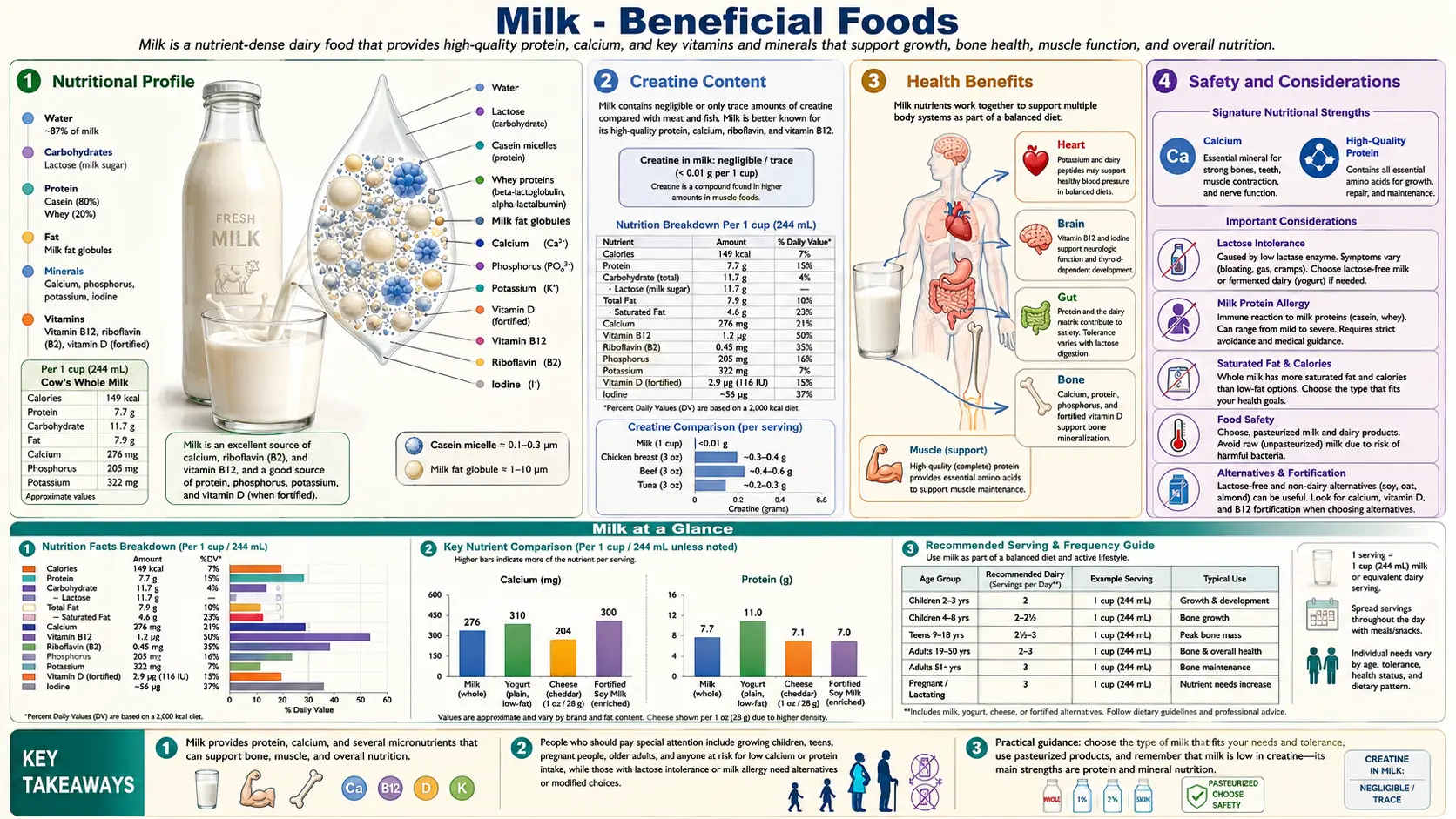
Whole cow's milk contains all three macronutrients — carbohydrate (as lactose), protein and fat — along with calcium, phosphorus, potassium, magnesium, zinc, iodine, vitamin B12, riboflavin and vitamin A; most US milk also has added vitamin D. Measured amounts are in the Nutritional Profile below, and the research on milk and health is gathered on the Milk Benefits hub.
Table of Contents
1. Nutritional Profile
USDA FoodData Central lists two records for whole milk, 3.25% milkfat, with added vitamin D: the SR Legacy record (FDC ID 171265) and a Foundation Foods record based on newer laboratory analyses (FDC ID 746782). Their values per 100 g (SR Legacy · Foundation):
- Energy: 61 kcal (SR Legacy) · 60 kcal (Foundation)
- Water: 88.13 g (SR Legacy) · 88.1 g (Foundation)
- Protein: 3.15 g (SR Legacy) · 3.27 g (Foundation)
- Total fat: 3.25 g (SR Legacy) · 3.2 g (Foundation)
- Saturated fatty acids: 1.865 g (SR Legacy) · 1.86 g (Foundation)
- Carbohydrate (by difference): 4.8 g (SR Legacy) · 4.63 g (Foundation)
- Lactose: 5.05 g (SR Legacy) · 4.81 g (Foundation)
- Calcium: 113 mg (SR Legacy) · 123 mg (Foundation)
- Phosphorus: 84 mg (SR Legacy) · 101 mg (Foundation)
- Potassium: 132 mg (SR Legacy) · 150 mg (Foundation)
- Magnesium: 10 mg (SR Legacy) · 11.9 mg (Foundation)
- Zinc: 0.37 mg (SR Legacy) · 0.42 mg (Foundation)
- Iodine: not listed (SR Legacy) · 37.9 µg (Foundation)
- Vitamin B12: 0.45 µg (SR Legacy) · 0.54 µg (Foundation)
- Riboflavin (B2): 0.169 mg (SR Legacy) · 0.138 mg (Foundation)
- Vitamin A (RAE): 46 µg (SR Legacy) · 32 µg (Foundation)
- Vitamin D (D2 + D3): 1.3 µg (SR Legacy) · 0.96 µg (Foundation)
The SR Legacy record gives the weight of one cup as 244 g. A ranking of these nutrients against Daily Values is on the Milk Nutrient Profile page.
Several components travel with the milk fat, so their amounts depend on the fat content and on what the cow ate. In US dairy foods analyzed by Fu et al. (2017), total vitamin K was 38.1 µg per 100 g in full-fat (4% fat) milk and 7.7 µg in nonfat milk, and reduced-fat or fat-free products held about 5–22% of the vitamin K of their full-fat equivalents. In a US comparison, the omega-6:omega-3 ratio was 5.77 in conventional milk, 2.28 in organic milk and 0.95 in milk from cows fed a nearly 100% forage-based diet, which also had higher total omega-3 and conjugated linoleic acid (CLA) (Benbrook et al. 2018); the details are on the Grass-Fed Milk and CLA page.
2. Protein: Whey and Casein
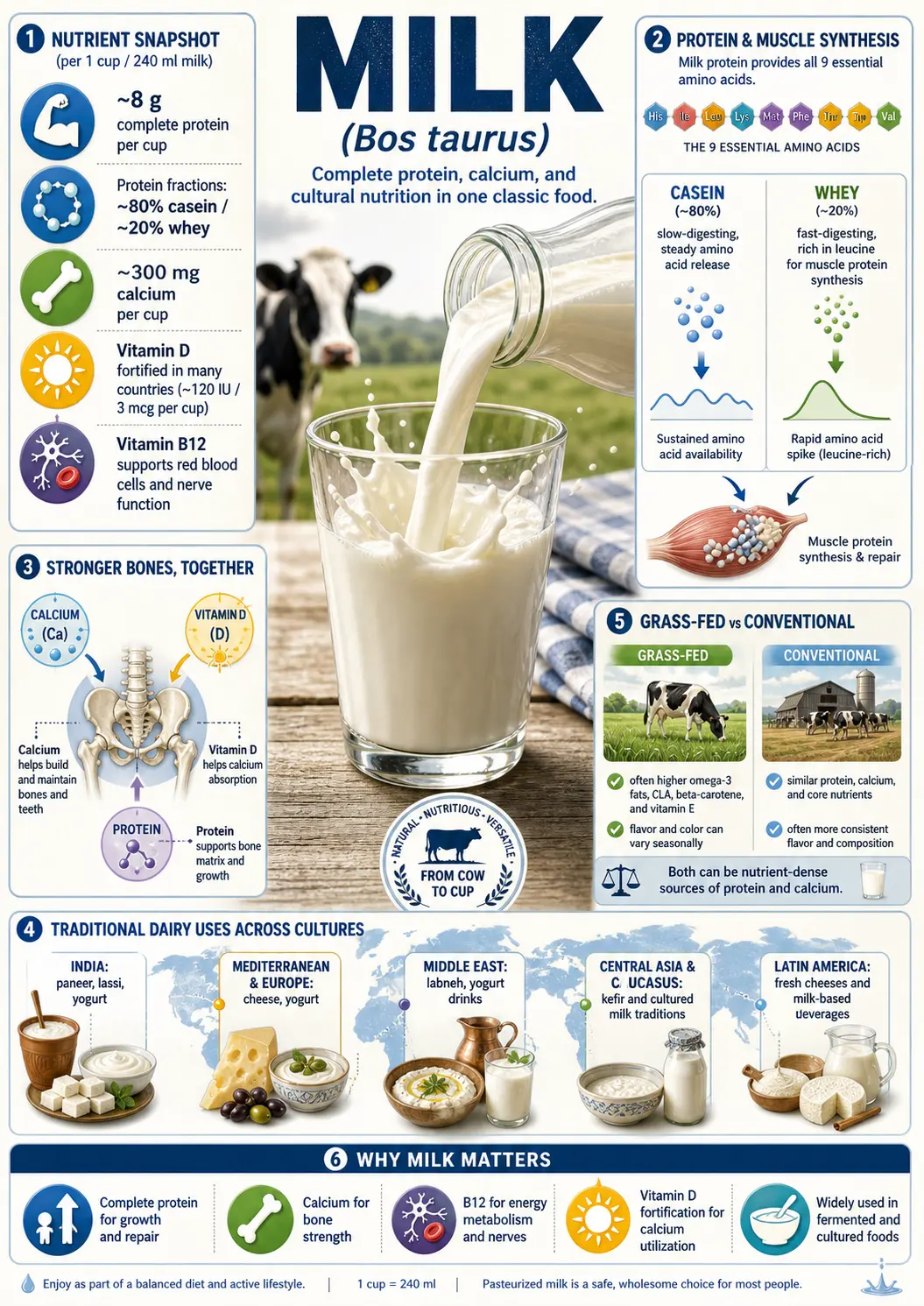
About 80% of the protein in cow's milk is casein and about 20% is whey (Pepe et al. 2013). In a tracer study in healthy adults, whey protein produced a rapid but short rise in plasma amino acids, while casein produced a prolonged, moderate rise, probably because of slower gastric emptying; whole-body protein synthesis rose 68% after the whey meal and 31% after the casein meal, whole-body protein breakdown fell 34% after casein but not after whey, and net leucine balance over 7 hours was more positive with casein (Boirie et al. 1997). In young men who drank 10 g of essential amino acids as whey hydrolysate or micellar casein after resistance exercise, muscle protein synthesis was about 122% greater with the whey hydrolysate (Tang et al. 2009). Both studies used isolated milk proteins, not milk itself.
3. Creatine Content
Milk is not a major source of creatine. In humans, over 95% of the body's creatine is in skeletal muscle, daily turnover to creatinine is estimated at about 2 g for a 70 kg man, and the food sources named in a 1994 review are especially meat and fish, with the rest made in the body from arginine, glycine and methionine (Balsom et al. 1994). Measurements of human milk and infant formulas found that a breast-fed infant receives about 9% of the creatine it needs from the diet and an infant fed cow's-milk-based formula up to 36%, with the remainder made by the infant's own body (Edison et al. 2013). Research on creatine monohydrate supplementation is covered on the Creatine page.
4. Calcium and Bone Health
Whole milk supplies 113–123 mg of calcium per 100 g in the two USDA records above, along with phosphorus and protein, and most US milk has added vitamin D. Whether drinking more milk lowers fracture risk is not settled; large cohort studies disagree:
- A 2011 meta-analysis of prospective cohort studies found no overall association between milk intake and hip fracture in women (6 studies, 195,102 women; pooled relative risk per daily glass 0.99, 95% CI 0.96–1.02). In men (3 studies) the pooled relative risk was 0.91 (0.81–1.01), and the authors concluded that more data were needed (Bischoff-Ferrari et al. 2011).
- In two Swedish cohorts — 61,433 women followed for a mean 20.1 years and 45,339 men followed for 11.2 years — higher milk intake was not associated with fewer fractures. In women, each glass of milk a day was associated with a hazard ratio of 1.09 (1.05–1.13) for hip fracture; in men the figure was 1.03 (0.99–1.07) (Michaëlsson et al. 2014).
- In the US Nurses' Health Study and Health Professionals Follow-up Study, milk drinking during the teenage years was not associated with a lower risk of hip fracture in older adults; in men, each additional glass a day as a teenager was associated with a 9% higher risk (RR 1.09, 1.01–1.17), partly explained by greater attained height (Feskanich et al. 2014).
- In the same two US cohorts, followed for up to 32 years, each daily serving of milk in adulthood was associated with an 8% lower risk of hip fracture in men and women combined; the authors noted that this contrasts with the Swedish finding in women (Feskanich et al. 2018).
All four are observational. Other food sources of calcium include some leafy green vegetables and sardines eaten with their bones; a 1999 review noted that some plants provide absorbable calcium, but in quantities that make an exclusively plant-based diet hard to rely on without fortified foods or supplements (Weaver et al. 1999).
5. Health Benefits
Rehydration. In a laboratory trial in 11 people who had lost 1.8% of body mass through exercise in the heat, urine output over the 5-hour recovery was 611 mL after low-fat milk drinks versus 1,184 mL after water and 1,205 mL after a sports drink, and subjects stayed in net positive fluid balance or euhydrated only after the milk drinks (Shirreffs et al. 2007). In a randomized trial of 13 common drinks in 72 euhydrated men, the beverage hydration index at 2 hours (water retained relative to still water) was 1.50 for full-fat milk and 1.58 for skimmed milk, close to an oral rehydration solution at 1.54 (Maughan et al. 2016).
Childhood growth. A meta-analysis of 12 controlled trials of dairy supplementation in children estimated the most likely effect at 0.4 cm of additional growth per year per roughly 245 mL of milk a day, with larger effects in children of lower height-for-age and in teenagers; the author rated the evidence as moderate quality (de Beer 2012).
Blood pressure. In the 8-week DASH feeding trial in 459 adults, a “combination” diet rich in fruits, vegetables and low-fat dairy foods, with reduced saturated and total fat, lowered systolic and diastolic blood pressure by 5.5 and 3.0 mm Hg more than a control diet, and by 11.4 and 5.5 mm Hg in participants with hypertension (Appel et al. 1997). The trial tested a whole dietary pattern, so it does not isolate the effect of milk.
Dairy fat and cardiometabolic health. A pooled analysis of 16 prospective cohorts (63,682 participants) found higher blood or tissue levels of the dairy-fat biomarkers pentadecanoic acid (15:0), heptadecanoic acid (17:0) and trans-palmitoleic acid associated with a lower incidence of type 2 diabetes — for example, a hazard ratio of 0.80 (0.73–0.87) for 15:0 and 0.65 (0.59–0.72) for 17:0 across the 10th-to-90th-percentile range (Imamura et al. 2018). A 2021 meta-analysis of 18 observational studies found higher 15:0 and 17:0 associated with lower cardiovascular disease risk and no association with all-cause mortality (Trieu et al. 2021). In three US cohorts using food questionnaires, dairy fat was not significantly associated with cardiovascular disease when compared with the same energy from carbohydrate, while modeled replacement of dairy fat with polyunsaturated or vegetable fat was associated with lower risk (Chen et al. 2016). The biomarkers cannot tell milk from cheese, yogurt or butter, and all of these studies are observational.
6. Lactose Intolerance and Alternatives
Lactose intolerance is defined as abdominal symptoms such as pain, bloating and diarrhoea after lactose in a person who malabsorbs it; the likelihood of symptoms depends on the lactose dose, lactase expression and the intestinal microbiome (Misselwitz et al. 2019). As noted above, lactase persistence is common in people of European ancestry and in some African, Middle Eastern and South Asian groups, and rare or absent elsewhere (Itan et al. 2010). A systematic review of randomized trials found moderate-quality evidence that most adults with lactose intolerance or malabsorption tolerate 12 to 15 g of lactose (about one cup of milk), and insufficient evidence that lactose-reduced milk, probiotics or colonic adaptation reduce symptoms (Shaukat et al. 2010). Approaches described in a 2019 review include a low-lactose diet and lactase supplements, with modest clinical outcomes (Misselwitz et al. 2019). In lactose-free milk the lactose has been split by an added enzyme, and fermented foods such as yogurt and hard cheeses contain less lactose than milk. Plant-based drinks sold as milk alternatives differ from cow's milk in nutrient content; a 2018 review noted that they are not a direct substitute for cow's milk in all cases (Vanga & Raghavan 2018).
More detail is on the Lactose Intolerance page. The A1 versus A2 beta-casein question, and the trials in people with self-reported milk intolerance, are covered on the A1 vs A2 Beta-Casein page.
7. Safety and Considerations
Cow's milk allergy. Cow's milk allergy is an immune reaction to milk proteins, distinct from lactose intolerance. A 2002 review put its incidence at about 2–3% in the first year of life in developed countries, described diagnosis by controlled elimination and milk challenge, and reported remission in about 85–90% of affected infants by age 3 (Høst 2002). In a US referral population of 807 children with IgE-mediated cow's milk allergy, resolution came later: 19% by age 4, 42% by age 8, 64% by age 12 and 79% by age 16 (Skripak et al. 2007).
Raw (unpasteurized) milk. The CDC states that raw milk and products made from it can expose people to germs such as Campylobacter, Cryptosporidium, E. coli, Listeria, Brucella and Salmonella, and that children under 5, adults over 65, pregnant women and people with weakened immune systems are at higher risk of serious illness from them. A CDC review of US dairy-associated outbreaks from 1993 to 2006 found that 73 of the 121 outbreaks with known pasteurization status (60%) involved nonpasteurized products, causing 1,571 cases, 202 hospitalizations and 2 deaths, and that nonpasteurized products caused about 150 times more outbreaks per unit of product consumed (Langer et al. 2012). A meta-analysis of 40 studies found that pasteurization lowered vitamins B1, B2, C and folate (and, qualitatively, B12 and E), but judged the effect on milk's nutritive value minimal because many of these vitamins occur in milk at low levels, while noting that milk is an important source of riboflavin (Macdonald et al. 2011). The evidence is set out on the Raw vs Pasteurized Milk page.
High intakes. In the Swedish cohorts described above, women who drank three or more glasses of milk a day had a mortality hazard ratio of 1.93 (1.80–2.06) compared with those drinking less than one glass; per glass a day, the hazard ratio was 1.15 in women and 1.03 in men. The authors called for cautious interpretation because of possible residual confounding and reverse causation (Michaëlsson et al. 2014).
Connections
- Fake Milk — Melamine, watering and reconstitution: how milk is faked and how laboratories catch it
- All Food
- Creatine
- Yogurt
- Kefir
- Eggs
- Calcium
- Phosphorus
- Vitamin B12
- Vitamin A
- Potassium
- Calcium and Bone Health
- Allergies
- Cardiovascular Disease
- Sardines
- Beef
- Vitamin B12 Test
- Iodine
- Banned Additives
- Carrageenan
- Conditions on this site that reference this page: Coxiella burnetii (Q Fever) · Lactose Intolerance · Calcium, Vitamin D, and Protein Intake for Bone Health
Key Research Papers
- Evershed RP, Payne S, Sherratt AG, et al. (2008). Earliest date for milk use in the Near East and southeastern Europe linked to cattle herding. Nature 455(7212):528-31 — PubMed PMID: 18690215
- Itan Y, Jones BL, Ingram CJ, et al. (2010). A worldwide correlation of lactase persistence phenotype and genotypes. BMC Evol Biol 10:36 — PubMed PMID: 20144208
- Tishkoff SA, Reed FA, Ranciaro A, et al. (2007). Convergent adaptation of human lactase persistence in Africa and Europe. Nat Genet 39(1):31-40 — PubMed PMID: 17159977
- Fu X, Harshman SG, Shen X, et al. (2017). Multiple Vitamin K Forms Exist in Dairy Foods. Curr Dev Nutr 1(6):e000638 — PubMed PMID: 29955705
- Benbrook CM, Davis DR, Heins BJ, et al. (2018). Enhancing the fatty acid profile of milk through forage-based rations, with nutrition modeling of diet outcomes. Food Sci Nutr 6(3):681-700 — PubMed PMID: 29876120
- Pepe G, Tenore GC, Mastrocinque R, et al. (2013). Potential anticarcinogenic peptides from bovine milk. J Amino Acids 2013:939804 — PubMed PMID: 23533710
- Boirie Y, Dangin M, Gachon P, et al. (1997). Slow and fast dietary proteins differently modulate postprandial protein accretion. Proc Natl Acad Sci U S A 94(26):14930-5 — PubMed PMID: 9405716
- Tang JE, Moore DR, Kujbida GW, et al. (2009). Ingestion of whey hydrolysate, casein, or soy protein isolate: effects on mixed muscle protein synthesis at rest and following resistance exercise in young men. J Appl Physiol (1985) 107(3):987-92 — PubMed PMID: 19589961
- Balsom PD, Söderlund K, Ekblom B (1994). Creatine in humans with special reference to creatine supplementation. Sports Med 18(4):268-80 — PubMed PMID: 7817065
- Edison EE, Brosnan ME, Aziz K, et al. (2013). Creatine and guanidinoacetate content of human milk and infant formulas: implications for creatine deficiency syndromes and amino acid metabolism. Br J Nutr 110(6):1075-8 — PubMed PMID: 23388580
- Bischoff-Ferrari HA, Dawson-Hughes B, Baron JA, et al. (2011). Milk intake and risk of hip fracture in men and women: a meta-analysis of prospective cohort studies. J Bone Miner Res 26(4):833-9 — PubMed PMID: 20949604
- Michaëlsson K, Wolk A, Langenskiöld S, et al. (2014). Milk intake and risk of mortality and fractures in women and men: cohort studies. BMJ 349:g6015 — PubMed PMID: 25352269
- Feskanich D, Bischoff-Ferrari HA, Frazier AL, et al. (2014). Milk consumption during teenage years and risk of hip fractures in older adults. JAMA Pediatr 168(1):54-60 — PubMed PMID: 24247817
- Feskanich D, Meyer HE, Fung TT, et al. (2018). Milk and other dairy foods and risk of hip fracture in men and women. Osteoporos Int 29(2):385-396 — PubMed PMID: 29075804
- Weaver CM, Proulx WR, Heaney R (1999). Choices for achieving adequate dietary calcium with a vegetarian diet. Am J Clin Nutr 70(3 Suppl):543S-548S — PubMed PMID: 10479229
- Shirreffs SM, Watson P, Maughan RJ (2007). Milk as an effective post-exercise rehydration drink. Br J Nutr 98(1):173-80 — PubMed PMID: 17459189
- Maughan RJ, Watson P, Cordery PA, et al. (2016). A randomized trial to assess the potential of different beverages to affect hydration status: development of a beverage hydration index. Am J Clin Nutr 103(3):717-23 — PubMed PMID: 26702122
- de Beer H (2012). Dairy products and physical stature: a systematic review and meta-analysis of controlled trials. Econ Hum Biol 10(3):299-309 — PubMed PMID: 21890437
- Appel LJ, Moore TJ, Obarzanek E, et al. (1997). A clinical trial of the effects of dietary patterns on blood pressure. DASH Collaborative Research Group. N Engl J Med 336(16):1117-24 — PubMed PMID: 9099655
- Imamura F, Fretts A, Marklund M, et al. (2018). Fatty acid biomarkers of dairy fat consumption and incidence of type 2 diabetes: A pooled analysis of prospective cohort studies. PLoS Med 15(10):e1002670 — PubMed PMID: 30303968
- Trieu K, Bhat S, Dai Z, et al. (2021). Biomarkers of dairy fat intake, incident cardiovascular disease, and all-cause mortality: A cohort study, systematic review, and meta-analysis. PLoS Med 18(9):e1003763 — PubMed PMID: 34547017
- Chen M, Li Y, Sun Q, et al. (2016). Dairy fat and risk of cardiovascular disease in 3 cohorts of US adults. Am J Clin Nutr 104(5):1209-1217 — PubMed PMID: 27557656
- Misselwitz B, Butter M, Verbeke K, et al. (2019). Update on lactose malabsorption and intolerance: pathogenesis, diagnosis and clinical management. Gut 68(11):2080-2091 — PubMed PMID: 31427404
- Shaukat A, Levitt MD, Taylor BC, et al. (2010). Systematic review: effective management strategies for lactose intolerance. Ann Intern Med 152(12):797-803 — PubMed PMID: 20404262
- Vanga SK, Raghavan V (2018). How well do plant based alternatives fare nutritionally compared to cow's milk?. J Food Sci Technol 55(1):10-20 — PubMed PMID: 29358791
- Høst A (2002). Frequency of cow's milk allergy in childhood. Ann Allergy Asthma Immunol 89(6 Suppl 1):33-7 — PubMed PMID: 12487202
- Skripak JM, Matsui EC, Mudd K, et al. (2007). The natural history of IgE-mediated cow's milk allergy. J Allergy Clin Immunol 120(5):1172-7 — PubMed PMID: 17935766
- Langer AJ, Ayers T, Grass J, et al. (2012). Nonpasteurized dairy products, disease outbreaks, and state laws-United States, 1993-2006. Emerg Infect Dis 18(3):385-91 — PubMed PMID: 22377202
- Macdonald LE, Brett J, Kelton D, et al. (2011). A systematic review and meta-analysis of the effects of pasteurization on milk vitamins, and evidence for raw milk consumption and other health-related outcomes. J Food Prot 74(11):1814-32 — PubMed PMID: 22054181
PubMed Topic Searches
- PubMed: Milk consumption and bone mineral density: meta-analysis
- PubMed: Dairy intake and cardiovascular disease risk
- PubMed: Whey protein and muscle protein synthesis
- PubMed: Casein protein and overnight muscle recovery
- PubMed: Milk and post-exercise rehydration
- PubMed: Lactose intolerance: diagnosis and management
- PubMed: A1 vs A2 beta-casein and gastrointestinal symptoms
- PubMed: Milk consumption and type 2 diabetes risk
- PubMed: Dairy and blood pressure: DASH diet evidence
- PubMed: Full-fat dairy and metabolic health
Browse all PubMed citations for “Milk”
This content is provided for informational purposes only and does not constitute medical advice. Decisions about diet belong with a qualified healthcare provider.