Food Dyes Banned in Other Countries: What Is Actually Restricted
Table of Contents
- Dye-by-Dye International Comparison
- The Southampton Study
- How the US and EU Systems Differ
- Recent Regulatory Changes
- Different Recipes in Different Markets
- Pending Actions and Proposals
- Summary Comparison
- Key Research Papers
- Connections
- Featured Videos
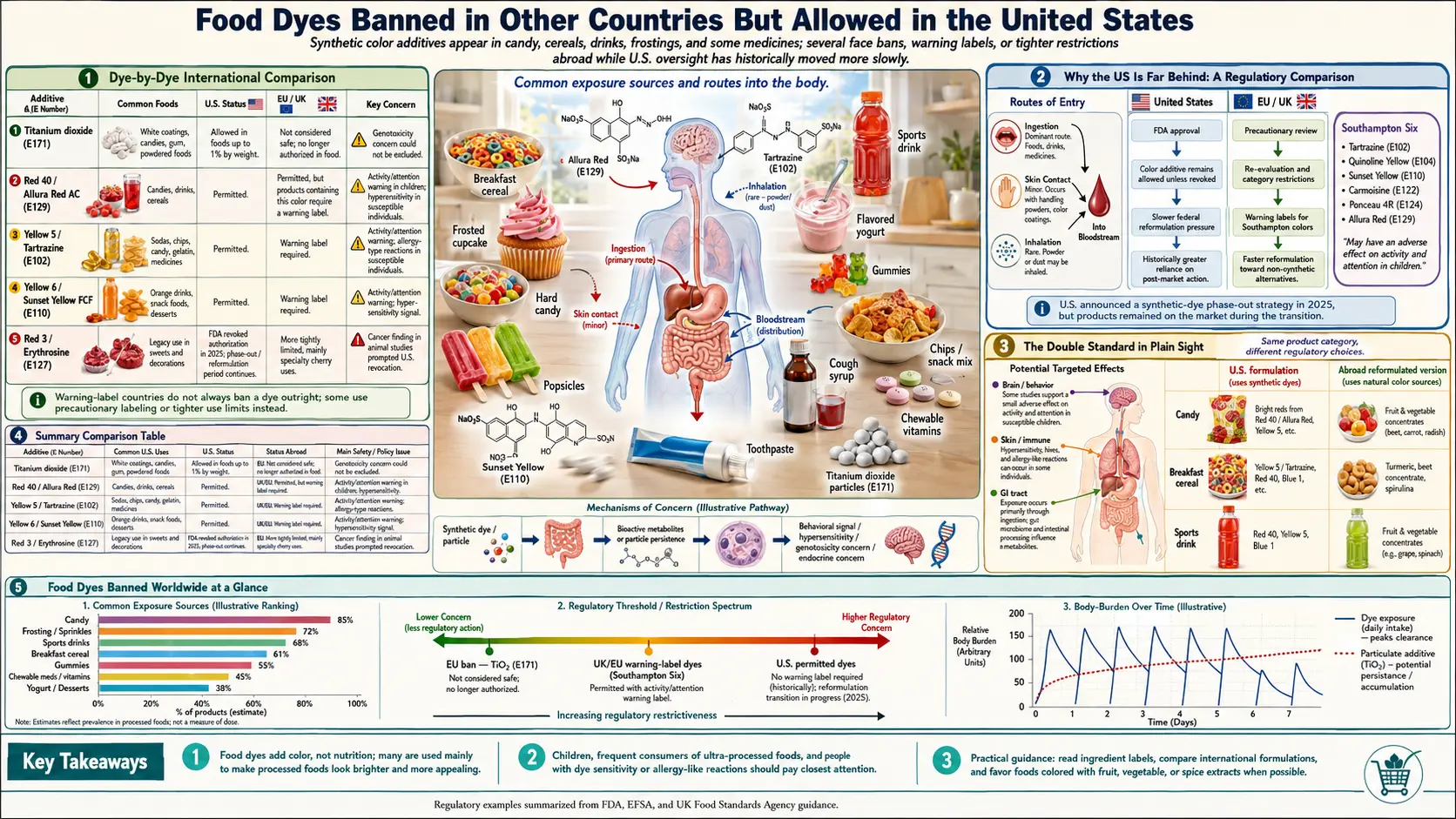
Lists of US food dyes “banned in other countries” are widely shared. Checked against each jurisdiction’s own list of permitted colours, the picture is narrower. Of the seven synthetic dyes FDA certifies for food, six are on the European Union’s list of authorised colours: Red 40, Yellow 5 and Yellow 6 must carry a warning label there, Blue 1 and Blue 2 need none, and Red 3 is limited to a few cherry products. Only Green 3 (Fast Green FCF) is not authorised in the EU or in Great Britain. Japan, Canada, and Australia and New Zealand list all seven. The clearest ban is on a white colour rather than a dye: the EU removed titanium dioxide (E171) from its list in 2022.
The differences also run the other way. Three of the six colours that carry the EU warning — quinoline yellow (E104), carmoisine (E122) and ponceau 4R (E124) — are not listed for food in the United States at all, and amaranth (E123), whose US listing as FD&C Red No. 2 FDA terminated, remains authorised in the EU for a few products and in Japan. US policy is changing too: FDA revoked Red 3 in January 2025 (effective in food on 15 January 2027), and in April 2025 HHS and FDA announced a plan to phase out the remaining petroleum-based dyes. Each entry below gives the status as of October 2026; the regulations are listed under Key Research Papers.
Dye-by-Dye International Comparison
A note on Norway, Austria and Finland, which older lists name as banning some of these dyes: Austria and Finland are EU member states, and Norway has applied the EU food-additive regulation (Regulation (EC) No 1333/2008) through the European Economic Area Agreement since 2011 (EEA Joint Committee Decision 050/2011). The EU entries below therefore apply in all three. Great Britain kept the EU rules as retained law after Brexit; Northern Ireland follows current EU rules.
Red 40 (Allura Red AC / E129)
- United States: Listed for food (21 CFR 74.340) and must be named in the ingredient list; no warning label. One of the six dyes in the April 2025 HHS/FDA phase-out plan, and still listed as permitted.
- European Union: Authorised. Since July 2010, foods containing it must state the colour’s name or E number followed by “may have an adverse effect on activity and attention in children” (Regulation (EC) No 1333/2008, Article 24 and Annex V).
- United Kingdom: Authorised with the same warning. The Food Standards Agency (FSA) states that it encourages manufacturers to work towards finding alternatives to the six colours and that some manufacturers and retailers have already removed them.
- Japan: On the list of designated food additives as Food Red No. 40.
- Australia/New Zealand: A “colouring permitted to a maximum level” under the Food Standards Code (Schedule 16). No warning label is required.
- Canada: On Health Canada’s List of Permitted Colouring Agents.
Yellow 5 (Tartrazine / E102)
- United States: Listed for food (21 CFR 74.705). Foods must declare it as “FD&C Yellow No. 5” in the ingredient list. Prescription drugs taken by mouth that contain it must carry the statement that it “may cause allergic-type reactions (including bronchial asthma) in certain susceptible persons” and that sensitivity, though low in the general population, “is frequently seen in patients who also have aspirin hypersensitivity” (21 CFR 201.20). No warning is required on food. Included in the April 2025 phase-out plan.
- European Union: Authorised, with the Annex V warning on activity and attention in children.
- United Kingdom: Authorised, with the same warning.
- Japan: Designated as Food Yellow No. 4.
- Australia/New Zealand: Colouring permitted to a maximum level (Schedule 16).
- Canada: Permitted.
Yellow 6 (Sunset Yellow FCF / E110)
- United States: Listed for food (21 CFR 74.706); over-the-counter drugs taken by mouth must declare it on the label (21 CFR 201.20). Included in the April 2025 phase-out plan.
- European Union: Authorised, with the Annex V warning.
- United Kingdom: Authorised, with the same warning.
- Japan: Designated as Food Yellow No. 5.
- Australia/New Zealand: Colouring permitted to a maximum level (Schedule 16).
- Canada: Permitted.
Red 3 (Erythrosine / E127)
- United States: On 16 January 2025 FDA revoked its authorization in food (effective 15 January 2027) and in ingested drugs (effective 18 January 2028) under the Delaney Clause, because it causes thyroid tumors in male rats; FDA stated that the rat mechanism is of limited relevance to humans and that a human cancer risk at current exposure levels is unlikely. Objections stayed the order in February 2025; FDA lifted the stay on 5 August 2026 and confirmed both dates. Its use in cosmetics and externally applied drugs ended in 1990.
- California: The California Food Safety Act (AB 418, 2023) prohibits it in food from 1 January 2027.
- European Union: Authorised only in cocktail cherries and candied cherries (up to 200 mg/kg) and in bigarreaux cherries in syrup and in cocktails (up to 150 mg/kg); it may not be sold directly to consumers (Regulation (EC) No 1333/2008, Annex II).
- United Kingdom: On the list of approved colours, under the same retained conditions.
- Japan: Designated as Food Red No. 3.
- Australia/New Zealand: Permitted only in named foods, including maraschino, cocktail or glacé cherries and icings and frostings (Schedule 15).
- Canada: Permitted in listed foods.
Blue 1 (Brilliant Blue FCF / E133)
- United States: Listed for food (21 CFR 74.101). Included in the April 2025 phase-out plan.
- European Union: Authorised, without a warning label. In its 2010 re-evaluation the European Food Safety Authority (EFSA) lowered the acceptable daily intake (ADI) from 10 to 6 mg per kg of body weight per day; refined intake estimates were below the new ADI, while a less refined estimate exceeded it for high-consuming children (EFSA 2010).
- United Kingdom: Authorised.
- Japan: Designated as Food Blue No. 1.
- Australia/New Zealand: Colouring permitted to a maximum level (Schedule 16).
- Canada: Permitted.
Blue 2 (Indigo Carmine / Indigotine / E132)
- United States: Listed for food (21 CFR 74.102). Included in the April 2025 phase-out plan.
- European Union: Authorised, without a warning label. In a 2023 follow-up EFSA confirmed an ADI of 5 mg per kg of body weight per day, recommended lower limits for toxic elements in the specification, and concluded there was no safety concern at the reported use levels (EFSA 2023).
- United Kingdom: Authorised.
- Japan: Designated as Food Blue No. 2.
- Australia/New Zealand: Colouring permitted to a maximum level (Schedule 16).
- Canada: Permitted.
Green 3 (Fast Green FCF / E143)
- United States: Listed for food (21 CFR 74.203). Included in the April 2025 phase-out plan.
- European Union: Not on the list of authorised food colours, so it may not be used in food.
- United Kingdom: Not on the FSA’s list of approved colours.
- Japan: Permitted: designated as Food Green No. 3.
- Australia/New Zealand: Colouring permitted to a maximum level (Schedule 16).
- Canada: Permitted.
Titanium Dioxide (E171)
- United States: Permitted as a color additive at up to 1% of the food’s weight (21 CFR 73.575). A color additive petition filed on 14 April 2023 asks FDA to revoke the food listing; FDA says it is reviewing that petition.
- European Union: In May 2021 EFSA concluded that a concern for genotoxicity could not be ruled out and that E171 “can no longer be considered as safe when used as a food additive.” Commission Regulation (EU) 2022/63 removed it from the list of authorised additives; it entered into force on 7 February 2022, and the six-month transition period ended on 7 August 2022.
- United Kingdom: Still authorised in Great Britain. It is not permitted in food manufactured in Northern Ireland, which follows the EU regulation.
- Japan: On the list of designated food additives.
- Australia/New Zealand: A “colouring permitted at GMP” (good manufacturing practice) under Schedule 16.
Two other US color additives, Citrus Red No. 2 (orange skins) and Orange B (sausage casings), are not on the EU list. FDA revoked Orange B effective 8 September 2026 and proposed revoking Citrus Red No. 2 in July 2026, noting that both uses appeared to have been abandoned. Health effects of the individual dyes are covered on the Red 40, Yellow 5 and Red 3 pages.
The Southampton Study: The Research That Changed European Policy
The EU warning label traces to a single trial, published in The Lancet in 2007 by McCann and colleagues at the University of Southampton: “Food additives and hyperactive behaviour in 3-year-old and 8/9-year-old children in the community: a randomised, double-blinded, placebo-controlled trial.”
- Design: A randomised, double-blinded, placebo-controlled crossover trial in 153 three-year-old and 144 eight- and nine-year-old children from the general population. Sixteen of the younger and 14 of the older children did not complete it, for reasons the authors report as unrelated to behaviour.
- What was tested: A challenge drink containing sodium benzoate plus one of two artificial-colour mixes (A or B), or a placebo drink.
- How it was measured: A single global hyperactivity aggregate combining observed behaviour with teacher and parent ratings, plus a computerised attention test for the older children.
- Findings in 3-year-olds: Mix A had a significant adverse effect compared with placebo (effect size 0.20, 95% CI 0.01–0.39); mix B did not. The mix A result held in children who drank more than 85% of the juice with no missing data (0.32).
- Findings in 8/9-year-olds: Among children who drank at least 85% of the drinks with no missing data, both mix A (0.12) and mix B (0.17) had significant adverse effects.
- What it can and cannot show: The authors concluded that “artificial colours or a sodium benzoate preservative (or both)” increase hyperactivity in children in the general population. Because every active drink contained sodium benzoate, the trial cannot attribute the effect to any single colour.
- EU response: Regulation (EC) No 1333/2008 added the Annex V warning for six colours — sunset yellow (E110), quinoline yellow (E104), carmoisine (E122), allura red (E129), tartrazine (E102) and ponceau 4R (E124) — applying from July 2010.
- UK response: The same warning applies, and the FSA encourages manufacturers to find alternatives to the six colours.
- Australia/New Zealand: Food Standards Australia New Zealand (FSANZ) reviewed the study and states that it “did not find evidence that would result in a lowering of safety limits for these colours”; no warning label was introduced.
- United States: After a 2011 Food Advisory Committee review, FDA concluded that a causal relationship between certified color additives and hyperactivity in the general population of children had not been established, and no warning label is required.
A 2012 meta-analysis found that restriction diets reduced ADHD symptoms (effect size g = 0.29) and that food colors had a small effect in parent reports (g = 0.18, falling to 0.12 after adjustment for publication bias); the effect was not reliable in studies confined to FDA-approved colors. The authors estimated that 8% of children with ADHD may have symptoms related to synthetic food colors (Nigg 2012).
How the US and EU Systems Differ
The Precautionary Principle and the US Standard
EU general food law (Regulation (EC) No 178/2002, Article 7) allows provisional risk-management measures when the possibility of harmful effects on health has been identified but scientific uncertainty persists. An additive may be used only once it is on the EU list of authorised additives, and EFSA re-evaluates older additives as new evidence emerges; the withdrawal of titanium dioxide in 2022 followed such a re-evaluation. In the United States, every color additive must be listed by FDA regulation before use, and each batch of a certified dye must be certified by FDA (for example 21 CFR 74.705(e)). Removing an approved color requires a formal rule or order and can take years. The Delaney Clause bars a color additive found to induce cancer in animals, which was the legal basis for revoking Red 3.
Where GRAS Fits
Critics of US food-chemical oversight often point to the “generally recognized as safe” (GRAS) pathway, under which some food substances can be used without FDA pre-market review. That pathway does not apply to the certified dyes on this page: each is listed by regulation in 21 CFR Part 74. The GRAS debate is covered on the Banned Additives page.
The Same Data, Weighed Differently
Regulators reviewing the same evidence have reached different conclusions. The EU added a warning label after the Southampton trial; FSANZ and FDA reviewed the same trial and did not. The EU withdrew titanium dioxide on EFSA’s 2021 opinion; Great Britain kept it on its list. FDA revoked Red 3 under a legal rule that does not weigh the size of the human risk, while stating that a human cancer risk at current exposure levels is unlikely.
Recent Regulatory Changes
- EU warning labels (2010): The Annex V warning on six colours has applied since July 2010.
- EFSA re-evaluations (2009 onward): EFSA has re-evaluated the authorised colours, including Brilliant Blue FCF (2010, ADI lowered) and indigo carmine (follow-up 2023, ADI confirmed).
- EU titanium dioxide withdrawal (2022): E171 removed from the list of authorised food additives; Great Britain did not follow.
- California Food Safety Act (2023): Prohibits food containing Red No. 3, brominated vegetable oil, potassium bromate or propylparaben from 1 January 2027.
- FDA revokes Red 3 (2025): Effective 15 January 2027 in food and 18 January 2028 in ingested drugs; the stay was lifted on 5 August 2026.
- HHS/FDA phase-out plan (April 2025): A national standard and timeline, work with industry to eliminate the six remaining synthetic dyes (Blue 1 and 2, Green 3, Red 40, Yellow 5 and 6) by the end of 2026, and revocation of Citrus Red No. 2 and Orange B. The plan relies largely on industry action; FDA’s chemical-review list shows the six dyes under a “risk management action,” and they remain listed as permitted.
- Orange B and Citrus Red No. 2 (2026): Orange B revoked effective 8 September 2026; revocation of Citrus Red No. 2 proposed in July 2026.
Different Recipes in Different Markets
Side-by-side comparisons of named products’ US and European ingredient lists circulate widely. They are not reproduced here: recipes change, vary from country to country, and are a statement about one manufacturer rather than about the rules. Two points are documented. The FSA notes that some manufacturers and retailers have removed the six warning-label colours, and FDA’s 2024 rule revoking brominated vegetable oil noted that some drinks had been reformulated to be sold in markets that did not allow it. Because Red 40, Yellow 5 and Yellow 6 are authorised in the EU, a European recipe without them reflects a manufacturer’s choice rather than a legal ban.
Pending Actions and Proposals
- Red 3: FDA’s revocation takes effect in food on 15 January 2027 and in ingested drugs on 18 January 2028.
- The six remaining certified dyes: Under the April 2025 plan, HHS and FDA aim for industry to eliminate them by the end of 2026; they remain listed as permitted color additives.
- Citrus Red No. 2: Revocation proposed in July 2026.
- Titanium dioxide: A 2023 petition asking FDA to revoke its food listing is under review.
- Warning labels: None is required in the US; after the 2011 Food Advisory Committee review, FDA concluded that a causal relationship had not been established.
- State law: California’s AB 418 takes effect on 1 January 2027.
Summary Comparison Table
- Red 40: US listed (in the 2025 phase-out plan); EU and UK authorised with warning label; Japan, Australia/New Zealand and Canada permitted
- Yellow 5: US listed, named on food labels, drug warning statement; EU and UK warning label; Japan, Australia/New Zealand and Canada permitted
- Yellow 6: US listed; EU and UK warning label; Japan, Australia/New Zealand and Canada permitted
- Red 3: US revoked (food 15 January 2027, ingested drugs 18 January 2028); EU and UK limited to a few cherry products; Australia/New Zealand limited to named foods; Japan and Canada permitted
- Blue 1: Permitted in all six jurisdictions; no warning label anywhere
- Blue 2: Permitted in all six jurisdictions; no warning label anywhere
- Green 3: Not authorised in the EU or UK; permitted in the US, Japan, Australia/New Zealand and Canada
- Titanium dioxide: Withdrawn in the EU and Northern Ireland (2022); permitted in the US, Great Britain, Japan and Australia/New Zealand
“Banned worldwide” does not describe these dyes. One of the seven US food dyes, Green 3, is not authorised in the EU and UK; three carry a warning label there; one, titanium dioxide, which is not a certified dye, has been withdrawn in the EU. Japan, Canada, and Australia and New Zealand permit all seven. Decisions about individual health conditions belong with a clinician.
Key Research Papers
- McCann D, Barrett A, Cooper A, et al. (2007). Food additives and hyperactive behaviour in 3-year-old and 8/9-year-old children in the community: a randomised, double-blinded, placebo-controlled trial. The Lancet 370(9598):1560-1567 — PubMed PMID: 17825405
- Nigg JT, Lewis K, Edinger T, Falk M (2012). Meta-analysis of attention-deficit/hyperactivity disorder or attention-deficit/hyperactivity disorder symptoms, restriction diet, and synthetic food color additives. Journal of the American Academy of Child and Adolescent Psychiatry 51(1):86-97 — PubMed PMID: 22176942
- EFSA Panel on Food Additives and Nutrient Sources added to Food (ANS) (2010). Scientific Opinion on the re-evaluation of Brilliant Blue FCF (E 133) as a food additive. EFSA Journal 8(11):1853 — PubMed PMID: 42079524
- EFSA Panel on Food Additives and Flavourings (FAF), Younes M, Aquilina G, Degen G, et al. (2023). Follow-up of the re-evaluation of indigo carmine (E 132) as a food additive. EFSA Journal 21(7):e08103 — PubMed PMID: 37502014
- EFSA Panel on Food Additives and Flavourings (FAF), Younes M, Aquilina G, Castle L, et al. (2021). Safety assessment of titanium dioxide (E171) as a food additive. EFSA Journal 19(5):e06585 — PubMed PMID: 33976718
Regulatory Documents
- Regulation (EC) No 1333/2008 on food additives, Article 24 and Annex V (labelling of six food colours) — EUR-Lex
- Regulation (EC) No 1333/2008, Annex II, consolidated text of 23 December 2020 (conditions of use for E 127; the list of authorised colours) — legislation.gov.uk (PDF)
- Commission Regulation (EU) 2022/63 of 14 January 2022 as regards the food additive titanium dioxide (E 171) — EUR-Lex
- Regulation (EC) No 178/2002 (General Food Law), Article 7: precautionary principle — EUR-Lex
- EEA Joint Committee Decision No 050/2011 of 20 May 2011, incorporating Regulation (EC) No 1333/2008 into the EEA Agreement — EFTA EEA-Lex
- Food Standards Agency. Approved additives and E numbers (Great Britain; note on titanium dioxide in Northern Ireland) — GOV.UK
- Food Standards Agency. Food additives (the six colours and the warning label) — GOV.UK
- Australia New Zealand Food Standards Code, Schedule 16: Types of substances that may be used as food additives (S16—3, colourings) — Federal Register of Legislation
- Australia New Zealand Food Standards Code, Schedule 15: Substances that may be used as food additives — Federal Register of Legislation
- Food Standards Australia New Zealand. Food colours — FSANZ
- Health Canada. List of Permitted Colouring Agents (modified 20 October 2025) — Government of Canada
- Japan, List of Designated Additives (1 March 2024; English version) — Japan Food Chemical Research Foundation
- 21 CFR Part 74, Subpart A: color additives subject to certification, foods — eCFR via LII
- 21 CFR 201.20: Declaration of presence of FD&C Yellow No. 5 and/or FD&C Yellow No. 6 in certain drugs for human use — eCFR via LII
- 21 CFR 81.10: Termination of provisional listings of color additives (FD&C Red No. 2) — eCFR via LII
- FDA (2025). Color Additive Petition From Center for Science in the Public Interest, et al.; Request To Revoke Color Additive Listing for Use of FD&C Red No. 3 in Food and Ingested Drugs. Order, 90 FR 4628, 16 January 2025 — Federal Register
- FDA (2026). Response to objections and lifting of the stay on the FD&C Red No. 3 order. 91 FR 50475, 5 August 2026 — Federal Register
- FDA (2026). Revocation of the Color Additive Listing for Use of Orange B on Casings or Surfaces of Frankfurters and Sausages. 91 FR 46276, 23 July 2026 — Federal Register
- FDA (2026). Proposal To Revoke the Color Additive Listing for Use of Citrus Red No. 2 on the Skins of Mature Oranges. 91 FR 46330, 23 July 2026 — Federal Register
- HHS/FDA (22 April 2025). HHS, FDA to Phase Out Petroleum-Based Synthetic Dyes in Nation's Food Supply — FDA press announcement
- FDA. List of Select Chemicals in the Food Supply Under FDA Review (updated 2 October 2026) — FDA
- FDA (2024). Revocation of Authorization for Use of Brominated Vegetable Oil in Food. Final rule, 89 FR 55040, 3 July 2024 — Federal Register
- California Assembly Bill 418 (2023), the California Food Safety Act, Chapter 328, Statutes of 2023 — California Legislative Information
PubMed Topic Searches
- PubMed: Food dye regulation — EU vs. US comparisons
- PubMed: Southampton food-additive hyperactivity trials
- PubMed: Titanium dioxide (E171) food-additive genotoxicity
- PubMed: Tartrazine (Yellow 5) adverse reactions
- PubMed: Erythrosine (Red 3) and thyroid outcomes
- PubMed: Sunset Yellow FCF (Yellow 6) toxicity
- PubMed: Brilliant Blue FCF (Blue 1) safety
- PubMed: Azo-dye benzidine contamination
- PubMed: Food additives, children, and ADHD (meta-analyses)
- PubMed: Precautionary principle in food safety
- PubMed: GRAS food-additive pathway critiques
- PubMed: Allura Red (Red 40) and colitis