rBGH/rBST: Recombinant Bovine Growth Hormone in US Dairy
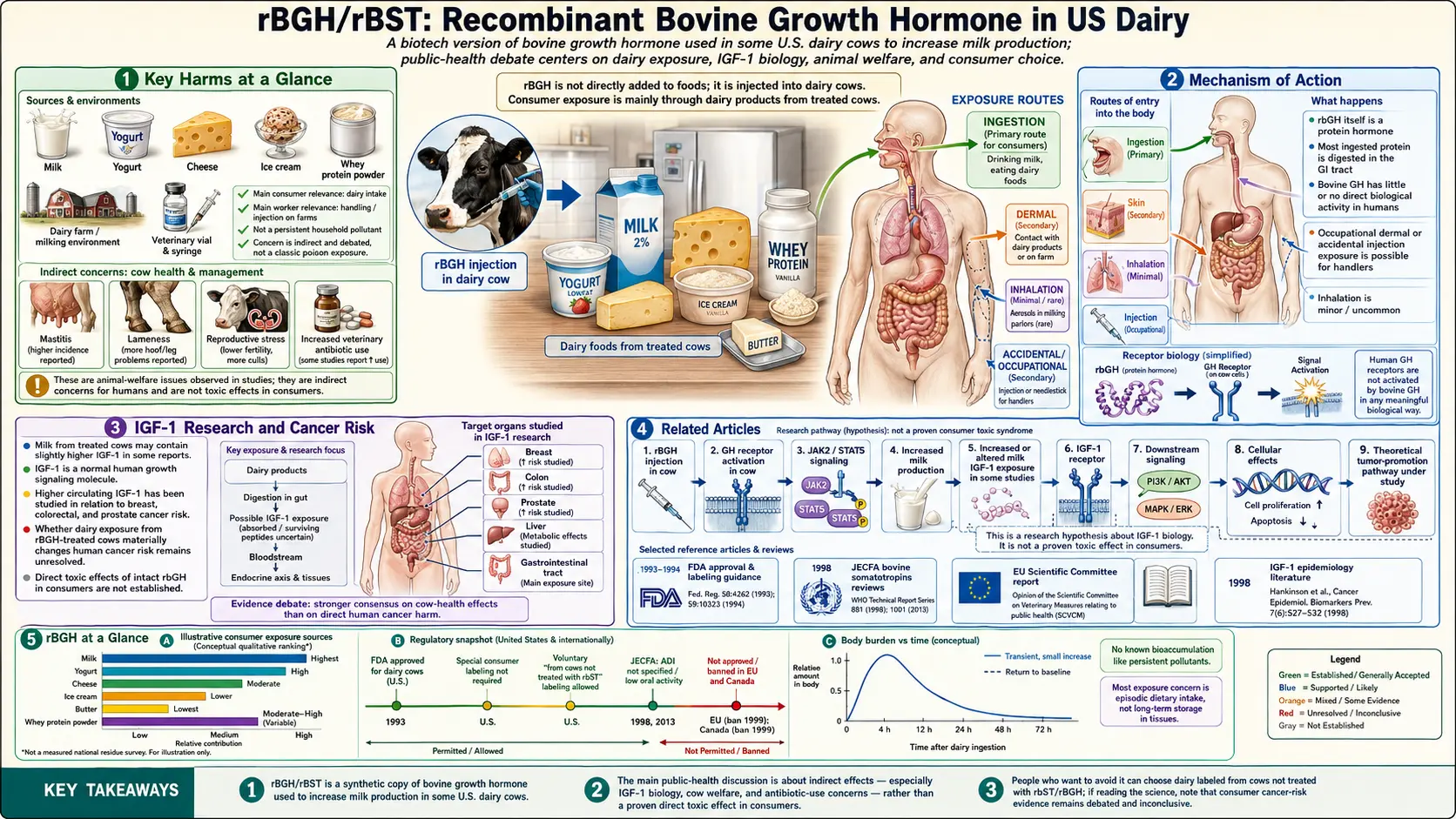
Recombinant bovine growth hormone (rBGH), also known as recombinant bovine somatotropin (rBST or rbST), is a genetically engineered version of the growth hormone made by the pituitary gland of cattle. It is injected into dairy cows every 14 days to raise milk yield; a meta-analysis by an expert panel of the Canadian Veterinary Medical Association found increases of 11.3% in first-lactation cows and 15.6% in older cows. Treatment also raises insulin-like growth factor 1 (IGF-1) in the cow's blood and milk. The US Food and Drug Administration approved it in November 1993, and its safety has been disputed ever since. A 1999 Council Decision (1999/879/EC) prohibits placing it on the market and administering it to dairy cows in the European Union, and Health Canada announced in January 1999 that it would not approve its sale in Canada.
Table of Contents
Key Points at a Glance
- Higher IGF-1 in milk — rbST treatment raises IGF-1 in milk; separately, a 2004 meta-analysis linked higher circulating IGF-1 in people with modestly higher risk of prostate cancer and premenopausal breast cancer. Whether milk from treated cows changes blood IGF-1 levels was not addressed by that analysis, and FDA scientists concluded that biologically significant amounts would not be absorbed.
- Prohibited in the EU, not approved in Canada — the EU has prohibited its sale and use in dairy cows since 1 January 2000; Health Canada announced in January 1999 that it would not approve it for sale. Both decisions rested on the health of the cows.
- Mastitis in cows — the Canadian panel's meta-analysis found about a 25% higher risk of clinical mastitis during treatment; mastitis is usually treated with antibiotics.
- Lameness and fertility — the same meta-analysis found about a 55% higher risk of lameness and about a 40% higher risk of a cow failing to conceive.
- Dispute inside Health Canada — at October 1998 Senate committee hearings, members of Health Canada's internal review team described pressure, coercion, theft of documents and a "rule of silence" with respect to rbST.
- Labeling — FDA's 1994 guidance allows voluntary statements such as 'from cows not treated with rbST' and suggests a context statement; in 2010 a federal appeals court struck down an Ohio rule's ban on claims such as "rbST free".
- Declining use — several large food companies and retailers announced between 2008 and 2009 that they would stop using milk from treated cows.
1. Overview
Bovine somatotropin (BST) is a protein hormone naturally produced by the anterior pituitary gland of cattle. It helps regulate metabolism, growth and milk production. Recombinant bovine somatotropin is made by recombinant DNA technology and formulated for injection.
- Product — the FDA-approved product, sometribove zinc suspension, is a recombinant methionyl form of bovine somatotropin. It was marketed by the agricultural biotechnology company that developed it until 2008, when it was sold to a pharmaceutical company's animal-health division.
- FDA approval — November 5, 1993, for use in lactating dairy cows to increase milk production. The product became commercially available in February 1994.
- Administration — injected under the skin; the EU animal-welfare committee noted that one manufacturer recommends an injection once every 14 days.
- Production increase — the Canadian panel's meta-analysis of randomized trials found milk production rose 11.3% in first-lactation cows and 15.6% in older cows, with considerable variation between studies; the EU animal-welfare committee put the increase at about 10%.
- Structure — the EU animal-welfare committee described commercially produced BST as very similar in structure to naturally occurring BST.
- Approved for cattle only — rbST is approved only for use in dairy cows. FDA scientists reported that bovine growth hormone is not biologically active in humans; the human-health debate centres on the extra IGF-1 in milk.
2. Regulatory History
United States: FDA Approval
The FDA's 1993 approval of rbST was contested by consumer groups and some scientists. Critics alleged industry influence over the review and the sidelining of dissenting reviewers; FDA scientists published their human food safety evaluation in 1990 and concluded that milk from treated cows presents no increased health risk to consumers.
- Before approval — the manufacturer conducted the trials and submitted a New Animal Drug Application. FDA scientists concluded in 1990 that bovine growth hormone is not biologically active in humans, that treatment raises IGF-1 in milk but within the range found in human breast milk, and that biologically significant amounts of intact IGF-1 would not be absorbed.
- GAO report (1992) — the US General Accounting Office report "Recombinant Bovine Growth Hormone: FDA Approval Should Be Withheld Until the Mastitis Issue Is Resolved" (PEMD-92-26, August 1992) argued that the indirect effects of more mastitis — more antibiotic treatment and possible residues in milk and meat — should be examined before approval.
- FDA's conclusion on mastitis — FDA concluded that the drug increased the risk of clinical mastitis and may increase milk somatic cell count, and that approved labeling communicates these risks. It judged that the increase (about 0.1 case per cow per year) was not a public health concern for antibiotic residues; its Veterinary Medicine Advisory Committee reviewed these findings at a public hearing on March 31, 1993.
- Conflict-of-interest allegations — critics alleged that FDA officials involved in the review or in the later labeling policy had worked for or with the manufacturer before or after their FDA service.
Status Outside the United States
- European Union — Council Decision 90/218/EEC of 25 April 1990 barred marketing and use of BST in dairy cows; Decision 94/936/EC extended this to 31 December 1999. In March 1999 two EU scientific committees reported: the Scientific Committee on Animal Health and Animal Welfare (SCAHAW, adopted 10 March 1999) on the cows, and the Scientific Committee on Veterinary Measures relating to Public Health (SCVMPH, 15–16 March 1999) on consumers. Council Decision 1999/879/EC, citing the animal-welfare report, prohibits placing BST on the market and administering it to dairy cows from 1 January 2000. The Decision does not prohibit producing BST in the EU, or importing it, for export to other countries.
- Canada — on 14 January 1999 Health Canada announced that it would not approve the sale of rbST in Canada. According to a Library of Parliament background paper, the decision rested on the Canadian Veterinary Medical Association expert panel's finding that rbST harmed the health of treated cows; a separate Royal College of Physicians and Surgeons of Canada panel concluded that consumption of products from treated animals does not present significant risks to human health. The same paper notes that Canada does not ban dairy products imported from countries where rbST is used.
- Australia — the 1999 Library of Parliament paper reports that, after a 12-month study, Australia decided in September 1992 not to approve rbST "for purely commercial reasons", since most Australian dairy exports went to countries that had not approved it.
- Other countries — the same 1999 paper listed South Africa, Brazil, Colombia, Korea, Costa Rica, Egypt, the United Arab Emirates, Honduras, Israel, Jamaica, Kenya, Mexico, Namibia, Peru, Russia, Slovakia, Turkey and Zimbabwe as having authorized rbST. Statements that New Zealand, Japan or Israel ban rbST, or bar imports of dairy products from treated cows, are widely repeated, but no government source confirming them was found.
- Codex Alimentarius — the Joint FAO/WHO Expert Committee on Food Additives (JECFA) concluded in 1998 that milk and meat from treated cows did not pose a danger to human health. At its June 1999 meeting the Codex Alimentarius Commission could not reach agreement on a Maximum Residue Limit for rbST and postponed setting one until a consensus could be reached.
3. Mechanism of Action
rbST works through a chain of hormonal changes in the cow, and the human-health question turns on one link in that chain: IGF-1.
- Effect on lactation — the EU animal-welfare committee concluded that BST's main effect is to change how the cow uses and mobilises nutrients in non-mammary tissues, sparing nutrients for milk synthesis, through effects on liver and fat tissue. It also raises cardiac output, heart rate and blood flow to the udder.
- Induction of IGF-1 — rbST raises circulating IGF-1 in the cow, and the same committee concluded that IGF-1 seems to be largely responsible for the effects on the udder. In six cows given recombinant growth hormone for 7 days, milk IGF-1 rose from 0.44 to 1.6 nmol/l and plasma IGF-1 from 15.5 to 56.9 nmol/l (Prosser 1989).
- How much IGF-1 in milk — estimates differ. The EU public-health committee (SCVMPH) concluded that rbST increases the IGF-1 excreted in milk by 25–70% in individual animals and that the data for exposure assessment were incomplete; the EU animal-welfare committee put the rise at approximately five-fold. FDA scientists concluded the levels stay within the range found in human breast milk, and a 2014 review by animal scientists concluded that treatment does not raise milk IGF-1 outside the range seen with farm, parity or stage of lactation. In 100 untreated bulk-tank samples, milk IGF-1 averaged 4.32 ng/ml (range 1.27–8.10 ng/ml).
- Pasteurization — in the bulk-tank study, IGF-1 concentration was not altered by pasteurization at 79°C for 45 seconds, but IGF-1 was undetectable in milk heated to 121°C for 5 minutes and in commercial infant formula (Collier 1991). Epstein argued in 1996 that pasteurization further increases IGF-1 in milk from treated cows.
- Digestion — in rats, IGF-1 placed in the gut was degraded within minutes in the duodenum and ileum; casein (a milk protein) helped preserve it (Xian 1995). In another rat study, about 9.3% of an oral dose of recombinant human IGF-1 reached the circulation, rising to 67.0% when given with casein (Kimura 1997). These are animal studies with purified IGF-1. FDA scientists reported that bovine IGF-1 lacks oral activity in rats, and the 2014 review concluded that oral IGF-1 has little or no biological activity in humans and that the IGF-1 already present in human digestive fluids far exceeds the amount consumed in milk.
- Same molecule as human IGF-1 — the amino-acid sequence of bovine IGF-1 is identical to that of human IGF-1, and the two were equipotent in receptor-binding assays (Honegger 1986).
- Cell proliferation — IGF-1 is a mitogen and anti-apoptotic peptide: it promotes cell division and inhibits programmed cell death, which is why its levels have been studied in relation to cancer.
4. Health Effects
IGF-1 and Cancer Risk
These studies measured IGF-1 in people's blood; none tested milk from treated cows.
- Breast cancer (Hankinson 1998) — in a case-control study nested in the Nurses' Health Study (397 cases, 620 controls), there was no association between IGF-1 and breast cancer overall or after menopause. Among premenopausal women, the top versus bottom third of IGF-1 had a relative risk of 2.33; among premenopausal women under 50 at blood collection it was 4.58, and 7.28 after further adjustment for IGFBP-3. The authors called for larger studies to give more precise estimates.
- Prostate cancer (Chan 1998) — in a nested case-control study within the Physicians' Health Study (152 cases, 152 controls), men in the highest quartile of plasma IGF-1 had a relative risk of 4.3 compared with the lowest quartile, independent of baseline prostate-specific antigen (PSA) levels.
- Colorectal cancer (Ma 1999) — in the same cohort (193 cases, 318 controls), men in the highest fifth of IGF-1 had a relative risk of 2.51 compared with the lowest fifth, after adjustment for IGFBP-3 and other factors.
- Meta-analysis (Renehan 2004) — pooling 21 studies (3,609 cases), the statistically significant associations reported for high IGF-1 were with prostate cancer and premenopausal breast cancer; the authors described the associations as modest and varying between cancer sites.
- Other cancers — a 1999 review noted that many types of tumour cells express or overexpress IGF-1 receptors, and that epidemiologic data at the time also pointed to colorectal and possibly lung cancer.
Mastitis, Antibiotics and Residues
- Mastitis — the Canadian panel's meta-analysis found that rbST increased the risk of clinical mastitis by approximately 25% during treatment; the EU animal-welfare committee listed estimates from meta-analyses and large studies of 15–45%, 23%, 25%, 42% and 79%, and found that mastitis treatment lasted longer in treated cows. FDA reported the increase as about 0.1 case per cow per year.
- Somatic cell count — somatic cells in milk are mainly white blood cells, and their count rises with udder infection. FDA concluded that the drug may increase milk somatic cell count, and its approved labeling communicates this.
- Antibiotic residues and resistance — the EU public-health committee listed as a secondary risk that more antibiotic treatment of mastitis might raise the risk of residues in milk and the selection of resistant bacteria. FDA reported that post-approval milk monitoring (1992–93 versus 1994–95) found no product-related increase in violative residues, and a 2014 review concluded there is no evidence that rbST use has increased human exposure to antibiotic residues in milk.
5. Animal Welfare Findings
The health of the cows was the stated basis of both the Canadian and the EU decisions.
- Mastitis — about 25% higher risk of clinical mastitis during treatment (Canadian panel meta-analysis). The EU animal-welfare committee noted that clinical mastitis is often a painful disease.
- Lameness — treated cows had an estimated 55% higher risk of clinical lameness (Canadian panel). The EU committee reported that in the largest study the number of older cows with foot disorders was 2.2 times higher.
- Reproduction — about a 40% higher risk of a cow failing to conceive; cows that did conceive had only a small increase (5 days) in days open (Canadian panel). The EU committee also reported a substantial increase in multiple births.
- Injection-site reactions — the EU committee reported reactions in most injected cows, severe in at least 4%.
- Culling — few studies reported culling, but those that did suggested a higher risk in older cows (Canadian panel); the EU committee cited a higher culling rate in older treated cows in the US post-approval monitoring study.
- A finding in the other direction — use in one lactation appeared to reduce the risk of metabolic disease, particularly ketosis, early in the next lactation (Canadian panel).
- Canada's decision — Health Canada's January 1999 decision rested on the veterinary panel's finding of harm to the health of treated cows; the separate human-safety panel did not find significant risks to human health.
- EU animal-welfare report — the SCAHAW report (adopted 10 March 1999) concluded that "BST administration causes substantially and very significantly poorer welfare because of increased foot disorders, mastitis, reproductive disorders and other production related diseases", and gave its opinion that, from the point of view of animal welfare, BST should not be used in dairy cows.
6. IGF-1 Research and Cancer Risk
Research on IGF-1 and cancer has continued since the late-1990s cohort studies. Two separate questions are often blurred: whether higher blood IGF-1 is linked with cancer, and whether milk from treated cows raises blood IGF-1 in people who drink it.
- IGF-1 receptor signaling — when IGF-1 binds its receptor (IGF1R), it activates the PI3K/AKT and RAS/MAPK pathways, which promote cell survival and growth and are frequently altered in cancer.
- Samuel Epstein's position — Samuel Epstein, of the University of Illinois School of Public Health in Chicago, was an early critic of rbST. In articles in the International Journal of Health Services (1990, 1996) and in a 2006 book, he argued that IGF-1 is substantially elevated and more bioactive in milk from treated cows, that it is absorbed from the gut, that it is a potential risk factor for breast and gastrointestinal cancers, and that the FDA had abdicated its regulatory responsibility.
- Dairy intake and blood IGF-1 — separately from the rbST question, a 2009 systematic review of 15 cross-sectional studies and 8 randomized trials found higher circulating IGF-1 in milk-intervention groups (weighted mean difference 13.8 ng/ml) and concluded that milk consumption may increase circulating IGF-1. A 1997 review by Outwater and colleagues discussed hormones and growth factors in dairy products as a possible factor in breast cancer.
- Meta-analysis — the 2004 Renehan meta-analysis of 21 studies reported modest associations between higher circulating IGF-1 and prostate and premenopausal breast cancer. Whether milk from treated cows changes blood IGF-1 levels was not addressed by that analysis.
- What the EU public-health committee concluded — SCVMPH noted that the epidemiological studies linking IGF-1 with breast and prostate cancer "refer to a time interval in which exposure to dairy products originated exclusively from non-rBST treated animals", and that whether rbST use modifies the level of risk "remains to be substantiated". It concluded that the possible contribution of lifelong exposure to IGF-1 in milk from treated cows to gut pathophysiology, particularly in infants, and to gut-associated cancers needed to be evaluated.
- Other reviews — Canada's human-safety panel, JECFA (1998) and FDA concluded that milk from treated cows does not pose a significant human health risk; a 2014 review by animal scientists reached the same conclusion.
7. Labeling Controversy
Alongside the regulatory decisions abroad, a long dispute ran in the United States over whether dairy companies could tell consumers that their milk came from untreated cows. The manufacturer argued that such labels mislead consumers into thinking that milk from untreated cows is superior, and in 2007 it asked for regulatory action against what it called deceptive milk labeling and advertising.
- FDA guidance — FDA's February 1994 interim guidance on voluntary labeling allows statements such as "from cows not treated with rbST" and suggests putting them in context, for example with the statement that no significant difference has been shown between milk from treated and untreated cows. It treated "BST-free" as false, because natural BST is present in all milk.
- Pennsylvania (2007–2008) — the Pennsylvania Department of Agriculture issued milk-labeling standards dated October 22, 2007 that would have barred references to rbST on milk labels, reported as due to take effect on January 1, 2008. After public objections, Governor Ed Rendell intervened and ordered a review. On January 17, 2008 the department issued revised standards that rescinded the October 2007 ones: a label may state that milk comes from cows not treated with rbST if it carries the statement "No significant difference has been shown between milk derived from rBST-treated and non-rBST-treated cows", and it may not state or imply a difference in composition.
- Ohio (2008–2010) — after Governor Ted Strickland's February 2008 executive order, the Ohio Department of Agriculture adopted a rule that banned claims about the absence of artificial hormones in milk ("composition claims" such as "rbST free") and required a disclaimer alongside production claims. Two trade groups, the International Dairy Foods Association and the Organic Trade Association, sued. On September 30, 2010 the US Court of Appeals for the Sixth Circuit (International Dairy Foods Association v. Boggs) struck down the ban on composition claims and the rule's ban on using an asterisk for the required disclosure, and affirmed the rest of the lower court's judgment. The court found that the record showed a compositional difference between milk from treated and untreated cows, citing evidence of elevated IGF-1 and higher somatic cell counts.
- Label wording today — the form "from cows not treated with rbST", paired with the context statement FDA's guidance suggests, is the form both the 1994 FDA guidance and the 2008 Pennsylvania standards describe.
8. Market Trends
rbST remains FDA-approved and has not been banned in the United States; its use has been shaped by consumer demand and company sourcing decisions.
- Company announcements — as reported in 2009, the largest US retailer said in 2008 that its store-brand milk no longer came from treated cows, and two large yogurt makers announced in 2009 that they would phase rbST out. One of the yogurt makers said that the safety of milk from treated cows was not the issue, but that consumers preferred milk from untreated cows. The company that then owned the product said rbST had been used safely for 15 years.
- Extent of use — according to FDA, USDA dairy surveys found rbST use on about 15% of US dairy operations and about 20% of cows at the time of the 2002 and 2007 surveys.
- Organic standards — USDA organic rules prohibit giving organic livestock hormones for growth promotion or production, such as rbST.
- Change of ownership — in 2008 the developer sold the product to a pharmaceutical company's animal-health business.
9. Related Articles
Key Research Papers
Key research papers and authoritative sources. Links resolve to DOI, PubMed, or the issuing agency.
- Hankinson SE, Willett WC, Colditz GA, et al. Circulating concentrations of insulin-like growth factor-I and risk of breast cancer. Lancet. 1998;351(9113):1393–1396. — doi:10.1016/S0140-6736(97)10384-1
- Chan JM, Stampfer MJ, Giovannucci E, et al. Plasma insulin-like growth factor-I and prostate cancer risk: a prospective study. Science. 1998;279(5350):563–566. — doi:10.1126/science.279.5350.563
- Ma J, Pollak MN, Giovannucci E, et al. Prospective study of colorectal cancer risk in men and plasma levels of insulin-like growth factor (IGF)-I and IGF-binding protein-3. J Natl Cancer Inst. 1999;91(7):620–625. — doi:10.1093/jnci/91.7.620
- Renehan AG, Zwahlen M, Minder C, O'Dwyer ST, Shalet SM, Egger M. Insulin-like growth factor (IGF)-I, IGF binding protein-3, and cancer risk: systematic review and meta-regression analysis. Lancet. 2004;363(9418):1346–1353. — doi:10.1016/S0140-6736(04)16044-3
- Prosser CG, Fleet IR, Corps AN. Increased secretion of insulin-like growth factor I into milk of cows treated with recombinantly derived bovine growth hormone. J Dairy Res. 1989;56(1):17–26. — PubMed PMID: 2703558
- Kimura T, Murakawa Y, Ohno M, Ohtani S, Higaki K. Gastrointestinal absorption of recombinant human insulin-like growth factor-I in rats. J Pharmacol Exp Ther. 1997;283(2):611–618. — PubMed PMID: 9353376
- Epstein SS. What's in Your Milk? An Expose of Industry and Government Cover-Up on the DANGERS of the Genetically Engineered (rBGH) Milk You're Drinking. Victoria, BC: Trafford Publishing; 2006. ISBN: 978-1425101503.
- European Union Scientific Committee on Veterinary Measures Relating to Public Health. Report on Public Health Aspects of the Use of Bovine Somatotrophin. 15–16 March 1999. Brussels: European Commission; 1999.
- Health Canada, Bureau of Veterinary Drugs. Report of the Canadian Veterinary Medical Association Expert Panel on rBST. Ottawa: Health Canada; 1999.
- Outwater JL, Nicholson A, Barnard N. Dairy products and breast cancer: the IGF-I, estrogen, and bGH hypothesis. Med Hypotheses. 1997;48(6):453–461. — doi:10.1016/S0306-9877(97)90110-9
- Giovannucci E. Insulin-like growth factor-I and binding protein-3 and risk of cancer. Horm Res. 1999;51(suppl 3):34–41. — doi:10.1159/000053160
- Mepham TB, Schofield PN, Zumkeller W, Cotterill AM. Safety of milk from cows treated with bovine somatotropin. Lancet. 1994;344(8934):1445–1446. — doi:10.1016/s0140-6736(94)90618-1
- International Dairy Foods Association v. Boggs, 622 F.3d 628 (6th Cir. 2010). United States Court of Appeals for the Sixth Circuit. Decided September 30, 2010. — Sixth Circuit opinion 10a0322p
- Collier RJ, Bauman DE. Update on human health concerns of recombinant bovine somatotropin use in dairy cows. J Anim Sci. 2014;92(4):1800–1807. — doi:10.2527/jas.2013-7383
- USDA National Agricultural Statistics Service. Dairy 2007: Facility Characteristics and Cow Comfort on U.S. Dairy Operations. Fort Collins, CO: USDA APHIS; 2009. APHIS publication
- Dohoo IR, DesCoteaux L, Leslie K, et al. A meta-analysis review of the effects of recombinant bovine somatotropin. 2. Effects on animal health, reproductive performance, and culling. Can J Vet Res. 2003;67(4):252–264. — PubMed PMID: 14620861
- Bauman DE. Bovine somatotropin: review of an emerging animal technology. J Dairy Sci. 1992;75(12):3432–3451. — doi:10.3168/jds.s0022-0302(92)78119-3
- Dohoo IR, Leslie K, DesCôteaux L, et al. A meta-analysis review of the effects of recombinant bovine somatotropin. 1. Methodology and effects on production. Can J Vet Res. 2003;67(4):241–251. — PubMed PMID: 14620860
- Juskevich JC, Guyer CG. Bovine growth hormone: human food safety evaluation. Science. 1990;249(4971):875–884. — PubMed PMID: 2203142
- Collier RJ, Miller MA, Hildebrandt JR, et al. Factors affecting insulin-like growth factor-I concentration in bovine milk. J Dairy Sci. 1991;74(9):2905–2911. — PubMed PMID: 1779049
- Xian CJ, Shoubridge CA, Read LC. Degradation of IGF-I in the adult rat gastrointestinal tract is limited by a specific antiserum or the dietary protein casein. J Endocrinol. 1995;146(2):215–225. — PubMed PMID: 7561632
- Honegger A, Humbel RE. Insulin-like growth factors I and II in fetal and adult bovine serum. Purification, primary structures, and immunological cross-reactivities. J Biol Chem. 1986;261(2):569–575. — PubMed PMID: 3941093
- Epstein SS. Potential public health hazards of biosynthetic milk hormones. Int J Health Serv. 1990;20(1):73–84. — PubMed PMID: 2407676
- Epstein SS. Unlabeled milk from cows treated with biosynthetic growth hormones: a case of regulatory abdication. Int J Health Serv. 1996;26(1):173–185. — PubMed PMID: 8932606
- Qin LQ, He K, Xu JY. Milk consumption and circulating insulin-like growth factor-I level: a systematic literature review. Int J Food Sci Nutr. 2009;60(suppl 7):330–340. — PubMed PMID: 19746296
- Scientific Committee on Animal Health and Animal Welfare. Report on Animal Welfare Aspects of the Use of Bovine Somatotrophin. Adopted 10 March 1999. Brussels: European Commission; 1999. — archived report (PDF)
- Council of the European Union. Council Decision of 17 December 1999 concerning the placing on the market and administration of bovine somatotrophin (BST) and repealing Decision 90/218/EEC (1999/879/EC). — EUR-Lex 31999D0879
- Forge F. Recombinant Bovine Somatotropin (rbST). Library of Parliament, Parliamentary Research Branch, background paper PRB 98-1E. Ottawa; October 1998, revised 11 August 1999. — Government of Canada Publications
- US General Accounting Office. Recombinant Bovine Growth Hormone: FDA Approval Should Be Withheld Until the Mastitis Issue Is Resolved. PEMD-92-26. August 6, 1992. — GAO PEMD-92-26
- Sechen SJ, FDA Center for Veterinary Medicine. Bovine Somatotropin (bST) – Possible Increased Use of Antibiotics to Treat Mastitis in Cows. Report submitted to the 78th JECFA meeting. October 30, 2013. — FDA report (PDF)
- Pennsylvania Department of Agriculture, Bureau of Food Safety and Laboratory Services. Revised Standards and Procedure for the Approval of Proposed Labeling of Fluid Milk (Milk Labeling Standards 2.0.1.17.08). January 17, 2008. — PA.gov (PDF)
- FoodNavigator. Growth hormone free milk labels adopted by Pennsylvania. January 18, 2008. — FoodNavigator
- Horovitz B. Companies cut synthetic hormone from dairy products. USA Today. March 2009. — USA Today
- PubMed — rBGH rBST IGF-1 cancer search