Brominated Vegetable Oil (BVO): Revoked in the US in 2024
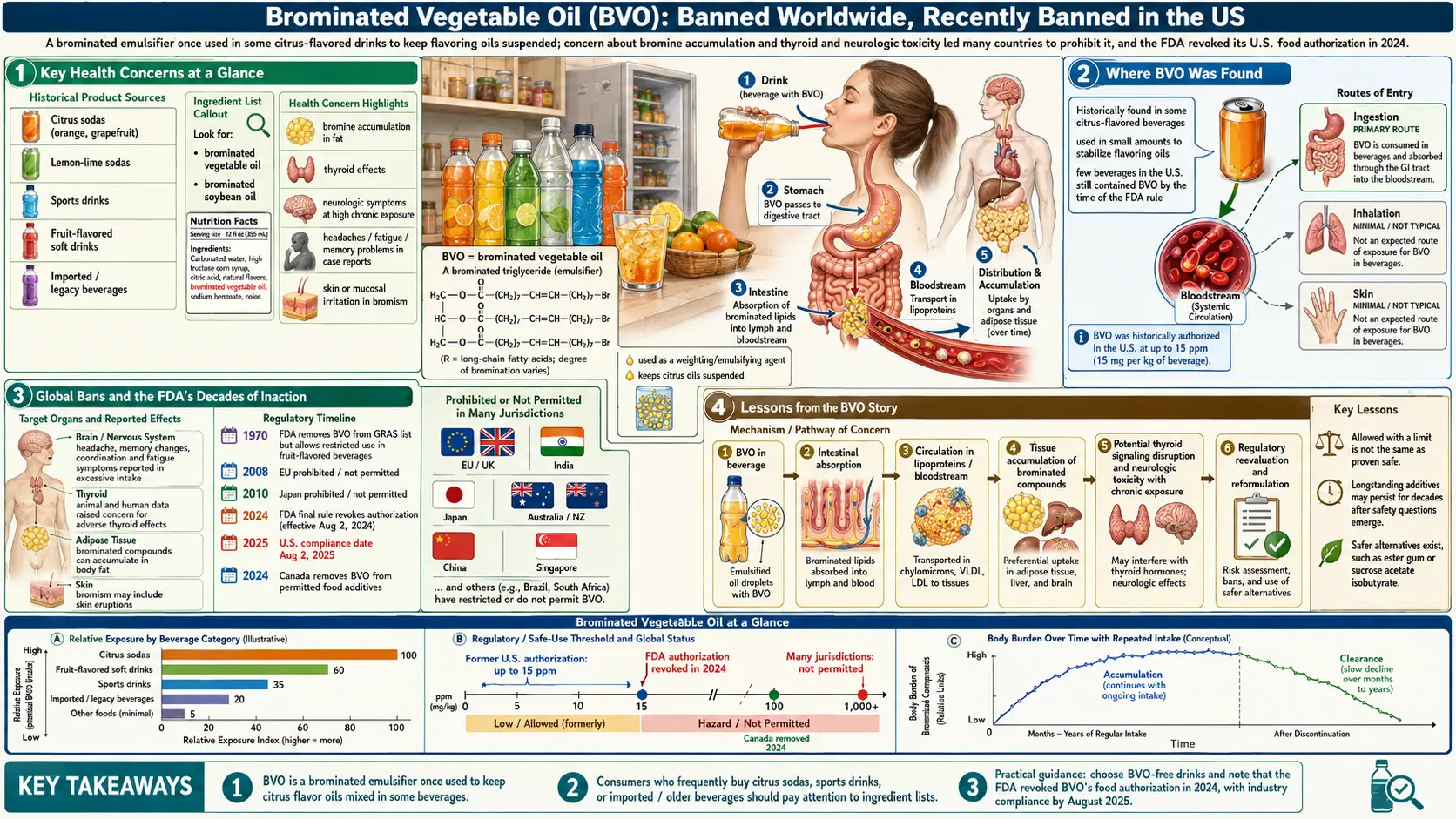
Brominated vegetable oil (BVO) is vegetable oil chemically reacted with bromine. It had been used since the 1920s, mainly to keep the flavoring oils in citrus-flavored soft drinks from separating and floating to the top. Its only US authorization was as a stabilizer for flavoring oils in fruit-flavored beverages, at no more than 15 parts per million (ppm) in the finished drink. FDA's 2024 final rule notes that BVO is not permitted in beverages in Australia, the European Union, Japan and New Zealand.
On 3 July 2024 the FDA published a final rule revoking that authorization (removing 21 CFR 180.30), effective 2 August 2024, with a compliance date one year after the effective date. The agency's stated reason was that there is "no longer a reasonable certainty of no harm" from the use of BVO in food, after FDA-led rat studies published in 2022 found thyroid toxicity and accumulation of bromine-containing fats in the body at doses the agency described as relevant to human exposure. BVO had been permitted on an "interim" basis since 1970, when FDA concluded it could no longer be regarded as generally recognized as safe (GRAS).
Table of Contents
- Key Findings at a Glance
- What Is Brominated Vegetable Oil?
- Where BVO Was Found
- Health Effects of BVO
- Bromine Accumulation in Body Tissues
- Thyroid Effects
- Nervous-System Effects
- Reproductive and Developmental Effects
- Heart, Liver and Kidney Findings
- Status Outside the US and the US Regulatory Timeline
- Reformulation Before the Ban
- What the BVO Record Shows
- Key Research Papers
- Connections
- Featured Videos
Key Findings at a Glance
- US authorization revoked — FDA's final rule of 3 July 2024 took effect on 2 August 2024, with a compliance date one year later. Before that, BVO had been allowed on an interim basis since 1970.
- Thyroid effects in rats — a 90-day FDA study found thyroid follicular-cell enlargement (hypertrophy) and raised thyroid-stimulating hormone (TSH) at the higher doses; FDA said it could not derive a safe level of dietary exposure from these studies.
- Accumulation of brominated fats — in the same study, brominated fatty acids built up in a dose-dependent way in the heart, liver and fat of rats; FDA estimated they could persist for up to 587 days after BVO was removed from the diet.
- Bromism in a heavy cola drinker — a 1997 case report describes severe bromide poisoning, with headache, fatigue, loss of coordination and memory loss, in a man who drank 2 to 4 liters a day of a BVO-containing cola.
- Reproductive and developmental effects in rats — at dietary levels of 0.25% to 2% BVO, a 1983 study found impaired reproduction and behavioral impairments in offspring; FDA's 2023 proposal listed reproductive and developmental toxicity as unresolved safety questions.
- Heart findings in older animal studies — studies in test animals fed BVO at levels far above most human consumption raised concerns about the heart; FDA states that later safety studies resolved the heart-related concerns.
- Not permitted abroad before the US acted — FDA's 2024 final rule notes that BVO is not permitted in beverages in Australia, the European Union, Japan and New Zealand, and that some BVO-containing products had already been reformulated to be sold in those markets.
- Previously found in — citrus-flavored soft drinks; comments on FDA's proposal noted that it remained in some store-brand, regional and lower-cost products.
What Is Brominated Vegetable Oil?
FDA describes BVO as a complex mixture of plant-derived triglycerides that have been reacted so that bromine atoms are bonded to the molecules. It has historically been made from corn, cottonseed and olive oil, and more recently from soybean oil, when it appeared on labels as "brominated soybean oil." Bromination makes the oil denser, which helped keep citrus flavoring oils evenly suspended in a drink instead of floating to the surface.
- Chemical nature — when BVO is eaten, bromine appears in the body in two forms: inorganic bromide in the blood, and organic (lipid-bound) bromine in the form of brominated fatty acids such as di- and tetra-bromostearic acid, which are stored in tissues.
- Labeling — when it was used in the US, BVO had to be listed on the label as "brominated vegetable oil" or as the specific oil that had been brominated.
- Regulatory history — FDA placed BVO on its original GRAS list in the late 1950s and early 1960s. On 27 January 1970 it concluded that BVO was no longer GRAS because of toxicity concerns under the conditions of use at the time (about 150 ppm in beverages), and in July 1970 it began regulating BVO as a food additive at a reduced level of 15 ppm on an interim basis. The interim authorization was set for 3 years and in 1974 extended for an indefinite period while further safety studies were done.
Where BVO Was Found
FDA states that BVO was used primarily to help emulsify citrus-flavored soft drinks, and that its only authorized use was as a stabilizer for flavoring oils in fruit-flavored beverages. By the time of the revocation, FDA said, many beverage makers had already reformulated, and few beverages in the US still contained it.
- Citrus-flavored soft drinks — the main use, including some citrus, orange and grapefruit-flavored sodas.
- Store-brand and regional drinks — comments on FDA's proposed rule said BVO-containing products were still sold as store-brand, "lesser-known regional brand" and "value" products; FDA agreed, and noted that BVO-containing beverages are often sugar-sweetened and that low-income consumers may be disproportionately exposed.
- Estimated exposure — FDA estimated mean and 90th-percentile US intakes of 5 and 9 mg of BVO per person per day (ages 2 and older), on the conservative assumption that every beverage labeled as containing BVO held the full 15 ppm.
Health Effects of BVO
Most of the evidence on BVO comes from animal studies, usually at doses well above typical human intake, plus a single published case of bromism linked to a BVO-containing drink. In its 2014 review, FDA found that the available data did not provide evidence of a health threat from the limited permitted use, but that many studies did not clearly establish safe levels of chronic use and had design deficiencies. The newer FDA-led rat studies are what led to the revocation.
Bromine Accumulation in Body Tissues
- Brominated fats are stored — in FDA's 90-day rat study, di- and tetra-bromostearic acid levels rose with dose in the heart, liver and inguinal fat, and serum bromide rose in the high-dose groups (Woodling 2022). After 90 days, accumulation had not reached a steady state.
- Slow clearance — FDA estimated that bioaccumulated brominated fatty acids could persist in the test animals for up to 587 days after BVO was removed from the diet. Earlier work in rats found that the stored bromine-containing material gradually decreased once the oil was no longer given (James 1978).
- Earlier human and animal data — FDA's rule states that the bioaccumulation seen in the new studies confirms previous studies in laboratory animals and humans that raised safety questions about BVO.
- Bromide half-life in people — for inorganic bromide, the blood elimination half-life was about 10 days in a case of poisoning from a bromide-salt preparation (Frances 2003) and 14 days in anesthetists exposed to halothane (Duvaldestin 1979). These figures come from bromide sources other than BVO.
Thyroid Effects
- FDA's rat study — in rats fed 0.002% to 0.5% BVO in the diet for 90 days, thyroid follicular-cell hypertrophy increased in the two highest-dose groups of males and the highest-dose group of females; TSH rose in the high-dose groups of both sexes and T4 fell in high-dose males (Woodling 2022). FDA's rule describes these results as thyroid toxicity with interference in the hypothalamic-pituitary-thyroid axis, and says they corroborate earlier studies in rats and pigs.
- Bromide and iodide — in rats, a high bromide intake (more than 100 to 150 mg a day) lowered iodide accumulation in the thyroid by speeding iodide elimination, and the effect was most pronounced in iodine-deficient animals (Pavelka 2001). This was a study of bromide salts, not of BVO.
- In people — no human study of BVO and thyroid disease was found in this review.
Nervous-System Effects
- Bromism from a BVO-containing cola — the one published case: a man who drank 2 to 4 liters of BVO-containing cola a day developed headache, fatigue, ataxia (loss of coordination) and memory loss over 30 days, and later a drooping eyelid, until he could no longer walk. His serum bromide was 3,180 mg/L; hemodialysis cleared his symptoms (Horowitz 1997).
- Bromism from other bromide sources — a case caused by a bromide-salt preparation describes confusion, disorientation, auditory and visual hallucinations and short-term memory loss, which improved within 8 days of stopping it (Frances 2003).
- Animal findings — lethargy and ataxia occurred in miniature pigs fed the highest dose (500 mg/kg body weight) of brominated sesame or soybean oil, probably because of raised blood bromine (Farber 1976). Offspring of rats fed 0.25% to 1% BVO showed behavioral impairments on standardized tests of functional development (Vorhees 1983). FDA's 2023 proposal listed developmental neurotoxicity as a safety question that had not been resolved.
Reproductive and Developmental Effects
- Fertility in rats — rats fed 2% BVO in the diet did not reproduce at all; 1% severely impaired conception; 0.25% and 0.5% produced lesser reproductive deficits (Vorhees 1983).
- Offspring — at 1%, offspring mortality was high and survivors showed impaired growth; the 0.5% group showed delayed vaginal opening (a marker of sexual maturation) and reduced activity. The study found no evidence of malformations (Vorhees 1983).
- Testes in pigs — moderate to marked testicular atrophy was seen in miniature pigs fed brominated soybean oil at 500 mg/kg body weight (Farber 1976).
- Regulatory view — FDA's 2023 proposed rule states that safety questions about developmental and reproductive toxicity remained, and that resolving them was not needed to conclude that there was no longer a reasonable certainty of no harm.
Heart, Liver and Kidney Findings
- Heart — FDA states that studies in test animals fed BVO at levels far exceeding most human consumption raised concerns about possible effects on the heart before its 1970 decision, and that additional safety studies later resolved the heart-related concerns. In miniature pigs fed brominated soybean oil at 500 mg/kg, fatty degeneration and focal degeneration or necrosis of heart-muscle fibers were seen (Farber 1976); rats fed brominated oils at 0.1 g per 100 g of diet for 15 weeks had more triglyceride and cholesterol in heart muscle (Bernal 1986).
- Liver — marked fatty degeneration of liver cells and raised liver enzymes occurred in pigs at the highest dose (Farber 1976).
- Kidney — fatty degeneration of the kidney tubules was also seen at that dose; tissue lesions were confined to the highest dose level (Farber 1976).
Status Outside the US and the US Regulatory Timeline
Status Outside the US
- Australia, the European Union, Japan and New Zealand — FDA's 2024 final rule states that BVO is not permitted for use in beverages in these jurisdictions, and that some BVO-containing products had been reformulated to be marketed there.
- Other countries — the rule says "some jurisdictions, including" these four; it does not give a full list or a count, and no primary source for other countries was found in this review.
US Regulatory Timeline
- 1920s — BVO comes into use as a flavoring-oil stabilizer and emulsifier.
- Late 1950s–early 1960s — after the 1958 Food Additives Amendment, FDA places BVO on its original GRAS list.
- 27 January 1970 — FDA concludes BVO is no longer GRAS because of toxicity concerns at the use level of the time (about 150 ppm) and removes it from the GRAS list.
- July 1970 — FDA authorizes BVO as a food additive on an interim basis, at up to 15 ppm in fruit-flavored beverages, for 3 years pending further data.
- 1974 — the interim authorization is extended for an indefinite period to allow safety studies to be completed.
- 2014 — FDA reassesses BVO and identifies four unresolved safety questions: thyroid toxicity, bioaccumulation, developmental neurotoxicity and reproductive toxicity.
- May 2022 — FDA publishes its 90-day rat study in Food and Chemical Toxicology.
- 7 October 2023 — California's Food Safety Act (AB 418, Chapter 328, Statutes of 2023) is signed. From 1 January 2027 it prohibits food containing brominated vegetable oil, potassium bromate, propylparaben or Red dye 3, with civil penalties of up to $5,000 for a first violation and $10,000 for each later one.
- 3 November 2023 — FDA publishes its proposed rule to revoke the authorization.
- 3 July 2024 — FDA publishes the final rule. All of the more than 40 public comments supported revocation.
- 2 August 2024 — the rule takes effect and 21 CFR 180.30 is removed; the compliance date is one year after the effective date.
Reformulation Before the Ban
FDA states that, over time, many beverage makers reformulated their products to replace BVO with an alternative ingredient, that safe and authorized substitutes had long been in use for the same function, and that some products had been reformulated to be sold in jurisdictions that do not permit BVO. The rule's economic analysis judged that disruption to small businesses would likely be small because replacement formulas had been in wide use for decades.
FDA also noted that a decade of news about manufacturers removing BVO may have led consumers to stop checking labels, while BVO remained in some store-brand and lower-cost products, and cited this as a reason for regulatory action.
What the BVO Record Shows
- A long interim period — BVO was permitted on an "interim" basis from 1970 until 2024, while the longer-term studies FDA had called for in 1970 were pending.
- Animal data drove the decision — FDA's revocation rested on rat studies at doses it described as relevant to human exposure; the agency said it could not derive a safe level of exposure from them.
- Accumulation complicates older studies — FDA wrote that the bioaccumulation of lipid-bound bromine makes it difficult to estimate cumulative exposure and to interpret shorter studies that reported no adverse effect.
- Different jurisdictions, different timing — BVO was not permitted in beverages in Australia, the EU, Japan and New Zealand while the US interim authorization continued; critics of the US system cite cases like this when arguing that additives restricted abroad warrant earlier review in the US.
- Unanswered questions — reproductive and developmental toxicity were still listed as unresolved when FDA acted, and human evidence is limited to case reports.
Key Research Papers
- Woodling KA, Chitranshi P, Jacob CC, et al. (2022). Toxicological evaluation of brominated vegetable oil in Sprague Dawley rats. Food and Chemical Toxicology 165:113137 — PubMed PMID: 35588981
- Horowitz BZ (1997). Bromism from excessive cola consumption. Journal of Toxicology: Clinical Toxicology 35(3):315-320 — PubMed PMID: 9140329
- Vorhees CV, Butcher RE, Wootten V, Brunner RL (1983). Behavioral and reproductive effects of chronic developmental exposure to brominated vegetable oil in rats. Teratology 28(3):309-318 — PubMed PMID: 6665731
- Farber TM, Ritter DL, Weinberger MA, et al. (1976). The toxicity of brominated sesame oil and brominated soybean oil in miniature swine. Toxicology 5(3):319-336 — PubMed PMID: 944471
- Bernal C, Basílico MZ, Lombardo YB (1986). [Toxicological effects induced by the chronic intake of brominated vegetable oils]. Archivos Latinoamericanos de Nutrición 36(3):432-442 (in Spanish) — PubMed PMID: 3632217
- James SP, Kestell P (1978). The fate of brominated soya oil in the animal body. Xenobiotica 8(9):557-564 — PubMed PMID: 99886
- Pavelka S, Babický A, Vobecký M, Lener J (2001). High bromide intake affects the accumulation of iodide in the rat thyroid and skin. Biological Trace Element Research 82(1-3):133-142 — PubMed PMID: 11697762
- Frances C, Hoizey G, Lamiable D, Millart H, Trenque T (2003). Bromism from daily over intake of bromide salt. Journal of Toxicology: Clinical Toxicology 41(2):181-183 — PubMed PMID: 12733857
- Duvaldestin P, Mazze RI, Hazebrouck J, et al. (1979). Halothane biotransformation in anesthetists. Anesthesiology 51(1):41-46 — PubMed PMID: 453592
Regulatory Documents
- FDA (2024). Revocation of Authorization for Use of Brominated Vegetable Oil in Food. Final rule, 89 FR 55040, 3 July 2024 — Federal Register
- FDA (2023). Revocation of Authorization for Use of Brominated Vegetable Oil in Food. Proposed rule, 88 FR 75523, 3 November 2023 — Federal Register
- FDA — Brominated Vegetable Oil (BVO): regulatory information and timeline
- FDA — Food Additive Status List
- California Assembly Bill 418 (2023), the California Food Safety Act, Chapter 328, Statutes of 2023 — California Legislative Information
PubMed Topic Searches
- PubMed: Brominated vegetable oil + thyroid (search)
- PubMed: Bromide accumulation / halogen toxicity (search)
- PubMed: Bromism / soda case reports (search)
- PubMed: Brominated vegetable oil reproductive toxicity (search)