Coffee Enemas
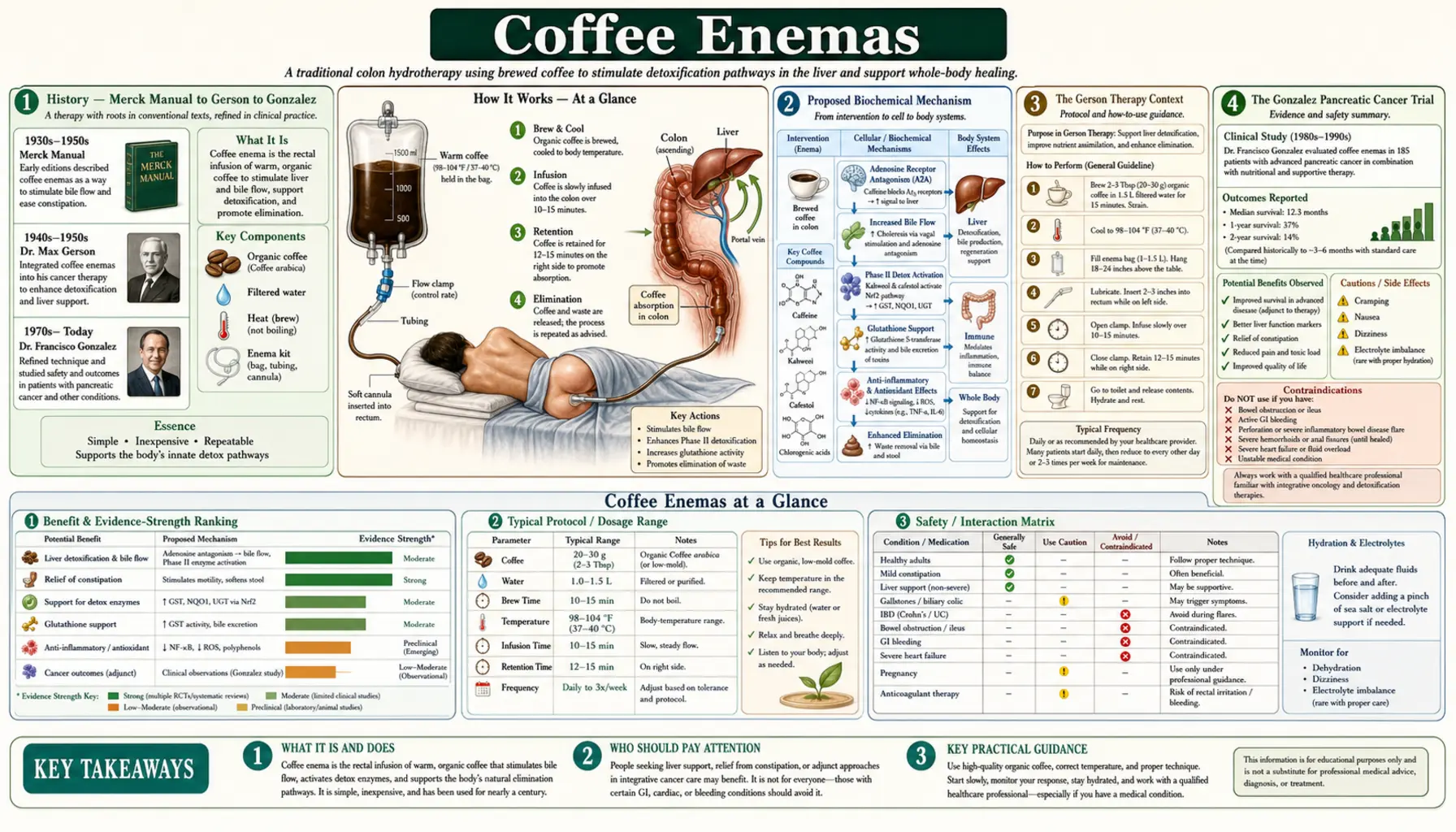
Coffee enemas are one of the most disputed practices in the detoxification field. They have been a core element of the Gerson therapy since the 1940s, and New York physician Nicholas Gonzalez used them within an enzyme-based regimen for pancreatic cancer that a National Cancer Institute–sponsored study at Columbia University later evaluated. The mechanism proponents describe rests on coffee compounds reaching the liver and raising detoxification-enzyme activity and bile flow. The enzyme finding traces to mouse studies in which green coffee beans were fed in the diet, and no study found has tested coffee enemas for that effect. A 2020 systematic review found no study reporting the effectiveness of coffee enemas, while case reports describe colitis, rectal burns, septicemia and deaths from electrolyte depletion. This page covers the history, the proposed mechanism, the clinical evidence, the reported harms, and how proponents describe the practice.
Table of Contents
- History — Merck Manual to Gerson to Gonzalez
- Proposed Biochemical Mechanism
- The Gerson Therapy Context
- The Gonzalez Pancreatic Cancer Trial
- Available Clinical Evidence (and Gaps)
- Preparation as Proponents Describe It
- Administration as Proponents Describe It
- Frequency in Published Descriptions
- Adverse Events and Who the Research Raises Concerns For
- Key Research Papers
- Connections
- Featured Videos
History — Merck Manual to Gerson to Gonzalez
Coffee enemas have been in use for at least 150 years, according to a 2021 narrative review by a practitioner who uses them (Isaacs 2021). Proponents point out that coffee enemas appeared in earlier editions of the Merck Manual, a standard physicians' reference; the editions and indications cited vary between accounts, and the practice later disappeared from conventional references.
Max Gerson, a German-American physician who treated cancer patients in the 1940s and 1950s, made coffee enemas a structural element of his treatment. In his 1958 book A Cancer Therapy: Results of Fifty Cases, Gerson argued that the breakdown of tumors under his plant-based dietary regimen produced a heavy toxic load for the liver, and that coffee enemas sped the excretion of those breakdown products through the bile. A 2010 summary in Oncology describes the Gerson view that coffee enemas dilate the bile ducts and promote excretion of toxic breakdown products, and states that none of these theories has been substantiated by scientific research (Cassileth 2010).
Nicholas Gonzalez, a New York physician, treated advanced pancreatic cancer in the 1990s with large doses of oral pancreatic enzymes, nutritional supplements, an organic diet and “detoxification” procedures that included coffee enemas. His 1999 pilot study of 11 patients reported survival above national figures (Gonzalez & Isaacs 1999). A later National Cancer Institute–sponsored study at Columbia University compared the regimen with gemcitabine-based chemotherapy and found that patients who chose chemotherapy lived about three times as long (Chabot 2010); Gonzalez disputed how that study was conducted.
Proposed Biochemical Mechanism
The biochemical rationale offered by Gerson, Gonzalez and later proponents has several parts. What each part rests on:
- Caffeine absorption from the rectum. Proponents hold that compounds absorbed through the rectal veins reach the liver through the portal circulation. In a 2013 crossover study of 11 healthy men, caffeine was absorbed from a 500 mL coffee enema, but its peak blood level and total exposure were about 3.5 times lower than after drinking a coffee beverage of similar caffeine content (Teekachunhatean 2013).
- Bile flow. Proponents hold that coffee enemas stimulate bile flow. Drinking coffee does raise the gut hormone cholecystokinin and contract the gallbladder: in a study of six healthy coffee drinkers, regular and decaffeinated coffee both did so, which points away from caffeine as the cause (Douglas 1990). No study found has measured bile flow after a coffee enema.
- Glutathione S-transferase (GST). Coffee enemas are often said to raise the liver enzyme glutathione S-transferase by “up to 700 percent.” That claim traces to a 1982 mouse study in which green coffee beans fed in the diet increased glutathione S-transferase activity in the small-intestinal lining and liver; the active compounds were the coffee diterpenes kahweol palmitate and cafestol palmitate, not caffeine, and the abstract gives no 700 percent figure (Lam 1982). A 1987 follow-up in mice found that the furan ring of kahweol and cafestol is needed for this effect (Lam 1987). A 2002 review describes the induction of GST and other protective enzymes by these diterpenes in animal and cell studies (Cavin 2002); in human research, these diterpenes, which unfiltered coffee supplies in significant amounts, have been implicated in coffee's cholesterol-raising effect (Higdon 2006). No study found tested coffee enemas for this effect.
- Bile-duct flushing. The Gerson rationale held that coffee solution retained in the colon triggers the bile ducts to empty, carrying toxins out rather than letting them be reabsorbed. This is Gerson's proposal; no study found has tested it.
- Glutathione. Proponents describe coffee enemas as supporting the glutathione system. In a randomized crossover study of 11 healthy Thai men, neither coffee enemas (three times weekly for six sessions) nor oral coffee raised serum glutathione or lowered the oxidation marker malondialdehyde over 12 days, and serum antioxidant capacity fell from baseline after both (Teekachunhatean 2012).
The enzyme findings come from animals fed coffee, and the two human studies of the enema route found lower caffeine exposure than oral coffee and no rise in serum glutathione. Whether the practice produces the effects its proponents describe has not been shown.
The Gerson Therapy Context
In the Gerson therapy, coffee enemas are one part of a larger program. Published descriptions of the therapy list:
- A plant-based, low-sodium, high-potassium diet with frequent fresh raw vegetable and fruit juices (the Gerson tradition describes 13 glasses a day; the 1995 melanoma review describes hourly juices)
- Coffee enemas, several a day in Gerson's own regimen
- Supplements including potassium, vitamin B12, thyroid hormone and pancreatic enzymes (Cassileth 2010), with niacin and castor oil treatments also part of Gerson's regimen
Because the elements are used together, no study has isolated the effect of the coffee enemas themselves. A 2010 summary states that case reviews by the National Cancer Institute and the New York County Medical Society found no evidence of usefulness for the Gerson diet, despite proponents' claims of recovery rates as high as 70% to 90% (Cassileth 2010).
A 1995 retrospective review of 153 melanoma patients treated at a Gerson-style hospital in Tijuana reported 5-year survival rates above those published elsewhere for each stage (Hildenbrand 1995). Coffee enemas were used “as needed for pain and appetite” in that cohort. The comparison was with survival figures from other published series, not a randomized or concurrent control group.
The Gonzalez Pancreatic Cancer Trial
The Gonzalez regimen for pancreatic cancer centered on large doses of orally taken pancreatic enzymes, with nutritional supplements, an organic diet and “detoxification” procedures including coffee enemas. Gonzalez held that the enzymes were the main anti-tumor element and that coffee enemas helped clear the breakdown products of tumor cells.
The 1999 pilot study (Gonzalez & Isaacs, Nutr Cancer 1999;33(2):117-24) followed 11 patients with inoperable stage II–IV pancreatic adenocarcinoma treated in the authors' private practice. Nine (81%) survived one year, five (45%) survived two years and four survived three years. The authors compared these figures with the 25% one-year and 10% two-year survival reported for all stages of the disease in the 1995 National Cancer Data Base. The study had a single treatment arm, no control group and no blinding.
The follow-up study (Chabot JA et al., J Clin Oncol 2010) began in 1998 as a National Cancer Institute–sponsored randomized phase III trial. Because most eligible patients refused random assignment, it was changed in 2001 to a controlled observational study in which patients chose their treatment. Of 55 patients with inoperable pancreatic cancer, 23 chose gemcitabine-based chemotherapy and 32 chose the enzyme regimen. Median survival was 14 months with chemotherapy and 4.3 months with the enzyme regimen, the adjusted mortality hazard ratio for the enzyme group was 6.96, one-year survival was 56% versus 16%, and quality-of-life ratings were better in the chemotherapy group. Gonzalez disputed the conduct and conclusions of the study.
Available Clinical Evidence (and Gaps)
A summary of the clinical evidence for coffee enemas:
- For cancer treatment: no controlled trial of coffee enemas alone. The one controlled study of a regimen that included them, the Gonzalez regimen, found shorter survival and worse quality of life than chemotherapy (Chabot 2010).
- For symptom relief during “detoxification” (headache, nausea, fatigue): practitioner reports from the Gerson and Gonzalez traditions; no controlled trial.
- For biochemical effects (GST, bile flow, glutathione): the GST data are from mouse feeding studies (Lam 1982; Lam 1987). A human study found no rise in serum glutathione after coffee enemas (Teekachunhatean 2012), and a human study found lower caffeine exposure from the enema than from drinking coffee (Teekachunhatean 2013).
- For constipation, the traditional use: enemas in general are used to empty the lower bowel; no study found compared coffee with other enema fluids.
- For mold illness / CIRS / chemical sensitivity: practitioner reports; no controlled trials of coffee enemas in these settings.
A 2020 systematic review that searched Western, Korean, Chinese and Japanese databases found no study reporting the effectiveness of coffee enemas; the nine studies it found were case reports of adverse events, and its authors did not recommend self-administered coffee enemas as a self-care practice (Son 2020). Proponents attribute the lack of trials to the absence of a commercial sponsor; the one National Cancer Institute–sponsored evaluation tested the Gonzalez regimen as a whole, not coffee enemas alone.
Preparation as Proponents Describe It
The Gerson Institute and practitioners in the Gerson and Gonzalez traditions publish their own preparation instructions. In outline, these describe ground coffee boiled and simmered in water, strained to remove the grounds, and cooled to body temperature before use, with about one quart (roughly one liter) per session; brewing times, coffee amounts and roasts differ between sources. Proponents specify caffeinated coffee because they regard caffeine as part of the mechanism, although the oral-coffee gallbladder study found that decaffeinated coffee contracted the gallbladder too (Douglas 1990).
For comparison, the 2013 pharmacokinetic study gave volunteers 500 mL of coffee solution retained for 10 minutes (Teekachunhatean 2013).
Temperature is the preparation detail that appears in the harm literature: several case reports describe rectal burns from coffee that was still hot, one of them followed by a stricture and rectal perforation (Sashiyama 2008; Jones 2010; Kim 2012).
Administration as Proponents Describe It
Gerson-tradition descriptions have the person lie on the right side with the knees drawn up while the coffee flows in by gravity from an enema bag, retain it for a period, and then evacuate. Proponents explain the right-side position as aiding exposure of the liver through the portal circulation; that rationale has not been tested. The case reports of rectal burns, colitis and perforation all involved self-administration (Son 2020).
Frequency in Published Descriptions
Frequency varies by source and indication. Gerson's own cancer regimen called for several coffee enemas a day; in the 1995 melanoma cohort they were used as needed for pain and appetite (Hildenbrand 1995). No study has compared frequencies.
The deaths reported in the medical literature involved very frequent self-administration: the two patients described by Eisele and Reay, as summarized in the 2020 systematic review, used coffee enemas at high frequency and had low sodium and chloride levels at autopsy (Eisele & Reay 1980; Son 2020).
Adverse Events and Who the Research Raises Concerns For
Adverse events reported in the medical literature:
- Deaths from electrolyte depletion — Eisele and Reay (JAMA 1980) reported two deaths related to coffee enemas. According to the 2020 systematic review, one patient had cancer and the other multiple illnesses; both had declined conventional treatment and used coffee enemas at high frequency, and autopsy showed a “low-salt pattern” (low sodium and chloride, relatively low potassium). The authors attributed it to large volumes of a fluid that contains no sodium or chloride (Son 2020).
- Septicemia — a 1984 case report describes polymicrobial enteric septicemia in a patient with breast cancer that had spread to the liver who used frequent coffee enemas; the patient developed liver failure and died (Margolin & Green 1984; Son 2020).
- Colitis and proctocolitis — case reports describe acute colitis with severe abdominal pain and bloody stools (Lee 2008) and proctocolitis (Keum 2010; Lee 2020) after coffee enemas. In the 2020 systematic review, seven of the nine case reports described colitis, rectal burns or perforation, and the authors considered the coffee fluid itself the most plausible cause (Son 2020).
- Rectal burns and perforation — rectal burns from hot coffee enemas (Sashiyama 2008; Jones 2010), and in one case a benign stricture from rectal burns followed by rectal perforation (Kim 2012).
The two deaths and the septicemia case occurred in people who were already seriously ill, including people with advanced cancer and liver involvement, and who used coffee enemas many times a day (Son 2020). No study has defined who can use coffee enemas safely or at what frequency.
Coffee enemas remain a contested practice. Decisions about any medical or alternative treatment belong with a clinician.
Key Research Papers
- Gonzalez NJ, Isaacs LL. Evaluation of pancreatic proteolytic enzyme treatment of adenocarcinoma of the pancreas, with nutrition and detoxification support. Nutr Cancer. 1999;33(2):117-24 (pilot study) — PubMed PMID: 10368805
- Chabot JA, Tsai WY, Fine RL, Chen C, Kumah CK, Antman KA, Grann VR. Pancreatic proteolytic enzyme therapy compared with gemcitabine-based chemotherapy for the treatment of pancreatic cancer. J Clin Oncol. 2010;28(12):2058-63 — PubMed PMID: 19687327
- Reed A, James N, Sikora K. Juices, coffee enemas, and cancer. Lancet. 1990;336(8716):677-8 — PubMed PMID: 1975864
- Eisele JW, Reay DT. Deaths related to coffee enemas. JAMA. 1980;244(14):1608-9 — PubMed PMID: 7420666
- Lee CJ, Song SK, Jeon JH, Sung MK, Cheung DY, Kim JI, Kim JK, Lee YS. [Coffee enema induced acute colitis] (in Korean; case report). Korean J Gastroenterol. 2008;52(4):251-4 — PubMed PMID: 19077527
- Teekachunhatean S, Tosri N, Rojanasthien N, Srichairatanakool S, Sangdee C. Pharmacokinetics of caffeine following a single administration of coffee enema versus oral coffee consumption in healthy male subjects. ISRN Pharmacol. 2013;2013:147238 — PubMed PMID: 23533801
- Lam LK, Sparnins VL, Wattenberg LW. Isolation and identification of kahweol palmitate and cafestol palmitate as active constituents of green coffee beans that enhance glutathione S-transferase activity in the mouse. Cancer Res. 1982;42(4):1193-8 — PubMed PMID: 7059995
- Cassileth B. Gerson regimen. Oncology (Williston Park). 2010;24(2):201 — PubMed PMID: 20361473
- Hildenbrand GL, Hildenbrand LC, Bradford K, Cavin SW. Five-year survival rates of melanoma patients treated by diet therapy after the manner of Gerson: a retrospective review. Altern Ther Health Med. 1995;1(4):29-37 — PubMed PMID: 9359807
- Higdon JV & Frei B, Coffee and health: a review of recent human research (kahweol / cafestol section) — PubMed PMID: 16507475
- Cavin C et al., Cafestol and kahweol, two coffee specific diterpenes with anticarcinogenic activity. — PubMed PMID: 12067578
- Green S. A critique of the rationale for cancer treatment with coffee enemas and diet. JAMA. 1992;268(22):3224-7 — PubMed PMID: 1433763
- Lam LK, Sparnins VL, Wattenberg LW. Effects of derivatives of kahweol and cafestol on the activity of glutathione S-transferase in mice. J Med Chem. 1987;30(8):1399-403 — PubMed PMID: 3612687
- Teekachunhatean S, Tosri N, Sangdee C, Wongpoomchai R, Ruangyuttikarn W, Puaninta C, Srichairatanakool S. Antioxidant effects after coffee enema or oral coffee consumption in healthy Thai male volunteers. Hum Exp Toxicol. 2012;31(7):643-51 — PubMed PMID: 22249393
- Douglas BR, Jansen JB, Tham RT, Lamers CB. Coffee stimulation of cholecystokinin release and gallbladder contraction in humans. Am J Clin Nutr. 1990;52(3):553-6 — PubMed PMID: 2393014
- Son H, Song HJ, Seo HJ, Lee H, Choi SM, Lee S. The safety and effectiveness of self-administered coffee enema: a systematic review of case reports. Medicine (Baltimore). 2020;99(36):e21998 — PubMed PMID: 32899046
- Margolin KA, Green MR. Polymicrobial enteric septicemia from coffee enemas. West J Med. 1984;140(3):460 — PubMed PMID: 6710988
- Keum B, Jeen YT, Park SC, Seo YS, Kim YS, Chun HJ, Um SH, Kim CD, Ryu HS. Proctocolitis caused by coffee enemas. Am J Gastroenterol. 2010;105(1):229-30 — PubMed PMID: 20054322
- Lee AH, Kabashneh S, Tsouvalas CP, Rahim U, Khan MY, Anees M, Levine D. Proctocolitis from coffee enema. ACG Case Rep J. 2020;7(1):e00292 — PubMed PMID: 32309489
- Sashiyama H, Hamahata Y, Matsuo K, Akagi K, Tsutsumi O, Nakajima Y, Takaishi Y, Takase Y, Arai T, Hoshino T, Tazawa A, Fu KI, Tsujinaka Y. Rectal burn caused by hot-water coffee enema. Gastrointest Endosc. 2008;68(5):1008 — PubMed PMID: 18657805
- Jones LE, Norris WE. Rectal burn induced by hot coffee enema. Endoscopy. 2010;42 Suppl 2:E26 — PubMed PMID: 20073005
- Kim S, Cha JM, Lee CH, Shin HP, Park JJ, Joo KR, Lee JI, Jeun JW, Lim K, Lim JU, Choi JH. Rectal perforation due to benign stricture caused by rectal burns associated with hot coffee enemas. Endoscopy. 2012;44 Suppl 2 UCTN:E32-3 — PubMed PMID: 22396264
- Isaacs LL. Coffee enemas: a narrative review. Altern Ther Health Med. 2021;27(3):46-49 — PubMed PMID: 33711817
PubMed Topic Searches
Connections
- All Remedies
- Detox Protocols Benefits Hub
- Detox Protocols (Main)
- Liver Phase 1 and Phase 2
- Sweating and Sauna Therapy
- Binders: Charcoal & Chlorella
- Gerson Therapy
- Coffee
- Glutathione
- N-Acetyl Cysteine
- Pancreatic Cancer
- Oncology
- Gastroenterology
- Hepatology
- Mold (Mycotoxins)
- Heavy Metals
- Potassium
- Magnesium
- Sodium
- Coffee Enemas: Gerson Therapy Tradition — the Gerson-therapy account of the same practice set against the mainstream oncology consensus and the documented harms.
- Gerson Therapy — Coffee Enema Component — the Kellogg-era origins, the Wattenberg Phase II argument, and the published harms case in detail.