Binders: Charcoal, Chlorella, and Beyond
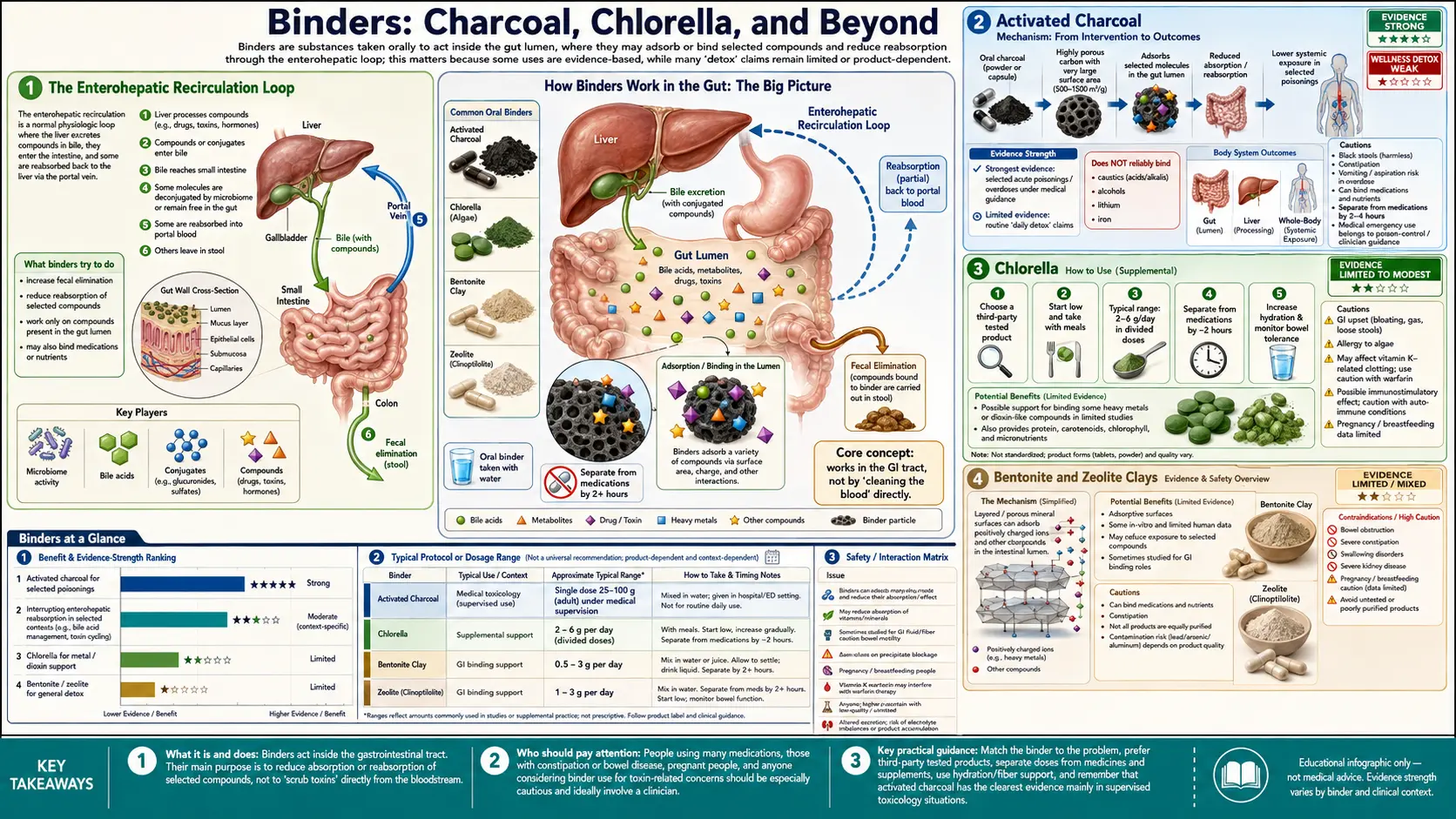
Intestinal binders are substances that adsorb or bind compounds in the gut lumen so that they leave the body in stool instead of being absorbed. The rationale for their use in detox protocols is enterohepatic recirculation: many compounds the liver conjugates are excreted in bile into the small intestine, where they can be reabsorbed rather than eliminated. Activated charcoal is the most frequently used method of gastrointestinal decontamination in poisoning, although toxicology position papers state that it should not be given routinely and that there is no evidence it improves clinical outcome. Chlorella increased fecal excretion of methylmercury, cadmium and dioxins in rodent studies. A calcium montmorillonite clay lowered aflatoxin biomarkers in a 3-month placebo-controlled trial in Ghana. Cholestyramine and colesevelam are prescription bile-acid sequestrants; Ritchie Shoemaker uses cholestyramine for illness he attributes to mold biotoxins from water-damaged buildings, which he calls chronic inflammatory response syndrome (CIRS). Each binder has a different adsorption profile and a different evidence base, covered below.
Table of Contents
- The Enterohepatic Recirculation Loop
- Activated Charcoal
- Chlorella
- Bentonite and Zeolite Clays
- Cholestyramine and Colesevelam
- Fiber, Pectin, and Chitosan
- Timing Relative to Food, Medications, and Other Supplements
- Constipation and Nutrient-Depletion Caveats
- Which Binder Has Been Studied for Which Exposure
- Cautions and Contraindications
- Key Research Papers
- Connections
- Featured Videos
The Enterohepatic Recirculation Loop
The liver excretes conjugated metabolites into bile, which empties into the duodenum at the ampulla of Vater. Bile acids are needed for fat digestion, and the body conserves them: about 95% of bile acids are reabsorbed in the terminal ileum, returned to the liver via the portal vein, and secreted again — the enterohepatic circulation. Some drugs and other compounds excreted in bile recirculate the same way; the cholestyramine prescribing information notes that the resin may interfere with the pharmacokinetics of drugs that undergo enterohepatic circulation.
Detox proponents describe this as a problem for detoxification. In their account, many toxins (mercury, persistent organic pollutants, mold biotoxins, hormones in their conjugated form) are excreted into bile by the liver and then reabsorbed in the ileum, so the work of conjugation does not end in elimination.
Intestinal binders are proposed as the way to break the loop. A binder in the gut lumen adsorbs the compound, the bound complex is not absorbed, and it leaves in stool. This is the mechanism by which multiple-dose activated charcoal increases the elimination of some drugs in volunteer studies, and the mechanism Ritchie Shoemaker invokes for cholestyramine. For most of the toxins named in detox protocols, the human evidence is limited, as described section by section below.
An early demonstration was a 1964 study in which oral activated charcoal lowered normal serum bilirubin values in newborn infants. Volunteer studies summarized in the 1999 multiple-dose charcoal position statement found that repeated doses of charcoal increase the elimination of digitoxin and digoxin, among other drugs. Animal and human studies of chlorella, clays and bile-acid sequestrants, described below, have applied the same idea to mercury, aflatoxin and other compounds.
Activated Charcoal
Activated charcoal is carbon that has been processed at high temperature with steam or chemical activation to create a microporous structure with a very large internal surface area. Surface area varies by product: a 1987 comparison of five commercial aqueous charcoal products reported 950 m² per gram for three of them, and 1,500 and 3,150 m² per gram for the two that reduced aspirin absorption most in volunteers.
Activated charcoal is the most frequently used method of gastrointestinal decontamination in the developed world, according to a 2016 review. The joint position papers of the American Academy of Clinical Toxicology and the European Association of Poisons Centres and Clinical Toxicologists state that single-dose activated charcoal should not be given routinely to poisoned patients. It may be considered if a patient has ingested a potentially toxic amount of a poison known to be adsorbed by charcoal up to one hour earlier, and the 2005 paper found no evidence that charcoal improves clinical outcome. In the volunteer studies it summarizes, using at least 50 g of charcoal, absorption fell by a mean 47.3% when charcoal was given at 30 minutes and 16.5% at 120 minutes. The 1999 multiple-dose statement says repeated doses should be considered only after a life-threatening ingestion of carbamazepine, dapsone, phenobarbital, quinine or theophylline — drugs for which enhanced elimination is documented, although no controlled study has shown clinical benefit.
For chronic, non-emergency use, detox protocols describe activated charcoal as binding:
- Mycotoxins (aflatoxin, ochratoxin, mold byproducts in CIRS)
- Bile-recirculated heavy metals (mercury, lead)
- Drug residues
- Bacterial endotoxin (LPS, lipopolysaccharide)
- Many organic chemicals (BPA, phthalates, glyphosate to a limited extent)
These chronic uses rest mainly on charcoal's adsorption properties rather than on controlled human trials. A 1988 review found that single doses of oral activated charcoal effectively prevent the gastrointestinal absorption of most drugs and toxins present in the stomach, with known exceptions: alcohols, cyanide, and metals such as iron and lithium — which bears on the claim that charcoal binds heavy metals.
The position papers address acute poisoning only and give no dose for chronic detox use.
Chlorella
Chlorella is a single-celled freshwater green alga with a tough cell wall. Proponents attribute its metal binding to the cell wall, and supplements are often sold as “broken-cell” chlorella on the premise that the intact cell is poorly digested.
The research on chlorella as a binder is mostly in animals. In rats given dietary cadmium, adding chlorella to the diet lowered cadmium accumulation in blood and tissues and increased fecal and urinary cadmium excretion (Shim 2009). In mice given a single oral dose of methylmercury, chlorella powder increased the mercury excreted in feces and urine about 1.9-fold and 2.2-fold over 24 hours, but blood and organ mercury did not differ, and the authors concluded it did not affect methylmercury absorption from the gut (Uchikawa 2010). In rats given dioxin-contaminated rice oil, a 10% chlorella diet increased fecal excretion of dioxin and furan congeners (Morita 1999). In humans, a 2019 study of 16 people with long-term amalgam fillings and titanium dental implants who took chlorella with a Fucus seaweed extract and sulfur amino acid supplements for 90 days reported lower hair mercury, silver, tin and lead than at baseline. That study had no placebo group and tested a combination, so the result cannot be attributed to chlorella alone.
Chlorella also contains chlorophyll, B vitamins, iron and magnesium. Its vitamin B12 content varies widely: a 2016 analysis of 19 dried chlorella supplements found from under 0.1 µg to about 415 µg per 100 g, and some high-B12 tablets also contained inactive corrinoid compounds.
No trial has established a chlorella dose for removing metals in people.
Chlorella takes up substances from its growth medium: the 2016 analysis attributed the B12 in chlorella tablets to B12-generating ingredients in the culture medium or to bacteria growing alongside the algae. Contamination of algal supplements with heavy metals from the growing environment is a recurring concern, and some manufacturers publish independent heavy-metal testing for each batch.
Bentonite and Zeolite Clays
Bentonite (specifically calcium montmorillonite) and zeolite (clinoptilolite) are aluminosilicate minerals with cation-exchange capacity that binds positively charged metal ions and certain mycotoxins. They are largely not absorbed and pass through the GI tract.
The strongest human evidence among clays is for a calcium montmorillonite clay against aflatoxin. The trials used one specific refined clay, NovaSil, so the results may not transfer to other clays. The Texas A&M group led by Timothy Phillips reports that this clay prevented aflatoxicosis in a variety of animals and binds aflatoxins with high affinity and capacity in the gastrointestinal tract (Phillips 2008). In a 3-month phase IIa placebo-controlled trial in Ghanaians at high risk of aflatoxin exposure, capsules of 1.5 g or 3.0 g of clay per day taken before meals significantly lowered serum aflatoxin–albumin adducts at 3 months in both dose groups, and the higher dose lowered the median urinary aflatoxin M1 level by up to 58% (Wang 2008).
Clinoptilolite zeolite is widely marketed for heavy-metal detoxification. A 2018 critical review summarizes in-vivo studies of clinoptilolite materials in veterinary and human medicine, including detoxification effects, and notes that public concerns have been raised about their safety. Its human evidence for metal removal is less developed than the aflatoxin evidence for calcium montmorillonite.
The Ghana trial used 1.5 g and 3.0 g of clay per day in capsules taken before meals, for 3 months. Among the 177 participants, the clay did not change serum vitamins A and E or nutrient minerals; of 15 non-nutrient minerals measured, only strontium rose in the high-dose group (Afriyie-Gyawu 2008).
Cholestyramine and Colesevelam
Cholestyramine and colesevelam are prescription bile-acid sequestrants — non-absorbed resins that bind bile acids in the gut, so the liver draws on cholesterol to make new bile acids and serum LDL cholesterol falls. They are older cholesterol-lowering drugs, now used far less than statins for that purpose; colesevelam is also labeled for type 2 diabetes.
Ritchie Shoemaker describes cholestyramine as central to his treatment of illness he attributes to biotoxins — first in estuary-associated illness, where he reported that visual contrast sensitivity recovered during cholestyramine treatment as symptoms abated (Shoemaker 2001), and later in people exposed to water-damaged buildings, a condition he calls chronic inflammatory response syndrome (CIRS). In his 2006 time-series study, 26 participants with a mean illness duration of 11 months completed all assessments. After 2 weeks of cholestyramine the group mean fell from 23 of 37 symptoms to 4, and visual contrast sensitivity improved; after 3 days back in the buildings without cholestyramine, all participants reported relapse. In the embedded double-blind trial, 7 participants given cholestyramine improved over 2 weeks while 6 given placebo did not, until they too received cholestyramine. Shoemaker argued that because cholestyramine's only known action is to bind compounds during enterohepatic recirculation, the improvement supported a toxin-mediated illness. The blinded trial had 13 participants.
Ciguatera fish poisoning is the most frequently reported seafood-toxin illness in the world. It is caused by lipid-soluble polyether toxins that accumulate in reef fish; the toxins are cumulative, and symptoms may persist for months or years (Lehane 2000). A 2008 review of ciguatera treatments, covering randomized trials and anecdotal reports, found that the appropriate treatment remains unclear, with reports of symptom improvement for some interventions such as intravenous mannitol (Friedman 2008).
Colesevelam is a newer bile-acid sequestrant. Its prescribing information lists constipation (11.0% vs 7.0% on placebo), dyspepsia and nausea as the most common adverse reactions in hyperlipidemia trials, reports cases of bowel obstruction, lists a history of bowel obstruction as a contraindication, and notes that it can raise triglycerides.
Both drugs require a prescription. The cholestyramine prescribing information lists constipation as the most common adverse reaction, warns that it may produce or worsen constipation and fecal impaction, reports rare intestinal obstruction including two deaths in children, and notes that long-term use may impair absorption of vitamins A, D, E and K (with bleeding from vitamin K deficiency) and lower folate. Both labels describe reduced absorption of other drugs taken close to the resin.
Fiber, Pectin, and Chitosan
Several food and supplement-grade fibers have binder-like properties:
- Modified citrus pectin (MCP) — a lower-molecular-weight pectin derivative. In a 6-day pilot study in healthy adults taking 15 g a day (20 g on day 6), urinary arsenic excretion rose 130% in the first 24 hours and urinary cadmium 150% by day 6; lead rose 560%, a change that did not reach conventional significance (p < 0.08) (Eliaz 2006). In a pilot study without a control group in children hospitalized with blood lead above 20 µg/dL, 15 g a day in three divided doses for 28 days was followed by lower blood lead and higher urinary lead excretion (Zhao 2008). Because the effect was measured in urine, the authors attribute it to systemic chelation rather than binding in the gut. Both studies used the same commercial MCP product.
- Soluble fiber (psyllium, glucomannan) — not as potent as activated charcoal but adds bulk and binds bile acids and some lipophilic toxins. Psyllium is also a bulk-forming laxative.
- Chitosan — a polysaccharide derived from shellfish exoskeletons; binds fat-soluble compounds and some heavy metals. Its shellfish origin raises a concern for people with shellfish allergy.
- Beta-glucan and inulin — prebiotic fibers fermented by gut bacteria; their direct binding capacity is modest.
Max Gerson's diet therapy, built on large amounts of fresh juice and high-fiber vegetables, supplies pectin and fiber; proponents describe this as helping to bind biliary toxins in transit.
Timing Relative to Food, Medications, and Other Supplements
Binders are largely nonspecific: they can bind other things in the gut lumen at the same time, including:
- Prescription medications — the cholestyramine label names warfarin, thyroid and thyroxine preparations, digitalis, estrogens and progestins, phenobarbital, thiazide diuretics and propranolol among others; the colesevelam label names cyclosporine, phenytoin, thyroid hormone, warfarin, certain oral contraceptives, olmesartan and several sulfonylureas
- Vitamins — both labels describe reduced absorption of fat-soluble vitamins
- Nutrients from food
- Polyphenols and other plant compounds
What the labels state: the cholestyramine label advises taking other drugs at least 1 hour before or 4 to 6 hours after the resin (or at as great an interval as possible). The colesevelam label directs that the listed drugs, and oral vitamin supplements, be taken at least 4 hours before colesevelam. For activated charcoal, the effect on absorption depends on timing, as the volunteer data above show.
Detox protocols commonly separate non-prescription binders from food, medications and other supplements by 1 to 2 hours, often placing a binder first thing in the morning or at bedtime. That interval comes from practitioner protocols rather than from trials. Medication timing around a prescribed sequestrant is set out in each drug's prescribing information.
Constipation and Nutrient-Depletion Caveats
Two recurring problems are reported with binder use:
- Constipation. Constipation is the most common adverse reaction listed for cholestyramine, and the colesevelam label reports cases of bowel obstruction. For activated charcoal, a review of published adverse events found gastrointestinal obstruction mainly when multiple doses were given without a cathartic, or when the patient had impaired peristalsis (Mauro 1994); a chart review of 878 patients given multiple-dose charcoal found clinically significant aspiration in 5 (0.6%) and no gastrointestinal obstruction (Dorrington 2003). The cholestyramine label states that increased fluid and fiber intake should be encouraged to relieve constipation, and that the dose should be increased gradually to reduce the risk of fecal impaction.
- Nutrient depletion. According to its label, long-term cholestyramine can impair absorption of vitamins A, D, E and K, causing bleeding from vitamin K deficiency, and can lower serum or red-cell folate; the label says supplementation with water-miscible or parenteral fat-soluble vitamins should be considered with long-term use. In the Ghana trial, 3 months of calcium montmorillonite clay did not change serum vitamins A and E or nutrient minerals. Data on long-term nutrient effects of the other binders are limited.
Which Binder Has Been Studied for Which Exposure
Where no human trial is named below, none was found for that use in the sources on this page.
- Acute oral poisoning — activated charcoal. The toxicology position papers state it should not be given routinely; it may be considered within one hour of a potentially toxic ingestion of a charcoal-adsorbed poison, and the volunteer studies they summarize used at least 50 g.
- Mold / CIRS / water-damaged building exposure — cholestyramine, in Shoemaker's protocol and his small studies (a 13-participant blinded trial). Some protocols use colesevelam as an alternative or add activated charcoal.
- Mercury (chronic), including after amalgam removal — chlorella increased mercury excretion in mice; one 16-person study without a placebo tested a chlorella-and-seaweed combination with sulfur amino acids. Protocols often pair chlorella with activated charcoal, NAC, alpha-lipoic acid and selenium.
- Aflatoxin exposure (peanut, corn, or grain contamination) — calcium montmorillonite clay, the one binder here with a placebo-controlled human trial showing lower exposure biomarkers.
- Heavy metal mixed exposure — modified citrus pectin increased urinary excretion of several metals in small uncontrolled pilot studies; chlorella's evidence is mainly in animals.
- Ciguatera fish poisoning — a 2008 review found the appropriate treatment remains unclear.
- Endotoxin / SIBO die-off / Lyme herxheimer — some protocols use activated charcoal during so-called die-off reactions.
- BPA / phthalate / industrial chemical exposure — some protocols combine activated charcoal with sauna and Phase 1/Phase 2 nutritional support.
- General “background” detoxification — some protocols use modified citrus pectin and chlorella in lower doses alongside fiber from whole foods.
Cautions and Contraindications
- Bowel obstruction or significant constipation — the 1999 multiple-dose charcoal statement says charcoal should not be used in the presence of intestinal obstruction; the colesevelam label lists a history of bowel obstruction as a contraindication; the cholestyramine label reports rare intestinal obstruction, including two deaths in children.
- Aspiration — both charcoal position papers state that charcoal is contraindicated unless the patient has an intact or protected airway; a review of adverse events identified aspiration of charcoal as a major cause of charcoal-related morbidity and mortality (Mauro 1994).
- Inflammatory bowel disease in flare — there is little published safety data on binder use during a flare.
- Multiple prescription medications — the sequestrant labels list many drugs whose absorption is reduced, and activated charcoal adsorbs most drugs; the cholestyramine label adds that stopping the resin can be hazardous if a drug such as digitalis was dose-adjusted while it was being taken.
- Pregnancy and lactation — there is little safety data on routine detox use of binders in pregnancy or lactation.
- Children — the cholestyramine label reports hyperchloremic acidosis in children and the pediatric obstruction deaths noted above; the 1999 charcoal statement says cathartics should not be given to young children because of fluid and electrolyte imbalance.
- Shellfish allergy — chitosan is derived from shrimp and crab exoskeletons.
- Aluminum and other minerals in clay — clays are aluminosilicates; in the Ghana trial, of 15 non-nutrient minerals measured in serum, only strontium rose with the higher clay dose.
Decisions about binders, and about their timing around prescription medicines, belong with a clinician.
Key Research Papers
- Chyka PA, Seger D, Krenzelok EP, Vale JA; American Academy of Clinical Toxicology; European Association of Poisons Centres and Clinical Toxicologists (2005). Position paper: Single-dose activated charcoal. Clin Toxicol (Phila) 43(2):61-87 — PubMed PMID: 15822758
- American Academy of Clinical Toxicology; European Association of Poisons Centres and Clinical Toxicologists (1999). Position statement and practice guidelines on the use of multi-dose activated charcoal in the treatment of acute poisoning. J Toxicol Clin Toxicol 37(6):731-51 — PubMed PMID: 10584586
- Uchikawa T, Yasutake A, Kumamoto Y, Maruyama I, Kumamoto S, Ando Y (2010). The influence of Parachlorella beyerinckii CK-5 on the absorption and excretion of methylmercury (MeHg) in mice. J Toxicol Sci 35(1):101-5 — PubMed PMID: 20118630
- Shim JA, Son YA, Park JM, Kim MK (2009). Effect of Chlorella intake on Cadmium metabolism in rats. Nutr Res Pract 3(1):15-22 — PubMed PMID: 20016697
- Phillips TD, Afriyie-Gyawu E, Williams J, et al. (2008). Reducing human exposure to aflatoxin through the use of clay: a review. Food Addit Contam Part A 25(2):134-45 — PubMed PMID: 18286403
- Wang P, Afriyie-Gyawu E, Tang Y, et al. (2008). NovaSil clay intervention in Ghanaians at high risk for aflatoxicosis: II. Reduction in biomarkers of aflatoxin exposure in blood and urine. Food Addit Contam Part A 25(5):622-34 — PubMed PMID: 18478481
- Shoemaker RC, House DE (2006). Sick building syndrome (SBS) and exposure to water-damaged buildings: time series study, clinical trial and mechanisms. Neurotoxicol Teratol 28(5):573-88 — PubMed PMID: 17010568
- Lehane L, Lewis RJ (2000). Ciguatera: recent advances but the risk remains. Int J Food Microbiol 61(2-3):91-125 — PubMed PMID: 11078162
- Eliaz I, Hotchkiss AT, Fishman ML, Rode D (2006). The effect of modified citrus pectin on urinary excretion of toxic elements. Phytother Res 20(10):859-64 — PubMed PMID: 16835878
- Kraljević Pavelić S, Simović Medica J, Gumbarević D, Filošević A, Pržulj N, Pavelić K (2018). Critical Review on Zeolite Clinoptilolite Safety and Medical Applications in vivo. Front Pharmacol 9:1350 — PubMed PMID: 30538633
- Merino JJ, Parmigiani-Izquierdo JM, Toledano Gasca A, Cabaña-Muñoz ME (2019). The Long-Term Algae Extract (Chlorella and Fucus sp) and Aminosulphurate Supplementation Modulate SOD-1 Activity and Decrease Heavy Metals (Hg(++), Sn) Levels in Patients with Long-Term Dental Titanium Implants and Amalgam Fillings Restorations. Antioxidants (Basel) 8(4):101 — PubMed PMID: 31014007
- Neuvonen PJ, Olkkola KT (1988). Oral activated charcoal in the treatment of intoxications. Role of single and repeated doses. Med Toxicol Adverse Drug Exp 3(1):33-58 — PubMed PMID: 3285126
- Juurlink DN (2016). Activated charcoal for acute overdose: a reappraisal. Br J Clin Pharmacol 81(3):482-7 — PubMed PMID: 26409027
- Krenzelok EP, Heller MB (1987). Effectiveness of commercially available aqueous activated charcoal products. Ann Emerg Med 16(12):1340-3 — PubMed PMID: 3688595
- Cai JS, Chen JH (2014). The mechanism of enterohepatic circulation in the formation of gallstone disease. J Membr Biol 247(11):1067-82 — PubMed PMID: 25107305
- Ulstrom RA, Eisenklam E (1964). The enterohepatic shunting of bilirubin in the newborn infant. I. Use of oral activated charcoal to reduce normal serum bilirubin values. J Pediatr 65:27-37 — PubMed PMID: 14180215
- Morita K, Matsueda T, Iida T, Hasegawa T (1999). Chlorella accelerates dioxin excretion in rats. J Nutr 129(9):1731-6 — PubMed PMID: 10460212
- Bito T, Bito M, Asai Y, et al. (2016). Characterization and Quantitation of Vitamin B12 Compounds in Various Chlorella Supplements. J Agric Food Chem 64(45):8516-8524 — PubMed PMID: 27776413
- Afriyie-Gyawu E, Wang Z, Ankrah NA, et al. (2008). NovaSil clay does not affect the concentrations of vitamins A and E and nutrient minerals in serum samples from Ghanaians at high risk for aflatoxicosis. Food Addit Contam Part A 25(7):872-84 — PubMed PMID: 18569006
- Shoemaker RC, Hudnell HK (2001). Possible estuary-associated syndrome: symptoms, vision, and treatment. Environ Health Perspect 109(5):539-45 — PubMed PMID: 11401768
- Friedman MA, Fleming LE, Fernandez M, et al. (2008). Ciguatera fish poisoning: treatment, prevention and management. Mar Drugs 6(3):456-79 — PubMed PMID: 19005579
- Zhao ZY, Liang L, Fan X, et al. (2008). The role of modified citrus pectin as an effective chelator of lead in children hospitalized with toxic lead levels. Altern Ther Health Med 14(4):34-8 — PubMed PMID: 18616067
- Mauro LS, Nawarskas JJ, Mauro VF (1994). Misadventures with activated charcoal and recommendations for safe use. Ann Pharmacother 28(7-8):915-24 — PubMed PMID: 7949514
- Dorrington CL, Johnson DW, Brant R; Multiple Dose Activated Charcoal Complication Study Group (2003). The frequency of complications associated with the use of multiple-dose activated charcoal. Ann Emerg Med 41(3):370-7 — PubMed PMID: 12605204
PubMed Topic Searches
Connections
- All Remedies
- Detox Protocols Benefits Hub
- Detox Protocols (Main)
- Liver Phase 1 and Phase 2
- Sweating and Sauna Therapy
- Coffee Enemas
- Chlorella
- Spirulina
- Activated Charcoal
- Bentonite Clay
- Mold (Mycotoxins)
- Mercury
- Lead
- Aflatoxin
- Heavy Metals
- CIRS (Chronic Inflammatory Response Syndrome)
- N-Acetyl Cysteine
- Selenium
- Magnesium
- Heavy Metal Testing
- Mycotoxin Testing