Sweating and Sauna Therapy
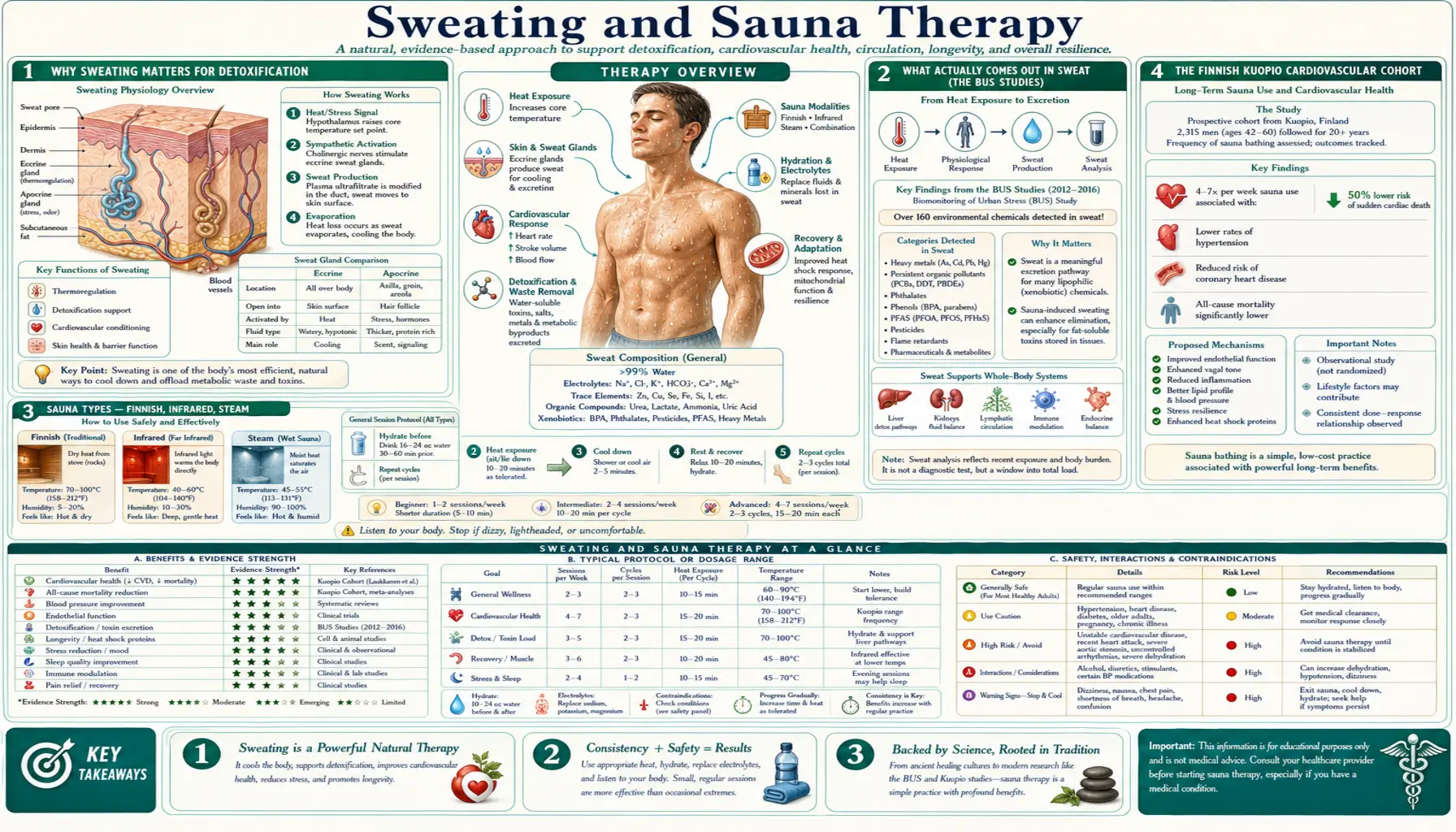
Sweat carries small amounts of metals and some industrial chemicals out of the body. Small descriptive studies led by Stephen Genuis at the University of Alberta (20 participants each, no comparison group) found arsenic, cadmium, lead, mercury, bisphenol A (BPA), phthalates and some PCB congeners in induced sweat — in some people at higher levels than in their blood or urine, or present in sweat when absent from serum — and a 2012 systematic review by Margaret Sears and colleagues called for properly sized trials. A 2019 review of sweat-gland physiology concluded that sweat's role in removing toxicants appears minor next to the kidneys and gut. Separately, the Finnish Kuopio Ischemic Heart Disease (KIHD) cohort found that men who used a sauna 4–7 times a week had lower rates of sudden cardiac death, fatal cardiovascular disease and all-cause death than men who used one once a week; it is an observational study and cannot show cause. The hazards reported in the research — alcohol, unstable heart disease, blood-pressure drops and heat in early pregnancy — are covered below.
Table of Contents
- Why Sweating Matters for Detoxification
- What Actually Comes Out in Sweat (the BUS Studies)
- Sauna Types — Finnish, Infrared, Steam
- The Finnish Kuopio Cardiovascular Cohort
- Frequency, Duration and Temperature Used in Studies
- Fluid and Electrolyte Losses
- Exercise-Induced Sweating as a Complement
- The Hubbard / Niacin Protocol Controversy
- Cautions and Contraindications
- Key Research Papers
- Connections
- Featured Videos
Why Sweating Matters for Detoxification
The body removes foreign chemicals mainly through urine and through bile into the stool; sweat is a third route, and how much it matters is disputed. Genuis's Blood, Urine and Sweat (BUS) papers concluded that many toxic elements “appeared to be preferentially excreted through sweat” and that blood or urine testing may underestimate the body burden. A 2019 review of sweat-gland physiology (Baker) reached a different conclusion about scale: the role of sweating in eliminating waste products and toxicants “seems to be minor” compared with the kidneys and gastrointestinal tract, sweat glands do not adapt to increase excretion, and studies suggesting a larger role “may be an artifact of methodological issues” such as contamination from the skin surface.
Humans have about 2–4 million eccrine sweat glands, on both hairless and hairy skin, with the highest densities on the palms and soles (Baker 2019). Eccrine sweat is mostly water, with sodium, chloride, potassium, lactate and urea; trace metals and organic pollutants are reported at low concentrations, and their measurement is easily distorted by material already on the skin.
The rationale offered by proponents is that some fat-soluble pollutants are stored in fat tissue and that heat mobilizes them into sweat. The authors of the BPA study proposed this for BPA; it was a hypothesis, not something the study measured.
What Actually Comes Out in Sweat (the BUS Studies)
The “BUS” studies — Blood, Urine, Sweat — led by Stephen Genuis at the University of Alberta are the most cited measurements. Each analysed paired blood, urine and induced-sweat samples from the same 20 participants (10 healthy, 10 with assorted health problems); the 2011 toxic-elements paper (Arch Environ Contam Toxicol 61:344-357) analysed approximately 120 compounds. Sweat was induced in an infrared sauna, a steam sauna or by exercise (in the BPA paper, 10, 7 and 3 participants respectively). Reported findings:
- Heavy metals — toxic elements were found to differing degrees in blood, urine and sweat; many appeared to be preferentially excreted through sweat, and some found in a participant's sweat were not found in their serum.
- BPA (bisphenol A) — found in the sweat of 16 of 20 participants, including some with no BPA detected in serum or urine. Sweat BPA did not differ significantly by collection method (exercise, infrared sauna or steam sauna).
- Phthalates — the metabolite MEHP was found in the blood, sweat and urine of every participant, and on average its concentration in sweat was more than twice the urine level; in several people the parent compound DEHP was found in sweat but not in serum.
- PCBs and perfluorinated compounds — some PCB congeners, but not all, appeared in sweat at varying concentrations; the most common perfluorinated compounds (PFHxS, PFOS, PFOA) did not appear to be excreted efficiently into sweat.
The Sears 2012 systematic review (J Environ Public Health, PubMed 22505948) included 24 of 122 records on arsenic, cadmium, lead and mercury in sweat. Populations, collection methods and concentrations varied widely. In people with higher exposure or body burden, sweat generally exceeded plasma or urine concentrations, and dermal excretion could match or surpass daily urinary excretion; cadmium was more concentrated in sweat than in plasma, and mercury levels normalized with repeated saunas in one case report. The authors wrote that sweating “deserves consideration” for toxic-element detoxification and that appropriately sized trials are needed to establish safe, effective protocols.
The limits of this evidence: each BUS study had 20 participants and no comparison group, and they measured concentrations in a sample rather than the total amount removed. None of the papers cited here is a randomized trial of sauna detoxification that measured toxicant levels; the one randomized pilot of a sauna-based regimen (Gulf War illness, below) measured symptoms. The 2019 physiology review notes that sweat-composition studies are prone to skin-surface contamination. The studies show that these substances can appear in sweat; whether the amounts matter clinically has not been established.
Sauna Types — Finnish, Infrared, Steam
A 2021 review (Patrick & Johnson) gives typical sauna temperatures of 45 °C to 100 °C (113–212 °F), depending on the type:
- Traditional Finnish (dry) sauna — a room heated by a stove, with low humidity. The KIHD acute-effects study used 73 °C at 10–20% humidity for 30 minutes, and a 2006 review of sauna experiments accepted those run at 80–90 °C. The Kuopio cohort findings come from Finnish men's habitual sauna use.
- Far-infrared (FIR) sauna — panels emit infrared radiation that warms the body at a lower air temperature. A 2009 review (Beever, Can Fam Physician, PubMed 19602651) found 9 relevant papers: limited moderate evidence for normalizing blood pressure and treating congestive heart failure, single-study evidence for chronic pain, chronic fatigue syndrome and obesity, and fair evidence refuting claims of cholesterol reduction. It noted that the health claims made for these products go beyond the published evidence.
- Steam room (humid sauna) — a room kept near saturation humidity at a lower air temperature than a dry sauna; sweat cannot evaporate into saturated air, so it gives little evaporative cooling.
No study cited here compared the amount of toxicants removed by the three types. In the BPA study, sweat BPA did not differ significantly between infrared sauna, steam sauna and exercise. Claims that far-infrared gives “deep tissue penetration” come from proponents and were not tested in these papers.
The cardiovascular and dementia associations below come from the Finnish cohort, so they describe Finnish-style sauna; far-infrared saunas and steam rooms were not studied there.
The Finnish Kuopio Cardiovascular Cohort
The Kuopio Ischemic Heart Disease Risk Factor Study (KIHD), from the University of Eastern Finland, is a population-based prospective cohort of 2,315 men aged 42–60 examined in 1984–1989; sauna habits were assessed once, at baseline. In the 2015 analysis (Laukkanen T et al., JAMA Intern Med 2015, PubMed 25705824), median follow-up was 20.7 years:
- 601 men reported one sauna session a week, 1,513 two to three, and 201 four to seven.
- After adjustment for cardiovascular risk factors, compared with one session a week, the hazard ratio for sudden cardiac death was 0.78 (95% CI 0.57–1.07, not statistically significant) for 2–3 sessions and 0.37 (0.18–0.75) for 4–7 sessions.
- The authors reported similar inverse associations for fatal coronary heart disease, fatal cardiovascular disease and all-cause mortality (P for trend ≤.005).
- Sessions longer than 19 minutes, compared with under 11 minutes, were associated with lower sudden cardiac death (hazard ratio 0.48, 0.31–0.75) and with lower fatal coronary and cardiovascular disease — but not with lower all-cause mortality.
- This is an observational study based on one baseline questionnaire, with only 201 men in the most frequent group; adjustment for risk factors cannot rule out that healthier men used saunas more. The authors wrote that further studies are needed to establish a mechanism.
A 2017 analysis of the same men (Laukkanen T et al., Age Ageing, PubMed 27932366) recorded 204 cases of dementia and 123 of Alzheimer's disease. Compared with one session a week, 4–7 sessions had hazard ratios of 0.34 (0.16–0.71) for dementia and 0.35 (0.14–0.90) for Alzheimer's disease; the 2–3-session group was not significantly different.
Later KIHD papers reported lower incident stroke with 4–7 sessions a week among 1,628 men and women (hazard ratio 0.38–0.39 depending on adjustment), lower incident hypertension (fully adjusted hazard ratio 0.53, 95% CI 0.28–0.98, for 4–7 sessions), and fewer hospital-diagnosed respiratory diseases (hazard ratio 0.73 for 2–3 and 0.59 for 4 or more sessions, against one or fewer).
On short-term effects, one 30-minute session at 73 °C in 102 adults with at least one cardiovascular risk factor lowered arterial stiffness (carotid-femoral pulse wave velocity from 9.8 to 8.6 m/s) and systolic blood pressure (from 137 to 130 mmHg). Reviews describe further proposed mechanisms — neuroendocrine, cardiovascular and cytoprotective responses to mild hyperthermia, and adaptation to repeated heat (hormesis) — which overlap with, but are separate from, detoxification.
Frequency, Duration and Temperature Used in Studies
None of the studies on this page tested one detoxification schedule against another. What they used or measured:
- Kuopio cohort: self-reported frequency (1, 2–3 or 4–7 sessions a week) and session length (under 11, 11–19 or over 19 minutes).
- KIHD short-term studies: one 30-minute session at 73 °C and 10–20% humidity; a crossover study compared 30 minutes of sauna at 75 °C with 15 minutes of cycling followed by 15 minutes of sauna.
- 2006 review of sauna experiments: 80–90 °C for five to 20 minutes, usually repeated one to three times.
- Hubbard-regimen pilot trial: daily for four to six weeks — 20–30 minutes of moderate aerobic exercise, then two to four hours of intermittent sweating in a 60–80 °C sauna with cool-off breaks, showers, fluids and electrolytes.
- BUS studies: sweat induced in an infrared sauna, a steam sauna or by exercise.
Some practitioners pair sauna with oral binders (chlorella, activated charcoal or cholestyramine) on the theory that the binder holds compounds excreted in bile while sweat provides a second route; none of the studies cited here tested that combination. Binders are covered on the Binders: Charcoal & Chlorella page.
Fluid and Electrolyte Losses
A 2019 review of sweat physiology gives sweat concentrations of roughly 10–90 mmol/L for sodium and for chloride and 2–8 mmol/L for potassium, with smaller amounts of calcium and trace minerals. It found that people with high sweat sodium (for example, with cystic fibrosis) are at increased risk of salt imbalance during prolonged heavy sweating, while sweat-induced deficiencies “appear to be of minimal risk” for trace minerals and vitamins.
In the KIHD short-term study, blood sodium and potassium stayed constant through one 30-minute session, while plasma creatinine rose slightly. The Gulf War pilot trial of a multi-hour daily regimen supplied fluids and electrolytes; one participant, who had a history of bowel resection, developed moderate hypokalemia (low potassium).
A 2006 review found that blood-pressure-lowering medication may predispose to orthostatic hypotension (a fall in blood pressure on standing) after bathing. In Finnish deaths that occurred in saunas, heat exposure itself was the cause of death in a quarter of cases (see Cautions).
Exercise-Induced Sweating as a Complement
Exercise also produces sweat, and the BUS studies included participants who collected sweat during exercise; in the BPA paper, sweat BPA did not differ significantly between exercise, infrared sauna and steam sauna. A 2022 study of 12 university students compared sweat from treadmill running with sweat from sitting in a sauna cabinet: nickel, lead, copper and arsenic concentrations were significantly higher in exercise sweat, while mercury did not differ. Its authors suggested that dynamic exercise may remove heavy metals more effectively than static heat exposure.
On cardiovascular measures, a crossover study of 72 adults with cardiovascular risk factors found that 30 minutes of sauna, and 15 minutes of cycling followed by 15 minutes of sauna, produced comparable short-term changes in blood pressure and arterial stiffness. In the KIHD cohort (2,277 men), those with both high cardiorespiratory fitness and frequent sauna use (3–7 sessions a week) had lower cardiovascular mortality than men low on both (hazard ratio 0.42), compared with 0.50 for high fitness alone and 0.72 for frequent sauna alone.
The Hubbard / Niacin Protocol Controversy
A regimen developed by L. Ron Hubbard in the 1970s — published papers call it the Hubbard regimen — combines gradually increasing doses of immediate-release niacin (nicotinic acid), 20–30 minutes of aerobic exercise and two to four hours a day of intermittent low-temperature sauna, with electrolytes, oils and multivitamins, for four to six weeks. Proponents describe it as a way to clear drug residues and stored environmental chemicals. A 2007 pilot report in World Trade Center rescue workers (Dahlgren, Cecchini and colleagues, Chemosphere) measured PCBs, dioxins and furans before and after a detoxification program and reported reductions in several congeners, some statistically significant “despite the small study size”; the authors called for a larger treatment study.
The one randomized trial found is a 2019 pilot in 32 veterans with Gulf War illness, assigned to the regimen (22) or a four-week waitlist (10). All 32 completed it. The physical-component quality-of-life score was 6.9 points higher than in the waitlist group, with a confidence interval that included no difference (−0.3 to 14.2); 11 of 16 quality-of-life, pain and fatigue measures improved, and no serious adverse events were recorded. Participants and staff could not be blinded, and toxicant levels were not reported.
In that trial the niacin dose was raised each day until it no longer produced a flush or other reactions, which most often happened at 5,000 mg a day for the last few days. Participants were told to expect a hot, red, itchy flush lasting up to an hour or longer. The trial authors cite niacin's effect on fat tissue — lipolysis inhibited for about an hour, then a large increase in free-fatty-acid release — as part of the rationale; the idea that the flush itself releases stored toxins is the proponents' and has not been tested. The trial excluded people with liver disease, kidney disease and most heart disease. In a separate large trial in statin-treated patients with vascular disease (HPS2-THRIVE, 25,673 adults), 2 g a day of extended-release niacin with laropiprant did not reduce major vascular events and increased serious adverse events, including musculoskeletal, gastrointestinal, skin, infection, bleeding and diabetes-related events.
Cautions and Contraindications
- Unstable angina, recent myocardial infarction, severe aortic stenosis — listed as contraindications in a 2001 review, which also found sauna safe for most people with stable coronary heart disease or an old myocardial infarction. A 2006 review found sauna not particularly risky for patients with hypertension, coronary heart disease or congestive heart failure who were medicated and stable.
- Blood-pressure medication — the 2006 review found that antihypertensive medication may predispose to orthostatic hypotension after bathing; medication in general was otherwise of no concern during a bath.
- Pregnancy — the evidence conflicts. A US cohort of 23,491 women found heat exposure in early pregnancy associated with neural tube defects; the association was strongest for hot tubs (adjusted relative risk 2.8), while for sauna alone it was 1.8 with a confidence interval that included no effect (0.4–7.9). Finnish reviews found sauna safe in the uncomplicated pregnancies of healthy women and found no adverse effects apart from toxemia cases; another review lists early pregnancy as a potential concern because hyperthermia might be teratogenic.
- Alcohol — among deaths in Finnish saunas in 1990–2002 (an annual rate under 2 per 100,000 people), half of those who died were under the influence of alcohol, and heat exposure was the cause of death in 25%. The 2001 review found that alcohol during sauna bathing increases the risk of hypotension, arrhythmia and sudden death, and states that it should be avoided.
- Niacin with statins — see the HPS2-THRIVE findings in the section above.
- Children and older adults — the 2006 review found sauna well tolerated by healthy people from childhood to old age, while noting that most of the data came from uncontrolled studies of people used to sauna since childhood.
- Other situations — fever, seizure disorders, implanted devices and insulin pumps are sometimes listed as cautions; the reviews cited here do not address them.
Decisions about sauna use with a heart condition, during pregnancy or alongside medication belong with a clinician.
Key Research Papers
- Genuis SJ, Birkholz D, Rodushkin I, Beesoon S. Blood, urine, and sweat (BUS) study: monitoring and elimination of bioaccumulated toxic elements. Arch Environ Contam Toxicol. 2011;61(2):344-357. — PubMed PMID: 21057782
- Sears ME, Kerr KJ, Bray RI. Arsenic, cadmium, lead, and mercury in sweat: a systematic review. J Environ Public Health. 2012;2012:184745. — PubMed PMID: 22505948
- Genuis SJ, Beesoon S, Lobo RA, Birkholz D. Human elimination of phthalate compounds: blood, urine, and sweat (BUS) study. ScientificWorldJournal. 2012;2012:615068. — PubMed PMID: 23213291
- Genuis SJ, Beesoon S, Birkholz D, Lobo RA. Human excretion of bisphenol A: blood, urine, and sweat (BUS) study. J Environ Public Health. 2012;2012:185731. — PubMed PMID: 22253637
- Laukkanen T, Khan H, Zaccardi F, Laukkanen JA. Association between sauna bathing and fatal cardiovascular and all-cause mortality events. JAMA Intern Med. 2015;175(4):542-548. — PubMed PMID: 25705824
- Laukkanen T, Kunutsor S, Kauhanen J, Laukkanen JA. Sauna bathing is inversely associated with dementia and Alzheimer's disease in middle-aged Finnish men. Age Ageing. 2017;46(2):245-249. — PubMed PMID: 27932366
- Laukkanen T, Kunutsor SK, Zaccardi F, et al. Acute effects of sauna bathing on cardiovascular function. J Hum Hypertens. 2018;32(2):129-138. — PubMed PMID: 29269746
- Patrick RP, Johnson TL. Sauna use as a lifestyle practice to extend healthspan. Exp Gerontol. 2021;154:111509. — PubMed PMID: 34363927
- Crinnion WJ. Sauna as a valuable clinical tool for cardiovascular, autoimmune, toxicant-induced and other chronic health problems. Altern Med Rev. 2011;16(3):215-225. — PubMed PMID: 21951023
- Beever R. Far-infrared saunas for treatment of cardiovascular risk factors: summary of published evidence. Can Fam Physician. 2009;55(7):691-696. — PubMed PMID: 19602651
- Hannuksela ML, Ellahham S. Benefits and risks of sauna bathing. Am J Med. 2001;110(2):118-126. — PubMed PMID: 11165553
- Dahlgren J, Cecchini M, Takhar H, Paepke O. Persistent organic pollutants in 9/11 World Trade Center rescue workers: reduction following detoxification. Chemosphere. 2007;69(8):1320-1325. (Replaces an entry for a 2006 Cecchini firefighter paper that could not be found in PubMed or Crossref.) — PubMed PMID: 17234251
- Genuis SJ, Beesoon S, Birkholz D. Biomonitoring and elimination of perfluorinated compounds and polychlorinated biphenyls through perspiration: blood, urine, and sweat study. ISRN Toxicol. 2013;2013:483832. — PubMed PMID: 24083032
- Baker LB. Physiology of sweat gland function: the roles of sweating and sweat composition in human health. Temperature (Austin). 2019;6(3):211-259. — PubMed PMID: 31608304
- Kuan WH, Chen YL, Liu CL. Excretion of Ni, Pb, Cu, As, and Hg in sweat under two sweating conditions. Int J Environ Res Public Health. 2022;19(7):4323. — PubMed PMID: 35410004
- Kunutsor SK, Khan H, Zaccardi F, et al. Sauna bathing reduces the risk of stroke in Finnish men and women: a prospective cohort study. Neurology. 2018;90(22):e1937-e1944. — PubMed PMID: 29720543
- Zaccardi F, Laukkanen T, Willeit P, et al. Sauna bathing and incident hypertension: a prospective cohort study. Am J Hypertens. 2017;30(11):1120-1125. — PubMed PMID: 28633297
- Kunutsor SK, Laukkanen T, Laukkanen JA. Sauna bathing reduces the risk of respiratory diseases: a long-term prospective cohort study. Eur J Epidemiol. 2017;32(12):1107-1111. — PubMed PMID: 28905164
- Kunutsor SK, Khan H, Laukkanen T, Laukkanen JA. Joint associations of sauna bathing and cardiorespiratory fitness on cardiovascular and all-cause mortality risk: a long-term prospective cohort study. Ann Med. 2018;50(2):139-146. — PubMed PMID: 28972808
- Lee E, Kostensalo J, Willeit P, et al. Standalone sauna vs exercise followed by sauna on cardiovascular function in non-naïve sauna users: a comparison of acute effects. Health Sci Rep. 2021;4(4):e393. — PubMed PMID: 34622026
- Kerr K, Morse G, Graves D, et al. A detoxification intervention for Gulf War illness: a pilot randomized controlled trial. Int J Environ Res Public Health. 2019;16(21):4143. — PubMed PMID: 31661809
- HPS2-THRIVE Collaborative Group; Landray MJ, Haynes R, Hopewell JC, et al. Effects of extended-release niacin with laropiprant in high-risk patients. N Engl J Med. 2014;371(3):203-212. — PubMed PMID: 25014686
- Kukkonen-Harjula K, Kauppinen K. Health effects and risks of sauna bathing. Int J Circumpolar Health. 2006;65(3):195-205. — PubMed PMID: 16871826
- Milunsky A, Ulcickas M, Rothman KJ, et al. Maternal heat exposure and neural tube defects. JAMA. 1992;268(7):882-885. — PubMed PMID: 1640616
- Kenttämies A, Karkola K. Death in sauna. J Forensic Sci. 2008;53(3):724-729. — PubMed PMID: 18471223