Liver Phase 1 and Phase 2 Biotransformation
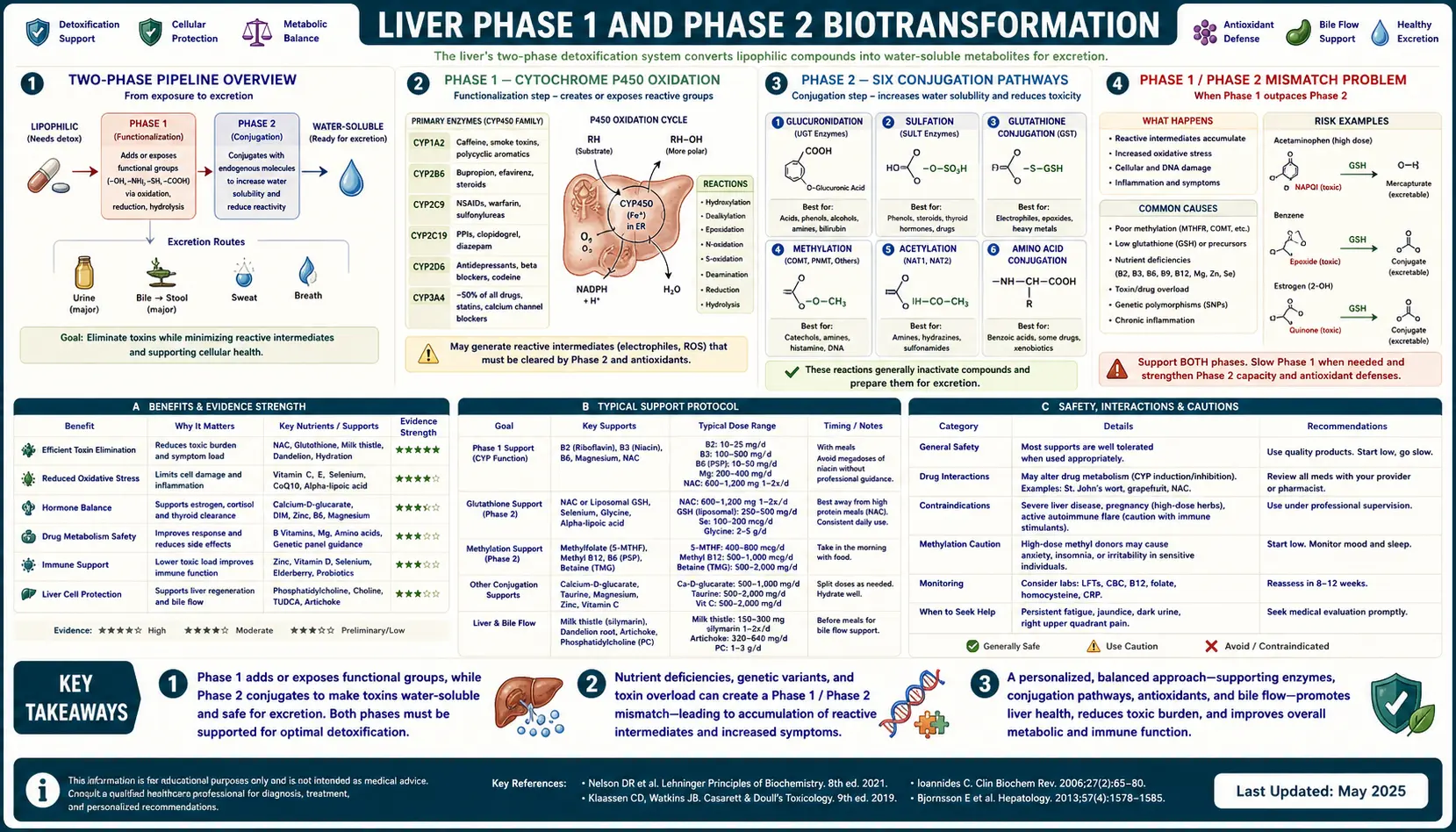
The body is exposed to many foreign compounds (xenobiotics) — from food components to environmental chemicals to drugs — and the liver handles many of the fat-soluble ones in two broad steps. Phase 1 is mainly oxidation by cytochrome P450 (CYP) enzymes, which add or expose a reactive group on the molecule. Phase 2 is conjugation: transferase enzymes attach a water-soluble group (glucuronic acid, sulfate, glutathione, an acetyl or methyl group, or an amino acid), and the conjugates are generally more water-soluble and more easily excreted than the parent compound. Reviews of P450 toxicology describe both faces of Phase 1: it often makes a drug less harmful, but it can also convert (“bioactivate”) a chemical into a reactive, more toxic product, which Phase 2 enzymes such as the glutathione S-transferases help to neutralize.
Table of Contents
- The Two-Phase Pipeline Overview
- Phase 1: Cytochrome P450 Oxidation
- Phase 2: The Six Conjugation Pathways
- The Phase 1 / Phase 2 Mismatch Problem
- Genetic Polymorphisms (CYP, NAT2, COMT, GST)
- Nutrient Cofactor Requirements
- Foods, Herbs, and Supplements Studied
- Drug-Drug-Food Interactions (the Practical Stakes)
- Testing Phase 1 / Phase 2 Function
- Cautions and Contraindications
- Key Research Papers
- Connections
- Featured Videos
The Two-Phase Pipeline Overview
Many xenobiotics are fat-soluble (lipophilic), while the body excretes waste mainly in water-based fluids — urine and bile. Phase 2 conjugates are generally more hydrophilic than their parent compounds and are eliminated more easily through bile or urine (Jancova 2010).
The two main enzyme systems — the NADPH-cytochrome P450 reductase / cytochrome P450 system for Phase 1 and the UDP-glucuronosyltransferases (UGTs) for Phase 2 — are both located in the endoplasmic reticulum, where many drugs are metabolized in sequence (Iyanagi 2007):
- Phase 1 (Functionalization) — cytochrome P450 enzymes oxidize the molecule, adding or exposing a functional group. Guengerich's 2008 review describes many well-defined examples in which this step decreases a drug's adverse effects, and an equally large field in which it bioactivates chemicals, including drugs, into reactive products. CYP2E1 is a prominent example: Lieber's 1997 review lists 85 xenobiotics that it can activate to hepatotoxic or carcinogenic products, and its oxidation of ethanol produces acetaldehyde, a highly reactive and toxic metabolite.
- Phase 2 (Conjugation) — transferase enzymes attach a polar group to the molecule. Jancova and colleagues describe Phase 2 reactions as generally serving as a detoxifying step, producing conjugates that are more hydrophilic than the parent compounds, and note that reduced Phase 2 capacity can lead to toxic effects of clinically used drugs.
A third stage, sometimes called Phase 3 (transport), covers the membrane pumps that move conjugates out of liver cells. For acetaminophen, the glucuronide, sulfate and glutathione conjugates are excreted by transporters in the canalicular membrane facing bile (MRP2 and BCRP) and in the basolateral membrane facing blood (MRP3 and MRP4) (McGill 2013). Transporters are also part of drug interactions: rifampicin induces intestinal and hepatic P-glycoprotein and can lower the levels of a drug that is not metabolized at all, such as digoxin (Niemi 2003).
Phase 1: Cytochrome P450 Oxidation
The human genome carries 57 CYP genes in 18 families (Nebert 2013). Of the 57 putatively functional human CYPs, only about a dozen, in the CYP1, CYP2 and CYP3 families, are responsible for the biotransformation of most foreign substances, including 70–80% of all drugs in clinical use; the forms most highly expressed in the liver are CYP3A4, 2C9, 2C8, 2E1 and 1A2 (Zanger 2013). The enzymes are heme proteins — Omura and Sato's 1964 work on the “carbon monoxide-binding pigment of liver microsomes” established its hemoprotein nature — and they receive electrons from NADPH-cytochrome P450 reductase (Iyanagi 2007).
Enzymes discussed on this page:
- CYP3A4 — present in both the liver and the small intestine. Markowitz and colleagues describe CYP3A4 substrates as at least 50% of all marketed medications. It is induced by St John's wort (Markowitz 2003) and rifampicin (Niemi 2003), and inhibited in the intestine by grapefruit furanocoumarins (Paine 2006; Bailey 2013) and by the antibiotic clarithromycin (Lee 2001).
- CYP2D6 — metabolizes about 20–25% of clinically used drugs; its genetic polymorphism produces poor, intermediate, efficient and ultrarapid metabolizers (Ingelman-Sundberg 2005).
- CYP2C9 — its substrates include (S)-warfarin and the sulfonylurea diabetes drugs, whose levels rifampicin lowers by inducing CYP2C-mediated metabolism (Niemi 2003).
- CYP2C19 — involved in activating clopidogrel, a prodrug that requires CYP450 biotransformation; carriers of reduced-function CYP2C19 alleles treated with clopidogrel had more major cardiovascular events (Mega 2010; details under Genetic Polymorphisms).
- CYP1A2 — substrates include caffeine, clozapine, fluvoxamine, olanzapine, tacrine and theophylline; it is induced by the polycyclic aromatic hydrocarbons (PAHs) in tobacco smoke (Kroon 2007).
- CYP2E1 — the ethanol-inducible enzyme of the microsomal ethanol-oxidizing system, with physiological roles in lipid metabolism and ketone use (Lieber 1997). CYP2E1 and other P450s convert part of an acetaminophen dose to a reactive intermediate (McGill 2013).
When reactive Phase 1 products are not detoxified, they can damage cells. In acetaminophen toxicity, the reactive metabolite depletes liver glutathione and binds cellular proteins, and the protein binding leads to oxidative stress and mitochondrial damage (McGill 2013). Guengerich lists the overall contribution of bioactivation to idiosyncratic drug reactions as one of the field's unresolved problems (Guengerich 2008).
Phase 2: The Six Conjugation Pathways
Jancova's 2010 review lists six conjugation reactions — glucuronidation, sulfation, methylation, acetylation, glutathione conjugation and amino acid conjugation — carried out mostly by transferase enzymes:
- Glucuronidation (UGT enzymes; donor UDP-glucuronic acid, UDPGA) — in humans, conjugation with glucuronic acid is described as by far the most important of these pathways (Jancova 2010). Most of an acetaminophen dose is eliminated by glucuronidation (UGT1A1 and 1A6) and sulfation (McGill 2013). UGT1A1 is the only enzyme that contributes substantially to bilirubin glucuronidation; in Gilbert syndrome, hepatic glucuronidating activity is reduced to about 30% of normal (Bosma 1995). Jancova's review puts Gilbert syndrome at approximately 10% of the population.
- Sulfation (SULT enzymes; donor 3'-phosphoadenosine-5'-phosphosulfate, PAPS) — PAPS is the universal sulfonate donor for all sulfonation reactions and can be synthesized by all mammalian tissues. Sulfonation handles steroids, catecholamines, serotonin, iodothyronines and other small endogenous molecules, as well as drugs (Jancova 2010).
- Glutathione conjugation (GST enzymes; cofactor glutathione) — GSTs form thioether conjugates between glutathione and hydrophobic, electrophilic compounds and play a major role in detoxifying epoxides derived from polycyclic aromatic hydrocarbons and alpha-beta unsaturated ketones (Jancova 2010). Glutathione is the most abundant non-protein thiol in mammalian tissues; its synthesis depends on the availability of the sulfur amino acid cysteine and on the rate-limiting enzyme glutamate cysteine ligase (Lu 2013). The reactive acetaminophen metabolite depletes liver glutathione (McGill 2013), and alcoholism with its associated malnutrition has been proposed to lower glutathione concentrations (Seeff 1986).
- Acetylation (NAT1 and NAT2; donor acetyl-coenzyme A) — acetylates aromatic amines and hydrazines. NAT2 is a major route for the detoxification of isoniazid, hydralazine and sulfonamide antibiotics, and variation in the NAT genes produces slow, intermediate and rapid acetylator phenotypes (Jancova 2010).
- Methylation (COMT, TPMT and others; donor S-adenosylmethionine, SAMe) — COMT transfers a methyl group from SAMe to catecholamines, and TPMT methylates the thiopurine drugs 6-mercaptopurine, 6-thioguanine and azathioprine (Jancova 2010). COMT also inactivates catechol drugs such as L-DOPA (Lachman 1996).
- Amino acid conjugation (mainly glycine) — glycine N-acyltransferase (GLYAT) conjugates glycine to acyl-CoA intermediates, a pathway that maintains free coenzyme A; only a small number of pharmaceutical drugs are conjugated to glycine (Badenhorst 2013). The preservative benzoate is conjugated to glycine to form hippurate; Badenhorst and colleagues argue in a 2014 review that this glycine conjugation of dietary benzoate worsens a dietary glycine shortage in humans.
The Phase 1 / Phase 2 Mismatch Problem
A recurring theme in toxicology reviews is that harm depends on the balance between activation and detoxification. Hayes and Pulford note that many compounds that induce glutathione S-transferases are themselves GST substrates, or are converted by cytochrome P450 into GST substrates, and they interpret GST induction as part of an adaptive response to chemical stress caused by electrophiles (Hayes 1995).
Examples from the research:
- NAT2 slow acetylation and bladder cancer — in the Spanish Bladder Cancer Study (1,150 patients, 1,149 controls), NAT2 slow acetylators had a higher overall risk of bladder cancer than rapid or intermediate acetylators (odds ratio 1.4, 95% CI 1.2–1.7), and the association was stronger in cigarette smokers; meta-analyses supported both the NAT2 association and the NAT2–smoking interaction (García-Closas 2005). Hein's review describes slow-NAT2 genotypes with bladder cancer and rapid-NAT2 genotypes with colorectal cancer as the most consistently reported associations, with small individual risks that increase alongside aromatic and heterocyclic amine exposures (Hein 2000).
- Chronic alcohol use and acetaminophen — a 1986 report described 25 chronic alcoholics (6 treated by the authors and 19 from the literature) who developed severe liver injury from acetaminophen taken in apparently moderate doses. The authors proposed two explanations: induction by chronic alcohol of the P450 system that converts acetaminophen to its toxic metabolite, or reduced glutathione from alcoholism and associated malnutrition. They described ethanol-potentiated acetaminophen hepatotoxicity as infrequent (Seeff 1986).
- Tobacco smoke and CYP1A2 — PAHs in tobacco smoke are believed to induce CYP1A1, CYP1A2 and possibly CYP2E1, and Zevin and Benowitz note that enzymes induced by smoking may also increase cancer risk by enhancing the metabolic activation of carcinogens (Zevin 1999). Crucifers such as broccoli contain compounds that induce Phase 2 enzymes, including glutathione transferases, epoxide hydrolase, NAD(P)H:quinone reductase and glucuronosyltransferases (Fahey 1997).
- Benzene — benzene causes acute leukemia; Smith's 2010 review describes a multimodal mechanism involving multiple metabolites whose roles are still being worked out, polymorphisms in candidate genes that confer susceptibility, and no evidence of a threshold dose (Smith 2010). In the Qidong broccoli-sprout trial, excretion of the benzene-derived glutathione conjugate was higher in GSTT1-positive participants than in those with the null genotype, irrespective of study arm (Egner 2014).
The sources reviewed here give no validated way to measure this balance in an individual. Hodges and Minich's 2015 review of foods and detoxification pathways notes that many nutrients exert biphasic, dose-dependent effects and that genetic polymorphisms may alter outcomes, and it calls for caution given the limits of current research.
Genetic Polymorphisms (CYP, NAT2, COMT, GST)
Inherited variation in these enzymes is common and differs by ancestry: a pooled analysis of more than 15,000 control subjects found major differences in the frequencies of CYP1A1, CYP2E1, CYP2D6, GSTM1, GSTT1, NAT2, GSTP and EPHX variants between Caucasian, Asian and African or African-American populations (Garte 2001). Examples:
- CYP2D6 — the ultrarapid-metabolizer phenotype, in which more than one active gene sits on one allele, affects about 5.5% of people in Western Europe, and Ingelman-Sundberg suggests it arose through dietary selection in populations in North East Africa. At ordinary doses the polymorphism can produce either adverse drug reactions or no drug response (Ingelman-Sundberg 2005).
- CYP2C19 — in a meta-analysis of 9,685 clopidogrel-treated patients (91.3% had undergone percutaneous coronary intervention), 26.3% carried one reduced-function CYP2C19 allele and 2.2% carried two. Compared with non-carriers, the risk of cardiovascular death, heart attack or stroke was higher with one allele (HR 1.55, 95% CI 1.11–2.17) and with two (HR 1.76, 1.24–2.50), and stent thrombosis was also more frequent in both groups (Mega 2010).
- NAT2 — the frequency of slow-acetylator mutations depends on racial and ethnic origin (Jancova 2010). The 2025 Clinical Pharmacogenetics Implementation Consortium guideline states that NAT2 poor metabolizers (“slow acetylators”) are predicted to have higher plasma hydralazine concentrations, which may lead to both greater efficacy and more adverse effects, including drug-induced lupus (Eadon 2025).
- COMT Val158Met — a G-to-A change at codon 158 that substitutes methionine for valine accounts for a common three-to-four-fold variation in COMT enzyme activity (Lachman 1996).
- GSTM1 and GSTT1 deletions — in the Spanish Bladder Cancer Study, deletion of both copies of GSTM1 was associated with higher bladder-cancer risk (odds ratio 1.9, 95% CI 1.4–2.7), while no significant association was found for GSTT1 (García-Closas 2005).
- UGT1A1 (Gilbert syndrome) — people with Gilbert syndrome in a 1995 study were homozygous for two extra bases (TA) in the promoter of the UGT1A1 gene (A(TA)7TAA instead of A(TA)6TAA, the variant called UGT1A1*28); the longer allele had a frequency of 40% among 55 normal subjects (Bosma 1995). In an FDA analysis of irinotecan-treated cancer patients, the homozygous 7/7 genotype was associated with a lower neutrophil-count nadir, and the irinotecan label was modified to describe the UGT1A1*28 risk of severe neutropenia, with lower starting doses for 7/7 homozygotes (Ramchandani 2007).
Commercial genotyping services report some of these variants. Zanger and Schwab describe polymorphisms in CYP2D6, 2C19, 2C9, 2B6, 3A5 and 2A6 as having growing evidence of clinical significance, while polymorphisms in CYP1A1, 1A2, 2C8, 2E1, 2J2 and 3A4 are generally less predictive (Zanger 2013).
Nutrient Cofactor Requirements
Each pathway depends on a donor molecule or cofactor:
- Phase 1 (CYP450): the heme of the P450 enzyme (Omura and Sato 1964) and electrons from NADPH, delivered by NADPH-cytochrome P450 reductase (Iyanagi 2007).
- Glucuronidation: UDP-glucuronic acid (UDPGA) (Jancova 2010).
- Sulfation: PAPS, the universal sulfonate donor (Jancova 2010).
- Glutathione conjugation: glutathione, whose synthesis depends on cysteine availability and on glutamate cysteine ligase; the transcription factors Nrf2, AP-1 and NF-κB regulate the genes for its synthesis (Lu 2013).
- Acetylation: acetyl-coenzyme A (Jancova 2010).
- Methylation: S-adenosylmethionine (Jancova 2010).
- Amino acid conjugation: glycine, used by glycine N-acyltransferase (Badenhorst 2013).
The sources reviewed here do not establish that ordinary dietary intake limits any of these pathways in healthy people. Lu's review lists conditions in which glutathione synthesis is dysregulated, including diabetes, pulmonary and liver fibrosis, alcoholic liver disease, cholestatic liver injury and endotoxemia (Lu 2013), and Badenhorst and colleagues argue that benzoate conjugation draws on dietary glycine (Badenhorst 2014).
Foods, Herbs, and Supplements Studied
The following have been studied for effects on Phase 1 and Phase 2 enzymes. Several findings come from cell or animal studies, as noted.
- Cruciferous vegetables and broccoli sprouts — crucifers such as broccoli and cauliflower contain isothiocyanates, mostly in the form of their glucosinolate precursors, and some, such as sulforaphane, are very potent inducers of Phase 2 enzymes. A 1997 study found that 3-day-old sprouts of certain broccoli and cauliflower cultivars contained 10 to 100 times more glucoraphanin — the glucosinolate precursor of sulforaphane, not sulforaphane itself — than the corresponding mature plants. The same study reported that sprouts of many broccoli cultivars contain negligible indole glucosinolates, which predominate in the mature vegetable and may give rise to degradation products such as indole-3-carbinol that can enhance tumorigenesis, and that sprout extracts reduced mammary tumors in carcinogen-treated rats (an animal study) (Fahey 1997). In humans, a 12-week randomized trial in 291 adults in Qidong, China, used a broccoli-sprout beverage supplying 600 μmol glucoraphanin and 40 μmol sulforaphane daily; compared with placebo, urinary excretion of the glutathione-derived conjugates of benzene rose 61% and of acrolein 23%, with no change for crotonaldehyde (Egner 2014). In ApcMin/+ mice, a sulforaphane-supplemented diet reduced the number and size of intestinal polyps (Hu 2006). Many Phase 2 inducers act through the Keap1–Nrf2–ARE pathway, in which oxidative or electrophilic signals release the transcription factor Nrf2 from Keap1 so that it switches on several dozen cytoprotective genes (Hayes 1995; Kensler 2007).
- Garlic — diallyl sulfide, a major flavor compound in garlic, and its metabolites inhibited and inactivated CYP2E1 in rat liver microsomes and in the purified enzyme; this is laboratory evidence, not a human result (Brady 1991).
- Milk thistle (silymarin / silibinin) — a 2001 systematic review described silymarin's effects on cell-membrane permeability, inhibition of the 5-lipoxygenase pathway, scavenging of reactive oxygen species and suppression of NF-κB. Pooled case-record data on 452 patients with Amanita phalloides mushroom poisoning showed mortality of 9.8% with silibinin versus 18.3% with standard treatment. Trials in toxic (for example solvent-related) or drug-induced liver disease were mostly outdated and underpowered and did not allow valid conclusions; in cirrhosis, silymarin produced a non-significant reduction in total mortality and a significant reduction in liver-related mortality (Saller 2001).
- Turmeric (curcumin) — in human liver-derived HepG2 cells, curcumin increased expression of glutathione S-transferase P1 through the antioxidant response element and Nrf2 (a cell study) (Nishinaka 2007). In mice given 250 mg/kg orally for 15 days, liver GST activity rose 1.8-fold, with no significant effect in other tissues (an animal study) (Susan 1992).
- N-acetylcysteine (NAC) — remains the only FDA-approved antidote for acetaminophen overdose, given orally or intravenously. Its standard regimen is highly effective for moderate overdoses treated within 8 hours of ingestion, and less effective for late presentation or very large overdoses (Akakpo 2022).
- Glycine — the amino acid used in glycine conjugation (Badenhorst 2013).
Drug-Drug-Food Interactions (the Practical Stakes)
Biotransformation enzymes and transporters are the mechanism behind many clinically important drug interactions. Examples from the research:
- Grapefruit — furanocoumarins in grapefruit are metabolized by CYP3A4 to reactive intermediates that bind covalently to the enzyme and inactivate it irreversibly; intestinal CYP3A4 activity stays impaired until new enzyme is synthesized. One whole grapefruit or 200 mL of juice can be enough to cause a clinically relevant rise in drug levels, and more than 85 drugs are known or predicted to interact. In one study felodipine levels averaged 3 times those seen with water; with 200 mL of juice once daily for 3 days, simvastatin exposure (AUC) was 330% of that with water (Bailey 2013). A trial that removed about 99% of the furanocoumarins from grapefruit juice identified them as the active ingredients behind the juice–felodipine interaction (Paine 2006).
- St John's wort — in 12 healthy volunteers, 14 days of St John's wort (300 mg three times daily) halved the area under the curve of alprazolam, a CYP3A4 probe, doubled its clearance and shortened its half-life from 12.4 to 6.0 hours, while CYP2D6 activity did not change significantly. The authors concluded that long-term use may reduce the effectiveness of CYP3A4 substrates or raise their dose requirements (Markowitz 2003).
- Tobacco smoke — the main pharmacokinetic interactions involve CYP1A2 substrates such as caffeine, clozapine, fluvoxamine, olanzapine, tacrine and theophylline. Kroon's review states that smokers may require higher dosages of interacting medications and that a dosage reduction may be needed after quitting (Kroon 2007).
- Rifampicin (rifampin) — induces CYP3A4 in the liver and small intestine, CYP2C enzymes and P-glycoprotein. Full induction is reached in about a week and dissipates roughly 2 weeks after stopping. Oral midazolam, triazolam, simvastatin, verapamil and most dihydropyridine calcium-channel blockers are ineffective during rifampicin treatment; use with the HIV protease inhibitors indinavir, nelfinavir and saquinavir is contraindicated; it can cause acute transplant rejection in patients on cyclosporin, opioid withdrawal in patients on methadone, and lower levels of (S)-warfarin and sulfonylureas. Levels of other drugs rise again as the induction wears off (Niemi 2003).
- Ritonavir — used as a pharmacokinetic enhancer in ritonavir-boosted protease-inhibitor regimens for HIV (Sherman 2011).
- Clarithromycin and other macrolide antibiotics — clarithromycin is a potent inhibitor of CYP3A4, the main enzyme that metabolizes simvastatin. A 2001 case report described rhabdomyolysis with clarithromycin and simvastatin, and the authors note earlier reports with other macrolide–statin combinations; the risk is described as greatest with renal insufficiency or other drugs associated with myopathy (Lee 2001).
Niemi and colleagues write that potential drug interactions need to be considered whenever rifampicin is started or stopped. Decisions about medicines and supplements belong with a clinician.
Testing Phase 1 / Phase 2 Function
Liska's 1998 review of the detoxification enzyme systems also covers laboratory tests used to assess them (Liska 1998). Approaches described in the research:
- Caffeine as a probe drug — caffeine demethylation, measured by blood clearance or urinary metabolites, has been used as an in vivo marker of CYP1A2 activity and clearly shows the effect of smoking (Zevin 1999).
- Other probe drugs — research studies use alprazolam pharmacokinetics as a CYP3A4 probe and the urinary dextromethorphan-to-dextrorphan ratio as a CYP2D6 probe (Markowitz 2003).
- Urinary organic acids — a urine organic-acid screen identified 5-oxoproline (pyroglutamic acid), an intermediate of the gamma-glutamyl cycle, at 58 times normal in a patient who developed high-anion-gap acidosis after receiving 20.8 g of acetaminophen over 10 days (a case report) (Humphreys 2005).
- Genotyping — tests for CYP, GST, NAT2, COMT and UGT1A1 variants; prescribing guidance based on NAT2 genotype exists for hydralazine (Eadon 2025), and the irinotecan label addresses UGT1A1*28 (Ramchandani 2007).
- Liver enzymes (ALT, AST, GGT, ALP, bilirubin) — serum GGT is commonly used as a marker of excessive alcohol intake or liver disease. Cellular GGT breaks down extracellular glutathione so that its amino acids can be reused, and Lee and colleagues' epidemiological studies suggest that serum GGT within the normal range may be an early, sensitive marker related to oxidative stress (Lee 2004).
Cautions and Contraindications
The research raises concerns in several situations:
- Narrow-therapeutic-window medication — rifampicin can cause acute transplant rejection in patients on cyclosporin and lowers (S)-warfarin levels (Niemi 2003); St John's wort halved alprazolam exposure (Markowitz 2003); and grapefruit raises felodipine and simvastatin levels (Bailey 2013). Enzyme inducers and inhibitors can therefore change serum levels of drugs where small changes matter.
- Acetaminophen with heavy alcohol use — case reports describe severe liver injury in chronic alcoholics taking apparently moderate acetaminophen doses; the authors of the 1986 report advised that alcoholics be cautioned about acetaminophen while they continue heavy drinking (Seeff 1986).
- Chemotherapy — concern that antioxidant supplements could reduce the cytotoxicity of chemotherapy led to a prospective study within a breast-cancer chemotherapy trial (1,134 patients). Use of any antioxidant supplement both before and during treatment was associated with a higher hazard of recurrence (adjusted HR 1.41, 95% CI 0.98–2.04, P = 0.06, not statistically significant); vitamin B12 use before and during treatment was associated with poorer disease-free survival (HR 1.83) and overall survival (HR 2.04), and iron use during treatment with recurrence (HR 1.79). Multivitamin use was not associated with outcomes. This was an observational analysis, not a randomized comparison of supplements (Ambrosone 2020).
- UGT1A1*28 and irinotecan — the 7/7 genotype is associated with a greater risk of severe neutropenia, which the irinotecan label addresses (Ramchandani 2007).
Key Research Papers
- Guengerich FP (2008). Cytochrome P450 and chemical toxicology. Chemical Research in Toxicology — PubMed PMID: 18052394
- Liska DJ (1998). The detoxification enzyme systems. Alternative Medicine Review — PubMed PMID: 9630736
- Iyanagi T (2007). Molecular mechanism of phase I and phase II drug-metabolizing enzymes: implications for detoxification. International Review of Cytology — PubMed PMID: 17482904
- Lieber CS (1997). Cytochrome P-4502E1: its physiological and pathological role. Physiological Reviews — PubMed PMID: 9114822
- Egner PA, Chen JG, Zarth AT, et al. (2014). Rapid and sustainable detoxication of airborne pollutants by broccoli sprout beverage: results of a randomized clinical trial in China. Cancer Prevention Research — PubMed PMID: 24913818
- Fahey JW, Zhang Y, Talalay P (1997). Broccoli sprouts: an exceptionally rich source of inducers of enzymes that protect against chemical carcinogens. Proceedings of the National Academy of Sciences of the USA — PubMed PMID: 9294217
- Saller R, Meier R, Brignoli R (2001). The use of silymarin in the treatment of liver diseases. Drugs — PubMed PMID: 11735632
- Hodges RE, Minich DM (2015). Modulation of metabolic detoxification pathways using foods and food-derived components: a scientific review with clinical application. Journal of Nutrition and Metabolism — PubMed PMID: 26167297
- Hu R, Khor TO, Shen G, et al. (2006). Cancer chemoprevention of intestinal polyposis in ApcMin/+ mice by sulforaphane, a natural product derived from cruciferous vegetable. Carcinogenesis — PubMed PMID: 16675473
- Smith MT (2010). Advances in understanding benzene health effects and susceptibility. Annual Review of Public Health — PubMed PMID: 20070208
- Hayes JD, Pulford DJ (1995). The glutathione S-transferase supergene family: regulation of GST and the contribution of the isoenzymes to cancer chemoprotection and drug resistance. Critical Reviews in Biochemistry and Molecular Biology — PubMed PMID: 8770536
- Ingelman-Sundberg M (2005). Genetic polymorphisms of cytochrome P450 2D6 (CYP2D6): clinical consequences, evolutionary aspects and functional diversity. The Pharmacogenomics Journal — PubMed PMID: 15492763
- Zanger UM, Schwab M (2013). Cytochrome P450 enzymes in drug metabolism: regulation of gene expression, enzyme activities, and impact of genetic variation. Pharmacology & Therapeutics — PubMed PMID: 23333322
- Nebert DW, Wikvall K, Miller WL (2013). Human cytochromes P450 in health and disease. Philosophical Transactions of the Royal Society B — PubMed PMID: 23297354
- Omura T, Sato R (1964). The carbon monoxide-binding pigment of liver microsomes. I. Evidence for its hemoprotein nature. Journal of Biological Chemistry — PubMed PMID: 14209971
- Jancova P, Anzenbacher P, Anzenbacherova E (2010). Phase II drug metabolizing enzymes. Biomedical Papers of the Medical Faculty of Palacky University Olomouc — PubMed PMID: 20668491
- McGill MR, Jaeschke H (2013). Metabolism and disposition of acetaminophen: recent advances in relation to hepatotoxicity and diagnosis. Pharmaceutical Research — PubMed PMID: 23462933
- Niemi M, Backman JT, Fromm MF, et al. (2003). Pharmacokinetic interactions with rifampicin: clinical relevance. Clinical Pharmacokinetics — PubMed PMID: 12882588
- Markowitz JS, Donovan JL, DeVane CL, et al. (2003). Effect of St John's wort on drug metabolism by induction of cytochrome P450 3A4 enzyme. JAMA — PubMed PMID: 13129991
- Bailey DG, Dresser G, Arnold JM (2013). Grapefruit–medication interactions: forbidden fruit or avoidable consequences? CMAJ — PubMed PMID: 23184849
- Paine MF, Widmer WW, Hart HL, et al. (2006). A furanocoumarin-free grapefruit juice establishes furanocoumarins as the mediators of the grapefruit juice-felodipine interaction. American Journal of Clinical Nutrition — PubMed PMID: 16685052
- Lee AJ, Maddix DS (2001). Rhabdomyolysis secondary to a drug interaction between simvastatin and clarithromycin. Annals of Pharmacotherapy — PubMed PMID: 11197581
- Kroon LA (2007). Drug interactions with smoking. American Journal of Health-System Pharmacy — PubMed PMID: 17823102
- Zevin S, Benowitz NL (1999). Drug interactions with tobacco smoking: an update. Clinical Pharmacokinetics — PubMed PMID: 10427467
- Sherman EM, Steinberg JG (2011). Heat-stable ritonavir tablets: a new formulation of a pharmacokinetic enhancer for HIV. Expert Opinion on Pharmacotherapy — PubMed PMID: 21142696
- García-Closas M, Malats N, Silverman D, et al. (2005). NAT2 slow acetylation, GSTM1 null genotype, and risk of bladder cancer: results from the Spanish Bladder Cancer Study and meta-analyses. Lancet — PubMed PMID: 16112301
- Hein DW, Doll MA, Fretland AJ, et al. (2000). Molecular genetics and epidemiology of the NAT1 and NAT2 acetylation polymorphisms. Cancer Epidemiology, Biomarkers & Prevention — PubMed PMID: 10667461
- Eadon MT, Hein DW, Andersen MA, et al. (2025). Clinical Pharmacogenetics Implementation Consortium guideline for NAT2 genotype and hydralazine therapy. Clinical Pharmacology & Therapeutics — PubMed PMID: 40974042
- Garte S, Gaspari L, Alexandrie AK, et al. (2001). Metabolic gene polymorphism frequencies in control populations. Cancer Epidemiology, Biomarkers & Prevention — PubMed PMID: 11751440
- Mega JL, Simon T, Collet JP, et al. (2010). Reduced-function CYP2C19 genotype and risk of adverse clinical outcomes among patients treated with clopidogrel predominantly for PCI: a meta-analysis. JAMA — PubMed PMID: 20978260
- Lachman HM, Papolos DF, Saito T, et al. (1996). Human catechol-O-methyltransferase pharmacogenetics: description of a functional polymorphism and its potential application to neuropsychiatric disorders. Pharmacogenetics — PubMed PMID: 8807664
- Bosma PJ, Chowdhury JR, Bakker C, et al. (1995). The genetic basis of the reduced expression of bilirubin UDP-glucuronosyltransferase 1 in Gilbert's syndrome. New England Journal of Medicine — PubMed PMID: 7565971
- Ramchandani RP, Wang Y, Booth BP, et al. (2007). The role of SN-38 exposure, UGT1A1*28 polymorphism, and baseline bilirubin level in predicting severe irinotecan toxicity. Journal of Clinical Pharmacology — PubMed PMID: 17192505
- Lu SC (2013). Glutathione synthesis. Biochimica et Biophysica Acta — PubMed PMID: 22995213
- Seeff LB, Cuccherini BA, Zimmerman HJ, et al. (1986). Acetaminophen hepatotoxicity in alcoholics: a therapeutic misadventure. Annals of Internal Medicine — PubMed PMID: 3511825
- Badenhorst CP, van der Sluis R, Erasmus E, van Dijk AA (2013). Glycine conjugation: importance in metabolism, the role of glycine N-acyltransferase, and factors that influence interindividual variation. Expert Opinion on Drug Metabolism & Toxicology — PubMed PMID: 23650932
- Badenhorst CP, Erasmus E, van der Sluis R, et al. (2014). A new perspective on the importance of glycine conjugation in the metabolism of aromatic acids. Drug Metabolism Reviews — PubMed PMID: 24754494
- Kensler TW, Wakabayashi N, Biswal S (2007). Cell survival responses to environmental stresses via the Keap1-Nrf2-ARE pathway. Annual Review of Pharmacology and Toxicology — PubMed PMID: 16968214
- Brady JF, Ishizaki H, Fukuto JM, et al. (1991). Inhibition of cytochrome P-450 2E1 by diallyl sulfide and its metabolites. Chemical Research in Toxicology — PubMed PMID: 1807447
- Nishinaka T, Ichijo Y, Ito M, et al. (2007). Curcumin activates human glutathione S-transferase P1 expression through antioxidant response element. Toxicology Letters — PubMed PMID: 17449203
- Susan M, Rao MN (1992). Induction of glutathione S-transferase activity by curcumin in mice. Arzneimittelforschung — PubMed PMID: 1418063
- Akakpo JY, Ramachandran A, Curry SC, et al. (2022). Comparing N-acetylcysteine and 4-methylpyrazole as antidotes for acetaminophen overdose. Archives of Toxicology — PubMed PMID: 34978586
- Humphreys BD, Forman JP, Zandi-Nejad K, et al. (2005). Acetaminophen-induced anion gap metabolic acidosis and 5-oxoprolinuria (pyroglutamic aciduria) acquired in hospital. American Journal of Kidney Diseases — PubMed PMID: 15983968
- Lee DH, Blomhoff R, Jacobs DR Jr (2004). Is serum gamma glutamyltransferase a marker of oxidative stress? Free Radical Research — PubMed PMID: 15346644
- Ambrosone CB, Zirpoli GR, Hutson AD, et al. (2020). Dietary supplement use during chemotherapy and survival outcomes of patients with breast cancer enrolled in a cooperative group clinical trial (SWOG S0221). Journal of Clinical Oncology — PubMed PMID: 31855498
Connections
- All Remedies
- Detox Protocols Benefits Hub
- Detox Protocols (Main)
- Sweating and Sauna Therapy
- Binders: Charcoal & Chlorella
- Coffee Enemas
- N-Acetyl Cysteine (NAC)
- Glutathione
- Glycine
- Methionine
- Taurine
- Milk Thistle
- Turmeric
- Magnesium
- Selenium
- Molybdenum
- Vitamin B12
- Folate
- Vitamin B6
- Broccoli Sprouts
- Garlic
- Acetaminophen
- Alcohol
- Liver Enzymes