Dr. Max Gerson and the Gerson Therapy
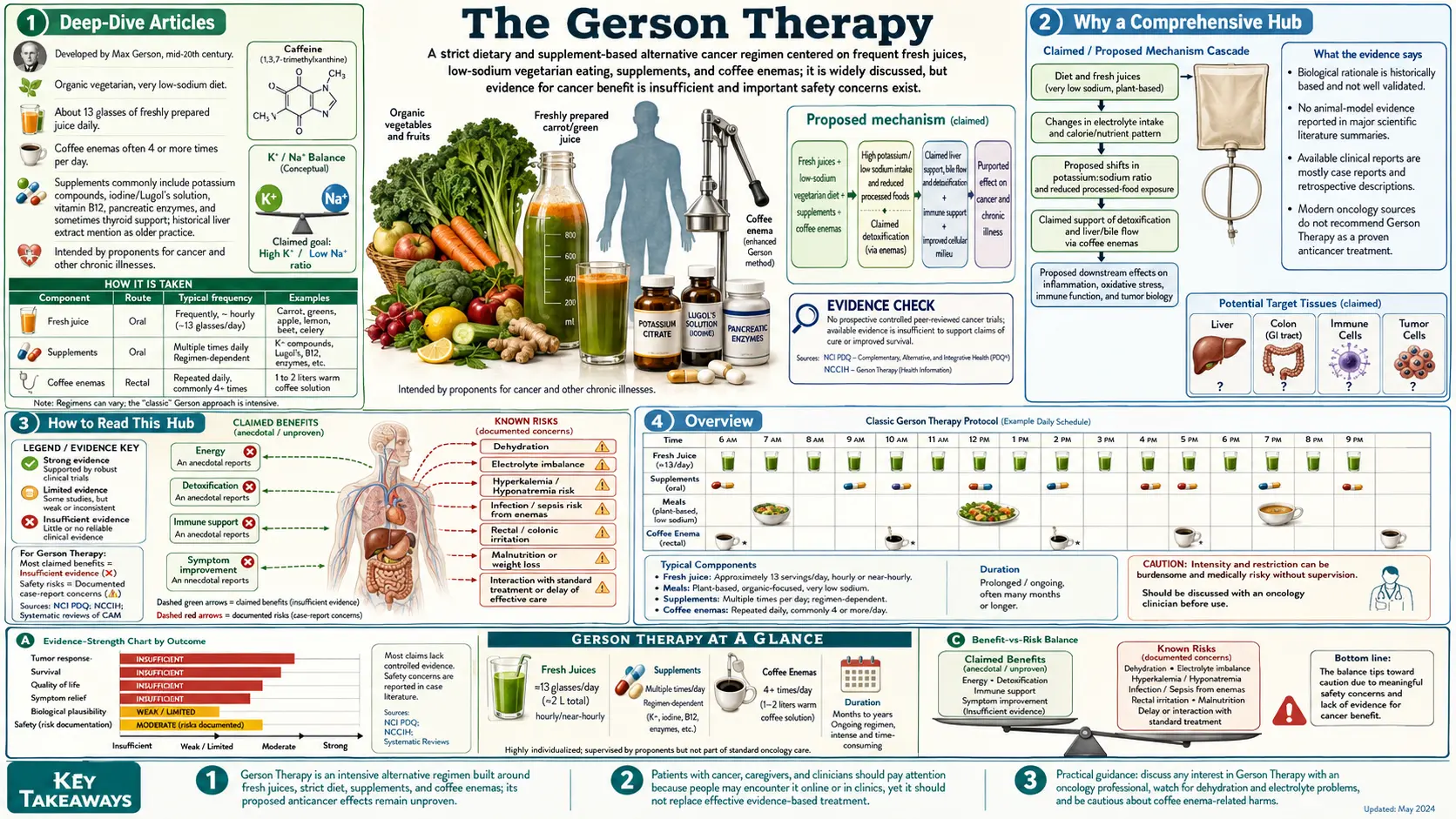
The Gerson Therapy is a 1930s nutritional and detoxification protocol developed by German-American physician Max Gerson (1881–1959). Its three pillars are an organic plant-based diet centered on freshly pressed juices, a battery of supplements, and frequent coffee enemas. The therapy is best known as one of the earliest popular alternative cancer protocols, but Gerson originally developed his approach for migraines and tuberculosis of the skin (lupus vulgaris) before adapting it for other chronic illnesses.
This hub reports Dr. Max Gerson’s work closely, as he and Charlotte Gerson state it in The Gerson Therapy: the day-by-day protocol; the biological theory behind it; the juices, foods and recipes; the coffee-enema procedure; the modified programs for chemotherapy patients, severely weakened patients and noncancer illness; the lab tests used to follow progress; the psychological side of healing; and the patients’ own accounts. The book’s own cautions and contraindications are kept on each page.
Table of Contents
Deep-Dive Articles
1. History of Max Gerson and the Therapy
From migraines and lupus vulgaris in 1920s Germany, through Albert Schweitzer’s endorsement, to the modern Gerson Institute and clinics in Tijuana. Biography, milestones, and how the protocol evolved.
Read the deep dive →2. The Gerson Diet Protocol
The strict organic plant-based diet: no salt, no fats (with narrow exceptions), no animal protein for the first six weeks, hyperalimentation with potassium-rich produce, the “saltless” rule, and the role of the Hippocrates soup.
Read the deep dive →3. Juicing in the Gerson Therapy
Why thirteen glasses a day, why a two-step grinder-and-press hydraulic juicer, why centrifugal juicers are forbidden, oxidation chemistry, and the role of fresh raw enzymes.
Read the deep dive →4. Gerson Juicing Recipes
Exact ingredients and ratios for the Green Juice, Carrot Juice, Carrot-Apple Juice, Orange Juice, the Hippocrates Soup, and the Special Soup of Dr. Gerson, along with timing throughout the day.
Read the deep dive →5. Coffee Enemas: Liver Detoxification and How to Take Them
From the book’s Chapters Twelve and Thirteen: the history of the enema, how Gerson says coffee opens the bile ducts and clears toxic breakdown products, preparation, procedure, frequency, flare-ups and the book’s own safety instructions.
Read the deep dive →6. The Step-by-Step Coffee Enema Protocol
Equipment, organic light-roast bean selection, brewing ratios, water source, temperature targets, retention time, body position, frequency in cancer vs. wellness use, and harm-reduction safeguards.
Read the deep dive →7. Gerson Supplements and Medications
Potassium compound, Lugol’s iodine, thyroid (Armour), niacin (B3), vitamin B12 with crude liver injections, pancreatic enzymes, CoQ10, and the dosage schedule.
Read the deep dive →8. Gerson Therapy and Cancer: Rationale and Results
Cancer as a metabolic disease in Gerson’s words, the cancer protocol, his first cases from 1928, the 1946 Senate hearing, the Fifty Cases, the 1995 melanoma review and the case histories the book reports.
Read the deep dive →9. The Detoxification Theory
Bile flow, glutathione S-transferase, theophylline and palmitates, the “tissue damage syndrome”, healing reactions (flares), and what modern hepatology actually says about coffee compounds and the liver.
Read the deep dive →10. Gerson Therapy Research: The Record as Gerson Reported It
The 1929 skin-tuberculosis trial, his 1946 Senate testimony, his own published papers from 1945 to 1978, the Fifty Cases, the 1995 melanoma review and the patient follow-ups the book reports.
Read the deep dive →11. Practical Guide for Home Use
Equipment costs, organic produce sourcing (and a 18–25 lb daily produce target), kitchen workflow, the “modified Gerson” for non-cancer use, and integrating the protocol with conventional medical care.
Read the deep dive →12. Niacin (Vitamin B3) in the Gerson Therapy
The 50 mg per juice schedule, the niacin flush and GPR109A receptor mechanism, NAD+/sirtuin/PARP biology, niacin in cancer chemoprevention, lipid effects, hepatotoxicity safety frame, and a full PubMed-linked research bibliography.
Read the deep dive →13. How Nutrition Heals: Max Gerson’s Founding Principle
Gerson’s founding principle: patient-centered medicine, forty-nine everyday cancer contributors, the multiple-hits theory, the liver’s dual role, and the illnesses the book reports diet treats.
Read the deep dive →14. The Biological Basis of the Gerson Therapy
Why the program works as Dr. Gerson explained it: potassium-sodium balance, protein and fat restriction, thyroid-driven metabolism, liver detox, and nutrient-dense hyperalimentation.
Read the deep dive →15. Remission and Healing Reactions in the Gerson Therapy
Chapter Five’s case that no remission is truly spontaneous: two long-term recoveries, Foster’s analysis of 200 regressions, and how the book handles healing-reaction flare-ups.
Read the deep dive →16. Melanoma and the Gerson Therapy
Chapter Six’s melanoma account: a 1995 review of 153 patients’ five-year survival by stage, plus stage IV, eye-melanoma and pregnancy recovery stories, as reported.
Read the deep dive →17. The Gerson Therapy for Other Diseases
Beyond cancer: the book’s accounts of epilepsy, addiction, mercury poisoning and stroke recovery on the Gerson program, and the potassium-sodium science behind the diet.
Read the deep dive →18. Gerson Diet: Foods Allowed and Forbidden
The book’s complete Gerson food lists: what to eat freely, occasional foods, every forbidden food with its reason, cooking methods, Hippocrates soup and menus.
Read the deep dive →19. Thirteen Glasses a Day: The Gerson Juice Schedule
Gerson’s core rule: thirteen 8-ounce glasses of fresh organic juice daily, one every waking hour, with the freshness rules, juicer types and kitchen tips.
Read the deep dive →20. The Gerson Saltless Diet
Why Dr. Gerson removed all salt and added potassium: Schweitzer’s observations, the potassium solution, lab monitoring, and the tissue damage syndrome.
Read the deep dive →21. Standard Gerson Therapy for Most Cancers
The book’s pivot chapter: every standard Gerson medication and dose, plus the first-year reductions and cautions.
Read the deep dive →22. Modified Gerson Therapy During Chemotherapy
How the book changes the protocol for patients already given chemotherapy: smaller juice portions, lower doses, contraindications, gentler enemas and a follow-up schedule.
Read the deep dive →23. Modified Gerson Therapy for Severely Weakened Patients
Gerson’s reduced protocol for severely weakened patients: smaller juices, delayed potassium, low Lugol and thyroid, gentle enemas and the first-year follow-up.
Read the deep dive →24. Modified Gerson Therapy for Noncancer Diseases
The reduced Gerson protocol for noncancer illness: ten juices, gentler doses, and disease-specific changes for diabetes, heart disease, arthritis, MS and addictions.
Read the deep dive →25. Psychological Approaches of the Gerson Therapy
Gerson’s view that more die of panic than cancer: how detox lifts mood, the caregiver’s role, and relaxation, visualization and affirmation techniques.
Read the deep dive →26. Gerson Lab Tests Explained
Chapter Twenty’s guide to Gerson monitoring labs: what each blood and urine test measures, its normal range, and the shifts the book expects during healing.
Read the deep dive →27. Gerson Therapy Patient Success Stories
Four patients’ own accounts of recovering on the Gerson Therapy, plus home-therapy tips and Charlotte Gerson’s lessons on exact compliance.
Read the deep dive →28. Gerson Therapy Recipes
Dr. Gerson’s kitchen in practice: Hippocrates Soup, saltless salads and dressings, slow-stewed vegetables, potatoes, fruit desserts and breads.
Read the deep dive →Why a Comprehensive Hub
This hub now lives under Dr. Max Gerson’s own section of Nutrition and Orthomolecular, so his biography, his therapy and every chapter-level article sit together in one place. Gerson described his program as a single treatment of the whole body rather than a list of separate remedies. He framed cancer as a problem of metabolism — the title of his 1954 paper — and the book describes the liver as playing a vital role in the process. The hub follows that view, laying out each part of the protocol as he and Charlotte Gerson describe it and showing how the parts fit together.
As the book presents it, the therapy works through a few connected actions: an organic, saltless, plant-based diet with thirteen glasses of fresh juice a day floods the body with potassium, enzymes and nutrients; the potassium compound, Lugol’s iodine and thyroid restore what Gerson called the normal potassium-sodium balance of the tissues; and coffee enemas help the liver release the toxins freed as tumor tissue breaks down. Gerson reports results with migraine, skin tuberculosis (lupus vulgaris), and advanced cancer, and the book adds accounts of diabetes, heart disease, arthritis and other chronic illnesses. Each deep dive above takes one of these elements in turn.
How to Read This Hub
Every page in this hub sits under Dr. Max Gerson’s section at /Notable_Doctors/Nutrition_and_Orthomolecular/Max_Gerson/. To meet the man first, start with the History page, then How Nutrition Heals and The Biological Basis for his theory in his own terms. For the daily program, read the Diet Protocol, Juicing and Recipes; for the coffee enema, read Coffee Enemas for Gerson’s reasoning and the Step-by-Step Protocol for the procedure. For the results Gerson and his successors report, see Cancer Treatment, Melanoma and Research. The book describes the therapy as self-administered at home or under physician supervision, tells readers to consult their Gerson Therapy physician before adding anything to it, and gives modified programs for chemotherapy patients, severely weakened patients and noncancer illness used where they apply.
Key Research Papers
- Gerson C, Walker M. The Gerson Therapy: The Proven Nutritional Program for Cancer and Other Illnesses. Revised and updated edition. Kensington Books. — primary source for this hub.
- Gerson M (1958). A Cancer Therapy: Results of Fifty Cases. — Gerson’s own account of the therapy and fifty case histories.
- Gerson MB (1945). Dietary considerations in malignant neoplastic diseases; a preliminary report. Rev Gastroenterol 12:419–424. — PubMed PMID: 21005988
- Gerson M (1949). Effects of a combined dietary regime on patients with malignant tumors. Exp Med Surg 7(4):299–317. — PubMed PMID: 15396126
- Gerson M (1954). [No cancer in normal metabolism; results of special therapy]. Med Klin 49(5):175–179. — PubMed PMID: 13144228
- Gerson M (1954). [Cancer a problem of metabolism]. Med Klin 49(26):1028–1032. — PubMed PMID: 13202917
- Gerson M (1978). The cure of advanced cancer by diet therapy: a summary of 30 years of clinical experimentation. Physiol Chem Phys 10(5):449–464. — PubMed PMID: 751079
- Cope FW (1978). A medical application of the Ling association-induction hypothesis: the high potassium, low sodium diet of the Gerson cancer therapy. Physiol Chem Phys 10(5):465–468. — PubMed PMID: 751080
- Hildenbrand GL, Hildenbrand LC, Bradford K, Cavin SW (1995). Five-year survival rates of melanoma patients treated by diet therapy after the manner of Gerson: a retrospective review. Altern Ther Health Med 1(4):29–37. — PubMed PMID: 9359807
PubMed Topic Searches
Connections
Featured Videos