Coffee Enemas in the Gerson Therapy: Liver Detoxification and How to Take Them
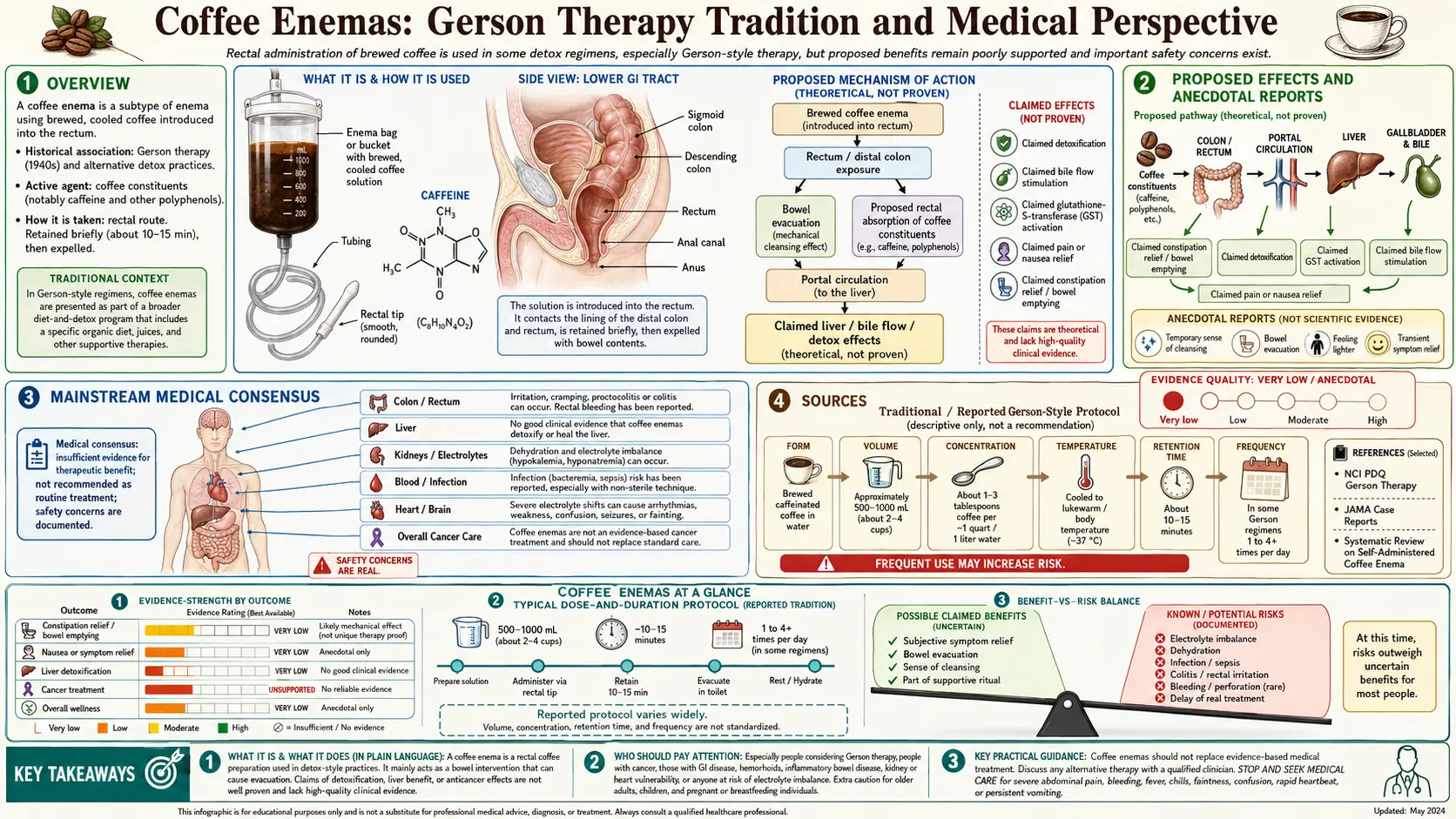
Table of Contents
- Overview
- Origins: From Ancient Enemas to the Gerson Protocol
- How the Coffee Enema Detoxifies the Liver
- Excretion of Cancer Breakdown Products
- Pain Relief and the 1946 Senate Hearing
- A Non-Reabsorbed, Repeatable Choleretic
- Preparing the Coffee Solution
- How to Take a Coffee Enema
- Frequency and Timing
- Variations and Flare-Ups
- The Book’s Safety Instructions
- Key Research Papers
- Connections
- Featured Videos
Overview
Coffee enemas—a quart of boiled, strained coffee at body temperature, retained in the colon for twelve to fifteen minutes—are the central detoxification procedure of the therapy developed by Dr. Max Gerson (1881–1959). In The Gerson Therapy, Charlotte Gerson and Morton Walker devote two chapters to them: Chapter Twelve, “Liver Detoxification with Coffee Enemas,” explains what the enema does, and Chapter Thirteen, “Coffee Enemas and How to Take Them,” gives the step-by-step procedure. The book calls taking coffee enemas “among the most vital aspects of the Gerson Therapy.”
Dr. Gerson’s own instruction, quoted in the book, is that the treatment “should be followed strictly, both in the clinic and later at home, for at least two years,” because “the liver is the main organ for the regeneration of the body’s metabolism.” The chapter opens with the account of a forty-six-year-old patient with cancer of the esophagus and larynx who reports that, on the full therapy with three coffee enemas a day during his worst reaction, his tumor died and broke away, and who continued daily coffee enemas afterward. This page summarizes both chapters as the book presents them.
Origins: From Ancient Enemas to the Gerson Protocol
The book notes that enemas are not new: they appear in the Manual of Discipline among the Dead Sea Scrolls, and The Essene Gospel of Peace describes cleansing the bowels with river water from a hollowed gourd. The use of coffee in the enema, the book states, probably dates only to the First World War.
As told by Gerson Therapy exponent Dr. Jerry Walters and recounted in the book, Germany during that war was short of morphine, anesthetics and drinking coffee. Wounded soldiers coming out of surgery were given plain water enemas; nurses, looking for something more to ease their pain, poured the surgeons’ leftover black coffee into the enema buckets, and the soldiers reported that their pain was much relieved.
These reports drew the interest of Professors O. A. Meyer and Martin Heubner at the University of Goettingen’s College of Medicine, who in the 1920s gave caffeine rectally to rats, observed that it opened the animals’ bile ducts, and published the finding in the German medical literature. Dr. Gerson first used drops of caffeine and potassium citrate added to enema water, then found that a solution made simply by boiling coffee grounds was more effective and easier for everyone to obtain. That procedure, the book says, “remains today.”
How the Coffee Enema Detoxifies the Liver
The book paraphrases the description given by Harold Manner, Ph.D., at a 1985 cancer conference, who credited Dr. Gerson with the technique. While the enema is retained for twelve to fifteen minutes, all of the body’s blood passes through the liver about every three minutes. Caffeine dilates the hemorrhoidal blood vessels and, in turn, the portal veins; the bile ducts expand, bile flow increases, and the smooth muscle of the internal organs relaxes. The quart of water stimulates the visceral nervous system and peristalsis, and dilutes the bile, increasing its flow further.
The enzyme glutathione S-transferase (GST) is central to the book’s explanation. It states that GST in the small bowel increases by 700 percent, and that this enzyme quenches free radicals, which then leave the liver and gallbladder in the bile. In 1990 the Austrian surgeon Dr. Peter Lechner, who had been investigating Dr. Gerson’s treatment, reported that GST:
- binds bilirubin and its glucuronides so they can be eliminated from liver cells;
- blocks and detoxifies carcinogens that require oxidation or reduction to be activated;
- forms a covalent bond with nearly all highly electrophilic substances, the precondition of their elimination from the body.
The book traces this to the laboratory of biochemist Lee W. Wattenberg, Ph.D., which identified two palmitates present in coffee, cafestol palmitate and kahweol palmitate, as potent enhancers of GST. It reports that in laboratory mice given coffee beans in their diet, liver detoxification increases by 600 percent and small-bowel detoxification by 700 percent, and states that analogous results take place in people taking coffee enemas. Dr. Lechner’s 1984 report, quoted in the book, adds that “coffee enemas have a definite effect on the colon which can be observed with an endoscope.”
Excretion of Cancer Breakdown Products
According to the book, the coffee enema lowers the quantity of toxins in the blood serum, “literally cleaning the poisons out of fluids nourishing normal cells.” It explains that cells challenged by toxins, oxygen starvation, malnutrition or trauma lose their preference for potassium, take up sodium and excess water, and swell, so that mitochondrial ATP production is impaired and the cell cannot repair itself until the challenge is removed. Around active tumors, the book states, are spheres of damaged normal tissue swollen with salt and water and poorly supplied with blood.
Dr. Gerson held it as axiomatic that no cancer could exist in the presence of normal metabolism. The book identifies four common tissue toxins—polyamines, ammonia, toxic-bound nitrogen and electrophiles—whose neutralization by liver and gut enzyme systems is “massively increased” by coffee enemas. It quotes the editors of Physiological Chemistry and Physics, who reprinted Dr. Gerson’s summary in 1978: “Caffeine enemas cause dilation of bile ducts, which facilitates excretion of toxic cancer breakdown products by the liver and dialysis of toxic products from blood across the colonic wall.”
Pain Relief and the 1946 Senate Hearing
The book cites Mark F. McCarty, writing in Medical Hypotheses in 1981, on the 1946 Senate subcommittee hearing on cancer research: five independent physicians with personal experience of Dr. Gerson’s patients submitted letters saying they had been surprised and encouraged by the results and urged a widespread trial of the method. One of them stated that “relief of severe pain was achieved in about 90 percent of cases.”
From the patient’s point of view, the book says, whatever degenerative disease is causing symptoms, the coffee enema means relief from confusion, general nervous tension, depression, many allergy-related symptoms and, most importantly, severe pain.
A Non-Reabsorbed, Repeatable Choleretic
The book is emphatic that drinking coffee is not a substitute: “In no way does the oral administration of beverage coffee have the same effect as its rectal administration.” Bile is normally reabsorbed up to ten times before leaving the body, and drinking coffee, it states, virtually ensures reabsorption of toxic bile. Other choleretics increase bile production but do little to enhance the liver’s detoxifying enzymes or to carry bile out of the body. Because clinicians using the Gerson Therapy found coffee enemas well tolerated as often as every four hours, the book proposes they be classed as “the only non reabsorbed, effective, repeatable choleretic agent.”
The book summarizes the physiological effects of a quart of coffee solution in the colon:
- It dilutes portal blood and, subsequently, the bile.
- Theophylline and theobromine in coffee dilate blood vessels and counter inflammation of the gut.
- The palmitates of coffee enhance glutathione S-transferase, removing toxic radicals from the blood serum.
- The fluid stimulates peristalsis and moves diluted toxic bile from the duodenum out the rectum.
- Because the enema is retained up to fifteen minutes while the blood passes through the liver about every three minutes, coffee enemas represent “a form of dialysis of blood across the gut wall.”
The book places the enemas within the whole regime: the sodium-restricted, high-potassium diet, potassium salts, thyroid and Lugol’s solution together aim to reduce serum toxins, restore cell potassium, reduce cell sodium and swelling, and increase mitochondrial energy production.
Preparing the Coffee Solution
Dr. Gerson’s original formula, as given in the book:
- Drop 3 rounded tablespoonfuls of ground (drip) coffee, not instant, into one quart of water.
- Let it boil three minutes, then simmer fifteen minutes more.
- Strain the solution.
- Fill a quart glass container and let it cool to body temperature.
- Use the solution at body temperature.
The Gerson Institute’s refinement adds the coffee to a quart of boiling water—distilled water if the drinking water is fluoridated, filtered water otherwise—boils it three minutes uncovered and simmers it fifteen minutes covered, strains it through a fine strainer or filter cloth, and tops it back up to the 1-quart level with hot water before letting it cool to body temperature.
For a full day, a concentrate can be made: bring 2½ to 3 quarts of water to a boil, add 15 rounded tablespoons of organic drip-grind coffee (3 tablespoons per enema, five enemas), return to a boil for a few minutes, simmer about fifteen minutes, strain, and divide into five equal portions in 1-quart glass bottles. Each portion is filled to a quart with distilled water (or a pint of chamomile tea plus water when a modified enema is needed) and heated to body temperature before use.
How to Take a Coffee Enema
Dr. Gerson wrote: “To make enemas most effective, the patient should lie on his right side, with both legs drawn close to the abdomen, and breathe deeply, in order to suck the greatest amount of fluid into all parts of the colon. The fluid should be retained ten to fifteen minutes.” The book’s detailed instructions:
- Setting: lie on a padded floor, a mattress protected with plastic, a camp bed or an enema bench, covered with a towel; a clean bathroom floor with a pad and pillow often works best. Be comfortable and warm.
- Position: right side, legs pulled up and relaxed. If pain prevents this, lie on the back with legs pulled up; the left side only as a last resort.
- Height: the bottom of the bag or bucket no more than about 18 inches (50 cm) above the body, so the coffee does not enter under too much pressure, which can set up counter-peristalsis and cramping.
- Retention: ideally twelve to fifteen minutes, by which time almost all the caffeine is absorbed. Not longer than fifteen minutes, since the liquid itself will then be absorbed. If only six to nine minutes are possible, release then rather than straining; the book says reaching twelve minutes can take three or four months of practice.
- Cramping: stop the flow by pinching the tube or lowering the bucket to body level for a while, then resume.
- Partial quart: if a full quart will not go in, take what is comfortable, hold and expel it, then take the rest. This is also the method during a healing reaction, when toxic pressure from the liver may make even half a quart difficult.
For a bedfast patient, a support person covers the mattress with plastic and a towel, the patient takes the enema in bed and holds it twelve to fifteen minutes if possible with a bedpan ready, and where incontinence is a problem the enema is introduced while the patient lies on the bedpan.
Frequency and Timing
For cancer patients and other very sick people, Dr. Gerson advised that during the first months enemas may be taken as often as every four hours, day and night. The book states that some terminal cancer patients have saved their lives by taking five coffee enemas a day for months at a time. Frequency is reduced after a period of time, and each patient adjusts it to his or her own needs; a patient who reduces too soon and feels ill, toxic or headachy returns to the more intensive level for a while before trying again.
- If the last enema of the day, at 10:00 P.M., keeps a patient awake at the start of therapy, it can be replaced with chamomile tea; usually within three to four days the late coffee enema no longer disturbs sleep.
- During severe reactions, heavy tumor absorption or pain at night, Dr. Gerson suggested a nighttime enema at 2:00 or 3:00 A.M.; the book reports these never seem to keep the patient awake.
- Before a nighttime or first-morning enema, eat a piece of fruit, applesauce or fruit salad left at the bedside to raise blood sugar a little.
Variations and Flare-Ups
- Irritated bowel, colitis, diarrhea, bleeding or cramping: half a quart of coffee plus half a quart of chamomile tea, described as soothing to the intestinal tract.
- Serious diarrhea: chamomile tea only, then coffee concentrate added back gradually (2–4 ounces, then 6–8 ounces, keeping the quart volume) until the full coffee enema is tolerated. During flare-ups with diarrhea, perhaps two chamomile enemas a day, then a gradual return to the regular schedule.
- Bile overflow with nausea and vomiting: omit coffee enemas, since they stimulate more bile flow; drink plenty of peppermint tea, eat oatmeal gruel, use only chamomile tea enemas, and resume coffee when the nausea has stopped completely.
- Gas: lower the bucket to or below body height so fluid can flow back and gas can bubble out.
- An enema that will not release (colon spasm): lie on the right side with legs drawn up, perhaps with a warm water bottle on the abdomen; don’t panic; if needed take another coffee enema with 3 teaspoons of 3 percent hydrogen peroxide added; if the spasm persists, take castor oil by mouth; for the next few days add 3–4 teaspoons of the regular potassium compound to each enema, but not for more than a week. The book states that the retained solution is absorbed and excreted through the kidneys.
- Hemorrhoid flare-up: zinc oxide ointment locally (not suppositories containing painkillers); the book advises not stopping the enemas and reports that the hemorrhoids shortly disappear.
- Rectal juice implants: when a patient in a healing reaction is vomiting and becoming dehydrated, 8 ounces of carrot/apple or green juice (with medications) warmed to body temperature, not orange juice and with no water added, is run into the rectum and retained until absorbed, repeatable hourly until the patient can drink again.
The book also describes the castor oil treatment, prescribed every other day for cancer patients as a more intensive cleanse; see the Coffee Enema Protocol and Detoxification pages.
The Book’s Safety Instructions
The book states that “coffee enemas are safe when used within the context of the combined regime of the Gerson Therapy”—the sodium-restricted, high-potassium diet, juices and supplements that accompany them—and that the therapy is followed either at home or under physician supervision, with the advice to always consult your Gerson Therapy physician before adding anything to the treatment. The precautions it gives for the enemas themselves:
- Use the solution at body temperature only.
- Keep the bucket or bag no more than 18 inches (50 cm) above the body.
- Do not hold the enema longer than fifteen minutes, and do not strain to hold it if cramping comes on.
- Use drip-grind coffee, not instant, and distilled water where the tap water is fluoridated.
- Stop coffee enemas during bile overflow with nausea and vomiting, and switch to chamomile tea until it has passed.
- Do not add the potassium compound to enemas for more than a week, or the colon becomes irritated.
- Castor oil treatment does not apply to cancer patients previously treated with cytotoxic or other chemotherapy drugs; they should not take castor oil.
- Eat a little fruit before a nighttime or early-morning enema to raise blood sugar.
This page reports the book’s instructions for the historical and educational record; it is not medical advice.
Key Research Papers
- Gerson C, Walker M. The Gerson Therapy: The Proven Nutritional Program for Cancer and Other Illnesses. New York: Kensington Publishing; 2001. Chapter Twelve, “Liver Detoxification with Coffee Enemas,” pp. 152–163, and Chapter Thirteen, “Coffee Enemas and How to Take Them,” pp. 164–173. (Book — no PubMed record.)
- Gerson M. A Cancer Therapy: Results of Fifty Cases and The Cure of Advanced Cancer by Diet Therapy. 6th ed. Bonita, CA: The Gerson Institute; 1999. Cited in Chapter Thirteen for enema frequency (p. 190). (Book — no PubMed record.)
- Gerson M. The cure of advanced cancer by diet therapy: a summary of 30 years of clinical experimentation. Physiol Chem Phys. 1978;10(5):449–464. — PubMed PMID: 751079
- Cope FW. A medical application of the Ling association-induction hypothesis: the high potassium, low sodium diet of the Gerson cancer therapy. Physiol Chem Phys. 1978;10(5):465–468. — PubMed PMID: 751080
- McCarty MF. Aldosterone and the Gerson diet — a speculation. Med Hypotheses. 1981;7(5):591–597. Cited in Chapter Twelve on the 1946 Senate hearing letters. — PubMed PMID: 7278723
- Sparnins VL, Wattenberg LW. Enhancement of glutathione S-transferase activity of the mouse forestomach by inhibitors of benzo[a]pyrene-induced neoplasia of the forestomach. J Natl Cancer Inst. 1981;66(4):769–771. Chapter Twelve reference 8. — PubMed PMID: 6262554
- Lam LK, Sparnins VL, Wattenberg LW. Isolation and identification of kahweol palmitate and cafestol palmitate as active constituents of green coffee beans that enhance glutathione S-transferase activity in the mouse. Cancer Res. 1982;42(4):1193–1198. — PubMed PMID: 7059995
- Gerson M. Effects of a combined dietary regime on patients with malignant tumors. Exp Med Surg. 1949;7(4):299–317. — PubMed PMID: 15396126
- Gerson MB. Dietary considerations in malignant neoplastic diseases; a preliminary report. Rev Gastroenterol. 1945;12:419–424. — PubMed PMID: 21005988
- Gerson M. [No cancer in normal metabolism; results of special therapy]. Med Klin. 1954;49(5):175–179. — PubMed PMID: 13144228
- Hildenbrand GL, Hildenbrand LC, Bradford K, Cavin SW. Five-year survival rates of melanoma patients treated by diet therapy after the manner of Gerson: a retrospective review. Altern Ther Health Med. 1995;1(4):29–37. — PubMed PMID: 9359807
PubMed Topic Searches
Connections
- All Remedies
- Gerson Therapy
- Detoxification
- Cancer Treatment
- Diet Protocol
- Research Evidence
- Coffee Enema Protocol
- Supplements
- History of Max Gerson
- Coffee
- Cancer
- Glutathione
- Liver Cleansing
- Detox Protocols
- Fasting
- Anti Inflammatory Diet
- Juicing
- Practical Guide
- Coffee Enemas (Detox Protocols) — the detox-protocol treatment of the same practice, including the Gonzalez pancreatic-cancer trials and the standard preparation recipe.