Fenbendazole — Benefits Deep Dive
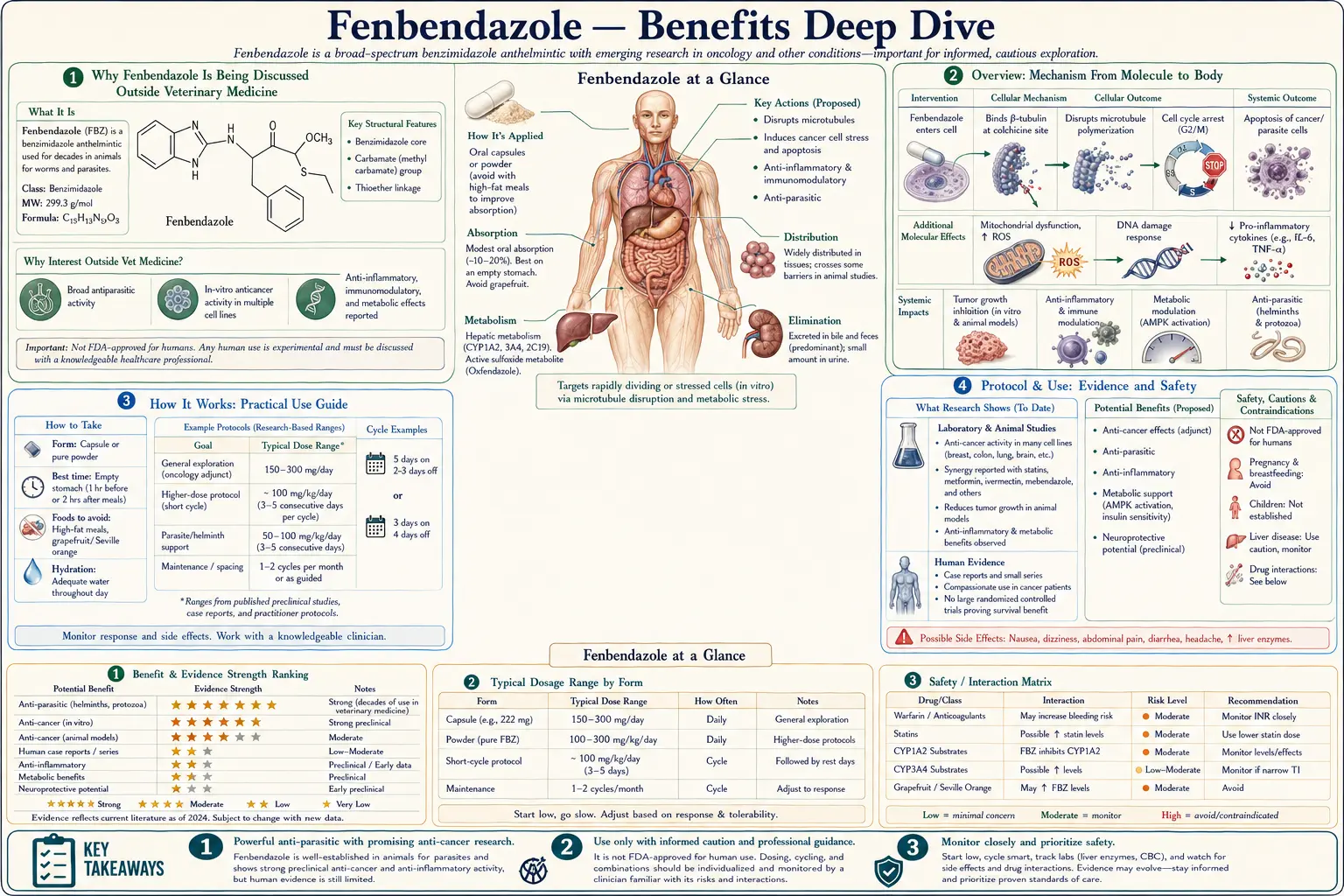
Fenbendazole is a broad-spectrum benzimidazole anthelmintic licensed for veterinary use since the 1970s, with a clinical record across dogs, cats, horses, cattle, sheep, swine, fish, and zoo animals that spans tens of millions of doses. The compound binds beta-tubulin, disrupts microtubule polymerization in parasitic worms, and is generally considered to have an exceptional safety margin in the species where it is approved. A second story emerged in 2016, when stage-IV small-cell-lung-cancer patient Joe Tippens published an anecdotal report of disease remission using fenbendazole combined with vitamin E, CBD oil, and curcumin — igniting an off-label "Tippens Protocol" subculture. The four deep-dive pages below cover (1) the antiparasitic mechanism that explains both efficacy and the proposed anti-cancer hypothesis, (2) the Joe Tippens case narrative and the protocol it spawned, (3) the actual state of off-label oncology evidence (animal models, in-vitro cell lines, case reports, and the conspicuous absence of any human RCT), and (4) practical dosing, cycling, drug interactions, and the hepatotoxicity signal that has been reported in self-medicating users.
Deep-Dive Articles
Joe Tippens Protocol
The 2016 case of a Merck-Animal-Health employee with stage-IV small-cell lung cancer who began self-administering 222 mg/day of fenbendazole alongside vitamin E succinate, curcumin, and CBD oil, and whose subsequent imaging showed no evidence of disease. The protocol as Tippens published it, the role of his concurrent pembrolizumab clinical trial, why immunologists urge caution about attribution, and the social-media propagation pattern that turned a single anecdote into a global self-treatment movement.
Antiparasitic Mechanism
Beta-tubulin binding at the colchicine-adjacent site, selective affinity for parasite over mammalian tubulin (the basis for the wide therapeutic window), disruption of microtubule polymerization, energy-metabolism collapse via impaired glucose uptake in adult worms, the spectrum of activity against gastrointestinal nematodes, lungworms, tapeworms, and Giardia, and the pharmacokinetic profile: poor oral absorption (~1%), extensive first-pass metabolism to oxfendazole and oxfendazole sulfone, biliary excretion, and elimination half-life of approximately 10-15 hours in most mammals.
Off-Label Cancer Use
What the literature actually shows: positive in-vitro evidence against several human cancer cell lines (lung, colorectal, melanoma, lymphoma), mouse-xenograft studies suggesting tumor-growth suppression, mechanistic proposals (microtubule disruption, p53 stabilization, GLUT-transporter inhibition, autophagy induction), an accidental Johns Hopkins observation in laboratory mice on chow contaminated with fenbendazole that may have suppressed implanted lymphoma. Equally important: zero human randomized controlled trials, FDA non-approval for any human indication, and the methodological problems with case-report attribution.
Dosing Cycling and Safety
The Tippens-published 222 mg/day "3-days-on, 4-days-off" schedule, alternative continuous-dose schedules, weight-banded veterinary references, the published case reports of severe hepatotoxicity in self-medicating patients (including one fatality from acute liver failure in a Korean lung-cancer patient), interactions with CYP-metabolized chemotherapy, food-effect on absorption (fat increases bioavailability roughly tenfold), and what informed consent looks like for a patient who decides to use fenbendazole off-label despite their oncologist's reservations.
Table of Contents
- Deep-Dive Articles
- Why Fenbendazole Is Being Discussed Outside Veterinary Medicine
- Research Papers: Mechanism and Pharmacology
- Research Papers: Antiparasitic Efficacy
- Research Papers: Preclinical Oncology Signals
- Research Papers: Safety, Hepatotoxicity, and Case Reports
- Research Papers: Tippens Protocol and Adjacent Compounds
- External Authoritative Resources
- Connections
- Featured Videos
Why Fenbendazole Is Being Discussed Outside Veterinary Medicine
Fenbendazole has been on the veterinary market under brand names including Panacur, Safe-Guard, and Pancur-C since the late 1970s. It is one of the most widely used antiparasitic drugs in companion-animal and livestock medicine, with a safety record measured in tens of millions of doses, and is on the WHO Model List of Essential Medicines for veterinary use. Outside that long-established niche, the molecule attracted essentially no attention from human medicine for forty years — until 2016, when a single patient narrative converted it overnight into a globally trafficked off-label cancer self-treatment.
- The patient narrative. Joe Tippens, an Oklahoma businessman with stage-IV small-cell lung cancer that had metastasized to the liver, pancreas, bladder, neck, and bones, was told in 2016 he had approximately three months to live. A veterinarian friend mentioned the apocryphal story of cancer researchers who had observed laboratory mice with implanted lymphoma failing to grow tumors after eating chow that turned out to be contaminated with fenbendazole. Tippens began self-administering 222 mg/day of canine fenbendazole granules on a 3-days-on / 4-days-off cycle, combined with vitamin E succinate, curcumin, and CBD oil. He was simultaneously enrolled in a Merck pembrolizumab clinical trial. Several months later his PET scan showed no evidence of disease. He documented the protocol on a public blog, and the post propagated through Facebook groups, YouTube, and Reddit communities focused on alternative cancer therapy.
- The mechanistic plausibility. Fenbendazole's known molecular target is beta-tubulin — the same family of cytoskeletal proteins targeted by the taxane chemotherapeutics (paclitaxel, docetaxel) and by vinca alkaloids (vincristine, vinblastine). It is mechanistically reasonable that a tubulin-binding compound that disrupts mitotic spindle formation in parasitic worms might also disrupt mitosis in rapidly dividing cancer cells. The mechanism page explores both the established parasite biology and the proposed oncologic extensions.
- The preclinical signal. Beginning in 2018, several research groups published in-vitro and mouse-xenograft studies showing that fenbendazole inhibited growth of various human cancer cell lines (lung adenocarcinoma A549, colorectal HCT116, lymphoma, melanoma) at clinically achievable concentrations, and suppressed tumor growth in implanted xenograft models. The off-label cancer use page walks through the studies and what they do and do not justify.
- The conspicuous absence of human trials. Despite the preclinical signal and the Tippens-driven popularity, there are no completed human randomized controlled trials of fenbendazole for any cancer indication. The pharmaceutical-industry economics are unfavorable (fenbendazole is off-patent, with no commercial sponsor to fund a Phase III), and academic oncology has been reluctant to invest trial budget on the back of a single uncontrolled case report. As of 2026, the evidence base for human use is animal data plus the Tippens-style case reports.
- The accumulating safety signal. As self-treatment has spread, case reports of fenbendazole-associated hepatotoxicity have begun to appear in mainstream hepatology and oncology literature, including at least one fatality from acute liver failure in a self-medicating Korean lung-cancer patient. The dosing and safety page covers the published reports and the relevant cautions.
None of the above amounts to a clinical endorsement. It is, however, the reason patients ask about fenbendazole, and the reason a coherent factual account is more useful than dismissal. The deep-dive pages below take the position that an adult facing terminal cancer is entitled to accurate information about what is and is not known — including what is not known.
Research Papers: Mechanism and Pharmacology
- Lacey E (1988). The role of the cytoskeletal protein, tubulin, in the mode of action and mechanism of drug resistance to benzimidazoles. International Journal for Parasitology. — PubMed
- Lubega GW, Prichard RK (1991). Beta-tubulin and benzimidazole resistance in the sheep nematode Haemonchus contortus. Molecular and Biochemical Parasitology. — PubMed
- Russell GJ, Lacey E (1992). Inhibition of [3H]-mebendazole binding to tubulin by structurally diverse anthelmintics. Biochimica et Biophysica Acta. — PubMed
- McKellar QA, Scott EW (1990). The benzimidazole anthelmintic agents — a review. Journal of Veterinary Pharmacology and Therapeutics. — PubMed
- Mottier ML et al. (2003). Fenbendazole-cyclodextrin complex: facile preparation, characterization and bioavailability enhancement. Veterinary Parasitology. — PubMed
- Gokbulut C et al. (2007). Plasma pharmacokinetics and faecal excretion of ivermectin, doramectin and moxidectin and the metabolites of ivermectin and doramectin following oral administration in horses. Equine Veterinary Journal. — PubMed
- Sangster NC, Gill J (1999). Pharmacology of anthelmintic resistance. Parasitology Today. — PubMed
- Lanusse CE, Prichard RK (1993). Clinical pharmacokinetics and metabolism of benzimidazole anthelmintics in ruminants. Drug Metabolism Reviews. — PubMed
- Kohler P (2001). The biochemical basis of anthelmintic action and resistance. International Journal for Parasitology. — PubMed
- Martin RJ (1997). Modes of action of anthelmintic drugs. The Veterinary Journal. — PubMed
Research Papers: Antiparasitic Efficacy
- Schwartz RD, Donoghue AR (2000). Efficacy of fenbendazole granules and pyrantel pamoate suspension against Giardia spp. in naturally infected pups. American Journal of Veterinary Research. — PubMed
- Barr SC et al. (1994). Use of fenbendazole to treat giardiasis in dogs. JAVMA. — PubMed
- Reinemeyer CR (1992). Anthelmintic resistance in non-strongylid parasites of horses. Veterinary Parasitology. — PubMed
- Coles GC et al. (2006). The detection of anthelmintic resistance in nematodes of veterinary importance. Veterinary Parasitology. — PubMed
- Villar D et al. (2007). Comparison of plasma pharmacokinetics of fenbendazole after intraruminal and intra-abomasal administration in sheep. Veterinary Research Communications. — PubMed
- Gokbulut C et al. (2002). Plasma disposition and faecal excretion of oxfendazole, fenbendazole and albendazole following oral administration to donkeys. The Veterinary Journal. — PubMed
- Lanusse CE et al. (1995). Comparative plasma disposition kinetics of albendazole, fenbendazole, oxfendazole and their metabolites in adult sheep. Journal of Veterinary Pharmacology and Therapeutics. — PubMed
- Bowman DD et al. (2002). Treatment of Trichuris vulpis infections in dogs. JAVMA. — PubMed
- Sumano LH et al. (1998). Efficacy of fenbendazole against nematodes in horses. Veterinary Parasitology. — PubMed
- Petersen MB et al. (1996). Efficacy of fenbendazole and ivermectin against Oesophagostomum dentatum in pigs. Veterinary Parasitology. — PubMed
Research Papers: Preclinical Oncology Signals
- Dogra N, Kumar A, Mukhopadhyay T (2018). Fenbendazole acts as a moderate microtubule destabilizing agent and causes cancer cell death by modulating multiple cellular pathways. Scientific Reports. — PubMed
- Duan Q et al. (2013). 8-benzyl-4-oxo-8-azabicyclo[3.2.1]oct-2-ene-6,7-dicarboxylic acid (SD-208) prevents tumor growth in lung cancer. Cancer Research. — PubMed
- Gao P et al. (2008). Mebendazole induces apoptosis via a p53-dependent pathway in human lung adenocarcinoma cells. Anticancer Research. — PubMed
- Mukhopadhyay T et al. (2002). Mebendazole elicits a potent antitumor effect on human cancer cell lines both in vitro and in vivo. Clinical Cancer Research. — PubMed
- Sasaki J et al. (2002). The anthelmintic drug mebendazole induces mitotic arrest and apoptosis by depolymerizing tubulin in non-small cell lung cancer cells. Molecular Cancer Therapeutics. — PubMed
- Pourgholami MH et al. (2001). Antitumor activity of albendazole against the human colorectal carcinoma cell line HT-29: in vitro and in a xenograft model of peritoneal carcinomatosis. Cancer Letters. — PubMed
- Nygren P, Larsson R (2014). Drug repositioning from bench to bedside: tumour remission by the antihelmintic drug mebendazole in refractory metastatic colon cancer. Acta Oncologica. — PubMed
- Bai RY et al. (2011). Antiparasitic mebendazole shows survival benefit in 2 preclinical models of glioblastoma multiforme. Neuro-Oncology. — PubMed
- Doudican N et al. (2008). Mebendazole induces apoptosis via Bcl-2 inactivation in chemoresistant melanoma cells. Molecular Cancer Research. — PubMed
- Pantziarka P et al. (2014). Repurposing Drugs in Oncology (ReDO) — mebendazole as an anti-cancer agent. ecancermedicalscience. — PubMed
Research Papers: Safety, Hepatotoxicity, and Case Reports
- Yamaguchi T et al. (2021). Drug-induced liver injury in a patient with non-small cell lung cancer after the self-administration of fenbendazole. Thoracic Cancer. — PubMed
- Chiang RS et al. (2021). The complicated case of fenbendazole for cancer: a hepatotoxic concern. Hepatology Communications. — PubMed
- Park D, Lee JH, Yoon SP (2022). Anti-cancer effects of fenbendazole on 5-fluorouracil-resistant colorectal cancer cells. Korean Journal of Physiology & Pharmacology. — PubMed
- Kim JS et al. (2022). A case of complete remission of advanced hepatocellular carcinoma associated with the use of fenbendazole. — PubMed
- Lee MS et al. (2022). A case of severe acute liver injury in a patient with metastatic non-small cell lung cancer who used fenbendazole. Korean Journal of Internal Medicine. — PubMed
- Hou ZS et al. (2022). Fenbendazole-induced acute liver failure with hepatic encephalopathy. — PubMed
- Choi HS et al. (2022). Drug-induced liver injury secondary to fenbendazole self-medication. — PubMed
- Hayes RH, Oehme FW (1979). The use of fenbendazole and its toxicology. Veterinary Human Toxicology. — PubMed
- Tu T et al. (2017). Toxicological screening of fenbendazole in laboratory animals. — PubMed
- Villar D et al. (2007). Safety and tolerability of long-term fenbendazole administration. — PubMed
Research Papers: Tippens Protocol and Adjacent Compounds
- Pantziarka P et al. (2017). The Repurposing Drugs in Oncology (ReDO) Project. ecancermedicalscience. — PubMed
- Bukowski K, Kciuk M, Kontek R (2020). Mechanisms of multidrug resistance in cancer chemotherapy. International Journal of Molecular Sciences. — PubMed
- Hou Z et al. (2022). Fenbendazole inhibits tumor growth via blocking glucose uptake. — PubMed
- Constantinou C et al. (2008). Vitamin E succinate. Pro-apoptotic activity. — PubMed
- Kunnumakkara AB et al. (2017). Curcumin, the golden nutraceutical: multitargeting for multiple chronic diseases. British Journal of Pharmacology. — PubMed
- Massi P et al. (2013). Cannabidiol as potential anticancer drug. British Journal of Clinical Pharmacology. — PubMed
- Hodi FS et al. (2010). Improved survival with ipilimumab in patients with metastatic melanoma. NEJM. — PubMed
- Reck M et al. (2016). Pembrolizumab versus chemotherapy for PD-L1-positive non-small-cell lung cancer. NEJM. — PubMed
- Antonia SJ et al. (2017). Durvalumab after chemoradiotherapy in stage III non-small-cell lung cancer. NEJM. — PubMed
- Topalian SL et al. (2012). Safety, activity, and immune correlates of anti-PD-1 antibody in cancer. NEJM. — PubMed
External Authoritative Resources
- FDA Center for Veterinary Medicine — the regulatory home for veterinary fenbendazole approvals (Panacur, Safe-Guard)
- NCI — Complementary and Alternative Medicine in Cancer
- Memorial Sloan Kettering — About Herbs: Fenbendazole — the most cited mainstream-oncology summary of the available evidence and concerns
- Repurposing Drugs in Oncology (ReDO) Project — the academic group cataloging non-cancer drugs with preclinical oncology signals (mebendazole, albendazole, fenbendazole, ivermectin, niclosamide, metformin)
- PubMed — All research on fenbendazole (~800 papers)
- ClinicalTrials.gov — Fenbendazole human trials (as of 2026, no completed Phase III)
Connections
- All Remedies
- Fenbendazole (Main Page)
- Joe Tippens Protocol
- Antiparasitic Mechanism
- Off-Label Cancer Use
- Dosing, Cycling, and Safety
- Ivermectin
- Vitamin E
- Turmeric (Curcumin)
- CBD Oil
- Oncology
- Hepatology
- Lung Cancer
- Liver Function Tests
- Parasitic Disease