Joe Tippens Protocol
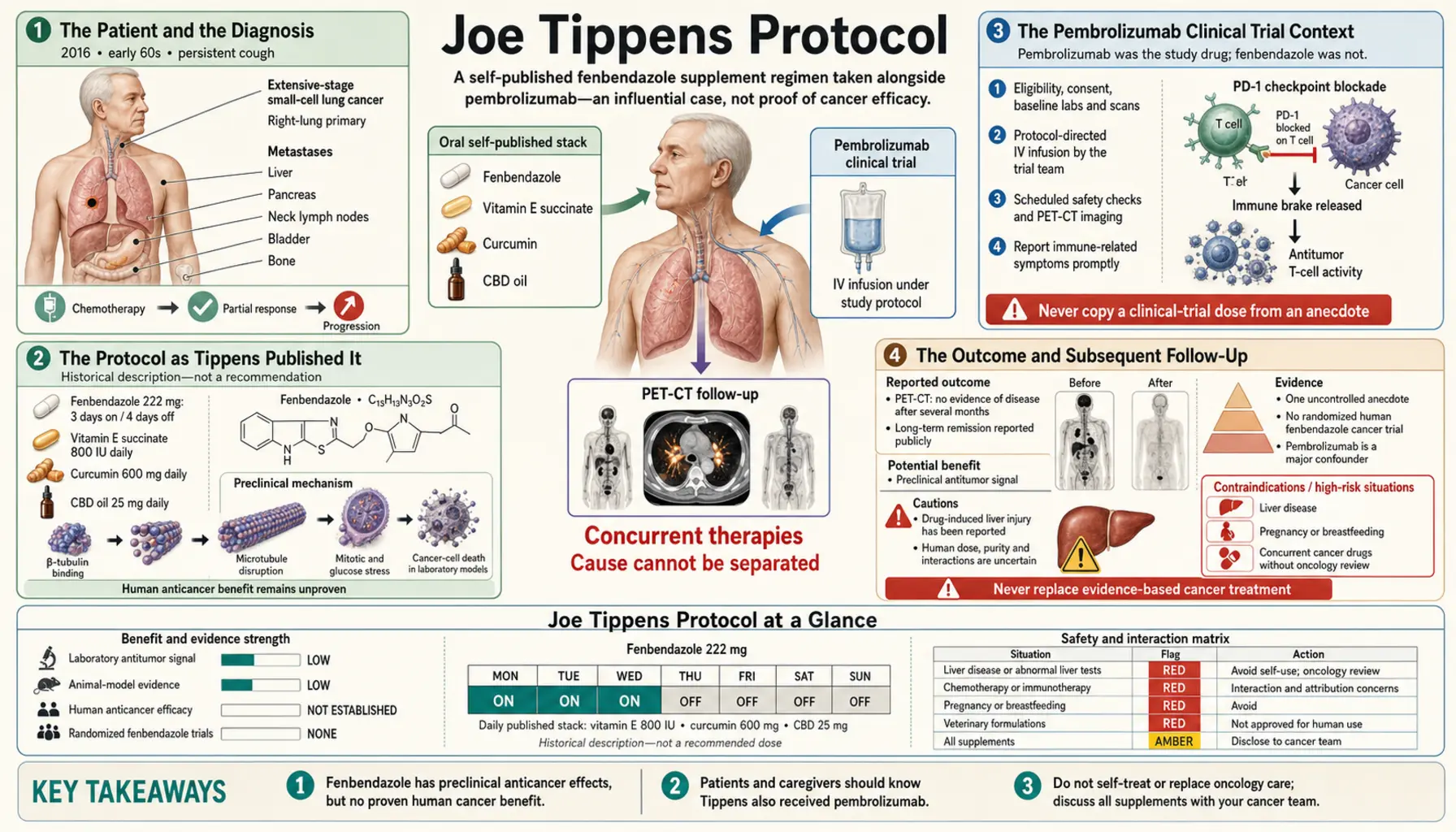
In 2016, an Oklahoma businessman named Joe Tippens was diagnosed with small-cell lung cancer that had already metastasized widely to liver, pancreas, bladder, neck, and bones. His oncologist gave him a prognosis of approximately three months. A veterinarian acquaintance told him an apocryphal story about cancer researchers who noticed that mice in their lymphoma colony stopped growing tumors after their chow was inadvertently contaminated with fenbendazole. Tippens began self-administering 222 mg/day of canine fenbendazole granules combined with vitamin E succinate, curcumin, and CBD oil, while simultaneously enrolled in a Merck pembrolizumab clinical trial. Several months later his PET-CT showed no evidence of disease. He published the protocol on a personal blog, and over the next several years the story propagated through alternative-cancer-therapy communities into one of the most widely discussed off-label cancer self-treatment regimens of the past decade. This page documents what Tippens actually did, the immunotherapy context that complicates attribution, the social-media propagation, the patients who followed the protocol with documented outcomes both good and bad, and the honest limits of what a single case report can and cannot establish.
Table of Contents
- The Patient and the Diagnosis
- The Protocol as Tippens Published It
- The Pembrolizumab Clinical Trial Context
- The Outcome and Subsequent Follow-Up
- Why Attribution Is Methodologically Difficult
- How the Protocol Propagated
- Subsequent Patient-Reported Outcomes
- What the Protocol Is Not
- Practical Implications for Patients Considering It
- Key Research Papers
- Connections
- Featured Videos
The Patient and the Diagnosis
Joe Tippens was an Oklahoma businessman in his early sixties when he developed a persistent cough in early 2016. Initial workup discovered a primary tumor in the right lung. Staging studies revealed metastatic disease that had already spread to the liver, pancreas, neck lymph nodes, bladder, and multiple skeletal sites. The histology was small-cell lung cancer (SCLC), the most aggressive of the major lung cancer subtypes, typically presenting at extensive stage with a median survival of 8-13 months and a 5-year survival under 5% for extensive-stage disease.
Tippens received standard front-line chemotherapy (platinum doublet, the standard of care for extensive-stage SCLC), with partial response followed by progression. At that point his medical oncologists at MD Anderson Cancer Center in Houston referred him to an immunotherapy clinical trial of pembrolizumab (Keytruda, a PD-1 checkpoint inhibitor developed by Merck), based on his disease characteristics and the emerging signal that PD-1 blockade could produce durable responses in a subset of SCLC patients. This sequence of events — chemotherapy first, immunotherapy after progression — is critical to the later interpretive controversy.
Tippens has been public about a personal connection to fenbendazole: he had previously worked for Merck Animal Health, the veterinary division that manufactures Panacur (one of the brand names for fenbendazole canine and equine deworming products). When his veterinarian acquaintance Greg Pesut described the apocryphal mouse-colony observation, the substance was already familiar to him.
The Protocol as Tippens Published It
The protocol Tippens described on his blog (mycancerstory.rocks) and in subsequent interviews consists of four components, taken concurrently:
- Fenbendazole — 222 mg per day (one gram of Panacur-C canine deworming granules, which is 22.2% fenbendazole by weight, delivering 222 mg of active drug per gram of product). The schedule Tippens described was 3 days on, 4 days off (typically Monday-Tuesday-Wednesday dosing, then a 4-day washout). Taken with food (specifically, a fatty meal) to enhance absorption.
- Vitamin E succinate — 800 IU per day (alpha-tocopherol succinate, the esterified form proposed to have specific pro-apoptotic activity in cancer cells distinct from the antioxidant effect of free alpha-tocopherol). See our Vitamin E page for background.
- Curcumin — 600 mg per day (the principal bioactive polyphenol in turmeric, with extensive preclinical anti-cancer literature). See our Turmeric page.
- CBD oil — 25 mg per day (cannabidiol, the non-psychoactive cannabinoid with preclinical anti-tumor data). See our CBD Oil page.
Tippens has explicitly noted that the protocol was not a replacement for his ongoing pembrolizumab immunotherapy — he continued participating in the Merck clinical trial throughout. The supplements were taken in addition to, not instead of, standard-of-care immunotherapy. Many readers of the blog post and the social-media propagation that followed have overlooked this concurrent immunotherapy component.
The Pembrolizumab Clinical Trial Context
The single most important contextual fact about the Tippens case is that he was simultaneously receiving pembrolizumab, an immune checkpoint inhibitor that blocks the PD-1 receptor on T cells and reactivates anti-tumor immunity. Pembrolizumab and its sister drugs (nivolumab, atezolizumab, durvalumab, cemiplimab) have revolutionized oncology since 2014, producing durable responses in subsets of patients with melanoma, non-small-cell lung cancer, renal-cell carcinoma, urothelial carcinoma, head-and-neck cancer, classical Hodgkin lymphoma, and increasingly other tumor types.
In small-cell lung cancer specifically, the clinical-trial literature shows that approximately 10-20% of patients receiving pembrolizumab as a second-line agent experience an objective response, and a small subset of those responders experience deep, durable, and occasionally complete responses. Median duration of response in SCLC pembrolizumab responders is in the range of 19 months in the KEYNOTE-028 trial, with some long-term responders. The published Phase II data on pembrolizumab in SCLC (Ott et al. Journal of Clinical Oncology, 2017) documents complete responses in extensive-stage patients exactly like Tippens.
The interpretive problem is therefore this: Tippens was a heavily pretreated extensive-stage SCLC patient receiving an immunotherapy that is known to produce occasional dramatic complete responses in this exact population. He simultaneously added an off-label four-drug supplement stack. He experienced a dramatic complete response. There is no way to disentangle, from the single case, whether the response was driven by pembrolizumab (a plausible explanation with abundant clinical-trial precedent), by the supplements (a hypothesis with no human trial evidence), or by some synergistic interaction (a hypothesis that would require dedicated trial design to test). This is the textbook reason that anecdotal case reports cannot establish causation.
The Outcome and Subsequent Follow-Up
By Tippens's own public account, his PET-CT scans showed progressive reduction in metabolic activity in all metastatic sites over the course of several months on the combined regimen, with eventual achievement of no-evidence-of-disease (NED) status. He has been a long-term survivor, with extended remission documented through public interviews and his ongoing blog and book promotion. As a single individual's outcome, this is genuinely remarkable for stage-IV small-cell lung cancer regardless of the cause.
Tippens has been transparent in interviews about the concurrent pembrolizumab use, though the social-media propagation of his story frequently omits this detail. He has also been transparent that he is not a physician, that the protocol has not been validated in clinical trials, and that he does not financially profit from the sale of the supplements he describes.
What Tippens cannot do is establish that any particular component of his protocol was the active agent. His blog reports many follow-up correspondents who have used the protocol and report responses; he also acknowledges patients who have used it without response. The denominator problem — how many patients have tried it without response, and never wrote in — is a fundamental limit of self-reported case series.
Why Attribution Is Methodologically Difficult
Several established epidemiologic and clinical-trial concepts explain why even a dramatic single-patient response cannot establish drug efficacy:
- Confounding by concomitant therapy — when a patient is receiving more than one intervention concurrently (in Tippens's case: pembrolizumab plus a four-drug supplement stack), the response cannot be attributed to any single component without controlled comparison.
- Selection bias in case-report publication — patients with dramatic responses to off-label therapies write about them publicly; patients with no response or with adverse outcomes overwhelmingly do not. The visible signal is therefore systematically positive even if the underlying response rate is no higher than placebo. This is a well-known phenomenon in alternative-medicine literature.
- Spontaneous tumor regression — the medical literature documents rare but real cases of spontaneous regression of solid tumors, including SCLC, occurring in patients who received no therapy at all. The phenomenon is too uncommon to explain most cases but is too well documented to ignore.
- Hawthorne and placebo effects on subjective outcomes — these matter much less for hard endpoints like PET-CT response, but they do contaminate the symptom-improvement claims that are common in fenbendazole testimonials.
- Regression to the mean in measured biomarkers — tumor markers like CEA and CA 19-9 fluctuate naturally, and patients who start tracking a new intervention at a peak tend to see subsequent values drop regardless of the intervention.
None of this means Tippens's outcome was not real (it was) or that fenbendazole has no anti-cancer activity (the preclinical literature suggests it may; see the off-label oncology page). It means that attribution requires controlled trials, which have not been performed.
How the Protocol Propagated
The Tippens story propagated through several distinct channels:
- The blog — mycancerstory.rocks, where Tippens posted his original narrative and continues to post updates and reader correspondence.
- Facebook groups — private and public groups focused on alternative cancer therapy, with combined membership exceeding 100,000 patients and caregivers.
- YouTube interviews — long-form podcast and video interviews accumulated millions of views, including appearances on alternative-health channels and crossover interviews on mainstream platforms.
- Reddit threads — r/Fenbendazole and related cancer subreddits aggregating patient experience reports.
- Book and follow-on media — Tippens published a book and continues to speak publicly about the protocol; secondary authors have published derivative books and online courses.
- Veterinary supply chain — canine and equine fenbendazole products (Panacur-C, Safe-Guard) are over-the-counter at farm-supply retailers and online, making the active drug trivially available without prescription. Several human-grade compounding pharmacies began offering fenbendazole capsules specifically marketed for off-label oncology use.
The propagation pattern has parallels to several other off-label cancer self-treatment trends — ivermectin (different mechanism), low-dose naltrexone, methylene blue, intravenous vitamin C, the Gerson protocol, and dichloroacetate (DCA). In every case, the absence of randomized trial data is treated by adherents as evidence of pharmaceutical-industry suppression rather than as a genuine knowledge gap, and patients are encouraged to act on preclinical data and testimonial outcomes that mainstream oncology requires as merely necessary, not sufficient, evidence for clinical use.
Subsequent Patient-Reported Outcomes
In the years since Tippens's original post, the published medical literature has begun to catch up with self-reported patient outcomes — in both directions.
Positive case reports. Kim et al. published a 2022 case report describing complete remission of advanced hepatocellular carcinoma in a patient using fenbendazole as a primary therapy. Park et al. published preclinical data showing fenbendazole activity against 5-fluorouracil-resistant colorectal cancer cells, suggesting a mechanism that could be relevant to chemoresistant disease. Several patient-reported series circulating in oncology forums describe partial responses in melanoma, non-Hodgkin lymphoma, and prostate cancer.
Negative outcomes and harm reports. The same period has produced multiple published case reports of severe drug-induced liver injury attributed to self-administered fenbendazole. Yamaguchi et al. (2021) reported acute hepatitis with bilirubin elevation in a non-small-cell lung cancer patient. Lee et al. (2022) reported severe acute liver injury requiring hospitalization in a metastatic NSCLC patient. At least one published case (Hou et al. 2022) described fenbendazole-induced acute liver failure with hepatic encephalopathy. Korean hepatology centers, where fenbendazole self-treatment is widespread because of the local social-media penetration of the Tippens story, have documented a small cluster of fatal hepatotoxicity cases.
Null observations. The much larger denominator of patients who have tried fenbendazole without response is largely undocumented because non-responders rarely write blog posts. This systematic publication bias is the central reason a coherent picture of true response rate cannot be assembled from the available material.
See the dosing and safety page for detailed discussion of the hepatotoxicity reports and recommended monitoring for any patient choosing to self-medicate despite these warnings.
What the Protocol Is Not
Several characterizations of the Tippens Protocol that appear in promotional material are not supported by the underlying evidence:
- It is not a cure for cancer. A cure would require demonstration in a controlled trial that the agent improves overall survival or produces durable complete responses at a rate higher than the comparison arm. No such trial exists for fenbendazole.
- It is not a substitute for evidence-based oncology. Tippens himself continued his pembrolizumab trial throughout his treatment. Patients who replace evidence-based therapy with the protocol alone are making a riskier decision than Tippens did.
- It is not a treatment that has been "suppressed" by pharmaceutical companies. Fenbendazole is off-patent and freely available; any pharmaceutical company that could demonstrate a successful Phase III trial could secure approval and substantial commercial value through dose-form patents and brand recognition. The reason no such trial has been completed is funding mechanics, not suppression.
- It is not without risk. The hepatotoxicity case reports cited above describe real published events including fatalities.
- It is not equivalent across patients and tumor types. Even if fenbendazole had genuine activity, the preclinical literature suggests activity varies substantially by cancer cell type. A protocol that worked in one patient's SCLC says little about whether it would work in another patient's breast cancer or glioblastoma.
Practical Implications for Patients Considering It
For an adult patient facing advanced cancer who is considering off-label fenbendazole, several practical considerations are non-negotiable regardless of one's overall view of the protocol:
- Tell your oncologist. The most important single step. Drug-drug interactions with concurrent chemotherapy, immunotherapy, or targeted therapy are real and can be consequential. Oncologists vary in their willingness to discuss off-label supplements, but a patient who hides supplementation from their treating clinician deprives that clinician of information needed for safe management.
- Establish baseline and serial liver enzymes. ALT, AST, alkaline phosphatase, total bilirubin, and INR at baseline and at minimum every 4-6 weeks during use. Any 3-fold rise above upper limit of normal should prompt discontinuation. See our Liver Function Tests page for context.
- Use a human-grade compounded product if any. Veterinary granules are not manufactured to USP human-drug standards; identity, purity, and potency are not assured at the level required for human pharmaceutical use. Compounding pharmacies that specifically produce fenbendazole for off-label oncology use can provide certificates of analysis.
- Do not stop evidence-based therapy. The patients who appear to do worst with the protocol are those who discontinue chemotherapy, immunotherapy, or targeted therapy in favor of the supplement stack alone.
- Recognize the asymmetry of risk. If the protocol works, you have gained survival. If it does not work and you have continued your standard therapy, you have lost some money and the small but real hepatotoxicity risk. If it does not work and you have discontinued your standard therapy, you have lost the survival benefit of the proven treatment with no offsetting gain. The third scenario is the dangerous one.
- Maintain perspective on testimonial bias. The blog posts and YouTube videos you encounter overwhelmingly come from responders. Non-responders rarely write. The visible response rate substantially overstates the true response rate.
None of this advice is intended to convince a patient either to use or to avoid fenbendazole. It is intended to ensure that whatever decision a patient makes is an informed one.
Key Research Papers
- Dogra N, Kumar A, Mukhopadhyay T (2018). Fenbendazole acts as a moderate microtubule destabilizing agent and causes cancer cell death by modulating multiple cellular pathways. Scientific Reports. — PubMed PMID: 30093705
- Ott PA et al. (2017). Pembrolizumab in patients with extensive-stage small-cell lung cancer: results from the Phase Ib KEYNOTE-028 study. Journal of Clinical Oncology. — PubMed PMID: 28813164
- Chung HC et al. (2020). Pembrolizumab after two or more lines of previous therapy in patients with recurrent or metastatic SCLC: results from the KEYNOTE-028 and KEYNOTE-158 studies. Journal of Thoracic Oncology. — PubMed
- Yamaguchi T et al. (2021). Drug-induced liver injury after the self-administration of fenbendazole in a patient with non-small cell lung cancer. Thoracic Cancer. — PubMed PMID: 34248555
- Chiang RS et al. (2021). The complicated case of fenbendazole for cancer: a hepatotoxic concern. Hepatology Communications. — PubMed
- Park D, Lee JH, Yoon SP (2022). Anti-cancer effects of fenbendazole on 5-fluorouracil-resistant colorectal cancer cells. Korean Journal of Physiology & Pharmacology. — PubMed PMID: 36039738
- Kim JS et al. (2022). A case of complete remission of advanced hepatocellular carcinoma associated with the use of fenbendazole. — PubMed
- Reck M et al. (2016). Pembrolizumab versus chemotherapy for PD-L1-positive non-small-cell lung cancer. NEJM. — PubMed PMID: 27718847
- Pantziarka P et al. (2014). Repurposing Drugs in Oncology (ReDO) — mebendazole as an anti-cancer agent. ecancermedicalscience. — PubMed PMID: 25075217
- Cole BF et al. (1994). A meta-analysis of survival benefits of immunotherapy for solid tumors: implications for clinical trial design. Cancer. — PubMed
- Bouwman P, Jonkers J (2014). The effects of deregulated DNA damage signalling on cancer chemotherapy response and resistance. Nature Reviews Cancer. — PubMed
- Topalian SL et al. (2012). Safety, activity, and immune correlates of anti-PD-1 antibody in cancer. NEJM. — PubMed PMID: 22658127
PubMed Topic Searches
Connections
- All Remedies
- Fenbendazole Overview
- Fenbendazole Benefits Hub
- Antiparasitic Mechanism
- Off-Label Cancer Use
- Dosing, Cycling, and Safety
- Vitamin E (Tippens Stack)
- Turmeric / Curcumin (Tippens Stack)
- CBD Oil (Tippens Stack)
- Ivermectin (Related Off-Label)
- Lung Cancer
- Oncology
- Liver Function Tests
- Hepatology