Fenbendazole Antiparasitic Mechanism
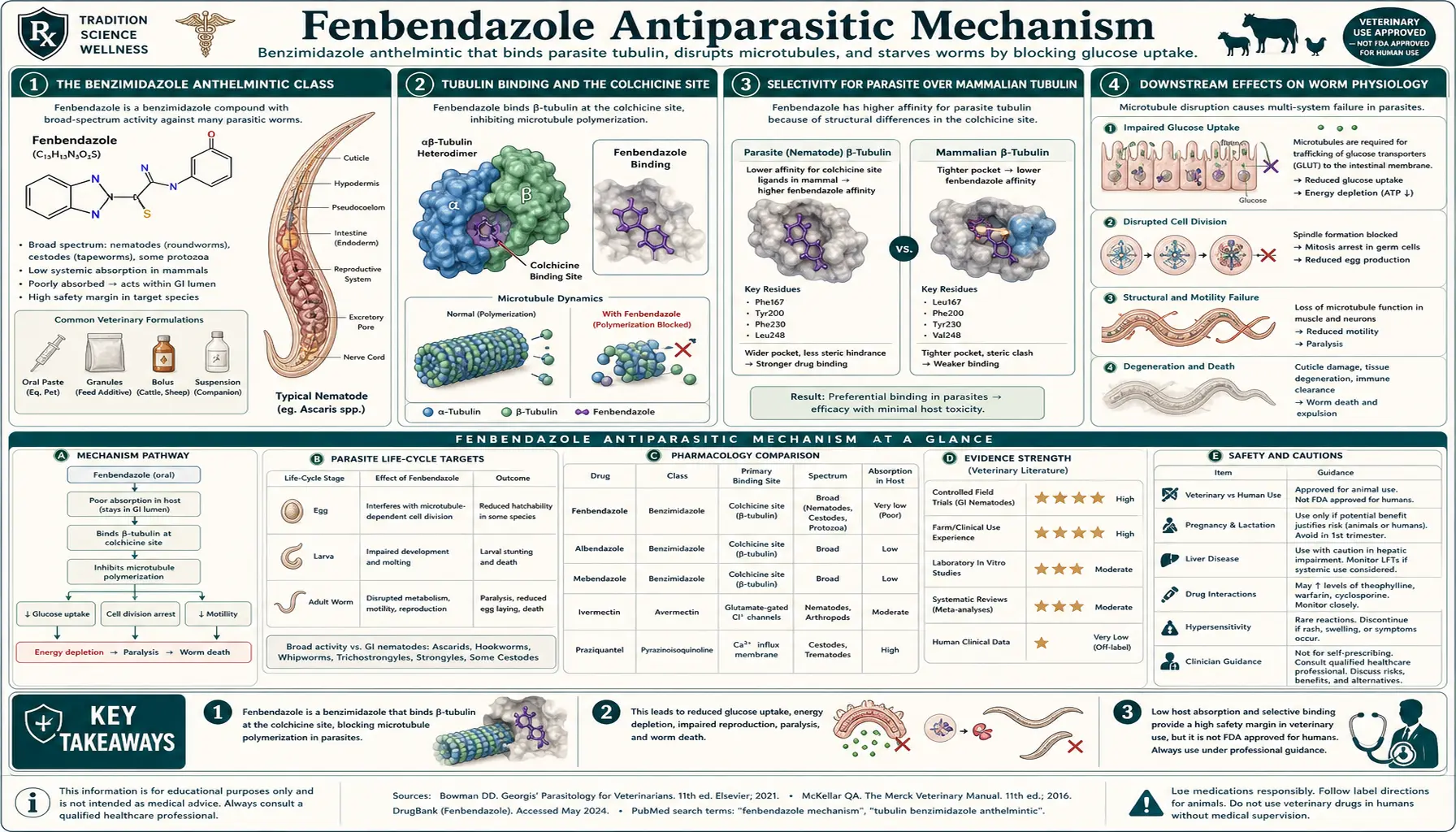
Fenbendazole is a benzimidazole carbamate anthelmintic whose principal molecular target is parasite beta-tubulin. It binds at or near the colchicine site of the tubulin heterodimer, blocks polymerization of microtubules in adult and larval helminths, and collapses two parasite functions that depend on intact microtubules: cytoplasmic transport (including glucose-transporter trafficking to the worm tegument) and mitotic spindle assembly in dividing cells of the worm gonad. The selectivity that makes fenbendazole a useful drug rather than a poison comes from differential binding affinity — the benzimidazole carbamates bind parasite tubulin approximately 250-400 times more avidly than mammalian tubulin, the basis for the wide therapeutic window. This page works through the structural pharmacology, the broad spectrum of parasites the drug treats in approved veterinary indications, and the pharmacokinetic profile (poor oral absorption, extensive hepatic metabolism, biliary excretion, and the active metabolite oxfendazole) that explains both why high doses are tolerated and why food coadministration matters so much.
Table of Contents
- The Benzimidazole Anthelmintic Class
- Tubulin Binding and the Colchicine Site
- Selectivity for Parasite over Mammalian Tubulin
- Downstream Effects on Worm Physiology
- Spectrum of Antiparasitic Activity
- Pharmacokinetics and Metabolism
- The Food Effect on Bioavailability
- Benzimidazole Resistance in Field Parasites
- Limited Human Use (Hydatid Disease and Microsporidia)
- The Mechanistic Bridge to Oncology Hypotheses
- Key Research Papers
- Connections
- Featured Videos
The Benzimidazole Anthelmintic Class
Benzimidazoles are a chemical class of antiparasitic drugs built on a bicyclic aromatic scaffold (benzene fused with imidazole) substituted at the 2-position with a methylcarbamate (-NHCO-OCH3) group and at the 5-position with various side chains that tune absorption, distribution, and spectrum. The class was introduced in the 1960s with thiabendazole and has since expanded to include:
- Albendazole — 5-propylthio benzimidazole carbamate; the WHO-Essential-Medicines-listed human anthelmintic for soil-transmitted helminths, hydatid disease, and neurocysticercosis.
- Mebendazole — 5-benzoyl benzimidazole carbamate; a human-approved oral anthelmintic for pinworm, hookworm, roundworm, and whipworm, also studied off-label in oncology.
- Fenbendazole — 5-phenylsulfanyl benzimidazole carbamate; the principal veterinary broad-spectrum anthelmintic.
- Oxfendazole — the sulfoxide metabolite of fenbendazole, separately licensed and itself active.
- Triclabendazole — 5-chloro-6-dichloro variant with specific activity against liver flukes.
- Flubendazole — fluorinated mebendazole variant.
- Oxibendazole, Cambendazole, Parbendazole, Febantel (a fenbendazole prodrug) — additional veterinary members.
Fenbendazole differs from albendazole and mebendazole primarily in its 5-position substituent (phenylsulfanyl group), which gives it poorer oral absorption than albendazole and a metabolism profile that runs through oxfendazole as the principal active metabolite.
Tubulin Binding and the Colchicine Site
Tubulin is the heterodimeric building block of microtubules, the dynamic cytoskeletal polymers that perform several essential cellular functions: intracellular transport along motor proteins, organization of the mitotic spindle that segregates chromosomes during cell division, support of cilia and flagella, and maintenance of cell shape. Each tubulin heterodimer consists of one alpha-tubulin and one beta-tubulin subunit. Microtubules grow by addition of GTP-bound heterodimers at the "plus end" and shrink by loss of GDP-bound heterodimers, producing the dynamic instability that allows the cytoskeleton to be remodeled rapidly during cell division.
Benzimidazole carbamates bind to beta-tubulin at or near the colchicine-binding site (a hydrophobic pocket at the interface between the alpha- and beta-tubulin subunits within the heterodimer). The binding distorts the conformation of beta-tubulin in a way that prevents the polymerizing addition of new heterodimers to growing microtubules. Existing microtubules continue to shrink at their minus ends but cannot rebuild at their plus ends, with the net result that the microtubule network depolymerizes. This is the same general mechanism of action used by colchicine itself (the gout drug), by vinca alkaloids (vincristine, vinblastine, used as anticancer chemotherapeutics), and by nocodazole (a laboratory reagent). The taxanes (paclitaxel, docetaxel) act on the same target but with the opposite effect — they stabilize microtubules and prevent their depolymerization, producing the same net cell-cycle arrest by a different physical mechanism.
The binding has been confirmed by competition with [3H]-mebendazole in radioligand assays, by X-ray crystallography of related benzimidazoles bound to tubulin, and by the demonstration that point mutations in beta-tubulin at positions 167, 198, and 200 confer benzimidazole resistance in field parasites (the same residues that line the binding pocket).
Selectivity for Parasite over Mammalian Tubulin
All eukaryotes use tubulin. If benzimidazoles bound mammalian tubulin with the same affinity as parasite tubulin, the drug would be a non-selective microtubule poison — useless as therapy. The therapeutic window depends entirely on differential binding affinity.
Quantitative competition binding studies (Lacey 1988, Russell & Lacey 1992, others) place the affinity of mebendazole and fenbendazole for nematode beta-tubulin at roughly 250-400-fold higher than for mammalian beta-tubulin. The structural basis is a small number of amino-acid differences in the binding pocket: parasite beta-tubulin has a phenylalanine at position 200 where mammalian tubulin has a tyrosine, and a glutamate at position 198 that participates in hydrogen-bonding contacts with the benzimidazole that the corresponding mammalian residue does not form. These small differences are amplified into a several-hundred-fold affinity difference.
The selectivity is the reason a 50 mg/kg single dose of fenbendazole is the standard dewormer for a 70-kg sheep, while the same body-weight-adjusted dose in humans (about 3.5 grams) is well into the territory studied by self-medicating cancer patients. Mammals tolerate doses that would be impossible if the affinity ratio were closer to 1:1. The selectivity is not absolute, however — sustained high doses do produce measurable effects on mammalian cells, particularly rapidly dividing tissues (gut epithelium, bone marrow), which is the empirical basis for both the rare hepatotoxicity signal and the off-label oncology interest. See the off-label cancer use page for the proposed cancer-cell mechanisms.
Downstream Effects on Worm Physiology
Microtubule depolymerization in parasitic worms produces several concurrent failures:
- Loss of intracellular transport. Microtubules are the railway track on which motor proteins (kinesins, dyneins) move cargo. In adult parasitic worms, the most clinically important cargo is the glucose transporter that traffics to the tegumental membrane (the outer surface of the worm) where it absorbs glucose from host intestinal contents. Loss of glucose transporter trafficking starves the worm of its principal energy substrate within 24-72 hours.
- Loss of secretory function. The worm tegument is also the surface across which the parasite secretes immunomodulatory molecules that suppress host immunity. Depolymerization disrupts secretory vesicle transport and exposes the worm to immune attack.
- Disruption of egg production. In gonadal cells of adult worms, microtubule depolymerization blocks meiosis and egg-shell deposition, reducing fecundity even in worms that survive the drug.
- Larval mortality. Larval stages are more dependent on cell division than adult somatic tissue and are correspondingly more sensitive. Many benzimidazoles are more ovicidal and larvicidal than they are adulticidal, an important practical property because larval stages are the source of pasture contamination in livestock parasitology.
The combined effect is parasite death, typically over 1-7 days depending on the worm species and the host's ability to clear paralyzed parasites from the gut.
Spectrum of Antiparasitic Activity
Fenbendazole has the broad spectrum characteristic of the benzimidazole class. Approved veterinary indications cover:
- Gastrointestinal nematodes — Haemonchus, Ostertagia, Trichostrongylus, Cooperia, Nematodirus, Bunostomum, Oesophagostomum, Chabertia, Strongyloides, Trichuris (whipworms), Ancylostoma and Uncinaria (hookworms), Toxocara and Toxascaris (roundworms).
- Pulmonary parasites — Dictyocaulus viviparus (cattle lungworm), Aelurostrongylus abstrusus (cat lungworm), and other respiratory nematodes.
- Tapeworms (cestodes) — Taenia spp. in dogs and cats; activity is partial against tapeworms relative to praziquantel, which is the cestode drug of choice.
- Protozoa — off-label efficacy against Giardia (Barr et al. 1994 documented eradication in dogs at 50 mg/kg orally for 3 days), reflecting the fact that Giardia also has microtubule-based locomotion and feeding.
- Encephalitozoon — some preclinical evidence for activity against microsporidia.
The single most important exception is the heartworm Dirofilaria immitis, which is not effectively treated by fenbendazole. Heartworm treatment uses melarsomine (adult) and macrocyclic lactones such as ivermectin or moxidectin (larval prevention).
Pharmacokinetics and Metabolism
The fenbendazole pharmacokinetic profile is the central explanation for both its safety in animals and the complexity of dose interpretation in human off-label use:
- Oral absorption is poor. Bioavailability from oral granules in monogastric mammals (including humans, dogs, pigs) is in the range of 1-5%. The bulk of the administered dose passes through the gastrointestinal tract unabsorbed and is excreted in feces. This is a feature, not a bug, for veterinary use — the unabsorbed drug remains in the gut lumen where most of the target parasites live, while the small absorbed fraction reaches systemic circulation to treat tissue-stage parasites.
- Hepatic metabolism is extensive. Absorbed fenbendazole undergoes first-pass oxidation by CYP3A4 to fenbendazole sulfoxide (the active metabolite, marketed separately as oxfendazole), and further oxidation to fenbendazole sulfone (less active). The metabolism is sufficiently rapid that fenbendazole and oxfendazole appear in plasma in roughly equal concentrations within hours of dosing.
- Distribution. The lipophilicity gives fenbendazole reasonable tissue distribution, with measurable concentrations in liver, kidney, lung, fat, and (importantly for human oncology hypotheses) in solid tumor tissue in xenograft studies.
- Elimination. Biliary excretion is the dominant route, with enterohepatic recirculation that extends the apparent half-life. Terminal elimination half-life in most mammals is 10-15 hours.
- Protein binding. Plasma protein binding is high (>90%), so dose-equivalent free-drug concentrations are smaller than total plasma concentration would suggest.
- Enzyme induction and inhibition. Fenbendazole is a modest inducer of CYP3A4 with chronic dosing; its metabolism is in turn affected by concurrent CYP3A4 inhibitors (ketoconazole, clarithromycin, grapefruit juice) and inducers (rifampin, phenytoin, carbamazepine).
The Food Effect on Bioavailability
One of the most consequential properties of fenbendazole for off-label dosing is that oral bioavailability increases approximately 5-10-fold when the drug is taken with a fatty meal compared to fasting. This is the classic food effect seen with highly lipophilic drugs: fat in the meal stimulates bile salt secretion, which solubilizes the drug into mixed micelles that are absorbed in the small intestine.
The practical implication is that a 222 mg "Tippens dose" taken with a high-fat breakfast produces several times the systemic plasma concentration of the same dose taken fasting. Without controlling for meal composition, dose-response analysis is impossible — two patients on the same milligram dose may have systemic exposures differing by an order of magnitude. This is part of why anecdotal dose-response data from self-medicating patient populations is hard to interpret.
For veterinary use, the food effect is typically managed by recommending coadministration with food. For human off-label use, the protocols of record either explicitly recommend with-food dosing (Tippens) or leave the question ambiguous; published case reports of hepatotoxicity have not consistently characterized meal composition.
Benzimidazole Resistance in Field Parasites
Benzimidazole resistance has become a major problem in veterinary parasitology, particularly in small-ruminant (sheep, goat) parasites in heavily treated regions. The molecular basis is well characterized: point mutations in parasite beta-tubulin at codon 200 (phenylalanine to tyrosine), codon 198 (glutamate to alanine), or codon 167 (phenylalanine to tyrosine) reduce drug binding affinity sufficiently that field doses no longer achieve the systemic concentrations required for parasite kill. The resistance can spread rapidly through worm populations under selection pressure from frequent dewormer use.
The resistance does not affect the activity of fenbendazole in oncology hypotheses because cancer cells presumably retain wild-type mammalian beta-tubulin sequence. It does, however, illustrate the principle that microtubule-binding drugs select for resistance through tubulin-sequence mutations — a principle that may also apply to long-term off-label cancer use if any single-mechanism therapy is sustained.
Limited Human Use (Hydatid Disease and Microsporidia)
Fenbendazole itself is not FDA-approved for any human indication. The benzimidazole class is, however, well established in human anthelmintic medicine:
- Albendazole is the WHO drug of choice for hydatid disease (cystic and alveolar echinococcosis) and for neurocysticercosis, and is used for soil-transmitted helminth eradication programs.
- Mebendazole is used in many countries for pinworm, hookworm, roundworm, and whipworm, often as a single 100 mg dose.
- Triclabendazole is the WHO drug of choice for fascioliasis (liver fluke).
The historical mass-deworming programs for soil-transmitted helminths (run by WHO, the Children Without Worms initiative, and several country-level programs) have administered billions of cumulative doses of albendazole and mebendazole with an excellent overall safety record. The class is therefore not a fringe pharmacology — it is an established human medicine, just with fenbendazole specifically being on the veterinary side of the regulatory boundary.
The Mechanistic Bridge to Oncology Hypotheses
The mechanistic bridge from antiparasitic activity to the proposed anti-cancer activity rests on the shared dependence of parasitic worms and cancer cells on functional microtubules:
- Both rapidly proliferating cell populations depend on intact mitotic spindle assembly to complete cell division.
- Both depend on cytoplasmic microtubule transport for surface-protein trafficking, including glucose transporters.
- Both are subject to apoptotic checkpoints that can be triggered by sustained mitotic arrest.
The argument is therefore that a drug capable of disrupting parasite microtubules might, at higher systemic concentrations, also disrupt cancer-cell microtubules — particularly cancer cells that have lost the p53 checkpoint and cannot mount a normal G2/M arrest response to mitotic disruption. The argument has plausibility but is not proof; the same argument could be made for many tubulin-binding compounds, and most are not anticancer drugs. The relevant question is whether the in-vivo human plasma concentrations achievable with off-label fenbendazole dosing reach the concentrations required for cancer-cell effect, and whether the effect is large enough to matter clinically. See the off-label cancer use page for the preclinical literature that attempts to answer this question.
Key Research Papers
- Lacey E (1988). The role of the cytoskeletal protein, tubulin, in the mode of action and mechanism of drug resistance to benzimidazoles. International Journal for Parasitology. — PubMed
- Lubega GW, Prichard RK (1991). Beta-tubulin and benzimidazole resistance in the sheep nematode Haemonchus contortus. Molecular and Biochemical Parasitology. — PubMed
- Russell GJ, Lacey E (1992). Inhibition of [3H]-mebendazole binding to tubulin by structurally diverse anthelmintics. Biochimica et Biophysica Acta. — PubMed
- Kwa MS et al. (1994). Beta-tubulin genes from the parasitic nematode Haemonchus contortus modulate drug resistance in Caenorhabditis elegans. Journal of Molecular Biology. — PubMed
- Lanusse CE, Prichard RK (1993). Clinical pharmacokinetics and metabolism of benzimidazole anthelmintics in ruminants. Drug Metabolism Reviews. — PubMed
- Mottier ML et al. (2003). Fenbendazole-cyclodextrin complex: facile preparation, characterization and bioavailability enhancement. Veterinary Parasitology. — PubMed
- Mckellar QA, Scott EW (1990). The benzimidazole anthelmintic agents — a review. Journal of Veterinary Pharmacology and Therapeutics. — PubMed
- Barr SC et al. (1994). Use of fenbendazole to treat giardiasis in dogs. JAVMA. — PubMed
- Schwartz RD, Donoghue AR (2000). Efficacy of fenbendazole granules and pyrantel pamoate suspension against Giardia spp. in naturally infected pups. American Journal of Veterinary Research. — PubMed
- Kohler P (2001). The biochemical basis of anthelmintic action and resistance. International Journal for Parasitology. — PubMed
- Sangster NC, Gill J (1999). Pharmacology of anthelmintic resistance. Parasitology Today. — PubMed
- Martin RJ (1997). Modes of action of anthelmintic drugs. The Veterinary Journal. — PubMed
PubMed Topic Searches
- PubMed: Benzimidazole tubulin binding
- PubMed: Fenbendazole pharmacokinetics
- PubMed: Albendazole human anthelmintic
- PubMed: Fenbendazole giardia
- PubMed: Beta-tubulin resistance mutations
Connections
- All Remedies
- Fenbendazole Overview
- Fenbendazole Benefits Hub
- Joe Tippens Protocol
- Off-Label Cancer Use
- Dosing, Cycling, and Safety
- Ivermectin
- Parasitic Disease
- Giardiasis
- Pinworm
- Hookworm
- Roundworm
- Tapeworm
- Anti-Parasitic Herbs