Ivermectin Treatment for Strongyloides
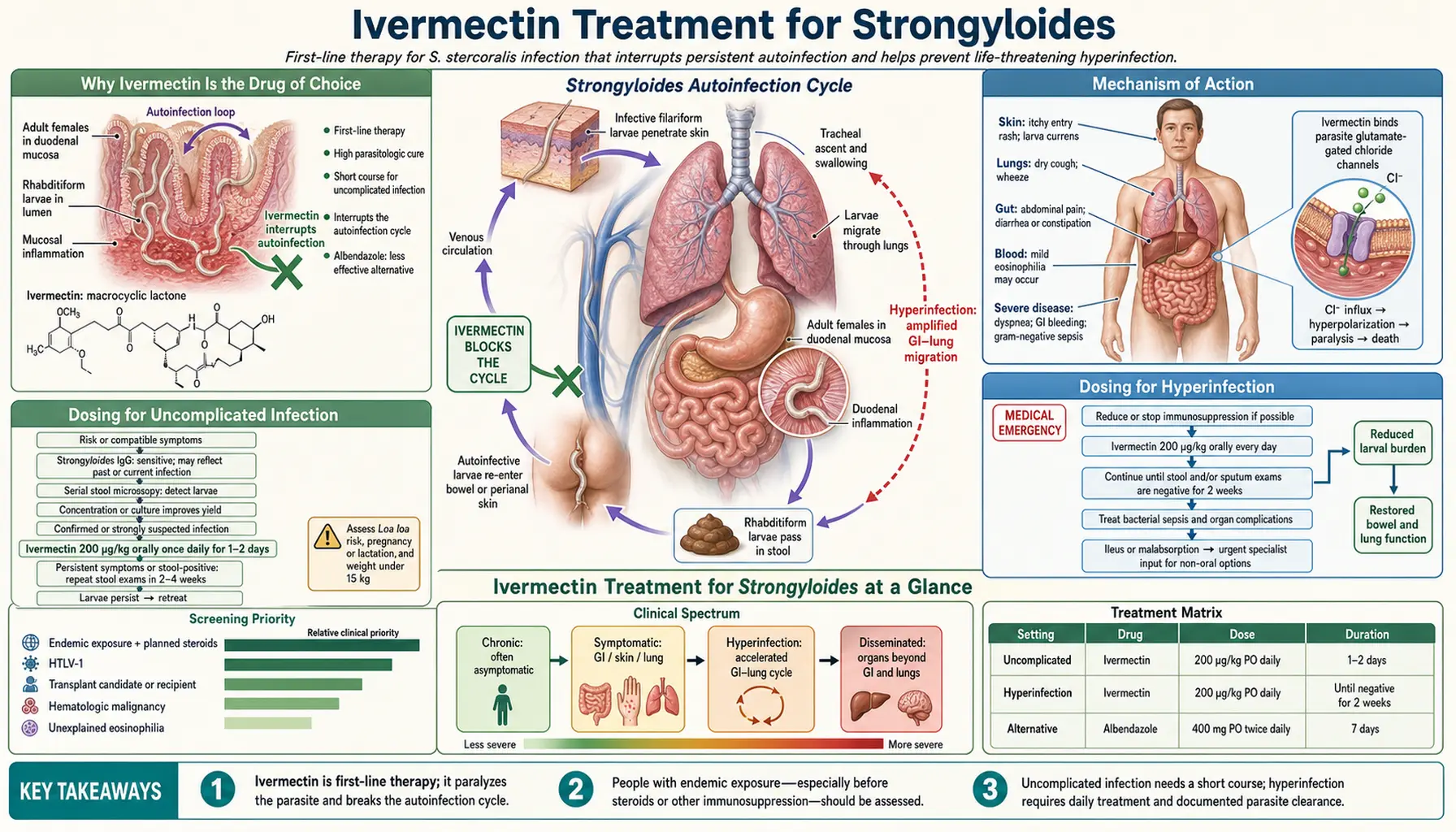
Table of Contents
- Why Ivermectin Is the Drug of Choice
- Mechanism of Action
- Dosing for Uncomplicated Infection
- Dosing for Hyperinfection
- Bioavailability and Food Interaction
- Albendazole as Alternative
- Post-Treatment Follow-Up
- Recurrence in HTLV-1 Patients
- Special Situations
- Key Research Papers
- PubMed Searches
- Connections
- Featured Videos
Why Ivermectin Is the Drug of Choice
Ivermectin is the clear first-line treatment for Strongyloides stercoralis by every major guideline — WHO Essential Medicines List, CDC, IDSA, and ASTMH. The evidence base is compelling. In a landmark Cochrane systematic review (Henriquez-Camacho et al. 2016), ivermectin achieved cure rates of 95–100% in uncomplicated infection, compared with 60–70% for albendazole. The older standard treatment, thiabendazole (25 mg/kg twice daily for 3 days), had equivalent efficacy to albendazole but a much higher side-effect burden: nausea, vomiting, dizziness, and occasional hepatotoxicity made it poorly tolerated and largely abandoned in clinical practice.
Ivermectin achieved its dominance because it combines near-perfect efficacy with excellent tolerability — in clinical trials, adverse event rates were similar to placebo. Its once-daily oral dosing and short treatment course (2 days for uncomplicated infection) ensure high compliance. Patients who have struggled through multi-week thiabendazole regimens, with nausea severe enough to require antiemetics, often find the 2-day ivermectin course almost imperceptibly easy. Generic ivermectin is available in most countries and inexpensive — approximately $0.10–$2.00 per tablet depending on the market. In high-income countries, the branded version (Stromectol) costs substantially more, but generic equivalents remain widely available.
The superiority of ivermectin over albendazole is consistent across multiple randomized controlled trials. The mechanism is more direct lethality to larval stages, while albendazole's microtubule-inhibiting mechanism kills more slowly and less completely. For a disease where the parasite can complete a full internal lifecycle — and escalate to life-threatening hyperinfection — complete eradication is the goal, not 60–70% reduction. Ivermectin's ability to achieve that in a 48-hour course makes it the right tool.
Mechanism of Action
Ivermectin's antiparasitic mechanism is selective and elegant. In nematodes, ivermectin binds with high affinity to glutamate-gated chloride (GluCl) channels located in the membranes of invertebrate nerve and muscle cells. This binding causes allosteric opening of the chloride channel, leading to increased chloride ion conductance across the cell membrane, hyperpolarization, and sustained muscle paralysis. The worm is paralyzed and unable to feed or maintain its position in the intestinal mucosa, leading to expulsion and death.
Critically, mammalian neurons lack glutamate-gated chloride channels — glutamate is not an inhibitory neurotransmitter in the mammalian central nervous system. This fundamental difference in neuropharmacology explains ivermectin's extraordinary selectivity: it is highly toxic to invertebrates and essentially non-toxic to mammals at therapeutic doses. At the dose used for Strongyloides treatment (200 mcg/kg), blood-brain barrier penetration in healthy adults is minimal, and CNS side effects are essentially absent. The P-glycoprotein transporter at the blood-brain barrier actively pumps ivermectin out of the CNS — a critical protective mechanism that, when absent (as in certain dog breeds with the MDR1/ABCB1 mutation), leads to CNS toxicity even at low doses. Humans have intact P-gp, providing a robust safety margin.
An additional dimension specific to Strongyloides: corticosteroids bind glucocorticoid receptors expressed on the parasite itself and accelerate larval development, promoting the autoinfection cycle. This is why immunosuppression — particularly corticosteroid therapy — can transform a dormant, decades-old Strongyloides infection into explosive hyperinfection within weeks. Ivermectin interrupts this process by killing filariform larvae before they can complete the autoinfection cycle. In a patient starting corticosteroids who has unrecognized Strongyloides, a 2-day ivermectin course administered before the steroids can prevent a potentially fatal cascade — a principle that underlies why Strongyloides screening before immunosuppression is so important.
Ivermectin also likely inhibits the parasite's pharyngeal pumping (its feeding mechanism) by paralyzing pharyngeal muscle cells via the same GluCl channel mechanism, starving the worm even before systemic paralysis kills it. Multiple sites of lethal action — neuromuscular paralysis plus impaired feeding — may contribute to the drug's near-complete efficacy.
Dosing for Uncomplicated Infection
Standard dosing for uncomplicated Strongyloides infection: ivermectin 200 mcg/kg orally once daily for 2 consecutive days. For a 70 kg adult, this is 14 mg per day (two doses of 14 mg, taken 24 hours apart). In practice, ivermectin is available as 3 mg tablets in the US and as 6 mg tablets in many other countries. A 70 kg patient would take approximately four to five 3 mg tablets per dose, depending on how the dose rounds.
Weight-based dosing reference table:
- 15–24 kg: 3 mg per dose
- 25–35 kg: 6 mg per dose
- 36–50 kg: 9 mg per dose
- 51–65 kg: 12 mg per dose
- 66–79 kg: 15 mg per dose
- 80 kg and above: 200 mcg/kg rounded to the nearest 3 mg tablet
The 2-day course is standard for immunocompetent patients with confirmed or suspected uncomplicated infection. The rationale for 2 days rather than 1: ivermectin kills larvae and adult worms present during the treatment window, but eggs may survive the first dose and hatch into newly susceptible larvae by day 2. A second dose 24 hours later catches that cohort. Some guidelines recommend a single dose, particularly in mass drug administration programs, but the 2-day course is standard in clinical settings where cure of individual patients is the goal.
Some experts advocate a third dose at day 15 in immunocompromised patients — even those without frank hyperinfection — to catch larvae that may have been in a non-susceptible lifecycle stage during the initial 2-day treatment. This third-dose strategy has not been rigorously validated in randomized trials but is widely practiced based on pharmacologic reasoning and expert consensus. For patients with mild immunosuppression (e.g., low-dose prednisone, well-controlled HIV), the standard 2-day course with vigilant follow-up is generally sufficient.
Practical note: patients should be counseled that the treatment is well-tolerated and short. The most common side effects are mild and transient — headache, dizziness, or loose stools — and occur in fewer than 5% of patients. These side effects may partly represent a Mazzotti-like reaction (inflammatory response to dying parasites) rather than direct drug toxicity.
Dosing for Hyperinfection
Hyperinfection and disseminated Strongyloides require both higher treatment intensity and extended duration. The standard approach: ivermectin 200 mcg/kg/day continued until stool cultures are negative on two consecutive tests (usually checked every 2–3 days), then continued for an additional 2 weeks after the second negative culture. In practice, this typically means a minimum of 7–14 days of total treatment, sometimes extending to 3–4 weeks in severe cases.
The rationale for extended treatment lies in parasite lifecycle dynamics. At any given moment, the total larval population of a hyperinfecting patient spans multiple lifecycle stages — rhabditiform larvae, filariform larvae, free-living adults, and eggs — with differing susceptibility to ivermectin. Eggs are essentially impervious to ivermectin. Rhabditiform larvae (L1/L2 stages in the intestinal lumen) are susceptible, as are filariform larvae (L3, the infective stage that penetrates intestinal mucosa or perianal skin). Adult worms embedded in intestinal crypts may require higher drug concentrations for complete killing. Extending treatment beyond 2 days ensures coverage of multiple successive larval cohorts as eggs hatch and develop into susceptible stages.
Monitoring stool cultures every 2–3 days during treatment is essential to guide duration. The endpoint is two consecutive negative agar plate cultures (the most sensitive stool method), not just symptom resolution — patients with hyperinfection may feel clinically better while still harboring significant larval burdens. Serology is not useful for short-term treatment monitoring; antibody titers change too slowly to reflect acute treatment response.
When oral administration is impossible — the most dangerous scenario in hyperinfection — due to ileus, severe vomiting, or intestinal obstruction from mass larval burden, alternative routes must be considered. Veterinary subcutaneous ivermectin formulations (1% solution in propylene glycol) have been used in life-threatening cases under compassionate use and case reports. The dose is the same (200 mcg/kg), and SC administration bypasses the gastrointestinal tract entirely, providing reliable systemic drug levels even in patients with compromised intestinal absorption. This approach is not FDA-approved for human use and requires pharmacy compounding and case-by-case institutional authorization. Given that untreated or undertreated hyperinfection carries mortality approaching 70–90%, the risk-benefit calculation generally strongly favors attempting SC ivermectin when oral administration fails.
Rectal administration of ivermectin (using a compounded liquid or dissolved tablets in enema form) has been reported in isolated cases when oral and SC routes are unavailable. Bioavailability data for rectal ivermectin in humans are essentially absent, making this a last resort with uncertain dosing. Enema ivermectin should only be considered when no other option exists.
Bioavailability and Food Interaction
Ivermectin's oral bioavailability is approximately 72% under fasted conditions, based on pharmacokinetic studies in healthy volunteers. A high-fat meal dramatically increases drug exposure: a standardized high-fat meal increases plasma Cmax (peak concentration) by approximately 2.5-fold and AUC (total drug exposure over time) by approximately 2-fold. This interaction occurs because dietary fat enhances gastrointestinal lymphatic absorption of ivermectin and reduces first-pass hepatic metabolism by slowing gastric emptying and increasing intestinal transit time, allowing more drug to be absorbed before reaching the liver.
This pharmacokinetic food interaction is clinically relevant and differs from most other drugs, where food-drug interactions are generally adverse. For ivermectin, the interaction is beneficial — taking the drug with a fat-containing meal substantially increases systemic drug exposure and should improve efficacy, particularly for high-burden infections where maximum parasite kill is the goal. Foods that meaningfully increase ivermectin absorption include whole milk, fatty cheese, eggs, avocado, and any meal with substantial fat content.
Despite this evidence, many historical guidelines recommended fasting administration, likely based on convention established before the food interaction was well-characterized. Newer expert opinion and some updated guidelines increasingly favor administration with food. The WHO recommendations for mass drug administration programs specify fasting administration for logistical simplicity, not therapeutic rationale. In clinical practice for individual patient treatment, a high-fat meal before ivermectin is pharmacologically justified and may meaningfully improve treatment outcomes.
Plasma half-life of ivermectin is approximately 16–18 hours in healthy adults. Peak plasma levels occur at 4 hours post-dose under fasted conditions, or 3–4 hours post-dose after a high-fat meal (earlier Tmax despite higher Cmax, due to enhanced absorption). The drug distributes widely into tissues, including adipose tissue and the intestinal wall — beneficial for reaching larvae embedded in intestinal mucosa and the submucosal lymphatics. Volume of distribution is approximately 3.1 L/kg. Ivermectin is extensively metabolized in the liver, primarily by CYP3A4, with less than 1% excreted unchanged in urine. Fecal excretion is the primary elimination route.
No dose adjustment is needed for renal impairment, as ivermectin is not renally cleared. Caution is appropriate with severe hepatic impairment (Child-Pugh C), as reduced CYP3A4 activity may lead to drug accumulation, though specific dose adjustment guidance is not established. In severe hepatic impairment, conservative dosing with careful monitoring is prudent.
Albendazole as Alternative
Albendazole 400 mg orally twice daily for 7 days is the recommended alternative to ivermectin, used when ivermectin is unavailable, contraindicated, or not affordable in a particular healthcare setting. Understanding albendazole's mechanism, efficacy profile, and limitations helps clinicians make informed treatment decisions when ivermectin is not an option.
Albendazole works via a completely different mechanism. It binds to β-tubulin in nematode cells, inhibiting microtubule polymerization and disrupting the parasite's cytoskeletal structure. Without intact microtubules, the parasite's absorptive cells cannot maintain their brush border architecture, nutrient transport collapses, and the secretory and reproductive functions dependent on intracellular transport fail. The result is a slow starvation and structural disintegration of the worm over 7–10 days — quite different from ivermectin's rapid paralytic mechanism. This slower kill rate means albendazole requires a full 7-day course compared to ivermectin's 2-day course.
Albendazole's 60–70% cure rate, while substantially inferior to ivermectin's 95–100%, remains clinically acceptable in some contexts. In mass drug administration programs targeting communities where multiple intestinal helminths co-exist — Strongyloides plus hookworm, ascariasis, and trichuriasis — albendazole's broad-spectrum activity against all four helminth types makes it operationally attractive, even though it is not the optimal drug for Strongyloides specifically. For individual patient treatment, this trade-off does not apply, and ivermectin should be used when available.
Side effects of albendazole at therapeutic doses are generally mild and transient: nausea, headache, and abdominal cramping in 5–10% of patients. Rarely, hepatotoxicity (elevated transaminases) or bone marrow suppression (neutropenia) occurs, particularly with prolonged use beyond 2–3 weeks. Standard 7-day courses for Strongyloides rarely cause these complications. Albendazole is teratogenic in animal studies (associated with embryotoxicity and skeletal malformations at doses not far above therapeutic); it is classified as FDA Pregnancy Category C (risk not ruled out). Ivermectin is also Category C. Neither drug should be used in the first trimester of pregnancy if avoidable; in the second and third trimesters, treating symptomatic or high-risk Strongyloides generally takes priority over theoretical fetal risk from a single treatment course.
Combination therapy — ivermectin plus albendazole — is sometimes used for severe hyperinfection based on the reasoning that two drugs with complementary mechanisms may achieve more complete larval kill. Evidence for this approach is limited to case reports and small series. The combination is not standard of care but represents a reasonable option for life-threatening refractory cases.
Post-Treatment Follow-Up
A structured post-treatment monitoring protocol is essential to confirm cure and detect early relapse. Strongyloides is unique among intestinal helminths in its capacity for autoinfection — a single surviving female can re-establish a population through internal reinfection even without any external exposure. This means treatment failure is not merely an inconvenience; it is a potential precursor to delayed hyperinfection, particularly in patients who subsequently become immunosuppressed for any reason.
Recommended monitoring schedule after treatment of uncomplicated infection:
- Stool ova and parasites exam — ideally agar plate culture, the most sensitive method — at 2 weeks and 4 weeks post-treatment. Collect 3 specimens at each time point to maximize sensitivity, since larval shedding is intermittent.
- Strongyloides IgG serology at 1 month, 3 months, and 6 months post-treatment.
- Clinical assessment for symptom resolution — urticaria, abdominal pain, and eosinophilia should begin to resolve within 1–2 months of successful treatment.
Cure confirmation requires two components: negative stool cultures AND serology titer decline. Serology is essential because stool tests have limited sensitivity — even agar plate culture is only about 80–90% sensitive for low-burden infections. A patient with negative stool cultures but flat or rising serology should be suspected to have persistent infection.
Interpreting serology: antibodies persist for months after parasite eradication. A single elevated antibody titer at 1 month post-treatment is expected and does not indicate treatment failure. The trajectory matters: titers should be declining by 3 months. A decline of 75% or more from baseline by 3–6 months, combined with negative stool cultures, represents cure. Failure to decline by 3 months, or rising titers after initial decline, indicates treatment failure and requires repeat treatment.
For patients who received albendazole (lower cure rate), more vigilant follow-up is warranted. A plan should be in place to treat with ivermectin if albendazole fails. For immunocompromised patients, follow-up should extend to 12 months, with stool cultures and serology every 3 months through the first year. Any new immunosuppressive therapy started during the follow-up period should prompt reassessment of Strongyloides status before initiation.
Eosinophilia resolution is a useful surrogate marker. Absolute eosinophil count typically normalizes (below 500/mcL) within 2–3 months of successful treatment. Persistent or worsening eosinophilia at 3 months should raise concern for treatment failure, though other causes of eosinophilia (other parasites, allergic conditions, drug reactions) must be excluded.
Recurrence in HTLV-1 Patients
HTLV-1 (Human T-lymphotropic virus type 1) co-infection fundamentally changes the post-treatment prognosis for Strongyloides, and every clinician treating Strongyloides in HTLV-1-endemic regions must understand this relationship. HTLV-1 preferentially infects and transforms CD4+ T cells, particularly the Th2 subset that orchestrates antiparasitic immunity. The depleted Th2 response in HTLV-1-infected individuals means the immune system cannot maintain the low-level parasite suppression that normally controls autoinfection between treatment courses.
The consequences are twofold. First, treatment outcomes are substantially inferior: multiple studies from Japan, the Caribbean, and South America document cure rates of only 50–70% with standard 2-day ivermectin in HTLV-1 co-infected individuals, compared with 95–100% in HTLV-1-negative patients. The same drug, same dose, dramatically lower efficacy — the immune system's inability to clear residual parasites after drug treatment leaves a reservoir from which the population rapidly recovers. Second, even after successful eradication (confirmed negative stool plus negative serology), the risk of re-infection and re-establishment is substantially higher in HTLV-1-positive patients living in endemic areas, and once re-established, the diminished immune control means larval populations can escalate more rapidly toward hyperinfection.
Management adaptations for HTLV-1-positive Strongyloides patients:
- Extended initial treatment: Many experts recommend 5–7 day initial ivermectin courses (rather than 2 days) in HTLV-1 co-infected patients, based on the pharmacologic rationale that covering more larval cohorts improves initial cure rates. Randomized trial evidence specifically in HTLV-1 co-infected patients is limited.
- Monthly prophylactic ivermectin: Used in HTLV-1-endemic regions — particularly Okinawa, Japan and parts of the Caribbean — for patients who have failed standard treatment or who live in high-risk environments. Monthly dosing (200 mcg/kg once per month) essentially interrupts the autoinfection cycle continuously, preventing larval population buildup even without immunologic control.
- Extended monitoring: Serial serology every 3 months for the first year post-treatment is the minimum standard. Any titer plateau or re-elevation should prompt re-treatment.
- Education on reinfection risk: HTLV-1-positive patients in endemic areas should be counseled about soil transmission routes and protective measures, since re-infection from the environment plus compromised immune control is a particularly dangerous combination.
The HTLV-1/Strongyloides co-infection scenario illustrates a general principle: the "90–95% effective" cure rate for ivermectin applies to immunocompetent hosts. In immunocompromised hosts — whether from HTLV-1, HIV, organ transplantation, or corticosteroids — both initial efficacy and durability of cure are reduced, and management must be adapted accordingly.
Special Situations
(a) Parenteral ivermectin for patients who cannot take oral medications
No commercially available parenteral ivermectin formulation is FDA-approved for human use. In life-threatening hyperinfection with ileus or severe vomiting preventing oral absorption, investigational compounded formulations have been used: veterinary ivermectin (1% solution in propylene glycol vehicle) diluted to a lower concentration for subcutaneous injection. The dose is identical to oral dosing (200 mcg/kg), but SC peak levels are lower and onset slower than oral administration. Plasma levels are still therapeutically sufficient in most cases. This approach requires pharmacy compounding, informed consent documentation, and typically requires institutional compassionate-use authorization. Given the 70–90% mortality of untreated hyperinfection with ileus, clinicians should pursue this option aggressively through institutional channels when oral administration genuinely fails.
(b) Pediatric dosing and safety
Weight-based dosing (200 mcg/kg/day) applies to children as in adults. Ivermectin is generally not recommended in children weighing less than 15 kg because safety and pharmacokinetic data in this weight range are limited. In children between 15 and 25 kg, the 3 mg tablet formulation (US) allows reasonable dose approximation. For children under 15 kg with confirmed or high-risk Strongyloides, individual risk-benefit assessment is warranted — untreated hyperinfection risk may outweigh theoretical uncertainty about ivermectin in this weight range.
(c) Pregnancy
Ivermectin is FDA Pregnancy Category C. Animal reproductive toxicology studies at near-therapeutic doses have generally not demonstrated teratogenicity (unlike albendazole, which shows skeletal malformations in rabbits at therapeutic doses). Human data from inadvertent first-trimester exposures in mass drug administration programs are reassuring but based on limited numbers. Most guidelines recommend avoiding ivermectin in the first trimester when feasible; delaying treatment to the second trimester is reasonable for uncomplicated infection discovered in the first trimester. For hyperinfection at any gestational age, the near-certain maternal mortality risk takes absolute precedence over theoretical fetal risk from treatment.
(d) Breastfeeding
Ivermectin is excreted in breast milk at low concentrations, approximately 0.4–1.5% of the maternal dose based on limited pharmacokinetic studies. The WHO considers ivermectin compatible with breastfeeding. Given the extraordinarily low bioavailability of ivermectin absorbed by the infant from breast milk (itself low in fat during early feeds), infant systemic exposure is negligible.
(e) Drug interactions
Ivermectin is both a substrate and inhibitor of P-glycoprotein (P-gp) and a CYP3A4 substrate. Drugs that inhibit P-gp or CYP3A4 (ketoconazole, itraconazole, ritonavir) may significantly increase ivermectin plasma levels and could potentiate toxicity. Rifampin is a potent P-gp inducer and CYP3A4 inducer that may substantially reduce ivermectin bioavailability — a clinically relevant concern when treating Strongyloides in patients receiving rifampin-based tuberculosis therapy. In this scenario, albendazole (not a P-gp substrate) may be preferable. Ivermectin also inhibits P-gp-mediated biliary excretion of other substrates, potentially elevating levels of co-administered P-gp substrates (digoxin, certain antiretrovirals).
(f) Loa loa co-infection warning
In hyperendemic Loa loa areas of Central and West Africa — particularly Cameroon, Democratic Republic of Congo, and neighboring countries — ivermectin can cause severe, potentially fatal neurological adverse events (encephalopathy, coma) in patients with high Loa loa microfilaremia exceeding 8,000 mf/mL. The mechanism involves rapid killing of microfilariae in cerebral capillaries, triggering inflammatory cerebral edema. Before treating Strongyloides with ivermectin in patients from these regions, screen for Loa loa by blood smear taken between 10 AM and 2 PM (peak daytime microfilaremia). If Loa loa is confirmed, quantify microfilaremia; if below 8,000 mf/mL, ivermectin can be used with close neurological monitoring. If above 8,000 mf/mL, albendazole for Strongyloides is the safer choice while Loa loa microfilaremia is managed first.
Key Research Papers
- Henriquez-Camacho C et al. Ivermectin versus albendazole or thiabendazole for Strongyloides stercoralis infection. Cochrane Database Syst Rev. Search PubMed [PubMed PMID 22715901]
- Keiser PB, Nutman TB. Strongyloides stercoralis in the Immunocompromised Population. Clin Microbiol Rev. Search PubMed [PubMed PMID 21208913]
- Marcos LA et al. Disseminated Strongyloidiasis. Am J Trop Med Hyg. Search PubMed [PubMed PMID 17238140]
- Requena-Mendez A et al. Evidence-based guidelines for screening and management of strongyloidiasis. PLoS Negl Trop Dis. Search PubMed [PubMed PMID 26063631]
- Greaves D et al. Strongyloides stercoralis: the forgotten killer. Trans R Soc Trop Med Hyg. Search PubMed [PubMed PMID 25310989]
- Lam CS et al. Disseminated strongyloidiasis: a retrospective study. J Infect. Search PubMed [PubMed PMID 23536768]
- Boulware DR et al. Hyperinfection strongyloidiasis with HTLV-1. Am J Trop Med Hyg. Search PubMed [PubMed PMID 27174396]
- Bisoffi Z et al. Strongyloides stercoralis: a plea for action. PLoS Negl Trop Dis. Search PubMed [PubMed PMID 28895697]
- Nutman TB. Human infection with Strongyloides stercoralis and other related Strongyloides species. Parasitology. Search PubMed [PubMed PMID 26580609]
- Roxby AC et al. Strongyloidiasis in transplant patients. Clin Infect Dis. Search PubMed [PubMed PMID 22046048]
PubMed Searches
- Ivermectin Strongyloides treatment efficacy
- Ivermectin mechanism glutamate-gated chloride channels
- Ivermectin bioavailability food effect
- HTLV-1 Strongyloides ivermectin recurrence
- Ivermectin parenteral strongyloidiasis
Connections
- All Parasites
- Strongyloides Overview
- Strongyloides Treatments Hub
- Hyperinfection Management
- Prevention and Screening
- Hyperinfection and Disseminated Strongyloidiasis
- Diagnosis
- Satoshi Ômura — the Nobel laureate who discovered ivermectin's source microbe
- River Blindness & Global Health — how ivermectin's donation program treated billions