Celery Remedies — History, Research & Healing Uses
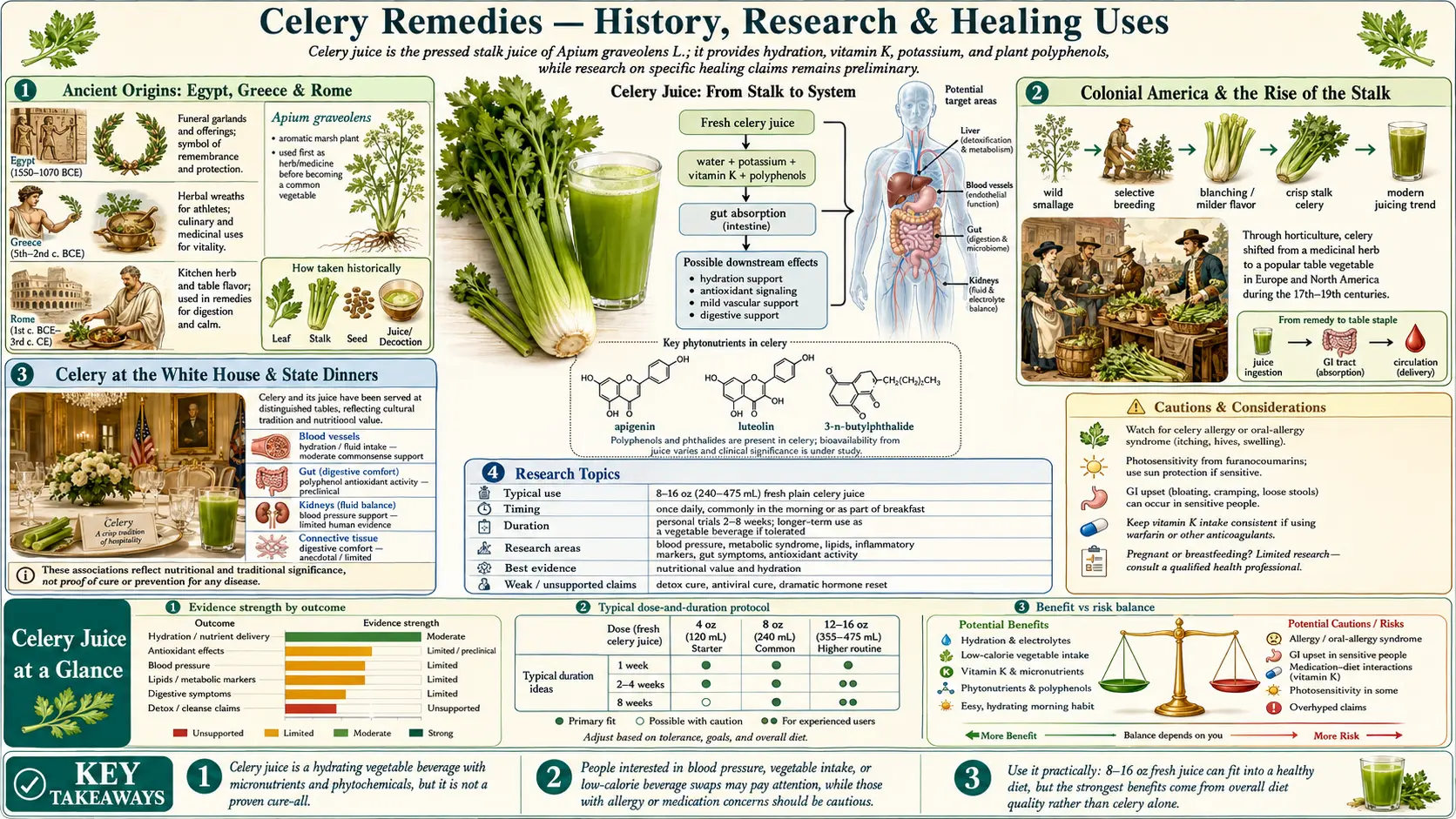



Celery (Apium graveolens L.) is among the oldest medicinal plants in recorded human history. Long before the crisp, pale green stalk appeared on salad plates and crudité platters, celery was a revered herb — cultivated for its seeds, leaves, and roots by ancient physicians, honored in royal tombs, sold as a luxury at exclusive hotels, and served as a prized beverage at some of the most formal dinners in American political history. This hub page traces that long history and links to focused research articles on celery's best-documented therapeutic uses.
Table of Contents
- Ancient Origins: Egypt, Greece & Rome
- Medieval & 16th-17th Century Europe
- Colonial America & the Rise of the Stalk
- The Gilded Age: Celery as a Drink of the Wealthy
- Celery at the White House & State Dinners
- The Modern Revival of Celery Juice
- Research Topics
- Connections
- Featured Videos
1. Ancient Origins: Egypt, Greece & Rome
The earliest documented use of celery dates to ancient Egypt, where garlands of wild celery leaves were found preserved in the tomb of Pharaoh Tutankhamun (c. 1323 BC). Egyptian priests and physicians considered celery a sacred plant associated with mourning, and its seeds and leaves were used as a diuretic, a digestive aid, and a remedy for swelling.
In ancient Greece, celery was known as selinon — the root of the modern botanical name. Victorious athletes at the Isthmian Games (held at Corinth from the 6th century BC onward) were crowned with wreaths woven from wild celery, and the herb appeared on coins minted by the Greek city of Selinus in Sicily. Hippocrates (c. 460–370 BC), often called the father of Western medicine, prescribed celery to "calm the nerves" and as a treatment for fluid retention and urinary complaints.
Roman physicians including Dioscorides (1st century AD) and later Galen continued the Greek tradition, documenting celery's use for digestive disorders, edema, and rheumatic conditions in the foundational texts De Materia Medica and the Galenic corpus. Roman cooks also began the slow agricultural process of selecting wilder, bitter varieties toward the milder forms that would eventually become the cultivated stalk celery of modern Europe.
2. Medieval & 16th–17th Century Europe
Throughout the medieval period, celery remained primarily a medicinal herb. Monastic herbalists cultivated it in physic gardens as a remedy for "cold humours," gout, and kidney complaints. The seeds were especially prized — ground, steeped as tea, or pressed into oils for poultices.
The transition from medicinal herb to culinary vegetable accelerated in 16th-century Italy, where gardeners in the northern regions began selecting and breeding celery for thicker, sweeter, less bitter stalks. By the late 1500s, Italian chefs were incorporating blanched celery stems into soups and stews, and seed catalogues from the 1600s began listing the improved varieties. French and Dutch horticulturists refined the crop further during the 17th century, developing the trench-blanching technique that produced the pale, tender stalks familiar today.
The 17th-century English herbalist Nicholas Culpeper, in his 1653 Complete Herbal, praised celery (which he called "smallage" in its wilder form) for its power to "open obstructions of the liver and spleen," to provoke urine, and to "cleanse the blood." This characterization — celery as a cleansing, diuretic, liver-supporting herb — has persisted almost unchanged from Culpeper's era to modern naturopathic practice.
3. Colonial America & the Rise of the Stalk
Celery arrived in colonial America with European settlers in the 1600s, but it took nearly two centuries for the crop to find commercial footing. Thomas Jefferson recorded celery among the vegetables grown at Monticello, noting planting dates in his Garden Book in the 1790s. For the first several decades of the American republic, celery remained a rare, labor-intensive specialty crop: the trench-blanching required for sweet, tender stalks demanded careful timing, constant hilling, and fertile, well-drained soil — conditions that most early American farmers could not economically reproduce.
The breakthrough came in the 1850s and 1860s in the "muck lands" of Kalamazoo, Michigan, where Dutch immigrant farmers discovered that the region's rich, black organic soils (former wetlands) were ideally suited to celery production. By the 1870s, Kalamazoo had become known as "Celery City," shipping millions of bunches annually by refrigerated rail car to the finest restaurants and hotels of New York, Chicago, Boston, and Philadelphia. This agricultural innovation transformed celery from a scarce specialty into a widely available — though still prestigious — vegetable.
4. The Gilded Age: Celery as a Drink of the Wealthy
During the late 19th century, celery occupied a social position in American dining that is difficult to imagine today: it was a luxury item displayed prominently on formal dinner tables, often presented in tall, ornate cut-glass or silver "celery vases" designed specifically to show off the long, pale stalks. The elegant celery vase — ranging from simple pressed-glass versions to elaborate sterling silver pieces — became a status fixture on the tables of Vanderbilts, Astors, Morgans, and the broader American upper class from roughly 1860 through 1910.
Equally remarkable was the rise of celery as a drink. In the 1860s, the pharmacist Dr. Brown in Brooklyn, New York, began bottling a sweetened celery seed soda known as Dr. Brown's Celery Tonic (later renamed Cel-Ray), marketed as a health beverage particularly popular in Jewish delicatessens. Around the same era, "celery wine," "celery cocktails," and tonics steeped from celery seeds were advertised in pharmacies and health spas from New York to San Francisco, promoted for calming the nerves, aiding digestion, and clearing "sluggish blood."
At the peak of celery's social prestige, a single bunch of prime hot-house Kalamazoo celery could cost the equivalent of several dollars in today's currency — roughly on par with what one would pay for imported cheese or aged wine. Grand hotels such as the Waldorf-Astoria in New York and the Palmer House in Chicago listed celery prominently on their printed menus, and celery-based compound salads, celery soups, and chilled celery juice beverages were staples of high society dining.
5. Celery at the White House & State Dinners
Celery's standing in 19th-century American fine dining extended directly to the nation's most prestigious tables. Printed menus and historical dining records from the late 1800s show celery appearing repeatedly at White House state dinners and formal receptions under presidents including Ulysses S. Grant, Rutherford B. Hayes, Benjamin Harrison, and Grover Cleveland. At these events, celery was frequently listed as its own course — chilled stalks in iced water, or presented in silver celery vases as part of the formal table setting — a deliberate signal of expense and refinement.
Congressional banquets, inaugural dinners, and diplomatic receptions followed the same pattern. A menu from an 1877 White House dinner honoring the visit of the Russian Grand Duke Alexis, for example, lists "celery" alongside oysters, terrapin, and champagne — items that together represented the most expensive and fashionable foods of the period. The fact that the single word "celery" merited its own menu line, alongside luxury proteins and imported wines, speaks directly to how rare and highly valued the vegetable then was.
Celery's place at these tables was gradually democratized in the early 20th century as large-scale Florida and California production brought prices down and mass-market availability up. By the 1920s, celery had transitioned from a luxury garnish at the president's table to an everyday household ingredient — but its reputation as a "clean," refined, health-supporting food persisted into the modern era.
6. The Modern Revival of Celery Juice
Carried quietly through the twentieth century by naturopathy and traditional medicine, celery returned to prominence with genuine blood-pressure research in the early 1990s and then, in the mid-2010s, as the daily 16-ounce "morning celery juice" ritual popularized by Anthony William ("Medical Medium"). The full account of that revival — the ancient roots, the founder's biography and unconventional claims, the science, and the mainstream reception — the fuller story is told in the dedicated History article.
7. Research Topics
The two focused research articles below gather the positive clinical and pharmacological evidence for celery juice's best-documented therapeutic applications — kidney health and blood pressure regulation.
Celery Juice & Kidney Disease
Comprehensive review of positive research on celery juice, celery seed extract, and celery phytochemicals in kidney function, chronic kidney disease (CKD), diabetic nephropathy, kidney stones, and nephroprotection. Covers diuretic mechanisms, luteolin-mediated renal antioxidant effects, apigenin's anti-fibrotic activity, and traditional nephrological uses — with links to published studies.
- Diuretic and natriuretic effects documented in peer-reviewed studies
- Flavonoid-mediated protection against oxidative and toxin-induced kidney damage
- Supportive evidence for kidney stone prevention via increased urine volume and mineral clearance
- Traditional use in Ayurveda, Arab herbal medicine, and TCM as a kidney tonic
- Practical preparation and dosage guidance for kidney support
Celery Juice & Lowering Blood Pressure
Detailed research summary on celery juice and celery seed extract as a natural approach to lowering elevated blood pressure. Includes the foundational University of Chicago 3-n-butylphthalide (3nB) investigations, clinical trials on celery seed extract in hypertensive subjects, mechanistic studies on vascular relaxation, and synergistic effects of potassium, apigenin, and dietary nitrates — with full reference list.
- 3-n-Butylphthalide (3nB): vasodilator and catecholamine modulator
- Clinical evidence of systolic and diastolic BP reductions in human studies
- Endothelial support through nitric oxide and potassium-mediated pathways
- Traditional Chinese Medicine protocols validated by modern pharmacology
- Practical daily dosing for blood pressure support
Connections
- All Remedies
- Celery Juice & Blood Pressure
- Celery Juice & Kidney Disease
- Potassium
- Hypertension
- Kidney Stones
- Liver Disease
- Liver Cleansing
- Detox Protocols
- Anti-Inflammatory Diet
- Gut Healing
- Milk Thistle
- Vitamin K
- Juicing
- Kidney Function
- Kidney Disease
- Potassium-Rich Foods
- Gerson Therapy
- Diet Protocol
Research Papers
- Clinical trials on celery juice — PubMed search
- Systematic reviews of celery juice — PubMed search
- Meta-analyses on celery juice — PubMed search
- Treatment research on celery juice — PubMed search
- Mechanism studies of celery juice — PubMed search
- Epidemiology of celery juice — PubMed search