Aspirin for Heart Attack Prevention
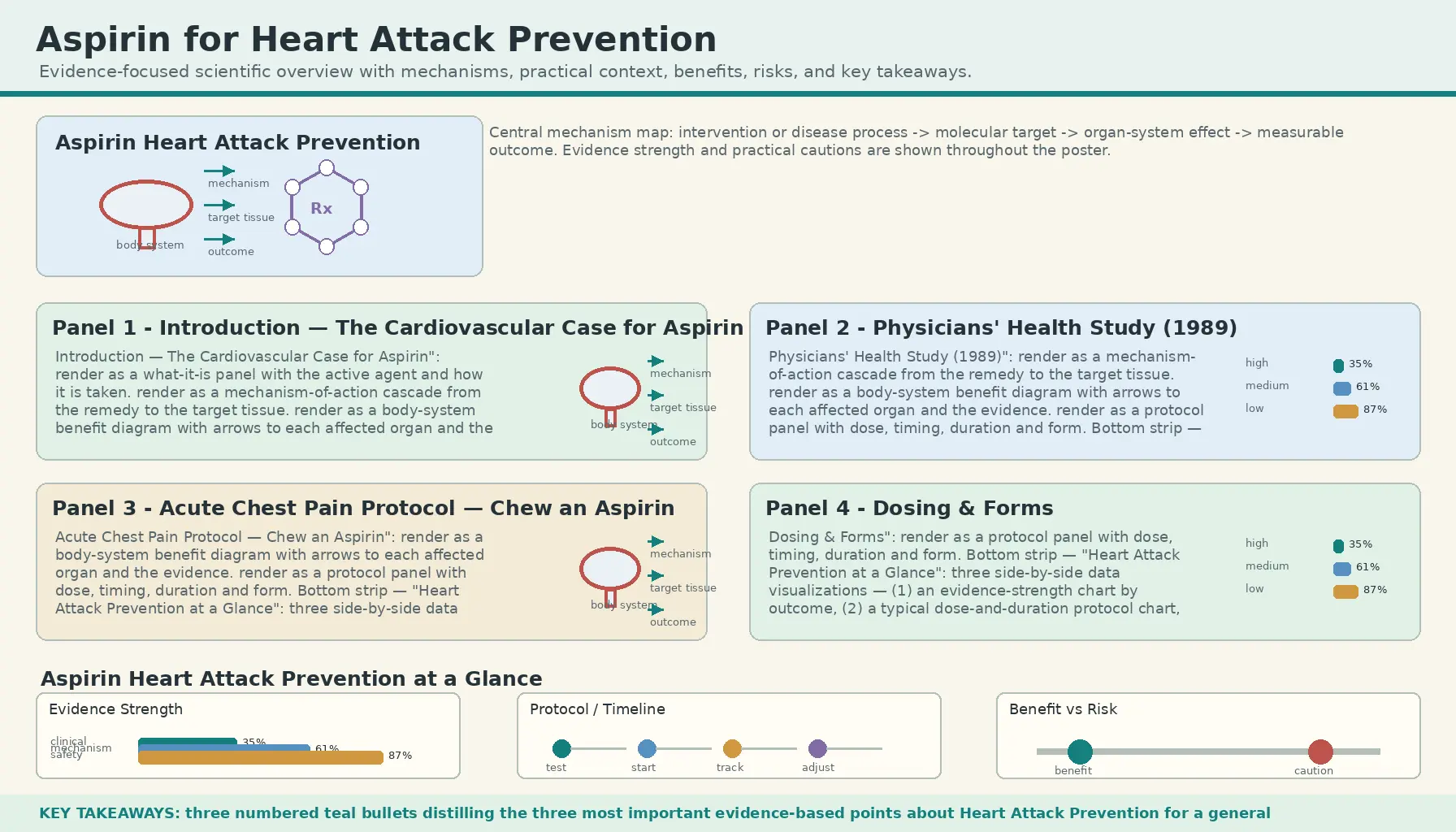
Acetylsalicylic acid (aspirin) is among the most extensively studied drugs in medical history, and its role in cardiovascular disease is arguably the most consequential. A low daily dose irreversibly blocks platelet aggregation for the life of each platelet, dramatically reducing the risk of thrombotic events in patients who have already suffered a heart attack or stroke. And during an active heart attack, a single chewed aspirin tablet — taken while waiting for emergency medical services — can measurably reduce the chance of dying. This page walks through the mechanism, the landmark trials, the 2018–2022 revisions to primary-prevention guidance, and the practical protocols every adult should understand.
Table of Contents
- Introduction — The Cardiovascular Case for Aspirin
- Mechanism — COX-1 Platelet Inhibition
- Secondary Prevention — The ATT Meta-Analyses
- ISIS-2 — The Landmark Acute MI Trial
- Physicians' Health Study (1989)
- The Primary Prevention Reckoning — ARRIVE, ASCEND, ASPREE
- USPSTF 2022 Recommendations
- Acute Chest Pain Protocol — Chew an Aspirin
- Post-PCI Dual Antiplatelet Therapy (DAPT)
- Diabetes & Cardiovascular Risk
- Aspirin Resistance
- Dosing & Forms
- References
- Connections
- Featured Videos
Introduction — The Cardiovascular Case for Aspirin
Heart attacks (acute myocardial infarction, or MI) are overwhelmingly caused by the rupture of an atherosclerotic plaque inside a coronary artery. When a plaque ruptures, it exposes thrombogenic material to flowing blood; platelets aggregate on the lesion within seconds and form a clot that occludes the vessel. Without rapid restoration of blood flow, heart muscle downstream of the clot begins to die.
Aspirin's cardiovascular value rests on a single, elegant mechanism: it permanently disables the platelet enzyme that drives this aggregation. The result is a reliable, cheap, orally administered "brake" on arterial thrombosis. Decades of large randomized trials have established three distinct clinical contexts in which aspirin matters:
- Secondary prevention — patients with established cardiovascular disease (prior MI, prior ischemic stroke, stable or unstable angina, prior coronary revascularization). Here the benefit is large and unambiguous.
- Acute MI — a single chewed aspirin during a suspected heart attack reduces short-term mortality.
- Primary prevention — healthy adults with no history of cardiovascular disease. Here the benefit is modest, the bleeding risk is real, and the calculus has shifted significantly since 2018.
Mechanism — COX-1 Platelet Inhibition
Aspirin's antithrombotic action derives from its ability to irreversibly acetylate a serine residue (Ser-529) in the active site of the enzyme cyclooxygenase-1 (COX-1). COX-1 is the enzyme platelets use to convert arachidonic acid into thromboxane A2 (TXA2), a potent vasoconstrictor and platelet aggregator.
Why the Inhibition Lasts for Days
Platelets are anucleate cell fragments; they cannot synthesize new protein. When aspirin acetylates COX-1 inside a circulating platelet, that platelet is disabled for the remainder of its lifespan — about 7 to 10 days. Roughly 10% of circulating platelets are replaced each day, so a single daily low dose of aspirin is sufficient to keep the total platelet pool in a permanently suppressed state.
Why Low Dose Works
A dose as low as 75–81 mg daily achieves nearly complete (>95%) inhibition of platelet TXA2 production. Higher doses do not produce more antithrombotic effect — they simply increase gastrointestinal and bleeding side effects. This is why the modern standard for cardiovascular prevention is the 81 mg "baby aspirin," not the 325 mg adult tablet.
COX-1 vs. COX-2 Selectivity
COX-1 also lives in the gastric mucosa and the kidney, where its prostaglandin products protect the stomach lining and regulate renal blood flow. Blocking COX-1 systemically — the inescapable consequence of oral aspirin — is what drives the gastritis, ulcer, and bleeding risks. Aspirin at low dose is relatively selective for platelet COX-1 because of platelet exposure during the first pass through the portal circulation, but the gastric-mucosal effect is never fully avoided.
Secondary Prevention — The ATT Meta-Analyses
The Antithrombotic Trialists' (ATT) Collaboration published two landmark meta-analyses that remain the definitive evidence base for aspirin in cardiovascular disease.
ATT 2002 (BMJ)
This pooled analysis of 287 randomized trials in more than 135,000 high-risk patients demonstrated that antiplatelet therapy (predominantly aspirin) reduced the combined risk of serious vascular events — non-fatal MI, non-fatal stroke, or vascular death — by approximately 22% (relative risk reduction) in patients with established cardiovascular disease.
Specific findings included:
- A one-third reduction in non-fatal MI
- A one-quarter reduction in non-fatal stroke
- A one-sixth reduction in vascular death
- Consistent benefit across subgroups: prior MI, acute MI, prior stroke/TIA, stable and unstable angina, and peripheral arterial disease
ATT 2009 (Lancet)
The 2009 ATT analysis directly compared primary and secondary prevention. In secondary prevention (roughly 17,000 patients with prior cardiovascular events), aspirin produced an absolute risk reduction of ~1.5% per year in serious vascular events — a benefit that clearly outweighs the absolute increase in major bleeding (~0.2% per year). In primary prevention the absolute benefit was far smaller, and the bleeding risk proportionally larger.
The clinical message has been durable: every patient with established atherosclerotic cardiovascular disease should be on antiplatelet therapy unless there is a specific contraindication. Aspirin 75–100 mg daily remains the default in most guidelines worldwide.
ISIS-2 — The Landmark Acute MI Trial
Published in The Lancet in 1988, the Second International Study of Infarct Survival (ISIS-2) is one of the most important cardiovascular trials ever performed. It randomized 17,187 patients with suspected acute MI within 24 hours of symptom onset to four groups in a 2×2 factorial design: streptokinase alone, aspirin (162.5 mg daily) alone, both, or neither (placebo).
Key Findings at 5 Weeks
- Aspirin alone reduced vascular mortality by 23% compared to placebo
- Streptokinase alone reduced vascular mortality by 25%
- Aspirin plus streptokinase reduced vascular mortality by 42% — roughly the sum of the individual benefits, confirming the agents acted through independent mechanisms
- Aspirin also reduced the rate of non-fatal reinfarction by approximately half, and reduced non-fatal stroke
- The major-bleeding excess from aspirin was small and did not offset the mortality benefit
ISIS-2 established two things that remain central to emergency cardiology today: first, that the first 24 hours after symptom onset is a uniquely high-leverage window for antiplatelet therapy; and second, that a simple, widely available, cheap oral medication can save lives on a population scale. The mortality benefit persisted out to 10 years of follow-up.
Physicians' Health Study (1989)
The Physicians' Health Study, published in the New England Journal of Medicine in 1989, was the first major randomized trial of aspirin for primary prevention in healthy adults. It enrolled 22,071 healthy male US physicians aged 40–84 with no history of MI, stroke, or transient ischemic attack, and randomized them to 325 mg aspirin every other day or placebo.
The trial was stopped early after an average of 5 years of follow-up because of a dramatic benefit:
- 44% reduction in the risk of a first MI (relative risk)
- The absolute benefit was concentrated in men over 50
- No significant effect on overall cardiovascular mortality was detected — the cohort was too healthy for there to be many events to prevent
- A small, non-significant increase in hemorrhagic stroke
- A small but real increase in clinically important bleeding
For nearly three decades after publication, the Physicians' Health Study underpinned widespread primary-prevention aspirin use in middle-aged adults. It took until 2018 for three large modern trials to show that the 1989 enthusiasm was partially misplaced.
The Primary Prevention Reckoning — ARRIVE, ASCEND, ASPREE
In 2018, three major randomized trials of aspirin for primary prevention were published in quick succession. Together they fundamentally changed how the medical community thinks about routine daily aspirin in people without established cardiovascular disease.
ARRIVE (Lancet 2018)
ARRIVE (Aspirin to Reduce Risk of Initial Vascular Events) randomized 12,546 adults at moderate cardiovascular risk (no diabetes) to 100 mg aspirin daily or placebo. After a median 5 years:
- No significant reduction in cardiovascular events (hazard ratio 0.96)
- Gastrointestinal bleeding doubled in the aspirin arm
- Overall event rates were lower than anticipated — modern statin therapy, blood pressure control, and smoking-cessation efforts had already suppressed the baseline risk the trial was powered to reduce
ASCEND (NEJM 2018)
ASCEND (A Study of Cardiovascular Events iN Diabetes) randomized 15,480 adults with diabetes but no known cardiovascular disease to 100 mg aspirin daily or placebo. After 7.4 years:
- 12% relative reduction in serious vascular events (absolute reduction ~1.1%)
- 29% relative increase in major bleeding (absolute increase ~0.9%)
- The benefit and harm were of nearly equivalent magnitude, meaning no net clinical gain for the average diabetic adult without known CVD
ASPREE (NEJM 2018)
ASPREE (Aspirin in Reducing Events in the Elderly) randomized 19,114 adults aged 70 and older (65+ in US racial/ethnic minorities) with no cardiovascular disease, dementia, or disability to 100 mg aspirin daily or placebo. After 4.7 years:
- No reduction in cardiovascular events
- 38% relative increase in major hemorrhage
- A small but statistically significant increase in all-cause mortality in the aspirin group, driven partly by cancer-related deaths — a finding that remains debated but is the opposite of what had previously been hoped
The cumulative message of these three trials was unmistakable: in contemporary low-to-moderate-risk adults already receiving modern cardiovascular risk reduction (statins, antihypertensives, smoking-cessation counseling), routine primary-prevention aspirin offers little or no net benefit.
USPSTF 2022 Recommendations
In April 2022 the US Preventive Services Task Force issued a major revision of its aspirin guidance, directly reflecting the 2018 evidence:
- Adults aged 40–59 with a 10-year cardiovascular risk of 10% or greater: the decision to initiate low-dose aspirin should be individualized. Net benefit is small; bleeding risk must be weighed. Grade C recommendation.
- Adults aged 60 or older: do not initiate low-dose aspirin for primary prevention. Grade D recommendation (recommend against).
- Secondary prevention (patients with established cardiovascular disease): these recommendations do not apply. Established-CVD patients should remain on antiplatelet therapy per their cardiologist's plan.
Patients already on daily aspirin for primary prevention should not stop abruptly on their own; they should discuss the decision with their clinician. Abrupt discontinuation in patients who have had coronary stenting is particularly dangerous.
Acute Chest Pain Protocol — Chew an Aspirin
If you suspect you or someone near you is having a heart attack, call 911 (or your local emergency number) first. Then, if the person is conscious, not allergic to aspirin, and not actively bleeding, have them chew one non-enteric-coated adult aspirin (325 mg) or two to four 81 mg tablets.
Why Chewing Matters
- Chewing fragments the tablet and mixes it with saliva, dramatically accelerating absorption across the buccal and gastric mucosa
- A chewed non-enteric aspirin achieves meaningful platelet inhibition within 15–20 minutes
- A swallowed, unchewed tablet may take 60 minutes or more to reach peak effect — too slow during an evolving MI
- Enteric-coated aspirin should not be used in this setting; the coating dissolves only in the small intestine and delays onset by an additional hour or more
Dose for Acute MI
Both the American Heart Association and the American College of Cardiology recommend 162–325 mg of non-enteric aspirin, chewed, as soon as an acute coronary syndrome is suspected. Paramedics and emergency departments routinely give the same dose if the patient has not already taken one.
Who Should Not Chew an Aspirin
- Known aspirin allergy (hives, anaphylaxis, aspirin-exacerbated respiratory disease)
- Active gastrointestinal bleeding
- Suspected hemorrhagic stroke — chest pain plus sudden severe headache, unilateral weakness, or speech disturbance warrants extra caution, and emergency dispatchers may advise withholding aspirin
The classic public-health message — call 911, chew an aspirin — has probably saved more lives than any other over-the-counter intervention in cardiovascular medicine. Every adult should know it.
Post-PCI Dual Antiplatelet Therapy (DAPT)
Percutaneous coronary intervention (PCI) — the placement of a coronary stent — introduces a metal scaffold into a vessel wall. Until the stent endothelializes, it is a thrombogenic surface. Patients who receive a stent are therefore placed on dual antiplatelet therapy (DAPT): aspirin plus a P2Y12 receptor inhibitor.
The P2Y12 Inhibitors
- Clopidogrel (Plavix) — prodrug requiring hepatic activation; historically the most common choice
- Ticagrelor (Brilinta) — reversible, more potent; preferred in many acute coronary syndrome protocols
- Prasugrel (Effient) — potent; preferred in certain PCI contexts, avoided in patients with prior stroke
Duration
Standard DAPT duration after drug-eluting stent placement is typically 6 to 12 months, with individual adjustments based on ischemic versus bleeding risk. After the P2Y12 inhibitor is stopped, aspirin is continued indefinitely as lifelong secondary prevention. Premature discontinuation of DAPT — particularly in the first weeks after stenting — carries a high risk of stent thrombosis, which is often fatal.
Bleeding vs. Ischemic Balance
Recent trials (including TWILIGHT and STOPDAPT-2) have explored shorter DAPT durations followed by P2Y12 monotherapy in selected patients at high bleeding risk. This is an actively evolving area; decisions belong to the treating cardiologist.
Diabetes & Cardiovascular Risk
People with diabetes have roughly twice the cardiovascular event rate of their non-diabetic peers, and diabetes was historically considered a "CVD risk equivalent" warranting prophylactic aspirin. The modern evidence is more nuanced.
The ASCEND Result Revisited
As noted above, ASCEND showed that in diabetic adults without established cardiovascular disease, aspirin produced a ~1.1% absolute reduction in vascular events but a ~0.9% absolute increase in major bleeding over 7.4 years. The net benefit is small and patient-specific.
Current Diabetes Guidelines
- American Diabetes Association (Standards of Care): aspirin for primary prevention is a "reasonable consideration" for adults with diabetes who are at increased cardiovascular risk, after weighing bleeding risk — a shared decision-making recommendation, not a universal one
- Diabetic patients with established CVD (prior MI, stroke, coronary revascularization, or symptomatic peripheral artery disease): aspirin is clearly indicated as secondary prevention
- Tighter glycemic, lipid, and blood-pressure control — along with SGLT2 inhibitors and GLP-1 receptor agonists — have become the dominant levers for cardiovascular risk reduction in diabetes, with aspirin now a smaller piece of the puzzle
Aspirin Resistance
Aspirin resistance is the laboratory finding that a patient's platelets continue to aggregate or produce thromboxane despite documented aspirin therapy. It is a heterogeneous concept with no universally accepted definition.
Reported Prevalence
- Estimates range widely, from roughly 5% to 30% of aspirin-treated patients, depending on the assay used and the population studied
- Platelet function tests (VerifyNow, light transmission aggregometry, urinary 11-dehydro-thromboxane B2) often disagree with each other, making a firm prevalence estimate impossible
Common Causes
- Non-adherence — the most common single cause; patients miss doses
- Enteric-coated absorption failure — variable absorption from enteric-coated formulations, especially in patients with altered gastric pH
- Concurrent ibuprofen use — ibuprofen competes for the COX-1 active site and can blunt aspirin's irreversible effect if taken shortly before
- High platelet turnover — inflammatory states, recent surgery, or diabetes can accelerate platelet production and dilute the aspirin-inhibited pool
- Rare genetic polymorphisms in COX-1 or thromboxane receptors
Clinical Significance
Observational studies suggest that patients with laboratory-defined aspirin resistance have higher rates of recurrent cardiovascular events, but no randomized trial has yet shown that routinely testing for aspirin resistance — and adjusting therapy based on the result — improves outcomes. Current guidelines do not recommend routine platelet function testing in aspirin-treated patients. When resistance is suspected, the first steps are verifying adherence, switching from enteric-coated to plain aspirin, and ensuring no interacting NSAID is being co-administered.
Dosing & Forms
81 mg vs. 325 mg
- 81 mg daily ("low-dose" or "baby aspirin"): the standard for chronic cardiovascular prevention. Fully inhibits platelet COX-1 with substantially less gastrointestinal toxicity than higher doses
- 162–325 mg: reserved for acute use — the first dose during suspected MI, or a loading dose in the catheterization laboratory. Not needed for maintenance therapy
- Large-scale trials (including the CURRENT-OASIS 7 trial) have shown that higher maintenance doses do not improve cardiovascular outcomes but do increase bleeding
Enteric-Coated vs. Plain
- Enteric-coated aspirin is designed to dissolve in the duodenum rather than the stomach, with the intent of reducing gastric mucosal irritation. Real-world data suggest the gastroprotective advantage is smaller than marketed, and enteric coating produces more variable absorption — a potential contributor to apparent aspirin resistance
- Plain aspirin, especially when chewed, is preferred for acute use and for any situation where rapid onset matters
- For chronic daily dosing, the choice between enteric-coated and plain is a patient-by-patient decision weighing gastric tolerability against absorption reliability
Chewable Aspirin for Acute Use
- Chewable 81 mg tablets (labeled for adults) are an excellent household-kit choice for acute MI response
- Four chewable 81 mg tablets equals 324 mg — within the recommended acute-MI dose
- Keep a bottle within easy reach in the home and car; do not substitute enteric-coated aspirin for this purpose
Timing of Daily Dose
Some studies suggest that bedtime dosing of aspirin may produce slightly better blood pressure and morning-platelet-activity profiles than morning dosing, though the clinical outcome difference is small. Taking aspirin with food reduces gastric irritation for many patients.
Gastroprotection
Patients at elevated gastrointestinal bleeding risk — those with a prior ulcer, age over 65, concurrent anticoagulant or corticosteroid use, or a history of Helicobacter pylori infection — are often co-prescribed a proton pump inhibitor (PPI) with chronic aspirin. PPIs significantly reduce upper gastrointestinal bleeding on aspirin without meaningfully blunting the cardiovascular benefit.
References
Landmark Acute MI & Secondary Prevention Trials
- ISIS-2 (Second International Study of Infarct Survival) Collaborative Group. Randomised trial of intravenous streptokinase, oral aspirin, both, or neither among 17,187 cases of suspected acute myocardial infarction. Lancet. 1988;2(8607):349-360.
- Steering Committee of the Physicians' Health Study Research Group. Final report on the aspirin component of the ongoing Physicians' Health Study. New England Journal of Medicine. 1989;321(3):129-135.
- Ridker PM, Cook NR, Lee IM, et al. A randomized trial of low-dose aspirin in the primary prevention of cardiovascular disease in women (Women's Health Study). New England Journal of Medicine. 2005;352(13):1293-1304.
Antithrombotic Trialists' Collaboration Meta-Analyses
- Antithrombotic Trialists' Collaboration. Collaborative meta-analysis of randomised trials of antiplatelet therapy for prevention of death, myocardial infarction, and stroke in high risk patients. BMJ. 2002;324(7329):71-86.
- Antithrombotic Trialists' (ATT) Collaboration. Aspirin in the primary and secondary prevention of vascular disease: collaborative meta-analysis of individual participant data from randomised trials. Lancet. 2009;373(9678):1849-1860.
Modern Primary Prevention Trials (2018)
- Gaziano JM, Brotons C, Coppolecchia R, et al. Use of aspirin to reduce risk of initial vascular events in patients at moderate risk of cardiovascular disease (ARRIVE): a randomised, double-blind, placebo-controlled trial. Lancet. 2018;392(10152):1036-1046.
- ASCEND Study Collaborative Group. Effects of aspirin for primary prevention in persons with diabetes mellitus. New England Journal of Medicine. 2018;379(16):1529-1539.
- McNeil JJ, Wolfe R, Woods RL, et al. Effect of aspirin on cardiovascular events and bleeding in the healthy elderly (ASPREE). New England Journal of Medicine. 2018;379(16):1509-1518.
- McNeil JJ, Nelson MR, Woods RL, et al. Effect of aspirin on all-cause mortality in the healthy elderly. New England Journal of Medicine. 2018;379(16):1519-1528.
USPSTF & Clinical Practice Guidelines
- US Preventive Services Task Force. Aspirin use to prevent cardiovascular disease: US Preventive Services Task Force recommendation statement. JAMA. 2022;327(16):1577-1584.
- Arnett DK, Blumenthal RS, Albert MA, et al. 2019 ACC/AHA guideline on the primary prevention of cardiovascular disease. Circulation. 2019;140(11):e596-e646.
- Lawton JS, Tamis-Holland JE, Bangalore S, et al. 2021 ACC/AHA/SCAI guideline for coronary artery revascularization. Circulation. 2022;145(3):e18-e114.
- Virani SS, Newby LK, Arnold SV, et al. 2023 AHA/ACC/ACCP/ASPC/NLA/PCNA guideline for the management of patients with chronic coronary disease. Circulation. 2023;148(9):e9-e119.
DAPT, Dosing, & Resistance
- CURRENT-OASIS 7 Investigators. Dose comparisons of clopidogrel and aspirin in acute coronary syndromes. New England Journal of Medicine. 2010;363(10):930-942.
- Mehran R, Baber U, Sharma SK, et al. Ticagrelor with or without aspirin in high-risk patients after PCI (TWILIGHT). New England Journal of Medicine. 2019;381(21):2032-2042.
- Krasopoulos G, Brister SJ, Beattie WS, Buchanan MR. Aspirin "resistance" and risk of cardiovascular morbidity: systematic review and meta-analysis. BMJ. 2008;336(7637):195-198.
Connections
- All Remedies
- Aspirin Overview
- Aspirin Side Effects
- Stroke
- Cardiovascular Disease
- Aspirin Health Benefits
- Aspirin and the Kidneys
- Aspirin for Stroke Prevention
- Oral Microbiome
- NAC (N-Acetylcysteine)
- Anti-Inflammatory Diet
- Hypertension
- Coronary Artery Disease
- Atrial Fibrillation
- Diabetes
- Aspirin and Cancer Prevention
- Chest Pain