Shinya Yamanaka: Reprogrammed Stem Cells and the Honest State of Regenerative Medicine
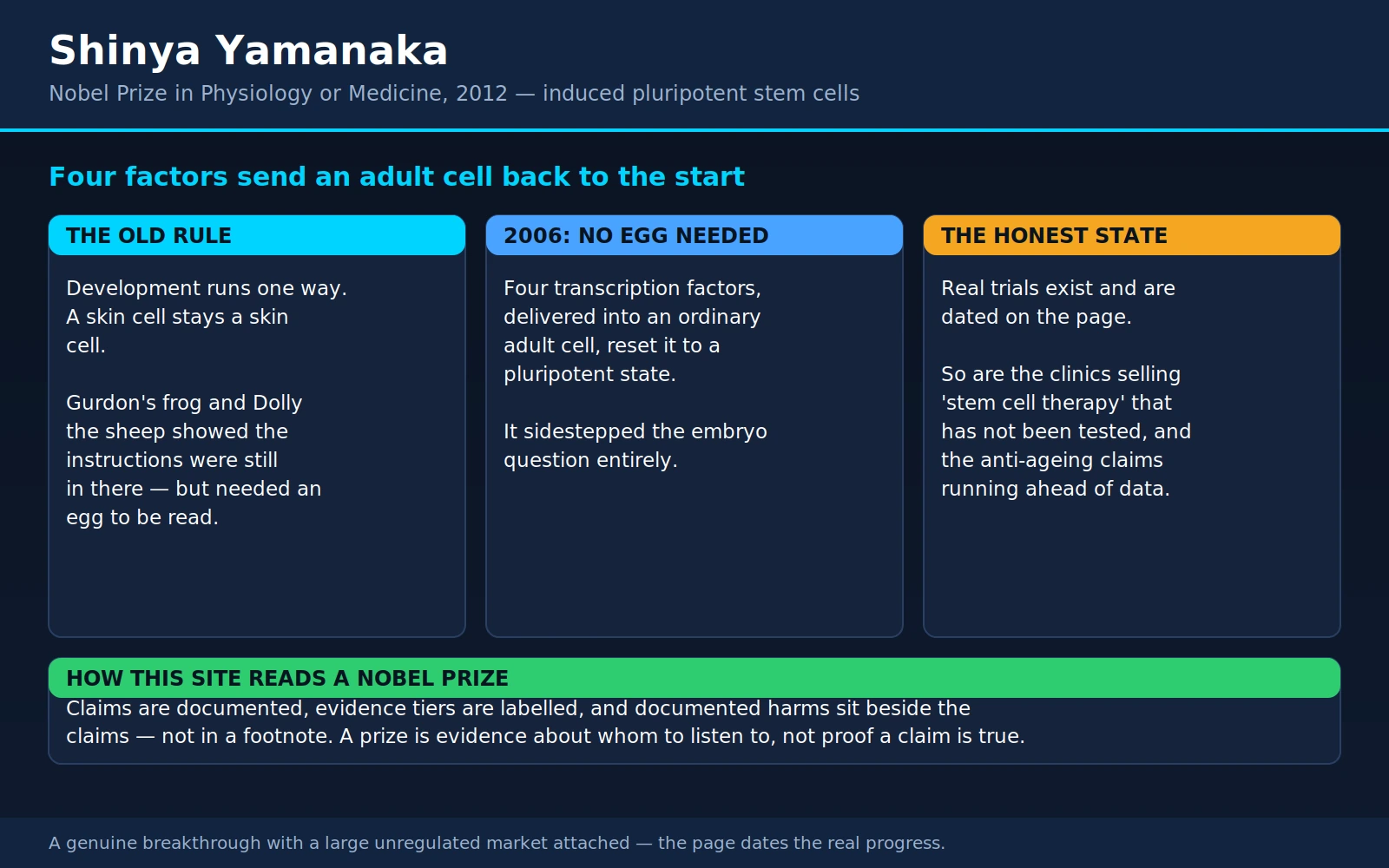
Table of Contents
- The Prize and the Two Men
- Gurdon's Frog Experiment, 1962
- Dolly, Embryos, and the Question Nobody Could Crack
- The Four Factors, 2006
- What iPS Cells Actually Are
- Real Clinical Progress, Honestly Dated
- The Clinics That Don't Wait
- Partial Reprogramming and the Anti-Aging Gold Rush
- Where Mainstream Medicine Agrees / Where Claims Outrun Evidence
- What Yamanaka Means for You Today
- Key Research Papers
- Connections
- Featured Videos
1. The Prize and the Two Men
On October 8, 2012, the Nobel Prize in Physiology or Medicine went to two men "for the discovery that mature cells can be reprogrammed to become pluripotent" — in plain language, for proving that a fully grown, fully specialized cell can be rewound into something like the cell you started life as. One laureate had waited fifty years for the call. The other had waited six.
Sir John B. Gurdon, then 79, is a Cambridge developmental biologist with one of the great underdog stories in science. At Eton, aged fifteen, he ranked last in biology among the 250 boys in his year, and his schoolmaster's report has become legend: "I believe he has ideas about becoming a scientist; on his present showing this is quite ridiculous." Gurdon framed the report — the only thing he ever framed, he says — and hung it above his desk at the Cambridge institute that now bears his name, to glance at whenever an experiment failed. In 1962, as a young researcher at Oxford, he performed the frog experiment described below, which quietly demolished a core assumption of biology. He was knighted in 1995, and was still doing his own experiments at the laboratory bench well into his eighties.
Shinya Yamanaka, then 50, is Gurdon's mirror image: the celebrated scientist who began as a struggling clinician. Born in Higashiosaka, Japan, in 1962 — the very year Gurdon's frog paper appeared — he was the son of a small factory owner who made sewing-machine parts. A judo and rugby player who broke his own bones more than ten times, he chose orthopedic surgery, earned his MD at Kobe University in 1987, and discovered in the operating room that he was bad at the one thing a surgeon cannot be bad at. An operation a skilled senior colleague could finish in ten minutes took him more than an hour; colleagues nicknamed him "Jamanaka" — a pun on jama, Japanese for "obstacle" or "nuisance." He quit surgery after two years.
Two things pushed him toward research. One was that failure. The other was his father, who had been injured at the family factory, received a blood transfusion, contracted hepatitis from it, and died of the resulting liver disease in 1989 — the same year the responsible virus, hepatitis C, was finally identified (a discovery that would earn its own Nobel Prize in 2020; see our Nobel Prize in Medicine hub). Yamanaka has said that watching medicine fail his father convinced him that for many patients the treatments that matter do not exist yet, and that somebody has to build them. He retrained in pharmacology, did a formative postdoc at the Gladstone Institutes in San Francisco — where his mentor taught him the motto he still repeats, "VW: vision and hard work" — then nearly quit science during a bleak stretch back in Japan, caring for hundreds of mice alone with no funding and no encouragement. A small professorship at the Nara Institute of Science and Technology in 1999 gave him his own laboratory at last. He aimed it at a problem most considered unsolvable, and solved it.
Today Yamanaka is Japan's most celebrated living scientist, founding director (2010–2022) of Kyoto University's Center for iPS Cell Research and Application (CiRA), and — characteristically — a serious marathon runner who races to raise donations for his institute's research fund, with a personal best around 3 hours 25 minutes, run in his mid-fifties. When the Nobel call came in 2012, he was at home fixing his washing machine. He went back to fixing it.
This page tells the story of both men, explains what induced pluripotent stem cells actually are, gives an honest, dated account of how far the medicine has really come — and then does something this site owes its readers: it explains, kindly and plainly, how to tell that genuine science from the for-profit "stem cell clinics" that are selling its vocabulary today, sometimes with catastrophic results.
2. Gurdon's Frog Experiment, 1962
Start with the question every cell in your body poses. You began as one fertilized egg. That egg divided into cells that became skin, brain, gut, muscle — each so specialized that a gut cell absorbs nutrients and a neuron fires electrical signals, and neither ever does the other's job. Biologists in the 1950s had a reasonable explanation: perhaps, as cells specialize, they discard or permanently switch off the genes they no longer need. A skin cell would then be a skin cell forever because the rest of its instruction book was gone. Specialization would be a one-way street.
The test is audacious in its simplicity: put the nucleus — the compartment holding the DNA — of a fully specialized cell into an egg whose own nucleus has been removed, and see what develops. If specialized cells have lost genetic information, the egg should stall. If the whole instruction book is still there, the egg might read it from page one and build an entire animal. American researchers Robert Briggs and Thomas King pioneered this "nuclear transfer" in frogs in 1952; nuclei from very early embryos worked, but nuclei from older, more specialized cells mostly failed, and the field leaned toward the one-way-street conclusion.
Gurdon, a graduate student in Oxford's zoology department, pushed the experiment to its logical extreme in the South African clawed frog Xenopus laevis. He destroyed the egg's own nucleus with ultraviolet light, then injected the nucleus of an unmistakably specialized cell — an intestinal epithelial cell from a feeding tadpole, a gut cell with an absorptive brush border, doing its everyday gut-cell job. Most transfers went nowhere. But a small fraction — on the order of one to two percent — developed into normal, swimming, feeding tadpoles, and in follow-up work some grew into adult frogs that were fertile. A genetic marker (a strain of frogs whose cells carry one nucleolus instead of two) proved the animals were built from the transplanted gut-cell nucleus, not from any surviving egg DNA.
The paper — "The developmental capacity of nuclei taken from intestinal epithelium cells of feeding tadpoles," published in late 1962 — carried a conclusion out of all proportion to its modest title. Nothing is deleted. A mature, specialized cell still contains the complete genome, every instruction needed to build every tissue of an entire animal. Specialization is not a shredding of the instruction book; it is a system of bookmarks and locks — what we now call epigenetics — deciding which pages get read. And something in the egg's cytoplasm can strip those locks off and start the book again from page one. Differentiation, in principle, is reversible.
It took years for the field to fully accept this — skeptics argued the successful tadpoles might trace to some rare stray primitive cell — and Gurdon's meticulous follow-up work through the 1960s and 70s wore the doubts down. Two details give the story its poetry: the experiment was published the year Shinya Yamanaka was born, and it defined the question — what exactly in the egg does the rewinding, and could you do it without an egg? — that Yamanaka would answer 44 years later.
3. Dolly, Embryos, and the Question Nobody Could Crack
For decades Gurdon's result stood as a fact about frogs. Amphibian eggs are enormous and forgiving; mammals, many argued, might be different. Then in 1996 the Roslin Institute in Scotland performed Gurdon's experiment in a sheep. Dolly, announced to the world in February 1997, was cloned by transferring the nucleus of a mammary-gland cell from a six-year-old ewe into an enucleated egg — one live lamb from 277 attempts. Dolly settled it: mammalian adult cells, human-like cells, also retain the full genome, and eggs can reprogram them too. (Ian Wilmut and Keith Campbell, who made Dolly, were not included in the 2012 prize — a decision many scientists still debate.)
The year after Dolly came the second landmark: in 1998 James Thomson's laboratory in Wisconsin derived human embryonic stem cells from surplus IVF embryos. These cells are pluripotent — capable of becoming any cell type of the body — and essentially immortal in culture. For medicine the implications were dazzling: grow replacement neurons, heart muscle, insulin-producing cells at will. But the derivation destroys a days-old embryo, and that fact ignited one of the fiercest ethical conflicts in modern science. In 2001 the United States restricted federal funding to a handful of already-existing embryonic lines; laws split country by country; the field spent a decade arguing morality in parallel with biology.
Behind both headlines sat the same unsolved technical question. Eggs can rewind a nucleus, and embryos can supply pluripotent cells — but eggs and embryos are exactly the materials that are scarce, ethically fraught, and impossible to scale. The egg's cytoplasm was presumed to contain some fantastically complex reprogramming machinery, hundreds of factors deep. The question nobody could crack: could you reverse a specialized cell with no egg and no embryo at all — with nothing but a defined, nameable set of molecules? Most thought the answer was no, or not in their lifetime. It is the problem Yamanaka, newly installed in his small Nara lab, bet his career on.
4. The Four Factors, 2006
Yamanaka's reasoning was simple enough to state in one sentence: embryonic stem cells stay pluripotent because certain genes keep them that way — so perhaps forcing the right few of those genes on in an ordinary cell could make it that way. The audacity was in the arithmetic. His team drew up a list of 24 candidate genes known to be active in embryonic stem cells; testing every possible combination would take lifetimes — there are over sixteen million subsets.
So he and his graduate student Kazutoshi Takahashi ran the screen backwards — the move working scientists still admire. First they loaded mouse skin fibroblasts with all 24 genes at once, using retroviruses as the delivery trucks. Astonishingly, a few colonies of embryonic-looking cells appeared — proof the answer was somewhere in the deck. Then they dealt the deck minus one card at a time: leave out gene #7, and if reprogrammed colonies still appear, gene #7 was dispensable; if colonies vanish, it was essential. Round by round the 24 shrank to ten, then to four: Oct3/4, Sox2, Klf4, and c-Myc — known ever since as the Yamanaka factors. Four genes, switched on for a couple of weeks, turned roughly one in several thousand skin cells into cells that looked, behaved, self-renewed, and differentiated like embryonic stem cells. Yamanaka named them induced pluripotent stem cells — iPS cells, with a lowercase "i" he has joked was borrowed from the iPod in hopes the idea would catch on similarly.
He first announced the result to a stunned, openly skeptical audience at the June 2006 international stem-cell meeting in Toronto; the paper appeared in Cell that August. The skepticism did not last, for a reason worth pausing on: the experiment is brutally checkable. It needed no rare eggs, no embryos, no heroic surgical skill — just four published gene sequences, standard viruses, and ordinary skin cells. Any competent molecular biology lab on Earth could attempt the recipe in weeks, which meant that if it were wrong, it would have died within a year. Instead, by mid-2007 multiple independent laboratories had reproduced and extended it, and in November 2007 came the leap that changed medicine's horizon: Takahashi and Yamanaka reported human iPS cells from adult human skin fibroblasts using the same four factors — published the same week that James Thomson's Wisconsin group independently achieved human reprogramming with a partly different four-gene set. Both groups deserve the credit for the human milestone, and the simultaneity itself was a message: this was now reproducible, general biology, not one lab's magic.
The 2012 Nobel followed just six years after the mouse paper — one of the fastest recognitions in the prize's history — jointly honoring the man who proved reversal was possible and the man who reduced it to four named genes.
5. What iPS Cells Actually Are
Strip away the jargon and an iPS cell is this: one of your own cells, rewound. A pinch of skin or a tube of blood; four factors switched on for a few weeks; out comes a self-renewing cell line in the state your cells occupied when you were a days-old embryo — pluripotent, meaning it can be coaxed to become essentially any cell type: beating heart muscle, insulin-producing islet cells, dopamine-making neurons, retinal cells, liver, blood, bone. Modern methods no longer even leave the four genes behind: reprogramming is now routinely done with delivery systems (episomal DNA, Sendai virus, RNA) that visit, flip the switches, and vanish.
Three consequences follow, in ascending order of how soon they matter to you.
First, the ethical standoff largely dissolved. No egg is needed, no embryo is created or destroyed. People who could never accept embryonic stem cell research could accept this, and much of the political heat drained out of the field within a few years. (Embryonic stem cells still matter scientifically and some leading therapies derive from them — but the moral bottleneck is gone.)
Second — and this is the quiet revolution already paying off — disease in a dish. Because iPS cells carry the donor's exact genome, you can take skin cells from a patient with, say, ALS, make iPS cells, differentiate them into motor neurons, and watch that patient's own disease unfold in a culture dish — then throw drugs at it. This is not science fiction; it is a working industry. Patient-derived neurons, heart cells and liver cells now model hundreds of genetic and degenerative conditions that were previously unstudiable in living human tissue. It has already changed real treatment decisions: in one celebrated example, researchers noticed that ALS patients' iPS-derived motor neurons were electrically hyperexcitable, found that an old epilepsy drug calmed them in the dish, and moved that drug into a human ALS trial on the strength of it. Pharmaceutical companies likewise screen new drug candidates against panels of iPS-derived human heart cells to catch dangerous cardiac side effects before the first human ever swallows a pill. If you take any recently approved medicine, there is a fair chance reprogrammed cells stood guard somewhere in its development. This benefit reaches you invisibly, asks nothing of you, and is already here.
Third, replacement parts — the famous promise: grow new retina, new neurons, new heart muscle from a patient's own cells, with no donor shortage and, in principle, no immune rejection. Because personal manufacture is slow and staggeringly expensive, Japan has also built banks of quality-controlled donor iPS lines chosen for immune-compatibility genes, so that a semi-matched line can be pulled off the shelf. This third consequence is real and advancing — and it is precisely where honesty about dates matters, so it gets its own section.
6. Real Clinical Progress, Honestly Dated
Here is the actual scoreboard, with dates and patient counts, because those numbers are the antidote to both hype and cynicism.
- 2014 — the world's first iPS transplant (eyes). On September 12, 2014, in Kobe, a Japanese woman in her seventies with wet age-related macular degeneration received a sheet of retinal pigment epithelium grown from her own reprogrammed skin cells — a project led by ophthalmologist Masayo Takahashi at RIKEN. The 2017 New England Journal of Medicine report is a model of sober science: at one year the graft had survived, her vision had stabilized (not improved), and there was no tumor. The planned second patient was canceled when genetic alterations were detected in his iPS cells — caution working exactly as it should — and the program shifted to banked donor lines, with a small allogeneic series following from 2017.
- 2018 — Parkinson's disease (brain). Neurosurgeons at Kyoto University began implanting iPS-derived dopamine-neuron progenitors into the putamen of patients with Parkinson's disease, in a seven-patient trial led by Jun Takahashi of CiRA. Results published in 2025: no serious safety events, brain imaging showing the grafted cells alive and producing dopamine, and modest motor improvement in several patients while off medication. Separately, a 2020 NEJM report described a single American patient who received personalized iPS-derived dopamine cells with no immunosuppression and showed modest improvement over two years. A parallel American program using embryonic-stem-derived dopamine cells has since advanced into a pivotal registration trial. This is genuine momentum — and still measured in dozens of patients, not thousands.
- 2019 — corneas. An Osaka University team began transplanting iPS-derived corneal epithelial sheets onto damaged eye surfaces; the first four patients, reported in 2024, had no tumors and no rejection, with meaningful vision gains in most.
- 2020 — hearts. Osaka surgeons implanted the first iPS-derived heart-muscle cell sheets onto failing hearts with ischemic cardiomyopathy; related Japanese trials inject cardiomyocyte spheroids. Early small series report safety and hints of improved pumping — and the teams have moved toward seeking Japanese regulatory approval. Hints, small numbers, honest uncertainty.
- 2019–present — blood and immune cells. A Kyoto team transfused the first platelets grown from a patient's own iPS cells (for a form of aplastic anemia); several companies are trialing iPS-derived natural-killer and T cells as off-the-shelf cancer immunotherapies adjacent to CAR-T.
- Diabetes. Islet-style insulin-producing cells grown from pluripotent stem cells have freed most participants in one small trial of severe type 1 diabetes from insulin injections — that landmark program uses embryonic-derived cells, with iPS versions entering first trials in Japan.
Now read the pattern, because the pattern is the truth of the field. Every entry above is a safety-first trial with tiny numbers — one patient, four, seven, twelve. Outcomes are reported in cautious phrases: "no tumor," "stabilized," "modest improvement." Timelines run in decades: eight years passed between the 2006 discovery and the first transplant, and another decade to the first efficacy readouts. As of early 2026, no iPS-cell therapy holds standard marketing approval anywhere in the world. Everything above is research — superb, carefully regulated, genuinely moving research.
Why so slow? One reason deserves plain words: the tumor problem. A cell rewound to embryonic potency is, almost by definition, a cell that can grow into anything — including a tumor called a teratoma if any undifferentiated cell slips through. Worse, one of the four factors, c-Myc, is a notorious cancer gene, and in early mouse experiments a substantial fraction of iPS-derived mice developed tumors when the implanted virus reactivated it. The field's answers — dropping or substituting c-Myc, using footprint-free reprogramming instead of genome-integrating viruses, exhaustively screening every cell line's genome, and purging undifferentiated cells before transplant — are exactly why that 2015 second eye patient was canceled and why no trial patient to date has developed a graft tumor. The slowness is not bureaucratic timidity. It is the price of doing this right.
7. The Clinics That Don't Wait
While the scientists above were spending a decade on one careful patient at a time, a parallel industry decided not to bother. Across the United States and worldwide, for-profit "stem cell clinics" sell injections — typically cells extracted from your own belly fat or bone marrow, or commercial "birth tissue" products from umbilical cords and amniotic fluid — for arthritis, back pain, COPD, neuropathy, multiple sclerosis, autism, erectile dysfunction, hair loss, and "anti-aging." A 2016 survey published in Cell Stem Cell counted 351 US businesses marketing at 570 clinics; the count has multiplied since. Prices run from about $2,500 to tens of thousands of dollars, cash, uncovered by insurance. Knee arthritis is the single most marketed indication — which matters to a lot of readers of a site like this one.
Let us be fair before being blunt. The people who walk into these clinics are usually in pain, out of patience, and out of better offers — and the biology being invoked is real biology, which is exactly what makes the sales pitch work. But three things are true. Fat and bone-marrow preparations contain almost no cells with any demonstrated ability to become new cartilage, lung, or brain — they are not iPS cells, not embryonic cells, and nothing Yamanaka's Nobel was awarded for. For nearly every condition on those menus, properly controlled trials either don't exist or have failed to show benefit beyond placebo. And the injections are not merely a waste of money; they carry real risk.
The risk has a face. In March 2017 the New England Journal of Medicine published the case of three women, aged 72 to 88, blinded at a Florida clinic. Each had macular degeneration; each paid $5,000 for "stem cells" prepared from her own liposuctioned belly fat and injected directly into both eyes on the same day — a thing no legitimate trial would ever do, because you never put both of a patient's eyes at risk in one sitting. Within weeks they suffered retinal detachments and hemorrhages; a year later their vision ranged from 20/200 to complete blindness. At least one had found the clinic through a listing on clinicaltrials.gov and believed she was joining a government-vetted study — but that registry is a bulletin board, not an endorsement, and being charged $5,000 to "enroll" was itself the giveaway. The FDA later took the clinic to federal court and won a permanent injunction.
Here is the detail that makes this story this page's centerpiece: the very same issue of the journal carried Masayo Takahashi's report of the genuine iPS retinal transplant — the trial with years of preclinical safety work, one patient, one eye, no fee, and a modest, honestly reported outcome. Same journal, same week, same disease, same phrase "stem cells": one is medicine being built, the other is medicine being counterfeited. The contrast is the entire lesson, and the journal ran the two reports side by side precisely so no one could miss it.
The harm is not limited to eyes. US and international case reports include a spinal tumor growing from cells injected into a man's spine at overseas clinics, and in 2018 the CDC traced a cluster of hospitalizations for bloodstream and joint infections to contaminated umbilical-cord-blood products sold to US clinics. The FDA has issued repeated public warnings and pursued multiple clinic chains in court.
How to tell research from retail — five questions that separate them cleanly:
- Who is paying whom? Legitimate trials essentially never charge you for the experimental product. If you must pay thousands of dollars to receive it, you are not a research participant; you are a customer. Nobody legitimate charges you to be an experiment.
- Is the FDA actually involved? Ask directly: "Is this treatment given under an FDA Investigational New Drug application, and can I see the trial's registration?" Real trials answer instantly and in writing. Evasion — or "the FDA doesn't regulate your own cells" — is your cue to leave.
- Does one injection treat everything? A clinic offering the same cells for knees, lungs, autism, and aging is describing no known biology. Real cell therapy is exquisitely specific: retinal cells for retinas, dopamine neurons for Parkinson's.
- Where are the published results? Real programs publish outcomes — including failures and canceled patients — in peer-reviewed journals. Testimonial videos and before/after anecdotes are marketing, not evidence.
- Would your specialist go with you? Actual trials recruit through physicians and academic centers and welcome your doctor's scrutiny. If the clinic discourages you from involving your own specialist, believe the discouragement.
One nuance in fairness: a gray zone of orthopedic "biologics" (platelet-rich plasma, bone-marrow concentrate for knee osteoarthritis) is being studied in legitimate trials with genuinely mixed results — see our Rheumatology section. That gray zone is not what this section is about. IV "stem cells" for autism, COPD, aging, or neurological disease, and anything injected into an eye or spine for cash, sit far outside it.
8. Partial Reprogramming and the Anti-Aging Gold Rush
The newest chapter is the strangest, and it runs on Yamanaka's four factors again. The observation: reprogramming does not just change a cell's identity — it also erases many molecular marks of its age. An iPS cell made from an 80-year-old's skin looks, by most epigenetic measures, young. So a tantalizing question: could you switch the four factors on briefly — long enough to wipe some age marks, not long enough to erase identity — and leave a skin cell still a skin cell, but younger? This is partial reprogramming, and it is the scientific engine behind the most heavily funded ventures in biotechnology: Altos Labs (launched 2022 with roughly $3 billion and a roster of the field's stars — Yamanaka himself serves as an unpaid senior scientific adviser while remaining at Kyoto), Retro Biosciences, NewLimit, and others chasing "epigenetic rejuvenation."
The honest tiering, and it matters:
- The mouse data are real and genuinely interesting. In a landmark 2016 study from the Salk Institute, cyclic short bursts of the Yamanaka factors extended the lifespan of prematurely aging mice by around a third and improved tissue repair in normal old mice. In 2020, a Harvard team using three of the four factors regenerated crushed optic nerves and restored vision in mice with glaucoma-like damage. These results have been partially replicated and extended across multiple laboratories. Something real is happening.
- The dangers are equally real. Push the factors too long in a living animal and cells lose their identity and form teratomas — shown bluntly in mouse experiments. c-Myc is still a cancer gene. "Partially" reprogramming a whole organism safely is an unsolved control problem, which is why the serious money is aimed first at single, contained tissues like the eye.
- Human anti-aging claims are premature. All of them. As of early 2026 no Yamanaka-factor therapy has demonstrated rejuvenation in a human being; the first cautious human eye-disease trials are only now being organized. Nothing sold today — no supplement, no "reprogramming" infusion, no exosome drip, no longevity-clinic protocol — delivers partial reprogramming. Any product borrowing this vocabulary at retail is borrowing it falsely.
Yamanaka's own posture toward the gold rush is instructive: advise, caution, stay at the university bench, and keep repeating that safety in a dish is not safety in a body. When the man whose name is on the factors says the human applications need another decade of care, that is the number to write down.
9. Where Mainstream Medicine Agrees / Where Claims Outrun Evidence
Where Mainstream Medicine Agrees
- Mature cells retain the complete genome, and cell specialization is reversible — settled science, twice Nobel-verified (Gurdon 1962, Yamanaka 2006).
- Four defined factors can reprogram human cells to pluripotency; the finding has been replicated thousands of times worldwide.
- iPS-based disease modeling and drug-toxicity screening are established, working tools that have already influenced real drug development.
- Early iPS transplant trials in macular degeneration, Parkinson's disease, cornea, and heart disease show acceptable safety so far and early signals of benefit — in small numbers of patients, under intense regulation.
- Partial reprogramming produces genuine rejuvenation-like effects in mice.
- Unproven direct-to-consumer stem-cell injections have caused documented blindness, tumors, and serious infections; regulators and every major scientific society warn against them.
Where Claims Outrun Evidence
- "Stem cells cure arthritis / COPD / autism / MS / neuropathy today" — no adequately controlled trial supports the injections being sold for these; this is the counterfeit trade of section 7.
- "Your own fat or bone marrow contains cells that regrow cartilage, lungs, or neurons" — not demonstrated; these preparations are not pluripotent cells.
- "iPS therapies are available now" — none holds standard marketing approval anywhere as of early 2026; access is through real trials only.
- "Anti-aging reprogramming is here" (or achievable via supplements, exosomes, or clinic infusions) — mouse-stage science, human trials barely beginning, retail versions fictitious.
- "A clinicaltrials.gov listing means government approval" — the registry is a bulletin board; the blinded Florida patients teach what that misunderstanding can cost.
10. What Yamanaka Means for You Today
A fair question for a health site: a Nobel Prize, four genes, frogs, and a sheep — what does any of it change for you, now? Three answers.
If you are healthy: reprogrammed cells are already working for you invisibly. Drugs entering the market today were screened against human heart and liver cells grown from iPS lines; diseases from ALS to rare genetic syndromes are being decoded in dishes of patient-derived cells. This is the quiet dividend, and you collect it without doing anything.
If you or someone you love has one of the target diseases — macular degeneration, Parkinson's, heart failure, type 1 diabetes, corneal blindness — the realistic hope has dates on it: safety established in the 2014–2025 first wave, efficacy trials with larger numbers running now, plausible first approvals within this decade for the leading programs. The practical move is one sentence to your specialist: "Are there actual iPS or stem-cell trials for my condition that I might qualify for — and can you help me check clinicaltrials.gov?" Asked through your own doctor at an academic center, that question costs nothing, risks nothing, and occasionally opens a real door. That is how the woman in Kobe found herself making history.
If you are tempted by a clinic — and if you have chronic joint pain, you have seen the ads — take the five questions from section 7 with you, and hold on to the single cleanest rule in this whole story: legitimate regenerative medicine does not sell itself for cash at the mall. The scientists doing this for real move at one carefully monitored patient at a time and publish every outcome, including their cancellations. Anyone offering you the future today, for $5,000, same-day, both eyes, is offering you neither the future nor medicine. Spend the money instead on what is proven for your condition — and give the field the one thing it verifiably still needs, which is time.
The two laureates are worth carrying with you as a final image. A schoolboy ranked last of 250 in biology, told a science career would be "quite ridiculous," framed the insult and proved that no cell's fate — and no person's — is fixed. A slow-handed surgeon nicknamed "the obstacle" quit the operating room and handed medicine its most powerful tool since the genome. Their shared discovery says, literally, that specialization is not destiny and the instruction book is never thrown away. It is hard to think of a Nobel Prize whose science and whose scientists tell the same story so exactly.
11. Key Research Papers
All PMIDs below were verified against PubMed at the time of writing.
- Gurdon JB. The developmental capacity of nuclei taken from intestinal epithelium cells of feeding tadpoles. J Embryol Exp Morphol 1962;10:622-40
- Wilmut I, Schnieke AE, McWhir J, et al. Viable offspring derived from fetal and adult mammalian cells. Nature 1997;385(6619):810-3
- Takahashi K, Yamanaka S. Induction of pluripotent stem cells from mouse embryonic and adult fibroblast cultures by defined factors. Cell 2006;126(4):663-76
- Takahashi K, Tanabe K, Ohnuki M, et al. Induction of pluripotent stem cells from adult human fibroblasts by defined factors. Cell 2007;131(5):861-72
- Yu J, Vodyanik MA, Smuga-Otto K, et al. Induced pluripotent stem cell lines derived from human somatic cells. Science 2007;318(5858):1917-20
- Turner L, Knoepfler P. Selling stem cells in the USA: assessing the direct-to-consumer industry. Cell Stem Cell 2016;19(2):154-157
- Ocampo A, Reddy P, Martinez-Redondo P, et al. In vivo amelioration of age-associated hallmarks by partial reprogramming. Cell 2016;167(7):1719-1733
- Mandai M, Watanabe A, Kurimoto Y, et al. Autologous induced stem-cell-derived retinal cells for macular degeneration. N Engl J Med 2017;376(11):1038-1046
- Kuriyan AE, Albini TA, Townsend JH, et al. Vision loss after intravitreal injection of autologous "stem cells" for AMD. N Engl J Med 2017;376(11):1047-1053
- Schweitzer JS, Song B, Herrington TM, et al. Personalized iPSC-derived dopamine progenitor cells for Parkinson's disease. N Engl J Med 2020;382(20):1926-1932
Live PubMed Searches
- Induced pluripotent stem cells Yamanaka
- iPS cell clinical trials
- Unproven stem cell clinics
- Partial reprogramming and aging
- iPS disease modeling
Connections
- All Notable Doctors
- Nobel Prize in Medicine — the laureates wing this page belongs to, including the 2020 hepatitis C prize that closed the circle on Yamanaka's father
- Yoshinori Ohsumi — fellow modern Japanese laureate; autophagy, the cell's recycling system (2016)
- Hall, Rosbash & Young — the 2017 prize for the circadian clock genes
- Tu Youyou — another modern laureate story: artemisinin and the malaria cure
- Ophthalmology — the medical field where iPS therapy touched a human being first
- Macular Degeneration — the disease of both the first genuine iPS transplant and the Florida clinic tragedy
- Neurology — where dopamine-neuron replacement is being tested
- Parkinson's Disease — the Kyoto iPS dopamine-cell trial explained in section 6
- Genetics & Genetic Disorders — the conditions disease-in-a-dish modeling serves best
- Cardiology — iPS heart-muscle sheets and drug cardiotoxicity screening
- Endocrinology — stem-cell-derived islet cells for type 1 diabetes
- Rheumatology — arthritis, the condition stem-cell clinics market hardest