Bloch & Lynen: How Your Body Builds Cholesterol — and How Statins Stop It
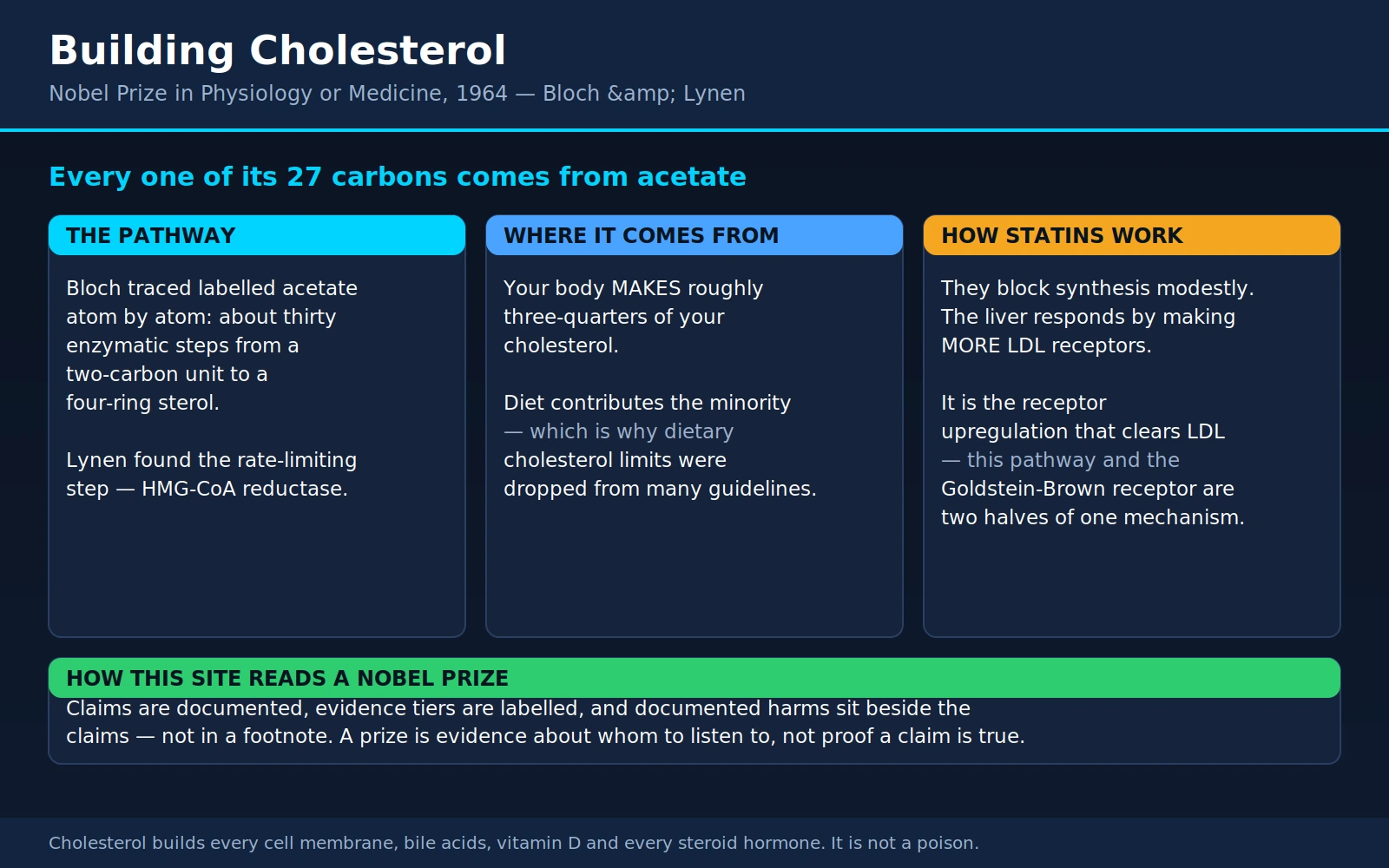
In 1964 the Nobel Prize in Physiology or Medicine went to two biochemists — one in Cambridge, Massachusetts, one in Munich — for what the Nobel committee called their discoveries concerning the mechanism and regulation of cholesterol and fatty acid metabolism. That phrasing is dry even by Nobel standards. What it actually means is this: Konrad Bloch and Feodor Lynen worked out, molecule by molecule, how a living cell manufactures cholesterol from nothing more elaborate than the two-carbon fragment left over when it burns sugar or fat.
That sounds like a piece of pure chemistry, of interest to specialists. It is not. The pathway they mapped is the reason your body makes most of its own cholesterol regardless of what you eat. It is the reason dietary cholesterol limits were quietly dropped from national guidelines and eggs were rehabilitated. It is the reason statins exist at all — the drug does not lower cholesterol by some vague metabolic magic, it plugs one specific enzyme that Lynen's laboratory helped identify as the pathway's control valve. And it is the reason the CoQ10-for-statin-muscle-pain question is a real biochemical question rather than a marketing invention: coenzyme Q10 comes off the very same production line.
Table of Contents
- The Prize and the Two Men
- Where Does Cholesterol Actually Come From?
- Bloch's Isotopes: Counting Every Carbon
- Lynen's Half: Activated Acetate and the Rate-Limiting Step
- Squalene, Lanosterol, and the Long Road
- Enter the Statins
- What Else the Pathway Makes — and the CoQ10 Question
- Cholesterol Is Not a Villain
- Rare Diseases That Prove the Pathway
- Diet, Honestly
- Where Mainstream Medicine Agrees — and What Remains Debated
- What the Prize Changed
- Key Research Papers
- Connections
- Featured Videos
1. The Prize and the Two Men
The 1964 prize was shared equally between two men who had never worked in the same laboratory, who approached the same chemistry from opposite ends, and whose lives ran through the twentieth century's worst decade on opposite sides of a border.
Konrad Bloch (1912–2000)
Konrad Emil Bloch was born in Neisse, in Upper Silesia — then part of Germany, today the Polish town of Nysa. He went to Munich to study chemical engineering at the Technische Hochschule, where he fell under the influence of Hans Fischer, the porphyrin chemist. He finished his degree in 1934. That was the year the Nazi racial laws reached the universities, and Bloch, who was Jewish, was pushed out of his research position.
What followed was the ordinary emergency of the period. He crossed into Switzerland and spent two years at a research institute in Davos, working on the phospholipids of the tubercle bacillus — useful work, but work taken because it was available rather than because he had chosen it. In 1936 he obtained a visa for the United States and enrolled at Columbia University, where he took his doctorate in 1938 under Hans T. Clarke in the department of biological chemistry.
That accident of placement decided everything. Columbia at that moment housed Rudolf Schoenheimer and David Rittenberg, who had just done something no one else in biology could do: they had learned to feed animals molecules tagged with heavy isotopes and then follow those specific atoms through the animal's metabolism. Schoenheimer's insight — that the body's constituents are in constant flux rather than sitting inert once built — was the intellectual revolution of the decade, and Bloch walked into the middle of it as a refugee with a fresh doctorate and no fixed research programme.
Bloch was consistently clear in later life about what that meant. He was a young chemist with no laboratory, no country and no plan, dropped by chance into the one place on earth where the tool that would define his career had just been invented. He gave the American scientific environment, and Schoenheimer and Rittenberg personally, the credit for the shape of everything he did afterwards. He moved to the University of Chicago in 1946 and to Harvard in 1954, where he stayed until his retirement. He died in Lexington, Massachusetts, in October 2000.
Feodor Lynen (1911–1979)
Feodor Felix Konrad Lynen was born in Munich, the son of a professor of mechanical engineering, and he essentially never left. He took his doctorate at the University of Munich in 1937 under Heinrich Wieland, the 1927 chemistry laureate whose own great work had been on the structure of the bile acids — which is to say, on cholesterol's downstream products. In the same year Lynen married Wieland's daughter Eva. The intellectual line from Wieland's sterol chemistry to Lynen's sterol biochemistry is not a coincidence; it was a family business.
Lynen remained in Germany through the Nazi period and the war. A severe skiing accident in the 1930s had left him with a permanently damaged leg, and that injury was the reason he was exempted from military service — he spent the war years in a Munich laboratory rather than in uniform. He was not a Nazi party member and was not politically prominent in any direction; he was a young academic who kept working because he was allowed to keep working, in a city that was being progressively flattened by bombing. Wieland's household in that period was known to have quietly sheltered people the regime was hunting, and Lynen was inside that circle.
After the war he rebuilt German biochemistry more or less from the studs. He became director of the Max Planck Institute for Cell Chemistry in Munich in 1954 — an institute effectively created around him — and it became one of the great training laboratories of postwar Europe. He died in Munich in August 1979 following surgery for an aneurysm.
Two ends of one pathway
It is worth being plain about the moral asymmetry here, because glossing it would be dishonest. One man was expelled from German science because of his ancestry and rebuilt a career in exile; the other stayed, was protected from the front by a ski injury, and inherited the wreckage afterwards. They were not adversaries and there is no evidence of friction between them — by the 1950s they were reading each other's papers closely and their laboratories were solving adjacent halves of the same puzzle. But the fact that the two men who jointly explained cholesterol biosynthesis spent the 1930s and 1940s on opposite sides of that history is part of the story, not a footnote to it.
Scientifically, the division of labour was almost geometric:
- Bloch worked backwards from the product. He had cholesterol, a 27-carbon four-ring molecule, and he wanted to know where each of its carbon atoms came from. Isotopes let him ask that question atom by atom.
- Lynen worked forwards from the raw material. He wanted to know the chemical identity and reactivity of the small activated fragments that cells actually use to build things — what "activated acetate" really was, and how a cell decides how fast to spend it.
They met in the middle, at a molecule called acetyl coenzyme A.
2. Where Does Cholesterol Actually Come From?
Here is the practical heart of this page, and it belongs near the top rather than buried in section nine:
Your body manufactures most of the cholesterol in it. Roughly three-quarters of your total body cholesterol is synthesised internally; the food you eat supplies the minority. A typical adult liver and intestine between them make on the order of 700 to 1,000 milligrams of cholesterol a day. A typical Western diet delivers something like 200 to 400 milligrams a day, and only a fraction of that is actually absorbed.
Before the 1940s this was not obvious at all. The prevailing assumption — sensible on its face — was that cholesterol in the body came mostly from cholesterol in food, the way iron in the body comes from iron in food. Rudolf Schoenheimer had already produced evidence against that view in the 1930s, but nobody could say what the alternative source was, because nobody could see a synthetic route. Cholesterol is a large, awkward, four-ring molecule with eight stereocentres and a branched tail. It looks like the sort of thing a cell would have to import.
What Bloch and Lynen established is that the cell builds it, from scratch, out of the most ordinary raw material in metabolism: the two-carbon acetyl group. Not a special dietary precursor. Not a rare vitamin. The same two-carbon unit produced when you burn glucose, when you burn fat, when you break down most amino acids — the unit that Hans Krebs had shown feeds the citric acid cycle. Anything that can be turned into acetyl-CoA can be turned into cholesterol. That includes the carbohydrate in your dinner and the alcohol in your glass.
Why this changed what your doctor tells you about eggs
The reason this matters at the breakfast table is a piece of physiology called compensation. Because the body makes most of its own cholesterol, and because it monitors how much it has, eating more cholesterol tends to cause the liver to make less of it and to absorb a smaller fraction of what arrives. The system has a thermostat. Pour in more from outside and, in most people, the internal furnace turns itself down.
This is why the historical advice to keep dietary cholesterol under 300 mg a day — roughly one and a half eggs — has been dropped from the US Dietary Guidelines and from the guidance of several other countries. The 2015–2020 Dietary Guidelines for Americans removed the numeric cap. The American Heart Association's 2020 science advisory on dietary cholesterol reviewed the human evidence and concluded that a specific numeric target is difficult for clinicians and patients to apply, and that guidance should focus on overall dietary patterns instead.
Two important qualifications, because this is exactly where the internet oversimplifies in both directions:
- "No numeric limit" is not the same as "eat unlimited cholesterol." The same AHA advisory noted that while observational studies generally show no significant association between dietary cholesterol and cardiovascular events, most meta-analyses of controlled feeding studies do find that intakes above current average levels raise total and LDL cholesterol. The effect is real; it is just smaller and more variable than the old advice implied.
- Compensation is not universal. A meaningful minority of people are hyper-responders whose LDL genuinely climbs when they eat more cholesterol. See section 10. If you are one of them, the population-level reassurance does not describe you, and the only way to find out is to measure — a lipid panel before and after a sustained dietary change.
The larger point stands, though, and it is Bloch and Lynen's point: the dominant source of your cholesterol is your own biochemistry. That is why the effective drugs target synthesis and clearance rather than diet, and why a patient with familial hypercholesterolaemia cannot eat their way out of the problem.
3. Bloch's Isotopes: Counting Every Carbon
The experiment that started it belongs to 1942, and it is beautifully simple in outline.
Bloch and Rittenberg fed mice and rats acetate — acetic acid, vinegar's active ingredient — in which the hydrogen atoms had been replaced with deuterium, the heavy isotope of hydrogen. Deuterium is chemically almost identical to ordinary hydrogen, so the animal's enzymes treat it as normal; but it is measurably heavier, so a mass spectrometer can find it afterwards. Then they isolated cholesterol from the animals' tissues and asked whether the heavy label had ended up in it.
It had. Cholesterol isolated from animals fed deuterium-labelled acetate carried the label. The two-carbon acetate fragment was a precursor of the 27-carbon sterol. Bloch and Rittenberg published this in the Journal of Biological Chemistry in 1942 — first as a short communication in March, then as a full paper in October.
From "acetate contributes" to "acetate is the only source"
Showing that some cholesterol carbon comes from acetate is one thing. Showing that all of it does — and knowing which carbon of the acetate goes to which position in the sterol — took another decade and required a second isotope.
After the war, carbon-14 became available to civilian researchers as a by-product of the reactor programme. Carbon-14 is radioactive, which means a chemist can find a single labelled carbon atom in a molecule by degrading the molecule piece by piece and measuring which pieces are hot. Crucially, acetate has two carbons that can be labelled independently — the methyl carbon and the carboxyl carbon — so you can feed one or the other and see where each ends up.
Bloch's group at Chicago and Harvard, together with several other laboratories, ground through this over years of painstaking degradation chemistry. The answer they arrived at is one of the cleanest results in biochemistry:
Every one of cholesterol's 27 carbon atoms comes from acetate. Fifteen of them from the methyl carbon, twelve from the carboxyl carbon, in a pattern that repeats with a regularity which itself became the clue to the mechanism. Nothing else contributes a single atom to the skeleton.
That repeating pattern was decisive. It showed that the sterol is not assembled ad hoc from a grab-bag of precursors, but built from a repeating five-carbon building block — the isoprene unit — which is itself assembled from acetate. Cholesterol turned out to belong to the same enormous chemical family as rubber, menthol, carotene, and the resins of pine trees. It is, structurally, a terpenoid.
Thirty steps, give or take
Getting from a two-carbon fragment to a four-ring sterol takes roughly thirty enzymatic steps. Counts in textbooks vary between about twenty-five and thirty-seven depending on where you draw the boundaries and how you count reactions that one enzyme performs in sequence, but "about thirty" is the honest number. Every one of those steps is catalysed by a specific protein; every one had to be found, purified and characterised by somebody.
The rough shape of the route:
- Acetyl-CoA → HMG-CoA. Three two-carbon units condense into a six-carbon intermediate, 3-hydroxy-3-methylglutaryl-CoA.
- HMG-CoA → mevalonate. One reduction, catalysed by HMG-CoA reductase. This is the step that matters — see section 4.
- Mevalonate → isopentenyl pyrophosphate. The activated five-carbon isoprene unit, ready to polymerise. Three ATP molecules are spent getting here.
- Five carbons → ten → fifteen. Head-to-tail condensations give geranyl and then farnesyl pyrophosphate. This is a critical junction — see section 7.
- Fifteen + fifteen → thirty: squalene. Two farnesyl units join tail-to-tail.
- Squalene → lanosterol. Oxygen is inserted, and the linear chain folds and cyclises in one spectacular concerted reaction into the four-ring sterol skeleton.
- Lanosterol → cholesterol. About nineteen further steps strip off three carbons and shuffle a double bond into place.
Bloch's laboratory made major contributions at nearly every stage of that list, and definitive ones at stages five and six.
4. Lynen's Half: Activated Acetate and the Rate-Limiting Step
While Bloch was chasing carbon atoms, Lynen was asking a more fundamental question: what is the reactive form of acetate that cells actually use?
Biochemists in the 1940s knew there had to be one. Free acetic acid is chemically lazy — it will not spontaneously condense with anything under the mild conditions inside a cell. Yet cells build fatty acids and sterols out of two-carbon units at speed. Something was activating the acetate, and the activated form was named "active acetate" as a placeholder while people looked for it. Fritz Lipmann had identified the cofactor involved — coenzyme A — and would share the 1953 Nobel Prize for it.
What acetyl-CoA is, and why it is reactive
Lynen and his colleague Ernestine Reichert isolated active acetate from yeast in 1951 and established its chemical nature. It is acetyl coenzyme A: an acetyl group attached to coenzyme A through a sulphur atom, forming a thioester.
That sulphur is the whole trick. An ordinary oxygen ester is stable and unreactive. A thioester is not: sulphur is a poor electron donor into the carbonyl group compared with oxygen, so the bond is high-energy and the molecule is chemically primed. Two consequences follow, and cells exploit both:
- The carbonyl carbon is electrophilic — easily attacked, so the acetyl group can be handed off to another molecule.
- The methyl carbon next door is acidified — it will give up a proton to form a carbanion, which can then attack something else. This is what lets two-carbon units link together into chains.
Recognising thioester chemistry as the engine of biosynthesis is Lynen's central contribution, and it reaches far beyond cholesterol. It is how fatty acids are built, how they are broken down, how the citric acid cycle starts, how acetylcholine is made, how proteins get acetylated. Acetyl-CoA sits at the crossroads of essentially all of intermediary metabolism — the point where sugar, fat and protein catabolism converge and where biosynthesis begins. Lynen's group went on to dissect fatty acid synthase as a multi-enzyme complex and to work out the role of biotin in carboxylation reactions, which he summarised in a 1967 lecture published in the Biochemical Journal.
The rate-limiting step, explained plainly
The other half of Lynen's prize citation is the word regulation, and it is the half that eventually became a $20-billion-a-year drug class.
A metabolic pathway is a production line: thirty stations, each with its own machine, each converting a part into the next part. Ask how fast the line runs and the answer is not "the average speed of the thirty machines." It is the speed of the slowest machine. Everything upstream of it piles up; everything downstream of it sits idle waiting. That slowest station is the rate-limiting step, and if you want to change the output of the whole line, that is the only station worth touching. Speed up any other machine and nothing happens.
Cells know this, which is why regulation is concentrated at rate-limiting steps rather than spread evenly. In cholesterol synthesis, the rate-limiting step is the second one:
HMG-CoA → mevalonate, catalysed by HMG-CoA reductase.
This step has a second property that makes it an even better control point: it is the committed step. HMG-CoA is a fork in the road — it can also be broken down to make ketone bodies, the fuel your brain runs on during fasting. Mevalonate cannot. Once mevalonate has been made, there is no route back and no other use for it: it is going to become an isoprenoid. So a cell that regulates HMG-CoA reductase is regulating exactly one thing, cleanly, without side effects on other pathways.
Lynen's laboratory in Munich did much of the early enzymology on this reductase. One of the most telling results came from Bernd Hamprecht working with Lynen: HMG-CoA reductase activity in rat liver was not constant but rose and fell on a daily rhythm, and fasting suppressed it. That is not the behaviour of a housekeeping enzyme. That is the behaviour of a control valve wired into the body's feeding state — a dial the cell actively turns. The finding is also the reason older statins were dosed in the evening: the enzyme's activity peaks overnight.
Two decades later, Michael Brown and Joseph Goldstein would work out the molecular machinery that turns that dial — a family of transcription factors called SREBPs, embedded in a membrane, cleaved and released when cellular cholesterol runs low. But the identification of the valve came first, and it came from Munich.
5. Squalene, Lanosterol, and the Long Road
Two intermediates on this pathway are worth naming, because you will meet both of them outside a biochemistry textbook.
Squalene
Squalene is a 30-carbon hydrocarbon, an oily liquid, built from six five-carbon isoprene units. It is the last intermediate before the rings close, and it looks nothing like cholesterol: a long floppy chain with no rings and no oxygen at all.
Its name comes from Squalus, the shark genus, because it was first isolated in quantity from shark liver oil — deep-water sharks store enormous amounts of it, apparently for buoyancy, since it is less dense than seawater. It is also present in olive oil at a few hundred milligrams per hundred grams, in amaranth and rice bran oil, and in human sebum, where it is one of the main components of the film that keeps your skin from drying out.
Bloch's laboratory, with Robert Langdon, showed in the early 1950s that squalene is a genuine intermediate on the route to cholesterol rather than a metabolic dead end — feed labelled squalene, and the label turns up in cholesterol.
A note on squalene and vaccines, since it comes up. Squalene is used as the oil phase of certain vaccine adjuvants — MF59, used in some influenza vaccines for older adults, and AS03. This is worth stating plainly rather than dodging, because the honest facts are more reassuring than the silence: squalene is not a foreign chemical being introduced to the body. Your own cells produce it continuously as an obligatory step in making cholesterol; it circulates in your blood, coats your skin and is present in the olive oil in your kitchen. The vaccine-adjuvant squalene is typically sourced from shark liver oil or plants and is chemically the same molecule. That does not make adjuvanted vaccines free of side effects — adjuvants are added precisely because they provoke a stronger immune response, and a stronger response means more sore arms and more transient fever. But the specific fear that squalene is an alien toxin is answered by this pathway: it is an intermediate in a reaction sequence running in your liver right now.
The cyclisation, and why oxygen matters
The next step is the most dramatic single reaction in the pathway. Squalene is oxidised — a single atom of oxygen is inserted to form an epoxide, 2,3-oxidosqualene — and then the whole floppy 30-carbon chain folds up on itself and, in one concerted enzymatic event, forms four fused rings.
The product is lanosterol. Tchen Tsoo Tien and Bloch published the definitive work on this conversion in 1957, in two back-to-back papers in the Journal of Biological Chemistry: one establishing that squalene becomes lanosterol, the other on the mechanism of the cyclisation itself. It remains a favourite example in chemistry teaching because a single enzyme controls the folding so precisely that it sets multiple stereocentres correctly in one shot.
Lanosterol still has 30 carbons. Getting to cholesterol's 27 requires removing three methyl groups and about nineteen further enzymatic steps — a long, expensive tail end that has puzzled biochemists for decades, since lanosterol is already a perfectly serviceable membrane sterol and some organisms stop there.
Bloch had a favourite argument about that oxygen requirement, and he returned to it in essays across the last decades of his life. Sterol synthesis needs molecular oxygen — not as a fuel but as a chemical reagent, at the cyclisation step and again at several of the demethylation steps. Eleven oxygen molecules are consumed making one cholesterol. That means sterol biosynthesis, as we know it, cannot have existed before oxygen accumulated in Earth's atmosphere. The pathway is a post-photosynthetic invention. Bloch used this to argue that the long refinement from lanosterol to cholesterol represents evolutionary optimisation of a membrane component — each step producing a molecule slightly better at the specific job of sitting between phospholipids and tuning membrane fluidity — and he backed the argument with experiments comparing how different sterols behaved in artificial membranes. It is a rare thing in biochemistry: a pathway whose shape encodes a piece of planetary history.
6. Enter the Statins
Once you know that a thirty-step pathway has one control valve, the pharmacological idea writes itself: block the valve. Doing it took a Japanese microbiologist working alone against his employer's scepticism.
Akira Endo and the mould
Akira Endo, a biochemist at the Sankyo pharmaceutical company in Tokyo, had spent time in New York in the late 1960s and had been struck by the prevalence of heart disease there compared with Japan. He reasoned that if a fungus wanted to defend itself against organisms that need sterols to build membranes, one elegant weapon would be a molecule that jams HMG-CoA reductase. So he went looking for one in moulds.
He screened something on the order of six thousand microbial strains. In 1973 he found what he was after in a culture of Penicillium citrinum: a compound he called ML-236B, later known as compactin or mevastatin. It is a competitive inhibitor of HMG-CoA reductase, and it works because part of the molecule is a structural mimic of HMG-CoA itself — the enzyme grabs it, cannot process it, and is occupied. Endo's group published the isolation in the Journal of Antibiotics in 1976 and the enzyme kinetics in FEBS Letters the same year.
Merck's lovastatin, isolated from Aspergillus terreus, followed and became the first statin approved for general use, in 1987. Every statin since — simvastatin, pravastatin, atorvastatin, rosuvastatin — is a variation on Endo's idea. He never received a Nobel Prize, a fact discussed on our Goldstein & Brown page, where the receptor half of this story is told and where Brown and Goldstein's own repeated public insistence on Endo's priority is on the record.
The two-step logic — and why it is not what most people think
Here is the part that is almost always explained wrongly, including by people who should know better. The intuitive story is: statins block cholesterol production, therefore there is less cholesterol, therefore your blood cholesterol falls. That story is not exactly false, but it is not the mechanism, and it gets the magnitude badly wrong.
What actually happens has two steps:
- The statin modestly reduces cholesterol synthesis in liver cells. Modestly — a partially inhibited enzyme still works, and the cell has compensatory tricks, including simply making more of the enzyme. On its own this would move blood LDL very little.
- The liver cell notices it is short of cholesterol and responds by making more LDL receptors. This is the SREBP machinery Brown and Goldstein worked out. LDL receptors are the vacuum cleaners on the surface of liver cells that grab LDL particles out of the bloodstream and pull them inside. More receptors on the cell surface means faster clearance of LDL from the blood.
It is step two that lowers your LDL number. The drug's target is the synthesis pathway; the drug's effect is on clearance. A statin lowers blood LDL mainly by making your liver hungrier for it.
This is not a fine distinction — it is the thing that ties the two halves of the twentieth century's cholesterol research into a single mechanism. Bloch and Lynen mapped the factory. Goldstein and Brown mapped the loading dock. Endo built a tool that turns down the factory precisely so the loading dock will run faster. Neither half explains a statin on its own.
It also makes a prediction that turns out to be right and clinically important: anything that upregulates LDL receptors should lower risk by roughly the same amount per unit of LDL reduction, regardless of the mechanism used to get there. A 2016 JAMA meta-analysis of 49 trials and over 312,000 participants found precisely that — statins reduced major vascular events by about 23% per 1 mmol/L (roughly 39 mg/dL) of LDL lowering, and non-statin interventions that work through LDL-receptor upregulation (diet, bile acid sequestrants, ileal bypass surgery, ezetimibe) reduced them by about 25%, statistically indistinguishable. The receptor pathway is the thing that matters. The route you take to engage it is negotiable.
7. What Else the Pathway Makes — and the CoQ10 Question
Remember the fork at farnesyl pyrophosphate, step four of the outline in section 3. Cholesterol is not the only thing this pathway produces. It is a trunk with several branches, all of them downstream of HMG-CoA reductase, and this is the single most important fact for understanding what statins might plausibly do beyond lowering LDL.
The branches include:
- Coenzyme Q10 (ubiquinone) — the electron carrier that shuttles electrons between complexes in the mitochondrial respiratory chain. Its long tail is built from ten isoprene units off the trunk pathway. Muscle and heart tissue are rich in it because they are mitochondria-dense.
- Dolichols — very long isoprenoid alcohols that act as membrane-anchored carriers during protein glycosylation, the process by which sugar chains are attached to newly made proteins.
- Prenyl groups (farnesyl and geranylgeranyl) — lipid tails covalently attached to certain signalling proteins to anchor them into membranes. Ras, Rho and Rab proteins all require this modification to work. It is the reason statins have plausible effects on inflammation and cell signalling that have nothing to do with LDL.
- Heme A, a component of mitochondrial cytochrome oxidase, and the isoprenoid side chain of vitamin K2 (menaquinone).
The CoQ10 hypothesis, stated at its strongest
Muscle symptoms — aching, weakness, cramping, heaviness in the thighs and shoulders — are the commonest reason people stop taking statins. The CoQ10 hypothesis explains them like this, and it deserves to be stated properly rather than waved away:
Statins inhibit HMG-CoA reductase. That enzyme sits above the branch point, so inhibiting it reduces flux not only to cholesterol but to every isoprenoid branch, CoQ10 included. CoQ10 is essential to mitochondrial energy production. Skeletal muscle is enormously dependent on mitochondrial energy production. Therefore statins should deplete muscle CoQ10, impair mitochondrial function in muscle, and cause exactly the symptoms patients report. Replacing the missing CoQ10 should fix it.
That chain of reasoning is mechanistically sound at every link, and the first empirical prediction it makes is correct. Statins do lower circulating CoQ10. A 2015 meta-analysis of eight placebo-controlled treatment arms found a significant reduction in plasma CoQ10 — about 0.44 µmol/L on average — consistently across atorvastatin, simvastatin, rosuvastatin and pravastatin, and in both short and long trials. This is not disputed. Anyone who tells you the CoQ10 idea is pure invention is wrong.
Then the evidence gets complicated
But "statins lower blood CoQ10" and "taking CoQ10 fixes statin muscle pain" are two different claims, and the second one is where the evidence goes soft. Three findings have to be held together:
First, the randomised trial evidence for supplementation is inconsistent, and the two major meta-analyses disagree.
- A 2015 meta-analysis in Mayo Clinic Proceedings pooled six randomised controlled trials with 302 statin-treated patients and found no significant benefit of CoQ10 on either muscle pain (standardised mean difference −0.53, 95% CI −1.33 to 0.28, p = 0.20) or creatine kinase, and no dose-response relationship.
- A 2018 meta-analysis in the Journal of the American Heart Association pooled twelve trials with 575 patients and reached the opposite conclusion — that CoQ10 significantly reduced muscle pain, weakness, cramping and tiredness, though it found no effect on creatine kinase.
Both are peer-reviewed meta-analyses by competent groups. They differ because they included different trials, and the trials themselves are small, short, use different CoQ10 doses and formulations, and — critically — use different and largely subjective ways of scoring muscle symptoms. When a field's meta-analyses point in opposite directions, the honest conclusion is not that one side is lying; it is that the underlying trials are too small and too heterogeneous to settle the question, and that the effect, if it exists, is not large enough to show through the noise.
Second, the single best-designed trial in patients with confirmed statin myalgia was null. Beth Taylor and colleagues published a two-stage study in Atherosclerosis in 2015 that is worth describing in detail because its design closes a loophole most trials leave open. They started with 120 patients who reported statin muscle pain and ran them through an eight-week blinded crossover of simvastatin versus placebo — not to test a supplement, but simply to confirm that their pain was actually caused by the statin. Only 41 of the 120 developed pain on simvastatin and not on placebo. Those 41 — people with objectively confirmed, statin-specific muscle pain — were then randomised to simvastatin plus 600 mg/day of ubiquinol or simvastatin plus placebo. Serum CoQ10 rose four-fold in the supplemented group, confirming they were absorbing it. Pain scores rose with simvastatin regardless of CoQ10 assignment. There was no difference in muscle strength, no difference in maximal oxygen uptake, and no difference in time to symptom onset.
Third — and this is the finding that reframes the whole question — most of the symptom burden appears on placebo too. Look again at Taylor's first stage: only 36% of people who were certain their statin was causing muscle pain actually developed pain on the drug and not on the placebo.
The SAMSON trial, published in the New England Journal of Medicine in 2020, pushed this further with an unusually clever design. Sixty patients who had stopped statins because of side effects each received twelve one-month bottles in random order: four containing atorvastatin, four containing identical placebo, and four containing nothing at all. Each patient rated their symptoms daily on a phone app. Because every patient served as their own control across all three conditions, the design separates the drug's pharmacological effect from the effect of taking a tablet you believe might hurt you.
The result: symptom scores were low in the no-tablet months and high in the statin months — and almost equally high in the placebo months. Roughly nine-tenths of the symptom burden experienced on the statin was reproduced by an identical dummy pill. This is the nocebo effect: real, felt, physically experienced symptoms generated by the expectation of harm rather than by the drug. It is not imaginary and it is not a character flaw. It is a well-documented phenomenon that shows up in every drug class where patients have been warned about a side effect. Notably, about half of the SAMSON participants restarted statin therapy after seeing their own data.
What to actually do with this
Putting it together, precisely and without dismissiveness:
- The mechanism is real. The isoprenoid branch is real, CoQ10 comes off it, and statins measurably lower circulating CoQ10. Nobody should tell you otherwise.
- The clinical benefit of supplementing is not established. The best-controlled trial in confirmed cases was null; the two major meta-analyses contradict each other. That is the definition of an unproven treatment, not a debunked one.
- Much of what is attributed to statins is not caused by the statin. Two independent, well-designed studies converge on this, and it means the first useful step for someone with muscle symptoms is usually a supervised rechallenge — stopping and restarting under medical guidance — rather than a supplement.
- CoQ10 is very safe, and trying it is a defensible personal decision. It has an excellent tolerability record, the main practical caution being a possible interaction with warfarin, since CoQ10 is structurally related to vitamin K. If you and your doctor decide to try it, treat it as an experiment with a defined endpoint, not as a permanent addition. Doses used in the trials ranged widely, commonly 100–600 mg/day, usually as ubiquinol for absorption.
- Do not stop a statin because of muscle symptoms without talking to whoever prescribed it. Genuine statin muscle injury exists and is occasionally serious; so does the far commoner nocebo pattern; and so does the risk of an unmanaged event in someone who needed the drug. Those three possibilities require different responses and cannot be told apart from the symptom alone.
8. Cholesterol Is Not a Villain
Fifty years of public health messaging has left many people with the impression that cholesterol is a poison the body would be better off without. It is worth saying flatly: you would be dead within days without it. Every one of the trillions of cells in your body contains it, and the reason evolution built a thirty-step, oxygen-hungry, ATP-expensive pathway to make it is that nothing else does its jobs.
Membranes
The largest single use of cholesterol is structural. Cell membranes are two layers of phospholipid, and on their own they would be either too fluid to hold anything or, at lower temperature, too rigid to function. Cholesterol wedges between the phospholipid tails and buffers this — it makes fluid membranes stiffer and rigid membranes more fluid, keeping them in a workable middle range across the temperatures a body actually experiences. This is the fluidity buffer function, and it was the subject of much of Bloch's later work: he compared sterols in artificial membranes and argued that the long refinement from lanosterol to cholesterol represents progressive optimisation for exactly this job.
Cholesterol also concentrates into ordered patches of membrane called lipid rafts, which act as organising platforms — receptors and signalling proteins cluster there, and disrupting cholesterol content disrupts the signalling. The membranes of nerve cells and the myelin sheath that insulates them are particularly cholesterol-rich; the brain holds around a fifth of the body's total cholesterol despite being about 2% of body weight, and makes essentially all of it locally, since the blood-brain barrier keeps circulating LDL out.
Bile acids
The liver converts cholesterol into bile acids — cholic and chenodeoxycholic acid — which are stored in the gallbladder and released into the small intestine after a meal. Bile acids are detergents: they emulsify dietary fat so that digestive enzymes can reach it, and they are indispensable for absorbing fat and the fat-soluble vitamins A, D, E and K. This is quantitatively the largest disposal route for cholesterol in the body, which is why drugs that bind bile acids in the gut and force the liver to make more of them (bile acid sequestrants) lower LDL — by exactly the receptor-upregulation mechanism described in section 6.
Vitamin D
In the outer layers of your skin sits 7-dehydrocholesterol — the immediate precursor of cholesterol, one enzymatic step short of the finish line. When ultraviolet B light strikes it, the B ring of the sterol opens and it becomes previtamin D3, which rearranges into vitamin D3. The liver and kidney then hydroxylate it into the active hormone. Your vitamin D is, quite literally, sunlight acting on an intermediate of the Bloch–Lynen pathway sitting in your skin.
Steroid hormones
Every steroid hormone in your body is made from cholesterol. The first step — cholesterol to pregnenolone, catalysed by a mitochondrial enzyme in the adrenal gland, gonads and placenta — is the gateway to all of them:
- Cortisol, the stress and anti-inflammatory hormone — the molecule whose isolation and clinical use earned Hench, Kendall and Reichstein the 1950 Nobel Prize. Cortisone and every corticosteroid drug that followed sit downstream of the pathway on this page.
- Aldosterone, which controls sodium retention and blood pressure.
- Testosterone and oestrogen, the sex hormones.
- Progesterone, essential to pregnancy.
So what does "high cholesterol is bad" actually mean?
It does not mean the molecule is toxic. It means something narrower and more specific, and getting the distinction right prevents a lot of confused thinking.
Cholesterol does not dissolve in blood. To travel, it must be packaged into lipoprotein particles — a lipid core wrapped in protein. The relevant particle for cardiovascular risk is LDL (low-density lipoprotein), and the risk story is about what those particles do at the artery wall, not about what cholesterol does inside a cell. When LDL particles are numerous, they cross into the artery wall, become oxidised and modified, and are engulfed by immune cells that then cannot get rid of them and turn into foam cells. That process is the beginning of atherosclerosis.
The risk therefore tracks the number of atherogenic particles in circulation and the duration of exposure, not the healthiness or otherwise of cholesterol as a chemical. This is why apolipoprotein B — which counts particles directly, since each atherogenic particle carries exactly one apoB molecule — is a better risk marker than LDL cholesterol, which measures the cargo rather than the vehicles. Our lipid panel page explains what each number on the standard report actually means, and there is an interactive cholesterol and lipoproteins visualization if you want to see the particles move.
Both things are true at once, and neither cancels the other: cholesterol is an essential molecule that you cannot live without, and a high burden of LDL particles over decades causes heart attacks. Anyone selling you only one half of that sentence is selling you something.
9. Rare Diseases That Prove the Pathway
Biochemistry textbooks describe pathways as diagrams. Medicine occasionally shows you what happens when one arrow in the diagram is broken, and those experiments of nature are the most direct proof that the pathway is not just real but essential.
Smith–Lemli–Opitz syndrome
Smith–Lemli–Opitz syndrome (SLOS) is caused by mutations in DHCR7, the gene for 7-dehydrocholesterol reductase — the enzyme that catalyses the very last step of the thirty-step pathway. It is inherited in an autosomal recessive pattern, meaning a child must inherit a defective copy from both parents. Estimates of incidence vary by population but are generally in the range of one in 20,000 to one in 60,000 births.
Children with SLOS cannot complete the final conversion. Cholesterol is low; its immediate precursor, 7-dehydrocholesterol, accumulates. The consequences are severe and begin before birth: distinctive facial features, small head size, cleft palate, fusion of the second and third toes, heart and kidney malformations, feeding difficulty, and intellectual disability that ranges from mild to profound. Severe cases are lethal in infancy; milder ones are compatible with a long life. Treatment with dietary cholesterol supplementation is used and can help growth and some symptoms, but it does not correct the neurological picture, in part because supplemental cholesterol cannot cross the blood-brain barrier — the developing brain has to make its own.
What SLOS demonstrates is not subtle: fetal cholesterol synthesis is not optional. A developing embryo cannot rely on the mother's supply. It must run this pathway itself, and a defect in a single step near the end produces catastrophic developmental abnormality. This is also why statins are contraindicated in pregnancy — not out of excessive caution, but because we know from SLOS exactly what a shortage of fetal cholesterol synthesis does.
Cerebrotendinous xanthomatosis
Cerebrotendinous xanthomatosis (CTX) breaks the pathway at the other end — not in making cholesterol but in disposing of it. The gene is CYP27A1, encoding sterol 27-hydroxylase, an enzyme in the conversion of cholesterol to bile acids. When it fails, the intermediate cholestanol accumulates instead and deposits in tissues.
The clinical picture unfolds slowly and is easy to miss for decades: chronic diarrhoea beginning in infancy, cataracts in childhood or adolescence, then in early adulthood fatty swellings in the tendons — the Achilles tendon most characteristically — and then a progressive neurological decline with unsteadiness, spasticity, seizures and cognitive impairment.
CTX belongs on this page for one reason above all: it is treatable, and treatment works far better the earlier it starts. Chenodeoxycholic acid replacement restores the feedback signal that the missing enzyme should have provided, suppresses cholestanol production, and can halt or partially reverse the disease if given before extensive neurological damage. Patients diagnosed in their forties after twenty years of unexplained symptoms are a recurring tragedy in the literature. Unexplained juvenile cataracts plus chronic childhood diarrhoea plus tendon xanthomas is the pattern that should trigger testing.
Why these conditions complicate "lower is always better"
Modern cardiology has moved steadily towards lower LDL targets, and for people at high cardiovascular risk the evidence supporting that direction is genuinely strong — the relationship between LDL reduction and event reduction holds down to very low achieved levels in trial populations, with no clear threshold identified so far.
But these rare diseases are a standing reminder that the statement cannot be true without qualification at the extremes. There exists a level of cholesterol availability below which cells cannot build membranes, brains cannot develop, and hormones cannot be made — SLOS locates that floor precisely. The clinically relevant version of the claim is narrower and defensible: within the range achievable by lipid-lowering therapy in adults, and over the timescales studied, lower LDL has been associated with lower cardiovascular risk without a demonstrated harm threshold. That is a much more careful sentence than "lower is always better," and the difference between them is the difference between an evidence claim and a slogan. It also explains why "your cholesterol is too low" is a real concern in a malnourished patient or a child with a metabolic disease, and generally not a real concern in an adult on a statin.
10. Diet, Honestly
This section is where the biochemistry becomes something you can act on. Everything here follows from section 2: because your body makes most of its own cholesterol, food-based approaches move the number less than people expect, but they are not useless, and some of them work through mechanisms this pathway explains directly.
Dietary cholesterol versus saturated fat: which moves LDL more?
For most people, saturated fat has a larger effect on blood LDL than dietary cholesterol does. They are separate things and it is worth keeping them separate: an egg yolk is high in cholesterol and moderate in saturated fat; butter is high in saturated fat and much lower in cholesterol; a prawn is very high in cholesterol and almost fat-free.
The mechanistic reason is the receptor story again. Saturated fatty acids reduce the activity and number of LDL receptors on liver cells, so LDL clears from the blood more slowly. Dietary cholesterol arriving in the liver mostly triggers the compensation described earlier — less synthesis, less absorption. One acts on clearance; the other is largely absorbed by the thermostat.
This is why the guidance shifted. It is also why the shift was widely misreported: dropping a numeric cholesterol limit is not the same as concluding that dietary cholesterol has no effect on blood lipids. The AHA's 2020 advisory was explicit that most controlled feeding studies do show a rise in total and LDL cholesterol when intake goes well above current average levels — it argued for pattern-based rather than number-based advice, not for indifference.
Hyper-responders: the people the average hides
Population averages describe nobody in particular. Feed a group of people extra cholesterol and you will find a wide spread of responses: many barely move, and a substantial minority — commonly estimated at something like a quarter of people, though estimates vary with the study and the definition — show a clear, reproducible rise in LDL. These are hyper-responders. The trait appears to be partly genetic, with apolipoprotein E genotype among the influences.
The practical advice is short and does not require knowing your genotype: measure. If you have moved to eating several eggs a day, or made any other large change in dietary cholesterol, get a lipid panel before and roughly eight to twelve weeks after. Your own numbers outrank any population average, in either direction. If your LDL and apoB did not move, the reassurance applies to you. If they rose meaningfully, it does not, and no amount of citing the guideline change will alter that.
Plant sterols and stanols
Here is a dietary intervention whose mechanism is a direct consequence of this page's chemistry. Plant sterols and stanols (phytosterols) are the plant kingdom's structural equivalents of cholesterol — found in nuts, seeds, vegetable oils, legumes and whole grains. They are so similar to cholesterol that they compete with it for space in the mixed micelles that carry fat across the intestinal wall. More phytosterol in the micelle means less room for cholesterol, so less cholesterol is absorbed and more leaves in the stool.
The effect is real, well-quantified, and modest. The largest meta-analysis of the dose-response — 124 studies, 201 comparisons — found that intakes of about 0.6 to 3.3 g/day lower LDL by roughly 6 to 12%, with the effect continuing to increase up to about 3 g/day and averaging around 12% at that dose. Above roughly 3 g/day the data thin out and the curve appears to plateau.
Getting 2–3 g/day from unfortified whole foods alone is difficult — ordinary diets supply a few hundred milligrams. The doses used in the trials generally came from fortified products or supplements. Following this site's whole-food framing, the sensible move is to eat the natural sources generously — nuts, seeds, olive oil, avocado, legumes, whole grains — which brings other benefits besides, and to treat concentrated phytosterol supplements as a deliberate, discussed decision rather than a default. Note also that people with the rare condition sitosterolaemia, who absorb plant sterols excessively, should avoid them.
Soluble fibre
Soluble fibre — the beta-glucan in oats and barley, the mucilage in psyllium, the pectin in apples and citrus, and the fibre in beans and lentils — works by a related trick. It forms a viscous gel in the small intestine that traps bile acids and carries them out in the stool rather than letting them be reabsorbed and recycled. The liver must then make replacement bile acids, and it makes them out of cholesterol — pulling cholesterol out of liver cells, which respond by putting out more LDL receptors. Once again, the mechanism runs through the receptor.
The magnitude is modest but reliable: roughly 3 g/day of oat beta-glucan is associated with an LDL reduction in the region of 5–7%. That is about three-quarters of a cup of dry oats. Psyllium at similar soluble-fibre doses performs comparably. Our page on fibre covers the wider effects. The whole-food route — oats, barley, beans, lentils, whole fruit — delivers the fibre along with everything else in the food, and is preferable to isolated supplements for most people.
Red yeast rice: a statin with no label
Red yeast rice is made by fermenting rice with the mould Monascus purpureus, and it has a long history in Chinese cooking and medicine. It contains a family of compounds called monacolins. The most abundant, monacolin K, is chemically identical to lovastatin — the same molecule Merck isolated from Aspergillus terreus and licensed as a prescription drug in 1987.
This should be said without either hostility or promotion. Red yeast rice lowers LDL because it contains a statin. It is not an alternative to statins; it is an unlabelled, unstandardised one. It therefore carries the same class of risks — muscle symptoms, liver enzyme elevation, the same drug interactions, the same contraindication in pregnancy — without a dose printed on the bottle.
And the dose really is unknown. An analysis published in the European Journal of Preventive Cardiology in 2017 tested 28 brands of red yeast rice bought from mainstream US retailers. Two contained no detectable monacolin K at all. Among the 26 that did, the content varied more than 60-fold — from 0.09 to 5.48 mg per 1,200 mg of product. Following each manufacturer's own serving instructions, the daily monacolin K intake would have varied more than 120-fold, from 0.09 mg to 10.94 mg. For comparison, prescription lovastatin starts at 20 mg. So two bottles on the same shelf can deliver a homeopathic trace or a meaningful pharmacological dose, and nothing on the label tells you which you bought. Some products have also been found to contain citrinin, a nephrotoxic mould by-product.
If someone is taking red yeast rice, the useful advice is: tell your doctor, because they are on a statin whether or not it is in the notes; do not combine it with a prescription statin; and expect the same monitoring. If the goal is a low, well-tolerated statin dose, a prescription at a known dose is the more controllable version of the same intervention.
What actually moves the number, in order
- Replacing saturated fat with unsaturated fat from whole sources — olive oil, nuts, seeds, fatty fish, avocado. The best-evidenced single dietary change for LDL.
- Soluble fibre from oats, barley, beans, lentils and whole fruit.
- Plant sterols and stanols from nuts, seeds, legumes and vegetable oils.
- Weight loss if there is excess weight, which improves triglycerides and HDL more than LDL but improves the whole particle picture.
- Physical activity, mainly through triglycerides, HDL and insulin sensitivity.
What is not on that list, deliberately: ultra-processed low-fat substitute products. Stripping fat out of a food and replacing it with refined starch and sugar is not the intervention the evidence supports, and the low-fat processed era did not produce the cardiovascular benefit it promised. Eat the whole foods.
And the honest ceiling: for a person with genuinely high LDL — particularly familial hypercholesterolaemia, where LDL receptor function is inherited broken — a diet that does everything right will typically move LDL by 10 to 20%. That is worth having and worth doing. It is not going to substitute for medication in someone whose LDL is 250 mg/dL because half their receptors do not work. Bloch and Lynen's pathway is the reason: the body makes most of it internally, and diet only ever had partial leverage on that.
11. Where Mainstream Medicine Agrees — and What Remains Debated
Broadly agreed
- The pathway itself. Acetyl-CoA to mevalonate to isoprenoid units to squalene to lanosterol to cholesterol, with HMG-CoA reductase as the rate-limiting and committed step. This is settled biochemistry, not a model.
- Endogenous synthesis dominates. The body makes most of its own cholesterol; dietary intake is the minority contributor and is partially compensated for.
- LDL is causal in atherosclerosis, not merely correlated. The case rests on randomised trials, Mendelian randomisation using genetic variants that raise or lower lifetime LDL, and the dose-response consistency across drug classes.
- Statins reduce cardiovascular events in secondary prevention — in people who already have established cardiovascular disease — and in high-risk primary prevention. The benefit per unit of LDL lowering is consistent across trials.
- The receptor is the final common path. Interventions that upregulate LDL receptors reduce risk in proportion to how much they lower LDL, whichever mechanism they use to do it.
- Cholesterol is essential. Membranes, bile acids, vitamin D, steroid hormones. Not a waste product, not a toxin.
- Serious statin muscle injury is real but uncommon, and rhabdomyolysis is rare. Liver enzyme monitoring practices have been relaxed over time as the risk proved smaller than initially feared.
Genuinely debated
- "Lower is always better" at the extremes. Trials support progressively lower LDL targets in high-risk patients and have not identified a threshold below which benefit stops. But the trials have not tested decades of very low LDL in people at low baseline risk, and the biology in section 9 says a floor must exist somewhere. Where it is, and whether it is ever reached by pharmacological therapy in adults, is unresolved.
- Statins in primary prevention for older adults. There is real uncertainty about starting a statin in a person over 75 with no established cardiovascular disease. Older adults were under-represented in the primary-prevention trials; competing causes of death compress the potential benefit; polypharmacy and frailty raise the cost of an added drug; and the time-to-benefit may exceed a given individual's life expectancy. Trials such as STAREE and PREVENTABLE were designed to address exactly this gap. Meanwhile, guidelines correctly describe it as a shared decision rather than a rule.
- Lipoprotein(a). Lp(a) is an LDL-like particle carrying an extra protein, its level is roughly 80–90% genetically determined, and elevated Lp(a) is an independent causal risk factor for cardiovascular disease and aortic stenosis affecting something like one in five people. Everyone agrees it matters. What is missing is proof that lowering it helps: statins do not lower it (and may raise it slightly), niacin lowers it without demonstrated outcome benefit, and the drugs designed specifically to lower it — antisense oligonucleotides and siRNA agents — are in outcome trials whose results are not yet in hand. It is currently the best-characterised risk factor without a proven treatment.
- How much of statin intolerance is pharmacological. SAMSON and the Taylor rechallenge data suggest most reported symptoms are not drug-specific. Clinicians who see patients with severe, reproducible symptoms argue the trials under-detect a real minority. Both can be true, and telling which patient is which remains a clinical judgement.
- Whether CoQ10 supplementation helps statin muscle symptoms. Covered in section 7. Two major meta-analyses disagree; the best-designed single trial was null; the mechanism is sound. Unproven, not disproven.
- The role of pleiotropic statin effects. Because statins reduce prenylation of signalling proteins, they have effects on inflammation, endothelial function and coagulation independent of LDL. How much of the clinical benefit these account for — and whether they explain effects seen in sepsis, cancer and other settings — is an active argument.
- Dietary cholesterol in specific subgroups. The population-level reassurance is reasonably solid. Whether it extends to hyper-responders, to people with type 2 diabetes, and to people eating five or more eggs a day is less settled, and studies in these groups have produced mixed results.
12. What the Prize Changed
Nobel Prizes in biochemistry often honour work whose consequences are hard to point at. This one is different, and the line from the laboratory to the pharmacy counter is unusually short and unusually straight.
1942. Bloch and Rittenberg feed labelled acetate to rodents and find the label in cholesterol.
1951. Lynen identifies active acetate as acetyl-CoA and establishes thioester chemistry as the engine of biosynthesis.
1950s. Bloch's laboratory establishes squalene and lanosterol as intermediates and shows all 27 carbons of cholesterol derive from acetate.
1960s. Lynen's group characterises HMG-CoA reductase and shows its activity is dynamically regulated by feeding state and time of day — identifying the control valve.
1964. The Nobel Prize in Physiology or Medicine, shared.
1973–1976. Akira Endo, reasoning from exactly this pathway, screens moulds for a reductase inhibitor and finds compactin.
1970s–1980s. Goldstein and Brown work out the LDL receptor and the feedback machinery that senses cellular cholesterol, explaining why inhibiting synthesis clears LDL from blood.
1987. Lovastatin is approved. Within twenty-five years, statins are among the most prescribed drugs on earth.
Four Nobel Prizes touch this story — Wieland's on bile acid structure in 1927, Bloch and Lynen's in 1964, Brown and Goldstein's in 1985 — and the one man whose work most directly produced the medicine, Akira Endo, was never given one.
The other legacy is methodological, and Bloch made the point himself repeatedly: the isotope tracer technique he learned from Schoenheimer and Rittenberg as a young refugee turned metabolism from a static inventory into a dynamic film. Before isotopes, you could analyse what a tissue contained. After them, you could watch atoms move through it. Nearly every pathway in the modern metabolic chart — including Krebs's cycles and Warburg's respiration — owes its final form to that technique.
And there is a last observation worth making about how this work got done. Bloch spent roughly two decades tracking individual carbon atoms through a thirty-step pathway, with no clinical application in sight and no way of knowing there would ever be one. He was not trying to cure heart disease. He was trying to find out where the carbon went. The drug class that resulted, and the millions of cardiovascular events it has prevented, exist because two governments and several universities were willing to pay for a chemist to answer a question that had no obvious use at the time. That is not a sentimental point; it is the strongest available argument for basic research, and it is written into the structure of every statin tablet.
13. Key Research Papers
Every citation below was verified against PubMed or Crossref: journal, year, volume, issue and pages confirmed against the indexed record. Where a claim about what a paper found appears in the text above, the finding was read from the abstract, not inferred from the title.
The original pathway work
- Bloch K, Rittenberg D. On the utilization of acetic acid for cholesterol formation. Journal of Biological Chemistry. 1942;145(2):625–636. The founding experiment: deuterium-labelled acetate fed to animals turns up in their cholesterol. Predates PubMed's coverage of this journal; verified through Crossref against the Journal of Biological Chemistry's own archival record.
- Tchen TT, Bloch K. On the conversion of squalene to lanosterol in vitro. Journal of Biological Chemistry. 1957;226(2):921–930. Establishes the squalene-to-lanosterol step. Its companion paper on the mechanism of the cyclisation appears immediately after it in the same issue, at pages 931–939.
- Bloch K. The biological synthesis of cholesterol. Science. 1965;150(3692):19–28. Bloch's Nobel lecture, and the best single first-hand account of how the whole pathway was assembled.
- Lynen F. The role of biotin-dependent carboxylations in biosynthetic reactions. Biochemical Journal. 1967;102(2):381–400. Lynen on the chemistry of carbon-chain assembly, from the laboratory that defined acetyl-CoA's role in it.
- Hamprecht B, Nüssler C, Lynen F. Rhythmic changes of hydroxymethylglutaryl coenzyme A reductase activity in livers of fed and fasted rats. FEBS Letters. 1969;4(2):117–121. The rate-limiting enzyme is shown to be dynamically regulated by feeding state and time of day — the evidence that it is a control valve rather than a bottleneck.
- Bloch KE. Speculations on the evolution of sterol structure and function. CRC Critical Reviews in Biochemistry. 1979;7(1):1–5. Bloch's argument that the oxygen requirement dates the pathway to after the oxygenation of Earth's atmosphere.
From pathway to drug
- Endo A, Kuroda M, Tsujita Y. ML-236A, ML-236B, and ML-236C, new inhibitors of cholesterogenesis produced by Penicillium citrinum. Journal of Antibiotics (Tokyo). 1976;29(12):1346–1348. The isolation of compactin — the first statin. (The PubMed record spells the species "citrinium"; the correct binomial is Penicillium citrinum.)
- Endo A. A historical perspective on the discovery of statins. Proceedings of the Japan Academy, Series B. 2010;86(5):484–493. Endo's own retrospective account of the screening programme and what followed. Open access.
- Goldstein JL, Brown MS. Regulation of the mevalonate pathway. Nature. 1990;343(6257):425–430. The synthesis of the two halves: how cells sense cholesterol and adjust both synthesis and receptor-mediated uptake.
- Silverman MG, Ference BA, Im K, Wiviott SD, Giugliano RP, Grundy SM, Braunwald E, Sabatine MS. Association between lowering LDL-C and cardiovascular risk reduction among different therapeutic interventions: a systematic review and meta-analysis. JAMA. 2016;316(12):1289–1297. 49 trials, 312,175 participants. Statins and non-statin LDL-receptor-mediated interventions reduce major vascular events by a near-identical amount per unit of LDL lowered — the clinical proof that the receptor is the final common path.
Statins, coenzyme Q10 and muscle symptoms
- Banach M, Serban C, Ursoniu S, et al. Statin therapy and plasma coenzyme Q10 concentrations — a systematic review and meta-analysis of placebo-controlled trials. Pharmacological Research. 2015;99:329–336. Eight placebo-controlled arms: statins significantly reduce plasma CoQ10 (weighted mean difference −0.44 µmol/L), consistently across statin types. The mechanistic premise of the CoQ10 hypothesis is confirmed.
- Banach M, Serban C, Sahebkar A, et al. Effects of coenzyme Q10 on statin-induced myopathy: a meta-analysis of randomized controlled trials. Mayo Clinic Proceedings. 2015;90(1):24–34. Six trials, 302 patients: no significant benefit of CoQ10 on muscle pain or creatine kinase, and no dose-response. (Note for anyone searching: this paper attracted several published comments in the same journal two months later, including an authors' reply carrying a near-identical title. The meta-analysis itself is the January 2015 article at pages 24–34.)
- Qu H, Guo M, Chai H, Wang WT, Gao ZY, Shi DZ. Effects of coenzyme Q10 on statin-induced myopathy: an updated meta-analysis of randomized controlled trials. Journal of the American Heart Association. 2018;7(19):e009835. Twelve trials, 575 patients, and the opposite conclusion to the paper above: CoQ10 significantly reduced muscle pain, weakness, cramp and tiredness, though not creatine kinase. Cited here because it disagrees — the field's two major meta-analyses genuinely conflict, and readers deserve both.
- Taylor BA, Lorson L, White CM, Thompson PD. A randomized trial of coenzyme Q10 in patients with confirmed statin myopathy. Atherosclerosis. 2015;238(2):329–335. The best-designed single trial: symptoms were first confirmed as statin-specific by blinded crossover (only 41 of 120 self-reported cases passed), and 600 mg/day of ubiquinol then failed to reduce pain, preserve strength or improve aerobic capacity in those 41.
- Wood FA, Howard JP, Finegold JA, et al. N-of-1 trial of a statin, placebo, or no treatment to assess side effects. New England Journal of Medicine. 2020;383(22):2182–2184. The SAMSON trial, published as a research letter. Sixty patients, twelve randomised one-month periods each of atorvastatin, placebo and no tablet: the great majority of the symptom burden attributed to the statin also appeared on placebo.
Diet, supplements and the rare diseases
- Carson JAS, Lichtenstein AH, Anderson CAM, et al. Dietary cholesterol and cardiovascular risk: a science advisory from the American Heart Association. Circulation. 2020;141(3):e39–e53. The careful version of the "eggs are fine" story: observational studies generally show no significant association with cardiovascular events, most controlled feeding studies still show a lipid effect above current average intakes, and dietary-pattern advice is preferred to a numeric cap.
- Ras RT, Geleijnse JM, Trautwein EA. LDL-cholesterol-lowering effect of plant sterols and stanols across different dose ranges: a meta-analysis of randomised controlled studies. British Journal of Nutrition. 2014;112(2):214–219. 124 studies, 201 comparisons: 0.6–3.3 g/day lowers LDL by 6–12%, with the effect continuing up to about 3 g/day.
- Cohen PA, Avula B, Khan IA. Variability in strength of red yeast rice supplements purchased from mainstream retailers. European Journal of Preventive Cardiology. 2017;24(13):1431–1434. 28 brands tested: two contained no monacolin K, and among the rest content varied more than 60-fold — more than 120-fold per recommended daily serving.
- Porter FD. Smith–Lemli–Opitz syndrome: pathogenesis, diagnosis and management. European Journal of Human Genetics. 2008;16(5):535–541. A clear clinical review of what happens when the pathway's final enzyme fails — the strongest available demonstration that fetal cholesterol synthesis is essential.
Live PubMed Searches
- Cholesterol biosynthesis pathway history
- HMG-CoA reductase statin mechanism
- Coenzyme Q10 statin myopathy
- Dietary cholesterol and blood lipids
- Plant sterols and LDL reduction
14. Connections
- Notable Doctors — the full index of physicians and scientists profiled on this site.
- Goldstein & Brown — the LDL receptor and the other half of this mechanism, plus the Akira Endo story in full.
- Hans Krebs — acetyl-CoA is the shared starting material for the citric acid cycle and for everything on this page.
- Hench, Kendall & Reichstein — cortisone and the corticosteroids, all built downstream of cholesterol.
- John Vane — aspirin's mechanism, the other great story of a drug explained by finding the enzyme it blocks.
- Otto Warburg — cellular respiration, and another laureate whose career ran through Germany in the same decades.
- Nobel Prize in Medicine — the complete roll of laureates, 1901 to the present.
- Lipid Panel — what each number on the standard cholesterol report actually measures.
- Apolipoprotein B — counting atherogenic particles rather than their cargo.
- Lipoprotein(a) — the largely genetic risk factor that still has no proven treatment.
- Coronary Calcium Score — imaging the consequences of decades of particle exposure.
- Atherosclerosis — what LDL particles do once they enter the artery wall.
- Cholesterol Management — the practical clinical picture, targets and treatment options.
- Coenzyme Q10 — the isoprenoid branch product at the centre of the statin muscle-symptom debate.
- Vitamin D3 — made from a cholesterol precursor sitting in your skin.
- Eggs — the food most directly affected by what this pathway explains.
- Oats — beta-glucan, bile acid trapping, and receptor upregulation from the breakfast bowl.
- Olive Oil — a dietary source of squalene and of the unsaturated fat that displaces saturated fat.
- Fibre — soluble fibre's wider effects beyond cholesterol.
- Cholesterol & Lipoproteins Visualization — watch the particles move through the circulation.