Hans Krebs: The Citric Acid Cycle and How Food Becomes Energy
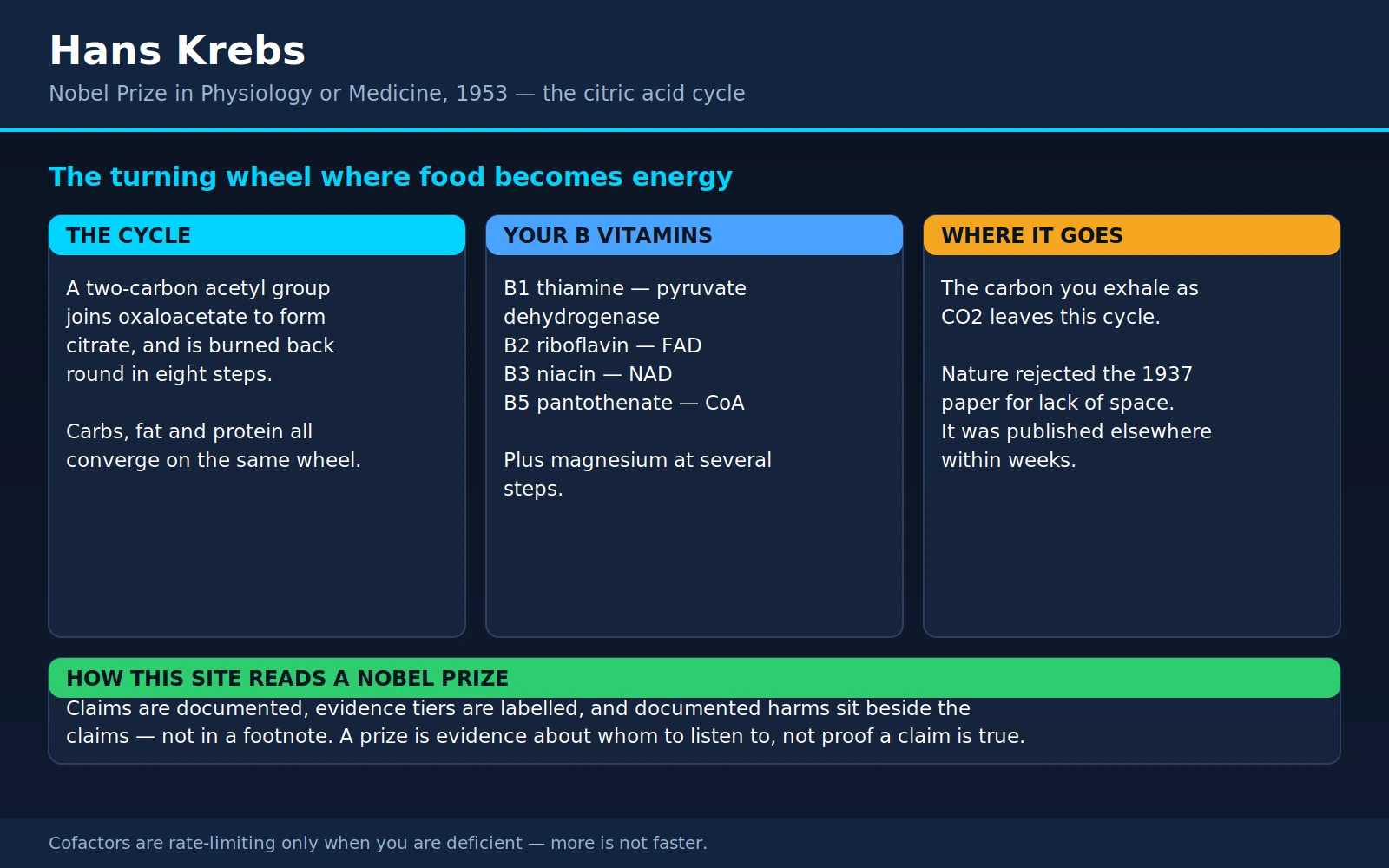
Table of Contents
- Who Hans Krebs Was
- The Urea Cycle, 1932
- The Question of 1937
- The Citric Acid Cycle, Plainly
- Nature Said No
- Lipmann's Half: Coenzyme A
- Your B Vitamins Work Here
- The Cycle in Today's Health Conversations
- Where Mainstream Medicine Agrees / Where Claims Outrun Evidence
- What Krebs Means for You Today
- Key Research Papers
- Connections
- Featured Videos
1. Who Hans Krebs Was
Hans Adolf Krebs (1900–1981) mapped the central roundabout of human metabolism — the citric acid cycle, the wheel of chemical reactions inside your cells where the carbon from your breakfast is finally burned and the energy in it is captured. Every calorie you have ever used passed through the pathway that bears his name. He was born on August 25, 1900 in Hildesheim, a cathedral town in northern Germany, the son of Georg Krebs, an ear, nose and throat surgeon. The expectation was that Hans would follow his father into the family practice, and he dutifully trained in medicine at Göttingen, Freiburg, and Munich. But somewhere in those years he caught a different ambition: not to treat the body's chemistry, but to understand it.
The turning point was the four years, 1926 to 1930, he spent as a paid assistant in the Berlin-Dahlem laboratory of Otto Warburg — the most formidable biochemist alive, and one of the most demanding. From Warburg, Krebs learned the two tools that would define his career: the Warburg manometer, a device that measures a tissue's gas exchange precisely enough to watch it breathe in a flask, and the tissue-slice technique, which keeps a sliver of living organ respiring in a dish for hours. He also absorbed Warburg's exacting standards — the insistence that a measurement be repeated until it could not be doubted. What he did not receive was encouragement. When the assistantship ended in 1930, Warburg — never a man to soften a verdict — told Krebs he saw no evidence of the ability a research career required, and advised him to go back to clinical medicine. Krebs recorded the judgment without bitterness, and then spent the next seven years producing two of the most important discoveries in the history of biochemistry.
The first came fast. In 1931 Krebs took a hospital post in Freiburg that left him bench time, and by mid-1932, working with a medical student, he had solved the riddle of how the liver makes urea — the first metabolic cycle ever described, told in the next section. He was 32, and suddenly famous among biochemists. Nine months later, Germany took everything back. In April 1933, weeks after the Nazi government's Law for the Restoration of the Professional Civil Service began purging Jewish scientists and physicians from their posts, Krebs was dismissed from Freiburg. He was barred from the laboratory where he had just made a landmark discovery.
What happened next is one of science's great rescues. Sir Frederick Gowland Hopkins — the founder of British biochemistry, who had shared the 1929 Nobel Prize with this site's Christiaan Eijkman for the discovery of vitamins — invited the young exile to his department at Cambridge. Krebs arrived in the summer of 1933 with little more than his notebooks and the manometers he had managed to ship out of Germany. Hopkins's bet paid off almost immediately. In 1935 Krebs moved to the University of Sheffield, where in 1937 he closed the loop on the citric acid cycle; he built Sheffield's biochemistry department and stayed nearly two decades. The Nobel Prize in Physiology or Medicine came in 1953, shared with Fritz Lipmann. In 1954 Krebs moved to Oxford as Whitley Professor of Biochemistry; he was knighted in 1958, and after formal retirement he simply kept working, running a metabolic research laboratory in Oxford until days before his death on November 22, 1981.
There is a coda that says much about the man. Warburg, the mentor who had doubted him, lived until 1970 — long enough to watch his dismissed assistant win the Nobel Prize and surpass every expectation. The two remained in respectful contact all their lives, and in his final years Krebs repaid the old debt in the most generous currency a scientist has: he wrote Warburg's biography, an affectionate, clear-eyed portrait of the difficult genius who had taught him how to measure. Two metabolic cycles carry Krebs's fingerprints. One carries his name. This page is about how that happened, and what the wheel he found is doing in your body right now.
2. The Urea Cycle, 1932
Krebs's first masterpiece was finished before his exile, and it answered a question so basic most people never think to ask it. When you eat protein, your body breaks it into amino acids and uses them — but using them leaves behind nitrogen, which comes off as ammonia. Ammonia is genuinely toxic, especially to the brain; the reason patients in severe liver failure become confused and drowsy is, in large part, ammonia the failing liver can no longer dispose of. A healthy liver packages that ammonia into urea — a small, harmless, water-soluble molecule your kidneys pour into urine. In 1932 everyone knew the liver did this. Nobody knew how.
Working in Freiburg with a medical student named Kurt Henseleit, Krebs attacked the problem with the tools he had carried out of Warburg's lab: thin slices of living liver, respiring in flasks, their chemistry measurable hour by hour. The two men fed the slices different candidate substances and measured urea output. Most additions did little. Then came the anomaly that made the discovery: tiny amounts of ornithine, a relatively obscure amino acid, boosted urea production enormously — far out of proportion to the amount added — and the ornithine itself was not used up. It behaved less like an ingredient and more like a machine: something the reaction used, and then returned.
Krebs's explanation was a genuinely new idea in biochemistry. Ornithine, he proposed, picks up ammonia and carbon dioxide to become citrulline; citrulline takes on a second nitrogen to become arginine; and the enzyme arginase then clips arginine apart — releasing one molecule of urea and regenerating ornithine, which swings back to the start and does it again. Not a straight line from ingredient to product, but a wheel: a small set of molecules turning in a circle, packaging poison into waste with every revolution. This was the first metabolic cycle ever described. Until that paper, biochemists drew pathways as one-way streets. Krebs showed that the deep architecture of metabolism includes roundabouts — and five years later he would find the biggest roundabout of all.
The urea cycle is not a museum piece. Children are born every year with a genetic break in one of its enzymes — urea cycle disorders — and the result is exactly what the chemistry predicts: ammonia accumulates, and an otherwise healthy-looking newborn becomes lethargic, stops feeding, and can slip into coma within days. Modern medicine can catch and treat these disorders — low-protein diets, nitrogen-scavenging drugs, in severe cases liver transplantation — and formal management guidelines (cited below) exist because Krebs and a medical student worked out the wheel these children's livers cannot turn. If you have ever wondered why a protein-heavy diet makes you urinate more urea, or why liver failure clouds the mind, you are wondering about the 1932 paper.
3. The Question of 1937
By the mid-1930s, the biggest question in biochemistry was hiding inside the most ordinary fact in biology. Everyone knew — had known since Lavoisier in the 1780s — that living things burn food. You take in carbohydrate, fat, and protein; you breathe in oxygen; you give off carbon dioxide and water; energy is released. The arithmetic of that combustion had been measured to the decimal. But a body is not a fireplace. You burn sugar at 37 °C, in water, with no flame, and you capture a usable share of the energy instead of losing it all as heat. That means the "burning" must happen in many small, enzyme-controlled steps. What nobody knew was the route — the actual sequence of molecules between your dinner and your exhaled breath.
Krebs went hunting for that route in pigeon breast muscle. The choice was the whole game, and he knew it — decades later he wrote a much-loved essay (cited below) on what he called the August Krogh principle: for many problems there is an animal on which it can be most conveniently studied. A pigeon's flight muscle is one of the most furiously respiring tissues in nature; minced and suspended in a flask, it goes on consuming oxygen at a ferocious rate for hours, long enough to feed it candidate molecules and watch, on Warburg's manometers, what each one does to the fire.
The puzzle pieces were already on the table; what was missing was the picture. The Hungarian biochemist Albert Szent-Györgyi — already famous for isolating vitamin C — had shown that a family of four-carbon acids (succinate, fumarate, malate, oxaloacetate) did something strange to pigeon-muscle respiration: added in tiny amounts, they boosted oxygen consumption far beyond what their own combustion could explain, as if they were not fuel but catalysts. Carl Martius and Franz Knoop had traced a separate thread: citrate, the six-carbon acid of citrus fruit, could be converted step by step to alpha-ketoglutarate and onward toward those same four-carbon acids. And there was a clue in a poison: malonate, a molecule that jams the enzyme handling succinate, did not merely dim respiration — it strangled it, and succinate piled up behind the block. That told Krebs the succinate step was not a side street. It was the main road.
Krebs had seen this pattern before — small amounts of a substance producing outsized, self-renewing effects — because he had built his first great discovery on it. Ornithine had behaved that way in liver, and the explanation had been a circle. So he asked the question no one else was asking: what if the catalytic acids of muscle respiration are not a list but a loop? The experiments that answered it were done at Sheffield in the spring of 1937 with a young colleague, William Arthur Johnson, and the decisive finding was this: pigeon muscle could make citrate from oxaloacetate — the last acid in the chain — provided fuel derived from carbohydrate was present. The end of the sequence fed the beginning. The chain closed. The road that burns your food is a circle.
4. The Citric Acid Cycle, Plainly
Here is the cycle as a story rather than a wall chart. Imagine a turning wheel inside nearly every cell you own, housed in the mitochondria. The wheel itself is built from small organic acids — citrate, alpha-ketoglutarate, succinate, fumarate, malate, oxaloacetate — and like the ornithine wheel before it, the wheel is not consumed. It is machinery. What gets consumed is the fuel it carries.
The fuel arrives as a two-carbon package called an acetyl group — and this is the beautiful part — it does not matter where that package came from. Eat carbohydrate, and it is broken to pyruvate, which a gatekeeper enzyme (pyruvate dehydrogenase — remember that name, your vitamin B1 works there) trims into acetyl groups. Eat fat, and beta-oxidation chops the long fatty-acid chains into acetyl groups two carbons at a time. Eat protein, and many amino acids, once their nitrogen is stripped off (and sent to Krebs's other cycle for disposal), are converted to acetyl groups or fed into the wheel directly. Three macronutrients, endless dietary arguments — one furnace.
Each turn works like this. The two-carbon acetyl package is loaded onto the four-carbon acid oxaloacetate, forming the six-carbon citrate — the same acid that makes lemons sour. Then, over eight enzymatic steps, the wheel dismantles what it was handed: two carbons are stripped off and released as carbon dioxide — the CO2 you are exhaling as you read this sentence — and the energy-rich electrons in the fuel are handed to two kinds of carrier molecules, NADH and FADH2. By the last step the wheel has regenerated oxaloacetate, which swings back to the start, catches the next acetyl group, and turns again. The loaded carriers, meanwhile, ferry their electrons to the respiratory chain next door, where oxygen accepts them and the cell mints ATP — the energy currency that pays for your heartbeat, your body heat, and the thought you are having right now. One turn of the wheel also produces one ATP-equivalent directly, but the carriers are the real payday: the cycle is less a power station than the power station's furnace room, loading the conveyor belts that feed the generators.
Stay with the breath for a moment, because it is the most concrete thing Krebs ever gave you. The carbon dioxide you exhale is not "used air" — it is your food, leaving. Carbon atoms that arrived in bread and butter and beef are spun off the wheel in trillions of mitochondria, dissolve into your blood, and depart through your lungs — hundreds of litres of CO2 a day. This is also, wonderfully, where fat goes when you "lose" it. Two Australian researchers, Ruben Meerman and Andrew Brown, did the audited arithmetic in the BMJ in 2014 (cited below): when you lose 10 kilograms of fat, about 8.4 kilograms leave your body through your lungs as carbon dioxide, and the remaining 1.6 kilograms leave as water. Fat is not "burned off" into nothingness, and it does not exit by the route most people would guess. You exhale it — through the cycle Hans Krebs mapped in minced pigeon muscle.
One more feature, because it explains half of modern metabolism research: the wheel is also a parts depot. Cells constantly siphon its intermediates off as raw material — to build amino acids, to make heme for your red blood cells, to begin fat synthesis when fuel is abundant — and constantly top the wheel back up. The cycle is a hub in both senses: everything burns through it, and much of what your body builds is drawn from it. That double life is why its parts keep turning up in stories about cancer, aging, and immunity, as we will see. In 1937 Krebs could not name the molecule that delivers the acetyl package — he knew a two-carbon donor existed, but its identity was the missing piece. Finding it would be someone else's half of the Nobel Prize.
5. Nature Said No
In June 1937, with the loop closed and the evidence in hand, Krebs wrote a short letter announcing the citric acid cycle and sent it to Nature — then, as now, the most prestigious scientific journal in the world. It came back. The editor's note explained that Nature had received sufficient letters to fill its correspondence columns for seven or eight weeks, that holding the manuscript that long seemed undesirable, and that Krebs might prefer to submit it elsewhere. It was a rejection for lack of space — a workload decision, not a scientific one — and it turned away the description of the central energy-producing pathway of life on Earth.
What Krebs did next is a small masterclass in temperament. He did not rage, and he did not wait. Within days he sent a fuller paper to Enzymologia, a small Dutch journal known for publishing quickly, and "The role of citric acid in intermediate metabolism in animal tissues" by H. A. Krebs and W. A. Johnson appeared within about two months. One of the most consequential biology papers of the twentieth century thus lives in a journal most scientists had barely heard of — a permanent piece of evidence that where a result is published and what a result is worth are different questions.
Krebs kept the rejection letter for the rest of his life. He reproduced it in his memoirs, and he liked to show it to young scientists nursing wounds from their own rejections — the most decorated biochemist in Britain, holding up proof that Nature had once told the citric acid cycle to try its luck elsewhere. Sixteen years after the rejection, the work it declined won the Nobel Prize.
The episode is worth one honest paragraph beyond the anecdote. It does not show that peer review is broken, and Krebs never claimed it did — the editor made a queue-management call under a paper shortage, and the scientific community evaluated the work quickly and fairly once published. What it does show is that editorial triage is not a verdict on truth, in either direction: famous journals decline important work, and famous journals publish work that later collapses. On a health-information site, the lesson cuts both ways — "published in a top journal" is not proof, "rejected" is not refutation, and the only durable currency is whether the result holds up when others test it. Krebs's cycle has been tested continuously for nearly ninety years. It holds.
6. Lipmann's Half: Coenzyme A
The 1953 Nobel Prize in Physiology or Medicine was split, and the split was just. Krebs had drawn the wheel, but a wheel needs to be fed — and the identity of the delivery vehicle that carries the two-carbon acetyl package to the wheel's rim was discovered by Fritz Lipmann. Lipmann's story runs strangely parallel to Krebs's: born in Königsberg in 1899, one year before Krebs; trained in German biochemistry; driven out by the same Nazi persecution, reaching the United States by way of Copenhagen; and honored in Stockholm in the same December ceremony. The 1953 prize went to two German-born refugees whom Germany had thrown away.
Working in Boston in the mid-1940s, Lipmann isolated a small, heat-stable molecule required for biological acetylation reactions — the attaching of two-carbon acetyl groups to other molecules — and named it coenzyme A, the A standing for acetylation. Its structure contained a surprise with everyday consequences: built into its backbone is pantothenic acid — vitamin B5. The carrier that delivers fuel to your metabolic furnace is partly made from a vitamin, which is one concrete reason the phrase "B vitamins and energy" is biochemistry rather than marketing (much more on this in the next section). Lipmann also gave biology one of its organizing ideas several years earlier: that cells store and spend energy through "energy-rich phosphate bonds," with ATP as the universal currency — the frame in which the cycle's output has been understood ever since.
Put the two halves together and the missing piece of 1937 snaps into place. The two-carbon donor Krebs could not name is the acetyl group riding on Lipmann's carrier: acetyl-CoA, isolated in pure form by Feodor Lynen in 1951. Whether it began as toast, olive oil, or steak, fuel enters the wheel as acetyl-CoA; the carrier hands over its cargo to oxaloacetate and goes back for more, millions of times a minute, in every mitochondrion you own. Krebs mapped the roundabout; Lipmann found the delivery truck. Neither discovery is complete without the other, and the Nobel committee's decision to honor them together was not diplomacy — it was an accurate diagram of how your body works.
7. Your B Vitamins Work Here
This is the section where a Nobel Prize from 1953 becomes practical advice for your kitchen. The citric acid cycle and its feeder reactions are run by enzymes, and several of those enzymes are helpless without small helper molecules — cofactors — that your body cannot build from scratch. It builds them from B vitamins. When a supplement label says "supports energy metabolism," this pathway is what the sentence is about — and the honest version of the claim, both its power and its limits, is worth two minutes of your attention.
Vitamin B1 (thiamine) becomes thiamine pyrophosphate, the working part of pyruvate dehydrogenase — the gatekeeper enzyme that converts carbohydrate's pyruvate into acetyl-CoA and thereby controls the main entrance to the wheel — and of a second enzyme inside the wheel itself (the alpha-ketoglutarate step). Starve the body of thiamine and the gate physically stalls: pyruvate backs up, and the tissues that burn the most glucose — nerves, brain, heart — fail first. That disease is beriberi: profound fatigue, painful neuropathy, and in the "wet" form a dilated, failing heart. It is the disease this site's Christiaan Eijkman chased through polished rice and chickens in the 1890s, work that led to the very concept of a vitamin — and the citric acid cycle is why the deficiency feels the way it feels. Beriberi's exhaustion is not vague "low energy." It is a specific enzyme, missing a specific cofactor, stalling a specific wheel. Thiamine deficiency has not vanished, either: it still appears in heavy alcohol use, after bariatric surgery, in severe vomiting of pregnancy, and in refeeding after starvation, and treating it remains one of medicine's cheapest miracles.
The rest of the B family staffs the same furnace room. Vitamin B2 (riboflavin) is built into FAD, the electron catcher bolted into the succinate step of the wheel (the very enzyme malonate poisoned in the 1937 experiments). Vitamin B3 (niacin) becomes NAD+, the carrier that accepts electrons at three of the wheel's harvesting steps — more NAD is loaded per turn than any other carrier, which is why pellagra, niacin's deficiency disease, opens with weakness and exhaustion before its famous rash. Vitamin B5 (pantothenic acid) is built into coenzyme A itself — Lipmann's delivery truck is partly made of it. (Honesty requires adding: pantothenic acid is named from the Greek for "from everywhere" because it is in nearly every food, and true deficiency is vanishingly rare — a fact worth remembering when B5 is sold to you separately.) Vitamin B7 (biotin) serves the enzyme that tops the wheel back up with fresh oxaloacetate when intermediates have been siphoned off for building projects — the depot's restocking clerk.
Two minerals belong in the same picture. Magnesium is the quiet partner of essentially every ATP-handling reaction in the cell — ATP does its work as a magnesium complex — and several cycle enzymes want magnesium directly; it is a fair candidate for the most underrated nutrient in energy metabolism. And iron is not only for hemoglobin: the wheel's aconitase and succinate enzymes, and the respiratory chain the wheel feeds, run on iron-sulfur clusters. Part of the crushing fatigue of iron deficiency is electron plumbing failing inside the mitochondria, not just pale blood.
Now the flip side, stated as plainly as the benefit. These nutrients are rate-limiting only when they are missing. If your thiamine, riboflavin, niacin and magnesium status is adequate, swallowing more does not spin the wheel faster — the enzymes are already fully staffed, and the surplus of the water-soluble B vitamins is simply excreted. Correcting a real deficiency can transform how a person feels, sometimes within days; stacking B vitamins on top of sufficiency is not an energy drug, and no honest reading of Krebs's biochemistry says otherwise. The practical translation is in section 10: get the cofactors from food, suspect deficiency in the situations that actually cause it, and spend your effort on the one intervention that genuinely increases the wheel's turnover — which is not a capsule.
8. The Cycle in Today's Health Conversations
Because the citric acid cycle sits at the center of metabolism, it gets invoked constantly in modern health arguments — sometimes accurately, sometimes as decoration. Here is a fair tour.
Keto and fasting. The ketogenic diet and fasting are often described as switching the body to "a different fuel." At the level of Krebs's wheel, the switch is smaller than the marketing: when carbohydrate is scarce, the liver converts fat into ketone bodies, ships them to the brain and muscles — and there they are converted back into acetyl-CoA, entering the same cycle at the same gate. The wheel does not know or care whether your acetyl groups arrived by way of toast or ketosis; what changes is the delivery logistics upstream, and those logistics have real physiological consequences worth their own pages. It is a pleasing footnote that ketone-body metabolism was itself a major project of Krebs's Oxford laboratory in his later decades — the man spent his whole career on both sides of this modern argument.
Cycle-intermediate supplements. Walk a supplement aisle and you will meet the wheel's parts for sale: citrate, malate, succinate, alpha-ketoglutarate. Tier them honestly. Magnesium citrate and magnesium malate are perfectly reasonable products — because of the magnesium; the citrate and malate are carriers that make the mineral soluble and absorbable, not energy boosters. Your mitochondria generate and consume these acids continuously at a scale that makes a capsule's contribution a rounding error. Alpha-ketoglutarate is the interesting one: a well-run 2020 study (cited below) found that calcium alpha-ketoglutarate extended lifespan and compressed end-of-life frailty in aged mice — a genuine, provocative result. But mice are not people, human trials are early, and "promising in aged mice" is where this claim currently ends. Succinate sold as a "cellular energizer" earns a flat no: swallowed succinate is largely consumed by the gut and liver before reaching your muscles' mitochondria, and no good human evidence supports the energy claims on the label.
Cancer metabolism. Krebs's mentor Otto Warburg spent his last decades insisting that cancer was fundamentally a disease of energy metabolism — a claim mainstream oncology long dismissed and has now partly, carefully, revived. The modern evidence runs straight through the wheel: some cancers carry mutations in the cycle's own enzymes. Mutant IDH enzymes (in many gliomas and some leukemias) manufacture an abnormal "oncometabolite" that scrambles how cells read their own genes — and drugs inhibiting mutant IDH are now approved medicines. Inherited defects in the succinate-handling enzyme and in fumarase cause rare familial tumors. This is real, bankable science — and it validates the narrow claim that some cancers corrupt metabolism, not the broad claim that any particular diet starves cancer. The honest chain from Warburg's obsession to today's IDH inhibitors is one of medicine's best stories about a heresy partly vindicated, and the citations below let you follow it.
Exercise — the genuine article. After the tiers above, it is a relief to name the intervention that truly does what the supplements only advertise. Exercise increases flux through the citric acid cycle immediately and enormously — a hard-working muscle can raise its energy turnover many-fold within seconds, and the wheel's turning rate rises to meet it, because the cycle is regulated by demand: use ATP, and the machinery senses the spending and feeds the furnace faster. Training goes further — it makes more mitochondria. Weeks of regular aerobic work measurably expand muscle's mitochondrial content, which is more wheels turning, not just faster ones. The cheapest, best-evidenced "Krebs cycle activator" on Earth is a brisk walk taken most days, and it is not close.
9. Where Mainstream Medicine Agrees / Where Claims Outrun Evidence
Where mainstream medicine agrees — none of this is controversial:
- The citric acid cycle is bedrock biochemistry — taught in every medical school on Earth, confirmed continuously since 1937, and the reason your exhaled breath carries your food's carbon away.
- B vitamins and magnesium are genuine, non-negotiable cofactors of energy metabolism; deficiency states (beriberi, pellagra, thiamine deficiency in alcohol use and after bariatric surgery) cause real disease, and replacement is standard, life-saving care.
- Urea cycle disorders are recognized medical emergencies with formal management guidelines — Krebs's 1932 wheel at the bedside.
- Cycle-enzyme mutations (IDH, succinate dehydrogenase, fumarase) cause specific cancers, and mutant-IDH inhibitors are approved drugs — metabolism as a legitimate cancer target.
- Exercise increases cycle flux and mitochondrial content; it is the most effective metabolic intervention available to a healthy person.
Where claims outrun evidence — said kindly, but said:
- "Krebs cycle activator" supplement language: no capsule of citrate, malate, or succinate meaningfully accelerates the wheel in a nourished person; the cycle is regulated by energy demand, not by ingredient supply.
- B-vitamin megadoses for energy in people who are not deficient: the enzymes are already saturated; the surplus is excreted. B vitamins fix deficiency fatigue, not all fatigue.
- Alpha-ketoglutarate for human longevity: one strong mouse study and early human data do not yet make an anti-aging regimen; unproven, watch this space.
- NAD-precursor supplements (a niacin-adjacent industry): they do raise blood NAD metabolites, but proven human health outcomes remain to be demonstrated.
- Metabolic cancer claims stretched past the data: mutant-IDH biology does not license "diet X starves tumors" — treatment decisions belong with an oncologist, with diet as support, not substitute.
10. What Krebs Means for You Today
Strip away the Nobel medals and the enzyme names, and Krebs left you a working mental model of your own energy. Your energy is a wheel, not a tank. It does not get "filled" by an energy product; it turns — continuously, in every cell with mitochondria — and what it needs from you is fuel worth burning, the cofactors that staff its enzymes, the oxygen you were going to breathe anyway, and, above all, demand. The wheel speeds up for people who ask something of it.
The cofactors come from food, and the food list is pleasantly ordinary. For thiamine: pork, sunflower seeds, lentils, and brown rice — the whole grain whose polishing caused beriberi, a full circle Eijkman would appreciate. For riboflavin: eggs, beef, almonds, and mushrooms. For niacin: chicken, tuna, beef, peanuts, and again brown rice. For pantothenic acid: nearly everything — eggs, mushrooms, avocados, sweet potatoes. For magnesium: leafy greens, pumpkin seeds, almonds, and dark chocolate. For iron: beef, sardines, lentils, and spinach. A person eating meals like that has staffed the furnace room, and no capsule improves on it.
Then there are the human lessons, which this site collects as deliberately as the biochemical ones. Krebs was told by the greatest biochemist of the age that he lacked the gift — and answered with the urea cycle within two years. He was expelled from his country at the exact moment of his first triumph — and rebuilt in a new language, in borrowed laboratories, within four years of stepping off the boat. The most famous journal in the world declined his masterpiece — and he had it published elsewhere inside two months and kept the rejection letter as a teaching prop. Doubt, exile, rejection: three verdicts that turned out to be wrong, and a career-long demonstration that the correct response to each is the next experiment. That he closed the ledger by writing his doubter's biography — generously — tells you the persistence never curdled into grievance.
And the wheel itself offers a kind of daily astonishment that costs nothing. The next time you exhale, consider what is actually leaving: carbon that was recently your dinner, pried loose two atoms at a time by a cycle first traced in pigeon muscle in Sheffield in 1937, by a refugee doctor working with equipment he had carried out of Germany. You are never not doing biochemistry. Eat real food, keep the cofactors stocked, move enough to make the wheel earn its keep — and breathe out, which is the sound of it working.
11. Key Research Papers
- Krebs HA, Johnson WA. The role of citric acid in intermediate metabolism in animal tissues. Enzymologia 1937;4:148-156. Predates PubMed indexing — related records on PubMed
- Krebs HA, Henseleit K. Untersuchungen über die Harnstoffbildung im Tierkörper (Studies on urea formation in the animal body). Hoppe-Seyler's Z Physiol Chem 1932;210:33-66. Predates PubMed indexing — related records on PubMed
- Krebs HA. The history of the tricarboxylic acid cycle. Perspect Biol Med 1970;14(1):154-70
- Kornberg H. Krebs and his trinity of cycles. Nat Rev Mol Cell Biol 2000;1(3):225-8
- Krebs HA. The August Krogh Principle: "For many problems there is an animal on which it can be most conveniently studied". J Exp Zool 1975;194(1):221-6
- Martínez-Reyes I, Chandel NS. Mitochondrial TCA cycle metabolites control physiology and disease. Nat Commun 2020;11(1):102
- Meerman R, Brown AJ. When somebody loses weight, where does the fat go? BMJ 2014;349:g7257
- Whitfield KC, Bourassa MW, Adamolekun B, et al. Thiamine deficiency disorders: diagnosis, prevalence, and a roadmap for global control programs. Ann N Y Acad Sci 2018;1430(1):3-43
- Asadi Shahmirzadi A, Edgar D, Liao CY, et al. Alpha-Ketoglutarate, an Endogenous Metabolite, Extends Lifespan and Compresses Morbidity in Aging Mice. Cell Metab 2020;32(3):447-456.e6
- Dang L, White DW, Gross S, et al. Cancer-associated IDH1 mutations produce 2-hydroxyglutarate. Nature 2009;462(7274):739-44
- Pirozzi CJ, Yan H. The implications of IDH mutations for cancer development and therapy. Nat Rev Clin Oncol 2021;18(10):645-661
- Häberle J, Burlina A, Chakrapani A, et al. Suggested guidelines for the diagnosis and management of urea cycle disorders: First revision. J Inherit Metab Dis 2019;42(6):1192-1230
Live PubMed Searches
- Krebs citric acid cycle history
- TCA cycle disease metabolites
- Thiamine and pyruvate dehydrogenase deficiency
- Alpha-ketoglutarate and aging
- Urea cycle disorders
Connections
- All Notable Doctors
- Otto Warburg — the mentor who doubted him: cellular respiration, the Warburg effect, and the lab where Krebs learned to measure
- Christiaan Eijkman — beriberi and the discovery of thiamine, the vitamin that gates the cycle's main entrance
- Albert Szent-Györgyi — vitamin C, and the four-carbon acid experiments the cycle was built on
- Frederick Banting — insulin, the hormone that directs which fuel reaches the wheel
- Yoshinori Ohsumi — autophagy: how cells recycle their own parts back into the furnace
- Nobel Prize in Medicine — this site's wing of laureates and their discoveries
- Vitamin B1 (Thiamine) — pyruvate dehydrogenase's cofactor; beriberi is this cycle stalling
- Vitamin B2 (Riboflavin) — the FAD electron catcher at the succinate step
- Vitamin B3 (Niacin) — NAD, the cycle's main electron carrier
- Vitamin B5 (Pantothenic Acid) — built into coenzyme A, Lipmann's half of the Nobel
- Magnesium — the mineral partner of ATP and multiple cycle enzymes
- Ketogenic Diet — ketones enter the same wheel as acetyl-CoA
- Exercise — the one intervention that genuinely spins the cycle faster