Otto Warburg: Cellular Respiration, Cancer Metabolism, and the Warburg Effect
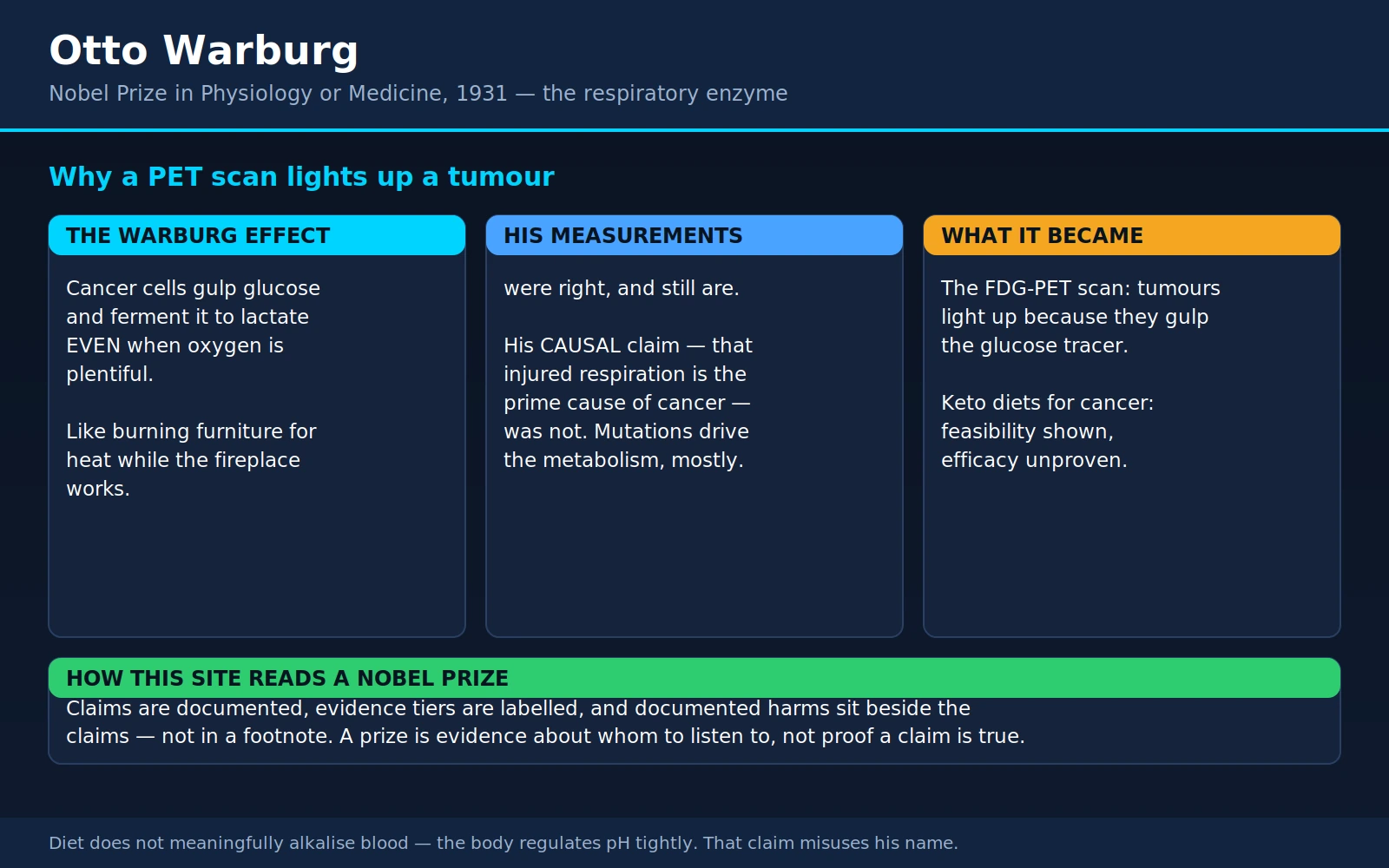
Table of Contents
- Who Was Otto Warburg?
- The Respiratory Enzyme
- The Toolkit: How He Actually Worked
- The Warburg Effect, Explained Plainly
- His Causal Claim — and Where Science Landed
- The Warburg Effect You Have Already Benefited From
- Where Alternative Medicine Runs with Warburg
- Surviving the Third Reich
- Where Mainstream Medicine Agrees / Where the Story Gets Oversold
- What Warburg Means for You Today
- Key Research Papers
- Connections
- Featured Videos
1. Who Was Otto Warburg?
Otto Heinrich Warburg (1883–1970) measured, more precisely than anyone before him, the two ways a living cell gets its energy — burning fuel with oxygen, and fermenting fuel without it — and then discovered that cancer cells lean on the second even when the first is available. The first discovery won him the 1931 Nobel Prize in Physiology or Medicine. The second, known everywhere today as the Warburg effect, lights up millions of cancer scans a year and anchors one of the most active fields in modern oncology. It also anchors a large share of the internet's alternative-cancer folklore, which is why this page exists: the real Warburg story is better, stranger, and more useful than the version that circulates.
He was born in Freiburg, Germany, in 1883, into scientific aristocracy. His father, Emil Warburg, was one of the leading physicists in Germany, and after the family moved to Berlin, dinner guests included Max Planck and Albert Einstein. Otto trained in chemistry under Emil Fischer — then the most celebrated organic chemist alive — earning a chemistry doctorate in Berlin in 1906, then adding an MD at Heidelberg in 1911. Two doctorates, in the two subjects his life's question required: he wanted to understand living cells with the exactness of physical chemistry.
When the First World War came, he volunteered and served as an officer in a Prussian cavalry regiment, was wounded, and was decorated with the Iron Cross. In 1918 Albert Einstein — a friend of his father's — wrote to him at the front, urging him to stop risking a mind science could not replace and come home to the laboratory. Warburg went. It is one of history's stranger footnotes that a personal letter from Einstein may have preserved the man who would define cancer metabolism.
From 1931 he directed his own institute, the Kaiser Wilhelm Institute for Cell Physiology in Berlin-Dahlem, built for him largely with Rockefeller Foundation money. There he ran a small, ferociously disciplined operation staffed mostly by technicians he trained himself. He never gave lecture courses, took almost no doctoral students, avoided committees and conferences, rode his horse every morning before work, and shared his household for half a century with his companion and manager, Jacob Heiss. Colleagues found him imperious — he considered most of them wrong about most things, and said so — but even his critics conceded the laboratory results were nearly always right. His onetime assistant Hans Krebs, himself a Nobel laureate, wrote Warburg's biography and ranked him among the greatest experimentalists of the twentieth century. Warburg worked essentially until the end, and died in Berlin in 1970, at eighty-six.
2. The Respiratory Enzyme
Start with the question that made his name, because it sounds simple and is not. You breathe in oxygen. Cells use that oxygen to "burn" the food you eat — slowly, at body temperature, without flame — and capture the released energy to power everything you do. But burning fuel at 37 °C is not something that just happens; sugar sitting in air does not combust. Something inside the cell must grab each oxygen molecule and press it into service. In Warburg's day nobody knew what that something was, or even whether it was a single thing. He called the unknown catalyst the Atmungsferment — the respiratory enzyme — and set out to identify a substance no one could see, isolate, or weigh.
His solution is still taught as one of the most elegant experiments in the history of biology. Warburg knew that carbon monoxide — the same gas that makes faulty furnaces deadly — stopped cells from using oxygen, and he suspected why: carbon monoxide is notorious for latching onto iron, as it does in the hemoglobin of poisoned patients. If the respiratory enzyme was built around iron, carbon monoxide would jam it. Then came the beautiful part. It was known from photochemistry that light can knock carbon monoxide off an iron compound. So Warburg poisoned living cells' respiration with carbon monoxide and shone light on them — and respiration resumed. By measuring which colors of light best broke the poison's grip, he could read out the light-absorption fingerprint of the enzyme itself — the spectrum of a molecule he had never purified, sitting inside living cells. The fingerprint matched an iron-porphyrin: iron held in the same ring-shaped chemical setting as the heme of blood. He had identified the working heart of a catalyst without ever holding it in a test tube.
Today we call that enzyme cytochrome c oxidase — the final station of the mitochondrial assembly line, the exact place where the oxygen from your last breath is consumed. For "his discovery of the nature and mode of action of the respiratory enzyme," Warburg received the 1931 Nobel Prize in Physiology or Medicine, unshared (nobelprize.org — 1931 prize summary). He was nominated dozens of times across his career, for this and for later work; many biochemists count at least two or three of his discoveries as Nobel-caliber on their own.
3. The Toolkit: How He Actually Worked
Warburg's deeper gift was building instruments that turned vague biological questions into numbers. His signature device, the Warburg manometer, was adapted from apparatus for measuring gases in blood: a sealed flask holding a sliver of living tissue, connected to a delicate pressure gauge. As the tissue consumed oxygen or released carbon dioxide, the pressure shifted, and the gauge translated the invisible breathing of cells into millimeters a scientist could write down. Paired with it was his tissue-slice technique — cutting tissue thin enough that every cell inside the slice could still be fed by simple diffusion, so it behaved, for a while, as if it were still part of a living organ. For roughly forty years, into the 1960s, a bench of Warburg manometers was what a serious biochemistry laboratory was; whole careers, including the mapping of the citric acid cycle, ran on his glassware and his methods.
The same toolkit kept producing fundamental discoveries. In the 1930s, with his longtime collaborator Walter Christian, Warburg isolated the "yellow enzyme" — the first flavoprotein — and worked out the hydrogen-carrying coenzyme now called NADP/NADPH, tracing its business end to nicotinamide, a form of vitamin B3. These molecules are the cell's rechargeable batteries for chemical hydrogen, central to metabolism in every organism on Earth. Along the way he introduced the "optical test" — tracking reactions by how these coenzymes absorb ultraviolet light — which became the basis for countless enzyme measurements still run on hospital blood analyzers today.
People trained in that room went on to remake biochemistry. The most famous was Hans Krebs, who spent four formative years as Warburg's assistant before discovering the citric acid cycle that bears his name. Warburg's contemporaries — among them Albert Szent-Györgyi, who mapped other stretches of the same energy chemistry — treated him as the field's reference standard, the man whose measurements you checked your own against. For balance, note that his judgment was not infallible even inside the laboratory: he spent decades insisting, against mounting evidence, on a too-efficient figure for the light requirement of photosynthesis, and never conceded. The pattern matters for what follows: a superb measurer of facts who defended his interpretations to the grave.
4. The Warburg Effect, Explained Plainly
In the early 1920s Warburg pointed his manometers at cancer. Here is the background you need, in one paragraph. A normal cell fed glucose (blood sugar) usually burns it completely, using oxygen, in its mitochondria — a slow, clean combustion that extracts the maximum energy from every molecule, on the order of fifteen times more usable energy than the alternative. The alternative is fermentation: splitting glucose partway without oxygen and dumping the leftover as lactate (lactic acid) — the fallback your muscles use in an all-out sprint when oxygen delivery cannot keep up. Fermentation is fast but astonishingly wasteful, so healthy tissues treat it as an emergency mode and switch back the moment oxygen returns.
What Warburg found when he measured tumor slices was strange enough that he re-ran it every way he knew. Cancer tissue gulped glucose at many times the rate of normal tissue and fermented most of it to lactate — even when the slices were bathed in abundant oxygen. The emergency mode was running full-throttle in no emergency. Scientists call this aerobic glycolysis — "fermentation in the presence of air" — and the honest analogy is a house whose owner is burning the furniture for heat while a perfectly good fireplace sits stocked with wood. It looks senseless: why would the most aggressively growing cells in the body choose the fuel pathway that extracts a fraction of the energy?
Two things to hold onto. First, his measurements were right. A century of repetition with ever-better instruments has confirmed that most aggressive cancers show exactly this glucose-guzzling, lactate-pouring behavior; the enzyme that finishes the job, lactate dehydrogenase (LDH), is so reliably elevated in some cancers that it is used as a blood marker. Second, the modern answer to "why" turns out to be more interesting than waste. A tumor is not just an energy consumer — it is a construction site. Rapidly dividing cells need carbon skeletons to build new DNA, membranes, and proteins, and running glucose partway through the furnace leaves those half-burned fragments available as building material. Aerobic glycolysis, researchers now argue, is less a broken engine than a factory retooled for growth at any cost — fast energy plus a stream of spare parts. Warburg saw the smoke perfectly; it took ninety years to understand the factory.
5. His Causal Claim — and Where Science Landed
Warburg did not stop at describing the phenomenon. He built a theory on it and defended that theory with total conviction for the rest of his life: cancer begins, he argued, when a cell's respiration is injured — by chemicals, radiation, oxygen starvation — and the cell, forced to survive on fermentation, degenerates into the primitive, growth-obsessed state we call malignant. In his famous late formulation: cancer has countless secondary causes, "but, even for cancer, there is only one prime cause" — the replacement of oxygen respiration by the fermentation of sugar. He dismissed the emerging genetic and viral theories of cancer with characteristic scorn, and in 1956 laid out his case in Science in a paper — "On the origin of cancer cells" — that is still cited today.
So where did a century of evidence land? Not where Warburg claimed — but closer to him than his critics once thought. The decisive discoveries of the DNA era established that cancer is, at root, a disease of damaged genes: mutations in growth-controlling genes (oncogenes and tumor suppressors with names like Ras, Myc, and p53) are what set a cell on the malignant path. And when researchers looked directly, the mitochondria of most cancer cells turned out to be not broken — most tumors can and do respire alongside all that fermentation, which quietly removes the foundation stone of Warburg's causal story. The modern reading, laid out in the Koppenol and Vander Heiden papers cited below, is that those driver mutations actively reprogram the cell's metabolism — the Warburg effect is largely a consequence and enabler of cancer, a tool the mutated cell seizes to grow faster, rather than the prime cause he insisted on.
But the vindication is real too, and it should be stated just as plainly. After decades in which cancer metabolism was dismissed as a settled curiosity, the field roared back in the 2000s, and in 2011 the most-cited framework in cancer biology — Hanahan and Weinberg's "Hallmarks of Cancer" — formally added deregulated cellular energetics to the short list of capabilities that define a cancer cell. A handful of rare cancers were even found to be driven by genuine mutations in metabolic enzymes themselves, and one of those discoveries has already produced approved drugs. Warburg had the arrow of causation mostly backwards; he had the importance of the target exactly right, about forty years before the rest of oncology agreed.
6. The Warburg Effect You Have Already Benefited From
If you or someone you love has ever had a PET scan for cancer, you have personally used Warburg's discovery. A PET scan works like this: the patient receives an injection of FDG, a radioactive look-alike of glucose, and a camera then maps where in the body that tracer accumulates. Because most tumors gulp glucose at many times the rate of the tissue around them — the Warburg effect, exactly as measured in 1923 — the cancer collects the tracer and lights up on the image, often revealing tumors and metastases well before they are visible any other way.
FDG-PET is the single most direct clinical descendant of Warburg's work, and it is not a niche tool: it is a workhorse of modern oncology, used to find cancers, stage how far they have spread, judge within weeks whether a treatment is working, and detect recurrence — millions of scans per year worldwide. There is a fair historical irony in it. The man who could not convince oncology that metabolism mattered ended up supplying the physical principle behind one of oncology's most trusted machines. When a radiologist reads the bright spots on a PET image, she is reading a Warburg manometer experiment performed inside a living patient.
7. Where Alternative Medicine Runs with Warburg
Warburg is probably the most-quoted Nobel laureate in alternative-cancer literature, and this site's policy is to document such claims at their strongest, then say plainly what the evidence shows. Three big ones circulate under his name.
Claim 1: The ketogenic diet starves cancer. The strongest version: since cancer cells are addicted to glucose and allegedly cannot burn ketones (the fat-derived fuel of a very-low-carbohydrate diet), a ketogenic diet should selectively starve the tumor while feeding the patient. This is the most scientifically serious of the three — it engages the real biology, and it is under genuine investigation. Where the evidence stands: laboratory and animal results are intriguing; in humans, a series of small trials, mostly in aggressive brain cancer, have shown the diet is feasible and generally safe alongside standard treatment — and have not demonstrated that it shrinks tumors or extends survival. The 2020 review cited below says it as fairly as anyone: promising adjunct hypothesis, efficacy unproven. The under-mentioned harms: many tumors flexibly burn ketones, fat, and the amino acid glutamine, so the "starvation" premise is leaky; and unintended weight loss is genuinely dangerous in cancer, where wasting (cachexia) itself shortens lives. Evidence tier: early-stage clinical research, not a treatment.
Claim 2: "Cancer hates oxygen" — so hyperbaric chambers, oxygenated water, or peroxide "oxygen therapies" should kill it. This one rests on a misreading you can now spot yourself: Warburg's central finding was that cancer cells ferment even when oxygen is plentiful. That is what "aerobic" glycolysis means — the oxygen is already there, and the tumor ferments anyway, so soaking tissues in still more oxygen does not flip the switch back. Hyperbaric oxygen has legitimate medical uses, including healing tissue damaged by radiation therapy, but it is not supported as a treatment for cancer itself, and drinking or infusing peroxide is flatly dangerous. Evidence tier: not supported for treating cancer.
Claim 3: The alkaline diet — cancer makes acid and thrives in acid, so an alkaline diet will prevent or cure it. The kernel of truth: tumors really do acidify their immediate surroundings, precisely because the Warburg effect pours out lactic acid. But the arrow points from tumor to acid, not acid to tumor — and, decisively, diet does not meaningfully change the pH of your blood. Your lungs and kidneys hold blood pH within the narrow band of roughly 7.35–7.45 regardless of what you eat; an "alkaline" menu changes the pH of your urine, which is your kidneys doing exactly their job. No clinical trial shows an alkaline diet treating cancer. Eat the vegetables — they are genuinely good for you — but for ordinary nutritional reasons, not pH ones. Evidence tier: not supported; premise contradicts basic physiology.
The common cost of all three, when they are used instead of treatment rather than alongside it, is measured in delayed diagnoses and abandoned therapy — the one outcome every version of this story agrees is fatal. Warburg himself, it is worth noting, prescribed none of these; his own prevention advice ran to clean food and avoiding carcinogens, and he pursued cancer's cure through chemistry, not cuisine.
8. Surviving the Third Reich
Here the story darkens, and honesty requires telling it with its edges intact. Warburg's father came from a prominent Jewish family (he had converted to Protestantism; Otto's mother was not Jewish), and under the Nazi race laws Otto was classified as half-Jewish. By every rule the regime applied to others, his career should have ended — Jewish and part-Jewish scientists were purged from German institutes wholesale, and many of his colleagues fled or were driven out. Warburg stayed. In 1941 he briefly lost his post, then was reinstated within weeks; an official in Göring's orbit arranged a bureaucratic reclassification of his ancestry, and he was permitted — uniquely, for a man of his classification — to keep his institute, his staff, and his research through the entire war.
Why? The explanation most historians consider plausible, though the paper trail is thin, is that the regime's leadership was obsessed with cancer — Hitler personally feared it; his mother had died of breast cancer — and Nazi Germany ran extensive anti-cancer campaigns. A famous scientist who might solve cancer was, on this reading, an asset worth an exemption. Warburg, for his part, was contemptuous of the Nazis in private, apolitical in public, never joined the party — and never used whatever protection he enjoyed to help anyone but himself and his laboratory. After the war, émigré colleagues who had lost everything did not forgive him for staying, and some never spoke to him again. His own reported explanation was characteristically self-centered: he was doing work no one else could do. Judge that as you will; this page's job is to report it, and the fairest summary is that he was a victim of the regime's racial laws and a beneficiary of its selective mercy at the same time.
One persistent legend needs careful handling. Biographies — including Krebs's — relate that Warburg was chosen for a second Nobel Prize in 1944, blocked only by Hitler's 1937 decree forbidding Germans to accept Nobel Prizes (issued in fury after a Peace Prize went to an imprisoned Nazi critic; other German laureates of the era were forced to decline). Nomination records confirm Warburg was indeed nominated in 1944. But the Nobel archives show the 1944 Prize in Physiology or Medicine was awarded — to Joseph Erlanger and Herbert Gasser, for their work on nerve fibers — and no official record documents a completed decision for Warburg that was withdrawn. So tell it as what it is: a contested anecdote from the biographies, resting on a real decree and a real nomination, not an established second prize.
9. Where Mainstream Medicine Agrees / Where the Story Gets Oversold
Where mainstream medicine fully agrees. The Warburg effect is real, measured, and near-universal in aggressive tumors — nobody disputes the phenomenon, only its interpretation. FDG-PET imaging built on it is standard of care. "Deregulated cellular energetics" sits in the canonical hallmarks of cancer. Cancer-metabolism research is a crowded, well-funded mainstream field, with thousands of papers a year. And targeting metabolism has already produced real, approved medicines: drugs inhibiting mutant IDH — a metabolic enzyme corrupted in certain leukemias, gliomas, and bile-duct cancers — reached the clinic in the late 2010s, and one of oncology's oldest workhorses, asparaginase for childhood leukemia, has always been a metabolic therapy: it starves leukemia cells of an amino acid they cannot make. A small family of rare tumors even carries true inherited mutations in respiration enzymes — the closest thing to literal Warburg cancers — and their discovery is part of why his stock has risen.
Where the story gets oversold. Four escalations to watch for. "Cancer is a metabolic disease, not a genetic one" — a genuine minority position argued by a few researchers, but the weight of evidence has genetics driving the metabolism far more than the reverse, and the honest version of the debate is about emphasis, not a suppressed either/or. "Sugar feeds cancer, so sugar caused your cancer, so quitting sugar cures it" — every cell in your body runs on glucose, your brain above all; your liver will manufacture glucose from other foods no matter what you eat; and no trial shows sugar abstinence treating cancer. The defensible kernel is different and worth keeping: obesity and chronically high insulin are genuine, well-documented cancer risk factors, which is a reason to care about metabolic health before anyone is sick. "Warburg cured cancer and was suppressed" — he neither claimed a cure nor had one, published in the world's most prominent journals until his death, and is among the most honored scientists who ever lived; the suppression narrative is simply false. "The Warburg effect proves [insert product]" — a 1923 measurement of tumor physiology cannot validate a 2026 supplement; only trials of the product can, and for the products in question they do not exist or do not show benefit.
10. What Warburg Means for You Today
Practically, in 2026, Warburg's legacy touches you in three ways. First, diagnosis: if cancer ever enters your life, PET imaging — his effect, weaponized for good — will likely help find it, stage it, and check whether treatment is working. Second, research directions worth watching, with sober labels: trials of ketogenic and fasting-style eating as adjuncts to chemotherapy and radiation (short-term fasting around chemotherapy sessions has shown hints of fewer side effects in small studies — see our Fasting page for the full evidence review); repurposing trials of the diabetes drug metformin; and drugs aimed at glutamine metabolism, LDH, and other Warburg-adjacent targets. Every one of these is a hypothesis under test, not a therapy you can order — "starving cancer with diet" remains a research question, and anyone considering significant diet changes during cancer treatment should work them out with their oncology team, full stop.
Third — and this is the part you can act on while healthy — the metabolic-health connection runs through prevention. The best-supported modern echo of Warburg is not a cancer cure but a risk factor: chronically elevated blood sugar and insulin, and the obesity that usually accompanies them, are linked to higher rates of a dozen cancers. Those are things you can measure — hemoglobin A1C, fasting insulin, and the HOMA-IR index — and things that respond to entirely unglamorous tools: whole foods, muscle, movement, and sleep. It would have amused the imperious old horseman of Dahlem not at all, but the most defensible health advice bearing his name in this century is: keep your own respiration-and-sugar economy in good order, and let the oncologists borrow his effect for their cameras.
11. Key Research Papers
- Warburg O. On the origin of cancer cells. Science 1956;123(3191):309-14
- Koppenol WH, Bounds PL, Dang CV. Otto Warburg's contributions to current concepts of cancer metabolism. Nat Rev Cancer 2011;11(5):325-37
- Vander Heiden MG, Cantley LC, Thompson CB. Understanding the Warburg effect: the metabolic requirements of cell proliferation. Science 2009;324(5930):1029-33
- Liberti MV, Locasale JW. The Warburg Effect: How Does it Benefit Cancer Cells? Trends Biochem Sci 2016;41(3):211-218
- Hanahan D, Weinberg RA. Hallmarks of cancer: the next generation. Cell 2011;144(5):646-74
- Pavlova NN, Thompson CB. The Emerging Hallmarks of Cancer Metabolism. Cell Metab 2016;23(1):27-47
- DeBerardinis RJ, Chandel NS. Fundamentals of cancer metabolism. Sci Adv 2016;2(5):e1600200
- Weber DD, Aminzadeh-Gohari S, Tulipan J, et al. Ketogenic diet in the treatment of cancer — Where do we stand? Mol Metab 2020;33:102-121
- Almuhaideb A, Papathanasiou N, Bomanji J. 18F-FDG PET/CT imaging in oncology. Ann Saudi Med 2011;31(1):3-13
Live PubMed Searches
- Warburg effect cancer metabolism
- Aerobic glycolysis in tumors
- Ketogenic diet cancer clinical trials
- FDG-PET tumor imaging
- Cancer metabolic reprogramming
Connections
- All Notable Doctors
- Every Medicine Nobel, 1901-2025 — Warburg's 1931 prize in the full sweep of the award's history
- Albert Szent-Györgyi — vitamin C and biological combustion: a contemporary working the same energy chemistry
- Frederick Banting — insulin: the hormone that governs the blood glucose Warburg watched tumors devour
- Alexander Fleming — penicillin, and a very different route to a world-changing accident of observation
- Barry Marshall — another stubborn contrarian on cancer's causes; unlike Warburg's, his causal claim proved right
- Oncology — the cancer-medicine hub this whole story feeds into
- Fasting — the evidence on fasting and fasting-mimicking approaches, including around chemotherapy
- Lactate — the fermentation end-product at the center of the Warburg effect
- LDH (Lactate Dehydrogenase) — the Warburg-effect enzyme used as a blood tumor marker
- Hemoglobin A1C — the three-month blood sugar average, cornerstone of metabolic-health screening
- Fasting Insulin — the earliest laboratory window on insulin resistance
- HOMA-IR — the calculated insulin-resistance index from glucose and insulin