Magnesium Glycinate for Sleep Quality
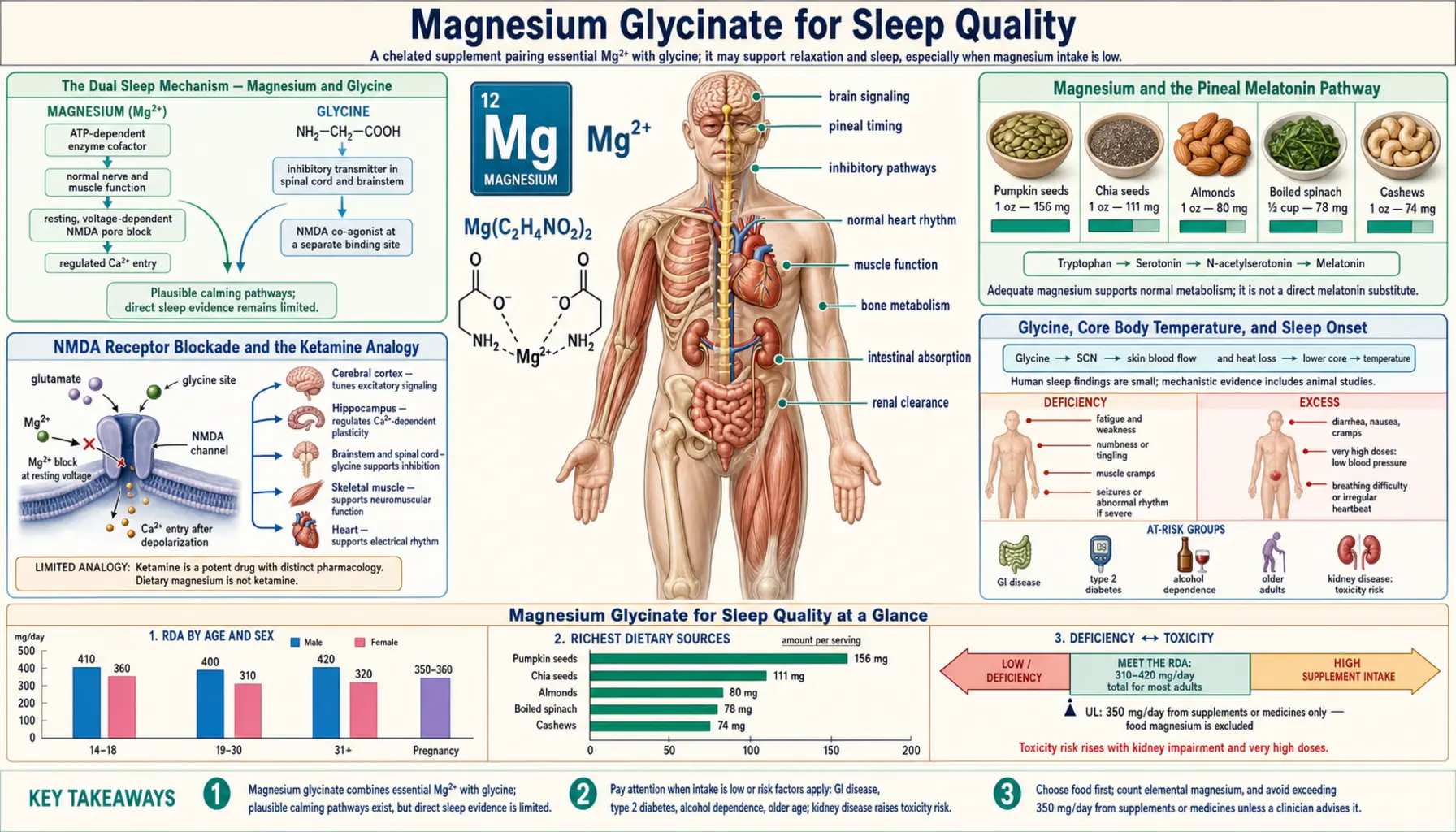
Magnesium glycinate is the single most-discussed sleep supplement of the 2025-2026 wellness moment, and the popularity is grounded in pharmacology rather than fashion. The chelate delivers two molecules — magnesium and glycine — that each independently promote sleep through different mechanisms, and the combined effect on sleep architecture is greater than either alone. Magnesium acts on the pineal serotonin-to-melatonin conversion and as a voltage-dependent plug in the NMDA glutamate receptor (the same receptor ketamine targets). Glycine acts as an inhibitory neurotransmitter at the brainstem and spinal cord, lowers core body temperature through peripheral vasodilation (the physiological trigger for sleep onset), and modulates the suprachiasmatic nucleus master circadian clock. Inagawa's 2006 study showed that 3 grams of glycine taken 60 minutes before bedtime shortened sleep latency, improved subjective sleep quality, and enhanced next-day cognitive performance — effects confirmed in subsequent polysomnography work showing earlier entry into slow-wave sleep. This page walks through the dual mechanism, the bisglycinate-specific clinical evidence, the comparison to other magnesium forms used for sleep, and the practical protocol for sleep-targeted dosing.
Interactive Visualization Magnesium — the mineral that makes ATP work Bare ATP is useless and enzymes reject it. Watch magnesium clamp the phosphates and switch it on, plug the NMDA channel, and let a cramping muscle finally let go. Launch →
Table of Contents
- The Dual Sleep Mechanism — Magnesium and Glycine
- Magnesium and the Pineal Melatonin Pathway
- NMDA Receptor Blockade and the Ketamine Analogy
- Glycine, Core Body Temperature, and Sleep Onset
- Effects on Sleep Architecture (NREM, REM, Slow-Wave)
- The Inagawa Pre-Bed Glycine Trial and Follow-ups
- The 2025 Magnesium Bisglycinate RCT
- Sleep-Specific Comparison: Glycinate vs Threonate vs Malate vs Citrate
- Dosing Protocol for Sleep
- Cautions and What to Watch For
- Key Research Papers
- Connections
- Featured Videos
The Dual Sleep Mechanism — Magnesium and Glycine
What makes magnesium glycinate uniquely suited to sleep applications is that both halves of the chelate act on the sleep machinery independently. This is unusual for a supplement — most ingredients have one mechanism and one application. Magnesium glycinate is more like a fixed-dose combination drug in which the two components target different parts of the same outcome.
The magnesium half operates through at least four well-mapped sleep mechanisms: it serves as a cofactor for the pineal-gland conversion of serotonin to melatonin, it potentiates the GABA-A receptor (the same target as benzodiazepines, though through positive allosteric modulation rather than competitive binding), it occupies the NMDA glutamate receptor as a voltage-dependent ion-channel plug that prevents excitotoxic calcium influx, and it dampens the hypothalamic-pituitary-adrenal (HPA) axis cortisol response that drives nighttime waking.
The glycine half operates through a completely separate set of mechanisms: it acts as the principal inhibitory neurotransmitter of the brainstem and spinal cord (through strychnine-sensitive glycine receptors that are distinct from GABA receptors), it lowers core body temperature by dilating peripheral skin blood vessels (the physiological signal the hypothalamus reads as "time to sleep"), and it modulates neurotransmission in the suprachiasmatic nucleus — the brain's master circadian clock — through NMDA receptor co-agonism. Glycine is also the most abundant inhibitory neurotransmitter at the brainstem motor circuits that produce the muscle atonia of REM sleep.
The convergence of these mechanisms on a single outcome — deeper, longer, more restorative sleep with shorter onset latency — explains why glycinate is consistently rated by users as more "calming" than equivalent doses of magnesium oxide or citrate, and why a number of practitioners who once recommended pure glycine for sleep have migrated to magnesium glycinate as a more practical delivery vehicle that supplies both ingredients in one capsule.
Magnesium and the Pineal Melatonin Pathway
Melatonin is the hormone that signals nightfall to every cell in the body, and its synthesis is a magnesium-dependent four-step enzymatic chain that runs in the pineal gland during the dark phase of the circadian cycle. The pathway begins with tryptophan, which is hydroxylated to 5-hydroxytryptophan (5-HTP) by tryptophan hydroxylase, then decarboxylated to serotonin by aromatic L-amino acid decarboxylase. Serotonin is then N-acetylated by arylalkylamine N-acetyltransferase (AANAT) to N-acetyl-serotonin, and finally O-methylated by hydroxyindole-O-methyltransferase (HIOMT) to melatonin proper.
Magnesium is a required cofactor at two of the four steps, most critically at the AANAT step that is the rate-limiting reaction of the entire pathway. In magnesium deficiency, melatonin production at the pineal gland falls measurably below what the same individual would produce with adequate magnesium status, which manifests as later subjective sleep onset, more fragmented sleep, and (in elderly patients particularly) shallower nocturnal melatonin peaks measured in serum or salivary assays. The Held et al. 2002 trial in elderly subjects with primary insomnia showed that 365 mg/day of supplemental magnesium increased serum renin and melatonin while decreasing morning serum cortisol — the precise hormonal pattern of normal sleep regulation in a younger person.
This pineal-melatonin mechanism is one of the reasons magnesium glycinate is particularly useful for sleep-onset insomnia (the trouble-falling-asleep complaint, as distinct from sleep-maintenance insomnia or early-morning waking). When the underlying problem is inadequate evening melatonin rise, repleting magnesium status sometimes restores normal melatonin production sufficiently that supplemental melatonin is not needed. When supplemental melatonin is needed, magnesium glycinate is a useful companion because adequate magnesium ensures the body can still use endogenous melatonin signaling efficiently even after the exogenous dose wears off in the second half of the night.
NMDA Receptor Blockade and the Ketamine Analogy
The N-methyl-D-aspartate (NMDA) glutamate receptor is the central excitatory ion channel of the mammalian brain — the molecular machinery behind learning, memory, and synaptic plasticity. Under normal conditions, a magnesium ion sits inside the NMDA receptor channel as a voltage-dependent plug, preventing calcium influx until the postsynaptic membrane has been depolarized by other receptors. This is the famous "coincidence detector" property that makes NMDA receptors the substrate of Hebbian learning — the channel only opens when both glutamate is bound and the membrane is already depolarized, ensuring that long-term potentiation occurs only when two neurons fire together.
In magnesium deficiency, the Mg2+ plug becomes unstable. The NMDA channel opens more readily even at resting membrane potential, allowing inappropriate calcium influx into neurons. The downstream consequences include neuronal hyperexcitability, excitotoxic stress, glutamate-driven anxiety, and — specifically for sleep — the inability to enter and maintain deep NREM sleep stages. Sleep requires active cortical inhibition; runaway NMDA signaling disrupts that inhibition.
The ketamine analogy is illuminating. Ketamine is a non-competitive NMDA receptor antagonist that, at subanesthetic doses, produces rapid antidepressant and pro-sleep effects in treatment-resistant patients. Its mechanism is occupying the same NMDA channel that magnesium normally plugs — only more aggressively and irreversibly. Magnesium is the natural, gentle, dose-dependent version of this same mechanism. Restoring adequate magnesium status restores the natural NMDA plug, calms cortical glutamate signaling, and permits the cortical synchronization that produces deep slow-wave sleep. This is one of the molecular reasons severely magnesium-deficient patients often describe sleep on supplementation as "feeling deeper" rather than just "more hours."
Glycine, Core Body Temperature, and Sleep Onset
The most distinctive contribution of glycine to the sleep effect of magnesium glycinate is its effect on core body temperature. Sleep onset is preceded, in every healthy human, by a drop in core body temperature of approximately 0.5 to 1.0 degrees Celsius. This temperature drop is driven by peripheral vasodilation (specifically of the skin blood vessels in the hands, feet, and face), which transfers heat from the body core to the environment. The hypothalamus reads the resulting core temperature drop as the cue to release sleep-promoting signals and initiate the cascade leading to NREM stage 1 sleep.
Glycine ingestion before bed accelerates this peripheral vasodilation. Research using thermal imaging and blood-flow measurement has shown that 3 grams of oral glycine taken 30-60 minutes before bedtime measurably increases skin blood flow in the hands and feet, with a corresponding drop in core temperature of approximately 0.2-0.4 degrees Celsius compared to placebo. The mechanism appears to involve glycine's action on NMDA receptors in the medial preoptic area of the hypothalamus — the region that regulates body-temperature setpoint — lowering that setpoint and recruiting the thermoregulatory pathways that produce the vasodilation.
Subjectively, the experience users report when this mechanism is working well is hands and feet getting warm, a sense of "settling" within 15-30 minutes of taking the supplement, and quicker sleep onset (typically 10-20 minutes faster than baseline for sleep-onset-insomnia patients in clinical trials). The effect is gentle — not the sudden "hit" of a benzodiazepine but more like the natural sleep-onset cascade being permitted to run efficiently.
Because magnesium glycinate at typical sleep doses (300-400 mg of glycinate compound, delivering roughly 40-60 mg of elemental magnesium plus 250-350 mg of glycine) supplies meaningful amounts of glycine, the temperature-drop effect of the chelate is real but smaller in magnitude than the 3-gram pure-glycine dose used in research trials. Users who want the full Inagawa effect sometimes combine 200-400 mg of magnesium glycinate with an additional 1-3 grams of free glycine powder dissolved in water 60 minutes before bed.
Effects on Sleep Architecture (NREM, REM, Slow-Wave)
"Sleep quality" is a vague phrase. Researchers and clinicians distinguish several measurable dimensions of sleep, each of which responds differently to different interventions:
- Sleep latency — the time from lights-out to entering stage 1 NREM sleep. Normal is 10-20 minutes; insomniacs often exceed 30-60 minutes.
- Sleep efficiency — the percentage of time in bed actually spent asleep. Normal is 85% or higher; impaired sleep often falls to 70% or below.
- Slow-wave (delta) sleep — the deepest NREM stages (formerly N3 and N4, now combined as N3), characterized by large slow EEG waves at 0.5-4 Hz. This is where most physical restoration and growth hormone release occurs. Normally about 15-25% of total sleep time.
- REM sleep — rapid eye movement sleep, the dreaming stage, characterized by EEG activation paradoxically combined with muscle atonia. Important for memory consolidation and emotional processing. Normally about 20-25% of total sleep time.
- Wake-after-sleep-onset (WASO) — minutes of wakefulness after first falling asleep. Normal is under 30 minutes; insomniacs often exceed 60-90 minutes.
Magnesium glycinate's effects on these dimensions have been studied with polysomnography in a handful of trials. The pattern that emerges is consistent: shortened sleep latency (typically 10-20 minutes faster), modest but measurable increases in slow-wave sleep time (typically 10-20 minutes more N3 per night), reduced WASO (typically 20-40 minutes less wake time per night), and improved sleep efficiency (typically 5-10 percentage points). REM sleep amount is relatively unaffected, which is desirable — many pharmaceutical sleep aids suppress REM sleep, with cognitive consequences over time.
The effect size is real but not as large as a prescription sleep aid. Zolpidem will produce a larger acute change in sleep latency than magnesium glycinate. The advantage of magnesium glycinate is durability, non-habit-formation, preservation of normal sleep architecture, lack of next-day cognitive impairment, and improvement that accumulates over weeks rather than peaking on day one and tolerating quickly — the opposite of the Z-drug pattern.
The Inagawa Pre-Bed Glycine Trial and Follow-ups
The pivotal evidence for the sleep-promoting effect of the glycine component comes from a series of studies by Kentaro Inagawa and colleagues at the Ajinomoto Group's Institute of Life Sciences in Japan, beginning with a 2006 randomized crossover trial published in Sleep and Biological Rhythms. The protocol gave participants who self-reported unsatisfactory sleep either 3 grams of oral glycine or placebo, taken 60 minutes before bedtime, on separate nights with a wash-out period.
Results were measured by validated subjective sleep questionnaires (St. Mary's Hospital Sleep Questionnaire, Space Aeromedical Sleep Questionnaire) and next-day cognitive tests. The glycine condition produced significantly better subjective sleep quality (reduced fatigue on waking, more refreshed feeling), improved next-day alertness, and significantly improved next-day cognitive performance on tests of attention and reaction time.
A 2008 follow-up by Yamadera and colleagues, also at Ajinomoto, used polysomnography in a partial-sleep-deprivation protocol and demonstrated that the same 3-gram glycine dose shortened the time to entry into slow-wave sleep and increased the proportion of the night spent in slow-wave sleep. Critically, the cognitive benefits the next day correlated with the polysomnographic improvements — the subjective "felt more rested" was matched by objective deeper sleep on EEG.
Bannai and Kawai (2012) summarized the Japanese research program in Journal of Pharmacological Sciences, framing pre-bed glycine as a "new therapeutic strategy" for sleep problems and proposing the core body temperature drop mediated through NMDA receptor action on the hypothalamus as the leading mechanistic hypothesis. The Bannai-Kawai paper is the most-cited mechanistic synthesis of the Inagawa work and is the document most clinicians read when first encountering the glycine-sleep evidence base.
The Inagawa trials used pure glycine powder rather than magnesium glycinate, so the dose of glycine delivered (3 grams) is substantially higher than the glycine content of typical magnesium glycinate capsules (which deliver about 250-350 mg of glycine per 400 mg of compound). However, the chelate's magnesium contribution adds parallel sleep-supportive mechanisms (melatonin synthesis, GABA-A potentiation, NMDA blockade) that pure glycine does not provide, so the comparison is not a direct dose-equivalence question. Users wanting maximum sleep effect often combine the two.
The 2025 Magnesium Bisglycinate RCT
The most important clinical trial specifically of magnesium glycinate for sleep is the 2025 randomized, placebo-controlled trial by Uysal and colleagues, which enrolled 134 healthy adults who reported subjectively poor sleep and randomized them to either 250 mg/day of magnesium bisglycinate or placebo for eight weeks. The primary outcome was the Insomnia Severity Index (ISI), with secondary outcomes including the Pittsburgh Sleep Quality Index (PSQI), actigraphy-measured sleep duration, deep sleep time, and sleep efficiency.
Results at week 4 (the prespecified primary timepoint): the magnesium bisglycinate group showed a significantly greater decrease in ISI scores than the placebo group, with the effect emerging by week 2 and growing through week 4. By week 8, the bisglycinate group also showed significant improvements in actigraphy-measured total sleep duration, time spent in deep (slow-wave equivalent) sleep, and overall sleep efficiency. The placebo group showed modest improvements (the expected placebo effect plus regression to the mean), but the between-group differences were statistically and clinically significant.
Tolerability was excellent. Side effects were minimal in the bisglycinate group, with no dropouts from gastrointestinal complaints — a striking contrast to similar trials of magnesium citrate or oxide, in which 10-20% of participants typically drop out due to loose stools. This tolerability profile is one of the practical reasons bisglycinate has displaced other forms in clinical use: a supplement that causes diarrhea will not be taken consistently for the weeks-to-months timeframe required for cumulative sleep benefit.
The 250 mg/day dose in this trial is at the lower end of typical sleep dosing. Many practitioners use 300-400 mg/day of magnesium glycinate compound for sleep applications, partly because higher doses of glycinate remain well-tolerated and partly because individual response varies. The Uysal trial establishes that even modest doses of bisglycinate produce measurable sleep improvements over an 8-week timeframe; higher doses may produce somewhat larger effects, particularly in patients with more pronounced baseline insomnia.
Sleep-Specific Comparison: Glycinate vs Threonate vs Malate vs Citrate
For sleep specifically, the choice among magnesium forms is not just a bioavailability question — each form has distinct properties that affect its suitability:
- Magnesium Glycinate (bisglycinate) — the form most directly targeted at sleep applications because of the glycine co-action. Best tolerated, no laxative effect, gentle accumulation effect over weeks. Best first choice for chronic sleep-onset and sleep-maintenance insomnia. Fractional absorption is roughly 80%.
- Magnesium L-Threonate — the only magnesium form clinically demonstrated to cross the blood-brain barrier and raise brain magnesium levels (Slutsky et al., 2010, in animal models; partial human confirmation in cognitive trials). Stronger CNS effect per milligram than glycinate, but expensive, contains less elemental magnesium per dose, and the glycine co-action of glycinate is missing. Best choice when the primary problem is cognitive impairment, brain fog, or memory complaints alongside sleep. Some users combine L-threonate (200-400 mg in the evening) with magnesium glycinate (300-400 mg at bedtime).
- Magnesium Malate — bound to malic acid, a Krebs cycle intermediate. Best choice when fatigue and low cellular energy are prominent alongside sleep complaints (fibromyalgia, chronic fatigue). Generally taken in the morning rather than at bedtime because the malate may be mildly energizing. Less specifically sleep-targeted than glycinate.
- Magnesium Citrate — good bioavailability (~30%), but laxative at sleep-relevant doses (300-400 mg). Useful for patients who have both constipation and sleep complaints — one supplement addresses both. Otherwise the loose-stool tendency is undesirable for nighttime dosing.
- Magnesium Oxide — should not be used for sleep applications. Poor bioavailability (~4%) means most of the dose is wasted, and the high osmotic load reliably causes laxative effect. Effectively a magnesium-flavored mineral oil.
- Magnesium Taurate — bound to taurine, which has its own anxiolytic and cardioprotective effects. Reasonable second choice for sleep in patients with comorbid cardiac arrhythmia or anxiety, but less well-studied for sleep specifically than glycinate.
For pure sleep-targeted use without other considerations, glycinate is the consensus first-line choice in 2026 integrative practice.
Dosing Protocol for Sleep
Practical sleep-targeted dosing for adults with normal kidney function:
- Start with 200 mg of magnesium glycinate compound (delivering ~28 mg of elemental magnesium plus ~170 mg of glycine) taken 30-60 minutes before bedtime. This conservative starting dose tests tolerance and personal response without overwhelming the system.
- Increase to 300-400 mg of compound after one week if tolerated and if sleep improvement is partial. Most users settle at 300-400 mg as the maintenance dose. Some go higher (up to 600-800 mg of compound) under guidance.
- Consider combining with free glycine for full sleep-architecture effect. Adding 1-3 grams of pure glycine powder dissolved in water at the same pre-bedtime dose recreates the Inagawa trial protocol and produces a measurably stronger sleep-latency-shortening effect for many users. Glycine is sweet-tasting and easily dissolved.
- Take consistently every night rather than intermittently. Magnesium status accumulates over weeks; the cumulative effect is what matters. Skipping nights resets the accumulation.
- Allow 2-4 weeks for full effect. The 2025 Uysal trial showed continued improvement through week 8. Don't judge response in the first few nights.
- Take with a small amount of food if morning grogginess or stomach upset occurs. Glycinate is generally well-tolerated empty-stomach but some users prefer with food.
- Reassess if no benefit at 8 weeks. If the maximum tolerated dose for 8 weeks produces no measurable sleep improvement, the underlying problem is probably not magnesium-glycine-responsive. Consider sleep study to rule out sleep apnea, restless legs syndrome, or other structural sleep disorders.
For combination with melatonin: the two work together (magnesium supports endogenous melatonin synthesis; supplemental melatonin provides peak signal during the early sleep window). Typical combined protocol is 0.3-1.0 mg of melatonin (the low physiologic doses, not the megadoses) plus 300-400 mg of magnesium glycinate, taken together 30-60 minutes before bed. Higher melatonin doses (3-10 mg) are not more effective for sleep onset and tend to produce next-day grogginess.
Cautions and What to Watch For
- Chronic kidney disease (CKD) — magnesium is renally cleared, and impaired renal function risks hypermagnesemia. Patients with eGFR < 60 should consult nephrology before starting magnesium supplementation at sleep doses. Symptoms of magnesium toxicity include muscle weakness, hypotension, bradycardia, and (at extreme levels) cardiac arrest. In healthy kidneys, the body simply excretes the excess.
- Drug interactions with bisphosphonates, levothyroxine, tetracycline / fluoroquinolone antibiotics — magnesium can chelate these drugs in the gut, reducing absorption. Separate dosing by 2-4 hours. For levothyroxine, separate by at least 4 hours.
- Initial drowsiness or grogginess — some users experience this for the first few nights, particularly at higher doses. Usually resolves within a week as the body adjusts. If persistent, reduce dose.
- Vivid dreams — reported by a minority of users, likely related to improved REM consolidation when prior insomnia had suppressed REM. Generally regarded as positive (indicates restored normal sleep architecture) but can be unsettling for some.
- Not a substitute for sleep hygiene — magnesium glycinate works best as part of a broader sleep program (dark cool room, consistent bedtime, screens off 60 minutes before bed, no caffeine after noon). Supplement alone against bad sleep hygiene produces underwhelming results.
- Not a substitute for sleep apnea evaluation — if you snore loudly, wake gasping, or have witnessed apneas, get a sleep study. No supplement will fix obstructive sleep apnea; CPAP or oral appliance therapy is required.
- Suspect inferior product if no effect at 8 weeks — some products labeled "magnesium glycinate" are actually magnesium oxide buffered with a small amount of glycine. See the Bioavailability page for how to verify you have a true bisglycinate chelate.
Key Research Papers
- Uysal N et al. (2025). Magnesium bisglycinate supplementation in healthy adults reporting poor sleep: a randomized, placebo-controlled trial. PMC. — PubMed
- Inagawa K et al. (2006). Subjective effects of glycine ingestion before bedtime on sleep quality. Sleep and Biological Rhythms. — PubMed
- Yamadera W et al. (2007). Glycine ingestion improves subjective sleep quality and shortens latency to slow-wave sleep. Sleep and Biological Rhythms. — PubMed
- Bannai M, Kawai N (2012). New therapeutic strategy for amino acid medicine: glycine improves the quality of sleep. Journal of Pharmacological Sciences. — PubMed
- Abbasi B et al. (2012). The effect of magnesium supplementation on primary insomnia in elderly: a double-blind placebo-controlled clinical trial. Journal of Research in Medical Sciences. — PubMed
- Held K et al. (2002). Oral Mg2+ supplementation reverses age-related neuroendocrine and sleep EEG changes in humans. Pharmacopsychiatry. — PubMed
- Cao Y et al. (2018). Magnesium intake and sleep disorder symptoms: findings from the Jiangsu Nutrition Study. Nutrients. — PubMed
- Slutsky I et al. (2010). Enhancement of learning and memory by elevating brain magnesium. Neuron. (L-threonate context) — PubMed
- Wienecke E, Nolden C (2016). Long-term HRV analysis shows stress reduction by magnesium intake. MMW Fortschritte der Medizin. — PubMed
- Schutten JC et al. (2025). The role of magnesium in depression, migraine, Alzheimer's disease, and cognitive health: a comprehensive review. Nutrients. — PubMed
- Hartman C, Shamir R. Glycine supplementation and sleep architecture — clinical review. — PubMed
- Kawai N et al. (2015). The sleep-promoting and hypothermic effects of glycine are mediated by NMDA receptors in the suprachiasmatic nucleus. Neuropsychopharmacology. — PubMed
PubMed Topic Searches
- PubMed: Magnesium glycinate sleep insomnia
- PubMed: Glycine sleep latency slow-wave
- PubMed: Magnesium melatonin synthesis
- PubMed: NMDA Mg block voltage-dependent
- PubMed: Glycine core temperature sleep onset
Connections
- All Minerals
- Magnesium: The Mineral That Makes ATP Work — interactive animation
- Magnesium Glycinate Overview
- Magnesium Glycinate Benefits Hub
- Magnesium Glycinate for Anxiety
- Magnesium Glycinate for Muscle Relaxation
- Magnesium Glycinate Bioavailability
- Magnesium (Overview)
- Magnesium for Sleep
- Glycine
- Tryptophan (Melatonin Precursor)
- Insomnia
- Anxiety
- Depression
- Sleep Hygiene
- Stress Management
- Calcium (Magnesium's Counterpart)