Thyme as a Digestive Aid
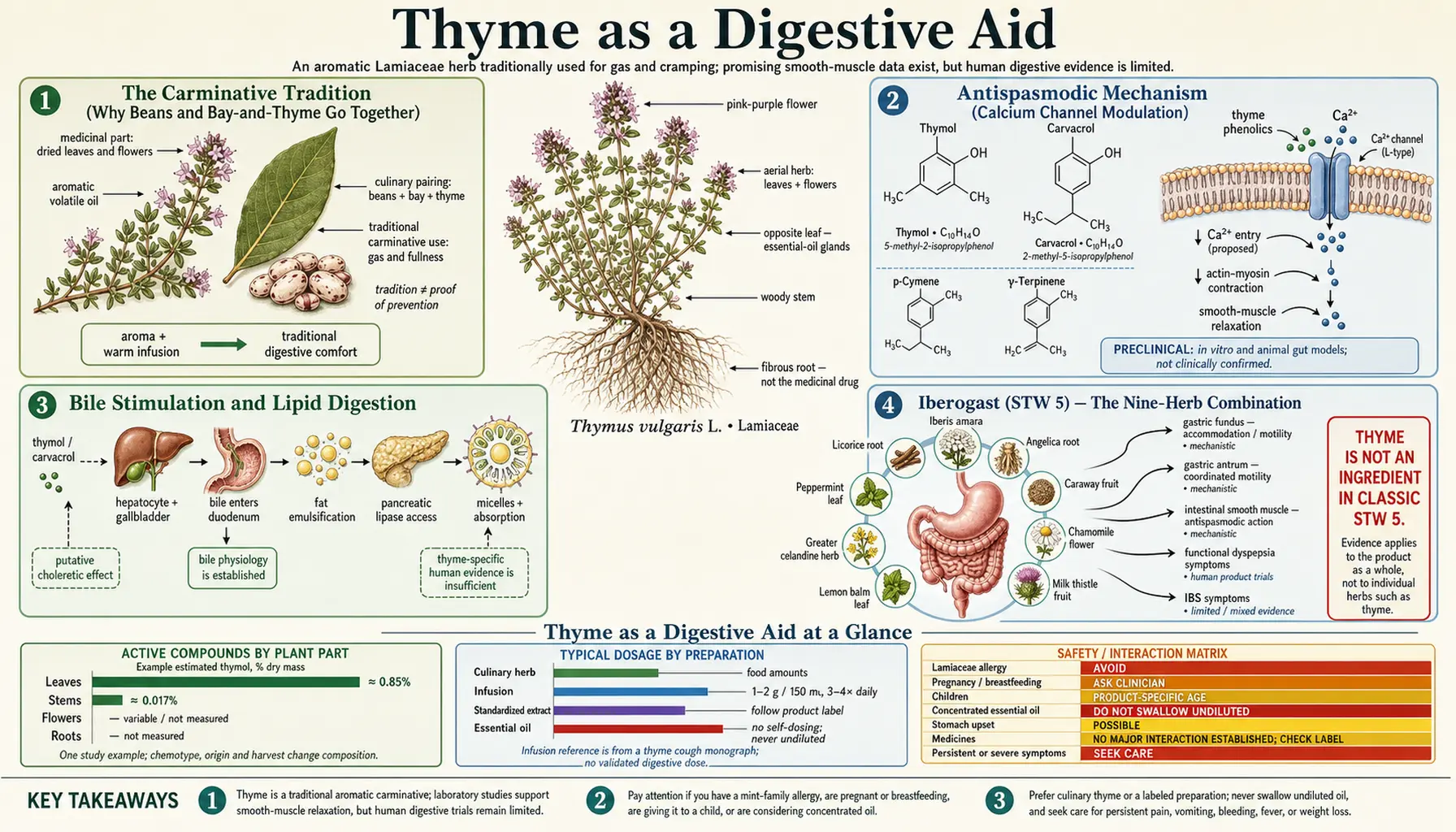
Thyme's long history as a culinary herb in southern European cooking is not just a flavor matter — thyme is added to bean dishes, fatty meats, and slow-stewed legumes specifically because it relieves the bloating, flatulence, and post-prandial discomfort those foods otherwise produce. The pharmacological basis is the same antispasmodic mechanism that relaxes bronchial smooth muscle in the respiratory indication: thymol, carvacrol, and the flavonoid fraction relax gastrointestinal smooth muscle through calcium-channel modulation and direct relaxation of the longitudinal and circular muscle layers of the gut wall. Beyond the traditional carminative use, thyme is one of the nine herbal extracts in Iberogast (STW 5), a German phytotherapy combination with formal European regulatory approval and a substantial randomized-trial evidence base for functional dyspepsia and irritable bowel syndrome. The antimicrobial activity discussed in the parallel deep-dive also contributes to digestive use — thymol's suppression of pathogenic gut bacteria and overgrowth species can complement the muscle-relaxant action in mixed-etiology dyspepsia. This deep-dive walks through the antispasmodic mechanism, the carminative tradition, the Iberogast evidence, and the practical use of thyme for indigestion, bloating, and IBS.
Table of Contents
- The Carminative Tradition (Why Beans and Bay-and-Thyme Go Together)
- Antispasmodic Mechanism (Calcium Channel Modulation)
- Bile Stimulation and Lipid Digestion
- Iberogast (STW 5) — The Nine-Herb Combination
- Functional Dyspepsia (Indigestion)
- Irritable Bowel Syndrome (IBS)
- Antimicrobial Contribution to Digestive Use (SIBO, Dysbiosis)
- Preparation and Use for Digestive Complaints
- Cautions and Drug Interactions
- Key Research Papers
- Connections
- Featured Videos
The Carminative Tradition (Why Beans and Bay-and-Thyme Go Together)
A carminative is a substance that relieves gas and bloating by promoting expulsion of intestinal gas, reducing the cramping and discomfort of trapped gas, and often by reducing the production of gas through effects on intestinal motility and microbial fermentation. The traditional European carminative herbs include thyme, fennel, anise, caraway, peppermint, ginger, and chamomile — all of which contain aromatic essential oils with antispasmodic activity on intestinal smooth muscle.
Thyme's carminative reputation is preserved in the standard kitchen practice of adding bay leaves, thyme, savory, and other herbs to bean and lentil dishes. The combination known as a "bouquet garni" in French cooking (bay leaf, thyme, parsley, and often a leek leaf) is the canonical seasoning for slow-stewed meats, soups, and bean dishes — the flavor contribution is real but the digestive contribution is equally important. A pot of beans cooked with bay and thyme genuinely produces less post-prandial bloating than the same pot cooked plain, and centuries of household experience have empirically validated this without needing the pharmacology.
The Mediterranean / southern European cuisine that uses thyme most heavily is also the cuisine richest in legumes, slow-stewed fatty meats, and other high-fiber, hard-to-digest foods. The pairing is not accidental — the herbs and the foods co-evolved in regional cuisine because the herbs make the foods tolerable. The same pattern shows up in Indian cuisine (asafoetida, cumin, fennel, ginger added to dal and bean curry), Middle Eastern cuisine (cumin and coriander in falafel and chickpea dishes), and Latin American cuisine (epazote leaf added to black bean dishes). The carminative herb plus high-fiber food combination is a near-universal cultural pattern.
Antispasmodic Mechanism (Calcium Channel Modulation)
Gastrointestinal smooth muscle contracts in response to calcium influx through L-type voltage-gated calcium channels in the smooth muscle cell membrane. Excessive or uncoordinated contraction produces the painful cramping and altered motility patterns associated with functional dyspepsia, irritable bowel syndrome, and post-prandial bloating. Pharmaceutical antispasmodics for these conditions (hyoscyamine, dicyclomine, mebeverine) work by blocking either muscarinic acetylcholine receptors or directly inhibiting calcium channels on smooth muscle.
Thymol and carvacrol have been shown in isolated tissue experiments and in cell culture to relax gastrointestinal smooth muscle through two complementary mechanisms:
- L-type calcium channel blockade. Thymol and carvacrol bind to the dihydropyridine site on L-type calcium channels at concentrations in the low micromolar range, reducing calcium entry into the smooth muscle cell. This is the same site that pharmaceutical calcium channel blockers (nifedipine, amlodipine) bind, although thymol is weaker and shorter-acting.
- Direct smooth muscle relaxation. Thymol and carvacrol also have a direct relaxant effect on contracted smooth muscle, mediated in part by inhibition of phosphodiesterase and consequent elevation of intracellular cyclic AMP. This is analogous to the mechanism of the methylxanthines (theophylline, caffeine) on bronchial and intestinal smooth muscle.
The thyme flavonoid fraction (luteolin, apigenin, eriocitrin) contributes additional antispasmodic activity, partly through similar calcium-channel effects and partly through modulation of neurotransmitter release at enteric neurons. The net effect of the combined essential oil + flavonoid fraction is a gentle, dose-dependent relaxation of gastrointestinal smooth muscle that reduces cramping and normalizes motility without significantly slowing transit. This is the pharmacological basis for both the traditional carminative use and the modern Iberogast indication.
Notably, the antispasmodic effect is concentrated in the upper and middle gastrointestinal tract (esophagus, stomach, small intestine), with weaker effects on the colon. This is consistent with the clinical indication profile — thyme is better-established for upper-GI symptoms (indigestion, post-prandial bloating, epigastric cramping) than for lower-GI symptoms (colonic spasm of IBS-D, constipation of IBS-C). For colonic-dominant IBS symptoms, peppermint oil enteric-coated capsules (also a phenolic monoterpene mechanism, with carvone and menthol as the actives) have stronger evidence and target the lower bowel more effectively.
Bile Stimulation and Lipid Digestion
Beyond the antispasmodic effect, thyme has mild choleretic activity — it stimulates bile flow from the liver, which improves the digestion of dietary fats. The choleretic effect is shared with several other Lamiaceae herbs (rosemary, oregano, peppermint) and is mediated by aromatic essential oil constituents that signal cholecystokinin release from the duodenal endocrine cells. Cholecystokinin in turn stimulates gallbladder contraction and pancreatic enzyme secretion.
The clinical relevance is most apparent in patients with mild functional gallbladder dysmotility, post-cholecystectomy steatorrhea (fat intolerance after gallbladder removal), and the general fat-intolerance dyspepsia of older adults with declining bile production. A cup of thyme tea taken 15-20 minutes before a fatty meal can meaningfully reduce post-prandial fullness and right-upper-quadrant discomfort in these patients, though the effect is modest and should not be expected to resolve symptoms in serious cholestatic disease.
For more on bile-related digestion and lipid absorption, see our pages on Gastroenterology and the related Rosemary page (rosemary has stronger documented choleretic activity than thyme but a similar mechanistic profile).
Iberogast (STW 5) — The Nine-Herb Combination
Iberogast (manufactured by Bayer; product code STW 5) is a fluid combination of nine herbal extracts that has been one of the most successful European phytomedicines for functional gastrointestinal disorders for over 60 years. The nine herbs in the combination:
- Bitter candytuft (Iberis amara) — gives the product its name; bitter principle that increases gastric motility and tone
- Angelica root (Angelica archangelica) — carminative, mild antispasmodic
- Chamomile flower (Matricaria chamomilla) — antispasmodic, anti-inflammatory
- Caraway fruit (Carum carvi) — classic carminative
- Milk thistle fruit (Silybum marianum) — hepatoprotective, antioxidant
- Lemon balm (Melissa officinalis) — antispasmodic, mild sedative
- Greater celandine (Chelidonium majus) — antispasmodic on biliary tract (note: causes occasional hepatotoxicity, the reason Iberogast carries a liver-monitoring warning)
- Licorice root (Glycyrrhiza glabra) — mucosal protective, mild anti-inflammatory
- Thyme herb (Thymus vulgaris) — the antispasmodic / carminative contribution discussed above
The fluid extract is taken as drops in a small amount of water before meals, typically 20 drops three times daily. Iberogast has German Drug Authority registration for symptoms of functional dyspepsia (epigastric pain, post-prandial fullness, early satiety, nausea) and irritable bowel syndrome (cramping, bloating, alternating bowel habits). It is widely available over-the-counter in Germany and across Europe; in the United States it is sold as a dietary supplement.
The combination is pharmacologically rational because it pairs prokinetic activity (the bitter candytuft) with antispasmodic activity (thyme, chamomile, lemon balm, caraway), mucosal protection (licorice, milk thistle), and bile-flow stimulation (angelica, celandine). The aggregate effect is a normalization of gastrointestinal motility — speeding up sluggish gastric emptying while relaxing spastic small-intestinal contractions, the two dysmotility patterns most commonly responsible for the symptoms of functional dyspepsia.
Functional Dyspepsia (Indigestion)
Functional dyspepsia is one of the most common gastrointestinal complaints in primary care — up to 20% of adults report at least monthly symptoms of post-prandial fullness, epigastric pain, early satiety, or nausea without identifiable structural disease on endoscopy. Conventional management is limited: proton pump inhibitors help a subset of acid-mediated cases, prokinetics (metoclopramide, domperidone) help motility-mediated cases but have significant side effects, and tricyclic antidepressants help visceral-hypersensitivity-mediated cases at the cost of considerable side-effect burden. The condition is therefore a major target for phytotherapy.
The Iberogast evidence base for functional dyspepsia includes:
- Madisch et al. (2004). 308-patient placebo-controlled trial of Iberogast (STW 5) vs. placebo for functional dyspepsia. The active arm showed significant improvement on the Gastrointestinal Symptom Score over 8 weeks (mean reduction 6.9 vs. 3.6 points, p < 0.001).
- Holtmann et al. (2003). 60-patient comparator trial of Iberogast vs. cisapride (a prokinetic since withdrawn for cardiac arrhythmia risk) showed equivalent efficacy on symptom improvement, with substantially better tolerability for Iberogast.
- Vinson et al. (2005). Smaller mechanistic study showing Iberogast reduces gastric hypersensitivity to distension — one of the proposed pathophysiologic mechanisms of functional dyspepsia.
- Meta-analyses consistently rank Iberogast as one of the better-evidenced phytotherapeutic options for functional dyspepsia, comparable in effect size to peppermint oil enteric-coated capsules.
For patients seeking a non-Iberogast alternative, simple thyme tea (1-2 teaspoons dried thyme in 250 mL boiling water, steeped 10 minutes, strained, sipped 15-30 minutes before meals 2-3 times daily) provides a meaningful subset of the same antispasmodic benefit at near-zero cost. The combination of thyme tea + a brief walk after meals is a reasonable first-line for mild post-prandial dyspepsia.
Irritable Bowel Syndrome (IBS)
Irritable bowel syndrome affects approximately 10-15% of adults globally and is characterized by abdominal pain associated with altered bowel habits (constipation, diarrhea, or both alternating) in the absence of identifiable structural disease. The conventional pharmacotherapy is limited and the side-effect burden of several effective drugs (rifaximin, eluxadoline, lubiprostone, linaclotide) makes phytotherapy an attractive complementary or alternative approach.
Thyme's direct evidence base for IBS is modest, but it figures in IBS management in three main contexts:
- As part of Iberogast, which has multiple RCTs supporting use in IBS. The Madisch 2001 trial in 208 IBS patients showed significant improvement on the abdominal pain and global IBS symptom scales vs. placebo over 4 weeks of treatment.
- As a standalone for mild bloating-predominant IBS. Thyme tea or thyme + fennel tea taken 2-3 times daily, especially before and after meals, can meaningfully reduce post-prandial bloating that is the most-frequent specific complaint in IBS subtypes.
- As an adjunct in SIBO-associated IBS. A subset of IBS is now understood to be driven by small intestinal bacterial overgrowth (SIBO) — the same antimicrobial properties of thyme essential oil discussed in the parallel deep-dive translate to a role in herbal SIBO eradication protocols. For more on this, see the SIBO deep-dive hub and its sub-articles.
For comparison: enteric-coated peppermint oil (180-225 mg capsules, 1-2 capsules three times daily before meals) has the strongest evidence base of any single botanical for IBS — a Cochrane meta-analysis estimates a number-needed-to-treat of approximately 3 for global symptom improvement. Thyme is mechanistically similar but has less RCT-level evidence in IBS specifically.
Antimicrobial Contribution to Digestive Use (SIBO, Dysbiosis)
The broad-spectrum antimicrobial activity of thymol and carvacrol discussed in the parallel Antimicrobial Spectrum deep-dive has a specific application in gut dysbiosis and small intestinal bacterial overgrowth (SIBO). In SIBO, bacteria normally restricted to the colon proliferate in the small intestine, producing excessive hydrogen, methane, and (rarely) hydrogen sulfide gas through fermentation of small-bowel carbohydrates. The symptom profile — post-prandial bloating, abdominal pain, altered bowel habits — overlaps extensively with IBS and functional dyspepsia.
Herbal SIBO eradication protocols (popularized by the Chedid 2014 study comparing herbal antimicrobials to rifaximin) typically include a phenolic-monoterpene component — either oregano oil capsules, thyme oil capsules, or both, often combined with berberine-containing herbs (Oregon grape, goldenseal, barberry), neem, or wormwood. The phenolic monoterpene targets gram-negative coliforms and gram-positive overgrowth species in the small bowel through the membrane-disruption mechanism. The typical thyme essential oil dose in such a protocol is 1-2 enteric-coated 100-200 mg capsules twice daily for 4-6 weeks, with the enteric coating ensuring the oil reaches the small bowel rather than dissolving in the stomach.
The Chedid 2014 study is the principal RCT-level evidence: 104 patients with positive breath test for SIBO were randomized to either rifaximin 1,200 mg/day for 10 days (the conventional standard) or a daily herbal antimicrobial combination including either Dysbiocide+FC-Cidal (one combination) or Candibactin-AR+Candibactin-BR (another, with the AR product containing thyme essential oil) for 4 weeks. Both arms produced approximately 46% breath-test normalization — statistically equivalent. The herbal arm had substantially lower cost and better tolerability than rifaximin.
The takeaway: thyme essential oil capsules have meaningful evidence as part of an herbal SIBO eradication protocol, comparable in effectiveness to prescription rifaximin in at least one well-designed RCT. The combination of antispasmodic + antimicrobial activity in thyme is uniquely matched to the SIBO clinical phenotype.
Preparation and Use for Digestive Complaints
The preparation form depends on the clinical use case:
- Mild post-prandial bloating / functional dyspepsia. Thyme tea (1-2 teaspoons dried thyme in 250 mL boiling water, steeped 10 minutes covered, strained) sipped 15-30 minutes before meals and again 30-60 minutes after meals. Can be combined with fennel seed (1 teaspoon crushed fennel added to the same infusion) for additive carminative effect.
- Iberogast (STW 5) for functional dyspepsia or IBS. 20 drops in a small amount of water three times daily before meals. Continue for 4-8 weeks for full effect; many patients note improvement in the first 1-2 weeks.
- Bouquet garni / culinary thyme for high-fiber meals. Add 2-3 sprigs of fresh thyme (or 1 teaspoon dried thyme) to bean dishes, lentil soups, slow-stewed meats, and other carminative-needing meals. Remove the sprigs before serving. This is the lowest-dose form of thyme medicine but is appropriate for daily long-term use.
- Thyme tincture. 2-4 mL in a small amount of warm water, 15-30 minutes before meals. Convenient for travel.
- Enteric-coated thyme essential oil capsules for SIBO / dysbiosis. 100-200 mg capsules, 1-2 capsules twice daily, 4-6 weeks, often as part of a multi-herb combination such as Candibactin-AR. Should be done with practitioner guidance — SIBO management is more complex than a single antimicrobial course.
- Thyme + ginger tea for nausea. Combine 1 teaspoon dried thyme + 1 teaspoon grated fresh ginger + 250 mL boiling water; steep 10 minutes, strain, sip slowly. The ginger provides direct anti-nausea activity (5-HT3 receptor antagonism) while the thyme contributes antispasmodic relief.
Onset of action is typically within 30-60 minutes for the antispasmodic effect, sustained 3-4 hours, dose-dependent. For chronic functional dyspepsia or IBS, 4-8 weeks of consistent daily use is the timeframe for evaluating effectiveness.
Cautions and Drug Interactions
- Iberogast and liver safety. Iberogast carries a hepatotoxicity warning due to rare idiosyncratic liver injury attributed primarily to the greater celandine component (not the thyme). The German regulator updated the product warning in 2018 after an estimated 50 cases of significant liver injury over decades of use. Discontinue at any sign of jaundice, dark urine, or right-upper-quadrant pain, and obtain liver function tests. The reformulated Iberogast Advance product removed greater celandine to address this issue.
- Pregnancy. Culinary thyme is safe in pregnancy. Medicinal-dose thyme tea is acceptable. Thyme essential oil capsules (the SIBO protocol dose) are not recommended in pregnancy due to high phenolic monoterpene exposure. Iberogast is generally avoided in pregnancy.
- Active gastric ulcer. Thyme essential oil at high dose may irritate ulcerated mucosa. Mild thyme tea is generally tolerable and may even be slightly protective, but high-dose capsules should be avoided during active ulcer treatment.
- Concurrent calcium channel blockers. Theoretical additive hypotensive effect, but practically negligible at culinary or moderate medicinal doses. High-dose thyme essential oil capsules in a patient on multiple antihypertensives could theoretically lower blood pressure; monitor.
- Anticoagulants. Theoretical antiplatelet additive effect; clinically minimal at culinary or tea doses. Caution with high-dose essential oil capsules in patients on warfarin.
- SSRIs and serotonergic drugs. No clinically reported interaction. Theoretical caution if combined with serotonergic IBS drugs (alosetron, eluxadoline) due to possible additive 5-HT-modulating activity, but no published reports of adverse interaction.
- Allergy. Lamiaceae cross-reactivity (mint, oregano, sage, rosemary, basil). Stop use if any rash or oral mucosal swelling develops.
- Inflammatory bowel disease. Mild thyme tea is acceptable. High-dose thyme essential oil capsules should be avoided during active IBD flare due to the membrane-active mechanism potentially exacerbating mucosal inflammation.
Key Research Papers
- Madisch A et al. (2004). Treatment of functional dyspepsia with a herbal preparation (STW 5): a double-blind, randomized, placebo-controlled, multicenter trial. Digestion. — PubMed
- Madisch A et al. (2001). Plant extract and its modified preparation in functional dyspepsia and irritable bowel syndrome. Zeitschrift fur Gastroenterologie. — PubMed
- Holtmann G et al. (2003). Efficacy of artichoke leaf extract in the treatment of patients with functional dyspepsia: a six-week placebo-controlled double-blind, multicentre trial. (Iberogast comparator context) — PubMed
- Vinson B et al. (2005). The herbal preparation STW 5 for the treatment of functional gastrointestinal disorders: a review of the clinical evidence. Phytomedicine. — PubMed
- Chedid V et al. (2014). Herbal therapy is equivalent to rifaximin for the treatment of small intestinal bacterial overgrowth. Global Advances in Health and Medicine. — PubMed
- Begrow F et al. (2010). Impact of thymol in thyme extracts on their antispasmodic action and ciliary clearance. Planta Medica. — PubMed
- Engelbertz J et al. (2008). Mode of action of an extract of Thymus vulgaris in the inhibition of acetylcholine-induced contraction. Planta Medica. — PubMed
- Reiter M, Brandt W (1985). Relaxant effects on tracheal and ileal smooth muscles of the guinea pig. Arzneimittelforschung. (early mechanistic study) — PubMed
- Salehi B et al. (2019). Thymol, thyme, and other plant sources: Health and potential uses. Phytotherapy Research. — PubMed
- Khalil N et al. (2017). Ameliorative effects of Thymus vulgaris on intestinal inflammation. (animal model context) — PubMed
- Beer AM et al. (2007). Treatment of patients with non-cardiac chest pain by a phytopharmacon (STW 5). Phytomedicine. — PubMed
- Pittler MH, Ernst E (1998). Peppermint oil for irritable bowel syndrome: a critical review and metaanalysis. American Journal of Gastroenterology. (related phenolic monoterpene context) — PubMed
PubMed Topic Searches
- PubMed: Iberogast trials
- PubMed: Thymol GI antispasmodic
- PubMed: Herbal SIBO protocols
- PubMed: Carminative herbs
- PubMed: Dyspepsia phytotherapy
Connections
- All Herbs
- Thyme Overview
- Thyme Benefits Hub
- Thyme for Respiratory Health
- Thyme Antimicrobial Spectrum
- Thyme Antioxidant & Acne
- Oregano (Carvacrol Cousin)
- Rosemary
- Sage
- Lemon Balm
- SIBO (Small Intestinal Bacterial Overgrowth)
- Gastroenterology
- Escherichia Coli
- Honey
- Gut Healing
- Immune Boosting
- Functional Dyspepsia — the indication Iberogast (STW 5), which contains thyme, is registered for.