Thai Basil for Stress, Mood and Antioxidant Defence
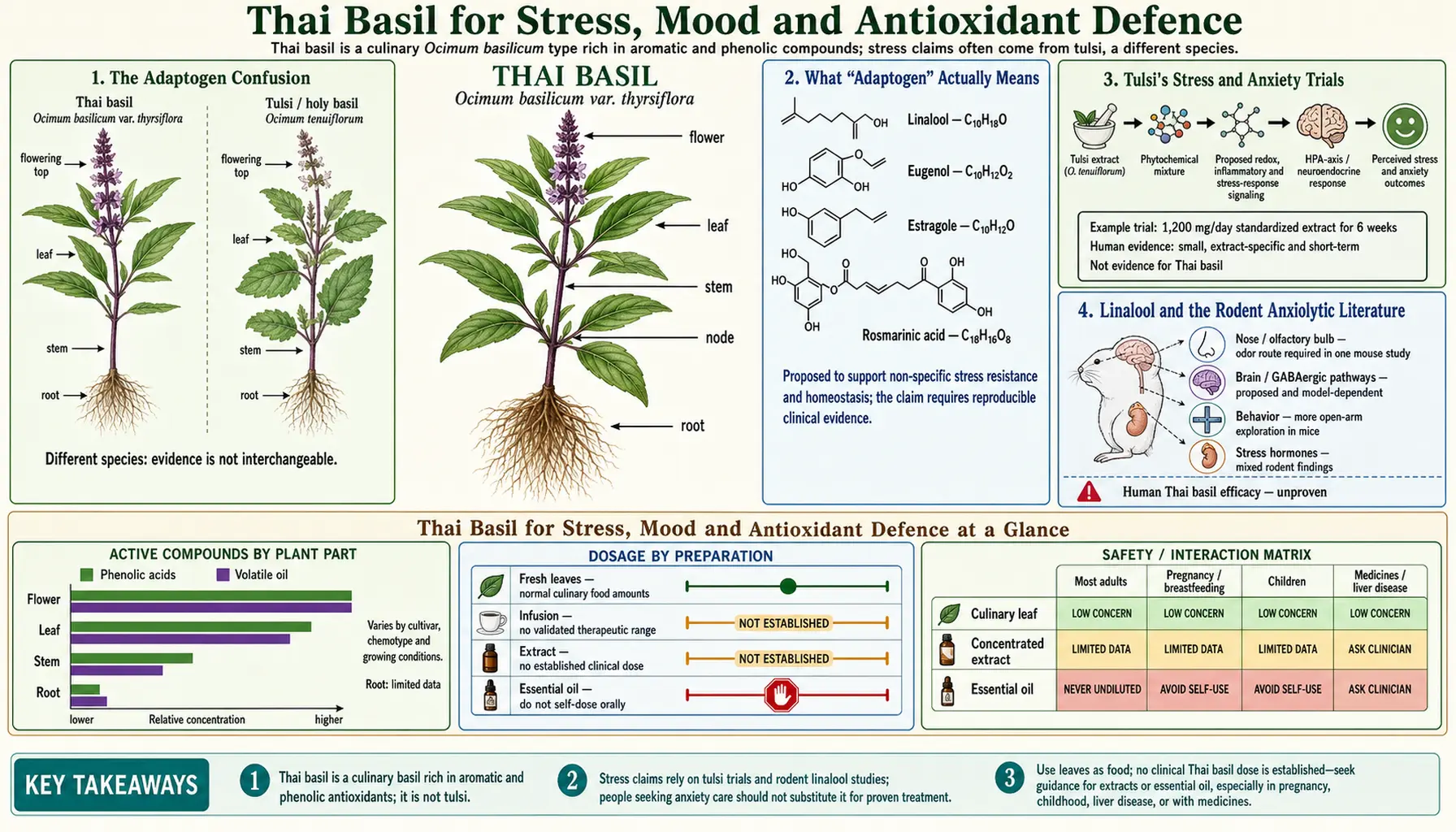
If you have seen basil described as an adaptogen — a herb that helps the body resist stress — you have seen a claim about a different plant. Adaptogen is tulsi's word. Ocimum tenuiflorum, the Indian sacred basil, has a substantial Ayurvedic reputation as a stress herb and a real, if modest, set of human trials in general stress and generalized anxiety. Thai sweet basil, Ocimum basilicum var. thyrsiflora, has none of that. It has never been described as an adaptogen in any tradition, and it has never been tested for stress in a human being.
That could be the whole page, but it would miss two genuinely interesting things. First, Thai basil's dominant secondary volatile is linalool, and linalool is one of the most-studied aroma molecules in the whole behavioural-pharmacology literature — with a real rodent anxiolytic signal, and with one standardised human preparation that does have randomized trial data (it is a lavender oil, not a basil oil, and that distinction is the point). Second, basil is a good source of rosmarinic acid, which makes it an excellent case study in why “high in antioxidants” is one of the least informative phrases in nutrition.
So this page does three things: hands the stress evidence back to tulsi with a clear label, examines what the linalool literature does and does not support, and takes the antioxidant claim apart properly — assay by assay, through bioavailability, to what is actually left. Which turns out to be something real, just much smaller and more specific than advertised.
Table of Contents
- The Adaptogen Confusion
- What “Adaptogen” Actually Means
- Tulsi's Stress and Anxiety Trials
- Linalool and the Rodent Anxiolytic Literature
- Aroma as a Route, and Why It Is Different
- Rosmarinic Acid and Antioxidant Chemistry
- The Antioxidant Assay Problem
- Bioavailability: The Ceiling on Every Claim
- Anthocyanins and the Purple Stems
- Sleep and Mood: Genuinely Unstudied
- The Real Mechanism: Food, Ritual and Pleasure
- How to Get Value From It Honestly
- Key Research Papers
- Safety and Disclaimer
- Connections
The Adaptogen Confusion
The mechanism of the mix-up is worth spelling out, because once you see it you will spot it everywhere.
- A trial is run on tulsi and published under the plant's older botanical name, Ocimum sanctum.
- A secondary source summarises it as “basil” — not dishonestly; “holy basil” contains the word.
- A tertiary source drops “holy” and the claim now attaches to basil in general.
- A reader who cooks Thai food reasonably concludes that the herb on the phở plate is an adaptogen.
- A supplement label then says “basil extract” with no binomial, and the loop closes with nobody having lied and the information being wrong.
The two species are not close substitutes. Tulsi's oil is dominated by eugenol; Thai basil's by estragole and linalool. In the kitchen they are not interchangeable either — tulsi is peppery and clove-like, Thai basil is sweet and anise-scented, and the Thai dish pad kraphao is literally named after tulsi. If a restaurant makes it with Thai basil, it is making a different dish. Cooks know these plants are different. Only the health literature has managed to merge them.
What “Adaptogen” Actually Means
The word has a specific history, which is useful because it lets you test whether a claim is using it meaningfully or decoratively.
It comes from mid-twentieth-century Soviet pharmacology — coined by Lazarev in the late 1940s and developed by Brekhman and Dardymov, working largely on Eleutherococcus and Panax. Three criteria were proposed. An adaptogen should:
- produce a non-specific increase in resistance to a wide range of physical, chemical and biological stressors;
- have a normalising action — correcting a disturbed state in either direction, rather than pushing a single parameter one way;
- be essentially innocuous, not disturbing normal physiology more than minimally.
Two honest observations follow. First, these criteria are hard to operationalise: “non-specific resistance” is not a measurable endpoint, which is why the category has never been recognised as a regulatory or pharmacological class in most jurisdictions. Second, the word has since drifted into a marketing term applied to almost any plant with a calming reputation, which drains it of content.
Applied honestly: tulsi is a traditional adaptogen candidate with some human data. Ashwagandha is another, with a larger and more recent trial literature. Thai sweet basil is not an adaptogen in any tradition or literature, and describing it as one is not a shade of meaning — it is simply the wrong plant.
Tulsi's Stress and Anxiety Trials
Evidence tier: small randomized and non-randomized human trials — in Ocimum tenuiflorum.
Described accurately, because this is what gets borrowed:
- Saxena and colleagues, Evidence-Based Complementary and Alternative Medicine, 2012 — a double-blind, placebo-controlled study of an Ocimum tenuiflorum extract for the management of general stress, reporting improvement in stress-symptom scores versus placebo. Find on PubMed.
- Bhattacharyya and colleagues, Nepal Medical College Journal, 2008 — a controlled trial of Ocimum sanctum leaf in generalized anxiety disorder, reporting reductions in anxiety and associated stress and depression scores. Find on PubMed.
- Jamshidi and Cohen, Evidence-Based Complementary and Alternative Medicine, 2017 — the systematic review that gathers tulsi's human studies, reporting favourable results across stress, metabolic, immune and neurocognitive outcomes while flagging small samples, short durations and heterogeneous preparations. Find on PubMed.
- Cohen, Journal of Ayurveda and Integrative Medicine, 2014 — “Tulsi — Ocimum sanctum: a herb for all reasons,” the standard narrative account of the plant's standing. Find on PubMed.
How much weight this bears. Subjective stress and anxiety scores are notoriously placebo-responsive, and small single-centre trials of herbal extracts are the study design most prone to inflated effects. The tulsi literature is best read as consistent-in-direction and weak-in-quality — enough to justify larger trials and a conversation with a clinician, not enough to justify confidence. That assessment belongs on the Holy Basil Benefits pages, where the plant is the subject.
Linalool and the Rodent Anxiolytic Literature
Evidence tier: animal, for the molecule; nothing for Thai basil.
This is the most legitimate scientific thread on this page, and it deserves proper handling because it is neither nothing nor what the marketing says.
Linalool is a monoterpene alcohol found in lavender, coriander leaf, makrut lime, rosewood and — substantially — in basil. It has been studied extensively in behavioural pharmacology, and the rodent literature reports anxiolytic-like and sedative-like effects, particularly by inhalation, in standard paradigms such as the elevated plus maze, open field and light–dark box. Proposed mechanisms include modulation of glutamatergic and GABAergic transmission, and there is a strand of work arguing that the inhaled effect depends on olfactory signalling rather than on the molecule reaching the brain in pharmacologically active amounts — an important and unresolved distinction.
What the literature does not support:
- That eating basil delivers a psychoactive dose of linalool. A handful of leaves contains a small fraction of the herb's already small essential-oil content, most of it lost to evaporation during cooking. Rodent studies use defined inhaled concentrations or injected doses.
- That results transfer species-to-species. Thai basil's oil composition differs from lavender's, and estragole rather than linalool is usually its dominant volatile.
- That rodent anxiety paradigms predict human anxiety outcomes. They are screening tools, and the attrition rate from promising rodent anxiolytic to useful human drug is severe.
The instructive comparison. The one linalool-rich botanical preparation that does have randomized controlled trial evidence for anxiety is a standardised oral lavender oil preparation, developed as a licensed medicine in Europe, tested in placebo-controlled trials in anxiety disorders, and delivered as a defined dose of a defined composition in a capsule designed for the purpose. That is what it takes: an identified active, a standardised composition, a stated dose, a formulation, and blinded trials. Thai basil has none of those five things. Its linalool is a flavour compound in a food, and there is no basis for a dose. See linalool anxiolytic-like effects in rodent models and standardised lavender oil in anxiety — randomized trials.
Aroma as a Route, and Why It Is Different
Something genuinely interesting sits underneath the aromatherapy claims, and it is more defensible than the claims themselves.
Olfaction is neuroanatomically unusual. Odour information reaches the amygdala and entorhinal cortex through remarkably few synapses, without the thalamic relay that gates most other senses. That is the structural reason smells summon emotion and memory so immediately — and it means an aroma can plausibly influence emotional state without any molecule acting as a systemic drug.
Two consequences worth keeping straight:
- An aroma effect is real but is not pharmacology. If the smell of a Thai basil leaf makes you feel better, that is a genuine change in your state, mediated by a genuine neural pathway. It is not evidence that a constituent is doing something measurable to a receptor at a therapeutic concentration, and it will not appear in a blood test.
- It is essentially impossible to blind. Everyone knows whether they were exposed to a strong aroma, which is why aromatherapy trials are so hard to interpret and why expectancy is a major contributor to their results. That does not make the benefit fake — expectancy effects are real effects — but it does mean the mechanism is not established by the trial.
Practical upshot. Crushing a basil leaf and breathing it in is a pleasant, harmless, free thing to do, and you do not need a pharmacological rationale for it. Diffusing basil essential oil is a different matter, because it involves a concentrated estragole-containing product — use it sparingly if at all, ventilate the room, and keep it away from young children and out of pregnancy, per the safety section.
Rosmarinic Acid and Antioxidant Chemistry
Evidence tier: in vitro and animal for the compound; nothing clinical for Thai basil.
Rosmarinic acid is the signature polyphenol of the mint family — an ester of caffeic acid, found in rosemary, sage, lemon balm, oregano, mint and basil. Basil is genuinely a good source. Alongside it, basil leaf carries caffeic and chicoric acids and a set of flavonoids including nevadensin, the flavone that turns out to inhibit the enzyme step responsible for estragole's genotoxicity, plus relatives of luteolin and apigenin.
Rosmarinic acid's chemistry is not in doubt. It donates electrons readily, quenches free radicals in solution, chelates metal ions, and shows anti-inflammatory activity in cell and animal models — including suppression of inflammatory signalling pathways at concentrations achievable in a dish.
Crucially, rosmarinic acid is non-volatile. It is not present in basil essential oil. Every polyphenol claim about basil is therefore a claim about the leaf, while every antimicrobial and aroma claim is a claim about the oil. Marketing routinely combines both in one paragraph as though a single product delivered them. No product does. See rosmarinic acid antioxidant and anti-inflammatory mechanisms.
The Antioxidant Assay Problem
“High in antioxidants” usually rests on a chemical assay, and the assays deserve scrutiny, because their limitations are officially acknowledged rather than merely alleged.
The common ones — ORAC, DPPH, FRAP, TEAC — all measure the same general thing: how well an extract quenches a particular artificial radical or reduces a particular indicator in a test tube. They are cheap, fast and reproducible, which is why every plant on earth has been run through them.
What they cannot tell you:
- Whether the compound is absorbed. The assay does not involve a gut.
- Whether it survives metabolism. Polyphenols are extensively conjugated in the gut wall and liver; what circulates is largely glucuronides and sulfates with different chemistry from the parent.
- Whether it reaches a relevant concentration in a relevant tissue. Typically it does not.
- Whether “more radical quenching” is even desirable. Reactive oxygen species are signalling molecules with physiological jobs — in exercise adaptation, immune killing and cell-cycle control. High-dose antioxidant supplement trials have repeatedly failed to show benefit and in some cases showed harm, which is the strongest available evidence that the simple “more antioxidants, better health” model is wrong.
The decisive institutional fact: the US Department of Agriculture withdrew its ORAC database in 2012, stating that the values had no demonstrated relevance to human health and were being misused in food marketing. When the body that created the numbers takes them down for being misleading, a food label built on them is not a scientific claim.
None of this means polyphenol-rich diets are unimportant. Diets high in vegetables, herbs, fruit, tea, coffee and cocoa look consistently better in population studies. But the effect appears to belong to whole dietary patterns, probably through several mechanisms including microbial metabolism and cell-signalling effects rather than simple radical scavenging — and it does not license a claim about any single garnish. See antioxidant capacity assays and their relevance to human health.
Bioavailability: The Ceiling on Every Claim
This is where the arithmetic closes the case, and it is the same arithmetic used on the blood sugar page, applied to a different claim.
A generous portion of Thai basil is 10–20 g of fresh leaf, which is about 90–92% water — so roughly 1.5 g of dry matter. Published analyses put rosmarinic acid in basil leaf on the order of a few milligrams per gram of fresh weight, varying several-fold with cultivar and growing conditions. So a handful supplies polyphenols in the range of single-digit to low tens of milligrams.
Then apply the pharmacokinetics. Rosmarinic acid is poorly absorbed intact; a substantial fraction reaches the colon, where gut bacteria hydrolyse and reduce it to smaller phenolic acids, and what is absorbed is largely conjugated. Peak plasma concentrations after realistic dietary intakes are low — well below the concentrations at which cell studies demonstrate effects — and clearance is rapid.
For scale: a single cup of coffee or green tea delivers polyphenols in the hundreds of milligrams. So does a serving of berries, or dark chocolate, or a good salad. Against a normal day's intake, a herb garnish is a rounding error.
The correct conclusion is not “basil is worthless.” It is: basil is one small contributor to total dietary polyphenol intake, and total intake, as part of a dietary pattern, is what the evidence is about. That framing is honest, it is still positive, and it points you at the right action — eat more plants generally — instead of at a capsule. See rosmarinic acid bioavailability in humans.
Anthocyanins and the Purple Stems
Thai basil's purple stems and pagoda-shaped flower spikes come from anthocyanins — the same pigment class that colours blueberries, red cabbage and purple sweet potato. Purple-leaved basil cultivars carry more.
Worth knowing, and worth not over-reading:
- Anthocyanins are genuinely interesting. They have a larger research literature than rosmarinic acid, including human studies of anthocyanin-rich foods and vascular measures.
- Their bioavailability is also low, and much of their apparent activity is now attributed to colonic microbial metabolites rather than the intact pigments.
- The quantity in basil stems is small. The stems are a few grams, often removed before serving. Berry portions are two orders of magnitude larger.
- Colour is a useful heuristic and a bad measurement. “Eat colourful plants” is decent shorthand for dietary variety. It is not a dose.
If you want the anthocyanin research, read it where the portions are meaningful — berries, purple vegetables — not in a herb stem you may discard.
Sleep and Mood: Genuinely Unstudied
Basil appears in lists of “calming herbs” and “herbs for sleep,” so the state of that evidence should be stated plainly:
- Thai sweet basil and sleep: no human studies. None. Not a small trial, not an open-label series.
- Thai sweet basil and depression or mood disorders: no human studies.
- Thai sweet basil and cognition: no human studies.
- Thai sweet basil and cortisol or any stress biomarker: no human studies. If you want to see what a real measurement looks like, the site's page on the cortisol test covers what it can and cannot show — and note that no basil study has ever measured it.
- The wider Ocimum basilicum literature contains rodent behavioural work on extracts, at the usual screening tier.
- Traditional use across sweet basil's global range does include a mild sedative reputation. That is a genuine tier of evidence, and it is the only one available here.
If you are struggling with sleep, low mood or anxiety, the interventions with real evidence are known and none of them are herbs from the phở plate: cognitive behavioural therapy for insomnia is first-line for chronic insomnia; regular activity, daylight exposure and consistent sleep timing have solid support; and for clinical anxiety or depression, established psychological and pharmacological treatments exist. See also Insomnia and Burnout.
The Real Mechanism: Food, Ritual and Pleasure
Having subtracted the pharmacology, something substantial is left, and it is not a consolation prize — it is arguably the most reliably beneficial thing on the page.
Consider what actually happens at a Vietnamese noodle shop. A bowl of hot broth arrives with a plate of raw herbs beside it. You tear the basil with your fingers, smell it, push it under the surface, add lime and chilli, taste, adjust. You are doing something, attentively, with your hands, to your own food, in the company of others, and then you eat it slowly because it is hot.
Every element of that has support in its own right:
- Attentional focus on sensory experience is the core of mindfulness practice, which has real trial evidence for stress and mood. A herb plate is a small, unlabelled instance of it.
- Eating slowly improves satiety signalling and reduces post-meal discomfort.
- Commensality — eating with other people — is one of the more robust correlates of wellbeing in the social-epidemiology literature.
- Cooking for yourself is associated with better diet quality, more or less regardless of cuisine.
- Pleasure in food supports adherence to any dietary change, which is the variable that determines whether a change lasts.
So the honest answer to “does Thai basil help with stress?” is: not as a drug, and quite possibly yes as part of a meal. That is a smaller claim than “adaptogen,” it is better supported, it is free, and it does not require buying anything.
How to Get Value From It Honestly
- Buy it fresh and use it fresh. Dried Thai basil loses the aroma that is the entire point.
- Grow it. It germinates readily, likes heat and full sun, and does well in a pot on a windowsill. Tending a plant and picking your own leaves is a better stress intervention than any capsule made from it, and the flower spikes are edible and pretty.
- Crush a leaf and smell it before you cook. Free, pleasant, and the one aroma effect available without a concentrated product.
- Add it off the heat so the volatiles survive, and tear rather than chop so the cut edges do not blacken.
- Make the infusion if you like it. A few sprigs steeped 5–10 minutes, covered, is a pleasant anise-scented tea and a traditional after-meal drink. Enjoy it as a drink, not as a treatment.
- Get your polyphenols where the portions are large: vegetables, berries, tea, coffee, cocoa, olive oil, whole spices. Herbs season that diet; they do not replace it.
- If you specifically want the stress research, read Holy Basil and Ashwagandha and take the question to a clinician — particularly if you take psychiatric or thyroid medication.
- Do not buy a Thai basil supplement. There is nothing to standardise it against, no dose, no evidence, and if it is oil-based it is an estragole concentrate.
Key Research Papers
Citations are PubMed search links rather than numeric identifiers, so you can confirm each result set for yourself. Titles, journals and years appear in the prose.
- Saxena and colleagues, Evidence-Based Complementary and Alternative Medicine, 2012 — double-blind placebo-controlled study of an Ocimum tenuiflorum extract in general stress. Find on PubMed. (RCT — tulsi, not Thai basil.)
- Bhattacharyya and colleagues, Nepal Medical College Journal, 2008 — controlled trial of Ocimum sanctum leaf in generalized anxiety disorder. Find on PubMed. (Human trial — tulsi.)
- Jamshidi and Cohen, Evidence-Based Complementary and Alternative Medicine, 2017 — systematic review of tulsi's human studies; consistent direction, weak individual quality. Find on PubMed. (Systematic review — tulsi.)
- Cohen, Journal of Ayurveda and Integrative Medicine, 2014 — “Tulsi — Ocimum sanctum: a herb for all reasons.” Find on PubMed. (Narrative review — tulsi.)
- Muráriková and colleagues, Molecules, 2017 — GC-MS characterisation across basil species and cultivars; why linalool content cannot be assumed. Find on PubMed. (Analytical.)
- Avetisyan and colleagues, BMC Complementary and Alternative Medicine, 2017 — composition and biological activity across basil cultivars. Find on PubMed. (In vitro.)
- Alhusainy and colleagues, Toxicology and Applied Pharmacology, 2010 — nevadensin, a basil flavone, inhibits estragole bioactivation. Relevant here because it is a flavone doing something specific and demonstrable, unlike generic “antioxidant” activity. Find on PubMed. (In vitro plus modelling.)
- Alhusainy and colleagues, Molecular Nutrition & Food Research, 2013 — in-vivo confirmation in rats of nevadensin's inhibition of estragole DNA adduct formation. Find on PubMed. (Animal.)
- Miller and colleagues, Cancer Research, 1983 — alkenylbenzene carcinogenicity structure–activity studies, the origin of the estragole file. Find on PubMed. (Animal.)
- Live search — the molecule behind the calming reputation: linalool anxiolytic-like effects in rodents. (Animal.)
- Live search — the linalool-rich preparation that does have trial data: standardised lavender oil in anxiety. (RCT — a different plant, and the standard Thai basil would have to meet.)
- Live search — the bioavailability ceiling: rosmarinic acid pharmacokinetics in humans.
- Live search — why the assays do not settle anything: antioxidant capacity assays and human relevance.
- Live search — the gap this page documents: Ocimum basilicum human trials in stress, anxiety and sleep.
Safety and Disclaimer
Thai basil as food is safe and customary, including in pregnancy, and this page argues for enjoying it rather than restricting it. The cautions concern concentrated products. Basil essential oil should not be swallowed — there is no established internal dose, and distillation delivers estragole stripped of the non-volatile flavones that suppress its activation in intact leaf. Estragole is a rodent hepatocarcinogen at high isolated doses; the European Medicines Agency concluded in 2005 that exposure at recommended herbal-medicine dosage does not pose a significant cancer risk, while advising that concentrated estragole exposure be minimised in young children, pregnancy and breastfeeding, and noting that topical use needs further assessment because skin absorption data are lacking. That advice is about oils, extracts and diffusion — not about a bowl of phở. For topical use dilute to 1–2% in a carrier oil and patch test: linalool is one of the recognised fragrance contact allergens and oxidised oil is more sensitising than fresh, so store bottles sealed and cool. Ventilate when diffusing, and keep essential oils out of children's reach.
This page is health education and not medical advice. Thai sweet basil has no clinical evidence for stress, anxiety, depression, sleep or cognition, and no herb should replace treatment for a mental-health condition. If you are experiencing persistent low mood, anxiety that interferes with daily life, insomnia lasting more than a few weeks, or any thoughts of harming yourself, contact a healthcare professional or a crisis service now — these are treatable and effective help exists. If you take antidepressants, anxiolytics, sedatives, lithium or thyroid medication, discuss any herbal product with your prescriber or pharmacist before starting it, because herb–drug interactions in this area are real and under-documented.
Connections
- All Herbs
- Thai Basil Benefits Hub — the evidence-tier summary and the borrowed-evidence watchlist.
- Thai Basil — the parent page: botany, the four-basil guide, full estragole figures.
- Holy Basil Benefits — where the adaptogen and stress-trial evidence actually belongs.
- Holy Basil History — the Ayurvedic and devotional background behind tulsi's standing.
- Ashwagandha Benefits — the adaptogen candidate with the largest recent trial literature.
- Thai Basil for Blood Sugar — the same borrowed-evidence pattern, and the same dose arithmetic.
- Thai Basil for Digestive Health — where stress and gut symptoms meet.
- Rosemary Benefits — the other great rosmarinic-acid herb.
- Sage Benefits — a mint-family relative studied for cognition, with its own concentrate caution.
- Peppermint Benefits — what a culinary herb looks like when it does have trial data.
- Antioxidants — the category index, and the assay caveats in context.
- Luteolin — a flavone of the same class as basil's nevadensin.
- Apigenin — another mint-family flavone with the same bioavailability ceiling.
- Anthocyanins — the pigments behind the purple stems.
- Anxiety — what actually treats it.
- Insomnia — and why CBT-I comes before any herb.
- Burnout — chronic stress as a situation rather than a deficiency.
- Cortisol Test — what a stress biomarker can and cannot show.