Ashwagandha — Benefits Deep Dive
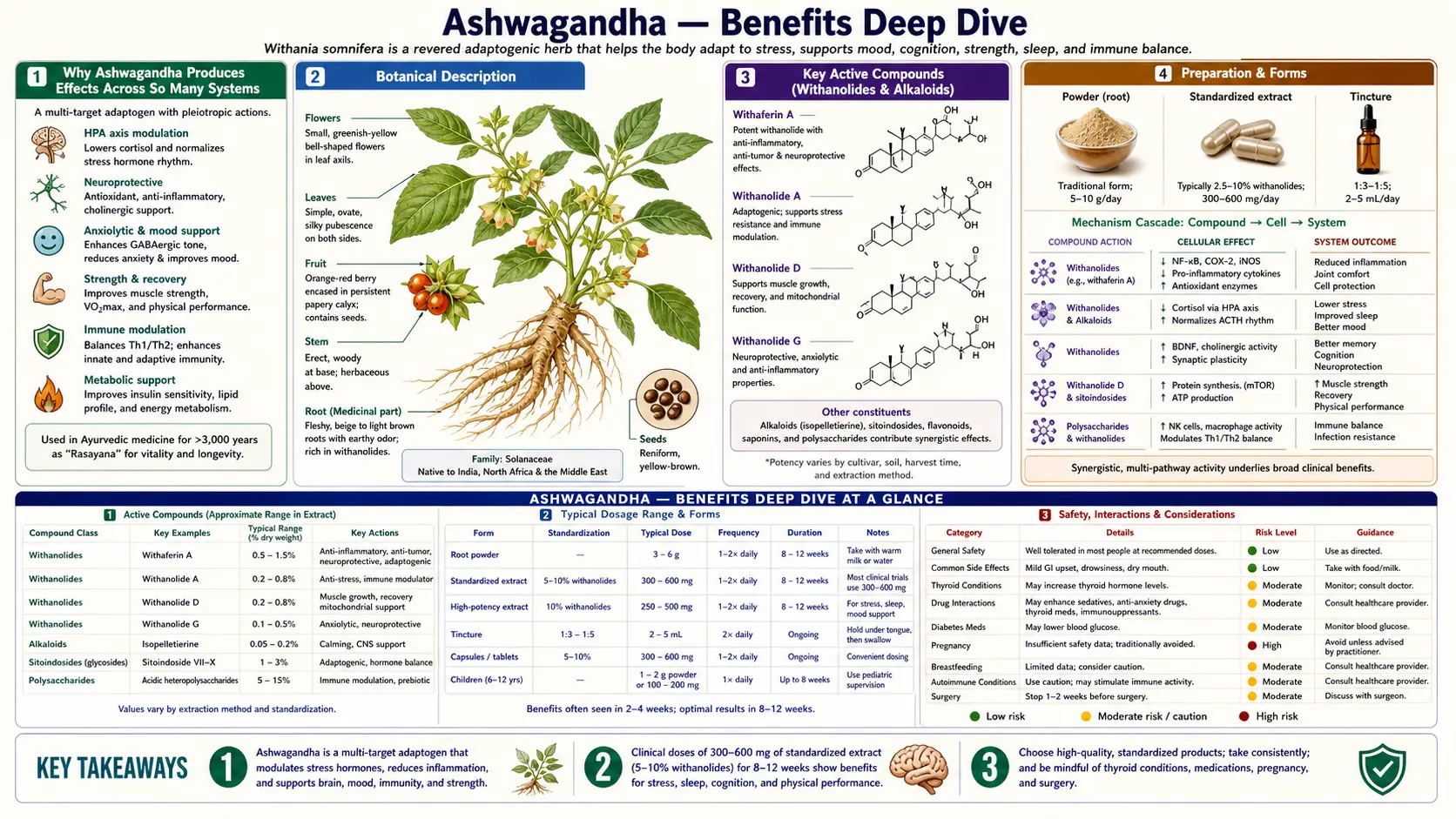
Withania somnifera — the Sanskrit name ashwagandha literally means "smell of the horse," referring both to the distinctive odor of the fresh root and to the traditional Ayurvedic claim that the root confers the strength and stamina of a stallion. For more than three thousand years it has been classified in Ayurveda as a rasayana — a rejuvenative tonic taken to extend lifespan, restore vitality, and build resilience against physical and psychological stress. Modern phytochemistry has isolated the active constituents responsible for these effects: a family of steroidal lactones called withanolides (withaferin A, withanolide A, withanolide D, withanone), plus the alkaloids somniferine and tropine, sitoindosides VII-X, and the unusual sleep-promoting sugar derivative triethylene glycol. Four benefit pages below explore the conditions where Ashwagandha has produced the largest measured clinical effects in randomized controlled trials — reduction of perceived stress and cortisol, improvement in sleep onset latency and quality, gains in working memory and processing speed, and increases in serum testosterone and reproductive function in men.
Deep-Dive Articles
Stress & Anxiety
The Chandrasekhar 2012 KSM-66 trial showing 27.9% reduction in serum cortisol versus 7.9% in placebo over 60 days, the Sensoril full-spectrum extract trials, GABA-A receptor modulation by withanolides as the proximate anxiolytic mechanism, HPA-axis adaptation, the foundational Bhattacharya 2000 anxiolytic activity research, and the practical clinical question of when to prefer Ashwagandha over an SSRI, benzodiazepine, or buspirone.
Sleep Quality
The Langade 2021 randomized trial demonstrating improvement in Pittsburgh Sleep Quality Index (PSQI), sleep onset latency, and total sleep time in insomniacs; the unusual mechanism of triethylene glycol from the leaves crossing the blood-brain barrier to induce sleep at the GABA-A receptor; the cortisol-lowering effect that improves sleep architecture; comparison with melatonin, magnesium glycinate, and L-theanine.
Cognitive Function
The Choudhary 2017 trial showing improvements in immediate and general memory, executive function, attention, and information-processing speed in adults with mild cognitive impairment; the Sehgal 2012 demonstration that withanolide A reverses beta-amyloid-induced synaptic loss; cholinergic activity, neurite outgrowth, and the neuroprotective implications for Alzheimer's and Parkinson's research.
Testosterone & Vitality
The Wankhede 2015 trial in resistance-trained men documenting a 15% increase in serum testosterone alongside doubled gains in strength and muscle mass; the Ambiye 2013 infertility trial showing improved sperm concentration, motility, and morphology in oligospermic men; LH and FSH modulation; the steroidogenic mechanism by which withanolides upregulate the StAR protein and cholesterol side-chain cleavage.
Table of Contents
- Deep-Dive Articles
- Why Ashwagandha Produces Effects Across So Many Systems
- Key Research Papers
- External Authoritative Resources
- Connections
- Featured Videos
Why Ashwagandha Produces Effects Across So Many Systems
Most botanical medicines act through a single dominant mechanism (caffeine antagonizes adenosine receptors, willow bark salicin inhibits prostaglandin synthesis, valerian potentiates GABA). Ashwagandha is unusual in that its withanolide constituents engage at least five distinct molecular targets, and the clinical effects across stress, sleep, cognition, and vitality emerge from the combined modulation of all five. This is the mechanistic basis for the Ayurvedic classification of Ashwagandha as a rasayana rather than a treatment for any single symptom.
- HPA-axis modulation and cortisol reduction — the proximate driver of the anti-stress effect. Withanolides act at the hypothalamic and pituitary level to dampen corticotropin-releasing hormone (CRH) and adrenocorticotropic hormone (ACTH) output, reducing adrenal cortisol secretion. Multiple randomized trials with KSM-66 and Sensoril extracts have measured serum or salivary cortisol reductions of 14-32% over 8-12 weeks at doses of 300-600 mg/day. This is the unifying mechanism behind the stress and anxiety, much of the sleep-quality, and a contributing piece of the testosterone effects (chronic high cortisol suppresses the hypothalamic-pituitary-gonadal axis).
- GABAergic activity at the GABA-A receptor — the proximate driver of the acute anxiolytic and sleep effects. Withanolides and the leaf-derived triethylene glycol act as positive allosteric modulators at the GABA-A receptor (the same family of receptors targeted by benzodiazepines, alcohol, and barbiturates, but with a different binding site and a much milder, non-sedating effect at therapeutic doses). The Bhattacharya laboratory at Banaras Hindu University published the foundational pharmacology in the late 1990s and early 2000s demonstrating this GABAergic mechanism.
- Cholinergic activity and neurite outgrowth — the proximate driver of the cognitive effects. Withanolide A and withanoside IV (a glycoside metabolized in vivo to the active sominone) have been shown in cell culture and rodent models to enhance acetylcholine signaling, promote neurite outgrowth, reverse synaptic loss induced by beta-amyloid (the Sehgal 2012 work), and increase BDNF expression. The cognitive-function deep dive covers these mechanisms and the clinical translation in mild cognitive impairment.
- Nrf2 activation and antioxidant defense — the unifying mechanism behind the neuroprotective and the anti-fatigue effects. Withaferin A is a potent activator of the Nrf2 (nuclear factor erythroid 2-related factor 2) pathway, which upregulates the cellular antioxidant defense system (glutathione synthesis, superoxide dismutase, catalase, NAD(P)H quinone dehydrogenase 1). Reduced oxidative stress in brain tissue translates to neuroprotection, and reduced oxidative stress in skeletal muscle translates to improved exercise recovery.
- Steroidogenic upregulation and LH/FSH modulation — the proximate driver of the testosterone and reproductive effects. Withanolides upregulate steroidogenic acute regulatory protein (StAR), the rate-limiting transporter that moves cholesterol into the inner mitochondrial membrane where it becomes pregnenolone (the precursor to all steroid hormones including testosterone). Ashwagandha supplementation has been shown to increase serum luteinizing hormone (LH) and follicle-stimulating hormone (FSH) in oligospermic men, restoring the pituitary signal that drives Leydig and Sertoli cell function.
The therapeutic complication is that effects depend critically on extract type and standardization. KSM-66 (a 5% withanolide root-only extract from Ixoreal Biomed) and Sensoril (a 10% withanolide full-spectrum root-and-leaf extract from Natreon) have most of the published RCT evidence and produce different clinical profiles — KSM-66 is favored for testosterone and exercise outcomes, Sensoril is favored for sleep and acute anxiety. Raw root powder at 3-5 grams per day is the traditional Ayurvedic preparation and also has efficacy, but the active withanolide dose is harder to quantify. Generic "ashwagandha extract" without standardization or trial-grade documentation may have negligible active content and should be avoided for any specific clinical target.
Key Research Papers
- Chandrasekhar K, Kapoor J, Anishetty S (2012). A prospective, randomized double-blind, placebo-controlled study of safety and efficacy of a high-concentration full-spectrum extract of ashwagandha root in reducing stress and anxiety in adults. Indian Journal of Psychological Medicine. — PubMed
- Langade D et al. (2021). Clinical evaluation of the pharmacological impact of ashwagandha root extract on sleep in healthy volunteers and insomnia patients: a double-blind, randomized, parallel-group, placebo-controlled study. Journal of Ethnopharmacology. — PubMed
- Choudhary D, Bhattacharyya S, Bose S (2017). Efficacy and safety of ashwagandha (Withania somnifera (L.) Dunal) root extract in improving memory and cognitive functions. Journal of Dietary Supplements. — PubMed
- Wankhede S, Langade D, Joshi K, Sinha SR, Bhattacharyya S (2015). Examining the effect of Withania somnifera supplementation on muscle strength and recovery: a randomized controlled trial. Journal of the International Society of Sports Nutrition. — PubMed
- Ambiye VR, Langade D, Dongre S, Aptikar P, Kulkarni M, Dongre A (2013). Clinical evaluation of the spermatogenic activity of the root extract of ashwagandha in oligospermic males: a pilot study. Evidence-Based Complementary and Alternative Medicine. — PubMed
PubMed Topic Searches
- PubMed: Ashwagandha clinical trials
- PubMed: Withanolide pharmacology
- PubMed: Ashwagandha cortisol RCTs
- PubMed: KSM-66 randomized trials
- PubMed: Sensoril extract trials
External Authoritative Resources
- NIH National Center for Complementary and Integrative Health — Ashwagandha — official US-government overview, safety considerations, and research status
- NIH Office of Dietary Supplements — Botanical Dietary Supplements Background
- LiverTox — Ashwagandha (hepatotoxicity case literature, important for the safety-conscious clinician)
- Natural Medicines (Therapeutic Research) — Ashwagandha Monograph (subscription, but the most rigorous interaction and contraindication database)
- PubMed — All research on Withania somnifera (~1,800+ papers)
Connections
- All Herbs
- Ashwagandha (Main Page)
- Ashwagandha for Stress & Anxiety
- Ashwagandha for Sleep Quality
- Ashwagandha for Cognitive Function
- Ashwagandha for Testosterone & Vitality
- Rhodiola Rosea
- Holy Basil (Tulsi)
- Bacopa Monnieri
- Ginseng
- Anxiety
- Insomnia
- Depression
- PTSD
- Testosterone
- Stress Management
- Sleep Hygiene
- Natural Anxiety Relief