Holy Basil (Tulsi) — Benefits Deep Dive
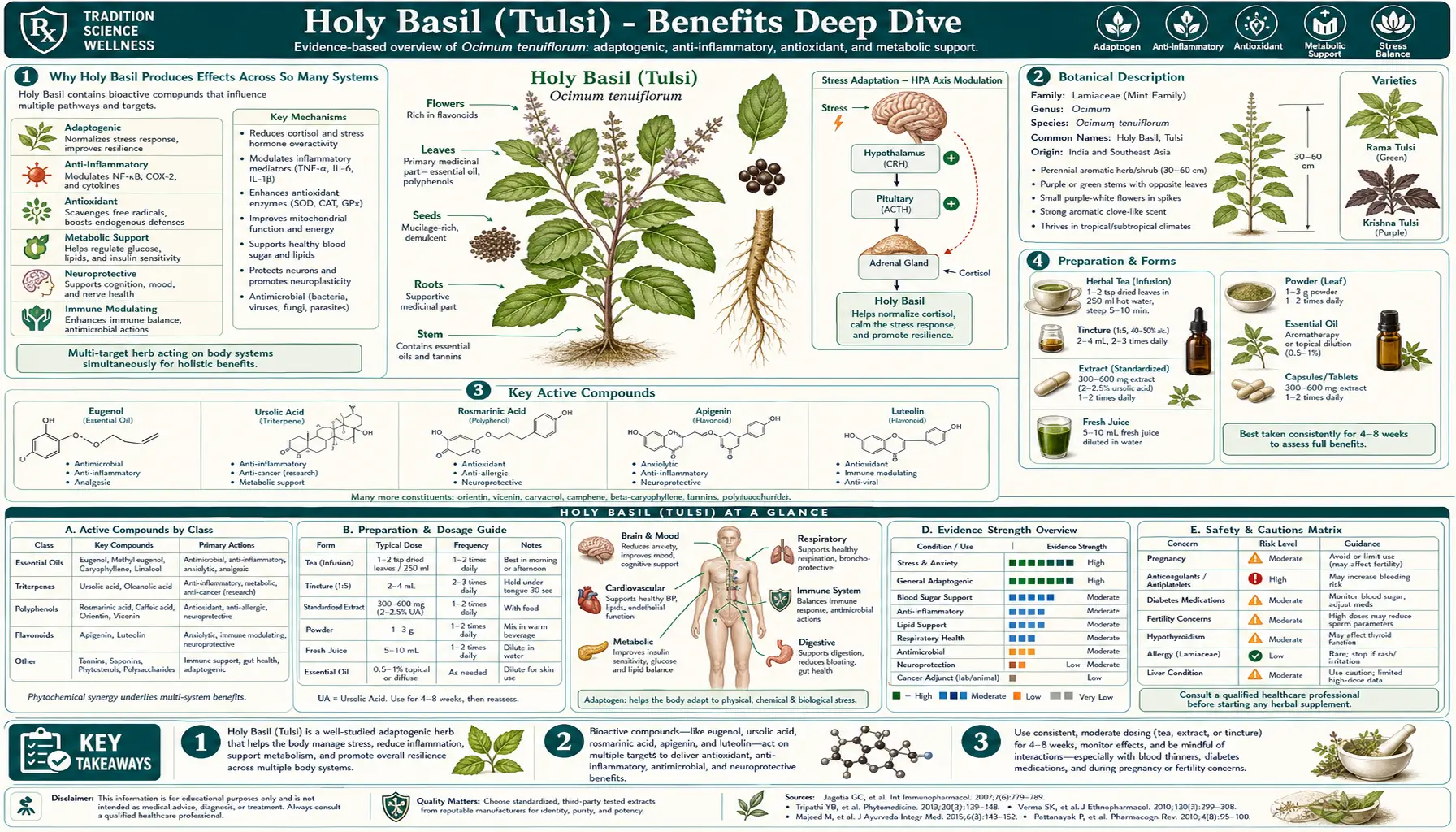
Holy Basil (Ocimum sanctum, also written Ocimum tenuiflorum), known as tulsi in Sanskrit and called "the incomparable one," is the most sacred plant in Hindu tradition and one of the most thoroughly studied herbs in modern Ayurvedic pharmacology. A single plant carries clinical effects across four very different conditions — HPA-axis stress adaptation with measurable cortisol reduction, glycemic control comparable to first-generation oral hypoglycemics in early diabetes, broad immune modulation including T-helper and NK cell activation, and bronchodilatory plus mucolytic respiratory action. The four deep-dive pages below walk through the pivotal clinical trials (Bhattacharyya 2008, Saxena 2012, Agrawal 1996, Mondal 2011, Singh 2002), the molecular mechanisms (eugenol COX inhibition, rosmarinic acid antioxidant action, ursolic acid NF-kB suppression, ocimumosides A/B HPA modulation), and why a single Ayurvedic adaptogen produces such different clinical effects depending on which organ system is targeted.
Deep-Dive Articles
Stress Adaptation & HPA Axis
The Bhattacharyya 2008 trial that established measurable serum cortisol reduction in healthy adults, the Saxena 2012 RCT in generalized anxiety disorder, the mechanism of eugenol + ursolic acid + rosmarinic acid on the hypothalamic-pituitary-adrenal axis, the "queen of herbs" Ayurvedic positioning as rasayana (rejuvenative tonic), and why holy basil produces a calming effect without sedation, dependency, or cognitive dulling — a profile that distinguishes it from benzodiazepines and SSRIs alike.
Blood Sugar & Diabetes
The landmark Agrawal 1996 RCT showing a 17.6% reduction in fasting glucose and a 7.3% reduction in postprandial glucose, the Mondal 2011 follow-up trial, the ICMR (Indian Council of Medical Research) studies that established tulsi as a documented adjunct for early type 2 diabetes, the mechanistic basis in pancreatic beta-cell stimulation and improved peripheral insulin sensitivity, and the practical regimen for adults using tulsi as part of a comprehensive metabolic protocol.
Immune Function
The Mondal 2011 trial documenting increased T-helper and natural killer cell activity in healthy adults taking tulsi extract, the broad antimicrobial spectrum (gram-positive and gram-negative bacteria, herpes simplex, hepatitis B, Candida, multidrug-resistant strains), the controlled trial of tulsi mouthwash as adjunct for radiation-induced oral mucositis, and the traditional use that long preceded the molecular validation: tulsi tea at the first sign of throat, sinus, or chest infection.
Respiratory Health
The Singh 2002 trial on bronchial asthma showing improved FEV1 and reduced symptom scores, the anti-tussive plus expectorant plus mucolytic mechanism (rare combination in a single plant), the traditional Ayurvedic combinations with ginger, turmeric, and black pepper for synergistic respiratory action, and the modern formulations (tulsi-pippali, tulsi-ginger-honey) that remain first-line for cough, bronchitis, and seasonal upper-respiratory infection in Indian household medicine.
Table of Contents
- Deep-Dive Articles
- Why Holy Basil Produces Effects Across So Many Systems
- Research Papers
- External Authoritative Resources
- Connections
- Featured Videos
Why Holy Basil Produces Effects Across So Many Systems
Most medicinal herbs are pharmacologically narrow — one or two active compounds producing one clinical effect, with everything else being marketing. Holy basil is genuinely unusual. A single plant produces clinically meaningful results in four very different conditions: chronic stress and anxiety, type 2 diabetes, immune dysregulation, and bronchial-respiratory disease. The reason traces to the herb's polypharmacy — at least five distinct bioactive compound classes, each acting on a different molecular target, packed into one biological matrix.
- Eugenol — a phenylpropanoid making up roughly 70% of the essential oil fraction in Krishna tulsi. Eugenol inhibits cyclooxygenase-2 (COX-2) at potencies comparable to ibuprofen, blocks calcium channels (the basis of mild blood-pressure reduction), relaxes bronchial smooth muscle (the basis of the asthma effect), and provides broad-spectrum antimicrobial activity. Eugenol is the single most-studied tulsi compound and explains the anti-inflammatory, mild antihypertensive, bronchodilatory, and antibacterial effects.
- Ursolic acid — a pentacyclic triterpenoid that suppresses NF-kB nuclear translocation, inhibits the pro-inflammatory cytokine cascade upstream of COX-2, and exerts measurable effects on glucose metabolism via AMPK activation in muscle and liver tissue. Ursolic acid is the principal mediator of the glycemic effect and contributes substantially to the long-term anti-inflammatory action.
- Rosmarinic acid — a polyphenolic antioxidant that scavenges reactive oxygen species, inhibits lipoxygenase (the leukotriene-producing pathway, separate from the COX prostaglandin pathway), and crosses the blood-brain barrier where it provides neuroprotection. Rosmarinic acid is the mediator of the antihistamine-like effect in allergic rhinitis and the cognitive-supportive properties.
- Ocimumosides A and B — two glycosides identified by the Bhattacharyya group at Central Drug Research Institute (Lucknow) as the principal mediators of the cortisol-modulating effect. Ocimumosides act on the hypothalamic-pituitary-adrenal axis, normalizing the cortisol response curve without the receptor downregulation that complicates chronic benzodiazepine or corticosteroid use.
- Apigenin and other flavonoids — apigenin acts at the GABA-A receptor benzodiazepine binding site, producing anxiolysis without sedation. This is a separate mechanism from the HPA-axis modulation and explains the rapid subjective calming effect of tulsi tea, distinct from the slow accumulation of HPA-axis adaptation that requires weeks of consistent dosing.
The therapeutic logic is that no single compound carries the full effect — the eugenol explains the respiratory and antimicrobial action, the ursolic acid explains the glycemic action, the rosmarinic acid explains the antioxidant and allergic effects, the ocimumosides explain the HPA modulation, and the apigenin explains the acute calming effect. A whole-plant extract or a standardized leaf powder delivers all five concurrently. This is why isolated tulsi-derived single-molecule pharmaceuticals have repeatedly underperformed the whole herb in clinical trials — the integrated effect requires the integrated phytochemistry.
The Ayurvedic positioning of holy basil as the "queen of herbs" and a premier rasayana (rejuvenative tonic) predates this molecular understanding by roughly three millennia. The Charaka Samhita and the Rig Veda both list tulsi as the herb prescribed for general resilience — what modern pharmacology would call multi-target polypharmacy. That ancient classification turns out to be a remarkably accurate description of what the phytochemistry actually does.
Research Papers
- Bhattacharyya D et al. (2008). Controlled programmed trial of Ocimum sanctum leaf on generalized anxiety disorders. Nepal Medical College Journal. — PubMed
- Saxena RC et al. (2012). Efficacy of an extract of Ocimum tenuiflorum (OciBest) in the management of general stress: a double-blind, placebo-controlled study. Evidence-Based Complementary and Alternative Medicine. — PubMed
- Agrawal P et al. (1996). Randomized placebo-controlled, single-blind trial of holy basil leaves in patients with noninsulin-dependent diabetes mellitus. International Journal of Clinical Pharmacology and Therapeutics. — PubMed
- Mondal S et al. (2011). Double-blinded randomized controlled trial for immunomodulatory effects of Tulsi (Ocimum sanctum Linn.) leaf extract on healthy volunteers. Journal of Ethnopharmacology. — PubMed
- Singh S et al. (2002). Effect of Ocimum sanctum fixed oil on chronic obstructive airway disease. Indian Journal of Pharmacology. — PubMed
External Authoritative Resources
- PubMed — All research on Holy Basil / Ocimum sanctum / Tulsi (~3,000+ papers)
- PMC — The Clinical Efficacy and Safety of Tulsi in Humans (Jamshidi & Cohen 2017 systematic review)
- Ministry of AYUSH (Government of India) — Ayurvedic Pharmacopoeia
- Indian Council of Medical Research (ICMR)
- NCCIH (NIH) — Herbs at a Glance
Connections
- All Herbs
- Holy Basil (Main Page)
- Holy Basil for Stress Adaptation
- Holy Basil for Blood Sugar & Diabetes
- Holy Basil for Immune Function
- Holy Basil for Respiratory Health
- Ashwagandha
- Rhodiola Rosea
- Bacopa Monnieri
- Ginger
- Turmeric
- Stress Management
- Blood Sugar
- Immune Boosting
- Diabetes
- Anxiety