Motherwort for Palpitations and Heart Complaints
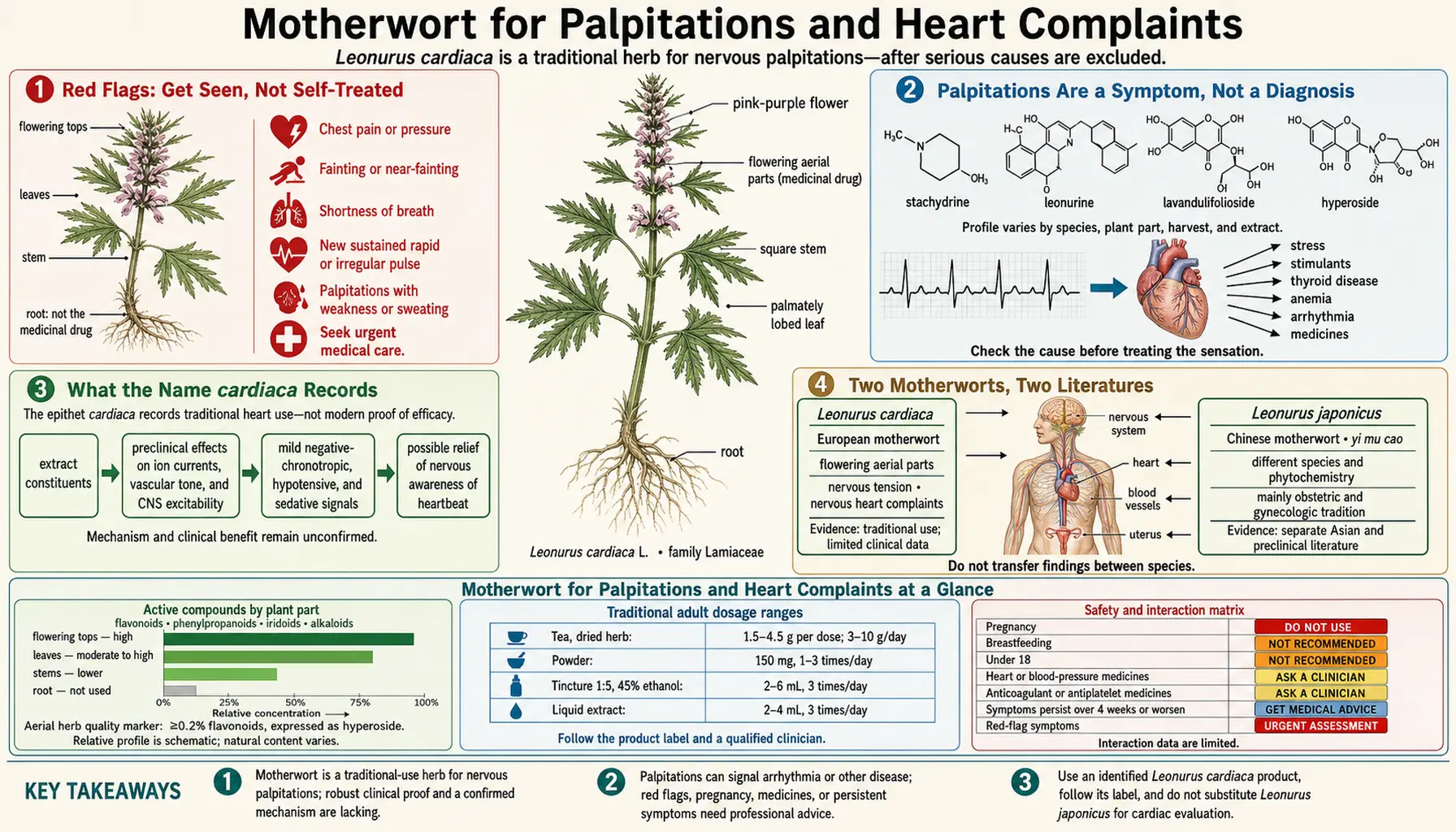
Most people who look up motherwort are looking up a feeling: a heart that thumps, flutters, races, or seems to trip over itself. The herb has carried a cardiac reputation for centuries — its botanical name, Leonurus cardiaca, says so outright — and if you search for a natural remedy for palpitations, motherwort is one of the first names you will meet. This page takes that tradition seriously and then does the harder thing: it tells you where the evidence actually stops, and why a page about palpitations has to be a page about getting a diagnosis first.
The single most useful sentence on this page is this one: palpitations are a symptom that needs a diagnosis, not a herb. Some causes are entirely benign. Some are not, and a few of the not-benign ones are treatable in ways that meaningfully lower your risk of stroke, heart failure, or sudden collapse — treatments that no plant substitutes for. Motherwort has never been shown in an adequate controlled trial to treat any arrhythmia. Read the red-flag list below before you read anything else.
Table of Contents
- Red Flags: Get Seen, Not Self-Treated
- Palpitations Are a Symptom, Not a Diagnosis
- What the Name cardiaca Records
- Two Motherworts, Two Literatures
- Constituents That Plausibly Touch the Heart
- The Preclinical Cardiac Work
- What Human Data Exist — and Their Limits
- Atrial Fibrillation: Why a Herb Does Not Cover the Risk
- Where Motherwort Might Reasonably Fit
- Forms, Bitterness, and Practical Notes
- Interactions in Exactly the Wrong Population
- Evidence Tiers at a Glance
- Key Research Papers
- Connections
Red Flags: Get Seen, Not Self-Treated
If any of the following apply to you, this is not a herb question. Arrange medical assessment — urgently for the first three.
- Palpitations with chest pain, chest pressure, or chest tightness. Treat as an emergency. Call emergency services.
- Palpitations with fainting, near-fainting, or greying-out vision. Loss or near-loss of consciousness during a fast heartbeat suggests the rhythm is not moving enough blood. This is one of the most important warning signs in all of cardiology.
- Palpitations with breathlessness at rest, or breathlessness that is new or worsening.
- A sustained fast heartbeat — one that goes on for many minutes or hours rather than a few seconds — or a rate you can count that is very fast (for example well above 120 beats per minute at rest).
- An irregular pulse that has no pattern to it, which is the classic feel of atrial fibrillation.
- Any known heart condition: a previous heart attack, heart failure, cardiomyopathy, valve disease, an implanted device, or a diagnosed rhythm disorder.
- New palpitations in someone with risk factors — older age, high blood pressure, diabetes, sleep apnoea, thyroid disease, a family history of sudden cardiac death, or a family history of unexplained drowning or seizure.
- Palpitations during exercise rather than after it, or palpitations triggered by exertion in a young person.
- Palpitations in pregnancy. This deserves assessment, and motherwort is contraindicated in pregnancy regardless — see the safety page.
The reason for insisting on this: palpitations are one of medicine's great convergent symptoms. The same flutter can come from caffeine, from a panic response, from an overactive thyroid, from anaemia, from low potassium or magnesium, from a benign extra beat, or from atrial fibrillation, supraventricular tachycardia, or a ventricular arrhythmia. You cannot tell which from the sensation alone, and neither can a herbalist. What tells you is a recording of the rhythm while it is happening — an ECG, a Holter monitor, a patch monitor, or in stubborn cases an implanted loop recorder — plus a small set of blood tests. That is a cheap, low-risk pathway with an enormous information payoff, and taking a bitter tincture instead of walking it delays the only step that changes anything.
Palpitations Are a Symptom, Not a Diagnosis
"Palpitations" simply means being aware of your own heartbeat in a way you do not usually notice. That awareness has no fixed cause. It can mean the heart is beating faster, harder, or irregularly — or, quite often, that the heart is doing something ordinary and your attention has landed on it. All three of those are real experiences; only some of them are cardiac problems.
The common benign causes
Premature beats — an early beat followed by a compensatory pause and then a stronger-than-usual beat — are the single most common explanation for the "thump" or "skip" people describe. Most people have some. In a structurally normal heart, isolated premature atrial or ventricular beats are generally considered harmless, though a very high burden of them warrants evaluation. Caffeine, nicotine, alcohol, decongestants, some asthma inhalers, thyroid medication, dehydration, poor sleep, and plain anxiety all raise awareness of the heartbeat.
The causes that are not cardiac at all
An overactive thyroid can present almost entirely as palpitations, tremor, and heat intolerance — see Hyperthyroidism. Anaemia makes the heart work harder to deliver the same oxygen, and can produce a pounding, fast pulse — see Anemia. Low potassium and low magnesium destabilise cardiac electrical repolarisation and are a genuinely common, genuinely correctable contributor; that is one of the few places where a nutrient rather than a herb has a defensible mechanism, covered on Magnesium Deficiency and Heart Palpitations.
The causes that need treatment
Atrial fibrillation, atrial flutter, supraventricular tachycardia and ventricular arrhythmias are all rhythm diagnoses with specific management, and some of them carry risks that have nothing to do with how bad the palpitations feel. This is the crux of the argument against self-treatment: symptom severity does not track risk. Plenty of atrial fibrillation is barely noticeable, and it still raises stroke risk. Plenty of benign premature beats feel dreadful, and they do not.
What the Name cardiaca Records
The plant's names are an unusually clear historical record. The genus Leonurus is Greek — leon (lion) plus oura (tail) — describing the long, shaggy, tapering flower spike; "lion's tail" survives as an English folk name. The species epithet cardiaca comes from kardia, heart. When Linnaean botany formalised the name, it was ratifying a use that was already old.
The vernacular names carry the same signal in different languages. The German Herzgespann is built on Herz (heart); older German and English herbals also use forms meaning heart-tension or heart-cramp, describing a gripped, constricted feeling in the chest. The old English name throw-wort is generally read as referring to the "throws" or throes of labour, tying the plant to the other half of its reputation. Between them, the names document two traditions — the cardiac and the obstetric — that were already firmly attached to this plant centuries before anyone could record an ECG.
Seventeenth-century English herbalism is emphatic. Nicholas Culpeper wrote that there was no better herb "to drive melancholy vapours from the heart, to strengthen it, and make the mind cheerful" — a line quoted in almost every modern account of motherwort, and worth noticing for what it describes: mood and a sense of cardiac strain together, not an arrhythmia. Pre-modern herbalists were describing the *experience* of a nervous, over-revved heart. They had no way of separating a panic-driven sinus tachycardia from atrial fibrillation, so the tradition cannot be read as evidence about either. Evidence tier: traditional use only.
Two Motherworts, Two Literatures
Anything you read about motherwort's cardiac effects needs a species attached to it, because two different plants share the common name and they do not share a research literature.
Leonurus cardiaca is the European plant — the one in European pharmacopoeias, the one registered in the EU as a traditional herbal medicinal product, and the one almost every English-language product means. Its research base is thin: a handful of laboratory and animal studies plus one small uncontrolled human report.
Leonurus japonicus is the East Asian species, known in traditional Chinese medicine as yi mu cao ("benefit-mother herb"). It is used at scale in China, has a far larger pharmacological literature, and is the source of most of the interesting molecular work — including nearly all of the research on the alkaloid leonurine, which is frequently and misleadingly attributed to European motherwort in supplement marketing.
This distinction matters practically. If you read a striking claim about motherwort protecting heart muscle or improving microcirculation, check the species: it is usually japonicus, often an isolated compound rather than the whole herb, and often given by injection in an animal model. That is not the same as a tincture of European L. cardiaca tops. Throughout this page, the species is named for every study described.
Constituents That Plausibly Touch the Heart
Motherwort is chemically busy, and no single molecule is "the active ingredient." Four groups matter for the cardiac discussion.
- Alkaloids — principally stachydrine. Stachydrine (also called proline betaine) is the most consistently measurable alkaloid in L. cardiaca and is used as an analytical marker. Direct quantification by nuclear magnetic resonance in Leonurus japonicus and L. cardiaca, reported by Kuchta and colleagues in Fitoterapia in 2014, is the standard reference for how the two species differ on this marker. Leonurine is the molecule with the more dramatic pharmacology, but it is associated chiefly with japonicus; in European cardiaca it is low, variable, and has been genuinely disputed in the analytical literature.
- Iridoid glycosides. Present across the genus and part of what defines the drug chemically; their contribution to any cardiac effect is not established.
- Flavonoids — rutin, quercetin, hyperoside, quercitrin and relatives. These are the constituents most often tested on heart-muscle preparations, and the ones examined in mitochondrial work.
- Diterpene bitters — labdane-type diterpenes such as leocardin, plus phenylethanoid glycosides including lavandulifolioside. The bitterness is not incidental: it is one of the plant's defining sensory features and one of the reasons people abandon the tea. New labdane diterpenes from L. cardiaca were characterised by Agnihotri and colleagues in Planta Medica in 2008.
Two honest consequences follow. First, whole-herb effects cannot be predicted from any one compound. Second, products vary enormously — by species, by harvest, by extraction solvent, and by whether the preparation is an aqueous infusion, an ethanolic tincture, or an oil extract. That variability is a large part of why clean clinical evidence has never materialised.
The Preclinical Cardiac Work
There is a real, if small, body of laboratory work on L. cardiaca and the heart. It is the most legitimate part of the herb's cardiac case, and it is still preclinical.
The most-cited experiment is by Ritter and colleagues, published in Planta Medica in 2010, on the cardiac and electrophysiological effects of primary and refined extracts of Leonurus cardiaca prepared to European Pharmacopoeia standards. Working on isolated cardiac preparations, they reported that the extracts slowed rate and produced electrophysiological changes of the general kind seen with mild antiarrhythmic activity, with effects attributed to more than one constituent class. This is a well-conducted study and it is also, unambiguously, a tissue-level result. It establishes plausibility. It does not establish that swallowing a tincture reaches a heart in a living person at a concentration that does anything. Evidence tier: preclinical (isolated tissue).
Bernatoniene and colleagues, in Planta Medica in 2014, examined L. cardiaca herb extract and several of its flavonoids on mitochondrial oxidative phosphorylation in the heart, describing effects on how cardiac mitochondria handle energy production. Again: a mechanism-level finding in a laboratory preparation. Evidence tier: preclinical.
Miłkowska-Leyck, Filipek and Strzelecka reported in the Journal of Ethnopharmacology in 2002 on the pharmacological effects of lavandulifolioside isolated from L. cardiaca, describing reduced heart rate, lowered blood pressure, and sedative effects in animal testing. This is the closest thing to an intact-organism cardiovascular result for a cardiaca constituent — and it is an isolated compound in animals, not the herb in humans. Evidence tier: preclinical (animal).
For the japonicus side of the ledger, work on leonurine spans cardioprotection, antioxidant activity and microcirculation, and includes a well-known report by Loh and colleagues in Stroke in 2010 describing leonurine's antioxidant and mitochondrial effects in a rat model of middle cerebral artery occlusion. Impressive, mechanistically interesting, and about a purified alkaloid from a different species in a stroke model — not a reason to take European motherwort for palpitations.
What Human Data Exist — and Their Limits
Here is the entire human picture, stated plainly.
The most-cited clinical report is by Shikov and colleagues in Phytotherapy Research in 2011: an evaluation of a Leonurus cardiaca oil extract in patients with arterial hypertension accompanied by anxiety and sleep disorders. Participants numbered in the dozens, the design was open-label with no placebo group, and the reported outcomes were improvements in anxiety and depression scores together with modest blood-pressure reductions. Every one of those outcomes is highly susceptible to expectation effects, regression to the mean, and observer bias — which is precisely what a placebo arm exists to control. The study has not been convincingly replicated. Evidence tier: preliminary uncontrolled human study.
Koshovyi and colleagues reported in Plants in 2021 on phytochemical and psychotropic research on modified dry extracts of L. cardiaca, pairing chemical characterisation with animal behavioural testing. That is chemistry plus animal work, not a human trial.
The general reviews say the same thing in more words. Wojtyniak, Szymański and Matławska's review of the phytochemistry and pharmacology of Leonurus cardiaca in Phytotherapy Research in 2013 remains the standard survey, and Fierascu and colleagues' 2019 update in BioMed Research International, written explicitly against the European Medicines Agency's assessment of the herb, reaches a comparable position: a rich traditional record, a reasonable preclinical base, and no adequate clinical trials.
So the honest bottom line for this section: there is no adequate controlled trial establishing motherwort as a treatment for any arrhythmia — not atrial fibrillation, not supraventricular tachycardia, not premature beats, not "palpitations" as a symptom. Europe's regulatory status for the herb reflects long-standing traditional use and an acceptable safety record, which is a different and much weaker claim than demonstrated efficacy. Anyone telling you otherwise is either describing tradition as though it were trial data, or quoting japonicus pharmacology as though it were a clinical result.
Atrial Fibrillation: Why a Herb Does Not Cover the Risk
This section exists because of a specific, foreseeable harm. Atrial fibrillation is common, it often presents as exactly the fluttering irregular heartbeat that sends people looking for motherwort, and its most serious consequence is completely silent until it happens.
In atrial fibrillation the atria quiver rather than contract, blood stagnates — particularly in the left atrial appendage — and clots can form and travel to the brain. The resulting strokes are, on average, more disabling than other strokes. The management of that risk is stroke-risk stratification and, for most people above a risk threshold, anticoagulation. That intervention is one of the better-evidenced in modern medicine, and its benefit is entirely independent of how much the palpitations bother you. Rate and rhythm control — medication, ablation, cardioversion — addresses symptoms and, in some patients, outcomes; anticoagulation addresses stroke.
Motherwort does none of that. It has no demonstrated effect on atrial fibrillation, no effect on clot formation in the atrium that anyone has shown, and no role in stroke prevention. What it can do, at least in principle, is soften the sensation enough that you postpone the appointment. Sustained untreated atrial fibrillation can also drive the heart muscle into a rate-related cardiomyopathy over months — a form of heart failure that is often reversible if the rhythm is treated and much less so if it is not.
If your palpitations are irregular, or if a pulse oximeter, smartwatch or blood-pressure cuff has flagged an irregular rhythm, that finding is worth an ECG regardless of how well you feel. Background reading: Atrial Fibrillation, Atrial Flutter, Arrhythmia, and Supraventricular Tachycardia.
Where Motherwort Might Reasonably Fit
None of the above means the herb is useless. It means its plausible role is narrow and specific, and it sits downstream of assessment rather than instead of it.
The defensible position looks like this. You have had palpitations evaluated. The recording showed sinus rhythm with occasional premature beats, or sinus tachycardia at times of stress; your thyroid, blood count and electrolytes were normal; your heart is structurally normal on echocardiography if that was done. Your clinician has told you the rhythm itself is not dangerous and that the problem is the awareness and the anxiety wrapped around it — a very common and very unpleasant situation that conventional medicine often has little to offer beyond reassurance and, sometimes, a beta-blocker.
In that setting, a mild, bitter, traditionally sedative herb taken for the nervous-tension component is a modest, low-stakes thing to try, provided you clear it against your medication list. What you would be treating is the anxiety and hypervigilance, not the rhythm — and that framing is honest about the mechanism, since the herb's best-supported activity in animals is sedative. See Motherwort for Anxiety and Nervous Tension for that side of the argument.
It also means adjusting expectations. Do not expect a herb to abolish premature beats. Do expect that reducing caffeine, treating sleep apnoea, correcting low magnesium or potassium, moderating alcohol, and addressing anxiety directly will each do more than any tincture. Those are unglamorous and they work.
Forms, Bitterness, and Practical Notes
The part used is the aerial part — the leafy flowering tops, gathered as the plant blooms.
- Infusion (tea). Traditionally around one to two grams of dried herb per cup, steeped covered. Be warned that motherwort is punishingly bitter — among the more unpleasant common herbal teas. Many people cannot finish a cup, which is itself a reason tea-based traditional dosing is hard to translate into anything consistent.
- Tincture. An ethanolic extract taken as drops in water is the most widely used modern form, largely because it sidesteps the volume of bitter liquid. The alcohol content is a consideration for anyone avoiding it and for anyone on medication where alcohol matters.
- Capsules. Powdered herb in capsules removes taste entirely, at the cost of fixing the dose at whatever the manufacturer chose and giving you no sensory feedback about the material.
- Oil extract. The preparation used in the Shikov study. It is not the same product as a tincture or a tea, and results with one preparation do not transfer to another.
Practical cautions specific to this page's audience: standardised dosing is not established, product quality varies, and species substitution between cardiaca and japonicus is a real phenomenon in the global supplement trade. Start low. Buy from a supplier that names the species on the label. And if you are on any cardiac or psychiatric medication, treat this as adding a drug — because pharmacologically that is what you are doing.
Interactions in Exactly the Wrong Population
Motherwort's problem is demographic as much as pharmacological. The people most drawn to it — people with palpitations, often older, often already diagnosed — are the people most likely to be taking beta-blockers, rate-limiting calcium channel blockers, antiarrhythmics, digoxin, or anticoagulants. That overlap turns theoretical interactions into practical ones.
In brief, and with the tier labelled honestly:
- Rate-slowing drugs (beta-blockers, diltiazem, verapamil, ivabradine): additive bradycardia is plausible given the animal heart-rate findings. Theoretical and preclinical, not documented in case reports.
- Digoxin and antiarrhythmic drugs: these have narrow therapeutic margins and the consequences of getting them wrong are arrhythmias. Adding an unquantified herb with electrophysiological activity in tissue is a poor trade. Theoretical.
- Sedatives (benzodiazepines, Z-drugs, sedating antihistamines, alcohol, other sedative herbs): additive drowsiness, and this one has the most mechanistic support of the group. Preclinical plus pharmacological class effect.
- Antiplatelet and anticoagulant drugs: caution on general principle for a herb with constituents that may affect platelets. Theoretical.
- Antihypertensives: additive blood-pressure lowering is plausible and, in someone already near the floor, symptomatic.
"Theoretical" is not a licence to ignore it. Where a population is heavily medicated and the consequences of an interaction are arrhythmia or bleeding, absence of published case reports mostly reflects that nobody is systematically collecting them. The asymmetry favours caution. The full discussion, including pregnancy, is on Motherwort Safety: Cardiac Interactions and Pregnancy.
Evidence Tiers at a Glance
- Traditional use only — motherwort for "nervous heart," cardiac tension, and stress-related palpitations. Centuries of European use; documented in the names cardiaca, Herzgespann and throw-wort; no trial support.
- Preclinical (isolated tissue) — extracts slow rate and alter cardiac electrophysiology (Ritter and colleagues, 2010, L. cardiaca).
- Preclinical (animal) — the isolated glycoside lavandulifolioside reduced heart rate and blood pressure and acted as a sedative (Miłkowska-Leyck and colleagues, 2002, L. cardiaca); leonurine cardioprotection and neuroprotection (largely L. japonicus).
- Preliminary human, uncontrolled — one small open-label oil-extract study in hypertension with anxiety and sleep disturbance (Shikov and colleagues, 2011).
- Randomized clinical trial evidence — none for palpitations, arrhythmia, blood pressure, or anxiety.
Key Research Papers
Every link below is a PubMed topic search, so it keeps working as the literature grows and shows you the current set rather than a single frozen record.
- Wojtyniak K, Szymański M, Matławska I. Leonurus cardiaca L. (motherwort): a review of its phytochemistry and pharmacology. Phytotherapy Research, 2013. The standard modern survey of what the plant contains and what has and has not been shown. PubMed: Leonurus cardiaca phytochemistry and pharmacology review
- Ritter M, Melichar K, Strahler S, et al. Cardiac and electrophysiological effects of primary and refined extracts from Leonurus cardiaca L. Planta Medica, 2010. Isolated cardiac preparations; rate slowing and mildly antiarrhythmic-type electrical effects. PubMed: Leonurus cardiaca cardiac electrophysiology
- Shikov AN, Pozharitskaya ON, Makarov VG, et al. Effect of Leonurus cardiaca oil extract in patients with arterial hypertension accompanied by anxiety and sleep disorders. Phytotherapy Research, 2011. The most-cited human report; small, open-label, no placebo arm. PubMed: Leonurus cardiaca oil extract hypertension anxiety
- Miłkowska-Leyck K, Filipek B, Strzelecka H. Pharmacological effects of lavandulifolioside from Leonurus cardiaca. Journal of Ethnopharmacology, 2002. Isolated glycoside; reduced heart rate and blood pressure and sedation in animals. PubMed: lavandulifolioside Leonurus cardiaca
- Bernatoniene J, Kopustinskiene DM, Jakstas V, et al. The effect of Leonurus cardiaca herb extract and some of its flavonoids on mitochondrial oxidative phosphorylation in the heart. Planta Medica, 2014. PubMed: Leonurus cardiaca flavonoids cardiac mitochondria
- Fierascu RC, Fierascu I, Ortan A, et al. Leonurus cardiaca L. as a source of bioactive compounds: an update of the European Medicines Agency assessment report. BioMed Research International, 2019. Ties chemistry and pharmacology to Europe's formal regulatory assessment. PubMed: Leonurus cardiaca bioactive compounds EMA assessment
- Kuchta K, Ortwein J, Hennig L, et al. Direct quantification of stachydrine in Leonurus japonicus and L. cardiaca by quantitative nuclear magnetic resonance. Fitoterapia, 2014. The reference for how the two species differ on their marker alkaloid. PubMed: stachydrine Leonurus japonicus and cardiaca
- Agnihotri VK, ElSohly HN, Smillie TJ, et al. New labdane diterpenes from Leonurus cardiaca. Planta Medica, 2008. Isolation of the bitter diterpene constituents. PubMed: labdane diterpenes Leonurus cardiaca
- Loh KP, Qi J, Tan BKH, et al. Leonurine protects middle cerebral artery occluded rats through antioxidant effect and regulation of mitochondrial function. Stroke, 2010. Purified alkaloid, animal model — and chiefly a japonicus constituent. PubMed: leonurine cerebral artery occlusion
- Koshovyi O, Raal A, Kireyev I, et al. Phytochemical and psychotropic research of motherwort (Leonurus cardiaca L.) modified dry extracts. Plants, 2021. Chemistry paired with animal behavioural testing. PubMed: Leonurus cardiaca psychotropic dry extracts
- Reviews of Leonurus japonicus (yi mu cao) traditional uses, phytochemistry and pharmacology, published across the ethnopharmacology literature. Cited here to make the species boundary explicit, since most leonurine pharmacology sits on this side of it. PubMed: Leonurus japonicus review
- Tachjian A, Maria V, Jahangir A. Use of herbal products and potential interactions in patients with cardiovascular diseases. Journal of the American College of Cardiology, 2010. The general framework for why cardiac patients are the wrong population for unquantified botanicals. PubMed: herbal products and cardiovascular drug interactions
- Broader searches for anything new on the herb and the heart: PubMed: Leonurus cardiaca arrhythmia and PubMed: motherwort palpitations clinical trial.
External Resources
- American Heart Association — patient information on arrhythmias and atrial fibrillation.
- MedlinePlus — US National Library of Medicine consumer health encyclopaedia.
- NHS (United Kingdom) — plain-language guidance on heart palpitations and when to seek urgent care.
- NCCIH — US National Center for Complementary and Integrative Health, on herbs and supplements.
- European Medicines Agency — publishes the herbal monograph and assessment report for motherwort herb.
Connections
- All Herbs
- Motherwort
- Motherwort Benefits Hub
- Motherwort for Anxiety
- Motherwort Safety
- Palpitations
- Heart Palpitations
- Arrhythmia
- Atrial Fibrillation
- Atrial Flutter
- Supraventricular Tachycardia
- Hypertension
- Hyperthyroidism
- Anemia
- Magnesium and Palpitations
- Potassium and Arrhythmia
- Hawthorn Benefits
- Hawthorn and Blood Pressure
- Valerian
- Lemon Balm
- Passionflower
- Cardiology
Safety Note and Disclaimer
This page is health education, not medical advice, and it is deliberately not an encouragement. Motherwort has no controlled-trial evidence for treating palpitations or any arrhythmia; its cardiac reputation is traditional and its supporting data are laboratory and animal work plus one small uncontrolled human study. A racing, irregular, skipping or pounding heartbeat — and any palpitation accompanied by chest pain, breathlessness, fainting or near-fainting — needs medical assessment and an ECG, not a herb. Do not stop, reduce or replace prescribed cardiac medication. Do not add motherwort if you take beta-blockers, other rate-slowing or blood-pressure drugs, digoxin, antiarrhythmics, sedatives, antiplatelet drugs or anticoagulants without first speaking to your doctor or pharmacist. Motherwort should be avoided in pregnancy and, for lack of data, while breastfeeding. Speak with a qualified clinician before starting any herbal preparation.