Hawthorn for Cardioprotection and Angina
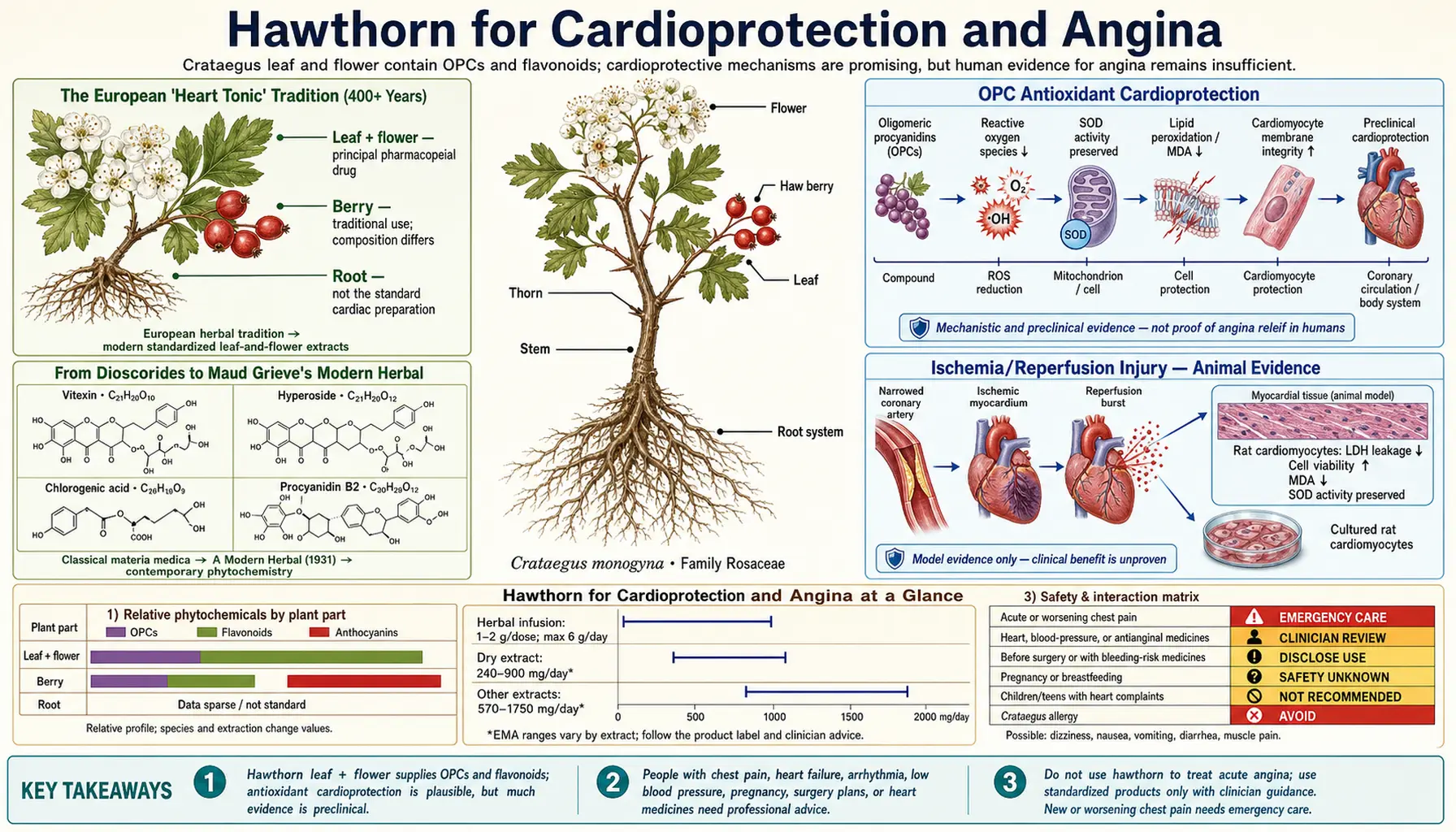
Beyond its formally approved indication for NYHA Class II heart failure, Hawthorn has been used for over four centuries in European herbal medicine as a general "heart tonic" — a gentle daily preparation for cardiac strengthening, prevention of ischemic events, and management of stable angina. Modern phytochemistry has explained much of this traditional use: Hawthorn flavonoids prolong the cardiac effective refractory period (anti-arrhythmic), oligomeric proanthocyanidins (OPCs) are among the most potent reactive-oxygen-species scavengers in the plant kingdom (cardioprotective against ischemia-reperfusion injury), and the combined OPC + flavonoid fraction increases coronary blood flow through endothelial nitric oxide release (anti-anginal). This deep-dive examines the cardioprotective and anti-anginal evidence, traces the long European history of the "heart herb" from Dioscorides through Grieve's 1931 Modern Herbal, and outlines the practical positioning of Hawthorn for the patient with ischemic heart disease, stable angina, or atrial fibrillation.
Table of Contents
- The European "Heart Tonic" Tradition (400+ Years)
- From Dioscorides to Maud Grieve's Modern Herbal
- OPC Antioxidant Cardioprotection
- Ischemia/Reperfusion Injury — Animal Evidence
- The Anti-Arrhythmic Mechanism
- Stable Angina — Clinical Evidence
- Atrial Fibrillation Considerations
- Coronary Blood Flow Enhancement
- Post-Myocardial-Infarction Recovery
- Practical Positioning — Where Hawthorn Fits
- Key Research Papers
- Connections
- Featured Videos
The European "Heart Tonic" Tradition (400+ Years)
Hawthorn (Crataegus) has been the European traditional remedy for cardiac complaints since at least the sixteenth century, when it first appears in vernacular herbals as a treatment for "weakness of the heart," "palpitations," and "cardiac exhaustion." By the eighteenth century it was an established item in continental European pharmacopoeias under the indication of tonicum cordis — a tonic for the heart.
The phrase "heart tonic" in the herbalist's lexicon meant something specific that has no direct equivalent in modern allopathic pharmacology. A tonic was understood as a long-term restorative agent that strengthened an organ's function without producing dramatic acute effects — closer in spirit to a vitamin or a structural support than to a drug. The patient was expected to take a tonic daily for months or years, not for a discrete pharmacologic event, and the benefit was expected to emerge slowly. This is in fact the pattern modern trials have confirmed for Hawthorn: the effect develops over 6-8 weeks, the magnitude is modest, and continuous long-term use is the well-established mode.
The most influential nineteenth-century clinical advocate was Irish-American physician Charles Cullen Greene, whose 1896 paper in the New York Medical Journal described striking clinical improvement in patients with "cardiac decompensation" treated with Hawthorn tincture. Greene's observations spread rapidly through North American eclectic and homeopathic practice and back to Europe, where they reinforced the existing herbal tradition and inspired more systematic phytochemical investigation in the twentieth century.
By the 1930s, German physiologists had begun to isolate the active fractions. By the 1970s, the OPC content of the leaf-and-flower extract had been characterized and standardized. The 1984 German Commission E approval, and the subsequent SPICE and HERB CHF trials, completed the arc from folk remedy to evidence-based therapy — one of the most successful examples of a traditional botanical surviving rigorous modern scrutiny.
From Dioscorides to Maud Grieve's Modern Herbal
The earliest documented medicinal use of Hawthorn appears in the first-century AD De Materia Medica of the Greek physician Pedanius Dioscorides, who recommended the fruit and bark for digestive complaints rather than for cardiac use. The specifically cardiac indication emerges later, in the early-modern European herbal tradition.
Key historical sources documenting the cardiac use:
- John Gerard, Herball (1597) — references the use of Hawthorn berries to "stay the bloody flux" but does not yet emphasize cardiac use
- Nicholas Culpeper, The English Physitian Enlarged (1653) — recommends Hawthorn for "stones in the kidneys" and dropsy (which we now recognize as cardiac edema)
- French and German pharmacopoeial monographs (eighteenth century) — the cardiac indication becomes formalized
- Maud Grieve, A Modern Herbal (1931) — the canonical English-language reference of the early twentieth century, which devotes a substantial chapter to Hawthorn and quotes Greene's 1896 observations approvingly. Grieve writes: "The fruit is an excellent cardiac tonic, useful in organic and functional heart troubles."
Grieve's entry captures the early-twentieth-century state of knowledge well. By her account, Hawthorn was used clinically for:
- "Functional heart trouble" (what we would now call anxious palpitations — see the Anxiety & Mood deep-dive)
- "Organic heart trouble" (structural heart disease, the modern equivalent of valvular disease and dilated cardiomyopathy)
- "Dropsy" (peripheral edema from cardiac failure)
- "Insomnia and nervousness arising from cardiac irritability"
This pattern of use — spanning structural heart disease, arrhythmia, edema, and the cardio-emotional crossover — is remarkably close to the indications modern phytochemistry has validated. The traditional knowledge was substantially correct; what modern research has added is mechanism, standardization, and dose-response.
OPC Antioxidant Cardioprotection
Oligomeric proanthocyanidins (OPCs) are among the most potent free-radical scavengers in the plant kingdom on a mole-for-mole basis. They sit alongside the proanthocyanidins of grape seed extract, pine bark (Pycnogenol), and dark cocoa as the dominant dietary source of high-potency polyphenolic antioxidants. The mechanism is direct hydrogen-atom transfer from the catechin / epicatechin hydroxyl groups to reactive oxygen species (ROS), neutralizing them before they can damage cellular structures.
In the cardiovascular system, the relevant ROS species are:
- Superoxide anion (O2•-) — generated by NADPH oxidase in inflammatory cells and by mitochondrial electron transport chain leak; principal driver of vascular endothelial dysfunction
- Hydroxyl radical (•OH) — the most reactive ROS; generated by the Fenton reaction; principal driver of cellular lipid peroxidation and DNA damage
- Peroxynitrite (ONOO-) — generated from NO + O2•- combination; nitrates protein tyrosines and impairs eNOS function
- Lipid hydroperoxides — oxidized phospholipids and oxidized LDL; drive atherosclerotic plaque formation
Hawthorn OPCs scavenge all of these species in cell-free assays at concentrations achievable with oral dosing. The clinical translation has been studied most rigorously in:
- Animal models of ischemia/reperfusion injury (see next section)
- Markers of oxidative stress in heart failure patients on chronic WS 1442 (modestly reduced 8-isoprostane and oxidized LDL in some studies)
- Markers of endothelial function (modestly improved flow-mediated dilation in some trials)
The size of the antioxidant effect in humans is modest compared to the in vitro potency, because of the substantial first-pass metabolism, bioavailability limitations, and competition from the body's endogenous antioxidant systems. But the effect is real and contributes to the overall cardioprotective profile.
Ischemia/Reperfusion Injury — Animal Evidence
Ischemia/reperfusion (I/R) injury is the paradoxical cellular damage that occurs not during the ischemic interval itself but immediately upon restoration of blood flow. It is the mechanism that limits the clinical benefit of reperfusion after myocardial infarction (after PCI or thrombolysis), liver transplantation, organ transplant generally, and stroke recanalization. The injury is driven by a burst of reactive oxygen species generation during the first minutes of reperfusion, when mitochondria suddenly resume electron transport in the presence of accumulated metabolic substrates and oxygen.
Hawthorn extract has been tested in multiple animal I/R models with consistently favorable results:
- Veveris et al. 2004 (pig model) — one of the most rigorous studies. Pigs treated with WS 1442 for 7 days before experimental coronary occlusion showed a 38% reduction in infarct size and significantly preserved contractile function 4 hours after reperfusion, compared to placebo-treated controls. The protective effect was abolished by NOS inhibitors, implicating the nitric oxide pathway as well as the antioxidant mechanism.
- Al Makdessi et al. 1996 (isolated rat heart) — Langendorff-perfused rat hearts pretreated with Hawthorn extract showed significantly better recovery of left ventricular developed pressure after 30 minutes of global ischemia and 60 minutes of reperfusion, with reduced lactate dehydrogenase release as a marker of cardiomyocyte damage.
- Jayalakshmi and Devaraj 2004 (rat model of isoproterenol-induced MI) — Hawthorn pretreatment reduced both infarct size and markers of oxidative damage (lipid peroxidation, protein carbonylation) in cardiac tissue.
The animal evidence has not been directly translated to large human trials of Hawthorn for acute MI or for cardioprotection during planned cardiac surgery, primarily because the regulatory and funding pathway for such trials of a non-patentable botanical is challenging. But the mechanistic case is strong, and it provides a rational basis for chronic Hawthorn use in patients with established ischemic heart disease as a long-term cardioprotective adjunct.
The Anti-Arrhythmic Mechanism
Hawthorn extracts prolong the cardiac effective refractory period (ERP) in isolated cardiac muscle preparations — an electrophysiologic effect that is broadly anti-arrhythmic for re-entrant arrhythmias such as paroxysmal supraventricular tachycardia, atrial flutter, and many cases of ventricular tachycardia. The mechanism appears to involve mild blockade of repolarizing potassium currents, similar in concept (though much weaker in magnitude) to the Class III antiarrhythmic drug amiodarone.
The clinical correlate is the SPICE trial subgroup finding of significantly reduced sudden cardiac death in patients with LVEF 25-35% (hazard ratio 0.59 for sudden cardiac death; see the Heart Failure deep-dive). Sudden cardiac death in heart failure patients is overwhelmingly due to ventricular arrhythmia, and a 41% reduction in this subgroup is mechanistically consistent with the anti-arrhythmic effect documented in cell-free studies.
Beyond the SPICE signal, smaller observational studies and case reports suggest reduced frequency of palpitations and benign ectopy in patients taking Hawthorn for general cardiovascular wellness. For atrial fibrillation specifically, see the next section.
An important contrast: while Hawthorn is broadly anti-arrhythmic and pro-arrhythmic effects are not seen in trials, it is not a replacement for established antiarrhythmic drugs in patients with documented dangerous arrhythmias. Patients with sustained ventricular tachycardia, AICD-eligible cardiomyopathy, or persistent atrial fibrillation require specialist management with established rate-control and rhythm-control strategies. Hawthorn fits adjunctively, not as primary therapy.
Stable Angina — Clinical Evidence
The European clinical literature on Hawthorn for stable angina is older and less rigorous than the heart failure data, because most modern trials have focused on the heart failure indication that received Commission E approval. However, multiple older European observational and uncontrolled studies, and the rational mechanism (anti-arrhythmic + coronary vasodilator + antioxidant), support adjunctive use:
- Hanak and Bruckel 1983 — an early German observational study of 60 patients with stable angina treated with Crataegus extract for 6 weeks reported reduction in anginal episode frequency and improved exercise tolerance on bicycle ergometry. The trial was open-label and uncontrolled.
- Iwamoto et al. 1981 (Japanese trial) — a small randomized trial of Crataegus extract in stable angina patients reported reductions in angina frequency and nitroglycerin consumption versus placebo.
- Animal coronary vasodilation studies — multiple studies in isolated coronary preparations demonstrate Hawthorn-induced vasodilation at concentrations achievable with oral dosing
The clinical positioning of Hawthorn for the patient with stable angina is:
- Adjunctive to established antianginal therapy (beta-blocker for first-line, nitrates for symptomatic episodes, sometimes calcium channel blocker)
- For the patient interested in a botanical addition that may incrementally improve exercise tolerance and reduce anginal frequency
- Not a replacement for any established secondary-prevention therapy — aspirin, statin, ACE inhibitor or ARB, beta-blocker as indicated
- Not appropriate for unstable angina (which is a medical emergency requiring hospitalization, not a botanical) — see Chest Pain for red-flag features
Atrial Fibrillation Considerations
Atrial fibrillation is the most common sustained arrhythmia, affecting an estimated 6 million Americans, with prevalence climbing steeply with age. Modern management involves anticoagulation for stroke prevention (warfarin or a direct oral anticoagulant), rate control (typically a beta-blocker or calcium channel blocker), and selective rhythm control (cardioversion, antiarrhythmics, ablation) in symptomatic patients.
Hawthorn's role in atrial fibrillation has not been well studied in dedicated trials, but the mechanistic profile suggests several potential roles:
- Symptom palliation — the mild anti-arrhythmic and rate-modulating effects may reduce palpitations and the subjective sense of cardiac irregularity, particularly in paroxysmal AF where episodes are intermittent. This is most relevant for patients on rate-control therapy who continue to have symptom burden.
- Adjunct in the "anxious-with-palpitations" phenotype — patients whose AF episodes are particularly distressing due to associated anxiety may benefit from the combined cardiac and mild anxiolytic effects (see the Anxiety & Mood deep-dive)
- Long-term cardioprotection — the antioxidant and endothelial-supportive effects are theoretically beneficial in a population at elevated cardiovascular risk
Important cautions:
- Hawthorn does not replace anticoagulation for stroke prevention. The patient with AF and an elevated CHA2DS2-VASc score still needs warfarin, dabigatran, rivaroxaban, apixaban, or edoxaban as appropriate.
- Hawthorn does not reliably restore sinus rhythm or rate-control patients to target rates — conventional rate-control or rhythm-control is required
- The mild antiplatelet activity of Hawthorn flavonoids is theoretically additive with anticoagulants — clinically the magnitude is small but worth monitoring
Coronary Blood Flow Enhancement
One of the older traditional uses of Hawthorn was as a "coronary vasodilator" for patients with ischemic heart disease. Modern phytochemistry has confirmed this effect through the endothelial nitric oxide synthase (eNOS) pathway already described.
The clinical relevance:
- In healthy coronary arteries, increased coronary blood flow improves myocardial oxygen delivery
- In atherosclerotic coronary arteries with fixed obstructive lesions, the magnitude of vasodilation is limited by the rigid stenosed segment, but the upstream and downstream segments can still vasodilate
- In coronary microvascular dysfunction (a recognized cause of angina with non-obstructive coronaries, particularly in women), the endothelial nitric oxide pathway is specifically impaired, and Hawthorn's eNOS activation could theoretically restore some microvascular function
The relevance to specific clinical contexts:
- Patient with established coronary artery disease on optimal medical therapy with residual exercise-induced angina — Hawthorn as a low-risk adjunct for symptom improvement
- Patient with INOCA (Ischemia with Non-Obstructive Coronary Arteries) where conventional therapy options are limited — Hawthorn worth considering given the microvascular dysfunction mechanism
- Patient with vasospastic (Prinzmetal's) angina — calcium channel blockers and nitrates remain first-line, but Hawthorn may have adjunctive role
Post-Myocardial-Infarction Recovery
The animal I/R data provides a rational basis for considering chronic Hawthorn use in patients recovering from myocardial infarction or undergoing cardiac rehabilitation, as one element of a comprehensive cardioprotective strategy. The conventional foundation remains:
- Dual antiplatelet therapy (aspirin + P2Y12 inhibitor for typically 12 months post-stent)
- High-intensity statin
- ACE inhibitor or ARB (especially with reduced ejection fraction or anterior MI)
- Beta-blocker (especially with reduced ejection fraction)
- Cardiac rehabilitation program (exercise, education, risk-factor modification)
- Smoking cessation, weight loss, blood pressure control
Hawthorn fits as an adjunct in this regimen with several theoretical benefits: antioxidant cardioprotection against ongoing oxidative stress, mild anti-arrhythmic effect reducing the small but real residual sudden cardiac death risk in post-MI patients with reduced ejection fraction, and mild improvement in exercise tolerance during the recovery and rehabilitation phase.
None of this is established by dedicated randomized trials in post-MI populations — the existing trial data is for chronic stable heart failure, not for post-MI cardioprotection — but the mechanistic rationale is reasonable, and the safety profile of Hawthorn is well established. Patients interested in this use should discuss with their cardiologist and ensure that Hawthorn is not displacing any guideline-directed primary therapy.
Practical Positioning — Where Hawthorn Fits
Beyond the formally approved NYHA Class II heart failure indication and the supportive blood pressure data, Hawthorn occupies a niche role in adjunctive cardiovascular care:
- Stable angina — adjunct to beta-blocker, statin, aspirin; symptom and exercise-tolerance improvement
- Atrial fibrillation — symptom palliation in rate-controlled patients with continued palpitations; not a replacement for anticoagulation or rate/rhythm control
- Post-MI recovery — adjunct to guideline-directed therapy; antioxidant and mild anti-arrhythmic effects theoretically beneficial
- Vasospastic / microvascular angina — eNOS activation pathway aligned with the underlying pathophysiology
- General cardiac wellness in elderly patients — the older European herbalist's "heart tonic" use for the patient over 70 with structural heart disease, mild symptoms, and a desire for a gentle long-term cardiotonic
Hawthorn is not appropriate as:
- Replacement for any established secondary-prevention therapy after myocardial infarction
- Replacement for anticoagulation in atrial fibrillation
- Primary therapy for unstable angina, acute coronary syndrome, or sustained dangerous arrhythmia
- Treatment for severe valvular disease or advanced systolic dysfunction
Key Research Papers
- Veveris M et al. (2004). Crataegus special extract WS 1442 improves cardiac function and reduces infarct size in a pig model of acute myocardial infarction. Life Sci 74(15):1945-1955. — PubMed
- Al Makdessi S et al. (1996). Myocardial protection by pretreatment with Crataegus oxyacantha: an assessment by means of the isolated perfused rat heart. Arzneimittelforschung 46(1):25-27. — PubMed
- Jayalakshmi R, Devaraj SN (2004). Cardioprotective effect of tincture of Crataegus on isoproterenol-induced myocardial infarction in rats. J Pharm Pharmacol 56(7):921-926. — PubMed
- Bahorun T et al. (1996). Phytochemical and antioxidant properties of Crataegus monogyna phytomedicines. Phytomedicine 3(1):95-101. — PubMed
- Wang J, Xiong X, Feng B (2013). Effect of crataegus usage in cardiovascular disease prevention: an evidence-based approach. Evid Based Complement Alternat Med. — PubMed
- Long SR et al. (2006). Crataegus oxyacantha: a clinical update with focus on heart failure. Therapy 3(4):527-533. — PubMed
- Tassell MC et al. (2010). Hawthorn (Crataegus spp.) in the treatment of cardiovascular disease. Pharmacogn Rev 4(7):32-41. — PubMed
- Garjani A et al. (2009). The effect of total extract of Securigera securidaca seeds and Crataegus oxyacantha on ischemia-reperfusion-induced arrhythmias in rats. Phytother Res 23(7):990-994. — PubMed
- Schwinger RH et al. (2000). Crataegus special extract WS 1442 increases force of contraction in human myocardium cAMP-independently. J Cardiovasc Pharmacol 35(5):700-707. — PubMed
- Liu P et al. (2010). Quantification of flavonoids in Crataegus pinnatifida by HPLC. J Food Sci 75(5):C467-C474. — PubMed
- Belz GG, Mohr-Kahaly S (2002). Crataegus utilis und kardiovaskulaere Pharmakologie. Cardiovascular Drugs and Therapy 16(3):205-211. — PubMed
- Joseph G et al. (1995). Pharmacological investigation of Crataegus oxyacantha extract on isolated guinea pig heart. Arzneimittelforschung 45(11):1157-1161. — PubMed
PubMed Topic Searches
- PubMed: Crataegus ischemia/reperfusion
- PubMed: Hawthorn antioxidant cardioprotection
- PubMed: Crataegus angina
- PubMed: Hawthorn arrhythmia refractory period
- PubMed: Crataegus coronary vasodilation
Connections
- All Herbs
- Hawthorn Overview
- Hawthorn Benefits Hub
- Hawthorn for Heart Failure
- Hawthorn for Blood Pressure
- Hawthorn for Anxiety
- Heart Failure
- Hypertension
- Chest Pain
- Cardiovascular Health
- Quercetin
- Garlic
- Turmeric
- Ginger
- Lipid Panel