Elderberry — Benefits Deep Dive
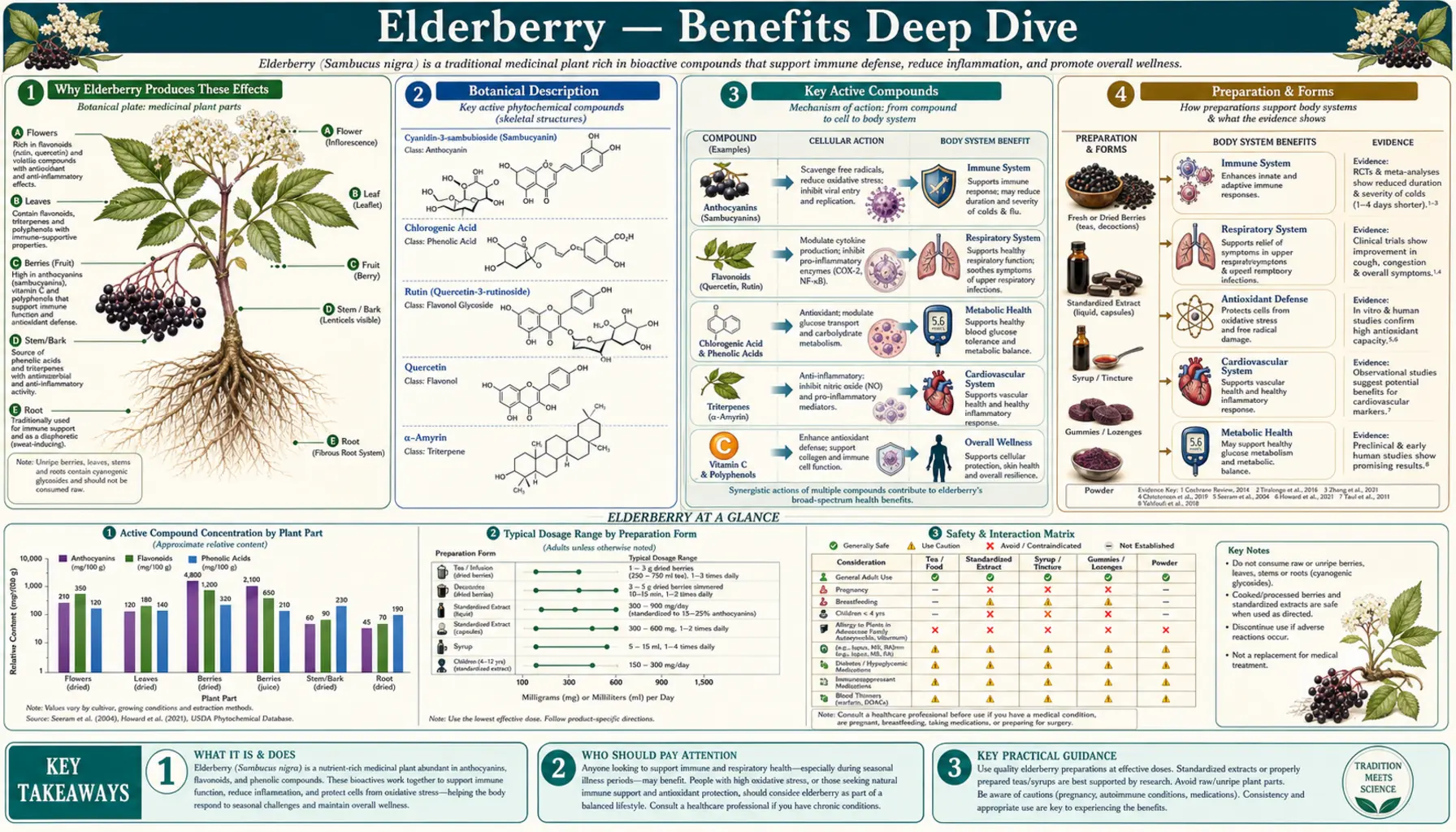
Elderberry (Sambucus nigra, European black elderberry) is the most-studied herbal cold-and-flu remedy in the Western herbal pharmacopoeia. The commercial Sambucol standardized syrup — developed by Israeli virologist Dr. Madeleine Mumcuoglu in the 1990s and validated in two influenza randomized controlled trials — established the clinical credibility that drove elderberry from folk remedy to mainstream supplement-aisle staple. The active compounds are deeply pigmented anthocyanins (especially cyanidin-3-glucoside and cyanidin-3-sambubioside) that directly bind influenza hemagglutinin and neuraminidase, neutralizing viral entry and replication. Critically: raw elderberries, leaves, bark, and stems contain cyanogenic glycosides (sambunigrin) that release hydrogen cyanide during digestion — raw fruit consumption has produced documented poisoning, including a 2020 cluster of hospitalized children. All elderberry preparations must be cooked, fermented, or commercially processed before consumption. Four deep-dive pages below explore the cold-and-flu evidence base, the broader immune-modulation pharmacology, the antioxidant and cardiovascular pilot data, and the preparation-and-safety landscape every elderberry consumer needs to understand.
Deep-Dive Articles
Cold & Flu
The two Zakay-Rones randomized controlled trials of Sambucol elderberry syrup for influenza (1995 Panama B outbreak; 2004 Norway B/Yamagata trial) — both showed symptom resolution approximately 4 days shorter than placebo. The Tiralongo 2016 randomized trial of intercontinental air travelers showing reduced cold duration and severity. The Hawkins 2018 meta-analysis pooling 180 patients across these trials. Mechanism: anthocyanins directly bind influenza hemagglutinin and inhibit neuraminidase.
Immune Modulation
Why anthocyanin-rich black elderberry produces broad-spectrum immune effects beyond direct antiviral action. The Barak 2001 ex-vivo cytokine study (Sambucol increased IL-1β, IL-6, IL-8, TNF-α production from healthy monocytes 2-45 fold). Upper respiratory anti-inflammatory effects via flavonoid signaling, complement activation, and the dual immune-stimulating-but-resolving cytokine profile.
Antioxidant & Cardiovascular
Black elderberry has one of the highest measured ORAC (oxygen radical absorbance capacity) values of any fruit — ranking with aronia and blackcurrant at the top of the polyphenol hierarchy. Cyanidin-3-glucoside (C3G) and cyanidin-3-sambubioside are the dominant anthocyanins. Small pilot trials of elderberry extract on blood pressure, lipid profiles, endothelial function, and uric acid — promising but underpowered, requiring larger confirmation.
Preparation & Safety
Raw elderberry toxicity warning. Cyanogenic glycoside sambunigrin in raw fruit, stems, leaves, and bark releases hydrogen cyanide on digestion — produces nausea, vomiting, dizziness, weakness, and in severe cases respiratory failure. The 2020 hospitalized-children cluster from raw juice consumption. Cooking and fermentation requirement (≥30 min simmer, >75°C). Commercial syrup safety. Autoimmune theoretical caution (Th1/cytokine stimulation may flare lupus, MS, RA).
Table of Contents
- Deep-Dive Articles
- Why Elderberry Produces These Effects
- Key Research Papers
- External Authoritative Resources
- Connections
- Featured Videos
Why Elderberry Produces These Effects
Black elderberry (Sambucus nigra) owes essentially all of its documented clinical effects to a single family of compounds: the deeply pigmented anthocyanins and related flavonoids concentrated in the ripe fruit skin and juice. These compounds act through three reinforcing mechanisms, each of which maps to a different category of clinical effect.
- Direct viral neutralization (anthocyanin binding to influenza surface proteins) — Cyanidin-3-glucoside (C3G) and cyanidin-3-sambubioside, the dominant anthocyanins in black elderberry, bind directly to influenza A and B hemagglutinin spikes. This sterically blocks viral attachment to sialic acid residues on host respiratory epithelium — the same docking step targeted by neuraminidase inhibitors like oseltamivir (Tamiflu), though via a different mechanism. Elderberry extracts also weakly inhibit influenza neuraminidase enzyme activity. The Krawitz, Roschek, and Torabian in-vitro studies all confirm dose-dependent reduction in viral plaque formation. This is the mechanism behind the Zakay-Rones influenza trials and the Tiralongo air-travel trial.
- Immune modulation (cytokine stimulation in healthy cells, anti-inflammatory in inflamed states) — The Barak 2001 ex-vivo study showed that Sambucol incubated with peripheral blood monocytes from healthy donors increased pro-inflammatory cytokine production 2–45 fold (IL-1β, IL-6, IL-8, TNF-α). Importantly, this is the cytokine pattern needed to mount an effective antiviral response. Other studies show elderberry polyphenols also activate complement (C3a and C5a) and stimulate neutrophil function. The result is a "trained" immune response that fights established infection without causing the dysregulated cytokine storm seen in severe viral disease. See Immune Modulation for the full mechanism map.
- Antioxidant and vascular polyphenol effects — Black elderberry has one of the highest measured ORAC values of any food (approximately 14,700 µmol TE per 100 g for the fresh fruit), driven by the same anthocyanins that handle the antiviral and immune work. These polyphenols scavenge reactive oxygen species, upregulate endogenous antioxidant enzymes (superoxide dismutase, catalase, glutathione peroxidase) via Nrf2 signaling, inhibit LDL oxidation, and modestly improve endothelial function in small clinical studies. See Antioxidant & Cardiovascular.
The therapeutic complication that overshadows all of these benefits is that the same Sambucus nigra plant that contains medicinal anthocyanins in the cooked ripe fruit also contains cyanogenic glycosides (primarily sambunigrin) in the raw fruit, the unripe green berries, the leaves, the bark, the stems, and the root. These glycosides release hydrogen cyanide (HCN) when hydrolyzed by digestive enzymes, producing classic cyanide poisoning symptoms: nausea, vomiting, diarrhea, dizziness, weakness, tachycardia, and in severe cases respiratory failure and seizures. Heat denatures the cyanogenic glycoside enzyme system and drives off HCN as a gas — this is why traditional elderberry preparations always involve simmering, fermentation, or baking. Commercial syrups, jams, wines, and liqueurs are safe because they have been heat-processed. Preparation and Safety explores in detail why raw elderberry juice from a home juicer is dangerous, why the 2020 hospitalized-children case happened, and why autoimmune patients should approach elderberry with theoretical caution.
Key Research Papers
- Zakay-Rones Z, Varsano N, Zlotnik M, Manor O, Regev L, Schlesinger M, Mumcuoglu M (1995). Inhibition of several strains of influenza virus in vitro and reduction of symptoms by an elderberry extract (Sambucus nigra L.) during an outbreak of influenza B Panama. Journal of Alternative and Complementary Medicine 1(4):361-9. — PubMed 9395631
- Zakay-Rones Z, Thom E, Wollan T, Wadstein J (2004). Randomized study of the efficacy and safety of oral elderberry extract in the treatment of influenza A and B virus infections. Journal of International Medical Research 32(2):132-40. — PubMed 15080016
- Tiralongo E, Wee SS, Lea RA (2016). Elderberry supplementation reduces cold duration and symptoms in air-travellers: a randomized, double-blind placebo-controlled clinical trial. Nutrients 8(4):182. — PubMed 27023596
- Hawkins J, Baker C, Cherry L, Dunne E (2019). Black elderberry (Sambucus nigra) supplementation effectively treats upper respiratory symptoms: A meta-analysis of randomized, controlled clinical trials. Complementary Therapies in Medicine 42:361-365. — PubMed 30670267
- Barak V, Halperin T, Kalickman I (2001). The effect of Sambucol, a black elderberry-based, natural product, on the production of human cytokines: I. Inflammatory cytokines. European Cytokine Network 12(2):290-6. — PubMed 11399518
PubMed Topic Searches
- PubMed: Sambucus nigra influenza
- PubMed: Elderberry anthocyanin / cyanidin-3-glucoside
- PubMed: Sambucol clinical trial
- PubMed: Elderberry URI meta-analysis
- PubMed: Sambunigrin cyanogenic glycoside toxicity
External Authoritative Resources
- NCCIH (NIH National Center for Complementary and Integrative Health) — Elderberry — balanced US government overview of evidence and safety
- MedlinePlus — Elderberry (Sambucus nigra) — consumer-facing safety and drug-interaction summary
- CDC MMWR — Poisoning from Elderberry Juice (1984 California outbreak) — classic public-health case report of raw-juice cyanogenic poisoning
- European Medicines Agency — Sambuci flos (Elder flower) monograph — formal EU herbal monograph
- PubMed — All Sambucus nigra research (~600+ papers)
Connections
- All Herbs
- Elderberry (Main Page)
- Elderberry for Cold and Flu
- Elderberry for Immune Modulation
- Elderberry Antioxidant and Cardiovascular
- Elderberry Preparation and Safety
- Echinacea
- Andrographis
- Garlic
- Quercetin
- Vitamin C
- Vitamin D3
- Zinc
- Influenza
- Cold & Flu Treatments
- Immune Boosting
- Oxidative Stress
- Sinusitis