Dong Quai and Menopause: An Evidence Review
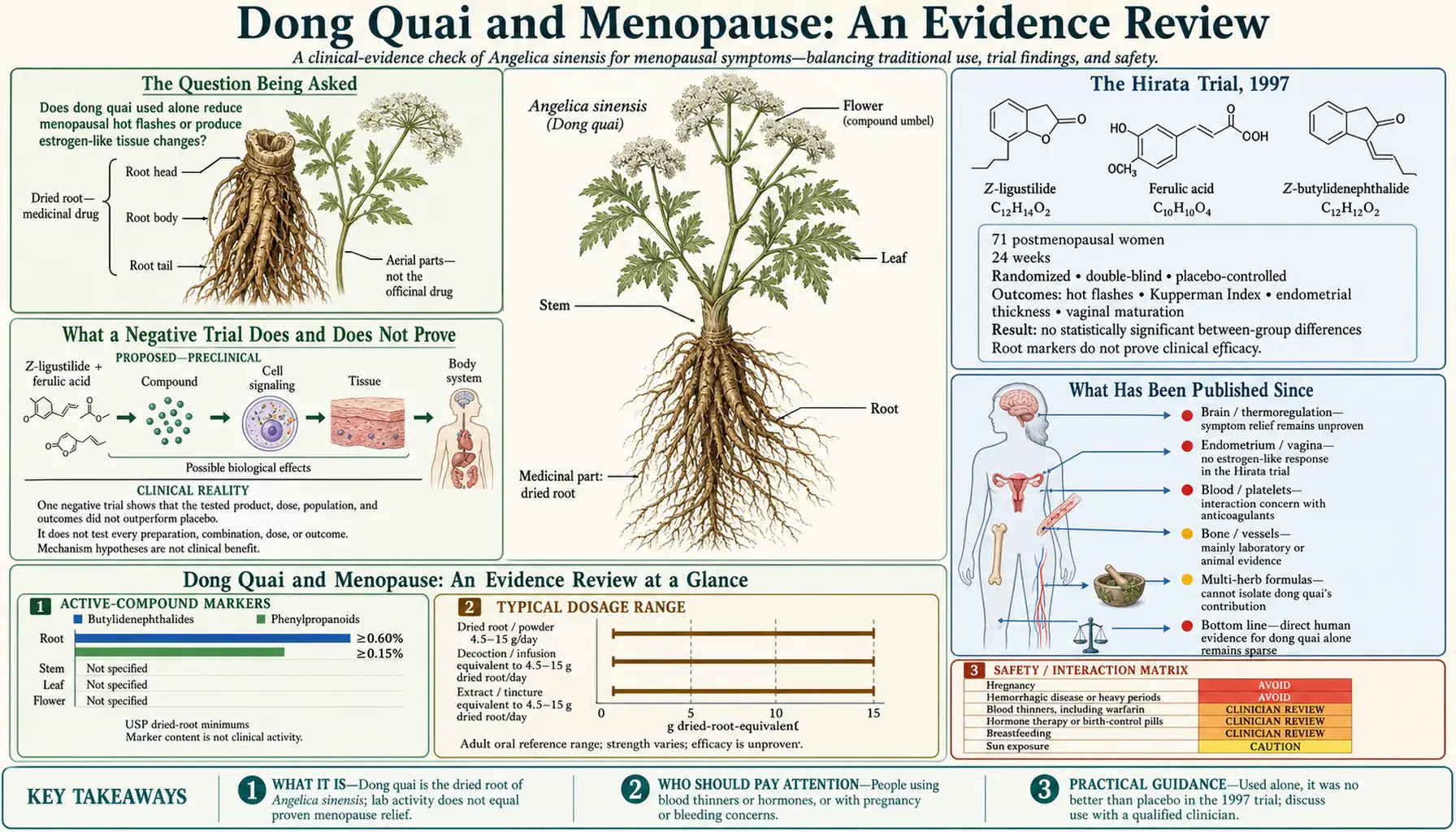
This page is a review, not a benefit claim. Dong Quai is one of the most widely sold botanicals for hot flushes, and it is also one of the very few that has been put through a properly designed randomised, placebo-controlled trial. The trial was negative, nothing published since has overturned it, and this article explains what was tested, what the fair counter-arguments are, and why they do not rescue the claim.
Table of Contents
- The Question Being Asked
- The Hirata Trial, 1997
- What a Negative Trial Does and Does Not Prove
- What Has Been Published Since
- The Fair Counter-Argument — and Its Limits
- Is Dong Quai Oestrogenic at All?
- Endometrial Safety and Hormone-Sensitive Conditions
- The Bleeding Argument Against Casual Use
- What Actually Works for Hot Flushes
- The Bottom Line
- Cautions and Contraindications
- Key Research Papers
- Connections
- Featured Videos
The Question Being Asked
Be precise about the claim on trial, because vagueness is how weak evidence survives.
The claim made by the supplement market is: a woman with vasomotor symptoms — hot flushes and night sweats — who takes Dong Quai capsules will have fewer or milder flushes than she would otherwise. That is a testable claim about a single herb taken alone, in a capsule, for a defined symptom, and it is the claim that matters because it is the one people spend money on.
It is a different question from “does a Chinese herbal formula prescribed by a practitioner for a diagnosed pattern help menopausal complaints”, and different again from “is Dang Gui a useful herb”. Those questions have their own answers, discussed below. But when a bottle labelled “Dong Quai — Female Ginseng” sits on a shelf in the menopause aisle, the first claim is the one being sold, and it is the one this page evaluates.
One piece of context is worth carrying through: as the Benefits hub explains, “female ginseng” is a Western marketing label. Traditional Chinese medicine does not classify Dang Gui as a menopause remedy, and it does not use it as a solo herb. The Western use case was, from the beginning, something of an invention.
The Hirata Trial, 1997
In 1997, Hirata and colleagues published a randomised, double-blind, placebo-controlled trial in Fertility and Sterility with the blunt title “Does dong quai have estrogenic effects in postmenopausal women?”
The design was straightforward and, for a botanical trial of that era, unusually good:
- 71 postmenopausal women, randomised.
- Dong Quai root preparation versus matching placebo, double-blind.
- 24 weeks of treatment — long enough for a real effect on vasomotor symptoms to appear, and long enough to look at tissue endpoints.
- Three outcomes chosen to detect both symptom relief and any oestrogen-like tissue effect:
- Hot flush counts — the symptom that matters to patients.
- Vaginal maturation index — a cytological measure of oestrogenic effect on vaginal epithelium.
- Endometrial thickness on ultrasound — another tissue-level oestrogen readout.
The result: no difference from placebo on any of the three. Hot flushes did not fall more in the treatment group. The vaginal maturation index did not change. Endometrial thickness did not change. The authors concluded that dong quai used alone did not produce oestrogen-like effects and was no more useful than placebo for menopausal symptoms.
Two features of the design deserve emphasis, because they are what make this trial hard to argue with:
- It was placebo-controlled and double-blind. Hot flushes are notoriously placebo-responsive — placebo arms in vasomotor trials routinely report reductions of 20–40% or more. An uncontrolled study of any hot-flush remedy will look impressive. Only a placebo arm separates the drug from the expectation.
- It measured tissue as well as symptoms. A herb could theoretically relieve flushes without being oestrogenic. Hirata's design tested both, and found neither.
What a Negative Trial Does and Does Not Prove
Honesty runs in both directions, so here is what the trial does not establish.
- It does not prove Dong Quai is inert. It tested one preparation, at one dose, in one population, for one set of outcomes.
- With 71 participants, a very small effect could have been missed. That is true of any trial of that size. But a hot-flush treatment whose effect is too small to detect in 71 women over 24 weeks is not a treatment anyone should be buying.
- It tested the single herb, not a formula. This is the strongest legitimate objection and it is addressed below.
What the trial does establish is more than enough for a purchasing decision: a Dong Quai preparation taken alone for 24 weeks did not beat a sugar pill for hot flushes. Given that this is precisely how the product is sold in the West, that is the relevant finding.
What Has Been Published Since
Nearly three decades on, the picture has not changed. Systematic reviews of botanicals for menopausal symptoms have repeatedly examined Dong Quai and have not found evidence that the single herb reduces hot flushes; reviews of complementary approaches for menopause consistently place it among the botanicals without supportive trial evidence, in contrast with a handful of others where the data are merely mixed.
The most relevant subsequent randomised trial actually tested a formula rather than the solo herb. Haines and colleagues, publishing in Climacteric in 2008, ran a randomised, double-blind, placebo-controlled study of Dang Gui Buxue Tang — the classical two-herb astragalus-and-Dong-Quai decoction — in Hong Kong Chinese women with menopausal symptoms. The formula was not shown to be more effective than placebo for the symptom outcomes studied.
That result matters because it closes off the easiest escape route. It is not the case that nobody ever tested a traditional Dang Gui formula properly. Someone did, in the population where the tradition originates, and it also failed to beat placebo.
The Fair Counter-Argument — and Its Limits
There is a real argument on the other side, and it deserves to be stated properly rather than strawmanned.
The argument: Chinese medicine never uses Dang Gui as a solo herb for menopausal symptoms. Traditional practice diagnoses a pattern — kidney yin deficiency with empty heat, liver qi constraint, and so on — and prescribes a multi-herb formula tailored to it, adjusted over time. Testing a single herb in an undifferentiated population is, from within that framework, testing something the tradition never claimed. Herbs in a formula also interact chemically: as the research on Dang Gui Bu Xue Tang shows, co-decoction changes what is extracted, and combinations are not the sum of their parts.
Some combination products have performed better than the solo herb. A small trial by Kupfersztain and colleagues, published in 2003, tested a preparation combining Angelica sinensis with German chamomile (Matricaria chamomilla) in women with hot flushes and reported a reduction in flush frequency. This is a genuine data point and should not be hidden.
Now the limits of that argument, which are substantial:
- The Kupfersztain study was small, and combination trials of this size in a condition with a large placebo response are exactly the kind of study that fails to replicate.
- A positive result for Angelica sinensis plus chamomile is not evidence for Angelica sinensis. Chamomile is the other half of the product, and attributing the effect to the herb you are selling is the oldest error in botanical research. The same logic applies to Si Wu Tang derivatives, where peony and chuan xiong are equally credible candidates.
- When a traditional Dang Gui formula was tested properly — Haines 2008 — it did not beat placebo either.
- Most decisively: the counter-argument is an argument for formulas, not for the product people actually buy. Even if it is entirely correct, it provides no support whatsoever for a bottle of single-herb Dong Quai capsules. If anything, it argues against them.
So the fair position is this: individualised Chinese herbal treatment for menopausal symptoms is a legitimate open question that has not been settled, and anyone who wants to pursue it should do so with a licensed practitioner using a formula. That open question does not make the solo-herb evidence positive. It remains negative.
Is Dong Quai Oestrogenic at All?
Two claims circulate simultaneously, which should itself be a warning sign: that Dong Quai works because it is a phytoestrogen, and that it is dangerous because it is a phytoestrogen. Both rest on the same unresolved premise.
What the evidence actually shows:
- Hirata's trial found no oestrogenic tissue effects — no change in vaginal maturation index, no change in endometrial thickness — after 24 weeks. This is the most relevant human evidence available, and it points away from clinically meaningful oestrogenicity.
- Laboratory screens have been inconsistent. Amato and colleagues, in Menopause in 2002, screened herbs commonly sold for menopausal symptoms for oestrogenic activity in a cell-based system; across this body of in-vitro work, results for Dong Quai have varied with the assay, the extract and the concentration used. No consistent oestrogen-receptor signal has emerged.
- Dong Quai is not a classical phytoestrogen source. It is not rich in isoflavones or lignans the way soy, red clover and flaxseed are. Its characteristic constituents are phthalides, coumarins, ferulic acid and polysaccharides — chemistry with no obvious reason to bind oestrogen receptors.
Honest verdict: the oestrogenic question is unresolved, and the weight of the human evidence leans towards “not meaningfully oestrogenic”. Anyone who tells you confidently that Dong Quai is a phytoestrogen — whether to sell it or to warn you off it — is going beyond the data.
Endometrial Safety and Hormone-Sensitive Conditions
Standard advice is to avoid Dong Quai if you have breast, uterine or ovarian cancer, endometriosis or fibroids. That advice is worth following, but you should understand what it rests on.
It rests on precaution, not demonstration. Given that the oestrogenic question is unresolved, and given that these are conditions where an unnecessary hormonal exposure could plausibly matter, declining a supplement with no proven benefit is an easy call. The risk-benefit arithmetic is simple when the benefit side is zero.
What would be dishonest is to state that Dong Quai has been shown to stimulate hormone-sensitive tissue. It has not — and Hirata's endometrial thickness result is mild evidence against it. Two things can be true at once: the precaution is sensible, and the mechanism behind it is unproven.
A separate and firmer point: any postmenopausal bleeding requires medical assessment, always, regardless of what supplements you take. Do not attribute it to a herb.
The Bleeding Argument Against Casual Use
Even setting efficacy aside, Dong Quai carries a specific risk that is under-communicated in the menopause context. As set out in the circulation article, Z-ligustilide has demonstrated antiplatelet activity and there are published case reports of markedly raised INR and bleeding when Dong Quai was added to stable warfarin therapy.
This matters more, not less, at this stage of life. Women in their fifties and sixties are increasingly likely to be taking daily aspirin, an anticoagulant for atrial fibrillation, or an antiplatelet drug after a cardiac event — and increasingly likely to be scheduled for procedures where bleeding matters. A supplement with no demonstrated benefit and a documented interaction with the most-monitored drug in the pharmacopoeia is a poor addition to that picture.
What Actually Works for Hot Flushes
It would be a failure of this page to say “this does not work” and stop there. Vasomotor symptoms are genuinely miserable, they can last for years, and they are treatable. Options worth discussing with a clinician:
- Menopausal hormone therapy remains the most effective treatment for hot flushes by a wide margin. The risk picture is far more favourable than the 2002 headlines suggested, particularly for women starting within ten years of their final period and under 60, and transdermal oestrogen carries a different venous-thrombosis profile from oral. The decision is individual, but many women were frightened away from an effective treatment by a misread of the evidence.
- Non-hormonal prescription options — certain SSRIs and SNRIs (such as venlafaxine, paroxetine and escitalopram), gabapentin, oxybutynin, and clonidine — have randomised evidence for vasomotor symptoms and are useful when hormones are contraindicated or unwanted.
- Neurokinin-3 receptor antagonists such as fezolinetant are a newer non-hormonal class developed specifically for vasomotor symptoms, working on the hypothalamic thermoregulatory pathway rather than on hormones.
- Cognitive behavioural therapy for menopausal symptoms has randomised evidence. It does not reduce flush frequency much, but it reliably reduces how bothersome they are — which is often the thing that actually affects daily life.
- Practical measures: layered clothing, a cool bedroom, reducing alcohol and identifying personal triggers, weight management, and stopping smoking.
- Other botanicals — black cohosh has the largest evidence base of any herb here, and even that is genuinely mixed rather than clearly positive. It is a more defensible choice than Dong Quai on the evidence, which is a low bar.
The Bottom Line
Stated as plainly as this site knows how:
If you are buying Dong Quai capsules for hot flushes, the best available evidence says they will not work. A 24-week randomised, double-blind, placebo-controlled trial in 71 postmenopausal women found no effect on hot flush frequency, no effect on vaginal maturation, and no effect on endometrial thickness. A later randomised placebo-controlled trial of the classical Dang Gui Buxue Tang formula also failed to beat placebo. Nothing published since has overturned either result.
Dong Quai remains a genuinely important herb in Chinese medicine with real pharmacology and a long, serious history — explored in the History article. Menopause is simply not what it is good at, and it never was: that use case was created by Western marketing, not by the tradition. Spend the money on something with evidence behind it, and spend the appointment time on the options above.
Cautions and Contraindications
- Warfarin — the single most important item. Published case reports describe markedly raised INR and bleeding after Dong Quai was added to stable warfarin therapy; coumarin constituents plus antiplatelet phthalides make the mechanism doubly plausible. Do not combine. Extend the same caution to apixaban, rivaroxaban, edoxaban, dabigatran, clopidogrel and daily aspirin.
- Stop two weeks before surgery and dental procedures, and tell the team you were taking it.
- Pregnancy. Avoid — traditional uterine-stimulant reputation and no human safety data. Relevant in perimenopause, where pregnancy is still possible.
- Breastfeeding. Insufficient data; avoid.
- Hormone-sensitive conditions. Avoidance is conventionally advised in breast, uterine and ovarian cancer, endometriosis and fibroids. Be clear that this is precautionary: evidence that Dong Quai is meaningfully oestrogenic is weak and inconsistent. Follow the precaution, but do not accept that the question is settled.
- Tamoxifen and aromatase inhibitors. Do not add botanicals marketed as hormonal without your oncology team's knowledge.
- Photosensitivity — state the uncertainty. Widely asserted, imperfectly demonstrated for this species. A. sinensis contains far lower furanocoumarin levels than A. archangelica, and the warning is largely extrapolated from related species. A theoretical caution at high doses, not an established effect.
- Any postmenopausal bleeding needs medical assessment. Never attribute it to a supplement.
- Heavy or erratic perimenopausal bleeding. Avoid Dong Quai — the antiplatelet activity works against you here.
Key Research Papers
- Hirata JD, Swiersz LM, Zell B, Small R, Ettinger B. Does dong quai have estrogenic effects in postmenopausal women? A double-blind, placebo-controlled trial. Fertility and Sterility. 1997;68(6):981–986.
- Haines CJ, Lam PM, Chung TK, Cheng KF, Leung PC. A randomized, double-blind, placebo-controlled study of the effect of a Chinese herbal medicine preparation (Dang Gui Buxue Tang) on menopausal symptoms in Hong Kong Chinese women. Climacteric. 2008;11(3):244–251.
- Kupfersztain C, Rotem C, Fagot R, Kaplan B. The immediate effect of natural plant extract, Angelica sinensis and Matricaria chamomilla (Climex) for the treatment of hot flushes during menopause. Clinical and Experimental Obstetrics & Gynecology. 2003;30(4):203–206.
- Amato P, Christophe S, Mellon PL. Estrogenic activity of herbs commonly used as remedies for menopausal symptoms. Menopause. 2002;9(2):145–150.
- Wei WL, Zeng R, Gu CM, Qu Y, Huang LF. Angelica sinensis in China — A review of botanical profile, ethnopharmacology, phytochemistry and chemical analysis. Journal of Ethnopharmacology. 2016;190:116–141.
- Zhang Y, Zhu Z, Li X, et al. Angelica sinensis: Botany, Traditional Uses, Phytochemistry, Pharmacology, Safety, and Applications. The American Journal of Chinese Medicine. 2026;54(4):1213–1251.
- Page RL 2nd, Lawrence JD. Potentiation of warfarin by dong quai. Pharmacotherapy. 1999;19(7):870–876.
- Ge B, Zhang Z, Zuo Z. Updates on the clinical evidenced herb-warfarin interactions. Evidence-Based Complementary and Alternative Medicine. 2014;2014:957362.
- Gong AG, Li N, Lau KM, et al. Calycosin orchestrates the functions of Danggui Buxue Tang, a Chinese herbal decoction composing of Astragali Radix and Angelicae Sinensis Radix. Journal of Ethnopharmacology. 2015;168:150–157.
- Maunder A, Mardon AK, Rao V, et al. Complementary therapies for management of menopausal symptoms: a systematic review to inform the update of the International Menopause Society recommendations on women's midlife health. Climacteric. 2026;29(2):165–209.
Live PubMed Searches
- Dong quai and menopause
- Angelica sinensis and hot flushes
- Danggui Buxue Tang menopausal symptoms
- Phytoestrogens and vasomotor symptoms
- Placebo response in hot-flush trials
- Fezolinetant for vasomotor symptoms
- CBT for menopausal hot flushes
- Black cohosh for menopause
- Hormone therapy and the timing hypothesis
Connections
- All Herbs
- Dong Quai (Angelica sinensis)
- Dong Quai Benefits Hub
- Dong Quai: History and Traditional Use
- Menstrual Health and Cramps
- Blood Building and Anemia
- Circulation and Cardiovascular
- Black Cohosh
- Chasteberry
- White Peony
- Astragalus
- Angelica (Angelica archangelica)
- Ferulic Acid