Dong Quai for Circulation and Cardiovascular Health
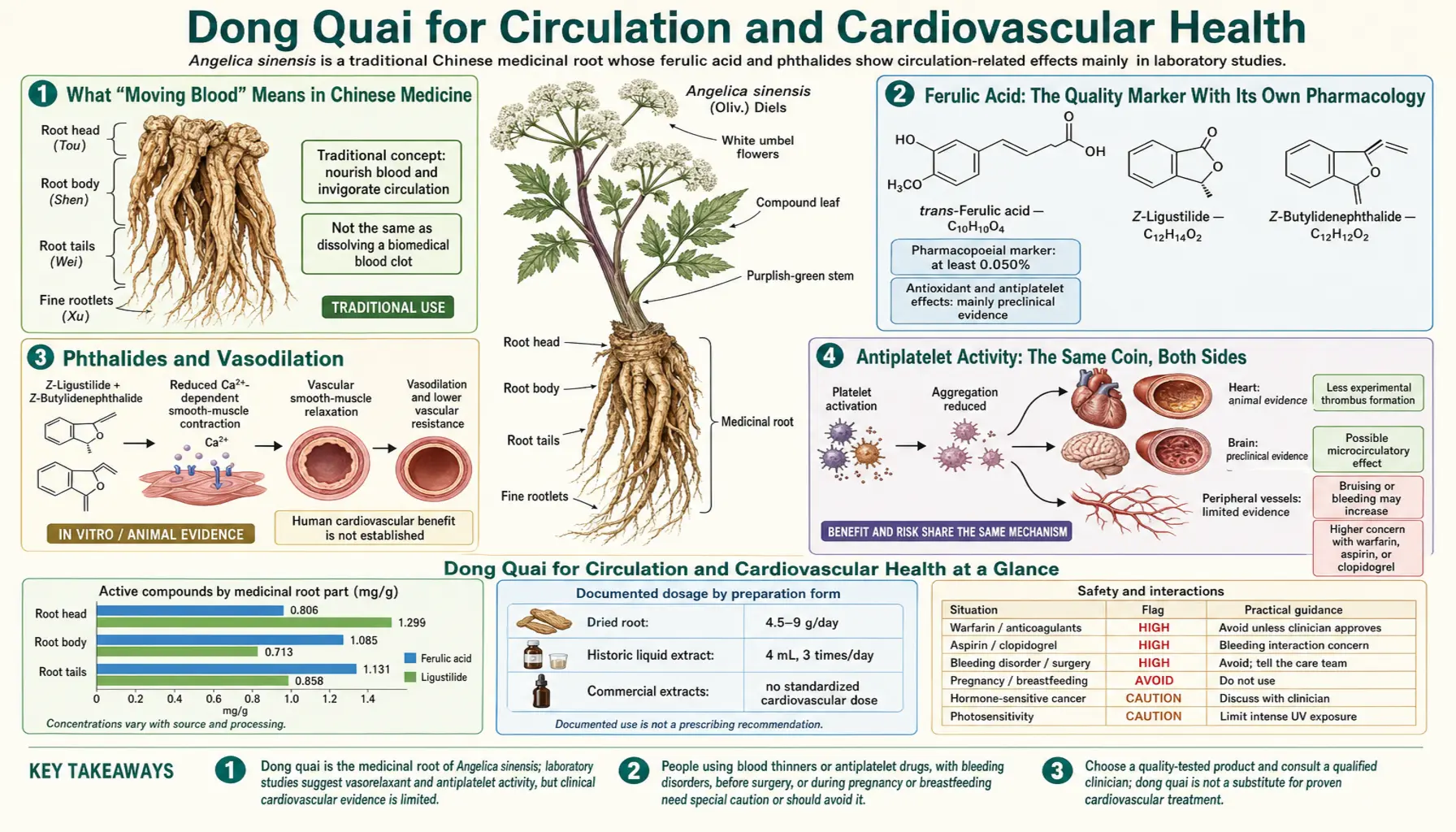
This is the area where Dong Quai's laboratory pharmacology is most convincing — the root contains compounds that genuinely relax blood vessels and genuinely inhibit platelets. It is also the area where that same pharmacology creates the herb's most serious safety problem. A herb that thins the blood is a herb that can make you bleed, and the case reports involving warfarin are not hypothetical.
Table of Contents
- What “Moving Blood” Means in Chinese Medicine
- Ferulic Acid: The Quality Marker With Its Own Pharmacology
- Phthalides and Vasodilation
- Antiplatelet Activity: The Same Coin, Both Sides
- Dang Gui Bu Xue Tang and Vascular Research
- What Human Cardiovascular Evidence Exists
- Where It Does Not Belong: Warfarin, Surgery, Bleeding Disorders
- Forms, Doses and Quality
- What Actually Moves Cardiovascular Risk
- Cautions and Contraindications
- Key Research Papers
- Connections
- Featured Videos
What “Moving Blood” Means in Chinese Medicine
Chinese medicine describes a pattern called xue yu — blood stasis. Its signs are fixed, stabbing pain that is worse at night and worse with pressure, dark or purplish discolouration of the tongue and lips, visible spider veins, dark clotted menstrual flow, and masses or lumps. Herbs that treat it are said to “invigorate blood and dispel stasis” (huo xue hua yu).
It is worth appreciating that this is one of the places where a traditional category maps unusually well onto modern physiology. A description of fixed pain, dusky colour, clotting and mass formation is a reasonable pre-modern description of impaired perfusion and thrombosis. So when the tradition says Dang Gui “moves blood” and modern chemistry finds vasodilator and antiplatelet compounds in the root, that is a genuine convergence rather than a retrofit.
Dong Quai occupies an unusual position: it both tonifies and moves blood. The fine root tails (dang gui wei) were traditionally considered the stronger movers, the body (dang gui shen) the stronger tonic. Almost all commercial material is whole root, quan dang gui.
Ferulic Acid: The Quality Marker With Its Own Pharmacology
Ferulic acid is a hydroxycinnamic acid found throughout the plant kingdom — in rice bran, wheat bran, coffee, artichoke and, relevantly here, in Dong Quai root. The Chinese Pharmacopoeia uses it as the HPLC quality marker for Radix Angelicae Sinensis, with a minimum content around 0.05%.
Two things need saying about that, and the second is the one usually left out.
First, ferulic acid is not pharmacologically inert. It is a capable free-radical scavenger, has been reported to inhibit platelet aggregation and thromboxane formation, and is studied for endothelial effects. In Chinese pharmacology it is often described as a contributor to the “blood-moving” actions.
Second — and this is the honest caveat — a marker compound is chosen for measurability, not for importance. Ferulic acid is stable, cheap to assay and easy to standardise against, which makes it an excellent quality control tool. It does not follow that it is the constituent doing the work, and the concentration of ferulic acid a person achieves in plasma after a decoction is far below what most cell experiments use. A product that passes on ferulic acid may still have lost nearly all of its volatile oil, which is where the phthalides live.
Phthalides and Vasodilation
The volatile oil is the more interesting fraction for circulation. Its dominant component is Z-ligustilide, accompanied by butylidenephthalide, senkyunolide A and a family of related and dimerised phthalides.
In isolated-tissue and animal work, these compounds relax vascular smooth muscle. The reported mechanisms include interference with calcium entry into smooth-muscle cells and effects on vascular tone regulation; ligustilide has also been studied for effects on cerebral blood flow and in models of ischaemic brain injury. Butylidenephthalide has a long history in Chinese pharmacology as an antianginal candidate, and phthalides as a class have attracted drug-development interest well beyond cardiology — including for neurodegenerative disease.
Two structural facts about ligustilide shape everything downstream:
- It is volatile and unstable. It oxidises, polymerises and dimerises on exposure to air, light and warmth. Stored root loses it. This is the honest explanation for why Dong Quai from a busy Chinese pharmacy and Dong Quai from a supermarket shelf behave differently.
- Its systemic exposure after oral dosing is modest and short-lived. Pharmacokinetic studies show rapid absorption and rapid elimination. The plasma concentrations achieved are not obviously in the range used in tissue-bath work.
So the fair statement is: the vasodilator pharmacology is real in the laboratory and mechanistically coherent with traditional use, and it has not been shown to produce a measurable clinical benefit in people. That gap is not a technicality — it is where the great majority of promising botanical mechanisms stop.
Antiplatelet Activity: The Same Coin, Both Sides
Platelets are the first responders of clotting. When ADP, collagen or thrombin activates them, they change shape, become sticky, and aggregate into a plug. Aspirin works by permanently disabling one enzyme (COX-1) in that pathway; clopidogrel works by blocking the ADP receptor.
Z-ligustilide has been shown to reduce ADP-induced platelet aggregation in rats and to reduce thrombus formation in an arteriovenous shunt model. Ferulic acid has been reported to inhibit platelet aggregation as well. Traditional practice, in its own vocabulary, has been saying the same thing for centuries: this herb moves blood and should not be given to someone who is bleeding.
Here is the thing that supplement marketing consistently fails to say out loud. “Improves circulation” and “increases bleeding risk” are the same finding described twice. There is no version of this pharmacology in which the herb thins the blood usefully but not inconveniently. If you believe the circulation claim, you must also believe the bleeding claim — they rest on identical evidence, and the bleeding side actually has human case reports behind it while the benefit side does not.
Dang Gui Bu Xue Tang and Vascular Research
Dang Gui Bu Xue Tang is the two-herb formula that pairs Dong Quai with astragalus, and it has become a favourite research model for the study of herbal combinations. It contains a famous surprise: the ratio is five parts astragalus to one part Dong Quai by weight, even though the formula is named after Dong Quai, the minor ingredient.
Modern work on the formula has looked at what that ratio actually does chemically. Co-decoction changes the extraction of constituents relative to decocting the herbs separately; the astragalus isoflavonoid calycosin has been identified as a major contributor to the decoction's measured biological activities, including in assays relevant to blood-vessel formation and endothelial function; and, strikingly, work on the formula has reported that components of the Angelica volatile oil can suppress some of the decoction's biological properties — which argues directly against the intuition that more Dang Gui would make it stronger.
Interpret it carefully. This literature is chemistry and cell biology of considerable sophistication. It tells you that traditional ratios are not arbitrary and that herb combinations are chemically more than the sum of their parts. It does not tell you that the formula improves circulation in human beings, and it hints that the vascular activity people attribute to Dong Quai may substantially belong to the astragalus sitting next to it.
What Human Cardiovascular Evidence Exists
Very little, and it should be said without euphemism.
- There are no randomised outcome trials. Nothing showing that Dong Quai reduces heart attacks, strokes, cardiovascular death, or amputation in peripheral arterial disease.
- There are no substantial randomised trials of surrogate endpoints — blood pressure, flow-mediated dilation, walking distance in claudication, lipid profiles — that would carry weight in a cardiology setting.
- Intravenous Angelica preparations have been used in Chinese hospital practice for stroke and vascular indications, and there is a Chinese-language literature on them. Those studies generally do not meet the methodological standards applied elsewhere, they use a parenteral product with a different exposure profile, and they say nothing about a capsule bought online.
- The best-designed randomised placebo-controlled trial of Dong Quai in any indication — Hirata and colleagues, 1997 — was negative. That is a different question, but it is a useful reminder of what happens to this herb under proper methodology.
The honest bottom line: if you are taking Dong Quai for your heart or your circulation, you are acting on plausible mechanism, not on demonstrated benefit — while accepting a documented bleeding risk. That is an unfavourable trade for most people, and a clearly bad one for anyone already on an antithrombotic drug.
Where It Does Not Belong: Warfarin, Surgery, Bleeding Disorders
This section carries the most important safety information on the page.
Warfarin
There are published case reports describing a substantial rise in INR — and bleeding — after Dong Quai was added to previously stable warfarin therapy. The best known is a 1999 report in Pharmacotherapy. Reviews of clinically evidenced herb-warfarin interactions list Dong Quai among the herbs with reported potentiation.
The mechanism is plausible from two independent directions:
- Coumarin-type constituents. Warfarin is itself a coumarin derivative; the Apiaceae are rich in coumarins. Additive or pharmacokinetic effects are entirely credible.
- Antiplatelet phthalides and ferulic acid. Adding platelet inhibition on top of anticoagulation raises bleeding risk even when the INR does not move.
If you take warfarin, do not take Dong Quai. This is not a “monitor closely” situation for a self-selected supplement with no proven benefit — there is nothing to weigh against the risk. The same reasoning extends to apixaban, rivaroxaban, edoxaban and dabigatran (where there is no INR to warn you), to clopidogrel, ticagrelor and prasugrel, and to daily low-dose aspirin.
Surgery and procedures
Stop Dong Quai at least two weeks before planned surgery, dental extraction, colonoscopy with likely biopsy, or an epidural or spinal injection. Tell the anaesthetist and surgeon that you had been taking it. Herbal supplements are the most commonly omitted category on pre-operative medication lists, and anaesthesia teams would far rather hear about it.
Other bleeding contexts
- Bleeding disorders — haemophilia, von Willebrand disease, thrombocytopenia, liver disease with coagulopathy. Avoid.
- Peptic ulcer disease or recent GI bleeding. Avoid.
- Heavy menstrual bleeding. Avoid — see Menstrual Health and Cramps.
- Combination with other antiplatelet botanicals — high-dose fish oil, garlic extract, ginkgo, ginger, turmeric/curcumin, feverfew and nattokinase all carry the same theoretical concern. Stacking them multiplies the uncertainty.
Forms, Doses and Quality
- Decoction is the traditional route: 6–12 g of dried root per day, almost always within a multi-herb formula. Water extraction captures both the polysaccharides and a portion of the volatile oil.
- Granule extracts of Dang Gui Bu Xue Tang or Si Wu Tang are the practical modern equivalent and what a licensed practitioner is likely to dispense. Follow the manufacturer's dosing rather than converting raw-herb grams.
- Capsules typically supply 500–600 mg of powdered root, an order of magnitude below the traditional dose. Powder degrades faster than whole root because of surface area.
- Tinctures extract the volatile oil well but leave behind the water-soluble polysaccharide fraction.
- Quality signals: the binomial Angelica sinensis on the label (not archangelica, not bare “angelica”); ferulic acid standardisation; a recent manufacture date; and a strong sweet, celery-like smell. Odourless root has lost its phthalides.
What Actually Moves Cardiovascular Risk
Because it would be dishonest to write a page about circulation and leave the reader with a herb of unproven benefit as their plan, here is where the evidence is overwhelming rather than suggestive:
- Not smoking — the single largest modifiable factor, and the one where quitting produces measurable risk reduction within a year.
- Blood pressure control. Knowing your number and treating it changes stroke risk more than any supplement in existence.
- LDL cholesterol, addressed according to your absolute risk.
- Regular movement — and in peripheral arterial disease specifically, supervised walking-to-claudication programmes improve walking distance substantially. This is one of the few interventions that literally improves circulation in the sense people mean.
- Sleep, weight and glucose control.
- A Mediterranean-style dietary pattern, which has randomised evidence behind it.
Dong Quai, if you use it, sits alongside those things. It does not substitute for any of them, and it must never substitute for a prescribed antithrombotic.
Cautions and Contraindications
- Warfarin — the standout item. Published case reports of markedly raised INR and bleeding. Do not combine. Extend the caution to all anticoagulants and antiplatelet agents, including daily aspirin.
- Stop two weeks before surgery, dental work and interventional procedures, and disclose it to the team.
- Bleeding disorders, active ulcer, recent haemorrhagic stroke. Avoid.
- Heavy menstrual bleeding. Avoid.
- Pregnancy. Avoid — traditional uterine-stimulant reputation and no human safety data.
- Breastfeeding. Insufficient data; avoid.
- Photosensitivity — report the uncertainty. Furanocoumarins cause phototoxicity, but A. sinensis contains far lower levels than A. archangelica, and the warning is largely extrapolated from related species rather than demonstrated for this one. A reasonable caution at high doses; not an established effect.
- Hormone-sensitive conditions. Conventionally advised against; the evidence that Dong Quai is meaningfully oestrogenic is weak and inconsistent. Precaution is sensible, certainty is not warranted either way.
- Do not use it to self-treat chest pain, claudication, palpitations or leg swelling. Those are symptoms that need a diagnosis. New or worsening chest pain, sudden unilateral leg swelling, or sudden breathlessness are emergencies.
Key Research Papers
- Zhang L, Du JR, Wang J, et al. Z-ligustilide extracted from Radix Angelica sinensis decreased platelet aggregation induced by ADP ex vivo and arterio-venous shunt thrombosis in vivo in rats. Yakugaku Zasshi. 2009;129(7):855–859.
- Page RL 2nd, Lawrence JD. Potentiation of warfarin by dong quai. Pharmacotherapy. 1999;19(7):870–876.
- Ge B, Zhang Z, Zuo Z. Updates on the clinical evidenced herb-warfarin interactions. Evidence-Based Complementary and Alternative Medicine. 2014;2014:957362.
- Gong AG, Li N, Lau KM, et al. Calycosin orchestrates the functions of Danggui Buxue Tang, a Chinese herbal decoction composing of Astragali Radix and Angelicae Sinensis Radix. Journal of Ethnopharmacology. 2015;168:150–157.
- Zhan JY, Zheng KY, Zhang WL, et al. Identification of Angelica oil as a suppressor for the biological properties of Danggui Buxue Tang. Journal of Ethnopharmacology. 2014;154(3):825–831.
- Zhu FQ, Ma JY, Zhang YY, et al. Research progress on mechanisms and pharmacokinetics of ligustilide. China Journal of Chinese Materia Medica. 2024;49(24):6625–6634.
- Wei WL, Zeng R, Gu CM, Qu Y, Huang LF. Angelica sinensis in China — A review of botanical profile, ethnopharmacology, phytochemistry and chemical analysis. Journal of Ethnopharmacology. 2016;190:116–141.
- Zhang Y, Zhu Z, Li X, et al. Angelica sinensis: Botany, Traditional Uses, Phytochemistry, Pharmacology, Safety, and Applications. The American Journal of Chinese Medicine. 2026;54(4):1213–1251.
- Vinayagam J, Kalaivani D, Senthilkumar GP, et al. Nature-origin phthalides for Parkinson's disease drug development. Neurochemistry International. 2026;197:106181.
Live PubMed Searches
- Angelica sinensis platelet aggregation
- Ligustilide vasodilation
- Butylidenephthalide vascular effects
- Ferulic acid and endothelial function
- Angelica sinensis and warfarin
- Herbal supplements and perioperative bleeding
- Danggui Buxue Tang and angiogenesis
- Supervised exercise for claudication
Connections
- All Herbs
- Dong Quai (Angelica sinensis)
- Dong Quai Benefits Hub
- Dong Quai: History and Traditional Use
- Menstrual Health and Cramps
- Blood Building and Anemia
- Menopause: Evidence Review
- Ferulic Acid
- Astragalus
- Angelica (Angelica archangelica)
- White Peony
- Black Cohosh
- Chasteberry