Dong Quai for Menstrual Health and Cramps
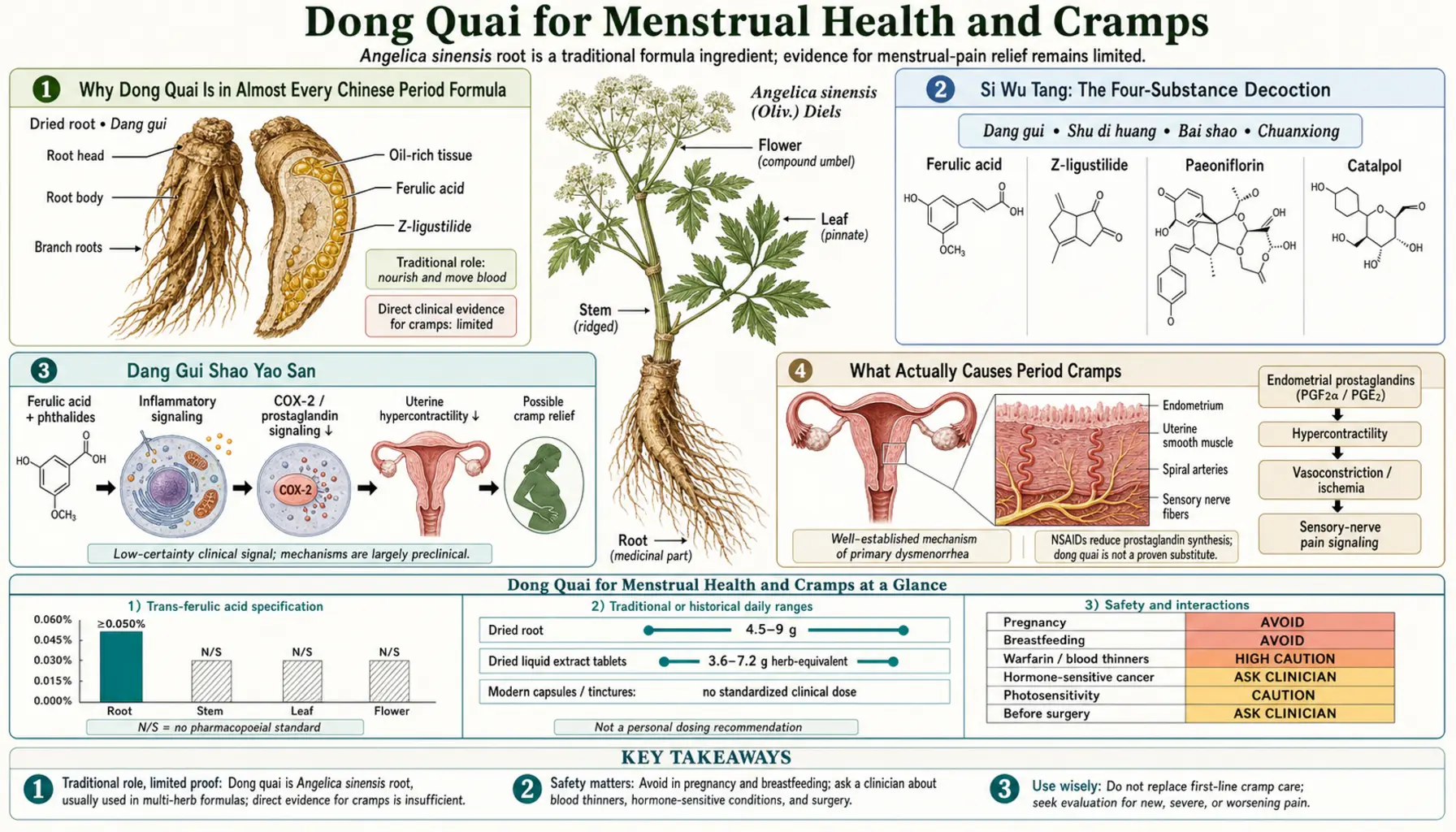
If Dong Quai has a genuine claim to fame, this is it. The root anchors the two Chinese formulas most widely prescribed for painful, irregular and scanty periods, and its dominant compound has real smooth-muscle-relaxing pharmacology. What it does not have is a good trial of the single herb on its own — and it carries a bleeding caution that matters enormously if your problem is heavy flow rather than cramping.
Table of Contents
- Why Dong Quai Is in Almost Every Chinese Period Formula
- Si Wu Tang: The Four-Substance Decoction
- Dang Gui Shao Yao San
- What Actually Causes Period Cramps
- Ligustilide and the Antispasmodic Story
- What the Human Trials Show — and Their Limits
- Heavy Bleeding: The Caution Nobody Prints on the Label
- Forms, Doses and Timing
- When It Is the Wrong Herb Entirely
- Cautions and Contraindications
- Key Research Papers
- Connections
- Featured Videos
Why Dong Quai Is in Almost Every Chinese Period Formula
Open any Chinese formulary at the gynaecology chapter and you will see 当归 (dang gui) again and again. This is not because Chinese medicine considers it a “women's herb” in the way Western marketing does — see the Benefits hub on why “female ginseng” is a modern invention. It is because Dong Quai is classified as doing two things at once that menstrual complaints are traditionally thought to need.
First, it tonifies blood (bu xue) — the traditional remedy for the pattern of pale complexion, dizziness on standing, light or absent periods, dry skin, brittle nails and a thin pulse. Second, it moves blood (huo xue) — the traditional remedy for stabbing, fixed pain, dark clotted flow and pain relieved by passing clots. Very few herbs are classified as doing both. Most tonics are considered cloying and stagnation-forming; most blood-movers are considered depleting. Dong Quai sits in the middle, which is why the tradition reaches for it so reflexively.
The two ends of the root were even used differently: dang gui shen, the body, for tonifying; dang gui wei, the fine tails, for moving. Modern practice mostly uses quan dang gui, the whole root, for both purposes.
Si Wu Tang: The Four-Substance Decoction
Si Wu Tang (四物汤, “Four Substances Decoction”) is the base formula for blood in Chinese medicine, and the ancestor of dozens of menstrual prescriptions. It contains four herbs:
- Dang Gui (Angelica sinensis) — tonifies and moves blood.
- Shu Di Huang (prepared Rehmannia) — the heavy, sweet, deeply tonifying element.
- Bai Shao (white peony root) — nourishes blood and, in the tradition's language, “softens the liver and relieves cramping”. Peony has genuine antispasmodic pharmacology of its own.
- Chuan Xiong (Ligusticum chuanxiong) — the strongest blood-mover of the four. Note that chuan xiong is also rich in ligustilide, the same phthalide that dominates Dong Quai's volatile oil. The two herbs are chemical cousins.
This matters when you interpret the evidence. Almost every clinical study labelled as testing a “Dong Quai formula” is testing Si Wu Tang or one of its descendants — and half the ligustilide in the pot may be coming from chuan xiong, while the antispasmodic effect could plausibly be coming from peony. A positive result for the formula is not a positive result for Dong Quai. This is the single most important interpretive point on the page.
Dang Gui Shao Yao San
Dang Gui Shao Yao San (当归芍药散, “Dang Gui and Peony Powder”) is the other classic, and it is the one most often reached for when period pain comes with bloating, puffiness, loose stools and a heavy, dragging quality rather than sharp cramping. It pairs Dang Gui, peony and chuan xiong with three herbs traditionally used to drain fluid — Poria, Atractylodes and Alisma.
It is a genuinely popular formula in Japanese Kampo as well, where it is called tōki-shakuyaku-san and is one of the most-prescribed gynaecological preparations. In Kampo the dang gui component is usually Angelica acutiloba, the Japanese species, not A. sinensis — another reason to read trial methods carefully before assuming a study tells you about the root in your cupboard.
What Actually Causes Period Cramps
To judge whether a herb could plausibly help, it helps to know what it would have to do. Primary dysmenorrhoea — period pain with no underlying disease — works like this:
- Progesterone falls at the end of the cycle. The endometrium begins to break down.
- Breakdown releases arachidonic acid, which cyclo-oxygenase enzymes convert into prostaglandins, chiefly PGF2α.
- PGF2α makes the myometrium — the muscular wall of the uterus — contract hard and often, with high resting tone between contractions.
- When the contraction pressure exceeds arterial pressure, blood flow to the muscle briefly stops. The muscle becomes ischaemic. That ischaemia is the pain — the same mechanism as angina or a leg cramp, in a different muscle.
This is why NSAIDs work so well and so specifically: ibuprofen, naproxen and mefenamic acid block cyclo-oxygenase and cut prostaglandin production at the source. It is also why the effective strategy is to start them before the pain peaks, not after.
Any herbal claim for period pain has to act somewhere on this chain — reduce prostaglandin production, relax the myometrium, or improve perfusion. Dong Quai's plausible route is the second.
Ligustilide and the Antispasmodic Story
Z-ligustilide is the dominant constituent of Dong Quai's volatile oil and the source of its warm, celery-like smell. It belongs to the phthalides, a family found across the Apiaceae. In laboratory preparations, ligustilide and related phthalides relax smooth muscle — including vascular smooth muscle, airway smooth muscle and, in the older Chinese literature, uterine strips. Reviews of ligustilide pharmacology describe effects on calcium handling and on vascular tone that are consistent with a genuine spasmolytic action.
Here is the honest framing. That work is real and it is the reason the traditional use is mechanistically plausible rather than pure folklore. But it is tissue-bath and animal pharmacology. Relaxing an isolated strip of muscle in a dish is a long way from measurably reducing a woman's pain score on day one of her period, and the gap between those two things is where most herbal claims die.
Ligustilide also has two properties that complicate its use as a drug:
- It is chemically unstable. It oxidises and dimerises on exposure to air, light and heat. A capsule of powdered root that has been on a shelf for two years genuinely contains less of it than one made last season. This is a real, underappreciated reason why people's experiences with Dong Quai vary so much.
- Its oral bioavailability is limited and variable. Pharmacokinetic studies show rapid metabolism, which means the concentrations achieved in tissue-bath experiments are not necessarily concentrations a person taking a decoction ever reaches.
Dong Quai also contains ferulic acid, which has been described as having antiplatelet and mild anti-inflammatory activity, and which is used as the pharmacopeial quality marker for the root. Whether ferulic acid contributes meaningfully to cramp relief at achievable doses is not established.
What the Human Trials Show — and Their Limits
The most useful synthesis is the Cochrane review of Chinese herbal medicine for primary dysmenorrhoea by Zhu and colleagues. It pooled dozens of randomised trials and reported that Chinese herbal formulas produced better pain outcomes than placebo, no treatment, conventional medication or heat compression across the included studies.
Now the caveats, which the review itself makes clearly and which most supplement copy omits:
- The trials were of low methodological quality. Small samples, poor or absent allocation concealment, short follow-up, and outcome measures that varied from trial to trial.
- The formulas were heterogeneous. Different herbs, different ratios, different preparation methods. Pooling them tells you something about “Chinese herbal medicine” as a practice, not about any one herb.
- Publication bias in this literature is substantial. Trials of traditional medicine published in some journals report positive results at rates that are statistically implausible.
- None of it isolates Dong Quai. As set out above, when a Si Wu Tang derivative works, peony and chuan xiong are equally credible candidates for the effect.
The honest bottom line: there is fair evidence that traditional Chinese multi-herb formulas containing Dong Quai can reduce period pain, with the quality of that evidence limiting how much weight it can carry. There is no good randomised evidence that Dong Quai on its own, as sold in a Western capsule, reduces period pain. If you want the effect the tradition describes, the tradition's own answer is to take the formula, not the single herb.
Heavy Bleeding: The Caution Nobody Prints on the Label
This is the practical warning that most sources bury or omit entirely, and it follows directly from the pharmacology in the circulation article.
Z-ligustilide has demonstrated antiplatelet activity — it reduced ADP-induced platelet aggregation and thrombus formation in rat models. Ferulic acid has been described similarly. Traditional practice describes Dong Quai as “moving blood”, which is the tradition's own way of saying it makes blood less inclined to stop.
Put those together and the implication is uncomfortable but clear: if your menstrual problem is heavy bleeding (menorrhagia) rather than cramping, Dong Quai is a poor choice and may make it worse. Traditional Chinese practice actually reflects this — classical texts caution against dang gui in cases of profuse bleeding and in loose stools. Western marketing, which sells it as an all-purpose “women's tonic”, does not.
Heavy periods also deserve to be taken seriously as a medical problem in their own right. Flooding, clots larger than a coin, soaking through protection hourly, or bleeding that leaves you exhausted and breathless are reasons to see a clinician and get a full blood count and ferritin — not reasons to buy a tonic. Heavy menstrual bleeding is the most common cause of iron deficiency in menstruating people worldwide, and it is treatable. See Blood Building and Anemia for why self-treating that pattern with herbs is a genuine safety issue.
Forms, Doses and Timing
Decoction — the traditional route
The traditional dose of Dong Quai in a decoction is 6–12 g of dried root per day, simmered with the rest of a formula for 20–40 minutes. Practitioners sometimes go higher within a formula. Because the active volatile oil is heat-labile, some traditions add aromatic herbs late in the simmer; Dong Quai is usually cooked with the main batch.
Granules
Concentrated granule extracts of Si Wu Tang and Dang Gui Shao Yao San are the most practical modern form and the one a licensed practitioner is most likely to dispense. Concentration ratios vary between manufacturers, so follow the specific product's dosing rather than converting from raw-herb grams yourself.
Capsules and tinctures
Western single-herb Dong Quai capsules typically supply 500–600 mg of powdered root per capsule. Reaching the traditional 6–12 g/day would mean ten to twenty capsules, which nobody takes. In practice most people taking capsules are taking a fraction of a traditional dose of a herb that was not traditionally used alone. Alcohol tinctures extract the volatile oil well but leave behind the water-soluble polysaccharides.
Timing
Traditional practice for menstrual complaints is usually to take the formula in the second half of the cycle and through the first days of bleeding, then stop — not to take it continuously. If you are working with a practitioner, follow their cycle-phase instructions; they are part of the method.
What to look for on a label
- The binomial Angelica sinensis, not Angelica archangelica and not a bare “angelica root”.
- Ferulic acid standardisation, which confirms the material is genuine root.
- A recent manufacture date — because of ligustilide instability, freshness is not a marketing gimmick here.
- A smell test if you can do one. Good root smells sweet and celery-like. Odourless powder has lost its oil.
When It Is the Wrong Herb Entirely
Period pain is not one condition, and reaching for a blood tonic when the cause is structural wastes time you may not have.
- Pain that started years after your periods did, or that is getting steadily worse, suggests secondary dysmenorrhoea — endometriosis, adenomyosis or fibroids — rather than primary.
- Pain with deep dyspareunia, bowel or bladder pain around your period, or infertility should prompt an endometriosis assessment. The average diagnostic delay is measured in years, and herbal self-treatment lengthens it.
- New severe pain with fever or abnormal discharge needs same-week medical assessment, not a tonic.
- Pain with a positive pregnancy test is an emergency until ectopic pregnancy is excluded.
- You take an anticoagulant or antiplatelet drug. See below — this is an absolute reason to skip Dong Quai.
Cautions and Contraindications
- Warfarin — the most important item on this list. Published case reports describe a marked rise in INR and bleeding after Dong Quai was added to previously stable warfarin therapy. The mechanism is plausible from two directions: coumarin-type constituents and antiplatelet phthalides. Do not combine them. Extend the same caution to apixaban, rivaroxaban, dabigatran, clopidogrel and regular aspirin, and tell any prescriber that you take it.
- Stop before surgery and dental procedures. Two weeks is the usual advice for herbs with antiplatelet activity. Mention it to your surgical team — herbal supplements are the single most commonly omitted item on pre-operative medication lists.
- Heavy menstrual bleeding. Avoid, for the reasons above.
- Pregnancy. Avoid. The root has a traditional uterine-stimulant reputation and there are no human safety data supporting self-administration.
- Breastfeeding. Insufficient data. Avoid.
- Bleeding disorders such as von Willebrand disease or thrombocytopenia — avoid.
- Photosensitivity — report the uncertainty honestly. Dong Quai is widely said to cause sun sensitivity. Furanocoumarins genuinely do cause phototoxicity, but A. sinensis contains far less of them than A. archangelica, and the warning is largely extrapolated from related species rather than demonstrated for this one. Reasonable position: a theoretical caution worth respecting at high doses or with phototherapy, not an established effect.
- Hormone-sensitive conditions. Caution is routinely advised in breast, uterine and ovarian cancer, endometriosis and fibroids. The evidence that Dong Quai is meaningfully oestrogenic is weak and inconsistent — but with a modifiable exposure and an unresolved question, precaution is the sensible default.
- Loose stools or ongoing diarrhoea. Traditional texts caution against dang gui here, and the practical experience matches: the root's oily quality can loosen stools further.
Key Research Papers
- Zhu X, Proctor M, Bensoussan A, Wu E, Smith CA. Chinese herbal medicine for primary dysmenorrhoea. Cochrane Database of Systematic Reviews. 2008;(2):CD005288.
- Wei WL, Zeng R, Gu CM, Qu Y, Huang LF. Angelica sinensis in China — A review of botanical profile, ethnopharmacology, phytochemistry and chemical analysis. Journal of Ethnopharmacology. 2016;190:116–141.
- Zhang Y, Zhu Z, Li X, et al. Angelica sinensis: Botany, Traditional Uses, Phytochemistry, Pharmacology, Safety, and Applications. The American Journal of Chinese Medicine. 2026;54(4):1213–1251.
- Zhu FQ, Ma JY, Zhang YY, et al. Research progress on mechanisms and pharmacokinetics of ligustilide in the treatment of locomotor system diseases. China Journal of Chinese Materia Medica. 2024;49(24):6625–6634.
- Zhang L, Du JR, Wang J, et al. Z-ligustilide extracted from Radix Angelica sinensis decreased platelet aggregation induced by ADP ex vivo and arterio-venous shunt thrombosis in vivo in rats. Yakugaku Zasshi. 2009;129(7):855–859.
- Page RL 2nd, Lawrence JD. Potentiation of warfarin by dong quai. Pharmacotherapy. 1999;19(7):870–876.
- Ge B, Zhang Z, Zuo Z. Updates on the clinical evidenced herb-warfarin interactions. Evidence-Based Complementary and Alternative Medicine. 2014;2014:957362.
- Li T, Zhao X. Research Progress on the Immunomodulatory Effects of Dang Gui (Radix Angelica sinensis) and Its Active Chemical Components. Molecules. 2026;31(7).
Live PubMed Searches
- Angelica sinensis dysmenorrhoea
- Si Wu Tang menstrual
- Dang Gui Shao Yao San
- Ligustilide smooth muscle relaxation
- Primary dysmenorrhoea prostaglandins
- Chinese herbal medicine endometriosis pain
- Paeoniflorin antispasmodic
- Heavy menstrual bleeding and iron deficiency
Connections
- All Herbs
- Dong Quai (Angelica sinensis)
- Dong Quai Benefits Hub
- Dong Quai: History and Traditional Use
- Blood Building and Anemia
- Circulation and Cardiovascular
- Menopause: Evidence Review
- White Peony
- Chasteberry
- Black Cohosh
- Astragalus
- Angelica (Angelica archangelica)
- Ferulic Acid
- Atractylodes (Bai Zhu) — one of the three fluid-draining herbs in Dang Gui Shao Yao San, the formula for period pain with bloating and loose stools