Dong Quai (Angelica sinensis): History and Traditional Use
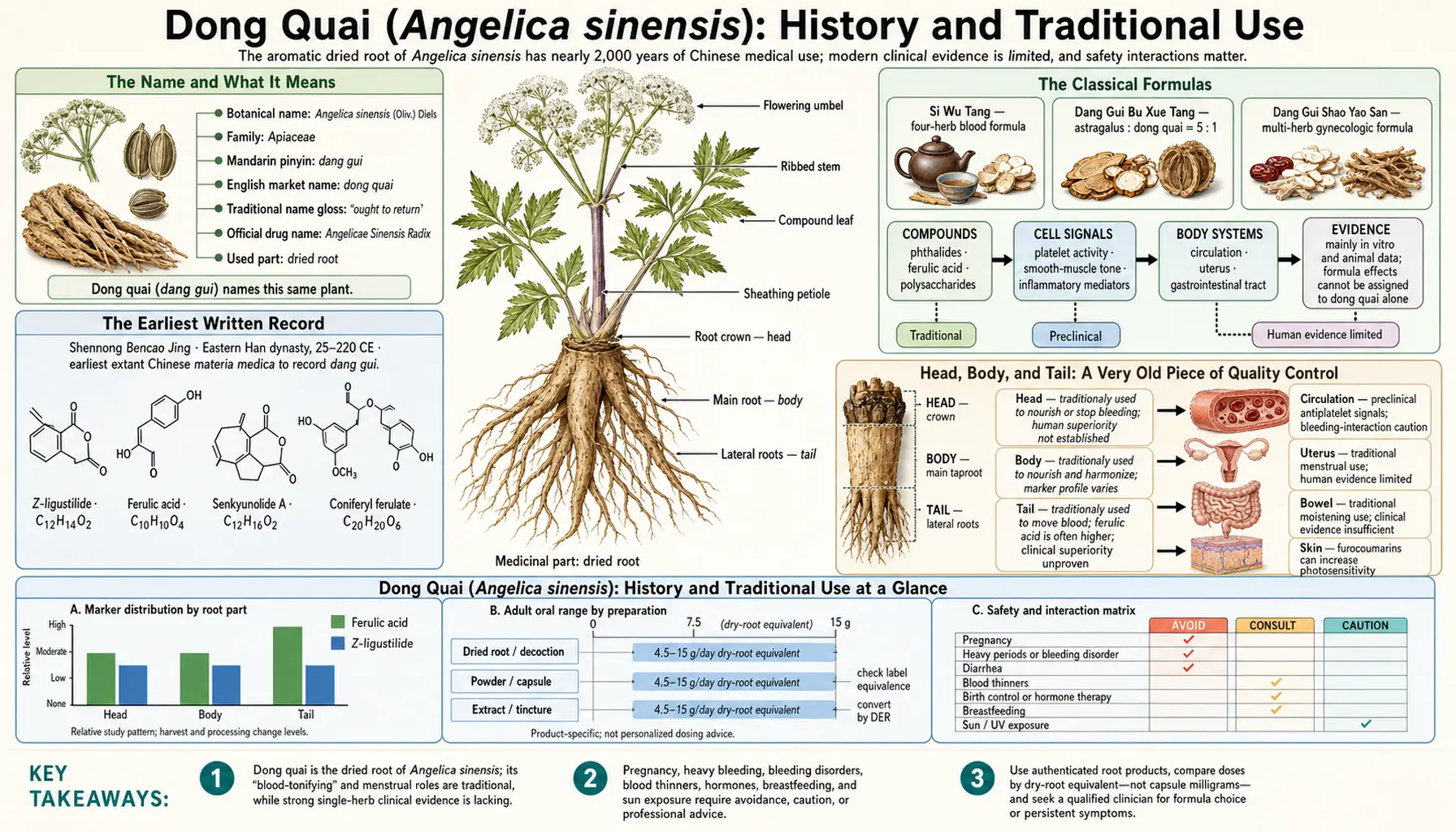
Dāng guī has been written about in China for roughly two thousand years, cultivated as a serious cash crop in the mountains of Gansu for centuries, prescribed to men and women alike, and — in the last hundred and thirty years — repackaged for Western buyers as a women's hormone remedy under a name no Chinese physician ever used.
That last transformation is the most interesting part of the story, and it is the part most often left out. This page follows the herb from its earliest written record through its classical formulas, its botanical naming, its spread across East Asia, its arrival in a Merck bottle in 1899, and finally into the modern laboratory — where some of the tradition held up remarkably well and one of its most heavily marketed claims did not.
Table of Contents
- The Name and What It Means
- The Earliest Written Record
- The Classical Formulas
- Head, Body, and Tail: A Very Old Piece of Quality Control
- Botanical Naming: Oliver, Diels, and a Century of Confusion
- How It Was Grown, Harvested, and Processed
- Regional Spread: Japan, Korea, and Vietnam
- How Dong Quai Reached the West
- How It Entered Modern Research
- What Modern Science Confirmed — and What It Did Not
- Research Papers
- Connections
- Featured Videos
The Name and What It Means
The Chinese name is written 当归 (traditional 當歸) and pronounced dāng guī. Read character by character it says something like "ought to return," and Chinese materia medica writers have offered explanations of that name for a very long time.
The medical explanation is that the herb makes blood return to where it belongs. The literary explanation, repeated in later herbals and in a great deal of modern popular writing, ties the name to a wife longing for a husband away at war or in trade: she takes the herb, and the name carries the wish that he ought to return.
Treat the romantic version as folklore rather than etymology. It is old folklore, repeated by respectable herbalists including Li Shizhen in the sixteenth century, and it is genuinely part of the herb's cultural history — but it is a story told about a name whose origin nobody can now establish.
The name travelled with the herb. In Vietnamese it is đương quy, in Japanese tōki (当帰), in Korean danggwi (당귀) — all direct borrowings of the same two characters. As the next sections show, in Japan and Korea those borrowed names came to sit on different plants, which is a recurring source of confusion in both the herb trade and the research literature.
The Earliest Written Record
Dāng guī appears in the Shénnóng Běncǎo Jīng (神農本草經, the "Divine Farmer's Classic of Materia Medica"), the foundational Chinese drug text. The book was compiled during the Han dynasty and is conventionally dated to roughly the first or second century CE, though it presents itself as far older and was assembled from earlier material over a long period — no single author or year can be given with confidence.
The Shennong Bencao Jing sorts its roughly 365 drugs into three grades. Dāng guī sits in the middle grade — substances used to treat illness and support the constitution, as distinct from the upper grade of daily tonics and the lower grade of potent, potentially toxic drugs. Its earliest recorded indications include cough with rising qi, cold and damp conditions, and women's disorders including infertility, alongside the treatment of sores. Notice how broad that already is: from the very first record, dāng guī is not a specialist gynaecological herb.
Later foundational texts expanded the entry:
- Míng Yī Bié Lù (名醫別錄, "Supplementary Records of Famous Physicians"), attributed to Tao Hongjing around 500 CE, added indications and further description.
- Xīnxiū Běncǎo (新修本草, the "Newly Revised Materia Medica"), promulgated by the Tang court in 659 CE and generally described as the world's first state-issued pharmacopoeia, carried dāng guī as an official drug.
- Běncǎo Gāngmù (本草綱目) by Li Shizhen, completed in 1578 and published in 1596, gave the herb an extended treatment including regional grades and the head-body-tail distinction discussed below.
Two thousand years of continuous written use is a genuinely impressive record, and it is why the herb is worth studying at all. It is not, however, evidence that the herb works — traditions can be both very old and mistaken, and the main Dong Quai page keeps that distinction firmly in view.
The Classical Formulas
Dāng guī is a formula herb. Almost nothing in its two-thousand-year record involves taking it alone, which is worth remembering when reading modern single-herb trials. Four combinations carry most of its history.
Dāng Guī Sháo Yào Sǎn (当归芍药散)
From the Jīnguì Yàolüè (金匱要略, "Essential Prescriptions of the Golden Cabinet"), part of Zhang Zhongjing's great clinical synthesis compiled around 200–220 CE. It pairs dāng guī and white peony with chuanxiong and three damp-draining herbs, and it was prescribed for abdominal pain in pregnancy and for a cluster of menstrual complaints. The same text contains Dāng Guī Sì Nì Tāng (当归四逆汤), used for cold, painful extremities — an early and clearly non-gynaecological indication.
Sì Wù Tāng (四物汤)
The "Four Substance Decoction" — dāng guī, prepared rehmannia, white peony, and chuanxiong — is the foundational blood-nourishing formula of Chinese medicine and the parent of dozens of variants. It is recorded in the Song-dynasty imperial formulary Tàipíng Huìmín Héjì Jú Fāng (太平惠民和劑局方), a government-standardized book of prepared medicines first issued in the late eleventh to early twelfth century and repeatedly expanded thereafter. That formulary matters historically for a reason beyond its contents: it was an attempt at state standardization of medicine manufacture, roughly eight hundred years before anything comparable existed in Europe.
Shí Quán Dà Bǔ Tāng (十全大补汤)
The "All-Inclusive Great Tonifying Decoction," also from the Song formulary, combines Si Wu Tang with the qi tonic Si Jun Zi Tang plus astragalus and cinnamon bark — ten herbs for people depleted after illness, blood loss, or childbirth. It remains one of the most-studied classical formulas in Japan, where it is prescribed as juzentaihoto.
Dāng Guī Bǔ Xuè Tāng (当归补血汤)
The most famous and the strangest. Li Dongyuan — one of the four great masters of the Jin-Yuan period — published it in Nèiwàishāng Biànhuò Lùn (内外伤辨惑论) in 1247. It contains only two herbs, and the ratio is lopsided: five parts astragalus to one part dāng guī by weight. A formula whose stated purpose is to tonify blood is built mostly from a qi herb, on the reasoning that qi generates blood.
That ratio is unusual enough that modern researchers have tested it directly rather than assuming it was arbitrary — with results discussed below. It is one of the few cases where a specific numerical claim from a thirteenth-century text can be put on a bench and checked.
Head, Body, and Tail: A Very Old Piece of Quality Control
Chinese pharmacy divides a single dong quai root into parts with separate names, separate actions, and separate prices: dāng guī tóu (当归头, the head), dāng guī shēn (当归身, the body, used to nourish blood), and dāng guī wěi (当归尾, the tails, used to move blood). The whole root together is quán dāng guī (全当归). Li Shizhen discusses the distinction, and it has been standard dispensary practice for centuries.
It is easy to file this under picturesque tradition. It is better than that. Modern analyses of phthalide and polysaccharide content across the root find real compositional differences — the fine rootlets proportionally richer in volatile oil, the fleshy body richer in water-soluble polysaccharide. Since the volatile oil carries the smooth-muscle-relaxing phthalides and the polysaccharides carry the blood-cell activity, the classical assignment of "tails move, body nourishes" tracks the chemistry surprisingly well. Whoever worked that out did it by smell, taste, and clinical observation alone.
Traditional processing (pào zhì) added another layer of deliberate modification: wine-fried dāng guī to emphasize blood-moving and pain relief, earth-fried to blunt the laxative effect in people with loose stools, and charred dāng guī for bleeding. These were treated as different items on a dispensary shelf, not as the same herb prepared differently.
Botanical Naming: Oliver, Diels, and a Century of Confusion
The plant's formal botanical name is Angelica sinensis (Oliv.) Diels, and that name is itself a compressed piece of history that you can read once you know the convention: the author in parentheses first described the plant, and the author outside the parentheses moved it to the name we now use.
The British botanist Daniel Oliver, working at Kew from Chinese collections, described the plant in the 1880s — not as its own species, but as a variety of Angelica polymorpha. Around the turn of the twentieth century the German botanist Friedrich Ludwig Emil Diels raised it to full species rank as Angelica sinensis. Hence the double authorship. Note the implication: European botany did not settle on a stable name for one of China's most-used medicinal plants until roughly 1900, some eighteen centuries after Chinese physicians first wrote it down.
That late and unstable naming had consequences that persist. Nineteenth- and twentieth-century Western sources variously called it "Chinese angelica," conflated it with the European garden angelica (Angelica archangelica), and imported pharmacological claims from one species into descriptions of the other. The photosensitivity warning that follows dong quai around Western supplement labels is largely an inheritance from that confusion: A. archangelica and A. dahurica are genuinely rich in furanocoumarins, and A. sinensis is not.
Within Chinese medicine the genus is carefully split by indication and has been for centuries — dāng guī (A. sinensis) for blood, bái zhǐ (A. dahurica) for headache and sinus congestion, dú huó (A. pubescens) for damp aching joints. The three are not interchangeable and were never treated as such. It was the Western literature, not the Chinese one, that blurred them.
How It Was Grown, Harvested, and Processed
Dong quai is a mountain crop. It needs cool summers, cold winters, and deep soil, and the centre of production has long been the high country of southern Gansu province in western China — above all Min County (岷县), whose roots are sold as mín guī and treated as the reference grade. Local tradition claims well over a thousand years of cultivation there; the documentary record for large-scale commercial cultivation is clearer from the later imperial period onward, when dāng guī was already an established item of long-distance trade.
The agronomy is unusually demanding, and understanding it explains a lot about price and quality:
- Two seasons to a crop. Seedlings are raised in one year, overwintered, transplanted, and the root lifted in the autumn of the second year. A grower commits land for two seasons before selling anything.
- Bolting ruins the harvest. If the plant flowers before the root is lifted, the root goes woody and hollow and is worthless as medicine. Flowering is triggered by seedling size and cold exposure, so growers spend enormous effort managing seedling vigour and winter storage — a bad year can destroy a large share of a crop.
- Slow smoke-drying. Lifted roots are cleaned, bundled, and hung to dry gradually over low smoky fires. This is not decoration: gentle drying preserves far more volatile oil than sun-drying or kiln heat, and the faint smoky note on good dong quai is a signature of correct processing.
- Grading by size and part. Roots were graded by weight, oil content, colour of the cut surface, and the head/body/tail division — a functioning quality system centuries before chromatography.
Every one of those steps is aimed, in effect, at protecting an unstable aromatic compound in the finished root. Traditional practice could not name Z-ligustilide, but the entire post-harvest protocol behaves as though it knew about it.
Regional Spread: Japan, Korea, and Vietnam
Dāng guī travelled with Chinese medicine across East Asia, and in two of the three destinations the name arrived but a different plant ended up carrying it. This is not a trivia point — it means a clinical trial conducted in Seoul or Osaka may not be a trial of dong quai at all.
Japan
Japanese Kampo inherited the Chinese formulas — tōki-shakuyaku-san is Dang Gui Shao Yao San, juzentaihoto is Shi Quan Da Bu Tang — but Japanese practice generally uses Angelica acutiloba, the domestically grown tōki, where the Chinese original specifies A. sinensis. The Japanese Pharmacopoeia recognizes Angelicae Acutilobae Radix as the official drug. The two species are related and share the phthalide chemistry in broad terms, but they are not the same plant and their profiles differ.
Korea
Korean practice uses danggwi, and here the divergence is larger. Much Korean material is Angelica gigas Nakai — cham-danggwi, "true danggwi" — whose dominant constituents are the pyranocoumarins decursin and decursinol angelate rather than ligustilide. That is a substantially different chemistry with a substantially different pharmacology. Supplement products sold as "Korean dong quai" or "Korean angelica" are frequently A. gigas, and research findings on it should not be quoted as findings about A. sinensis. Korean practice also uses A. acutiloba in places.
Vietnam
In Vietnamese traditional medicine the herb is đương quy, used in the same blood-nourishing role as in China. Historically most material was imported from China; in the twentieth century cultivation was established in Vietnam's northern highlands, where the cool mountain climate suits the plant.
How Dong Quai Reached the West
The Western career of this herb has two distinct chapters, and the gap between them is instructive.
The pharmaceutical chapter came first. At the very end of the nineteenth century — around 1899 — the German pharmaceutical firm Merck marketed a liquid extract of Chinese angelica root under the trade name Eumenol, promoted for menstrual disorders. This is a striking fact: dong quai entered Western medicine as an industrially produced proprietary preparation, sold by a mainstream drug company, roughly seventy years before the health-food-store era. Eumenol was discussed in European medical literature of the period. It eventually faded, as most botanical proprietaries of that generation did, without ever being tested to a standard that would satisfy anyone now.
The supplement chapter came much later. Dong quai re-entered the West through the natural-products trade of the later twentieth century, arriving alongside the broader Western interest in Chinese medicine. It was in this second wave that the herb acquired the label that now dominates its English-language marketing: "female ginseng."
That phrase deserves to be named for what it is. It has no counterpart in classical Chinese sources. Dāng guī is not a ginseng, is not related to ginseng, and was never classified with ginseng; and its traditional indication list — trauma, sores, constipation, cold limbs, anaemic exhaustion in either sex — is conspicuously not sex-specific. The tag was a marketing convenience that made an unfamiliar Chinese root legible to Western buyers by borrowing the prestige of a herb they already knew.
The cost of that convenience has been real. It set Western expectations on menopause and hormones, an indication where the herb's best trial found nothing, and it quietly buried the indications where the traditional evidence is oldest and most consistent. Hook's 2014 review in the Journal of Ethnopharmacology — titled to ask whether the benefits were "lost in translation" — is the full account. The narrowing of a broad two-thousand-year blood tonic into a Western menopause supplement is a case study in how traditional knowledge gets damaged in transit, and the damage was done by the marketing, not by the tradition.
How It Entered Modern Research
Systematic laboratory study of dāng guī is mostly a Chinese project of the second half of the twentieth century, and it proceeded in recognizable stages.
- Isolating the chemistry (mid-twentieth century onward). The volatile oil was resolved into its phthalide components, with Z-ligustilide identified as the dominant one, and ferulic acid was isolated from the water-soluble fraction. The instability of ligustilide was recognized early and has complicated every analysis since.
- Ferulic acid as a drug in its own right. Chinese pharmacology pursued sodium ferulate as an antiplatelet agent independently of the herb — one of the clearer instances of a traditional medicine yielding a single-compound pharmaceutical.
- Standardization. The Chinese Pharmacopoeia settled on ferulic acid as the HPLC quality marker for the crude drug, with a minimum of roughly 0.05%, alongside a minimum volatile-oil content. Ferulic acid was chosen for being stable and easy to assay, not for being the active principle — a distinction the supplement market routinely blurs.
- The polysaccharide programme. From the 1990s onward, Angelica sinensis polysaccharides (ASP) were studied for effects on blood-cell production — proliferation of haematopoietic progenitors, erythropoietin expression, recovery of counts in myelosuppressed animals. This is the modern research thread that most directly engages the classical "blood tonic" claim.
- The first rigorous Western trial (1997). Hirata and colleagues randomized 71 postmenopausal women to dong quai root or placebo for 24 weeks and measured hot flushes, vaginal maturation index, and endometrial thickness. Published in Fertility and Sterility, it found no significant difference on any endpoint.
- Testing the classical ratios (2000s). Research groups in Hong Kong took Dāng Guī Bǔ Xuè Tāng apart systematically, varying the astragalus-to-dāng-guī ratio and measuring what came out. The 5:1 proportion recorded in 1247 was subjected to the kind of test its author could not have imagined.
- Discovering a hazard nobody could have known (1990s). Case reports of dangerously raised INR in warfarin patients who added dong quai appeared in the clinical literature, and animal work showed the herb alters warfarin's pharmacodynamics. Warfarin did not exist until the mid-twentieth century, so no amount of classical experience could have anticipated this. It is a reminder that tradition is silent on precisely the questions modern life keeps asking.
What Modern Science Confirmed — and What It Did Not
An honest scorecard. Both columns are real.
| Traditional claim | Modern status |
|---|---|
| Relieves cramping, spasmodic pain | Mechanistically supported. Ligustilide and butylidenephthalide relax smooth muscle in isolated-tissue and animal studies. No clean single-herb human trial exists. |
| "Moves blood" | Supported in the laboratory. Ferulic acid and phthalides inhibit platelet aggregation; ligustilide dilates vessels in isolated preparations. The same finding is the basis of the bleeding warnings. |
| "Tonifies blood" | Partly supported, and only in animals. ASP acts on haematopoietic progenitors and erythropoietin expression in animal and cell models. It has not been shown to raise haemoglobin in humans. |
| Body nourishes, tails move | Chemically corroborated. Root parts genuinely differ in phthalide and polysaccharide content. |
| The 5:1 astragalus ratio matters | Corroborated. Laboratory work found the ratio changes the decoction's chemical and biological profile rather than being arbitrary. |
| Moistens the intestines (constipation) | Untested. One of its most consistent traditional uses and among the least studied. |
| Relieves hot flashes (a Western claim) | Not supported. The 24-week placebo-controlled trial of the single herb was negative, and nothing since has overturned it. |
| It is oestrogenic — "female ginseng" | Not established. Assays disagree; effects that appear are often not blocked by anti-oestrogens, arguing against receptor mediation. The label is Western marketing, not Chinese tradition. |
| It is a source of iron or vitamin B12 | False. A dried root supplies negligible iron, and plants are not a reliable source of B12. This is a modern misreading of "blood tonic," not a traditional claim. |
The pattern is worth stating plainly. Where the tradition made chemical and pharmacological claims — that the root parts differ, that the ratio matters, that it relaxes cramping tissue and moves blood — modern work has largely backed it up. Where the tradition has been reinterpreted in modern terms it never used — hormones, oestrogen, hot flashes, iron — the reinterpretation has failed. Dāng guī came out of the laboratory looking better as what it always said it was, and worse as what the West decided to sell it as.
Research Papers
Every entry below has been verified against its PubMed record — author list, title, journal, year, volume, issue and pages all confirmed to match — and the year/volume/pages link opens that exact record.
- Hook ILI. Danggui to Angelica sinensis root: are potential benefits to European women lost in translation? A review. Journal of Ethnopharmacology. 2014;152(1):1–13. — The single best source on how the herb's traditional indications were reshaped for the Western market.
- Wei WL, Zeng R, Gu CM, Qu Y, Huang LF. Angelica sinensis in China — a review of botanical profile, ethnopharmacology, phytochemistry and chemical analysis. Journal of Ethnopharmacology. 2016;190:116–141. — Covers botany, traditional use, cultivation, and analytical standards together.
- Chao WW, Lin BF. Bioactivities of major constituents isolated from Angelica sinensis (Danggui). Chinese Medicine. 2011;6:29. — Compound-by-compound review of ligustilide, ferulic acid, and the polysaccharides.
- Hirata JD, Swiersz LM, Zell B, Small R, Ettinger B. Does dong quai have estrogenic effects in postmenopausal women? A double-blind, placebo-controlled trial. Fertility and Sterility. 1997;68(6):981–986. — The trial that closed the book on single-herb dong quai for hot flushes: 71 postmenopausal women, 24 weeks, no separation from placebo on any endpoint.
- Dong TTX, Zhao KJ, Gao QT, et al. Chemical and biological assessment of a Chinese herbal decoction containing Radix Astragali and Radix Angelicae Sinensis: determination of drug ratio in having optimized properties. Journal of Agricultural and Food Chemistry. 2006;54(7):2767–2774. — A thirteenth-century ratio put to a laboratory test.
- Page RL 2nd, Lawrence JD. Potentiation of warfarin by dong quai. Pharmacotherapy. 1999;19(7):870–876. — The hazard no classical text could have recorded: a 46-year-old woman stable on warfarin whose INR more than doubled after four weeks of concurrent dong quai.
- Lo ACT, Chan K, Yeung JHK, Woo KS. Danggui (Angelica sinensis) affects the pharmacodynamics but not the pharmacokinetics of warfarin in rabbits. European Journal of Drug Metabolism and Pharmacokinetics. 1995;20(1):55–60.
Live PubMed Searches
- Angelica sinensis — ethnopharmacology and traditional use
- Angelica sinensis cultivation and quality in Gansu
- Angelica sinensis compared with Angelica acutiloba
- Angelica gigas and decursin (Korean danggwi)
- Dang Gui Bu Xue Tang and the astragalus ratio
- Si Wu Tang pharmacology
- Z-ligustilide stability and degradation
- Angelica sinensis traditional processing (pao zhi)
- Chemical differences between root head, body, and tail
Connections
- All Herbs
- Dong Quai (Angelica sinensis) — the main research article: chemistry, evidence, dosing, and the warfarin warning.
- Dong Quai Benefits — the deep-dive hub.
- Menstrual Health and Cramps — the herb's oldest and most consistent indication.
- Blood Building and Anemia — what "blood tonic" meant then, and what it does not mean now.
- Circulation and Cardiovascular — the "moving blood" tradition and its modern correlate.
- Menopause: Evidence Review — the Western claim, trial by trial.
- Angelica (Angelica archangelica) — the European species that Western writers spent a century confusing with this one.
- Astragalus — the other half of Dang Gui Bu Xue Tang, at five parts to one.
- White Peony — dong quai's partner in Si Wu Tang and Dang Gui Shao Yao San since the Han dynasty.
- Codonopsis — the qi tonic paired with dong quai when qi and blood are both said to be depleted.
- Black Cohosh — the Western botanical that ended up carrying the menopause claim dong quai could not.
- Chasteberry — Europe's own long-standing cycle herb, with a different history and a clearer mechanism.
- Ferulic Acid — the marker compound that became a drug in its own right.