Dong Quai for Blood Building and Anemia
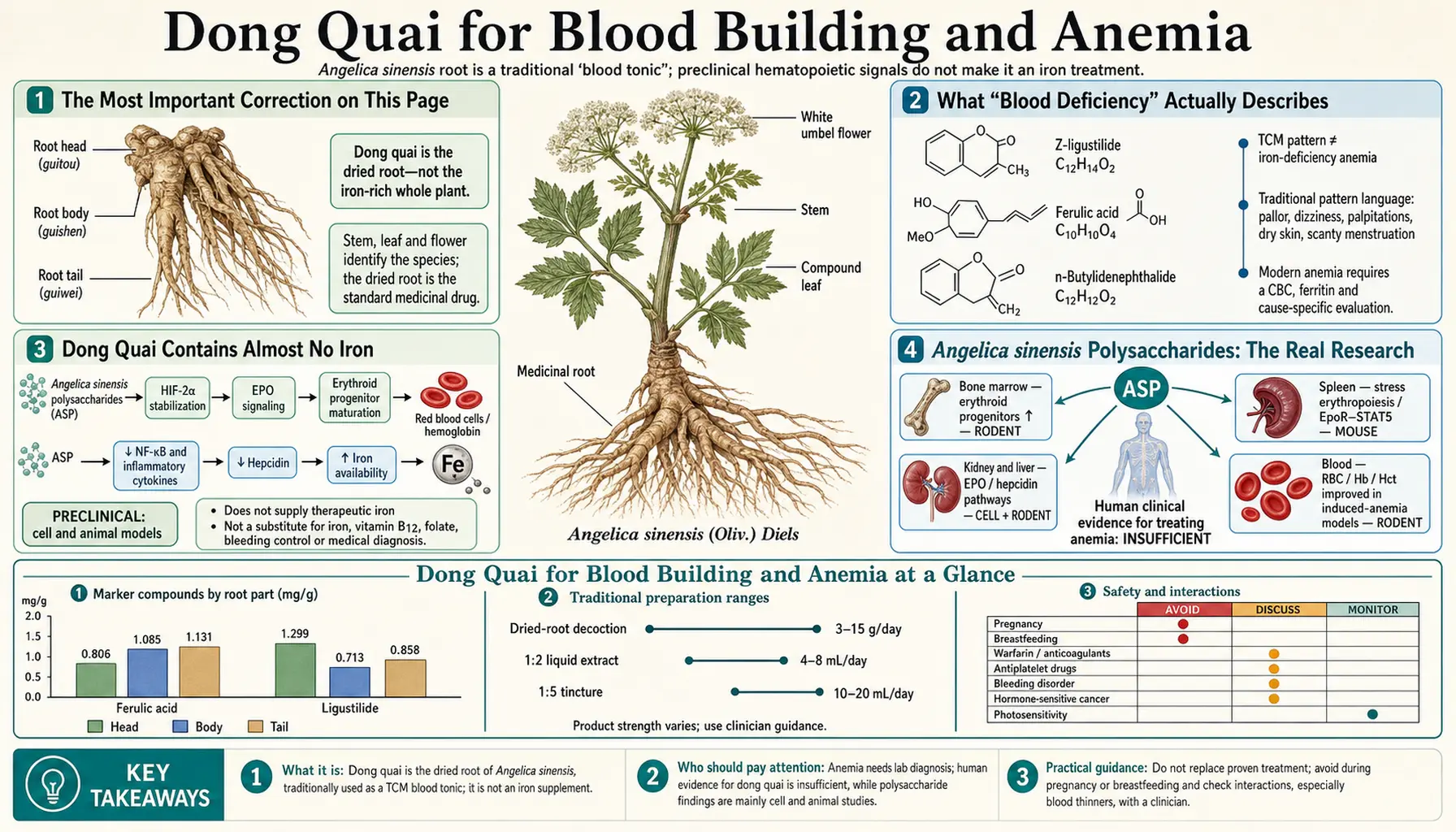
Dong Quai's most famous traditional role is as a blood tonic, and that reputation is the reason it is sold as a natural treatment for anaemia. This page exists mainly to correct that. There is real and interesting research on Angelica sinensis polysaccharides and blood-cell production — and there is no good human evidence that Dong Quai raises haemoglobin, no meaningful iron in the root, and a genuine risk in using it as a substitute for finding out why you are anaemic.
Table of Contents
- The Most Important Correction on This Page
- What “Blood Deficiency” Actually Describes
- Dong Quai Contains Almost No Iron
- Angelica sinensis Polysaccharides: The Real Research
- Dang Gui Bu Xue Tang and the Counterintuitive 5:1 Ratio
- What Human Evidence Exists — and What Does Not
- Why Self-Treating Anaemia Is a Safety Problem
- What a Proper Anaemia Workup Looks Like
- If You Still Want to Use It
- Cautions and Contraindications
- Key Research Papers
- Connections
- Featured Videos
The Most Important Correction on This Page
In Chinese medicine, Dang Gui is the archetypal herb that bu xue — “tonifies blood”. English translations of that phrase have been read, for a century, as if the tradition were claiming the herb treats anaemia. It is not. Two separate mistakes are stacked on top of each other:
- “Blood” in Chinese medicine (xue) is not the red fluid in your veins. It is a functional category describing nourishment, moisture and the capacity of tissue to be supplied. “Blood deficiency” is a symptom pattern — pallor, dizziness, dry skin, brittle nails, floaters, insomnia, scanty periods, numb extremities — not a laboratory finding. The overlap with iron-deficiency anaemia is partial and coincidental.
- Dong Quai contains negligible iron, and there is no good human trial showing that it raises haemoglobin. The traditional claim was never about iron because iron was not a concept available to the physicians who made it.
The practical consequence is a safety issue, not a disappointment. Anaemia is a sign, not a diagnosis. Treating the number without finding the cause means missing the cause — and the causes range from a heavy period, to coeliac disease, to a slow bleed from a colon cancer. That is why this page frames Dong Quai for anaemia as a risk rather than a benefit.
What “Blood Deficiency” Actually Describes
It is worth taking the traditional pattern seriously on its own terms, because it is a real cluster of complaints even if it is not a haematological diagnosis.
Xue xu — blood deficiency — describes someone who is pale, tires easily, gets light-headed standing up, has dry skin and hair, brittle or ridged nails, sees floaters, sleeps poorly with vivid dreaming, has scanty or delayed periods, and whose hands and feet go numb or tingle. A practitioner would find a pale tongue and a thin pulse.
Notice what that list is. It is largely a description of reduced tissue perfusion and nutritional depletion, and it overlaps meaningfully with genuine iron deficiency, B12 deficiency, hypothyroidism, chronic fatigue after illness, and simple undernutrition. The pattern is a useful clinical observation. What it is not is a measurement, and what a herb classified as treating it does is restore the pattern — in the tradition's framework — not raise a number.
Chinese medicine also uses Dang Gui as a blood tonic in contexts that have nothing to do with anaemia at all: dry constipation in the elderly, chronic non-healing sores, numbness and joint pain, and post-surgical recovery. That breadth is the clue that bu xue means something other than “raises haemoglobin”.
Dong Quai Contains Almost No Iron
This is worth stating in plain arithmetic, because it settles the question quickly.
A traditional daily dose of Dong Quai is 6–12 g of dried root. Dried plant roots generally contain iron in the range of a few tens of milligrams per kilogram — that is, a few hundredths of a milligram per gram. Even a generous estimate puts a full traditional daily dose in the range of a fraction of a milligram of iron. Western capsules typically deliver 500–1000 mg of root per day, an order of magnitude less again.
For comparison:
| Source | Approximate elemental iron |
|---|---|
| Standard ferrous sulfate tablet (325 mg) | ~65 mg |
| Adult female RDA (19–50 years) | 18 mg/day |
| Adult male RDA | 8 mg/day |
| 85 g of cooked beef liver | ~5 mg |
| A cup of cooked lentils | ~6.6 mg |
| A full traditional daily dose of Dong Quai root | a fraction of a milligram |
Whatever Dong Quai does, it cannot be supplying iron. Any product that claims to treat iron-deficiency anaemia with Dong Quai as the active ingredient is making a claim that the chemistry cannot support. If a Dong Quai supplement does raise your ferritin, check the label — there is probably added ferrous fumarate in it, and you should know that so you do not double-dose.
Angelica sinensis Polysaccharides: The Real Research
Now the part that is genuinely interesting, reported honestly.
Hot-water extraction of Dong Quai yields a fraction of large sugar polymers known as Angelica sinensis polysaccharides (ASP). This is the fraction that has been studied for effects on blood-cell production, and the work is not trivial. In rodent models of stress erythropoiesis — where the bone marrow has been damaged by chemotherapy drugs such as 5-fluorouracil or cyclophosphamide — ASP administration has been reported to speed the recovery of red cell production. Recent work describes effects on extramedullary erythropoiesis in the spleen, on erythroblastic island formation (the nurse-macrophage structures where developing red cells mature), and on the metabolic state of the splenic microenvironment.
Related work on the Dang Gui Bu Xue Tang formula reports reduced myelosuppression in animals treated with cyclophosphamide or gemcitabine.
Here is the honest interpretation, and it matters:
- These are animal studies. Mice and rats, not people.
- The model is chemotherapy-induced marrow suppression, not iron deficiency. Those are completely different diseases. Speeding recovery from a marrow toxin says nothing about whether a herb helps someone whose iron stores are empty because they bleed 80 mL every month.
- Doses are frequently high and routes are frequently not oral. Polysaccharide research often uses injected or intraperitoneal administration precisely because large polysaccharides are poorly absorbed from the gut. Extrapolating to a capsule is not safe.
- The fraction studied is often not the fraction sold. ASP is water-extracted. An alcohol tincture contains little of it. A powdered-root capsule contains it only in whatever proportion it exists in the raw root.
The correct summary is: ASP is a legitimate object of haematology research and a reasonable hypothesis. It is not an established treatment for anything in humans. If it eventually proves useful, the likely setting is supportive care during chemotherapy under oncological supervision — a context in which self-medication is especially unwise, because interactions with cytotoxic drugs are exactly what oncologists worry about.
Dang Gui Bu Xue Tang and the Counterintuitive 5:1 Ratio
Dang Gui Bu Xue Tang (当归补血汤, “Dang Gui Decoction to Tonify the Blood”) is the formula most directly associated with this topic, and it contains a famous surprise. It has only two herbs:
- Astragalus root (Huang Qi, Astragalus membranaceus) — five parts by weight.
- Dong Quai root (Dang Gui) — one part by weight.
The formula is named for Dang Gui, yet Dang Gui is the minority ingredient at a 5:1 ratio. In traditional theory the logic is that qi generates blood, so a large dose of the qi tonic drives the smaller dose of the blood tonic; the herb the formula is named for is the target of the action rather than the bulk of the prescription.
This has been a productive object of modern chemical study. Research groups have compared the 5:1 decoction against other ratios and against the single herbs, looking at the chemical profile of the resulting extract and at biological readouts. Two findings from that literature are worth knowing:
- Co-decocting the two herbs changes what ends up in the pot compared with decocting them separately and mixing — the extraction of astragalus constituents such as calycosin and astragaloside is altered by the presence of Dong Quai and vice versa. Work on the formula has identified calycosin as a substantial contributor to its measured activities.
- Some components of the Dong Quai volatile oil have been reported to suppress rather than enhance certain biological properties of the decoction — which is a real complication for the assumption that more Dang Gui would be better.
What this body of work does not establish is that Dang Gui Bu Xue Tang treats anaemia in humans. It is chemistry and cell/animal pharmacology. Interesting, well done in places, and not clinical evidence. Note also that if the formula turns out to be useful, most of what is in it is astragalus.
What Human Evidence Exists — and What Does Not
Search the clinical literature for randomised, placebo-controlled trials in which Dong Quai — alone or in a formula — raised haemoglobin in people with anaemia, and the result is thin. What exists is mostly small, mostly published in journals with limited methodological oversight, mostly using combination formulas, and frequently without the blinding and allocation concealment that make a result trustworthy.
The best-known randomised, placebo-controlled trial of Dong Quai in any indication remains the 1997 study by Hirata and colleagues in postmenopausal women — and it was negative for its primary outcomes. That trial does not test anaemia, but it is a useful calibration: when this herb has been examined with proper methods, it has not outperformed placebo.
Stated plainly: there is no good human evidence that Dong Quai raises haemoglobin, raises ferritin, or corrects anaemia of any type. Anyone who tells you otherwise should be asked to name the trial.
Why Self-Treating Anaemia Is a Safety Problem
This is the heart of the page. Anaemia is not a disease. It is a finding that something else is going on, and the something else can be trivial or lethal. Reaching for a tonic short-circuits the one thing that actually matters: finding out which.
Common causes of iron deficiency, roughly in the order a clinician thinks about them:
- Heavy menstrual bleeding — the most common cause in menstruating people, and itself often treatable. Note that Dong Quai's antiplatelet activity may make this worse, so using it here is doubly counterproductive.
- Gastrointestinal blood loss — peptic ulcer, gastritis, oesophagitis, angiodysplasia, colonic polyps, and colorectal cancer. In an adult man or a postmenopausal woman, unexplained iron deficiency is treated as a possible GI cancer until proven otherwise, and warrants endoscopy. This is not scaremongering; it is standard practice, and iron deficiency is sometimes the only early sign.
- Coeliac disease — iron deficiency is a classic presentation, sometimes with no bowel symptoms at all. A simple blood test (tissue transglutaminase antibodies, with total IgA) finds most cases.
- Helicobacter pylori infection — a treatable cause of refractory iron deficiency.
- Dietary insufficiency and malabsorption — including after bariatric surgery or with long-term proton-pump inhibitor use.
- Pregnancy, with sharply increased requirements.
And iron deficiency is not the only anaemia. B12 or folate deficiency produces a large-cell anaemia and, in the case of B12, can cause irreversible neurological damage if it is masked or delayed. Anaemia of chronic disease points at inflammation, kidney disease or malignancy. Haemolysis and thalassaemia trait have entirely different management. Giving iron to someone with haemochromatosis or thalassaemia can do harm.
The failure mode is specific and it is worth naming: you feel a bit better on a tonic, you attribute it to the herb, you stop worrying about the fatigue, and the cause goes unexamined for another eighteen months. The herb did not have to be harmful to have caused the harm.
What a Proper Anaemia Workup Looks Like
If you are fatigued, pale, breathless on stairs, or have been told you are anaemic, this is what you should actually be asking for. Knowing the names makes the conversation easier.
- Full blood count — gives haemoglobin and, critically, MCV (average red-cell size). Small cells point towards iron deficiency or thalassaemia; large cells towards B12/folate deficiency, alcohol or thyroid disease.
- Ferritin — the best single measure of iron stores. Important caveat: ferritin rises with inflammation, so a “normal” ferritin alongside a high CRP does not exclude iron deficiency.
- Transferrin saturation and total iron-binding capacity — helps distinguish true iron deficiency from anaemia of chronic disease.
- CRP — to interpret the ferritin.
- B12 and folate.
- Coeliac serology (tissue transglutaminase IgA plus total IgA) in unexplained iron deficiency.
- Reticulocyte count — tells you whether the marrow is responding.
- Kidney and thyroid function, and consideration of endoscopy where the pattern warrants it.
Iron-deficiency anaemia, once confirmed, responds to iron — and modern practice increasingly favours alternate-day dosing of oral iron, because a dose raises hepcidin for roughly 24 hours and blunts absorption of the next one. Every-other-day dosing often absorbs as much total iron as daily dosing with fewer side effects. Take it with vitamin C or a citrus source, away from tea, coffee, calcium and antacids.
If You Still Want to Use It
There is a reasonable position that is neither “this cures anaemia” nor “never touch it”. If the traditional pattern describes you and you want to work within that framework:
- Get the workup first, and take the treatment for whatever it finds. The herb is at best an addition, never a replacement.
- Work with a licensed practitioner and use a formula, not a single-herb capsule. The tradition itself does not use Dang Gui alone for this; Dang Gui Bu Xue Tang and Si Wu Tang are the traditional vehicles, and the tradition matches formula to pattern.
- Use a water decoction or granule extract if the polysaccharide research is your reason for interest — ASP is water-soluble and largely absent from alcohol tinctures.
- Tell your doctor. Especially if you take any anticoagulant or antiplatelet drug, or are due for surgery.
- Put the effort where the return is: actual dietary iron. Red meat, liver, shellfish, lentils, beans, tofu, pumpkin seeds and dark leafy greens, with a vitamin-C source at the same meal to boost non-haem absorption.
Cautions and Contraindications
- Warfarin. Published case reports describe a marked rise in INR and bleeding after Dong Quai was added to stable warfarin therapy. Coumarin constituents plus antiplatelet phthalides make the mechanism doubly plausible. Do not combine. Apply the same caution to apixaban, rivaroxaban, dabigatran, clopidogrel and regular aspirin. This caution is especially pointed here: someone being treated for anaemia caused by a bleed is precisely the person who must not take an antiplatelet herb.
- Stop before surgery and dental procedures — two weeks is the usual advice, and tell the surgical team.
- Heavy menstrual bleeding. Avoid; the herb may worsen the very blood loss causing the deficiency.
- Pregnancy. Avoid — traditional uterine-stimulant reputation, no human safety data. Pregnancy anaemia should be managed medically; it is common, consequential and easily treated.
- Breastfeeding. Insufficient data; avoid.
- Active cancer treatment. Do not add Dong Quai during chemotherapy without your oncology team's knowledge, whatever the myelosuppression research suggests. Interaction risk is real and the animal data do not translate.
- Photosensitivity. Widely asserted, imperfectly demonstrated for this species. A. sinensis contains far lower furanocoumarin levels than A. archangelica, and the warning is largely extrapolated. Treat it as a theoretical caution, not a fact.
- Hormone-sensitive conditions. Caution is conventionally advised; evidence that Dong Quai is meaningfully oestrogenic is weak and inconsistent. Precaution is reasonable, certainty is not warranted in either direction.
- Loose stools. Traditional texts caution against dang gui in diarrhoea, and the oily root can loosen stools further.
Key Research Papers
- Wang B, Jiang H, Sun N, et al. Angelica sinensis polysaccharides ameliorate 5-FU-induced stress anemia via promoting extramedullary erythroblastic island formation. International Immunopharmacology. 2024;142(Pt A):113061.
- Sun N, Wang Z, Jiang H, et al. Angelica sinensis polysaccharides promote extramedullary stress erythropoiesis via ameliorating splenic glycolysis. Journal of Molecular Histology. 2024;55(5):661–673.
- Gao Y, Zhang Y, Liu W, et al. Danggui Buxue decoction alleviates cyclophosphamide-induced myelosuppression by regulating β-hydroxybutyric acid metabolism. Pharmaceutical Biology. 2023;61(1):710–721.
- Liu Y, Chang M, Hu Z, et al. Danggui Buxue Decoction enhances the anticancer activity of gemcitabine and alleviates gemcitabine-induced myelosuppression. Journal of Ethnopharmacology. 2021;273:113965.
- Gong AG, Li N, Lau KM, et al. Calycosin orchestrates the functions of Danggui Buxue Tang, a Chinese herbal decoction composing of Astragali Radix and Angelicae Sinensis Radix. Journal of Ethnopharmacology. 2015;168:150–157.
- Zhan JY, Zheng KY, Zhang WL, et al. Identification of Angelica oil as a suppressor for the biological properties of Danggui Buxue Tang. Journal of Ethnopharmacology. 2014;154(3):825–831.
- Wei WL, Zeng R, Gu CM, Qu Y, Huang LF. Angelica sinensis in China — A review of botanical profile, ethnopharmacology, phytochemistry and chemical analysis. Journal of Ethnopharmacology. 2016;190:116–141.
- Li T, Zhao X. Research Progress on the Immunomodulatory Effects of Dang Gui (Radix Angelica sinensis) and Its Active Chemical Components. Molecules. 2026;31(7).
- Page RL 2nd, Lawrence JD. Potentiation of warfarin by dong quai. Pharmacotherapy. 1999;19(7):870–876.
- Hirata JD, Swiersz LM, Zell B, Small R, Ettinger B. Does dong quai have estrogenic effects in postmenopausal women? A double-blind, placebo-controlled trial. Fertility and Sterility. 1997;68(6):981–986.
Live PubMed Searches
- A. sinensis polysaccharide erythropoiesis
- A. sinensis polysaccharide haematopoiesis
- Danggui Buxue Tang and anaemia
- Iron-deficiency anaemia: investigating the cause
- Alternate-day oral iron and hepcidin
- Coeliac disease presenting as iron deficiency
- Unexplained iron deficiency and colorectal cancer
- Herbal medicine and chemotherapy myelosuppression
Connections
- All Herbs
- Dong Quai (Angelica sinensis)
- Dong Quai Benefits Hub
- Dong Quai: History and Traditional Use
- Menstrual Health and Cramps
- Circulation and Cardiovascular
- Menopause: Evidence Review
- Astragalus
- White Peony
- Angelica (Angelica archangelica)
- Black Cohosh
- Chasteberry
- Ferulic Acid