Dong Quai (Angelica sinensis) Benefits
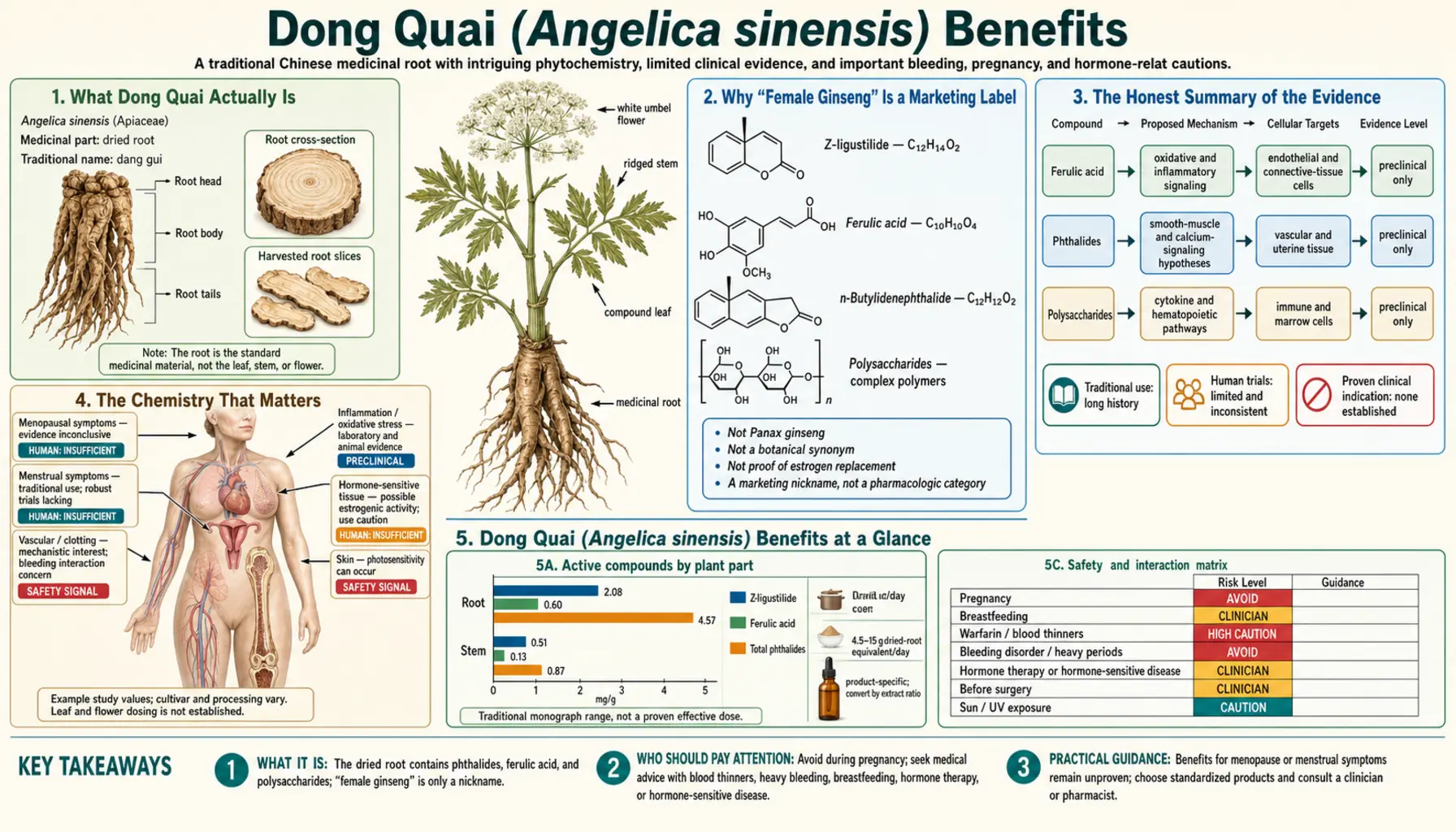
Dong Quai is the dried root of Angelica sinensis, one of the most heavily used herbs in the entire Chinese materia medica — and one of the most heavily oversold in Western supplement aisles. These four articles separate what the root is traditionally used for, what its chemistry plausibly does, and what has actually been measured in people. In two of the four areas the honest answer is not the one on the bottle.
Menstrual Health and Cramps
The Si Wu Tang and Dang Gui Shao Yao San tradition, ligustilide's antispasmodic pharmacology, what the small formula trials in period pain really show, and the heavy-bleeding caution nobody prints on the label.
Blood Building and Anemia
Why “tonifies blood” in Chinese medicine is not a claim about haemoglobin, why the root contains almost no iron, and why treating anaemia with Dong Quai instead of a workup can hide a serious cause.
Circulation and Cardiovascular
Ferulic acid and the phthalides as vasodilators and platelet inhibitors, the famous 5:1 Dang Gui Bu Xue Tang ratio, and the bleeding risk that is the flip side of the same chemistry.
Menopause: Evidence Review
A dedicated look at the best-known trial — Hirata and colleagues, 1997, 71 women, 24 weeks, no effect on hot flushes — and at whether anything published since changes the answer. It does not.
Table of Contents
- What Dong Quai Actually Is
- Why “Female Ginseng” Is a Marketing Label
- The Honest Summary of the Evidence
- The Chemistry That Matters
- Safety First: Warfarin, Bleeding, Pregnancy
- Buying and Quality: What to Look For
- Key Research Papers
- External Resources
- Connections
- Featured Videos
What Dong Quai Actually Is
Dong Quai is the dried root of Angelica sinensis (Oliv.) Diels, a member of the carrot and celery family, Apiaceae. In Chinese pharmacy the drug has a formal name — Radix Angelicae Sinensis — and a common one, 当归 (dāng guī). Vietnamese herbalists call it đương quy. The plant is a tall umbellifer with the hollow, ridged stem and flat-topped flower cluster you would recognise from wild carrot or angelica in a garden.
Almost all commercial supply comes from a small area of north-west China. Gansu province, and Min County in particular, grows the overwhelming majority of the world's Dong Quai. The plants are lifted in autumn in their second year — earlier and the root is thin, later and it bolts to seed and turns woody and worthless as medicine. Harvested roots are traditionally dried slowly in smoke sheds, which is why good Dong Quai has a faint smoky note over the sweet, celery-like aroma.
Traditional pharmacy divides the root into parts and treats them as different medicines:
- Dang gui shen — the body of the root. The classic blood-tonifying portion.
- Dang gui tou — the head or crown.
- Dang gui wei — the tails, the fine rootlets. Considered the blood-moving part.
- Quan dang gui — the whole root, both tonifying and moving. This is what almost every Western capsule contains.
Not the same as the other Angelicas
Confusion between Angelica species is the single most common error in English-language writing about this herb, and it matters for safety.
| Plant | Common name | Note |
|---|---|---|
| Angelica sinensis | Dong Quai, Dang Gui | The subject of these pages. Chinese blood tonic. |
| Angelica archangelica | European garden angelica | A different plant with a far higher furanocoumarin content. Most photosensitivity warnings originate here. Covered separately on this site. |
| Angelica dahurica | Bai Zhi | Chinese herb, but used for sinus congestion, headache and discharge — not as a blood tonic. |
| Angelica pubescens | Du Huo | Used for lower-body damp-cold joint pain. |
| Angelica acutiloba | Japanese tōki | The species generally used in Japanese Kampo where a Chinese formula calls for dang gui. |
Why “Female Ginseng” Is a Marketing Label
You will see Dong Quai sold as “female ginseng” on bottles, in blog posts, and in the copy of otherwise reputable retailers. That phrase is a Western marketing invention. It is not a traditional Chinese designation and it misrepresents how the herb is actually used.
In Chinese medicine, Dang Gui is a blood tonic — a category with nothing gendered about it. It appears in formulas for pallor and fatigue after blood loss, for dry constipation in the elderly, for numbness and tingling in the limbs, for chronic non-healing sores, for trauma and bruising, and for the recovery phase after surgery or childbirth. Men receive it as often as women. Two of the four classical formulas it anchors — Dang Gui Bu Xue Tang and Shi Quan Da Bu Tang — are general restoratives, not gynaecological prescriptions.
Why does the nickname persist? Because it sells, and because Si Wu Tang, the formula most associated with menstrual complaints, is the one that made it to the West first. The practical consequence is real: shoppers buy Dong Quai as a hormone-like women's tonic and expect it to behave like one. As the menopause evidence review lays out, when that specific expectation was tested in a proper randomised trial, it failed.
The Honest Summary of the Evidence
Here is where the four topic pages land, stated up front so nobody has to read four articles to get the gist.
| Claim | Best available evidence | Verdict |
|---|---|---|
| Relieves period cramps | Mostly multi-herb formula trials of modest quality; plausible antispasmodic pharmacology from ligustilide | Possible as part of a formula. Weak evidence for the single herb. |
| Builds blood / treats anaemia | Animal work on Angelica sinensis polysaccharides; essentially no human haemoglobin data. The root contains negligible iron. | Not established. Do not substitute it for an anaemia workup. |
| Improves circulation | Real vasodilator and antiplatelet pharmacology in laboratory models; no cardiovascular outcome trials | Mechanistically plausible, clinically unproven — and the same activity creates bleeding risk. |
| Relieves hot flushes | A 24-week randomised, placebo-controlled trial in 71 postmenopausal women found no difference | Negative. The single herb does not work for this. |
| Is oestrogenic | Inconsistent laboratory results; the same trial found no change in vaginal maturation index or endometrial thickness | Unresolved. Caution in hormone-sensitive conditions is precautionary, not evidence-based. |
| Interacts with warfarin | Published case reports of markedly raised INR and bleeding | Real and important. This is the standout safety issue. |
The Chemistry That Matters
Three groups of compounds carry most of the pharmacology, and understanding them explains a lot about why product quality varies so wildly.
Z-ligustilide is the dominant compound in the volatile oil and the source of the root's warm, celery-like smell. It is a phthalide — the same chemical family that gives celery its scent — and it is the constituent most often credited with the smooth-muscle-relaxing and vasodilating effects. Crucially, ligustilide is unstable. It oxidises and dimerises on exposure to air, light and heat, so a root that has been sitting in a warehouse or on a shop shelf for two years is genuinely a weaker medicine than a fresh one. If your Dong Quai smells of nothing, it probably does very little. Related phthalides include butylidenephthalide and senkyunolide A.
Ferulic acid is a simple phenolic acid, widely distributed in plants, and the compound that pharmacopoeias use as the analytical quality marker for Dong Quai — the Chinese Pharmacopoeia sets a minimum of roughly 0.05% by HPLC. It is worth being clear about what that means: ferulic acid is a marker, chosen because it is stable and easy to measure, not because it is necessarily the most active constituent. A product can pass on ferulic acid and still have lost most of its volatile oil.
Angelica sinensis polysaccharides (ASP) are large sugar polymers extracted with hot water. They are the fraction studied for effects on blood-cell production and immune signalling. They are also, notably, the fraction least likely to be present in an alcohol tincture — which matters if the reason you are taking the herb is the polysaccharide research.
Safety First: Warfarin, Bleeding, Pregnancy
Most herb pages bury the cautions at the bottom. For Dong Quai the safety section is arguably the most useful thing on the page, so it goes here.
- Warfarin. There are published case reports of a substantial rise in INR and bleeding after Dong Quai was added to stable warfarin therapy. The mechanism is doubly plausible — coumarin-type constituents plus the antiplatelet phthalides. If you take warfarin, do not take Dong Quai. The same caution logically extends to other anticoagulants and antiplatelet drugs, including apixaban, rivaroxaban, clopidogrel and daily aspirin, even though the case-report literature centres on warfarin.
- Surgery and dental procedures. Stop at least two weeks before any planned procedure, and tell the anaesthetist you were taking it. This is standard practice for herbs with antiplatelet activity.
- Pregnancy. Avoid. Dong Quai has a traditional reputation as a uterine stimulant and there are no human safety data. Traditional Chinese practice does use it during pregnancy in specific formulas under supervision, but that is not a reason for self-administration.
- Heavy menstrual bleeding. The same antiplatelet chemistry that is sold as a circulation benefit can make heavy periods heavier. If your problem is flooding rather than cramping, this is the wrong herb.
- Photosensitivity — state the uncertainty. You will read everywhere that Dong Quai causes sun sensitivity. Be precise: furanocoumarins do cause phototoxicity, but A. sinensis contains far lower levels of them than A. archangelica, and the warning has largely been extrapolated from related species rather than demonstrated for this one. Treat it as a theoretical caution worth respecting at high doses, not an established effect.
- Hormone-sensitive conditions. Caution is routinely advised in breast, uterine and ovarian cancer, endometriosis and fibroids. The honest position is that evidence Dong Quai is meaningfully oestrogenic is weak and inconsistent in both directions. The caution is precautionary. Follow it if you have such a condition, but do not let anyone tell you the oestrogenic question is settled — it is not.
Buying and Quality: What to Look For
- Smell the product if you can. Whole or sliced root should smell sweet, warm and celery-like. Odourless root has lost its volatile oil.
- Prefer whole root or sliced root over old capsules if you are decocting. Powder in a capsule has enormous surface area and degrades faster.
- Check the Latin binomial on the label. It should read Angelica sinensis. If it says Angelica archangelica or simply “angelica root”, it is a different herb.
- Ferulic acid standardisation tells you the material is genuine and not badly degraded. It does not tell you the volatile oil is intact.
- Ignore “female ginseng” branding. It signals marketing copy rather than pharmacy.
- Typical traditional dose in decoction is 6–12 g of dried root per day, usually as part of a multi-herb formula rather than alone. Capsule products are frequently far below this in real terms.
Key Research Papers
Botany, chemistry and general pharmacology
- Wei WL, Zeng R, Gu CM, Qu Y, Huang LF. Angelica sinensis in China — A review of botanical profile, ethnopharmacology, phytochemistry and chemical analysis. Journal of Ethnopharmacology. 2016;190:116–141.
- Zhang Y, Zhu Z, Li X, et al. Angelica sinensis: Botany, Traditional Uses, Phytochemistry, Pharmacology, Safety, and Applications. The American Journal of Chinese Medicine. 2026;54(4):1213–1251.
- Li T, Zhao X. Research Progress on the Immunomodulatory Effects of Dang Gui (Radix Angelica sinensis) and Its Active Chemical Components. Molecules. 2026;31(7).
Menstrual health
- Zhu X, Proctor M, Bensoussan A, Wu E, Smith CA. Chinese herbal medicine for primary dysmenorrhoea. Cochrane Database of Systematic Reviews. 2008;(2):CD005288.
- Zhu FQ, Ma JY, Zhang YY, et al. Research progress on mechanisms and pharmacokinetics of ligustilide. China Journal of Chinese Materia Medica. 2024;49(24):6625–6634.
Blood building and haematopoiesis
- Wang B, Jiang H, Sun N, et al. Angelica sinensis polysaccharides ameliorate 5-FU-induced stress anemia via promoting extramedullary erythroblastic island formation. International Immunopharmacology. 2024;142(Pt A):113061.
- Sun N, Wang Z, Jiang H, et al. Angelica sinensis polysaccharides promote extramedullary stress erythropoiesis via ameliorating splenic glycolysis. Journal of Molecular Histology. 2024;55(5):661–673.
- Gao Y, Zhang Y, Liu W, et al. Danggui Buxue decoction alleviates cyclophosphamide-induced myelosuppression by regulating β-hydroxybutyric acid metabolism. Pharmaceutical Biology. 2023;61(1):710–721.
Circulation and platelets
- Zhang L, Du JR, Wang J, et al. Z-ligustilide extracted from Radix Angelica sinensis decreased platelet aggregation induced by ADP ex vivo and arterio-venous shunt thrombosis in vivo in rats. Yakugaku Zasshi. 2009;129(7):855–859.
- Gong AG, Li N, Lau KM, et al. Calycosin orchestrates the functions of Danggui Buxue Tang, a Chinese herbal decoction composing of Astragali Radix and Angelicae Sinensis Radix. Journal of Ethnopharmacology. 2015;168:150–157.
Menopause and safety
- Hirata JD, Swiersz LM, Zell B, Small R, Ettinger B. Does dong quai have estrogenic effects in postmenopausal women? A double-blind, placebo-controlled trial. Fertility and Sterility. 1997;68(6):981–986.
- Haines CJ, Lam PM, Chung TK, Cheng KF, Leung PC. A randomized, double-blind, placebo-controlled study of the effect of a Chinese herbal medicine preparation (Dang Gui Buxue Tang) on menopausal symptoms in Hong Kong Chinese women. Climacteric. 2008;11(3):244–251.
- Page RL 2nd, Lawrence JD. Potentiation of warfarin by dong quai. Pharmacotherapy. 1999;19(7):870–876.
- Ge B, Zhang Z, Zuo Z. Updates on the clinical evidenced herb-warfarin interactions. Evidence-Based Complementary and Alternative Medicine. 2014;2014:957362.
Live PubMed Searches
- Angelica sinensis pharmacology
- Dong quai clinical trial
- Ligustilide smooth muscle
- A. sinensis polysaccharide erythropoiesis
- Danggui Buxue Tang
- Angelica sinensis and warfarin
- Ferulic acid vasodilation
- Si Wu Tang
- Angelica sinensis furanocoumarins
- Angelica sinensis dysmenorrhoea
External Resources
- Memorial Sloan Kettering — About Herbs: Dong Quai
- PubChem — Ligustilide
- PubChem — Ferulic acid
- NCCIH — Menopausal Symptoms: In Depth
- NIH Office of Dietary Supplements — Botanical Dietary Supplements
- Kew — Plants of the World Online
Connections
- All Herbs
- Dong Quai (Angelica sinensis)
- Dong Quai: History and Traditional Use
- Dong Quai for Menstrual Health and Cramps
- Dong Quai for Blood Building and Anemia
- Dong Quai for Circulation and Cardiovascular Health
- Dong Quai and Menopause: An Evidence Review
- Angelica (Angelica archangelica)
- Astragalus
- White Peony
- Black Cohosh
- Chasteberry
- Ferulic Acid