Olive Oil — Benefits Deep Dive
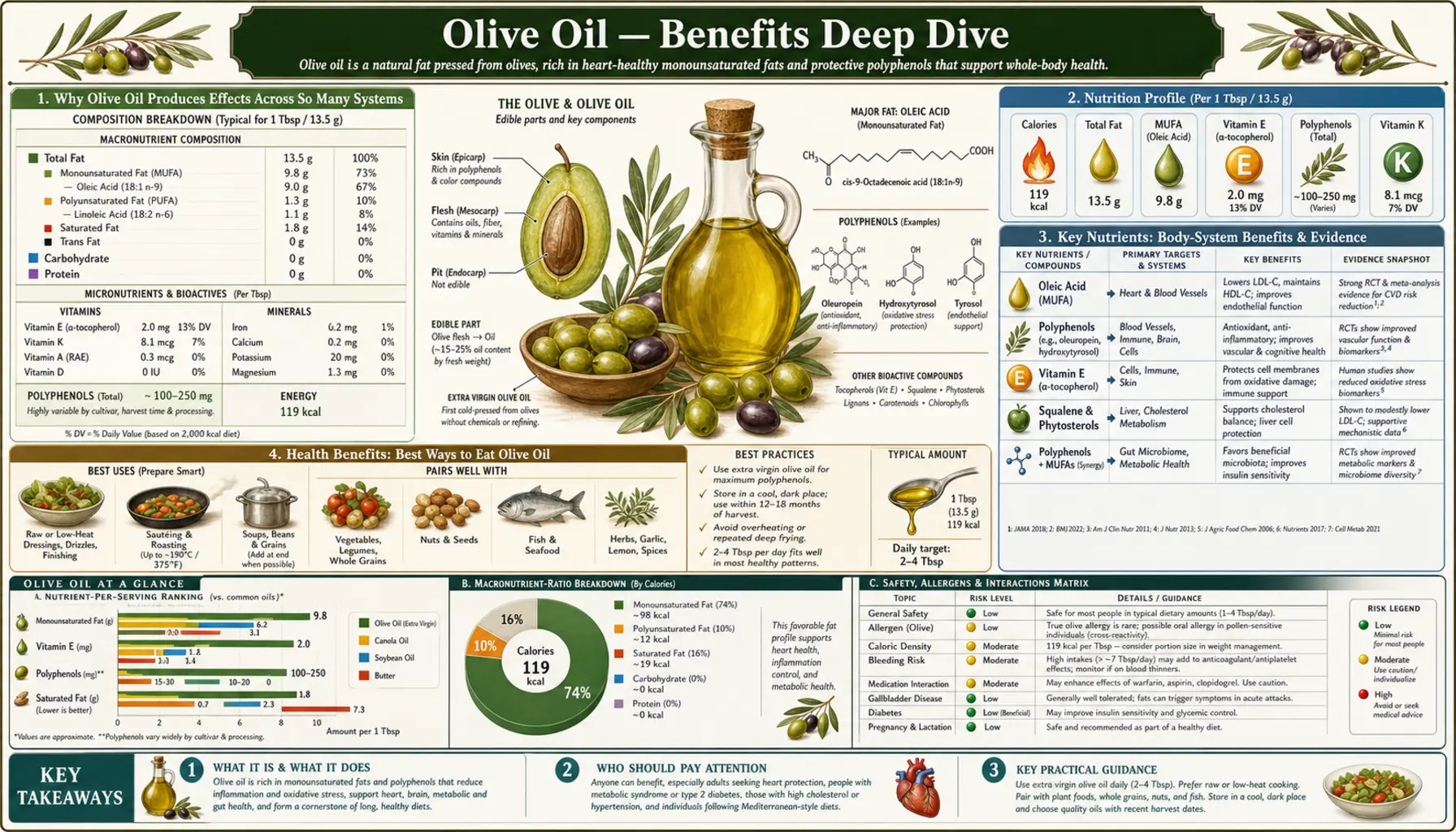
Olive oil is the single best-studied dietary fat in clinical medicine. The PREDIMED trial in Spain (Estruch et al., 2013 and 2018) randomized 7,447 high-cardiovascular-risk adults to either a Mediterranean diet supplemented with extra-virgin olive oil (at least 1 liter per week), a Mediterranean diet supplemented with mixed nuts, or a low-fat control diet, and found a roughly 30% relative reduction in major cardiovascular events in both intervention arms. Olive oil's benefit is not merely its monounsaturated fat content (oleic acid) — refined olive oils with identical fatty-acid profiles produce weaker effects. The active fraction is concentrated in the unsaponifiable polyphenol component: hydroxytyrosol, oleuropein, and the natural ibuprofen-mimic oleocanthal. These four deep-dive pages cover the polyphenol chemistry, the cardiovascular trial evidence, how to distinguish authentic extra-virgin from adulterated supermarket oil, and the surprisingly favorable thermal-oxidative stability that makes EVOO appropriate for most home cooking applications.
Deep-Dive Articles
Polyphenols and Oleocanthal
The bioactive phenolic fraction in extra-virgin olive oil — hydroxytyrosol, oleuropein, tyrosol, oleocanthal, and oleacein. Oleocanthal's remarkable structural and pharmacologic similarity to ibuprofen as a non-selective COX inhibitor, the EFSA-approved 5 mg/day polyphenol claim, lab assays for biophenol content, and why polyphenol concentration ranges from under 50 mg/kg in mass-market oils to over 800 mg/kg in early-harvest single-estate EVOO.
Heart Health
The PREDIMED trial's 30% reduction in major cardiovascular events with high EVOO intake, the LDL-cholesterol modification story (EVOO polyphenols reduce LDL oxidation, the proximate event in atherogenesis), the endothelial-function literature, blood pressure effects, the original Seven Countries Study observation that started the field, and the dose threshold (roughly 25-50 mL/day) at which clinical benefit appears.
Extra Virgin Quality
The IOC and EU regulatory definition of "extra virgin" (free acidity below 0.8%, peroxide value below 20 meq O2/kg, organoleptic panel rating), the Tom Mueller and UC Davis studies documenting widespread adulteration of supermarket EVOO with refined or non-olive oils, how to read a label (harvest date, single-estate, polyphenol assay), and the sensory markers (bitterness, pungency, fruitiness) that signal a high-polyphenol oil.
Cooking Temperature
The smoke-point myth and why it is the wrong metric. EVOO's actual thermal-oxidative stability in real-world frying tested by Modern Olives Laboratory (Australia), polar compound formation versus seed oils at sustained 180°C, the polyphenol antioxidant protection during heating, recommended temperature ceilings for home cooking, and why authentic EVOO is in fact one of the more stable cooking oils despite its lower smoke point than refined seed oils.
GLP-1 and Appetite
How 2-oleoylglycerol and oleoylethanolamide, two digestion products of olive oil, trigger the same GLP-1 and PPAR-alpha pathways targeted by drugs like semaglutide — and why the comparison to Ozempic breaks down at the pharmacokinetics. Includes the arithmetic on how much 2-OG a real serving produces, the Copenhagen carrot-oil crossover trial, and a factual look at who is promoting this claim commercially.
Table of Contents
- Deep-Dive Articles
- Why Olive Oil Produces Effects Across So Many Systems
- Research Papers: Polyphenols and Oleocanthal
- Research Papers: Heart Health
- Research Papers: Extra Virgin Quality and Adulteration
- Research Papers: Cooking Temperature and Oxidative Stability
- Research Papers: Cross-Cutting (Brain, Cancer, Inflammation)
- External Authoritative Resources
- Connections
- Featured Videos
Why Olive Oil Produces Effects Across So Many Systems
Most dietary fats are evaluated through a single lens: their fatty-acid composition (saturated, monounsaturated, polyunsaturated; omega-3 versus omega-6 ratio). By that conventional measure, olive oil is "merely" a high-monounsaturated-fat oil — approximately 73% oleic acid, 11% saturated, 8-10% linoleic acid (omega-6), and trace omega-3. Other oils with similar fatty-acid profiles exist (high-oleic safflower, high-oleic sunflower, refined canola), and they do not produce comparable clinical effects. The implication is that the fatty acids are not the active fraction.
The active fraction is the small (1-2% of total mass) unsaponifiable component: a complex mixture of polyphenols, tocopherols (Vitamin E), squalene, beta-sitosterol, chlorophyll, and minor lignans. Three reasons this matters clinically:
- Polyphenol antioxidant and anti-inflammatory action — hydroxytyrosol and oleuropein are exceptionally potent free-radical scavengers, comparable on a molar basis to ascorbic acid. They reduce LDL oxidation, the proximate biochemical event that converts circulating LDL into the atherogenic particles that initiate vascular plaque. The EFSA (European Food Safety Authority) approved a health claim in 2011 that "olive oil polyphenols contribute to the protection of blood lipids from oxidative stress" at a threshold dose of 5 mg of hydroxytyrosol and its derivatives per 20 g of olive oil daily. See the polyphenols deep-dive for the full chemistry.
- Oleocanthal as a natural NSAID — a 2005 Nature paper by Beauchamp et al. identified oleocanthal in extra-virgin olive oil as a compound that produces the characteristic peppery throat-burn sensation. The same paper documented that oleocanthal is a non-selective COX-1 and COX-2 inhibitor with potency comparable to ibuprofen on a molar basis. Daily consumption of approximately 50 mL of high-polyphenol EVOO delivers roughly 9 mg of oleocanthal, equivalent in COX-inhibitory activity to about 10% of an adult ibuprofen dose — spread continuously through the day. This chronic low-level COX inhibition is hypothesized to contribute to the cardiovascular and possibly cancer-prevention effects.
- The lipid matrix matters for absorption of other nutrients — olive oil increases the bioavailability of fat-soluble vitamins (A, D, E, K) and carotenoids (lycopene from tomatoes, lutein from leafy greens, beta-carotene from carrots) when consumed together. The classic Mediterranean tomato-and-olive-oil pairing is bioavailability-driven; dressing a salad with olive oil rather than fat-free dressing roughly triples carotenoid absorption.
The therapeutic implication is that the form of olive oil matters as much as the quantity. Refined "light" olive oil, "pure" olive oil, or "olive pomace oil" have most of their polyphenols stripped or destroyed during the refining process. They retain the monounsaturated fatty-acid profile but lose the bioactive fraction. The extra-virgin quality deep-dive explores how to find authentic, high-polyphenol EVOO and how to distinguish it from the substantial fraction of supermarket "extra virgin" oils that fail laboratory quality testing.
Research Papers: Polyphenols and Oleocanthal
- Beauchamp GK et al. (2005). Phytochemistry: ibuprofen-like activity in extra-virgin olive oil. Nature. — PubMed: Beauchamp oleocanthal 2005
- EFSA Panel on Dietetic Products (2011). Scientific Opinion on the substantiation of health claims related to polyphenols in olive oil. — PubMed: EFSA polyphenol claim
- Covas MI et al. (2006). EUROLIVE Study Group: the effect of polyphenols in olive oil on heart disease risk factors. Annals of Internal Medicine. — PubMed: EUROLIVE trial
- Hydroxytyrosol bioavailability and pharmacokinetics — PubMed: Hydroxytyrosol PK
- Oleuropein hydrolysis to hydroxytyrosol in vivo — PubMed: Oleuropein metabolism
- Oleocanthal COX-1 and COX-2 inhibition assays — PubMed: Oleocanthal COX
- LeGendre O et al. (2015). (-)-Oleocanthal rapidly and selectively induces cancer cell death via lysosomal membrane permeabilization. Molecular and Cellular Oncology. — PubMed: Oleocanthal LMP
- Hydroxytyrosol antioxidant capacity in vitro and in vivo — PubMed: Hydroxytyrosol antioxidant
- Polyphenol concentration in EVOO by cultivar (Koroneiki, Picual, Coratina) and harvest timing — PubMed: Polyphenol by cultivar
- Oleacein cardiovascular and anti-inflammatory effects — PubMed: Oleacein
Research Papers: Heart Health
- Estruch R et al. (2013). Primary prevention of cardiovascular disease with a Mediterranean diet. NEJM. (Original PREDIMED publication). — PubMed: PREDIMED 2013
- Estruch R et al. (2018). Primary Prevention of Cardiovascular Disease with a Mediterranean Diet Supplemented with Extra-Virgin Olive Oil or Nuts. NEJM. (Re-analysis after data corrections). — PubMed: PREDIMED 2018 re-analysis
- Guasch-Ferre M et al. PREDIMED secondary analyses on olive oil dose and cardiovascular outcomes — PubMed: PREDIMED olive oil dose
- Keys A, Seven Countries Study original publications — PubMed: Seven Countries Study
- Olive oil and LDL oxidation: clinical trials — PubMed: Olive oil LDL oxidation
- Endothelial function and EVOO: flow-mediated dilation studies — PubMed: Endothelial function
- Olive oil and blood pressure: meta-analysis — PubMed: Olive oil and BP
- Guasch-Ferre M et al. (2020). Olive oil consumption and cardiovascular risk in U.S. adults. JACC. — PubMed: US olive oil cardiovascular
- Olive oil and HDL function: cholesterol efflux capacity — PubMed: HDL cholesterol efflux
- Schwingshackl L et al. (2014). Monounsaturated fatty acids, olive oil and health status: systematic review and meta-analysis. Lipids in Health and Disease. — PubMed: Schwingshackl MUFA meta
Research Papers: Extra Virgin Quality and Adulteration
- Frankel EN et al. (2011, UC Davis Olive Center). Tests indicate that imported extra virgin olive oil often fails international and USDA standards. — PubMed: UC Davis adulteration
- International Olive Council (IOC) trade standard for olive oils — PubMed: IOC standard
- Free fatty acidity, peroxide value, and K232/K270 absorbance as EVOO quality markers — PubMed: EVOO chemical markers
- Organoleptic panel test (IOC panel) for EVOO classification — PubMed: IOC sensory panel
- Refined olive oil and deodorized olive oil — chemical and bioactive differences from EVOO — PubMed: Refined vs EVOO
- EVOO authentication by fatty acid profile and stable isotope analysis — PubMed: EVOO authentication
- Polyphenol degradation during EVOO storage and shelf life — PubMed: Polyphenol degradation
- Soybean oil and sunflower oil adulteration of EVOO — detection methods — PubMed: Adulteration detection
- NMR spectroscopy fingerprinting of EVOO geographic origin — PubMed: NMR fingerprinting
- Tom Mueller's "Extra Virginity" and the olive oil fraud industry — PubMed: Olive oil fraud
Research Papers: Cooking Temperature and Oxidative Stability
- De Alzaa F, Guillaume C, Ravetti L (2018). Evaluation of chemical and physical changes in different commercial oils during heating. Acta Scientific Nutritional Health. (Modern Olives Lab study). — PubMed: Modern Olives heating study
- Smoke point versus oxidative stability of cooking oils — PubMed: Smoke point vs stability
- Polar compound formation during deep frying with EVOO vs seed oils — PubMed: Polar compounds frying
- Polyphenol antioxidant protection during EVOO heating — PubMed: Polyphenol thermal protection
- Trans fatty acid formation in heated oils — PubMed: Trans fat formation
- Aldehyde formation (4-HNE, acrolein) during sustained frying — PubMed: Aldehyde formation
- Olive oil tocopherol (Vitamin E) thermal degradation — PubMed: Tocopherol thermal
- Rancimat induction time for EVOO vs other oils — PubMed: Rancimat EVOO
- Health implications of degraded cooking oils (oxidized lipids and cardiovascular risk) — PubMed: Oxidized lipids and CVD
- Reuse of frying oils and cumulative degradation — PubMed: Frying oil reuse
Research Papers: Cross-Cutting (Brain, Cancer, Inflammation)
- PREDIMED-NAVARRA sub-study: olive oil and cognitive decline — PubMed: PREDIMED cognition
- Oleocanthal and Alzheimer's amyloid beta clearance — PubMed: Oleocanthal and Alzheimer's
- Olive oil and breast cancer risk: meta-analysis — PubMed: Olive oil and breast cancer
- Olive oil and colorectal cancer prevention — PubMed: Olive oil and CRC
- Olive oil and type 2 diabetes prevention (PREDIMED diabetes sub-study) — PubMed: PREDIMED T2DM
- Olive oil and rheumatoid arthritis symptoms — PubMed: Olive oil and RA
- Olive oil and inflammatory bowel disease — PubMed: Olive oil and IBD
- Squalene in olive oil and skin protection — PubMed: Squalene skin
- Olive oil and gut microbiome modulation — PubMed: Olive oil microbiome
- Olive oil and all-cause mortality: meta-analysis — PubMed: All-cause mortality
External Authoritative Resources
- International Olive Council (IOC) — the intergovernmental body that sets EVOO trade standards, methods, and definitions
- UC Davis Olive Center — ongoing research on olive oil chemistry, sensory analysis, and supermarket adulteration
- EFSA — Scientific Opinion on Olive Oil Polyphenols Health Claim (2011)
- PREDIMED Trial Official Site — the landmark Mediterranean diet trial
- PubMed — All research on EVOO polyphenols
Connections
- All Food
- Olive Oil (Main Page)
- Polyphenols and Oleocanthal
- Heart Health
- Extra Virgin Quality
- Cooking Temperature
- GLP-1 and Appetite
- Omega-3 Fatty Acids
- Vitamin E (Tocopherols)
- Vitamin K (Fat-Soluble)
- Atherosclerosis
- Hypertension
- Type 2 Diabetes
- Mediterranean Diet
- Avocado (Monounsaturated)
- Nuts