Olive Oil: History and Origins
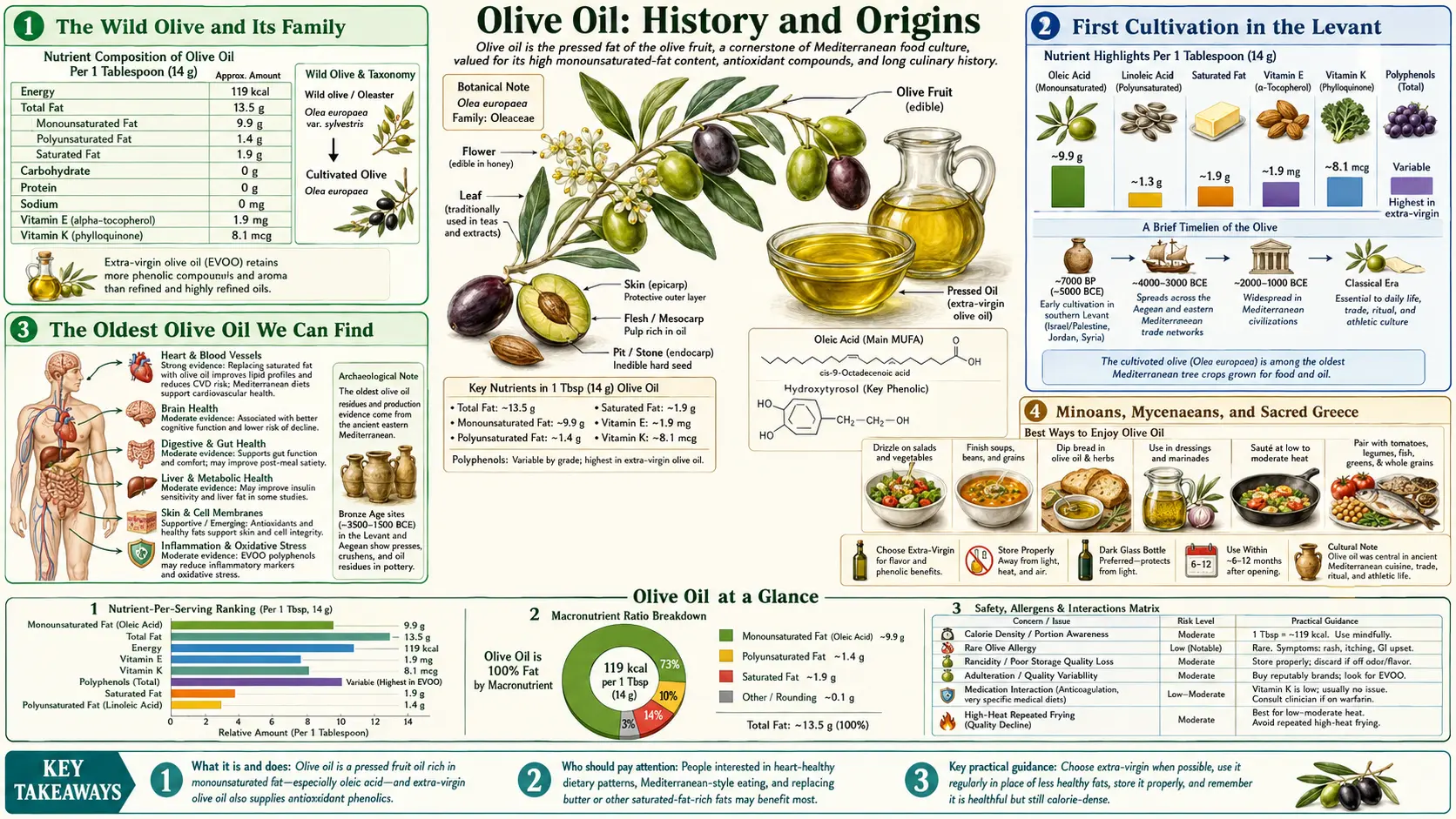
Long before anyone wrote anything down, people around the eastern Mediterranean were gathering the small, bitter fruit of the wild olive. The earliest chemical proof that they were pressing it into oil comes from clay jars buried at Ein Zippori in the Lower Galilee, where residue inside two vessels has been dated to roughly 5800 BCE — about eight thousand years ago. Olive oil, in other words, is not an invention with a name and a date. It is one of humanity's oldest prepared foods, and its story is really the story of a single tough little tree, Olea europaea, and the many peoples who learned to grow it, press it, trade it, burn it for light, rub it on their skin, and treat it as something close to sacred. This article follows what the archaeological and historical record actually supports: where the olive was first tamed, how cultivation spread across the Mediterranean and eventually to the Americas, and the cultural and culinary place it has held for millennia. Where the record is firm we say so; where a claim is legend or popular attribution, we name it as such.
Table of Contents
- The Wild Olive and Its Family
- First Cultivation in the Levant
- The Oldest Olive Oil We Can Find
- Minoans, Mycenaeans, and Sacred Greece
- Liquid Gold of the Roman World
- Light, Medicine, and Ritual
- Across the Sea to the Americas
- From Mediterranean Staple to Modern Science
- Research Papers and References
- Connections
- Featured Videos
The Wild Olive and Its Family
The cultivated olive belongs to the species Olea europaea, a member of the olive family, Oleaceae — the same botanical family as lilac, jasmine, forsythia, and the ash tree. Its wild ancestor is the oleaster, a thorny, scrubby form of the same species that still grows across the Mediterranean basin. The oleaster bears small, hard, intensely bitter fruit with little flesh; left to itself it is barely food at all. Turning that wild shrub into the productive, oil-rich tree of the modern grove was the work of thousands of years of human selection.
People knew the wild olive long before they grew it. Charred olive stones and wood at sites around the eastern Mediterranean show that foragers were collecting wild olives for a very long time — by some reconstructions, gathering of wild olive material in the region reaches back many thousands of years before any orchard existed. This matters for the history that follows: the olive was a familiar wild resource first, and a cultivated crop second. Domestication did not introduce a new plant so much as it intensified, selected, and tamed one that local people had already been using.
The tree itself helps explain why it succeeded. The olive is evergreen, extraordinarily long-lived (individual trees can survive for centuries, and some claimed ancient specimens far longer), and superbly adapted to exactly the hot, dry, stony, sun-baked country of the Mediterranean where little else thrives. It tolerates drought and poor soil, regrows readily after being cut back or even burned, and can be propagated from cuttings and from the knotty woody swellings at its base. A tree that survives hard ground, hard summers, and hard treatment, and that yields a storable, tradeable, calorie-dense oil, was almost destined to become a foundation of Mediterranean life.
First Cultivation in the Levant
Where and when the wild oleaster became the cultivated olive is a question that modern genetics and archaeology have worked on together, and the answer they converge on points to the Levant — the eastern edge of the Mediterranean. A widely cited genetic study by Gérard Besnard and colleagues, published in the Proceedings of the Royal Society B in 2013, traced the maternal lineages of olive trees across the Mediterranean and concluded that the cradle of the olive's primary domestication lies in the northern (north‐eastern) Levant — broadly the region around the modern Syria‐Turkey border — with the process beginning on the order of six thousand years ago. From this core area, cultivated forms then spread and repeatedly mixed with local wild populations as they moved west.
Cultivation in the broader Levant is usually placed in the window between roughly 6,000 and 8,000 years ago, spanning the late Neolithic into the Chalcolithic period. The picture is one of a long, gradual taming rather than a single moment of invention: people favoured the trees that fruited more heavily and pressed more easily, propagated those by cuttings, and over many generations shifted the population toward the larger-fruited, oilier domesticated olive.
One striking line of evidence comes from ancient pollen. A 2023 review by Oz Barazani, Arnon Dag, and Zachary Dunseth in Frontiers in Plant Science describes a marked surge in olive pollen in the southern Levant around the Early Bronze Age — so much pollen, in places, that it points to olive growing on a scale beyond what local communities could have eaten themselves. That over-production is taken as a signal of something new: the olive had become not just a food but a commodity, grown deliberately, in quantity, for storage and trade. The orchard, and the economy built on it, had arrived.
The Oldest Olive Oil We Can Find
Growing olives is one thing; pressing them into oil is another, and here the archaeological record is unusually concrete. The earliest direct chemical evidence for olive oil — not just olive fruit or wood, but the pressed product itself — comes from Ein Zippori, a site in the Lower Galilee in northern Israel excavated in 2011‐2013. Researchers led by Dvory Namdar, working with Nimrod Getzov and Ianir Milevski, sampled the walls of ancient pottery and chemically extracted the organic residues soaked into the clay. The residues matched olive oil, and two of the vessels were dated to about 5800 BCE — roughly eight thousand years ago. Remarkably, the ancient residue closely resembled fresh, one-year-old olive oil, a sign of how well it had been preserved.
Ein Zippori is not entirely alone. It is usually mentioned alongside Kfar Samir, a now-submerged prehistoric settlement off the Carmel coast of Israel, where waterlogged conditions preserved crushed olive pulp and pits interpreted as the debris of early oil extraction. Taken together, these sites give us the oldest reasonably secure evidence anywhere for the deliberate production of olive oil, and they place that achievement firmly on the eastern Mediterranean seaboard — the same Levantine zone the genetic evidence points to for domestication.
It is worth being honest about what such dates mean. Archaeological "earliest known" claims describe the oldest evidence found so far, not the first time something ever happened; a still-older site could always turn up. What the Ein Zippori and Kfar Samir finds reliably tell us is that by around eight thousand years ago, communities in the Levant were not merely eating olives but extracting, storing, and presumably valuing their oil — the start of a continuous tradition that has never since been broken.
Minoans, Mycenaeans, and Sacred Greece
From its Levantine homeland the cultivated olive travelled west, and on the islands and shores of the Aegean it found a second home so complete that the olive became inseparable from Greek identity. On Minoan Crete, in the second millennium BCE, olive oil was a pillar of the palace economy: oil was pressed, stored in great jars, and recorded by palace scribes. Some of the very oldest written references to olive oil in the world come from this Aegean Bronze Age world, in the form of clay tablets.
The Mycenaeans, who followed on the Greek mainland, kept meticulous palace accounts in the script known as Linear B, and these tablets — from centres such as Pylos and Knossos — record olive oil in detail: quantities, allocations, and the oil itself, written with a word read as e-ra-wo (an early ancestor of the Greek elaion, "oil"). Olive oil here was wealth and administration, dispensed by the palace and, the evidence suggests, exported by sea. The Aegean had become a place that produced oil in surplus and shipped it abroad.
Alongside the economics ran a deep reverence. The ancient Greeks treated the olive as sacred and as a symbol of peace, wisdom, and prosperity. A famous legend — and it should be read as legend, not history — held that the goddess Athena and the sea-god Poseidon competed for the patronage of a great city; Poseidon struck the rock and produced a spring of seawater, but Athena planted the first olive tree, and the people, judging her gift the more useful, named their city Athens in her honour. Whatever its mythic status, the story captures something true about how the Greeks valued the tree. The same reverence shows in athletics: victors at the ancient Olympic Games were crowned not with gold but with the kotinos, a wreath cut from the wild olive, the highest honour the games could bestow.
It is to this Greek world that one of olive oil's most repeated phrases is traditionally attributed: the description of olive oil as "liquid gold," commonly credited to Homer. The attribution is popular and old, but worth flagging carefully — scholars note that Homer's actual lines speak of liquid oil in a golden flask, so the "gold" may belong to the vessel as much as to the oil. Presented as a flourish, the phrase is fair; presented as a verbatim quotation, it deserves the caution this page gives it.
Liquid Gold of the Roman World
If the Greeks made the olive sacred, the Romans made it industrial. As Rome's power spread, so did the olive: vast groves were planted across North Africa, the Iberian peninsula, and the Mediterranean provinces, and olive oil became a staple traded across the empire on a scale not seen before. Roman writers on agriculture — among them Cato the Elder, Varro, Columella, and the encyclopaedist Pliny the Elder — discussed olive growing, pressing, and oil quality in practical detail, treating the grove as a serious commercial investment.
The Romans graded their oil. Ancient sources describe a hierarchy running from the finest oil pressed from green, unripe olives (oleum ex albis ulivis) down through oil from riper fruit to low grades pressed from windfall or damaged olives — the poorest fit only for the cheapest uses. This grading by ripeness and pressing, and the matching of grade to use and to social rank, is a recognisable ancestor of the quality tiers (extra virgin and below) that govern olive oil to this day.
The sheer volume of the Roman oil trade has left a startling physical monument. Much oil moved in pottery amphorae, often shipped from the rich oil province of Baetica in what is now southern Spain. In Rome itself, the discarded fragments of these used oil jars were piled up over centuries into an artificial hill, Monte Testaccio — a mound composed of the broken remains of tens of millions of amphorae, much of it olive-oil containers. Few archaeological sites make the scale of an ancient food trade so literally visible: an entire hill built from the empty bottles of the Roman oil supply.
Light, Medicine, and Ritual
Through all these centuries olive oil was never only food. In a world without electricity, it was one of the most important sources of light: poured into simple lamps, it burned cleanly and steadily, lighting homes, temples, and public buildings across the ancient Mediterranean. The same oil was the basis of soaps, ointments, and perfumes, infused with herbs and aromatics, and was rubbed into the skin as a cosmetic and cleanser — Greek athletes famously coated themselves in oil before exercise and scraped it off afterward.
Olive oil also carried profound religious and ceremonial weight. It was used to anoint kings, priests, and the dead, and it appears throughout the religious literature of the region; in the Hebrew and Christian scriptures, olive oil is mentioned again and again in connection with lamps, offerings, and anointing, and the olive branch became an enduring emblem of peace. To anoint someone with oil was to mark them as chosen or consecrated — a meaning so durable that words and gestures rooted in it survive in religious practice today.
As a traditional medicine, olive oil has an equally long pedigree. Ancient and classical physicians in the Greek and Roman tradition recommended it for a wide range of complaints, applied to wounds and skin and taken internally; it sat among the most basic remedies of the ancient pharmacy. This page records that history as history, not as medical advice: the fact that olive oil was prescribed for many ailments in antiquity tells us how it was valued, not which of those uses would hold up to modern testing. The honest line between the two — inherited reputation versus measured evidence — is exactly what the final section turns to.
Across the Sea to the Americas
For most of its history the olive stayed within reach of the Mediterranean and neighbouring lands, because it needs that particular climate — mild, wet winters and long, hot, dry summers — to thrive. That changed with the European voyages to the Americas. As part of the great exchange of plants, animals, and people that followed 1492, Spanish colonists carried the olive across the Atlantic to lands that had never known it.
The documented introductions are specific. Olive trees were brought from Spain to Peru, with the colonist Antonio de Ribera credited with bringing young olive plants to the area of Lima around 1560 — tradition holds that only a few of the saplings survived the long voyage. From these South American beginnings, and through continued Spanish efforts, olive growing took hold in parts of the New World with suitable climates. Further north, the olive reached California with the Spanish Franciscan missions: from 1769 onward, beginning around Mission San Diego de Alcalá under the Franciscans associated with Junípero Serra, olives were planted along the mission chain, giving rise to the hardy old California cultivar still known as the Mission olive, originally grown to press oil.
The olive's spread to the Americas is therefore a clear, datable, human-driven episode rather than a vague diffusion — a tree native to one corner of the Old World, deliberately transplanted by particular people to particular places where, given the right Mediterranean-like climate, it could finally grow. Today California, Chile, Argentina, and Australia all produce olive oil, even as Spain, Italy, Greece, Tunisia, and Turkey — the old heartland — still account for the overwhelming majority of the world's supply.
From Mediterranean Staple to Modern Science
For thousands of years olive oil's reputation rested on tradition and taste. In the twentieth century it began to rest on data as well. When the American physiologist Ancel Keys and colleagues launched the Seven Countries Study in the late 1950s and 1960s, comparing diet and heart disease across populations, the olive-oil-rich eating patterns of the Mediterranean stood out for their low rates of cardiovascular disease. That work helped crystallise the idea of the Mediterranean diet, with olive oil as its central fat — a dietary pattern later recognised by UNESCO as an Intangible Cultural Heritage of Humanity.
The scientific story since then has been one of testing the old food against modern methods, and of identifying the specific compounds — oleic acid, and the polyphenols of extra virgin olive oil such as hydroxytyrosol and oleocanthal — that may underlie its effects. The detailed modern evidence, including large trials of the Mediterranean diet, the mechanisms of olive oil's polyphenols, dosing, cooking, quality, and cautions, is covered on the companion Olive Oil Benefits articles and on the main Olive Oil page. This history is concerned only with how olive oil came to occupy the place it holds.
The thread is unusually unbroken. The same oil that was pressed into clay jars in the Galilee eight thousand years ago, recorded on Mycenaean tablets, graded by Roman writers, burned in ancient lamps, and carried by Spanish settlers across an ocean is the oil now studied in randomised trials and bottled with a harvest date. Knowing that long history does not, by itself, prove any health claim — tradition raises questions that research must answer — but it does explain why so few foods are as deeply woven into human culture as the oil of the olive.
Research Papers and References
The list below combines peer-reviewed studies on the domestication and early history of the olive with curated PubMed topic-search links into the archaeobotanical and historical literature. Ancient primary sources (the Linear B palace tablets and the Roman agricultural writers Cato, Varro, Columella, and Pliny the Elder) are named in the article as historical sources rather than as modern citations. Author names, titles, and journals are given as plain text; only the stable DOI, PMID, or archive link is hyperlinked, and each opens in a new tab.
- Besnard G, Khadari B, Navascués M, et al. The complex history of the olive tree: from Late Quaternary diversification of Mediterranean lineages to primary domestication in the northern Levant. Proceedings of the Royal Society B: Biological Sciences. 2013;280(1756):20122833. — doi:10.1098/rspb.2012.2833 · PMID: 23390107
- Namdar D, Amrani A, Getzov N, Milevski I. Olive oil storage during the fifth and sixth millennia BC at Ein Zippori, Northern Israel. Israel Journal of Plant Sciences. 2015;62(1-2):65-74. — doi:10.1080/07929978.2014.960733
- Barazani O, Dag A, Dunseth Z. The history of olive cultivation in the southern Levant. Frontiers in Plant Science. 2023;14:1131557. — doi:10.3389/fpls.2023.1131557
- Diez CM, Trujillo I, Martinez-Urdiroz N, et al. Olive domestication and diversification in the Mediterranean Basin. New Phytologist. 2015;206(1):436-447. — doi:10.1111/nph.13181 · PMID: 25420413
- Olive (Olea europaea) domestication and archaeobotany — PubMed: olive domestication and archaeobotany
- History and early production of olive oil — PubMed: olive oil history and ancient production
External Authoritative Resources
- Wikipedia — Olive (Olea europaea)
- Wikipedia — Symbolic and cultural significance of the olive
- International Olive Council