Olive Oil for Heart Health
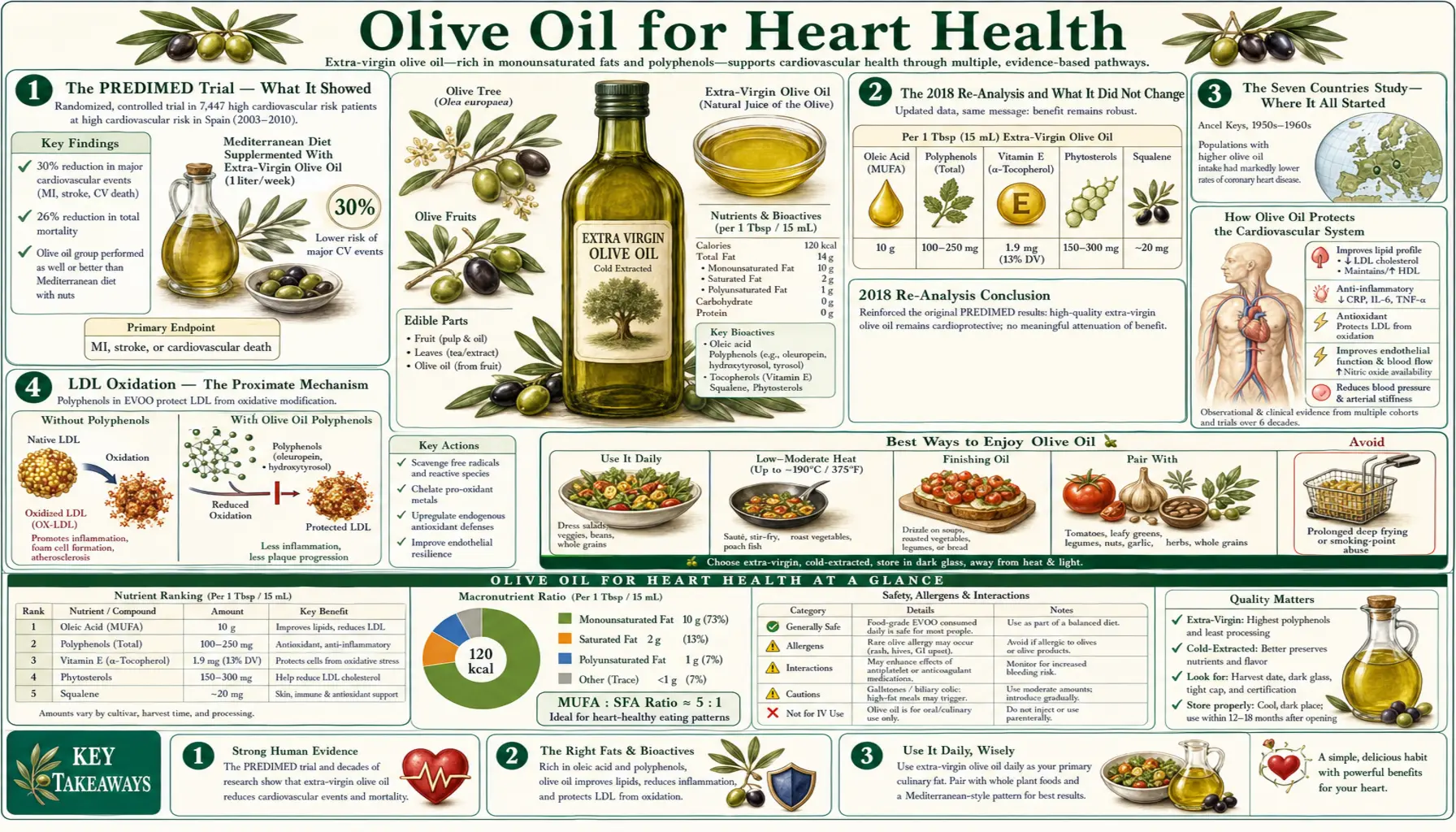
The PREDIMED trial (Prevención con Dieta Mediterránea, Estruch et al., 2013 and re-published 2018 in NEJM) is the single most important randomized controlled trial of a dietary pattern in the modern cardiovascular-medicine era. 7,447 high-risk Spanish adults with established cardiovascular risk factors but no prior cardiovascular event were randomized to one of three diets: Mediterranean diet supplemented with at least 1 liter of extra-virgin olive oil per week per household; Mediterranean diet supplemented with 30 g/day mixed nuts; or low-fat control diet with advice. After median 4.8 years of follow-up, the primary endpoint — combined myocardial infarction, stroke, and cardiovascular death — was reduced by approximately 30% in both the olive oil and nuts groups relative to the low-fat control. The trial was stopped early on ethical grounds when the magnitude of benefit became apparent. The implication: a single dietary change — adding 50 mL of EVOO to daily intake — produces cardiovascular event reduction comparable to a moderately effective statin.
Table of Contents
- The PREDIMED Trial — What It Showed
- The 2018 Re-Analysis and What It Did Not Change
- The Seven Countries Study — Where It All Started
- LDL Oxidation — The Proximate Mechanism
- Endothelial Function and Flow-Mediated Dilation
- Blood Pressure Effects
- HDL Function and Cholesterol Efflux
- Dose-Response and the Clinical Threshold
- Practical Application for Cardiovascular Risk Reduction
- Cautions
- Key Research Papers
- Connections
- Featured Videos
The PREDIMED Trial — What It Showed
PREDIMED was a multicenter, parallel-group, single-blind, randomized controlled trial conducted across 11 Spanish recruiting sites between October 2003 and December 2010. Eligible participants were men aged 55-80 and women aged 60-80 who were free of cardiovascular disease at enrollment but had either type 2 diabetes or at least three major cardiovascular risk factors (current smoking, hypertension, elevated LDL cholesterol, low HDL, overweight, family history of premature CVD).
The 7,447 enrollees were randomized to one of three diets:
- Mediterranean diet + EVOO — 2,543 participants. Provided a free 1-liter bottle of high-quality extra-virgin olive oil per week per household, with instructions to use it as the primary culinary fat. Target intake: at least 4 tablespoons (60 mL) per day. Standard Mediterranean diet counseling: high vegetable intake, legumes 3+ servings/week, fish 3+ servings/week, white meat preferred over red, moderate wine with meals if customary, avoid processed and pastry products.
- Mediterranean diet + nuts — 2,454 participants. Provided 30 g/day of mixed nuts (15 g walnuts, 7.5 g almonds, 7.5 g hazelnuts) plus the same Mediterranean diet counseling.
- Low-fat control — 2,450 participants. Standard American Heart Association-style counseling to reduce dietary fat to under 30% of calories, low intake of red meat, dairy, and added fats. No supplemental food provided.
The primary endpoint was a composite of myocardial infarction, stroke, or cardiovascular death. With median follow-up of 4.8 years (originally planned for longer, but the trial was stopped early when the protective effect of the Mediterranean diets became clear and continuing the low-fat control was judged ethically problematic):
- Primary endpoint events: 96 in the EVOO group, 83 in the nuts group, 109 in the control group
- Hazard ratio for the composite primary endpoint vs. control: 0.70 for EVOO (95% CI 0.54-0.92, p=0.01) and 0.72 for nuts (0.54-0.95, p=0.03)
- This is a 30% relative reduction in major cardiovascular events with EVOO supplementation
- Stroke specifically: hazard ratio 0.65 for the EVOO group (a 35% reduction)
- Number needed to treat to prevent one major cardiovascular event over 4.8 years: approximately 61
The effect size was comparable in magnitude to that documented for moderate-intensity statin therapy in similar populations (atorvastatin 10 mg, for example, produces approximately a 30-35% relative risk reduction in the same composite endpoint over similar follow-up). The trial was therefore a milestone in establishing dietary intervention as a meaningful cardiovascular prevention strategy on par with pharmacotherapy.
The 2018 Re-Analysis and What It Did Not Change
In 2017-2018, the PREDIMED authors voluntarily acknowledged that approximately 10% of randomizations had not been performed at the individual level — some recruiting sites had used household-level randomization (where multiple family members were assigned to the same arm together), and one center had used a non-random method. The original 2013 NEJM paper was retracted and re-published in 2018 with revised statistical handling. The revised paper used cluster-robust standard errors that account for the household-level randomization issue.
The key point: the conclusions did not materially change. With the revised analysis:
- EVOO hazard ratio: 0.69 (95% CI 0.53-0.91)
- Nuts hazard ratio: 0.72 (95% CI 0.54-0.95)
- Effect sizes and statistical significance both essentially unchanged
The 2018 re-publication therefore confirmed PREDIMED as the most rigorously analyzed large dietary trial showing meaningful cardiovascular benefit from a specific dietary intervention. Subsequent secondary analyses by Guasch-Ferre and colleagues have examined olive oil intake within the trial (as a quantitative exposure rather than randomization arm) and found dose-response relationships: higher EVOO consumption within the EVOO arm associated with greater protection.
The 2020 Guasch-Ferre JACC analysis using the U.S. Health Professionals Follow-up Study and Nurses' Health Study (~93,000 participants, 28 years of follow-up) extended the finding to a U.S. population with much lower baseline olive oil intake: replacing 5 g/day of margarine, butter, mayonnaise, or dairy fat with olive oil was associated with 5-7% lower cardiovascular disease risk. The protective effect was concentration-dependent and largely independent of overall diet quality.
The Seven Countries Study — Where It All Started
The hypothesis that olive oil consumption is cardioprotective originated with Ancel Keys's Seven Countries Study, launched in 1958 and continuing in various forms for over 50 years. Keys observed that mortality from coronary heart disease varied dramatically across populations and correlated strongly with average dietary saturated fat intake — the original "diet-heart hypothesis." But within that broad correlation, the Greek island of Crete was a striking outlier: comparable total dietary fat intake to Finland, but a fraction of the coronary disease mortality.
Cretan diet at the time of the original Keys survey consisted of approximately 40% of calories from fat — high by any modern standard — but the fat came almost entirely from olive oil rather than animal sources. Vegetable intake was extraordinarily high (the Cretan population at the time was largely subsistence-farming and consumed enormous quantities of wild greens), legume intake was high, fish was eaten regularly along the coast, and red meat and dairy intake were both modest. The "Mediterranean diet pattern" as a defined construct was extracted from this Cretan observational baseline.
The Seven Countries Study could not establish causation — it was observational and many population-level variables differed. But it generated the hypothesis that PREDIMED ultimately tested under randomized conditions four decades later, and it confirmed.
LDL Oxidation — The Proximate Mechanism
The most upstream biochemical event in atherogenesis is the oxidative modification of circulating LDL particles. LDL itself is not atherogenic. Native LDL passes harmlessly through arterial intima and is taken up by the regulated LDL receptor pathway on hepatocytes for clearance. Oxidized LDL behaves differently: it is recognized by scavenger receptors (CD36, SR-A) on monocyte-derived macrophages in the arterial intima, internalized in an unregulated fashion, and accumulates as cytoplasmic lipid droplets — the foam cell. Foam cell death releases inflammatory mediators, recruits additional monocytes, and the cycle progresses to plaque.
EVOO polyphenols (specifically hydroxytyrosol and its secoiridoid precursors) reduce LDL oxidation by direct free-radical scavenging in the LDL particle surface and by sparing endogenous antioxidants (alpha-tocopherol, lipid-soluble antioxidants) within the particle. The EUROLIVE trial directly demonstrated this. 200 healthy European men were randomized to three different olive oils for three-week crossover periods: low polyphenol (less than 10 mg/kg), medium polyphenol (164 mg/kg), and high polyphenol (366 mg/kg). 25 mL of oil consumed daily. Endpoint: plasma markers of LDL oxidation. Results showed a dose-dependent reduction in oxidized LDL with increasing polyphenol content, independent of changes in total or LDL cholesterol.
This is the mechanistic basis for the EFSA health claim. The EFSA scientific opinion specifically cites EUROLIVE and 6 other clinical trials demonstrating reduced LDL oxidation as the substantiation for the "polyphenols protect blood lipids from oxidative stress" claim.
Importantly, this mechanism explains why refined "light" olive oil produces a weaker cardiovascular effect than EVOO despite identical fatty acid composition. Refined olive oil retains the monounsaturated fat (oleic acid) but the refining process strips out the polyphenols. The fatty-acid composition is therefore a partial story; the polyphenol contribution to LDL-oxidation protection is the larger fraction of the documented benefit.
Endothelial Function and Flow-Mediated Dilation
Beyond LDL oxidation, EVOO has well-documented direct effects on vascular endothelial function. The endothelium — the single-cell layer lining the vasculature — produces nitric oxide (NO) in response to shear stress, mediating vasodilation. Loss of endothelial NO production (endothelial dysfunction) is one of the earliest detectable changes in atherosclerosis, predating any visible plaque by years to decades.
Endothelial function is most commonly measured non-invasively by flow-mediated dilation (FMD): brachial artery diameter is measured by ultrasound, blood flow is occluded for 5 minutes by a blood-pressure cuff, the cuff is released, and the resulting vasodilation in response to the reactive hyperemia is measured. Healthy young adults have FMD of 8-12%; impaired FMD (under 6%) predicts cardiovascular events independent of conventional risk factors.
Multiple randomized trials have demonstrated EVOO consumption acutely and chronically improves FMD. The Vogel et al. 2000 study at UCSF showed acute improvement in FMD 3 hours after consumption of 50 g EVOO. Larger chronic studies showed sustained FMD improvement after several weeks of 30-50 mL daily intake. The mechanism is thought to be a combination of polyphenol-mediated NO bioavailability protection (less NO scavenging by reactive oxygen species), direct upregulation of endothelial nitric oxide synthase (eNOS), and the anti-inflammatory effect of oleocanthal.
Blood Pressure Effects
Meta-analyses of randomized trials show modest but consistent blood pressure reduction with EVOO consumption — typically 2-4 mmHg systolic and 1-2 mmHg diastolic with sustained intake of approximately 25-50 mL/day. The effect is modest individually but meaningful at the population level (the well-established epidemiologic relationship is that each 2 mmHg systolic reduction in population blood pressure produces approximately a 10% reduction in stroke incidence and 7% reduction in coronary mortality).
The proposed mechanism is multifactorial: improved endothelial NO bioavailability promoting vasodilation; modest ACE inhibition by oleuropein; reduced vascular smooth muscle responsiveness to vasoconstrictors; possible diuretic effect at high intake. Polyphenol content of the oil matters — high-polyphenol EVOO produces greater BP reduction than refined olive oil in head-to-head comparisons.
For hypertensive patients, EVOO consumption is one component of the dietary approach to BP control (along with reduced sodium intake, increased potassium and magnesium intake, the DASH eating pattern, weight loss, and regular aerobic exercise). It is not a substitute for pharmacotherapy in established hypertension, but it adds meaningfully to the non-pharmacologic toolkit.
See our Hypertension page for the full discussion of non-pharmacologic blood pressure management.
HDL Function and Cholesterol Efflux
The current understanding of HDL has moved beyond the simple "good cholesterol" framing of the 1990s. Total HDL-cholesterol concentration is a relatively weak predictor of cardiovascular events once other risk factors are controlled, and pharmacologically increasing HDL cholesterol (with niacin, CETP inhibitors, fibrates) has consistently failed to reduce events. What matters is HDL function — specifically the ability of HDL particles to accept cholesterol from peripheral macrophages and transport it back to the liver for excretion (reverse cholesterol transport, with cholesterol efflux capacity as the laboratory measurement).
EVOO consumption improves HDL functionality without necessarily raising HDL cholesterol concentration much. The Hernaez et al. 2017 trial in Circulation from the PREDIMED group showed that randomization to the EVOO Mediterranean arm produced significant improvements in HDL cholesterol efflux capacity, reduction in HDL-associated proinflammatory proteins, and increased HDL antioxidant capacity, with only modest changes in HDL particle concentration. This functional-quality improvement is now considered the more relevant mechanism than the modest HDL-C numerical change.
Dose-Response and the Clinical Threshold
The PREDIMED protocol target was 60 mL/day (approximately 4 tablespoons) of EVOO. Adherent participants generally consumed 50-60 mL/day; less adherent participants consumed less. The cardiovascular benefit appeared to plateau at intake above approximately 25-30 mL/day, with diminishing returns beyond that, suggesting:
- Below approximately 15 mL/day (1 tablespoon): minimal documented benefit. This is likely the cardiovascular dose floor.
- 25-50 mL/day (about 2-3.5 tablespoons): the dose range with the strongest evidence base. PREDIMED participants in this range showed the documented 30% event reduction.
- Above 60 mL/day: possibly additional benefit but increasingly subject to caloric concerns (over 500 kcal/day from oil alone) and diminishing returns.
The PREDIMED study compared people who consumed 50-60 mL of EVOO daily for years against people whose primary culinary fat was butter, lard, or refined seed oils. The reasonable interpretation is that substituting EVOO for these other fats (rather than adding EVOO to an unchanged diet) is the strategy that approximates the trial intervention. Drizzling olive oil over a high-saturated-fat diet may produce less benefit than fully substituting it.
Practical Application for Cardiovascular Risk Reduction
For an individual seeking to apply PREDIMED-grade cardiovascular benefit:
- Use authentic high-polyphenol EVOO. The clinical effect depends on the polyphenol fraction, not just the monounsaturated fat content. See the Extra Virgin Quality page for selection guidance.
- Target approximately 30-50 mL/day. This is roughly 2-3.5 tablespoons or about 1 ounce. Within the PREDIMED-validated dose range.
- Substitute for other culinary fats. Replace butter, margarine, vegetable seed oils, and mayonnaise with EVOO. Replacement is more important than addition.
- Use both cooked and raw. EVOO retains its polyphenols reasonably well during cooking (see Cooking Temperature page). Raw use (salad dressing, drizzle on finished dishes, dip for bread) preserves the most polyphenols and provides the strongest sensory experience.
- Pair with vegetables. Mediterranean diet effects come from multiple components together. EVOO + leafy greens, EVOO + tomatoes, EVOO + cruciferous vegetables — the lipid matrix increases carotenoid and lipophilic phytonutrient absorption.
- Combine with the broader Mediterranean pattern. Olive oil alone is helpful but acts within the context of high vegetable, legume, whole grain, fish, and nut intake plus moderate dairy and reduced red meat. The PREDIMED intervention was the full pattern with EVOO as the dose-escalated component, not EVOO in isolation.
- Be consistent. The cardiovascular benefit accrues over years of sustained intake. Sporadic use produces sporadic benefit.
Cautions
- Caloric content — 9 kcal/g, so 50 mL/day is approximately 400 kcal. This must be included in (not added to) total daily caloric intake. EVOO replaces other dietary fat calories rather than adding to them. Weight gain from drizzling EVOO on top of an unchanged diet will offset most cardiovascular benefit.
- Not a substitute for proven pharmacotherapy — patients with established cardiovascular disease, prior MI or stroke, diabetes, or familial hypercholesterolemia generally need both dietary intervention and appropriate pharmacotherapy (statins, antiplatelets, blood pressure medications). EVOO supplements rather than replaces these.
- Mild platelet inhibition — addressed in the Polyphenols and Oleocanthal page. At normal dietary doses, the effect is mild and clinically beneficial. Patients on full anticoagulation or with bleeding disorders should mention high EVOO intake to their physician.
- Quality matters — refined "light" or "pure" olive oil lacks the polyphenol fraction that drives most of the cardiovascular benefit. Substituting refined olive oil for butter is a marginal improvement; substituting authentic high-polyphenol EVOO is a substantially larger improvement.
- Effect size is real but not unlimited — the 30% PREDIMED reduction is meaningful but does not abolish cardiovascular risk. Coexisting risk factors (smoking, hypertension, diabetes, dyslipidemia, family history) must still be managed.
Key Research Papers
- Estruch R, Ros E, Salas-Salvado J, Covas MI, Corella D, Aros F, et al. (2018). Primary Prevention of Cardiovascular Disease with a Mediterranean Diet Supplemented with Extra-Virgin Olive Oil or Nuts. NEJM 378(25):e34. — PubMed: PMID 29897866
- Estruch R et al. (2013). Primary prevention of cardiovascular disease with a Mediterranean diet. NEJM 368(14):1279-1290. (Original publication, subsequently re-analyzed.) — PubMed: PMID 23432189
- Guasch-Ferre M, Liu G, Li Y, Sampson L, Manson JE, Salas-Salvado J, et al. (2020). Olive Oil Consumption and Cardiovascular Risk in U.S. Adults. JACC 75(15):1729-1739. — Search PubMed
- Covas MI, Nyyssonen K, Poulsen HE, et al. (2006). The effect of polyphenols in olive oil on heart disease risk factors. Annals of Internal Medicine 145(5):333-341. (EUROLIVE trial). — PubMed: PMID 16954359
- Hernaez A, Castaner O, Goday A, Ros E, Pinto X, Estruch R, et al. (2017). The Mediterranean Diet decreases LDL atherogenicity in high cardiovascular risk individuals: a randomized controlled trial. Molecular Nutrition & Food Research 61(9). — Search PubMed
- Hernaez A, Castaner O, Elosua R, Pinto X, Estruch R, Salas-Salvado J, et al. (2017). Mediterranean Diet Improves High-Density Lipoprotein Function in High-Cardiovascular-Risk Individuals: A Randomized Controlled Trial. Circulation 135(7):633-643. — PubMed: PMID 28193797
- Vogel RA, Corretti MC, Plotnick GD (2000). The postprandial effect of components of the Mediterranean diet on endothelial function. JACC 36(5):1455-1460. — PubMed: PMID 11079642
- Schwingshackl L, Hoffmann G (2014). Monounsaturated fatty acids, olive oil and health status: a systematic review and meta-analysis of cohort studies. Lipids in Health and Disease 13:154. — PubMed: PMID 25274026
- Marin C, Ramirez R, Delgado-Lista J, et al. (2011). Mediterranean diet reduces endothelial damage and improves the regenerative capacity of endothelium. American Journal of Clinical Nutrition 93(2):267-274. — PubMed: PMID 21123460
- Estruch R, Martinez-Gonzalez MA, Corella D, et al. (2006). Effects of a Mediterranean-style diet on cardiovascular risk factors: a randomized trial. Annals of Internal Medicine 145(1):1-11. (PREDIMED pilot). — PubMed: PMID 16818923
- Lopez-Miranda J, Perez-Jimenez F, Ros E, De Caterina R, Badimon L, Covas MI, et al. (2010). Olive oil and health: summary of the II international conference on olive oil and health consensus report, Jaen and Cordoba (Spain) 2008. Nutrition, Metabolism & Cardiovascular Diseases 20(4):284-294. — PubMed: PMID 20303720
- Toledo E, Salas-Salvado J, Donat-Vargas C, Buil-Cosiales P, Estruch R, Ros E, et al. (2015). Mediterranean Diet and Invasive Breast Cancer Risk Among Women at High Cardiovascular Risk in the PREDIMED Trial: A Randomized Clinical Trial. JAMA Internal Medicine 175(11):1752-1760. — PubMed: PMID 26365989
PubMed Topic Searches
- PubMed: PREDIMED Mediterranean cardiovascular
- PubMed: Olive oil and LDL oxidation
- PubMed: EVOO endothelial function
- PubMed: Olive oil and hypertension
- PubMed: Mediterranean diet stroke and MI
Connections
- All Food
- Olive Oil Overview
- Olive Oil Benefits Hub
- Polyphenols and Oleocanthal
- Extra Virgin Quality
- Cooking Temperature
- Mediterranean Diet
- Atherosclerosis
- Hypertension
- Coronary Artery Disease
- Type 2 Diabetes
- Lipid Panel
- Omega-3 Fatty Acids
- Nuts (PREDIMED Arm)
- Fish