Olive Oil Polyphenols and Oleocanthal
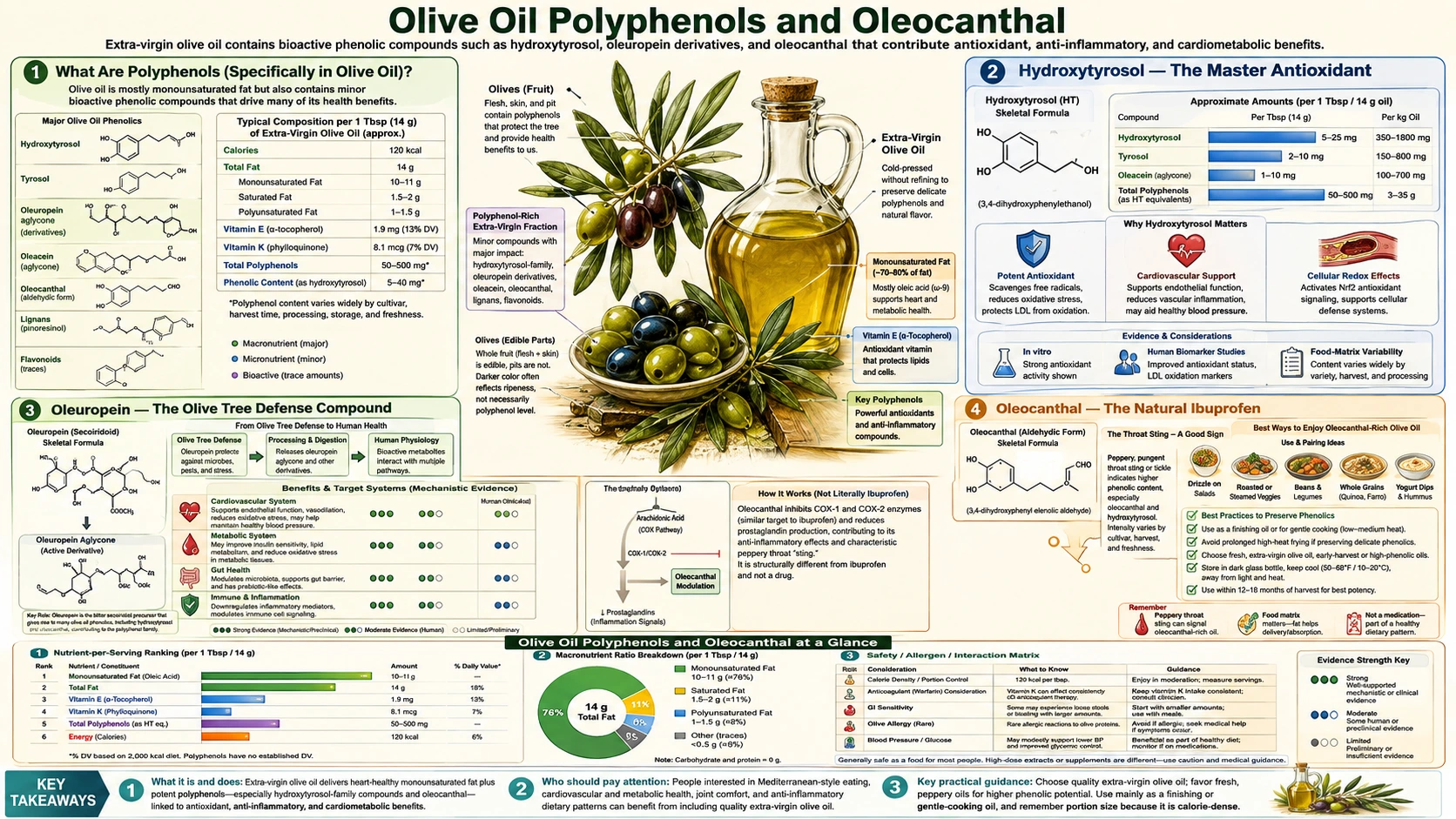
In 2005, Gary Beauchamp and colleagues at the Monell Chemical Senses Center in Philadelphia were tasting newly pressed extra-virgin olive oil at an industry symposium in Sicily. The peppery throat-burn sensation that high-quality EVOO produces felt strangely familiar — Beauchamp had experienced the same sting two days earlier from a liquid ibuprofen preparation. He took samples back to his lab. The 2005 Nature paper that resulted identified the responsible compound as a previously uncharacterized phenolic secoiridoid — oleocanthal — and demonstrated that it inhibits cyclooxygenase (COX-1 and COX-2) with potency comparable to ibuprofen on a molar basis. Oleocanthal is one of approximately 36 phenolic compounds in EVOO. Together they make up perhaps 1-2% of total oil mass, but they account for the majority of EVOO's documented clinical effects.
Table of Contents
- What Are Polyphenols (Specifically in Olive Oil)?
- Hydroxytyrosol — The Master Antioxidant
- Oleuropein — The Olive Tree Defense Compound
- Oleocanthal — The Natural Ibuprofen
- Oleacein, Tyrosol, and Other Phenolics
- The EFSA 5 mg / 20 g Polyphenol Claim
- Why Polyphenol Concentration Varies 50-Fold Across Oils
- Measuring Polyphenols — The Lab Tests You Can Read
- Practical Selection — Finding High-Polyphenol EVOO
- Cautions
- Key Research Papers
- Connections
- Featured Videos
What Are Polyphenols (Specifically in Olive Oil)?
Polyphenols are a broad class of plant secondary metabolites characterized by multiple phenol structural units. The olive tree (Olea europaea) synthesizes its phenolic compounds primarily as a defense against insect predation, fungal infection, and oxidative damage to its fruit. When olives are crushed and the oil mechanically separated from the fruit pulp and pit, a small fraction of these phenolic compounds partition into the oil phase. The exact composition and concentration depend on cultivar, growing region, harvest timing, ripeness at harvest, milling temperature, malaxation time, and storage conditions.
EVOO contains approximately 36 identified phenolic compounds. The major classes are:
- Simple phenols — hydroxytyrosol and tyrosol. These are the primary low-molecular-weight phenols and the form in which most EVOO polyphenols are eventually absorbed and excreted.
- Secoiridoids — the larger, more complex molecules unique to the Oleaceae family. Oleuropein, oleocanthal, oleacein, and ligstroside aglycone are all secoiridoids. They hydrolyze in vivo to release hydroxytyrosol or tyrosol plus a secoiridoid moiety.
- Lignans — pinoresinol and acetoxypinoresinol. Present in smaller quantities, antioxidant active.
- Flavonoids — luteolin and apigenin. Trace amounts; contribute to antioxidant capacity.
- Phenolic acids — caffeic acid, vanillic acid, p-coumaric acid in trace amounts.
Total phenolic content in EVOO ranges from approximately 50 mg/kg (lower-end commercial blends) to over 800 mg/kg (early-harvest single-estate oils from high-polyphenol cultivars like Coratina or Koroneiki). This 16-fold range explains why two bottles both labeled "extra virgin olive oil" can produce dramatically different physiologic effects when consumed at the same dose.
Hydroxytyrosol — The Master Antioxidant
Hydroxytyrosol (3,4-dihydroxyphenylethanol, abbreviated 3,4-DHPEA) is the single best-characterized olive polyphenol. It is the most abundant simple phenol in EVOO directly, and additionally the in-vivo hydrolysis product of oleuropein and oleacein. The combined "hydroxytyrosol and its derivatives" pool is what the EFSA health claim references.
Mechanistically, hydroxytyrosol is an exceptionally potent free-radical scavenger. Its catechol structure (two adjacent hydroxyl groups on the benzene ring) is the same chemical motif that gives epinephrine and dopamine their reactivity, and gives epicatechin in green tea or quercetin in apples their antioxidant activity. In standardized in-vitro assays (ORAC, TEAC, DPPH), hydroxytyrosol scores at or above ascorbic acid on a molar basis — meaning it can quench reactive oxygen species at concentrations comparable to Vitamin C.
The clinically most important target of hydroxytyrosol is oxidized LDL. Circulating LDL particles, when modified by oxidative attack on their phospholipid and apolipoprotein B components, become recognized by scavenger receptors on monocyte-derived macrophages in the arterial intima. Macrophages take up oxidized LDL avidly, transform into foam cells, and initiate the atherosclerotic plaque. Reducing LDL oxidation in plasma is therefore one of the more upstream interventions in cardiovascular disease prevention. The EUROLIVE trial (Covas et al. 2006, Annals of Internal Medicine) randomized 200 healthy European men to three different olive oils (low, medium, high polyphenol) and showed dose-dependent reductions in plasma markers of LDL oxidation as polyphenol content increased.
Hydroxytyrosol pharmacokinetics: oral bioavailability is approximately 75-99% (free hydroxytyrosol is absorbed efficiently); peak plasma concentration occurs within 30-60 minutes; the molecule is rapidly conjugated to sulfate and glucuronide forms by phase II liver enzymes; urinary excretion is dose-dependent. The conjugated forms retain some antioxidant activity. Most clinical effects are attributed to the parent compound during its brief unconjugated window, with sustained exposure provided by hydrolysis of secoiridoid precursors over many hours after a meal.
Oleuropein — The Olive Tree Defense Compound
Oleuropein is the dominant phenolic compound in olive leaves and unripe olive fruit. In the fruit, it is responsible for the characteristic bitterness of green table olives — which is why all commercial olive curing processes (Greek-style brine cure, Spanish-style lye cure, California-style oxidation cure) are designed primarily to extract or hydrolyze oleuropein into less bitter compounds.
In EVOO, oleuropein concentration is highest in oils from early-harvest (green) olives and from bitter-tasting cultivars (Coratina, Picual, Koroneiki). As olives ripen toward purple-black on the tree, fruit oleuropein concentration declines and so does the oleuropein content of oil pressed from those olives. This is the chemical basis for the "early harvest" marketing premium — early-harvest oils are more bitter and more pungent and they contain meaningfully more polyphenol.
Mechanistically, oleuropein hydrolyzes in vivo to release hydroxytyrosol and an oleuropein-aglycone fragment. The pharmacokinetics are therefore similar to those of hydroxytyrosol but with a delayed-release profile — oleuropein acts as a slow-release reservoir of hydroxytyrosol in the gut and circulation.
Direct effects of oleuropein itself (independent of its hydroxytyrosol hydrolysis product) have been documented in cell-culture and animal models: ACE inhibition (modest, contributes to blood-pressure effect), anti-inflammatory action via NF-kB inhibition, anti-platelet effects (inhibits platelet aggregation), and direct antimicrobial activity against several bacteria and yeast. The clinical relevance of these direct effects in humans at dietary doses is debated — most authors now attribute the bulk of in vivo effect to the hydroxytyrosol that oleuropein liberates.
Olive leaf extracts (sold as supplements) contain much higher oleuropein concentrations than olive oil itself, and have been studied in their own right for hypertension and immune support. For more on the leaf-based supplement form, see our Olive Leaf page.
Oleocanthal — The Natural Ibuprofen
Oleocanthal (chemically: decarboxymethyl ligstroside aglycone) is the compound responsible for the characteristic peppery sting at the back of the throat that is the sensory signature of high-quality EVOO. The compound was named by Beauchamp's 2005 Nature team from the Greek roots "oleo" (olive), "canth" (sting), and "al" (aldehyde).
The pharmacology of oleocanthal is striking. In standard COX inhibition assays:
- Oleocanthal inhibits COX-1 with IC50 approximately 0.6 µM (similar to ibuprofen at 1.6 µM)
- Oleocanthal inhibits COX-2 with IC50 approximately 4.8 µM (vs ibuprofen at 7.1 µM)
- The COX-1 to COX-2 inhibition ratio is approximately 4:1 — similar to ibuprofen's non-selectivity
A daily serving of 50 mL of high-polyphenol EVOO containing 200 mg/kg oleocanthal delivers approximately 10 mg of oleocanthal — equivalent in COX-inhibitory activity to roughly 10% of a typical adult ibuprofen dose (200 mg per pill). The dose is small per acute meal but is delivered chronically across years of dietary exposure. This continuous low-dose COX-1 inhibition is hypothesized to contribute to:
- Cardiovascular protection — mirroring the established benefit of low-dose aspirin via COX-1-mediated reduction in platelet thromboxane A2 production and platelet aggregation. Oleocanthal does not produce aspirin's irreversible platelet inhibition (no covalent modification), but the chronic dosing approximates the effect.
- Possible anti-cancer activity — chronic COX-2 inhibition is mechanistically linked to reduced colorectal and possibly other cancer risk. Oleocanthal has also been shown in cell-culture models to induce selective cancer cell death by lysosomal membrane permeabilization (LeGendre et al. 2015), an entirely separate mechanism from COX inhibition.
- Anti-inflammatory effect — reduced prostaglandin E2 production at the systemic level. The osteoarthritis-symptom benefit reported in some Mediterranean-diet observational studies is plausibly oleocanthal-mediated.
- Potential Alzheimer's prevention — oleocanthal has been shown in mouse models to increase blood-brain barrier clearance of amyloid beta, the hallmark protein deposit of Alzheimer's disease. The PREDIMED-NAVARRA cognitive sub-study found EVOO supplementation associated with slower cognitive decline, plausibly oleocanthal-mediated.
Oleocanthal does not raise gastric ulcer risk in the way chronic ibuprofen does — the dose is too low per acute exposure, and food matrix effects buffer gastric exposure. There is no documented case of oleocanthal-mediated NSAID gastropathy from olive oil consumption.
Oleacein, Tyrosol, and Other Phenolics
Oleacein (decarboxymethyl oleuropein aglycone) is the second major secoiridoid in EVOO after oleocanthal, and is the dihydroxylated structural analog of oleocanthal. Oleacein has strong antioxidant activity (it hydrolyzes to release hydroxytyrosol) and additional direct effects on ACE inhibition and macrophage polarization. Concentrations of oleacein in EVOO often parallel those of oleocanthal.
Tyrosol (p-hydroxyphenylethanol) is the mono-hydroxylated structural analog of hydroxytyrosol. It is a weaker antioxidant on its own but is also released from in-vivo hydrolysis of ligstroside, oleocanthal, and other ligstroside-derived secoiridoids. The EFSA polyphenol claim references "hydroxytyrosol and its derivatives," explicitly including tyrosol in the qualifying pool.
Pinoresinol and acetoxypinoresinol are lignans present in smaller quantities. They have direct antioxidant activity and are absorbed essentially intact. Mediterranean diet research has linked dietary lignan intake to cardiovascular benefit; olive oil is a contributing food source.
Luteolin and apigenin are flavone flavonoids present at trace concentrations. They contribute to total antioxidant capacity but are not present in quantities that would justify olive oil as a primary dietary source of either compound.
Total EVOO polyphenol concentration is the sum of all of these compounds, and is typically measured either as total polyphenols by colorimetric methods (Folin-Ciocalteu) or as individual compound profiling by HPLC-DAD or LC-MS. The EFSA claim uses the HPLC method (IOC method COI/T.20/Doc. No 29) and counts only hydroxytyrosol, tyrosol, and their secoiridoid precursors weighted by their hydrolysis yield.
The EFSA 5 mg / 20 g Polyphenol Claim
In 2011, the European Food Safety Authority (EFSA) Panel on Dietetic Products, Nutrition and Allergies issued a scientific opinion (EFSA Journal 2011;9(4):2033) supporting the health claim that "olive oil polyphenols contribute to the protection of blood lipids from oxidative stress." This is one of relatively few EFSA-approved health claims for a food ingredient based on Article 13(1) of the EU health-claims regulation.
The qualifying threshold is specifically: 5 mg of hydroxytyrosol and its derivatives (oleuropein-complex and tyrosol) per 20 g of olive oil. To carry the claim on the label, a producer must demonstrate by IOC HPLC method that their oil delivers at least this amount, and the package must state that "the beneficial effect is obtained with a daily intake of 20 g of olive oil."
What does 5 mg / 20 g translate to in standard concentration units?
- 5 mg per 20 g equals approximately 250 mg per kg of olive oil
- This is a meaningful threshold — most commercial supermarket "extra virgin" olive oils fall below it
- Better-quality early-harvest single-estate EVOO often reaches 400-800+ mg/kg total polyphenols, well above the threshold
- The 20 g daily intake roughly equals 1.5 tablespoons, easily achievable in normal dietary use
In practical use: producers who carry the EFSA claim on the label are explicitly attesting to lab-tested polyphenol content above the threshold. The claim is rare in the United States retail market (FDA does not adopt EFSA claims), but is increasingly common on premium European EVOO sold internationally. Looking for the claim on the bottle is one fast way to identify a high-polyphenol oil.
Why Polyphenol Concentration Varies 50-Fold Across Oils
Polyphenol content in EVOO is determined by a sequence of agricultural and processing decisions:
- Cultivar — some olive cultivars are intrinsically high-polyphenol. Coratina (Italy, Puglia) often exceeds 800 mg/kg. Picual (Spain) commonly 400-600 mg/kg. Koroneiki (Greece) 300-500 mg/kg. Lower-polyphenol cultivars include Arbequina (Spain) and Hojiblanca (Spain) at 100-300 mg/kg in typical production.
- Harvest timing (ripeness) — the largest single variable. Polyphenol concentration in olive fruit declines as the fruit ripens. Early-harvest (green to green-pink) olives can produce oil at 600-800 mg/kg; the same trees harvested 4 weeks later when olives are black-purple may produce oil at 150-300 mg/kg. Early harvest yields less oil per kilo of fruit (lower olive maturity = lower oil content), so early-harvest production costs more per liter.
- Growing conditions — water stress (less irrigation), temperature stress, and direct sunlight all increase polyphenol production in the olive fruit as a defensive response. Drought-stressed olives from southern Italy or Andalusia in a hot dry year produce more polyphenol than irrigated olives in a temperate year.
- Milling temperature — "cold pressed" (under approximately 27°C) preserves polyphenols. Heated extraction degrades polyphenols. The IOC term "first cold pressed" requires temperatures below 27°C at the malaxation stage.
- Time from harvest to milling — olives must be milled within 24-48 hours of harvest. Olives that sit longer ferment and oxidize, increasing oil acidity and degrading polyphenols.
- Malaxation time — extended malaxation (slow mixing of crushed olive paste) increases polyphenol extraction but also increases oxidative loss. Optimum is typically 30-45 minutes.
- Storage — oxygen exposure, heat, and light degrade polyphenols progressively. A bottle of high-polyphenol EVOO loses approximately 30-50% of its polyphenol content within 18-24 months even under good storage. Within 6 months of harvest, in dark glass, sealed, kept cool, polyphenol content is largely preserved.
The cumulative effect is dramatic. A premium early-harvest Coratina from a single Puglian estate, milled cold within hours of picking and bottled in dark glass with the harvest date printed, sold within 6 months: 800+ mg/kg. A mass-market blended supermarket "extra virgin" of unknown cultivar, late harvest, unclear storage history, on the shelf 18 months past harvest under store lighting: under 100 mg/kg, sometimes under 50 mg/kg. Same labeling, fundamentally different products.
Measuring Polyphenols — The Lab Tests You Can Read
Several reputable EVOO producers and retailers now publish lab-tested polyphenol values on the bottle, the product page, or a downloadable certificate of analysis. The relevant numbers:
- Total biophenols (total polyphenols) — the headline number. Higher is better for clinical effect. Above 250 mg/kg meets the EFSA threshold; above 400 mg/kg is genuinely high-polyphenol; above 600 mg/kg is premium category.
- Oleocanthal concentration — sometimes reported separately. 100-300 mg/kg in good oils. Higher oleocanthal correlates with stronger throat-burn sensation when tasting.
- Oleacein concentration — often reported alongside oleocanthal. Combined oleocanthal + oleacein values above 400 mg/kg indicate exceptional secoiridoid content.
- Free fatty acidity (free acidity, FFA) — reported as % oleic acid. Below 0.8% is the IOC threshold for extra virgin. The best oils are well below this, often 0.10-0.30%. Lower is better.
- Peroxide value (PV) — reported as meq O2/kg. Below 20 meq O2/kg is the IOC threshold. Better oils are well below, often 5-10 meq O2/kg. Lower is better (less prior oxidation).
- K232 and K270 — UV absorbance values that detect oxidation byproducts. IOC limits: K232 below 2.5, K270 below 0.22. Lower is better.
- Harvest date — not a chemical measurement but the single most useful date on the label. Within 12 months of harvest is fresh; within 6 months is excellent; past 24 months is degraded regardless of original quality.
Practical Selection — Finding High-Polyphenol EVOO
For a consumer trying to obtain the clinical benefits documented in PREDIMED and EUROLIVE, the practical selection rules:
- Buy from producers that publish polyphenol lab values. Single-estate Italian, Spanish, Greek, Portuguese, Australian, Californian (Sciabica, McEvoy Ranch), and Chilean producers increasingly do. Mass-market brands rarely do.
- Look for harvest date printed on the bottle. Required by law on California olive oil; voluntary elsewhere. If only "best by" date is shown, the oil is probably not premium.
- Prefer dark glass or tin container. Clear glass admits light, which degrades polyphenols progressively even unopened.
- Smaller bottles are better. Once opened, oxidation begins. A 250-500 mL bottle finished within 6-8 weeks preserves polyphenols better than a 1-liter bottle finished slowly over 6 months.
- Use the sensory test. Authentic high-polyphenol EVOO tastes bitter on the back of the tongue and produces a peppery throat-burn on swallowing. The burn can make you cough — the IOC organoleptic panel uses "number of coughs" as an actual scored metric for oleocanthal content. Bland, buttery, no-burn oil is low-polyphenol regardless of label.
- Store properly at home. Cool (below 25°C), dark cabinet, cap tightened. Do not store on a windowsill or above the stove. Refrigeration is unnecessary and produces unsightly cloudiness but does not harm the oil.
- Use within 12-18 months of harvest. Buy what you will consume in that window.
- Avoid blends from multiple unnamed countries. "Bottled in Italy, oils sourced from Spain, Greece, Tunisia" is a marker of mass-market processed product, not premium.
See the Extra Virgin Quality deep-dive for the full discussion of how widespread supermarket EVOO adulteration is, and how to distinguish authentic from adulterated oil at the point of purchase.
Cautions
- Anti-platelet activity — oleocanthal's COX-1 inhibition produces mild dose-dependent platelet inhibition. At normal dietary doses (1-3 tablespoons/day), this is plausibly beneficial. At very high intake (above ~100 mL/day) of very high-polyphenol oil, additive effect with aspirin or with anticoagulants is possible. Patients on anticoagulants for bleeding-risk conditions should discuss EVOO consumption patterns with their physician but rarely need to restrict normal dietary intake.
- Polyphenol degradation with age — the same bottle that was a high-polyphenol oil at bottling is a much lower-polyphenol oil 18-24 months later. Buy fresh, use fresh.
- The smoke-point question is addressed elsewhere — see the Cooking Temperature page. Polyphenols actually protect the oil during heating and degrade more slowly under cooking conditions than is commonly believed.
- Caloric content — olive oil at 9 kcal/g is calorie-dense. 50 mL/day (the dose used in PREDIMED) is approximately 400 kcal. This is included within (not added to) total daily caloric intake.
- Olive allergy — rare but documented IgE-mediated allergy to olive proteins exists. Refined olive oil typically lacks the protein fraction that triggers allergy; EVOO retains trace protein and is the form that has produced allergic reactions in sensitized individuals.
Key Research Papers
- Beauchamp GK, Keast RS, Morel D, Lin J, Pika J, Han Q, Lee CH, Smith AB, Breslin PA (2005). Phytochemistry: ibuprofen-like activity in extra-virgin olive oil. Nature 437(7055):45-46. — Search PubMed
- EFSA Panel on Dietetic Products (2011). Scientific Opinion on the substantiation of health claims related to polyphenols in olive oil. EFSA Journal 9(4):2033. PubMed: EFSA opinion 2033
- Covas MI, Nyyssonen K, Poulsen HE, Kaikkonen J, Zunft HJ, Kiesewetter H, et al. (2006). The effect of polyphenols in olive oil on heart disease risk factors: a randomized trial. Annals of Internal Medicine 145(5):333-341. — PubMed: PMID 16954359
- Visioli F, Galli C (1998). Olive oil phenols and their potential effects on human health. Journal of Agricultural and Food Chemistry 46(10):4292-4296. PubMed: Visioli olive phenols
- LeGendre O, Breslin PA, Foster DA (2015). (-)-Oleocanthal rapidly and selectively induces cancer cell death via lysosomal membrane permeabilization. Molecular & Cellular Oncology 2(4):e1006077. — Search PubMed
- Abuznait AH, Qosa H, Busnena BA, El Sayed KA, Kaddoumi A (2013). Olive-oil-derived oleocanthal enhances beta-amyloid clearance as a potential neuroprotective mechanism against Alzheimer's disease. ACS Chemical Neuroscience 4(6):973-982. — PubMed: PMID 23414128
- de la Torre R (2008). Bioavailability of olive oil phenolic compounds in humans. Inflammopharmacology 16(5):245-247. PubMed: de la Torre bioavailability
- Servili M, Selvaggini R, Esposto S, Taticchi A, Montedoro G, Morozzi G (2004). Health and sensory properties of virgin olive oil hydrophilic phenols. Journal of Chromatography A 1054(1-2):113-127. — Search PubMed
- Tripoli E, Giammanco M, Tabacchi G, Di Majo D, Giammanco S, La Guardia M (2005). The phenolic compounds of olive oil: structure, biological activity and beneficial effects on human health. Nutrition Research Reviews 18(1):98-112. — PubMed: PMID 19079898
- Owen RW, Mier W, Giacosa A, Hull WE, Spiegelhalder B, Bartsch H (2000). Phenolic compounds and squalene in olive oils: the concentration and antioxidant potential of total phenols, simple phenols, secoiridoids, lignans and squalene. Food and Chemical Toxicology 38(8):647-659. — PubMed: PMID 10908812
- Parkinson L, Cicerale S (2016). The Health Benefiting Mechanisms of Virgin Olive Oil Phenolic Compounds. Molecules 21(12):1734. — PubMed: PMID 27999296
- Lucas L, Russell A, Keast R (2011). Molecular mechanisms of inflammation. Anti-inflammatory benefits of virgin olive oil and the phenolic compound oleocanthal. Current Pharmaceutical Design 17(8):754-768. — PubMed: PMID 21443487
PubMed Topic Searches
- PubMed: Oleocanthal COX inhibition
- PubMed: Hydroxytyrosol LDL oxidation
- PubMed: EFSA polyphenol claim
- PubMed: Oleuropein cardiovascular
- PubMed: Oleocanthal and Alzheimer's
Connections
- All Food
- Olive Oil Overview
- Olive Oil Benefits Hub
- Heart Health
- Extra Virgin Quality
- Cooking Temperature
- Olive Leaf (Oleuropein Source)
- Hydroxytyrosol — the olive polyphenol named in the EFSA blood-lipid protection claim.
- Mediterranean Diet
- Vitamin E (Tocopherols in EVOO)
- Atherosclerosis
- Hypertension
- Alzheimer's Disease
- Rheumatoid Arthritis
- Colorectal Cancer
- Omega-3 Fatty Acids