Olive Oil Cooking Temperature and Thermal Stability
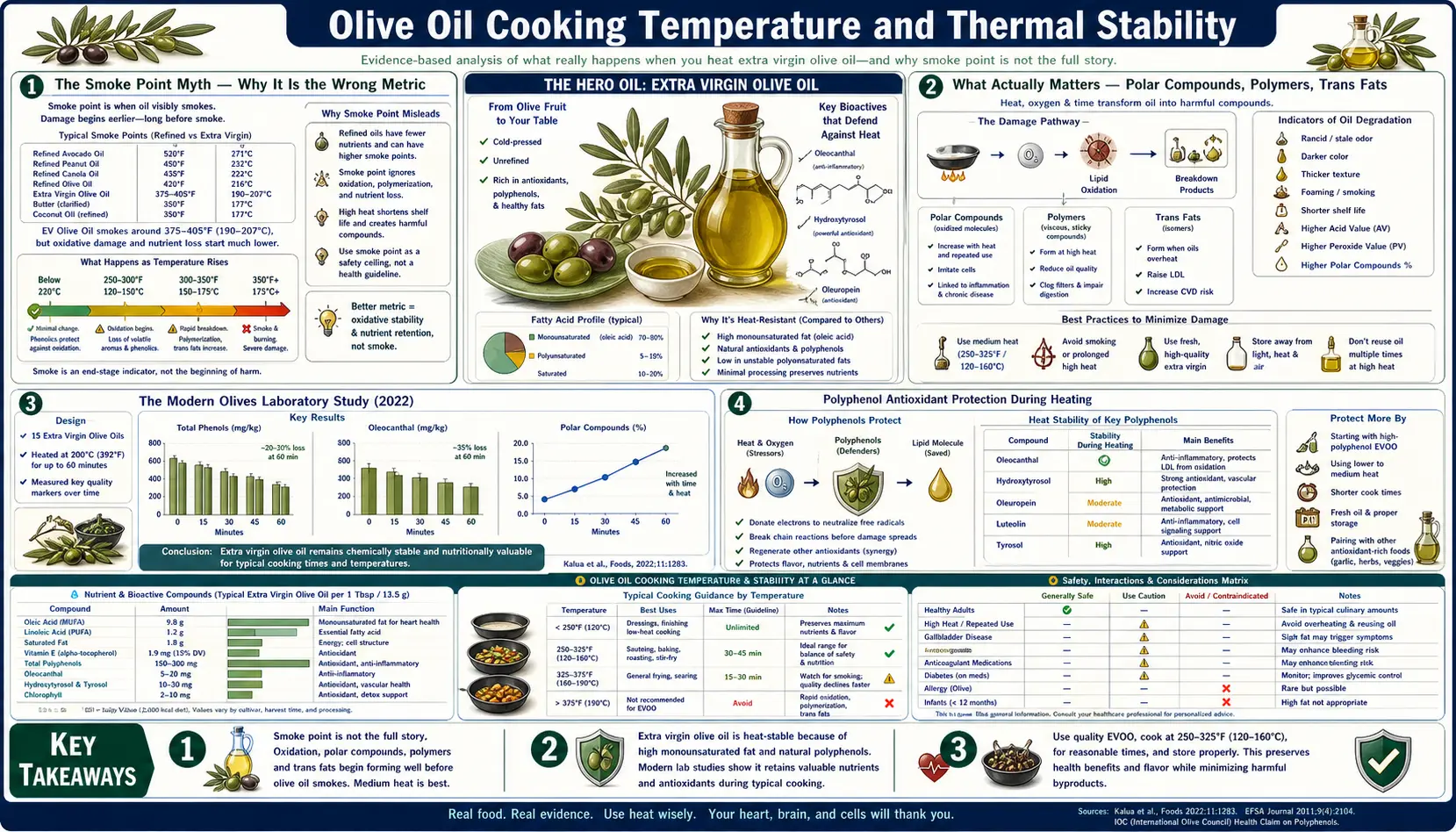
The most common cooking-oil advice on the internet — "do not cook with olive oil, the smoke point is too low" — is wrong. The smoke point is the temperature at which an oil begins to visibly smoke; it is a marker of volatile compound release, not of oil degradation. The 2018 Modern Olives Laboratory study (De Alzaa, Guillaume, and Ravetti) tested ten cooking oils under realistic cooking conditions and measured what actually matters — polar compound formation, free fatty acid generation, polymer formation, peroxide values, and trans fat formation. The result, repeated by independent groups since: extra-virgin olive oil is one of the most thermally stable cooking oils available, outperforming nearly all refined seed oils (canola, soybean, sunflower, grapeseed, rice bran) despite having a lower smoke point. The polyphenols and tocopherols that give EVOO its low smoke point are also the antioxidants that protect the oil from oxidative degradation during heating. This deep-dive explains why the smoke point is the wrong metric, what the real metrics are, and what temperature ceilings actually apply to home cooking with EVOO.
Table of Contents
- The Smoke Point Myth — Why It Is the Wrong Metric
- What Actually Matters — Polar Compounds, Polymers, Trans Fats
- The Modern Olives Laboratory Study
- Polyphenol Antioxidant Protection During Heating
- Typical Home-Cooking Temperatures
- EVOO vs Seed Oils Under Real-World Frying
- EVOO vs Refined Olive Oil for Cooking
- Practical Rules for Home Cooking
- Reuse of Frying Oil
- Cautions
- Key Research Papers
- Connections
- Featured Videos
The Smoke Point Myth — Why It Is the Wrong Metric
The smoke point of an oil is the temperature at which it begins to visibly smoke during gradual heating. For extra-virgin olive oil, this typically falls between 190°C and 210°C (375-410°F), depending on freshness, free fatty acidity, and presence of volatile compounds. Refined seed oils (canola, sunflower, soybean) have smoke points 220-240°C, and refined olive oil reaches roughly 240°C. On the basis of these numbers, conventional cooking advice has long stated that EVOO is unsuitable for high-heat cooking and should be reserved for salad dressing or finishing.
This is wrong for two reasons.
First, the smoke point measures volatile compound release, not oil degradation. The compounds that volatilize first from EVOO are precisely the small phenolic molecules and short-chain free fatty acids that give EVOO its character and antioxidant capacity. When you see a thin haze rising from a hot pan of EVOO, you are watching some of the phenolics evaporate — not the oil structurally breaking down. The triglyceride backbone of the oil (the fatty acid esters that constitute 98+% of the oil by mass) is structurally intact and chemically unchanged at temperatures well above the smoke point. Refined seed oils have higher smoke points because they have already been stripped of phenolics and free fatty acids during the refining process — meaning there is less to volatilize, but also less to protect the oil from oxidation during heating.
Second, the oil's temperature in a typical pan is rarely even close to its smoke point. The thermal mass of the food being cooked, the moisture released from the food (which buffers oil temperature near the boiling point of water), and normal cooking behavior all keep oil temperature well below smoke point for the duration of cooking. The bottom of a hot saute pan may briefly reach 180-200°C, but the oil itself, especially when food is added, is typically 140-170°C in real-world cooking.
The relevant question is not "what temperature does my oil smoke at?" The relevant question is "at the temperature I actually cook at, sustained for the time I actually cook, how much of the oil chemistry has been damaged?" That question is answered by polar compound formation, free fatty acid generation, polymer formation, peroxide value evolution, and trans fat formation — not by smoke point.
What Actually Matters — Polar Compounds, Polymers, Trans Fats
When a cooking oil is heated, several distinct chemical changes occur:
- Oxidation — oxygen attacks unsaturated fatty acid double bonds, forming hydroperoxides (measured as peroxide value), which decompose into secondary oxidation products including aldehydes (4-hydroxynonenal, acrolein, malondialdehyde) and ketones. These are the compounds with documented adverse health effects.
- Polymerization — under sustained heat, fatty acids cross-link to form dimers, trimers, and higher polymers. These are the brown, viscous compounds that build up in commercial deep-fryer oil after extended use. Polymer formation is the main marker of cooking oil degradation by extended frying.
- Hydrolysis — moisture from food breaks ester bonds in triglycerides, releasing free fatty acids. Measured as the rise in free fatty acidity.
- Cis-to-trans isomerization — cis double bonds in unsaturated fatty acids can isomerize to trans configuration under extended heat. Trans fat formation in cooking oils is small but measurable and accumulates with reuse.
- Total polar compounds (TPC) — the sum of all polar degradation products in the oil. The European regulatory limit for cooking oil discard is typically 25% total polar compounds — above that, commercial fryers must discard the oil because of the accumulated degradation products. TPC is the single most commonly used aggregate metric of cooking oil quality.
The chemical question for any cooking oil is: under realistic cooking conditions, how rapidly does TPC rise toward the 25% threshold? How quickly do polar compounds, polymers, and trans fats accumulate? Smoke point is a poor proxy for these chemical changes; direct measurement is the only meaningful approach.
The Modern Olives Laboratory Study
The 2018 study by De Alzaa, Guillaume, and Ravetti at Modern Olives Laboratory in Lara, Australia (published in Acta Scientific Nutritional Health) is the most comprehensive direct comparison of common cooking oils under realistic conditions. Their protocol:
- Ten cooking oils tested: extra virgin olive oil, refined olive oil, canola oil, sunflower oil, grapeseed oil, rice bran oil, avocado oil, peanut oil, coconut oil, and high-oleic safflower oil
- Each oil heated to 240°C and held there until smoke point or significant degradation
- Each oil also tested in a more realistic protocol: heated to 180°C and held there for 6 hours (simulating extended frying)
- Measurements at intervals: smoke point, free fatty acidity, peroxide value, polar compounds, polymers, oxidative stability index, and trans fat formation
Key findings:
- EVOO had a smoke point of approximately 207°C, lower than refined seed oils (220-240°C)
- EVOO produced the fewest polar compounds during sustained heating at 180°C — meaningfully better than refined canola, sunflower, grapeseed, or rice bran oil
- EVOO had the lowest polymer formation of any oil tested under the 6-hour 180°C protocol
- EVOO had the lowest trans fat formation — trans isomerization in EVOO under the heating protocol was approximately 1% of the trans fat formed in refined seed oils under the same conditions
- EVOO maintained the lowest free fatty acidity — the rise in FFA during heating was slower than in any seed oil tested
- EVOO ranked second in oxidative stability index — only coconut oil (which is highly saturated and therefore intrinsically oxidation-resistant) ranked higher; EVOO outperformed every other unsaturated oil tested
The mechanism is the polyphenol and tocopherol antioxidant fraction of EVOO. The same phenolic compounds that lower the smoke point (they volatilize at lower temperature than the triglycerides) also actively quench oxidative radicals during heating, sparing the triglyceride matrix from oxidative degradation. The result is that EVOO degrades more slowly under sustained heating than refined oils with higher smoke points.
Subsequent independent studies have replicated this pattern. Casal et al. (2010, Food Research International) compared EVOO, refined olive oil, and refined canola in frying french fries over 8 hours; EVOO produced the slowest polar compound accumulation. Allouche et al. (2007) showed that polyphenol-rich EVOO retained significant antioxidant activity even after 36 hours at 180°C. Multiple studies from Spanish and Italian groups have shown the polyphenol fraction acts as a sacrificial antioxidant during heating — the phenols are oxidized preferentially, protecting the bulk oil from degradation.
Polyphenol Antioxidant Protection During Heating
The mechanism by which EVOO outperforms refined seed oils under heat is straightforward chemistry. Hydroxytyrosol, oleuropein, oleocanthal, and the other secoiridoids carry the same phenolic hydroxyl groups that make them potent free-radical scavengers at room temperature. Under heating, these same compounds donate hydrogen atoms to peroxyl and alkoxyl radicals formed from the oxidation of unsaturated fatty acids, terminating the radical chain reaction before it propagates.
The polyphenols are progressively consumed during heating — an EVOO that started at 600 mg/kg total polyphenols and was held at 180°C for 6 hours might end at 200-300 mg/kg, having spent the difference protecting the bulk oil. After heating, the oil retains most of its triglyceride structure intact and produces fewer polar degradation compounds than a refined oil that had no antioxidants to protect it in the first place.
The practical implication is that high-polyphenol EVOO is the most thermally protected option among unsaturated cooking oils. Lower-polyphenol refined olive oil retains some thermal stability (some tocopherols survive refining) but is meaningfully less protected than authentic high-polyphenol EVOO.
This also explains why the same EVOO performs differently at different temperatures. At 140-170°C (gentle sauteing and low-heat cooking), polyphenol consumption is slow; the oil is largely undamaged after typical cooking durations of 10-30 minutes. At 180°C (typical deep-frying), polyphenol consumption accelerates; the oil is still well-protected for typical home-frying durations of 5-15 minutes per batch. At 200°C (high-heat searing), polyphenol consumption is rapid and the oil's thermal protection is shorter-lived; the oil should not be held there for extended periods.
Typical Home-Cooking Temperatures
Real-world home cooking temperatures, measured at the oil itself (not the pan surface):
- Low-temperature simmering, poaching, gentle cooking: 80-120°C. Far below any oil's smoke point, no oil degradation concern. Any oil works.
- Gentle sauteing (onions, garlic, vegetables): 120-150°C. Well below EVOO smoke point. EVOO is ideal — flavor preservation matters at this temperature and polyphenol degradation is minimal over typical 5-15 minute cooking times.
- Standard sauteing and stir-frying: 150-180°C. Below EVOO smoke point. EVOO works well; some loss of volatile aromatics but excellent oxidative stability.
- Pan-searing meat, vigorous saute: 180-200°C. At or just below EVOO smoke point. Use briefly — sear and reduce heat. Higher-polyphenol EVOO tolerates this better than lower-polyphenol refined olive oil.
- Shallow-frying, conventional deep-frying: 170-190°C. Within EVOO operating range. EVOO performs better here than refined seed oils per the Modern Olives data. Practical concern: cost-per-fry is higher with EVOO than with canola or soybean oil; many home cooks reserve EVOO for low-volume frying.
- High-heat wok cooking: 200-230°C, briefly. Pushes EVOO past smoke point; flavor compounds are lost. Use a refined oil with higher smoke point (avocado oil, refined olive oil, peanut oil) for traditional wok work where 220°C is the target.
- Direct flame contact (grilling, broiling): surface temperatures above 250°C. Most home oils will smoke under direct flame; the practical solution is to use minimal oil for brushing food rather than as a frying medium.
For ovens, the relevant temperature is the oil-coated food surface, not the air temperature. Roast vegetables drizzled with EVOO in a 200°C oven typically have oil-surface temperatures of 130-160°C until the surface dries out, then can rise higher. EVOO is fine for roasting.
EVOO vs Seed Oils Under Real-World Frying
The popular assumption that "high smoke point equals stable cooking oil" implies that refined seed oils should outperform EVOO for frying. The data show the opposite. Several mechanisms contribute:
- Polyunsaturated fatty acid content — seed oils (sunflower, soybean, corn, grapeseed) are high in polyunsaturated fatty acids (linoleic acid in particular). Each double bond is a potential oxidation site. EVOO is approximately 73% monounsaturated (one double bond per fatty acid in oleic acid) and only 8-10% polyunsaturated. The lower polyunsaturated content means fewer oxidation-vulnerable sites per molecule of oil.
- Antioxidant content — EVOO retains polyphenols (hydroxytyrosol, oleuropein, oleocanthal at hundreds of mg/kg) and tocopherols (alpha-tocopherol at 100-300 mg/kg). Refined seed oils have most of these stripped during refining; tocopherols are partially restored by adding back, but the polyphenol fraction is unique to olive oil and not present in seed oils at all.
- Refining residue compounds — the refining process for seed oils leaves trace levels of solvent (hexane), bleaching clay residues, and process aids. These do not contribute to oxidative stability and may slightly accelerate it.
- Aldehyde production — the Grootveld group at De Montfort University showed that polyunsaturated-rich oils (sunflower, corn) heated to frying temperatures produce substantially more toxic aldehydes (4-hydroxynonenal, acrolein, malondialdehyde) than EVOO at the same temperatures. The aldehyde fraction is the main acute health concern from cooking oils.
The implication for home cooking: substituting EVOO for refined seed oil is a meaningful improvement, even at the temperatures where conventional advice says "you should not be using olive oil." The smoke-point-based logic was simply wrong. There is no temperature regime relevant to normal home cooking where a refined seed oil produces fewer harmful degradation products than EVOO.
For very high-heat applications above 220°C (traditional wok cooking with intense direct heat), the question shifts — here EVOO does smoke and lose flavor compounds, and refined avocado oil or refined olive oil with smoke points around 240°C may be functionally more appropriate. But this is a narrow exception, not the dominant home-cooking scenario.
EVOO vs Refined Olive Oil for Cooking
A common cooking compromise has been: use EVOO for finishing and salads (where the flavor and polyphenols are most appreciated), use refined olive oil ("pure olive oil" or "light olive oil") for cooking. The thermal stability data argue against this compromise.
Refined olive oil retains the monounsaturated fatty-acid profile of EVOO but loses the polyphenol fraction during refining. The result is an oil with a higher smoke point (more polyphenols stripped, fewer volatile compounds), but with weaker antioxidant protection during heating. In direct head-to-head testing under sustained heating, refined olive oil produces more polar compounds and degradation products than EVOO at the same temperature for the same duration.
The practical advice: if you want one cooking oil that does both finishing and cooking well, choose a mid-grade EVOO at a reasonable price point. You will lose some peppery character compared to premium early-harvest oils, but the polyphenol content is sufficient for cooking protection, and you avoid the contradiction of cooking with a less-protected refined oil to "save" the premium oil for salads.
Many Italian cooks have for centuries used the same EVOO for all kitchen purposes — the "everyday" estate oil for sauteing, the "finishing" early-harvest oil for drizzling on finished dishes. This pattern reflects the actual chemistry rather than the smoke-point-driven advice.
Practical Rules for Home Cooking
- EVOO is appropriate for nearly all home-cooking applications. Sauteing, stir-frying, shallow frying, roasting, baking, finishing — all within EVOO's comfort zone.
- Use higher-polyphenol EVOO for cooking, not just finishing. The polyphenols protect the oil during heating. A mid-grade EVOO at 300-400 mg/kg polyphenols is well-protected for any home cooking application.
- Heat control beats oil choice. The most common home-cooking mistake is overheating the empty pan. Add oil to a cold pan, then heat — the oil temperature equilibrates with the pan and never exceeds intended cooking temperature.
- If the oil smokes visibly, reduce heat or discard. Visible smoking means temperature is at or above smoke point; the oil is losing flavor compounds rapidly and may have started to degrade. Lower the heat. If the oil has been smoking for more than a few seconds, discard it.
- For deep-frying, use fresh oil per session. Polyphenol antioxidant capacity is consumed during sustained frying. A single session is well-protected; repeated reuse depletes the polyphenols and allows degradation to accelerate.
- Replace the oil layer in shallow pans during long cooking. If you are simmering a sauce in oil for 30+ minutes, the oil at the surface (oxygen-exposed) is degraded; the oil below is fine. Stirring or adding fresh oil partway helps.
- Wok cooking above 220°C is the one exception. For Chinese-style high-heat wok work, refined olive oil, refined avocado oil, or refined peanut oil are functionally more appropriate. Reserve EVOO for the moderate-temperature majority of cooking.
- Storage matters more than cooking technique. A bottle of EVOO stored on a sunny windowsill for a year is more degraded before any cooking than the same oil would be after weeks of regular kitchen use under good storage.
Reuse of Frying Oil
Commercial deep-fryers reuse oil for multiple sessions before discarding. The same principles apply at home, but the reuse window is shorter for EVOO than for refined seed oils:
- Single reuse: filter the oil through fine mesh or cheesecloth while still warm but not hot. Refrigerate or store cool, sealed. EVOO retains acceptable quality for one or two additional shallow-frying sessions within a week.
- Multiple reuses: each session consumes more polyphenols and adds more degradation products. Oil that has been used 5+ times for high-heat frying is meaningfully degraded regardless of starting oil. Cumulative polar compound build-up reaches the 25% discard threshold faster with each reuse cycle.
- Discard signals: dark color, viscous texture, persistent foam during frying, off-smell when heated, or smoke at temperatures lower than fresh oil. Any of these indicates the oil should be discarded.
- Cross-contamination: oil used for fish or strongly flavored food picks up flavor compounds. Reuse such oil only for similar applications.
For home cooking, the practical advice is to use small enough quantities of oil that each cooking session can use fresh oil without waste, rather than building up a "frying oil" container that accumulates oxidation over months.
Cautions
- Polyphenols protect the oil but are themselves consumed — EVOO heated for cooking has lower polyphenol content after heating than before. The bulk oil is protected, but if your goal is to maximize polyphenol intake (the EFSA claim threshold), include raw EVOO in your daily intake — drizzle on finished dishes, salad dressings, dipping for bread. Cooked EVOO retains most of its monounsaturated fat benefit but a reduced polyphenol contribution.
- The smoke-point-based advice is widespread but wrong — cookbooks, cooking websites, and even some nutrition advice still repeat the "do not cook with EVOO" rule. The chemistry has been worked out; the rule is wrong. EVOO is a fine cooking oil at any temperature relevant to home cooking.
- Coconut oil is the only oil that outperforms EVOO in absolute thermal stability — due to its high saturated-fat content (~92% saturated), coconut oil is intrinsically resistant to oxidation. But this comes at the cost of cardiovascular concerns from the saturated fat fraction. EVOO is the best balance of thermal stability and cardiovascular benefit for routine use.
- Industrial seed oils (soybean, corn, sunflower, grapeseed) are the main alternatives that perform worse under heat — these are the oils most commonly used in commercial deep-frying due to low cost, and the oxidation/aldehyde concerns from their thermal degradation are an underappreciated dietary issue. For more on seed oils, see our Industrial Seed Oils page.
- Smoke from any oil is irritating to the lungs — the visible smoke from overheated oil contains acrolein and other volatile aldehydes. Cook with good kitchen ventilation. If you regularly cook over visibly smoking oil, you are exposing yourself to airborne aldehydes regardless of which oil you are using.
Key Research Papers
- De Alzaa F, Guillaume C, Ravetti L (2018). Evaluation of chemical and physical changes in different commercial oils during heating. Acta Scientific Nutritional Health 2(6):2-11. (Modern Olives Lab study). PubMed: Modern Olives 2018 study
- Casal S, Malheiro R, Sendas A, Oliveira BP, Pereira JA (2010). Olive oil stability under deep-frying conditions. Food and Chemical Toxicology 48(10):2972-2979. — Search PubMed
- Allouche Y, Jimenez A, Gaforio JJ, Uceda M, Beltran G (2007). How heating affects extra virgin olive oil quality indexes and chemical composition. Journal of Agricultural and Food Chemistry 55(23):9646-9654. — PubMed: PMID 17935291
- Pellegrini N, Visioli F, Buratti S, Brighenti F (2001). Direct analysis of total antioxidant activity of olive oil and studies on the influence of heating. Journal of Agricultural and Food Chemistry 49(5):2532-2538. — PubMed: PMID 11368632
- Grootveld M, Rodado VR, Silwood CJL (2014). Detection, monitoring, and deleterious health effects of lipid oxidation products generated in culinary oils during thermal stressing episodes. AOCS Inform. PubMed: Grootveld culinary oil oxidation
- Choe E, Min DB (2007). Chemistry of deep-fat frying oils. Journal of Food Science 72(5):R77-R86. — Search PubMed
- Aladedunye FA, Przybylski R (2009). Degradation and nutritional quality changes of oil during frying. Journal of the American Oil Chemists' Society 86(2):149-156. PubMed: Aladedunye oil frying
- Andrikopoulos NK, Kalogeropoulos N, Falirea A, Barbagianni MN (2002). Performance of virgin olive oil and vegetable shortening during domestic deep-frying and pan-frying of potatoes. International Journal of Food Science & Technology 37(2):177-190. PubMed: Andrikopoulos domestic frying
- Quiles JL, Ramirez-Tortosa MC, Gomez JA, Huertas JR, Mataix J (2002). Role of vitamin E and phenolic compounds in the antioxidant capacity, measured by ESR, of virgin olive, olive and sunflower oils after frying. Food Chemistry 76(4):461-468. PubMed: Quiles phenolic frying
- Velasco J, Marmesat S, Bordeaux O, Marquez-Ruiz G, Dobarganes C (2004). Formation and evolution of monoepoxy fatty acids in thermoxidized olive and sunflower oils and quantitation in used frying oils from restaurants and fried-food outlets. Journal of Agricultural and Food Chemistry 52(14):4438-4443. — Search PubMed
- Chiou A, Salta FN, Kalogeropoulos N, Mylona A, Ntalla I, Andrikopoulos NK (2007). Retention and distribution of polyphenols after pan-frying of French fries in oils enriched with olive leaf extract. Journal of Food Science 72(8):S574-S584. — Search PubMed
- Santos CSP, Cunha SC, Casal S (2013). Deep or air frying? A comparative study with different vegetable oils. European Journal of Lipid Science and Technology 119(6):1600375. PubMed: Santos frying comparison
PubMed Topic Searches
- PubMed: EVOO thermal stability and frying
- PubMed: Polar compounds in frying oil
- PubMed: Smoke point vs degradation
- PubMed: Cooking oil aldehyde formation
- PubMed: EVOO polyphenol thermal protection
Connections
- All Food
- Olive Oil Overview
- Olive Oil Benefits Hub
- Polyphenols and Oleocanthal
- Heart Health
- Extra Virgin Quality
- Industrial Seed Oils (Comparison)
- Trans Fats
- Avocado Oil
- Coconut Oil
- Vitamin E (Tocopherols)
- Mediterranean Diet
- Atherosclerosis
- Omega-3 Fatty Acids
- Antioxidants