Avocado — Benefits Deep Dive
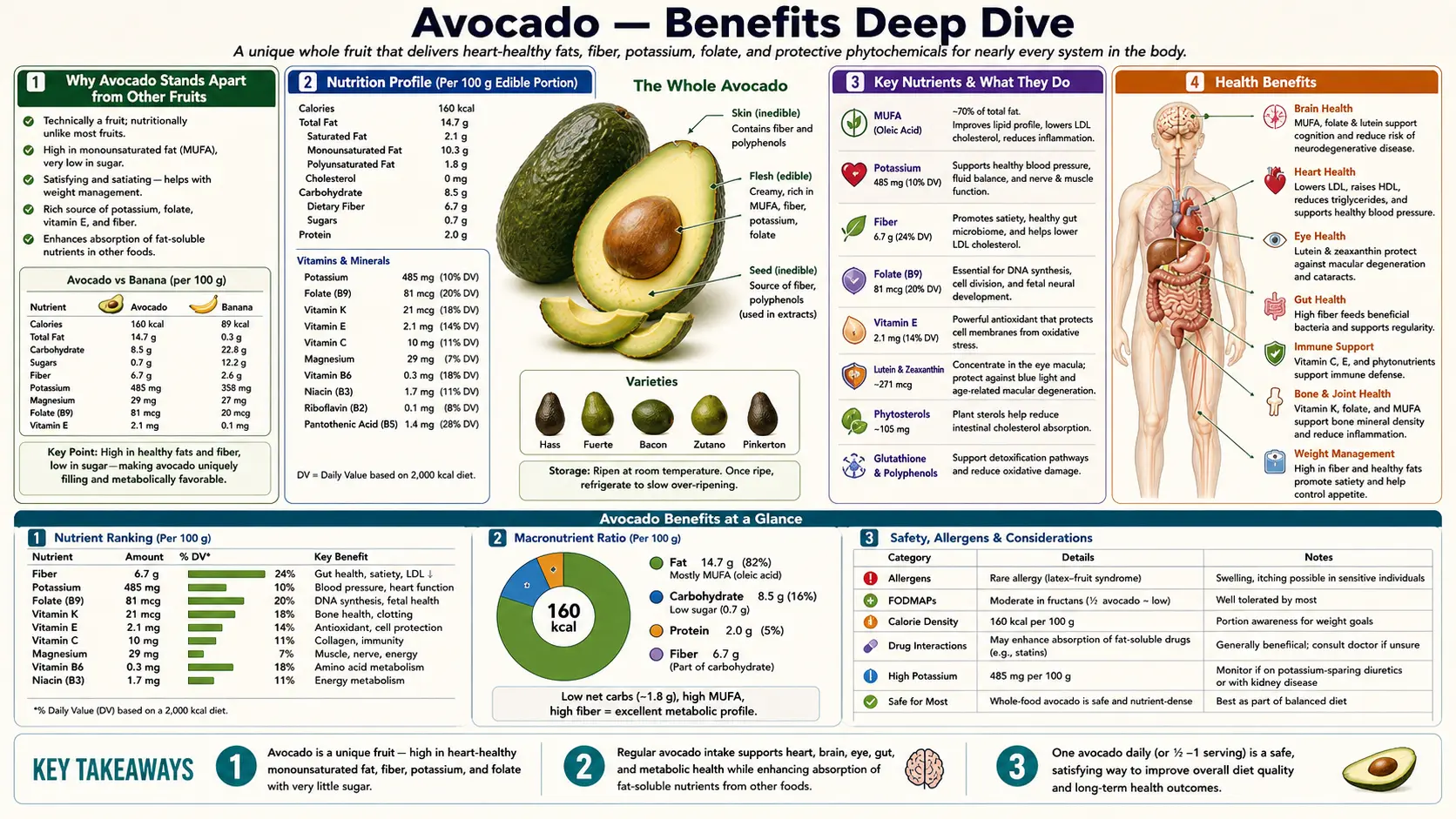
Avocado (Persea americana) is the rare whole-food fruit whose macronutrient profile is dominated by fat rather than carbohydrate — approximately 77% of its calories come from lipids, with most of that as oleic acid, the same monounsaturated fatty acid that defines the Mediterranean diet. The benefits cluster into four distinct mechanisms: (1) the lipid profile that lowers LDL cholesterol and raises HDL when substituted for saturated fat or refined carbohydrate, (2) one of the densest dietary potassium sources in the supermarket — roughly 975 mg per medium fruit, more than a banana — with direct blood-pressure-lowering action through the sodium-potassium-renin axis, (3) the unusual viscous-fiber and monounsaturated-fat combination that produces sustained satiety and reduces postprandial glucose excursion, and (4) the role of avocado's fat content as a vehicle that dramatically increases absorption of fat-soluble carotenoids (lutein, zeaxanthin, beta-carotene) from co-eaten vegetables.
Deep-Dive Articles
Monounsaturated Fats
Oleic acid (the dominant fatty acid in avocado and olive oil) and the LDL-lowering, HDL-raising lipid signature when avocado is substituted for saturated fat or refined carbohydrate. The PREDIMED Mediterranean diet trial, the Wang 2015 JAHA avocado-a-day trial, the mechanism of cholesterol-ester reshuffling, and the comparison of avocado to extra virgin olive oil and nuts as monounsaturated-fat sources.
Potassium and Blood Pressure
Why a medium avocado delivers roughly 975 mg of potassium — more than a banana, and one of the densest potassium sources outside leafy greens. The DASH diet, the WHO 3,510 mg/day potassium target, the sodium-potassium ratio as a stronger predictor of cardiovascular events than sodium alone, and the renal mechanism by which dietary potassium suppresses sodium reabsorption.
Fiber and Satiety
The 10 g of total fiber per medium avocado (roughly 70% insoluble, 30% soluble) and its action on gut transit, the microbiome, satiety hormones (cholecystokinin, GLP-1, PYY), and postprandial glucose excursion. The Wien 2013 Nutrition Journal half-avocado-at-lunch satiety trial, and the practical use of avocado in weight-stability and glycemic-control diets.
Skin and Carotenoid Absorption
Avocado fat dramatically increases the absorption of fat-soluble carotenoids from co-eaten vegetables — Unlu 2005 found 4-7× higher absorption of beta-carotene from salsa and 4× higher of lutein from salad. The skin benefits of lutein and zeaxanthin (the same retinal pigments that protect the macula also concentrate in skin), the dermatological topical-oil literature, and the vitamin E content.
Table of Contents
- Deep-Dive Articles
- Why Avocado Stands Apart from Other Fruits
- Research Papers: Monounsaturated Fats & Lipids
- Research Papers: Potassium & Blood Pressure
- Research Papers: Fiber & Satiety
- Research Papers: Skin & Carotenoid Absorption
- Research Papers: Cross-Cutting (Cardiometabolic, Weight, Diabetes)
- External Authoritative Resources
- Connections
- Featured Videos
Why Avocado Stands Apart from Other Fruits
The avocado is botanically a fruit (specifically, a single-seeded berry of the laurel family, Lauraceae — closely related to cinnamon and bay laurel), but its macronutrient profile is unlike any other commonly consumed fruit. A typical Hass avocado (the most-traded cultivar) delivers approximately 240 kcal per medium fruit (~200 g), distributed as roughly 22 g of fat, 12 g of total carbohydrate (of which 10 g is fiber, leaving only 2 g of net digestible carbohydrate), and 3 g of protein. Sugar content is negligible (~0.5 g per fruit). This profile — very-low-sugar, very-high-fat, very-high-fiber — is closer to a nut or an olive than to a banana or an apple.
- Fat composition (oleic-acid-dominant) — approximately 67% of avocado fat is monounsaturated (predominantly oleic acid, C18:1 omega-9, the same fatty acid that dominates olive oil). About 15% is saturated (mostly palmitic acid), and ~18% is polyunsaturated (mostly linoleic acid). This lipid signature is the basis for the cardiovascular and lipid effects that have been demonstrated in randomized controlled trials including the Wang 2015 avocado-a-day trial.
- Mineral density (potassium-rich) — a medium Hass avocado contains roughly 975 mg of potassium, more than a medium banana (~422 mg) and approaching the daily-target densities of leafy greens. Potassium has independent blood-pressure-lowering effects through the renal sodium-potassium exchange mechanism, and the sodium-potassium ratio of the diet is now considered a stronger predictor of cardiovascular events than sodium alone. This is the basis for the blood pressure benefit.
- Fiber density (high total fiber, slow-digesting matrix) — 10 g of fiber per medium fruit is roughly 36% of the daily target (DV 28 g) in a single serving. Approximately 70% is insoluble (cellulose, hemicellulose, lignin from the cell walls) and 30% soluble (predominantly the heteropolysaccharide complex unique to the avocado fruit pulp). The fiber, combined with the high fat content, slows gastric emptying and produces measurable satiety and glycemic-stabilization effects.
- Carotenoid carrier (the food-matrix synergy effect) — fat-soluble carotenoids from vegetables (lutein, zeaxanthin, beta-carotene, alpha-carotene, lycopene) require dietary fat for intestinal absorption. Avocado's fat content acts as an absorption vehicle: Unlu 2005 documented 4-7× higher absorption of carotenoids from salsa and salad when 75-150 g of avocado was added to the same meal. This converts avocado from a passive food item into an active nutritional amplifier for any plant-rich meal it accompanies.
What avocado lacks: vitamin C is modest (~10 mg per fruit), it is not a meaningful source of any of the B vitamins except folate (~120 mcg) and pantothenic acid, and the protein content is too low to count as a meaningful protein source. The strengths are concentrated in lipids, minerals (potassium, magnesium, copper), fiber, and the absorption-enhancing fat matrix.
Research Papers: Monounsaturated Fats & Lipids
- Wang L et al. (2015). Effect of a moderate fat diet with and without avocados on lipoprotein particle number, size and subclasses. JAHA. — PubMed: Wang JAHA 2015
- Estruch R et al. (2018). PREDIMED — Primary prevention of cardiovascular disease with a Mediterranean diet supplemented with extra virgin olive oil or nuts. NEJM. — PubMed: PREDIMED 2018
- Mahmassani HA et al. (2018). Avocado consumption and risk factors for heart disease: a systematic review and meta-analysis. AJCN. — PubMed: Avocado meta-analysis
- Pacheco LS et al. (2022). Avocado intake and longitudinal weight and body mass index changes in an adult cohort. Journal of Nutrition. — PubMed: Avocado weight cohort
- Lichtenstein AH et al. (2021). AHA dietary guidance: monounsaturated fat substitution. Circulation. — PubMed: AHA 2021 guidance
- Pacheco LS et al. (2022). Avocado consumption and risk of cardiovascular disease in US adults. JAHA. — PubMed: Avocado CVD US
- Lopez-Ledesma R et al. (1996). Monounsaturated fatty acid (avocado) rich diet for mild hypercholesterolemia. Archives of Medical Research. — PubMed: Lopez-Ledesma 1996
- Alvizouri-Munoz M et al. (1992). Effects of avocado as a source of monounsaturated fatty acids on plasma lipid levels. Archives of Medical Research. — PubMed: Alvizouri 1992
- Carranza-Madrigal J et al. (1997). Effects of a vegetarian diet vs. a vegetarian diet enriched with avocado in hypercholesterolemic patients. Archives of Medical Research. — PubMed: Carranza 1997
- Sabate J et al. (2012). Avocados and cardiovascular health: a review. Critical Reviews in Food Science and Nutrition. — PubMed: Sabate review
Research Papers: Potassium & Blood Pressure
- Appel LJ et al. (1997). DASH (Dietary Approaches to Stop Hypertension) trial. NEJM. — PubMed: DASH trial
- WHO (2012). Guideline: Potassium intake for adults and children (3,510 mg/day target). — PubMed: WHO potassium guideline
- Aburto NJ et al. (2013). Effect of increased potassium intake on cardiovascular risk factors and disease: systematic review and meta-analyses. BMJ. — PubMed: Aburto BMJ 2013
- Yang Q et al. (2011). Sodium and potassium intake and mortality among US adults: NHANES analysis. Archives of Internal Medicine. — PubMed: Yang Na/K mortality
- Whelton PK et al. (2017). ACC/AHA hypertension guideline. Hypertension. — PubMed: ACC/AHA HTN 2017
- Filippini T et al. (2020). Potassium intake and blood pressure: dose-response meta-analysis of trials. JAHA. — PubMed: Filippini 2020
- Stone MS et al. (2016). Potassium intake, bioavailability, hypertension, and glucose control. Nutrients. — PubMed: Stone Nutrients 2016
- Dreher ML, Davenport AJ (2013). Hass avocado composition and potential health effects. Critical Reviews in Food Science and Nutrition. — PubMed: Dreher 2013
- O'Donnell M et al. (PURE Study, 2014). Urinary sodium and potassium excretion and risk of cardiovascular events. NEJM. — PubMed: PURE NEJM 2014
- Cogswell ME et al. (2012). Sodium and potassium intakes among US adults: NHANES 2003-2008. AJCN. — PubMed: NHANES Na/K
Research Papers: Fiber & Satiety
- Wien M et al. (2013). A randomized 3×3 crossover study to evaluate the effect of Hass avocado on post-ingestive satiety and glucose/insulin responses. Nutrition Journal. — PubMed: Wien 2013 satiety
- Reynolds A et al. (2019). Carbohydrate quality and human health: a series of systematic reviews and meta-analyses. Lancet. — PubMed: Reynolds Lancet 2019
- Slavin J (2013). Fiber and prebiotics: mechanisms and health benefits. Nutrients. — PubMed: Slavin Nutrients
- Zhu L et al. (2019). Avocado consumption, satiety, glucose, insulin, and inflammatory response: meta-analysis. Nutrients. — PubMed: Zhu 2019 meta
- Henning SM et al. (2019). Avocado consumption increased microbial diversity and abundance of Lactobacillus. Journal of Nutrition. — PubMed: Avocado microbiome
- Park E et al. (2018). Avocado fruit on postprandial markers of cardio-metabolic risk: randomized clinical trial. Nutrients. — PubMed: Park 2018
- Heskey C et al. (2019). Avocado intake and post-prandial glucose and insulin responses. Nutrients. — PubMed: Heskey 2019
- James-Martin G et al. (2020). Avocado consumption and cardiometabolic health: meta-analysis of randomized trials. Journal of the American Heart Association. — PubMed: Avocado cardiometabolic
- Fulgoni VL et al. (2013). Avocado consumption is associated with better diet quality and nutrient intake. Nutrition Journal. — PubMed: Fulgoni 2013
- Sabate J, Dreher ML (2022). Hass avocado nutrition, cardiometabolic, and weight effects: updated review. Advances in Nutrition. — PubMed: Sabate 2022 review
Research Papers: Skin & Carotenoid Absorption
- Unlu NZ et al. (2005). Carotenoid absorption from salad and salsa by humans is enhanced by the addition of avocado or avocado oil. Journal of Nutrition. — PubMed: Unlu 2005 carotenoid
- Brown MJ et al. (2004). Carotenoid bioavailability is higher from salads ingested with full-fat than with fat-reduced salad dressings. AJCN. — PubMed: Brown 2004
- Stahl W, Sies H (2012). Beta-carotene and other carotenoids in skin protection from sunlight. AJCN. — PubMed: Stahl skin carotenoids
- Roberts RL et al. (2009). Lutein and zeaxanthin in skin health. Skin Pharmacology and Physiology. — PubMed: Lutein skin
- Dreher ML, Davenport AJ (2013). Hass avocado composition and potential health effects. Critical Reviews in Food Science and Nutrition. — PubMed: Dreher 2013
- Werman MJ et al. (1991). Avocado oils and hepatic lipid metabolism. Lipids. — PubMed: Avocado oil hepatic
- Maeda-Yamamoto M et al. (2017). Avocado fruit extract and dermal collagen. Journal of Cosmetic Dermatology. — PubMed: Avocado dermal
- Henning SM et al. (2019). Hass avocado consumption skin elasticity and firmness. Antioxidants. — PubMed: Avocado skin elasticity
- Lin TK et al. (2017). Anti-inflammatory and skin barrier repair effects of topical avocado and olive oil. International Journal of Molecular Sciences. — PubMed: Topical avocado oil
- Rosenblat G et al. (2011). Polyhydroxylated fatty alcohols derived from avocado suppress inflammatory response. Archives of Dermatological Research. — PubMed: Avocado PFA
Research Papers: Cross-Cutting (Cardiometabolic, Weight, Diabetes)
- Pacheco LS et al. (2022). Avocado consumption and risk of cardiovascular disease in US adults (Nurses' Health Study + Health Professionals Follow-up). JAHA. — PubMed: Pacheco JAHA 2022
- Wang DD et al. (2015). Dietary fat content and quality and cardiovascular events. Journal of the American College of Cardiology. — PubMed: Wang fat quality JACC
- Trichopoulou A et al. (2003). Adherence to a Mediterranean diet and survival in a Greek population. NEJM. — PubMed: Trichopoulou 2003
- Jenkins DJ et al. (2008). The effect of a plant-based low-carbohydrate Eco-Atkins diet on body weight and blood lipid concentrations. Archives of Internal Medicine. — PubMed: Eco-Atkins
- Ros E (2010). Health benefits of nut consumption. Nutrients. — PubMed: Ros nuts review
- Schwingshackl L et al. (2018). Comparison of the long-term effects of dietary intervention on cardiovascular risk factors. Critical Reviews in Food Science and Nutrition. — PubMed: Schwingshackl 2018
- Estruch R et al. (2016). Effect of the Mediterranean diet on heart failure: PREDIMED randomized controlled trial. Journal of the American College of Cardiology HF. — PubMed: PREDIMED HF
- Hu FB (2003). Plant-based foods and prevention of cardiovascular disease: an overview. AJCN. — PubMed: Hu plant-based 2003
- Dreher ML (2018). Whole fruits and fruit fiber: emerging health effects. Nutrients. — PubMed: Dreher fiber 2018
- Hannon BA et al. (2020). Daily Avocado consumption improves abdominal adiposity in adults with overweight or obesity. Journal of Nutrition. — PubMed: Hannon abdominal fat
External Authoritative Resources
- USDA FoodData Central — Avocados, raw, all commercial varieties — the authoritative macronutrient and micronutrient profile
- Linus Pauling Institute — Fruit Micronutrient Center
- American Heart Association — Monounsaturated Fats Position
- NHLBI — DASH Eating Plan (the high-potassium, blood-pressure-lowering dietary pattern)
- PubMed — All research on avocado and health
Connections
- All Food
- Avocado (Main Page)
- Avocado Monounsaturated Fats
- Avocado Potassium & Blood Pressure
- Avocado Fiber & Satiety
- Avocado Skin & Carotenoid Absorption
- Potassium
- Magnesium
- Vitamin E
- Vitamin K
- Folate
- Hypertension
- High Cholesterol
- Mediterranean Diet
- Extra Virgin Olive Oil