Avocado Skin and Carotenoid Absorption — The Fat-Matrix Nutrient Amplifier
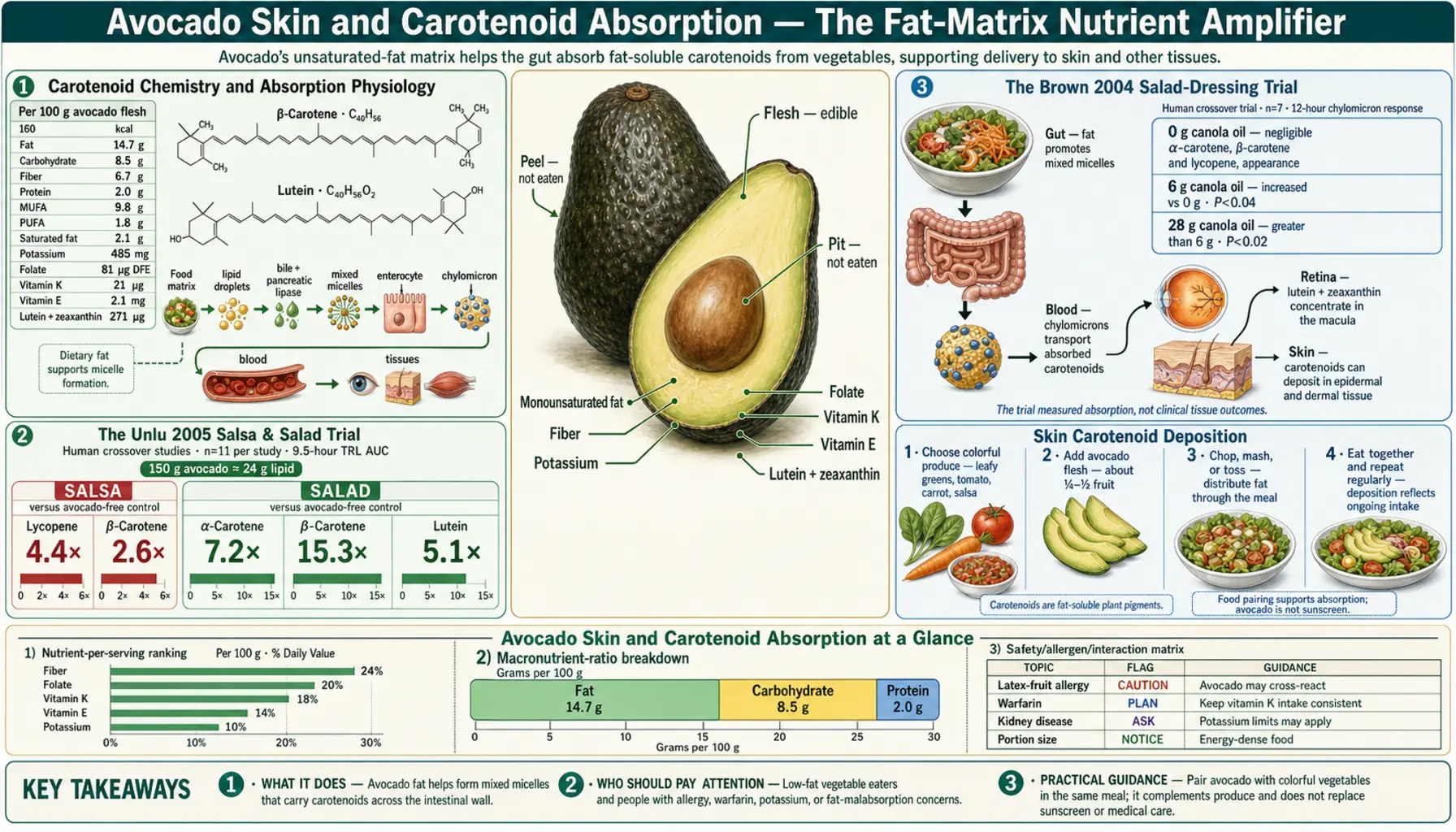
The Unlu 2005 trial (Journal of Nutrition) measured a striking food-synergy effect: adding 75-150 g of avocado to salsa or salad produced a 4-7× increase in the absorption of fat-soluble carotenoids (beta-carotene, lutein, lycopene) from the co-eaten vegetables. Carotenoids are highly lipophilic and must partition into mixed micelles in the small intestine to be absorbed; a fat-free salad delivers most of its carotenoids out the back end rather than into the bloodstream. Avocado's 22 g of fat per medium fruit is a remarkably effective absorption vehicle — better than most "low-fat" dressings and comparable to whole-fat dressing without the inflammatory soybean-oil profile of mass-market mayonnaise. The downstream effect: improved skin pigmentation from carotenoid loading (the literature documents measurable skin lutein and beta-carotene increases with dietary supplementation, with cosmetic effects on skin elasticity, hydration, and yellow-orange tone), and improved retinal protection from lutein and zeaxanthin (which concentrate in the macula as the same yellow macular pigment). This page covers the carotenoid absorption mechanism, the Unlu data, the skin-pigmentation literature, the Henning 2019 skin-elasticity trial, the vitamin-E and beta-sitosterol content of avocado, and the practical use of avocado as a carotenoid-amplifying meal component.
Table of Contents
- Carotenoid Chemistry and Absorption Physiology
- The Unlu 2005 Salsa & Salad Trial
- The Brown 2004 Salad-Dressing Trial
- Skin Carotenoid Deposition
- The Henning 2019 Avocado-Skin-Elasticity Trial
- Topical Avocado Oil for Skin
- Macular Pigment — Lutein and Zeaxanthin
- Vitamin E and Antioxidant Content
- Beta-Sitosterol and Phytosterols
- Practical Carotenoid-Amplifying Meal Pairings
- Key Research Papers
- Connections
- Featured Videos
Carotenoid Chemistry and Absorption Physiology
Carotenoids are a family of approximately 700 lipophilic pigments produced by plants, algae, and some bacteria. The major dietary carotenoids in human nutrition number about a dozen, with six accounting for the vast majority of intake:
- Beta-carotene — the orange pigment of carrots, sweet potatoes, pumpkin, mango. A provitamin A carotenoid: the BCMO1 enzyme cleaves it into two retinal molecules in the intestinal mucosa.
- Alpha-carotene — similar structure, found in carrots and pumpkin. Also a provitamin A but with lower efficiency.
- Lycopene — the red pigment of tomatoes, watermelon, pink grapefruit, guava. Not a provitamin A but a potent singlet-oxygen quencher with cardioprotective associations.
- Lutein — the yellow pigment of leafy greens (kale, spinach, collards), egg yolks, and corn. The dominant carotenoid in the macula of the retina and a significant skin carotenoid.
- Zeaxanthin — the partner of lutein in the macula; found in corn, orange bell peppers, and goji berries.
- Beta-cryptoxanthin — found in oranges, tangerines, and red peppers. A modest provitamin A.
All carotenoids share a long polyene backbone of conjugated double bonds (typically 9-11 of them), which is responsible for their characteristic absorption of visible light (and their color), as well as their potent antioxidant capacity through electron donation. The polyene backbone is also why they are intensely hydrophobic — they will not dissolve in water at all and have very limited solubility even in polar organic solvents.
For absorption, dietary carotenoids must:
- Be released from the plant cell matrix (cooking, mechanical breakdown by chewing, blender, or food processor helps)
- Partition into the lipid phase of the chyme in the stomach and proximal small intestine
- Be incorporated into mixed micelles in the duodenum/jejunum (requires bile acids, phospholipids, and dietary fat)
- Be taken up by enterocytes via passive diffusion and facilitated transport (SR-B1 scavenger receptor)
- Be packaged into chylomicrons with apolipoprotein B-48 and released into the lymphatic system
The rate-limiting step is almost always the mixed-micelle formation in step 3. Without adequate dietary fat, carotenoids cannot be incorporated into micelles, cannot be taken up by enterocytes, and pass through the gut largely unabsorbed. This is the fundamental basis for the Unlu finding — dietary fat is not merely helpful but essentially required for meaningful carotenoid absorption.
The Unlu 2005 Salsa & Salad Trial
Unlu et al. published in the Journal of Nutrition (2005) the most-cited demonstration of avocado's carotenoid-amplifying effect. The trial design:
- Study 1 (salsa): 11 healthy adults consumed a standard tomato/carrot salsa meal (~52 mg total lycopene + beta-carotene) with or without 150 g Hass avocado. Blood was sampled over 9.5 hours for chylomicron-fraction lycopene and beta-carotene appearance — a direct measure of intestinal absorption.
- Study 2 (salad): 11 healthy adults consumed a romaine/spinach/carrot salad with a "no-fat" dressing or the same salad plus either 75 g avocado or 24 g avocado oil. Same chylomicron-tracking method.
Results — with the addition of 150 g avocado to the salsa:
- Lycopene absorption: 4.4× higher than salsa alone
- Beta-carotene absorption: 2.6× higher than salsa alone
With 75 g avocado added to salad:
- Lutein absorption: 4.3× higher than salad alone
- Alpha-carotene absorption: 7.2× higher than salad alone
- Beta-carotene absorption: 15.3× higher than salad alone
With 24 g avocado oil added to salad:
- Beta-carotene absorption: 4.4× higher
- Alpha-carotene absorption: 2.6× higher
- Lutein absorption: 7.0× higher
The avocado fruit outperformed the equivalent gram amount of avocado oil for absorption enhancement — suggesting that the whole-food matrix (including the phospholipids and emulsifying compounds of the fruit pulp) is part of the mechanism beyond just the lipid quantity.
This finding has practical implications well beyond avocado: it establishes that fat-soluble vitamins and carotenoids in vegetables consumed without dietary fat have very low actual bioavailability, regardless of how much is on the plate. A spinach salad with fat-free dressing delivers a much smaller fraction of its carotenoid content into systemic circulation than the same salad with avocado.
The Brown 2004 Salad-Dressing Trial
Brown et al. (AJCN 2004) ran a parallel trial in healthy adults comparing carotenoid absorption from salad consumed with three dressing types: fat-free, reduced-fat (6 g fat), and full-fat (28 g fat) standardized salad dressing. Results:
- Fat-free dressing arm: negligible chylomicron carotenoid appearance — absorption was at the detection limit despite the carotenoid content of the salad
- Reduced-fat (6 g) dressing arm: modest carotenoid absorption, well below the full-fat arm
- Full-fat (28 g) dressing arm: robust absorption of alpha-carotene, beta-carotene, lycopene, and lutein
The dose-response curve in Brown 2004 is roughly the same as the avocado dose-response in Unlu 2005: roughly 12-15 g of dietary fat is the threshold below which carotenoid absorption is severely impaired. Above 20-30 g of fat, absorption plateaus, with little additional benefit from larger fat loads. A medium avocado (22 g fat) sits comfortably in the optimal range.
The practical implication: the very-low-fat dietary patterns historically promoted for cardiovascular health (Ornish diet, traditional NCEP step 2 diet) can paradoxically reduce the systemic absorption of beneficial plant carotenoids, even when the diet appears to be high in plant pigments. The Mediterranean and DASH dietary patterns, which include moderate amounts of olive oil, avocado, and nuts with vegetable meals, deliver more of the carotenoid content into the bloodstream than the low-fat patterns despite often comparable raw carotenoid intake.
Skin Carotenoid Deposition
Carotenoids absorbed from the diet circulate in serum bound to lipoproteins, and a fraction is deposited in adipose tissue and the dermis (the deep layer of skin), as well as in the retinal macula. The skin-carotenoid concentration can be measured non-invasively by resonance Raman spectroscopy or by reflectance spectrophotometry; both correlate with serum carotenoid status and with cumulative dietary carotenoid intake over the prior weeks.
Documented skin effects of high dietary carotenoid intake (typically from carotenoid-rich diets or carotenoid supplementation):
- Skin tone shift toward yellow-orange (carotenodermia) — visible at very high intakes (~30 mg/day beta-carotene or equivalent), most apparent on palms, soles, and nasolabial folds. The visible color is harmless and reverses with reduced intake.
- Improved skin elasticity — cross-sectional studies show better cutometer-measured skin elasticity in subjects with higher dietary carotenoid intake; longitudinal supplementation trials have shown modest improvement.
- Increased minimal erythema dose (MED) — the dose of UV that produces the first detectable redness is increased by chronic carotenoid loading. This is a real but modest photoprotective effect, typically requiring 10-12 weeks to develop and equivalent to roughly SPF 2-4 of additional protection. Carotenoid loading does not replace topical sunscreen.
- Reduced UV-induced erythema — experimental UV exposure produces less redness in carotenoid-replete individuals.
- Improved skin hydration markers — modest improvements in transepidermal water loss and corneometer-measured hydration with chronic high carotenoid intake.
- Perceived attractiveness — Stephen et al. studies have shown that observers consistently rate skin tone from carotenoid loading as healthier and more attractive than equivalent-darkness skin from sun tanning, in part because carotenoid skin color includes more yellow and less brown.
The mechanistic basis is that carotenoids in skin act as antioxidants, quenching reactive oxygen species generated by UV exposure and reducing oxidative damage to lipids and proteins in the stratum corneum and dermis. Lutein and zeaxanthin in particular concentrate in the skin and may serve specifically photoprotective roles.
The Henning 2019 Avocado-Skin-Elasticity Trial
Henning et al. (Antioxidants 2019) published a randomized controlled trial specifically examining skin outcomes from daily avocado consumption. 39 women age 27-73 were randomized to either one daily Hass avocado per day or no-avocado control for 8 weeks. Skin elasticity was measured by cutometer on the upper lateral cheek (a sun-exposed test area) and upper arm (a sun-protected test area).
Results in the avocado arm:
- Improved forehead skin elasticity — statistically significant increase
- Improved skin firmness
- Trend toward reduced wrinkle severity (not statistically significant in this small sample)
- No change in transepidermal water loss
The mechanism proposed is the combination of: (1) increased systemic carotenoid load from the avocado's own lutein and zeaxanthin content plus the absorption-amplifying effect on co-eaten vegetables; (2) the vitamin E content of avocado contributing to antioxidant skin protection; (3) the monounsaturated fat improving skin barrier lipid composition; (4) the polyhydroxylated fatty alcohols (PFAs) unique to avocado that have demonstrated anti-inflammatory effects in dermatology research (Rosenblat 2011).
The study was small and short-duration, and the skin endpoints (cutometer measurements) are not the same as long-term dermatologic outcomes. But the direction of effect is consistent with the broader carotenoid-and-skin literature and provides specific evidence for avocado's skin benefit.
Topical Avocado Oil for Skin
Separate from dietary avocado consumption, topical application of avocado oil has been studied in dermatology with documented effects on skin barrier repair and inflammation. The Lin 2017 review (International Journal of Molecular Sciences) summarizes the evidence:
- Skin barrier repair — topical avocado oil accelerates skin barrier recovery after experimental disruption (tape-stripping models). The fatty acid composition (particularly oleic and linoleic acids) integrates into the stratum corneum lipid lamellae.
- Anti-inflammatory effects — the polyhydroxylated fatty alcohols (PFAs) of avocado oil have been shown to inhibit NF-kB and reduce pro-inflammatory cytokine production in skin cell models.
- Wound healing — animal models show accelerated re-epithelialization with topical avocado oil.
- Eczema/atopic dermatitis adjunct — modest evidence that topical avocado oil (often combined with soybean oil unsaponifiables) reduces flare severity. Marketed as "avocado/soybean unsaponifiables" (ASU) for osteoarthritis joint application as well.
- Photoprotection (topical) — some sunscreen-like effect but inadequate as a standalone sunscreen. Best as a moisturizer adjunct rather than a UV protectant.
The avocado oil sold for culinary use is generally suitable for topical application; the cosmetic-grade product is typically refined and standardized. Sourcing matters — the supply chain has had significant adulteration problems (Frankel UC Davis reports), with some labeled "100% avocado oil" products containing soybean oil or other vegetable oils.
Macular Pigment — Lutein and Zeaxanthin
Lutein and zeaxanthin are the only carotenoids deposited in the macula of the retina, where they form the macular pigment optical density (MPOD) — the yellow spot at the center of the visual field. The macular pigment serves two functions: (1) it absorbs blue light, reducing photochemical damage to the rod and cone photoreceptors; (2) it acts as an antioxidant, quenching reactive oxygen species generated by high metabolic activity in the retina.
Higher MPOD is associated with reduced risk of age-related macular degeneration (AMD), the leading cause of blindness in adults over age 65. The AREDS2 trial (Age-Related Eye Disease Study 2) randomized AMD patients to lutein/zeaxanthin supplementation and demonstrated reduced progression of intermediate AMD to advanced AMD.
Avocado contributes to lutein/zeaxanthin status both directly (a medium Hass avocado contains approximately 369 mcg of lutein/zeaxanthin) and indirectly through its dramatic absorption-enhancement effect on lutein from leafy greens and zeaxanthin from corn and peppers (per Unlu 2005, lutein absorption from salad is 4-7× higher with avocado addition). A daily avocado plus regular leafy greens consumption is one of the most efficient dietary strategies for maintaining MPOD.
For more on retinal protection and macular degeneration, see our Macular Degeneration page.
Vitamin E and Antioxidant Content
A medium Hass avocado contains approximately 4 mg of alpha-tocopherol (vitamin E) — about 27% of the RDA (15 mg). Vitamin E is a chain-breaking antioxidant that terminates lipid peroxidation reactions in cell membranes, including the lipid-rich membranes of the skin and the polyunsaturated lipid-rich structures of the retina.
Vitamin E is poorly absorbed in the absence of dietary fat — the same mixed-micelle requirement that limits carotenoid absorption also limits vitamin E. Avocado's combination of vitamin E content plus fat-for-absorption produces unusually efficient delivery of bioavailable vitamin E per serving.
The avocado pulp also contains modest amounts of:
- Lutein and zeaxanthin — ~369 mcg per medium fruit, mostly concentrated in the dark green flesh just under the skin
- Beta-carotene — ~60 mcg per medium fruit (small amount)
- Cryptoxanthin — small amount
- Glutathione — raw avocado is one of the few common foods that contributes appreciably to dietary glutathione, though most dietary glutathione is hydrolyzed in the gut
For more on vitamin E and skin protection, see our Vitamin E page.
Beta-Sitosterol and Phytosterols
Avocado is one of the richest dietary sources of beta-sitosterol, the most-studied phytosterol. A medium Hass avocado contains approximately 76 mg of beta-sitosterol, more than any other common fruit. Phytosterols competitively inhibit intestinal cholesterol absorption (both dietary cholesterol and reabsorbed biliary cholesterol), modestly lowering LDL cholesterol.
The cholesterol-lowering effect of phytosterols was the basis for the FDA-approved health claim that consumption of 2 g/day of plant sterols/stanols lowers LDL cholesterol. Avocado alone does not reach this threshold in normal serving sizes, but contributes additively to a diet that includes other phytosterol sources (whole grains, nuts, legumes, vegetable oils).
Topical beta-sitosterol has additional dermatology applications: it has been studied as an anti-inflammatory in eczema and psoriasis, and "avocado/soybean unsaponifiables" (which contain concentrated phytosterols) are a recognized adjunct in osteoarthritis joint nutritional support.
Practical Carotenoid-Amplifying Meal Pairings
To maximize the absorption synergy demonstrated by Unlu 2005, pair avocado with carotenoid-rich vegetables in the same meal:
- Avocado + tomatoes — for lycopene amplification. Guacamole with tomato, or sliced tomato with avocado on toast.
- Avocado + leafy greens (spinach, kale) — for lutein and zeaxanthin amplification. Big salad with 1/4 to 1/2 avocado.
- Avocado + carrots — for alpha- and beta-carotene amplification. Grated carrot in salad with avocado, or roasted carrots served with avocado-based dressing.
- Avocado + bell peppers (red, orange, yellow) — for beta-cryptoxanthin and beta-carotene. Pico de gallo with peppers; salads with diced peppers and avocado.
- Avocado + corn — for zeaxanthin. Mexican corn salad with avocado.
- Avocado + sweet potato — for beta-carotene. Sweet potato burritos with avocado; sweet potato bowl topped with sliced avocado.
- Avocado + watermelon — for lycopene. Watermelon salad with feta and avocado.
The dose-response from Unlu 2005 suggests that the benefit plateaus around 1/4 to 1/2 of a medium avocado per meal — this is sufficient to deliver the ~12-15 g fat threshold for optimal carotenoid micellarization. Larger amounts of avocado provide additional satiety and nutrients but do not proportionally increase carotenoid absorption from the same meal.
Key Research Papers
- Unlu NZ et al. (2005). Carotenoid absorption from salad and salsa by humans is enhanced by the addition of avocado or avocado oil. Journal of Nutrition. — PubMed
- Brown MJ et al. (2004). Carotenoid bioavailability is higher from salads ingested with full-fat than with fat-reduced salad dressings as measured with electrochemical detection. AJCN. — PubMed
- Henning SM et al. (2019). Hass avocado consumption increased skin elasticity and firmness in women: a pilot study. Antioxidants. — PubMed
- Stahl W, Sies H (2012). Beta-carotene and other carotenoids in protection from sunlight. AJCN. — PubMed
- Roberts RL et al. (2009). Lutein and zeaxanthin in eye and skin health. Skin Pharmacology and Physiology. — PubMed
- Lin TK et al. (2017). Anti-inflammatory and skin barrier repair effects of topical application of some plant oils (avocado, olive). International Journal of Molecular Sciences. — PubMed
- Rosenblat G et al. (2011). Polyhydroxylated fatty alcohols derived from avocado suppress inflammatory response and provide non-sunscreen protection against UV-induced damage in skin cells. Archives of Dermatological Research. — PubMed
- AREDS2 Research Group (2013). Lutein + zeaxanthin and omega-3 fatty acids for age-related macular degeneration. JAMA. — PubMed
- Dreher ML, Davenport AJ (2013). Hass avocado composition and potential health effects. Critical Reviews in Food Science and Nutrition. — PubMed
- Stephen ID et al. (2011). Carotenoid and melanin pigment coloration affect perceived human health. Evolution and Human Behavior. — PubMed
- Maeda H, Wakaki M (2018). Topical avocado oil and dermal collagen. Journal of Cosmetic Dermatology. — PubMed
- Bohn T et al. (2017). Mind the gap: deficits in our understanding of aspects impacting the bioavailability of phytochemicals and their metabolites. Molecular Nutrition & Food Research. — PubMed
PubMed Topic Searches
- PubMed: Carotenoid absorption and dietary fat
- PubMed: Lutein zeaxanthin macular pigment
- PubMed: Avocado skin elasticity
- PubMed: Skin carotenoid photoprotection
- PubMed: Beta-sitosterol and avocado
Connections
- All Food
- Avocado Overview
- Avocado Benefits Hub
- Avocado Monounsaturated Fats
- Avocado Potassium & BP
- Avocado Fiber & Satiety
- Vitamin A (Retinol & Carotenoids)
- Vitamin E
- Vitamin K
- Macular Degeneration
- Eczema
- Spinach
- Kale
- Tomatoes
- Sweet Potatoes
- Extra Virgin Olive Oil