Avocado Fiber and Satiety — The Glycemic and Appetite Effects
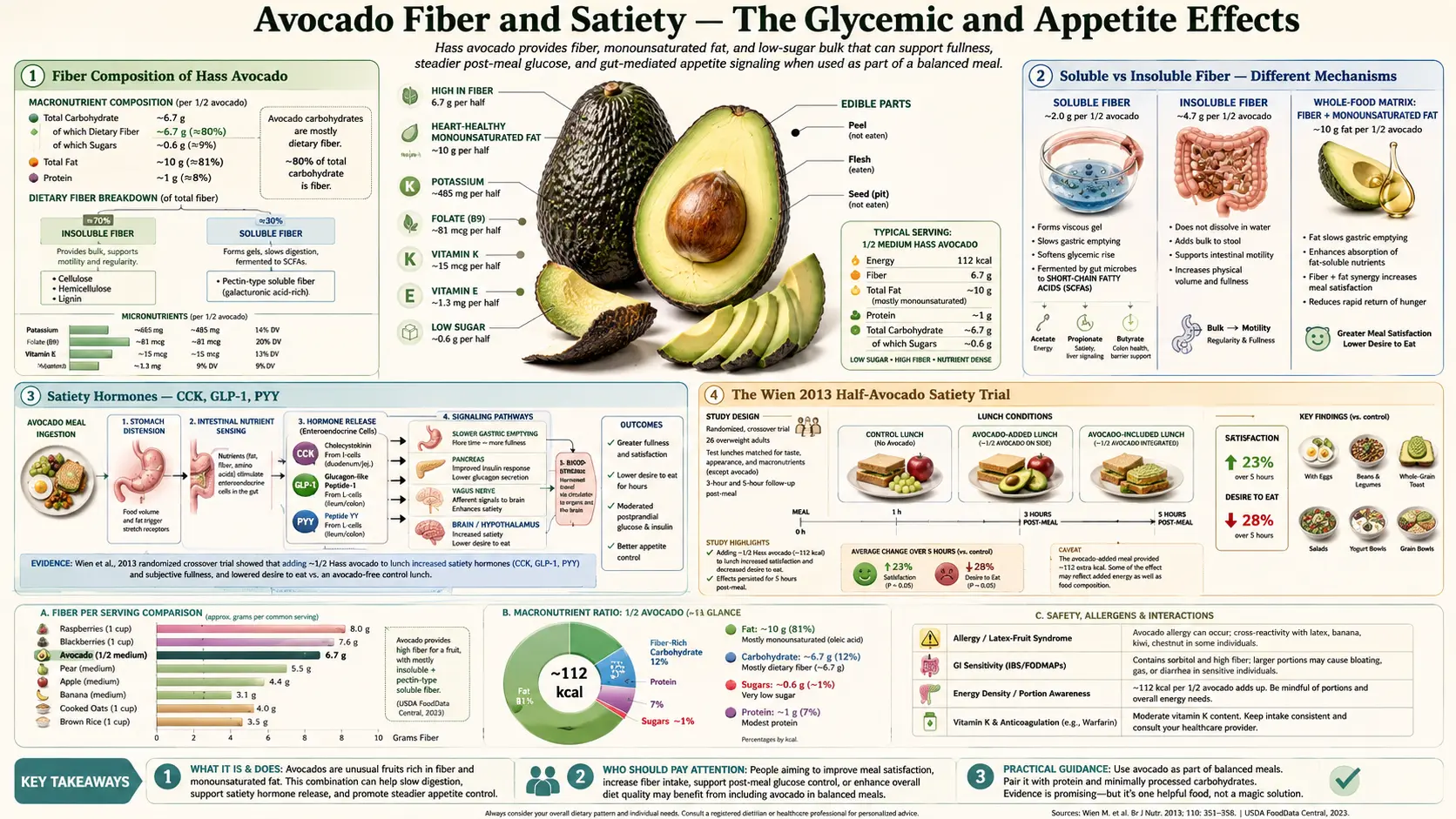
A medium Hass avocado delivers roughly 10 g of fiber — about 36% of the daily-value target (28 g) in a single piece of fruit. The fiber is approximately 70% insoluble (cellulose, hemicellulose, lignin) and 30% soluble (a heteropolysaccharide unique to the avocado fruit pulp). Combined with the avocado's high monounsaturated-fat content, this fiber load slows gastric emptying, prolongs satiety, blunts the postprandial glucose response, and feeds the gut microbiome. The Wien 2013 Nutrition Journal randomized trial established that half an avocado added to a standard lunch reduced self-reported hunger by 40% over 3 hours and reduced the desire to eat by 28% over 5 hours. The Henning 2019 microbiome trial showed measurable increases in Lactobacillus and Faecalibacterium prausnitzii (an anti-inflammatory commensal) after 12 weeks of daily avocado consumption. This page covers the fiber chemistry, the satiety-hormone cascade, the postprandial glycemic effects, the emerging microbiome data, and the practical role of avocado in weight-stability, glycemic-control, and IBS / FODMAP-sensitive diets.
Table of Contents
- Fiber Composition of Hass Avocado
- Soluble vs Insoluble Fiber — Different Mechanisms
- Satiety Hormones — CCK, GLP-1, PYY
- The Wien 2013 Half-Avocado Satiety Trial
- Postprandial Glucose and Insulin Response
- The Avocado-Microbiome Interaction
- Weight Management — The Pacheco and Hannon Trials
- Application in Type 2 Diabetes
- IBS and FODMAP Considerations
- Practical Use in Daily Meals
- Key Research Papers
- Connections
- Featured Videos
Fiber Composition of Hass Avocado
USDA FoodData Central lists Hass avocado at approximately 6.7 g of dietary fiber per 100 g of edible flesh. A medium Hass avocado (~200 g) therefore delivers approximately 10-13 g of fiber depending on the specific fruit. This is comparable to a cup of cooked black beans (15 g) or 1/2 cup of raw raspberries (4 g) on a per-serving basis.
The compositional breakdown:
- Insoluble fiber: ~7 g per medium fruit (~70%) — cellulose, hemicellulose, and lignin from the plant cell walls. Insoluble fiber adds bulk to stool, accelerates gut transit, and reduces colonic transit time.
- Soluble fiber: ~3 g per medium fruit (~30%) — predominantly a complex heteropolysaccharide containing mannose, galactose, arabinose, glucose, xylose, and rhamnose, with a smaller pectin component. Soluble fiber forms a viscous gel in the gut lumen, slows gastric emptying, slows nutrient absorption, and is partially fermented by colonic bacteria to short-chain fatty acids.
The relatively high proportion of soluble-to-insoluble fiber (compared to most fruits, which are more dominantly insoluble) is part of what gives avocado its satiety and glycemic effects — soluble viscous fiber is the more potent of the two for those endpoints.
Soluble vs Insoluble Fiber — Different Mechanisms
The clinical effects of dietary fiber differ between the two major fractions:
Insoluble fiber acts primarily as a mechanical bulking agent. It is not significantly fermented by colonic bacteria and is excreted largely intact in stool. The clinical effects:
- Increased stool weight and decreased transit time
- Reduced risk of constipation
- Reduced colonic luminal pressure (helpful in diverticular disease)
- Mechanical "scrubbing" of the gut lining (the dental-floss analogy)
- Minimal effect on glycemic response or satiety hormones
Soluble viscous fiber (like the heteropolysaccharide in avocado, the beta-glucan in oats, the psyllium husk in fiber supplements) forms a gel in the small intestine. The clinical effects:
- Slowed gastric emptying — prolonged sensation of stomach fullness
- Slowed glucose absorption from the small intestine — lower and flatter postprandial glucose curve
- Bile-acid binding in the small intestine — modestly lowers LDL cholesterol by interrupting enterohepatic bile acid recirculation
- Substrate for colonic bacterial fermentation — produces short-chain fatty acids (acetate, propionate, butyrate) that nourish the colonocytes and signal satiety to the brain
- Increased viscosity of the unstirred layer at the intestinal wall — reduces nutrient transport rate
Avocado's combination of meaningful amounts of both fractions, plus a heavy fat load that also slows gastric emptying, produces synergistic effects greater than the sum of fiber alone.
Satiety Hormones — CCK, GLP-1, PYY
The satiety effect of avocado is mediated by a coordinated release of gut peptide hormones in response to the fat and fiber load:
- Cholecystokinin (CCK) — secreted by I-cells of the duodenum and jejunum in response to fat and protein in the chyme. CCK signals satiety to the brain via the vagus nerve, slows gastric emptying, and triggers pancreatic enzyme secretion and gallbladder contraction. The fat load of avocado is a potent CCK stimulus.
- Glucagon-like peptide-1 (GLP-1) — secreted by L-cells of the distal small intestine in response to carbohydrate, fat, and protein. GLP-1 enhances insulin secretion (the incretin effect), suppresses glucagon, slows gastric emptying, and signals satiety. The pharmacologic GLP-1 receptor agonists (semaglutide, liraglutide, tirzepatide) replicate this signal at supraphysiologic concentrations.
- Peptide YY (PYY) — co-secreted with GLP-1 by L-cells. PYY 3-36 (the active fragment) signals satiety by binding Y2 receptors in the arcuate nucleus of the hypothalamus, where it inhibits the orexigenic NPY/AgRP neurons. Fat and fiber are both PYY-secretagogues.
- Oleoylethanolamide (OEA) — a lipid satiety signal produced in the small intestine from dietary oleic acid (the dominant fatty acid in avocado, ~67% of total fat). OEA activates PPAR-alpha receptors in the small intestine and signals satiety via the vagus nerve.
- Ghrelin suppression — ghrelin is the "hunger hormone" secreted by the stomach; its release is suppressed by meal contents. Mixed-macronutrient meals (especially those containing fat and fiber) suppress ghrelin more effectively than carbohydrate-dominant meals.
The integrated effect of these signals is a longer, more durable sensation of fullness after an avocado-containing meal compared to an isocaloric carbohydrate-dominant meal — the basis for the Wien 2013 trial findings.
The Wien 2013 Half-Avocado Satiety Trial
Wien et al. published in Nutrition Journal (2013) one of the cleanest randomized crossover designs of avocado on satiety. 26 overweight adults (BMI 28.1 average) consumed three test lunches in randomized crossover order:
- Standard lunch — no avocado, energy controlled
- Standard lunch plus 1/2 Hass avocado (~70 g) — added on top, ~112 additional kcal
- Standard lunch with 1/2 Hass avocado substituted — energy-equivalent substitution
Self-reported hunger, satisfaction, and desire to eat were measured on visual-analogue scales before lunch, immediately after, and at 30 min, 1 h, 2 h, 3 h, and 5 h post-lunch. Postprandial blood glucose and insulin were measured at the same time points.
Findings:
- Self-reported satisfaction at 3 hours: 26% higher with avocado addition vs no avocado
- Self-reported hunger at 3 hours: 40% lower with avocado addition
- Desire to eat at 5 hours: 28% lower with avocado addition
- Postprandial blood glucose: no significant difference between groups despite the higher fat content of the avocado meal
- Postprandial insulin: no significant rise above the standard-lunch arm
The lack of insulin response despite the added calories is mechanistically informative — the calories were predominantly fat (with embedded fiber), neither of which is a strong insulin secretagogue. This explains why avocado can be added to a meal without producing the post-prandial insulin spike that typically follows a carbohydrate-dominant meal.
Postprandial Glucose and Insulin Response
The Park 2018 randomized crossover trial (Nutrients) extended the Wien findings to a meal-replacement context. Avocado was incorporated into a mixed meal as a partial replacement for refined carbohydrate, and postprandial glucose and insulin were compared. The avocado-containing meal produced:
- ~25% lower peak postprandial glucose at 60 minutes
- ~20% lower peak postprandial insulin at 60 minutes
- ~30% lower 4-hour insulin AUC
- Increased GLP-1 and decreased ghrelin
The mechanism is the substitution effect: removing some refined carbohydrate from a meal and replacing it with whole-food fat and fiber dramatically reduces the glycemic load of the meal. This is the same principle behind low-glycemic-index dietary patterns and the rationale for using avocado as a butter or bread replacement in diabetes-focused diets.
The Heskey 2019 trial used a slightly different design (avocado added to a standardized breakfast in healthy adults) and found similar but more modest effects on postprandial markers, suggesting that the glycemic benefit is most pronounced when avocado substitutes for refined carbohydrate rather than being added on top.
The Avocado-Microbiome Interaction
The Henning 2019 Journal of Nutrition 12-week randomized trial examined microbiome changes from daily Hass avocado consumption (one whole fruit per day) in overweight adults. Stool samples were sequenced (16S rRNA gene) at baseline, week 4, week 8, and week 12. Key findings:
- Increased abundance of Lactobacillus species, particularly L. acidophilus — a beneficial commensal genus broadly associated with gut barrier function
- Increased Faecalibacterium prausnitzii — one of the most-studied beneficial commensals, a major producer of butyrate (the preferred energy substrate for colonocytes), and a known anti-inflammatory bacterium frequently depleted in inflammatory bowel disease and depression
- Reduced abundance of Lactobacillus-displacing Proteobacteria
- Increased fecal short-chain fatty acid concentrations — particularly butyrate and acetate
- Increased microbial alpha-diversity (the within-individual species richness measure)
The mechanism is that the soluble heteropolysaccharide fiber and the residual fat that escapes small-intestinal absorption serve as fermentation substrates for the colonic microbiome. The fiber feeds the beneficial saccharolytic bacteria, which produce SCFAs that nourish colonocytes, strengthen tight junctions, and signal satiety. This is the same general mechanism by which oats, legumes, and other high-soluble-fiber foods improve gut health, but with avocado's specific heteropolysaccharide producing a somewhat different fermentation profile than the better-studied beta-glucans and pectins.
The clinical relevance: patients aiming to modulate the gut microbiome (those with IBS, IBD in remission, depression, or metabolic syndrome) may benefit from including avocado as one component of a diverse, fiber-rich dietary pattern. The effect is documented but modest — avocado alone will not transform the microbiome.
Weight Management — The Pacheco and Hannon Trials
Two pivotal weight-management trials:
Pacheco 2022 cohort analysis (Journal of Nutrition) used 30-year follow-up data from the Nurses' Health Study and Health Professionals Follow-up Study, with over 100,000 adults. Hypothetical substitution analysis estimated that consuming 1/2 serving of avocado per day in place of margarine, butter, processed meats, or sugar-sweetened beverages was associated with reduced weight gain over the follow-up period and reduced incidence of obesity. The avocado-rich diet pattern was associated with smaller weight gain per year compared to matched substitution patterns.
Hannon 2020 randomized controlled trial (Journal of Nutrition) randomized 105 adults with overweight or obesity to either daily avocado consumption (1 fruit/day) or a no-avocado control diet for 12 weeks, with energy intake unrestricted. The avocado arm showed:
- Reduced visceral adipose tissue (VAT) in women — significantly different from control, despite similar total caloric intake. Men did not show the same effect, possibly due to baseline differences in fat distribution.
- Slightly improved insulin sensitivity
- No significant change in total body weight
- Improved diet quality (HEI-2015 score)
The visceral fat finding is particularly interesting because abdominal visceral adiposity is the metabolically active fat depot most strongly tied to insulin resistance, dyslipidemia, and cardiovascular risk. Reducing visceral fat without changing total body weight represents a favorable change in body composition even when scale-weight is stable.
The practical interpretation: avocado is not a "weight loss food" in the direct sense, but it appears to be a "weight-distribution-improving food" when added as part of a healthy dietary pattern. For comprehensive weight-management strategies, see our Mediterranean Diet page.
Application in Type 2 Diabetes
Several features of avocado make it well-suited to type 2 diabetes dietary management:
- Very low net carbohydrate — only ~2 g net (12 g total minus 10 g fiber) per medium fruit, with negligible effect on blood glucose
- High monounsaturated fat — substitution for saturated fat improves the lipid profile that diabetic patients often need to address (typical pattern: high triglycerides, low HDL, normal-to-elevated LDL particle number)
- Slows postprandial glucose excursion — when used as a butter or carbohydrate substitute (avocado on toast in place of butter, avocado-based sandwich spread in place of mayonnaise)
- Improves insulin sensitivity — modest but documented in Hannon 2020 and others
- Adds satiety — weight stability or modest reduction is a major goal in type 2 diabetes
- Potassium-rich — supports the blood-pressure control that is central to diabetic kidney protection
The American Diabetes Association explicitly endorses avocado as part of a healthy diabetes dietary pattern. The caveat is the calorie density — in patients aiming to lose weight, portion control matters and avocado should typically be substituted for other fat sources rather than added on top. For more on diabetes management, see our Type 2 Diabetes page.
IBS and FODMAP Considerations
Avocado is one of the foods with a notable caveat for the low-FODMAP elimination diet used in irritable bowel syndrome (IBS) and SIBO management. Specifically, avocado is high in polyols (sorbitol), which can cause bloating, abdominal pain, and diarrhea in FODMAP-sensitive patients.
Monash University FODMAP guidance:
- Low-FODMAP serving size: 1/8 of a medium avocado (~30 g) — this small portion is generally tolerated
- Above 1/8 avocado: approaches the FODMAP threshold for many sensitive patients
- Above 1/4 avocado: typically triggers symptoms in FODMAP-sensitive patients during the elimination phase
The elimination phase typically lasts 2-6 weeks, followed by structured reintroduction. Many IBS patients are able to tolerate moderate avocado intake (1/4 to 1/2 fruit) during the reintroduction phase, identifying their personal threshold. The polyol restriction is generally one of the most consistently helpful FODMAP categories in IBS but also one of the least dramatic — many patients tolerate small amounts even during strict elimination.
For more on the low-FODMAP approach, see our SIBO page and IBS page.
Practical Use in Daily Meals
- Avocado toast — the prototypical satiety-supporting breakfast. 1/2 avocado mashed onto whole-grain sourdough with sea salt and lemon delivers fat, fiber, complex carbohydrate, and moderate protein in a low-glycemic-load combination. Add an egg for additional protein.
- Salad addition — 1/4 to 1/2 avocado per salad dramatically improves satiety and (per Unlu 2005) increases absorption of fat-soluble carotenoids from the rest of the salad — see carotenoid absorption page.
- Guacamole — traditional Mexican preparation with onion, tomato, cilantro, lime, and salt. Pair with raw vegetable crudités or low-glycemic crackers.
- Smoothies — 1/4 avocado adds creaminess and satiety without significant flavor. Particularly effective for weight-management smoothies aimed at sustaining the meal-replacement window.
- Sandwich/burger spread — replaces mayonnaise (high in inflammatory omega-6 PUFA from soybean oil) with whole-food oleic acid.
- Burrito/taco filling — replaces cheese (saturated fat) with monounsaturated avocado fat.
- Frequency — daily intake of 1/2 to 1 medium fruit is well-tolerated. The Wang 2015 and Hannon 2020 trials used one fruit per day with no adverse effects beyond the calorie consideration.
Key Research Papers
- Wien M et al. (2013). A randomized 3×3 crossover study to evaluate the effect of Hass avocado intake on post-ingestion satiety, glucose and insulin responses, and subsequent energy intake in overweight adults. Nutrition Journal. — PubMed
- Park E et al. (2018). Avocado fruit on postprandial markers of cardio-metabolic risk: a randomized controlled dose response trial. Nutrients. — PubMed
- Heskey C et al. (2019). Avocado intake, and longitudinal weight and body mass index changes. Nutrients. — PubMed
- Henning SM et al. (2019). Hass avocado consumption modulates microbial diversity. Journal of Nutrition. — PubMed
- Hannon BA et al. (2020). Daily avocado consumption improves abdominal adiposity and insulin sensitivity in adults with overweight and obesity. Journal of Nutrition. — PubMed
- Pacheco LS et al. (2022). Avocado intake and longitudinal weight and body mass index changes in an adult cohort. Journal of Nutrition. — PubMed
- Reynolds A et al. (2019). Carbohydrate quality and human health: a series of systematic reviews and meta-analyses. The Lancet. — PubMed
- Fulgoni VL et al. (2013). Avocado consumption is associated with better diet quality and nutrient intake, and lower metabolic syndrome risk in US adults. Nutrition Journal. — PubMed
- Zhu L et al. (2019). Avocado consumption, satiety, glucose, insulin, and inflammatory response: meta-analysis. Nutrients. — PubMed
- James-Martin G et al. (2020). Avocado consumption and cardiometabolic health: systematic review and meta-analysis. JAHA. — PubMed
- Slavin J (2013). Fiber and prebiotics: mechanisms and health benefits. Nutrients. — PubMed
- Dreher ML, Davenport AJ (2013). Hass avocado composition and potential health effects. Critical Reviews in Food Science and Nutrition. — PubMed
PubMed Topic Searches
- PubMed: Avocado satiety/glucose
- PubMed: Avocado microbiome SCFA
- PubMed: Viscous fiber satiety
- PubMed: Meal-stimulated satiety hormones
- PubMed: Avocado in T2D
Connections
- All Food
- Avocado Overview
- Avocado Benefits Hub
- Avocado Monounsaturated Fats
- Avocado Potassium & BP
- Avocado Skin & Carotenoids
- Type 2 Diabetes
- Metabolic Syndrome
- Insulin Resistance
- SIBO
- IBS
- Mediterranean Diet
- Intermittent Fasting
- HbA1c
- Probiotics & Microbiome
- Oats (Beta-Glucan)