Hookworm Symptoms and Diagnosis
Iron-Deficiency Anemia & Blood Loss
The hallmark of hookworm disease — chronic intestinal bleeding that drains the body's iron.
Read the deep dive →Ground Itch & Larval Migration
The early phases — the itchy rash where larvae enter the skin and the cough as they cross the lungs.
Read the deep dive →Hookworm in Pregnancy & Children
Why the anemia hits hardest in pregnant women and growing children — and the lasting cost.
Read the deep dive →Hookworm infection is caused by tiny parasitic roundworms — chiefly Necator americanus and Ancylostoma duodenale — that live in the small intestine and feed on blood. It is one of the most common infections in the world, affecting hundreds of millions of people, mostly in warm, poor regions where people walk barefoot on contaminated soil. The thread that ties together everything hookworm does to the body is a single, simple fact: the adult worm latches onto the gut wall and drinks blood, day after day, for years. Most of the harm — the tiredness, the pale skin, the swollen feet, the strange cravings, the stunted growth in children — flows from that slow, steady loss of blood and the iron it carries. This page walks through how the trouble unfolds in stages that follow the worm's own journey through the body (skin, then lungs, then gut), explains why the central problem is iron-deficiency anemia from chronic blood loss, describes the other effects, and shows how doctors confirm the diagnosis — including why a light infection can be completely silent.
Table of Contents
1. How the Harm Unfolds in Stages
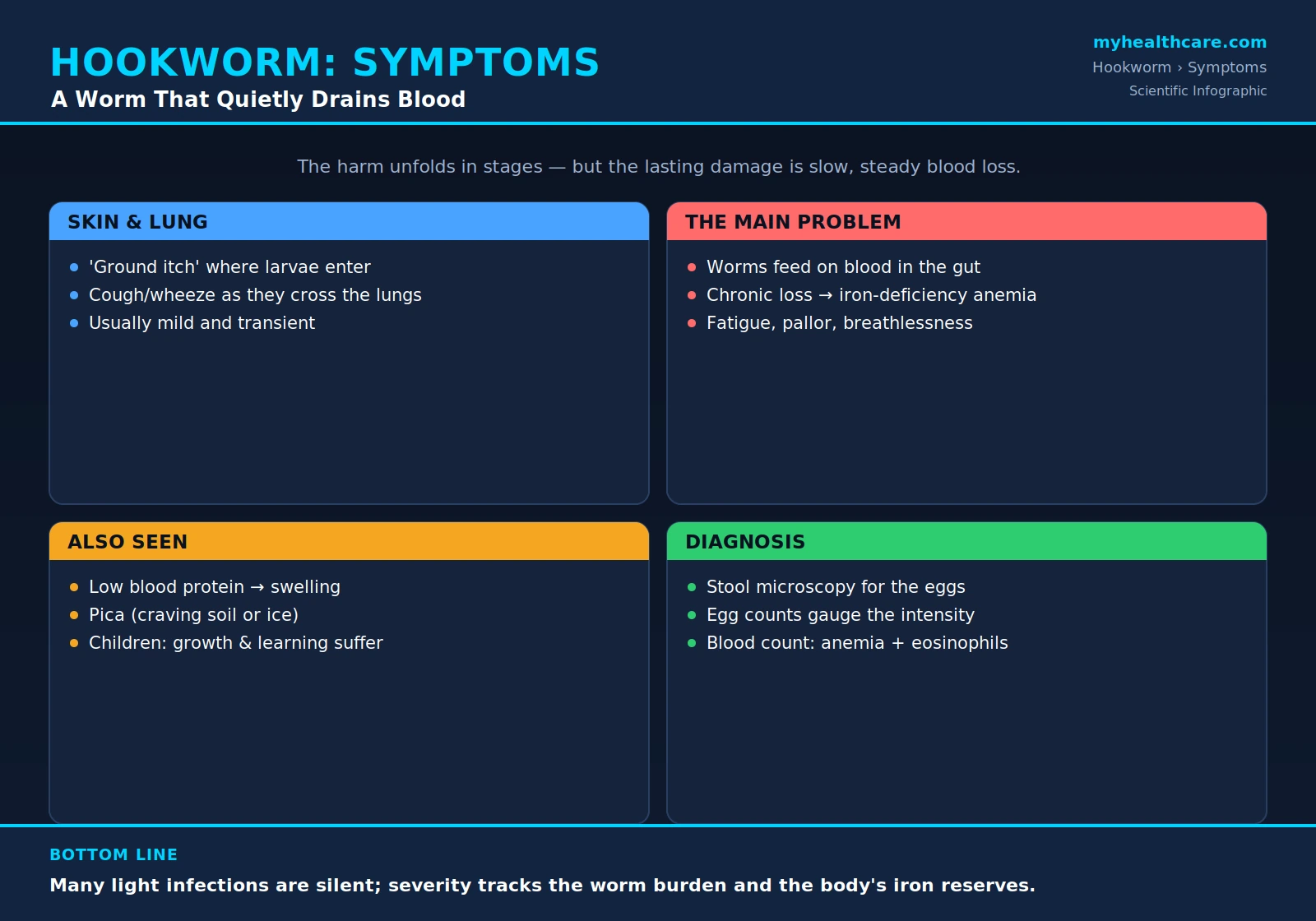
The clearest way to understand hookworm disease is to follow the parasite's own route through the body, because each stop on that journey produces its own set of symptoms. The young worms (larvae) live in warm, moist soil. When bare skin — usually a foot — touches contaminated ground, the larvae burrow in and begin a remarkable migration that ends in the gut, where the adult worms settle and feed.
The harm therefore arrives in three broad phases that mirror this trip:
- The skin phase (entry). Where the larvae penetrate the skin, they cause a local reaction — an itchy, sometimes raised and red rash classically known as "ground itch." This is the body's first encounter with the parasite and the first symptom many people notice.
- The lung phase (migration). From the skin the larvae enter the bloodstream and are carried to the lungs. There they break out of the small blood vessels into the air sacs, travel up the airways, and are swallowed. As they pass through the lungs they can cause a cough, wheeze, or chest discomfort.
- The intestinal phase (residence). Once swallowed, the worms mature in the small intestine, attach to the lining, and begin feeding on blood. This is the long-lasting phase — adult worms can live for years — and it is the source of the disease's most important and characteristic consequences.
Keeping this three-stage map in mind makes the symptom list coherent. A skin rash, a cough, and severe fatigue can seem unrelated, but in hookworm they are simply the same infection seen at three different points along the parasite's path. The skin and lung phases are brief and often mild; it is the intestinal phase — quiet, chronic, and easy to overlook — that does the lasting damage.
2. The Central Problem: Chronic Blood Loss and Anemia
If there is one thing to understand about hookworm disease, it is this: the central, defining harm is chronic intestinal blood loss leading to iron-deficiency anemia. Everything else is, in a sense, a footnote to this single mechanism.
Adult hookworms attach to the wall of the small intestine and feed on blood. They do this in two ways: they rupture tiny blood vessels and ingest blood directly, and they secrete substances that keep the wound from clotting, so the damaged spot continues to ooze even after the worm moves to a new site. A person harboring many worms loses a small but steady amount of blood every single day. Multiplied across a heavy worm burden and continued for months or years, those small daily losses add up to a serious, ongoing drain on the body's iron — the mineral at the heart of the red blood cells that carry oxygen.
The result is iron-deficiency anemia: too few healthy red blood cells, and red cells that are small (microcytic) and pale (hypochromic) because they lack the iron needed to fill them with hemoglobin. The familiar symptoms follow directly — fatigue and weakness, pale skin and pale inner eyelids, breathlessness on exertion, a fast heartbeat (palpitations), dizziness, and headache. In its most severe and prolonged form, the strain of pumping thin, oxygen-poor blood can lead to heart failure.
Crucially, how sick a person becomes depends heavily on how many worms they carry (the worm burden) and on how much iron they already had in reserve. A well-nourished adult with a few worms may notice little; a child or pregnant woman with a heavy burden and low iron stores can become dangerously anemic. This burden-dependence is a recurring theme of hookworm disease and explains why the same infection can be trivial in one person and disabling in another.
Because this anemia is the core of the disease, it has its own detailed page. For the full picture — how much blood is lost, how the iron drain progresses, and how the body tries to compensate — see Iron-Deficiency Anemia and Blood Loss.
3. The Skin and Lung Phases
Before the worm ever reaches the gut, its journey through the skin and lungs can announce itself — though these early phases are easily missed or mistaken for something else.
"Ground itch" (the skin phase). Where the larvae burrow through the skin — most often on the feet, ankles, or hands of someone who has been barefoot or working with bare hands on contaminated soil — they trigger a local inflammatory reaction. The result is an itchy, sometimes stinging rash with small red bumps, traditionally called ground itch (or, historically in the southern United States, "dew itch" or "toe itch"). It usually appears within a day or two of exposure and settles over a few days to a couple of weeks.
The lung phase. Carried by the blood to the lungs, the migrating larvae break out of small vessels into the air sacs and crawl up the airways to be swallowed. This passage can irritate the lungs and produce a dry cough, wheezing, a sore throat, or low-grade fever — a pattern sometimes accompanied by a temporary rise in a type of white blood cell called eosinophils. When migrating worms cause this kind of transient lung inflammation with eosinophilia, it falls under the umbrella historically named Löffler syndrome (Löffler's syndrome). In hookworm the lung phase is usually mild and self-limited, but it is part of why a new infection can briefly resemble a chest cold.
These early symptoms are important mostly as clues. On their own they are rarely severe, but in the right setting — an itchy foot rash followed weeks later by a cough and then by creeping fatigue — they can point toward a hookworm infection that the slower intestinal phase would otherwise reveal only much later. The skin and lung phases are covered in depth on the Ground Itch and Larval Migration page.
4. Pregnancy and Children
Hookworm is rarely an equal-opportunity disease. The same daily blood loss that an iron-replete adult man might shrug off can be devastating for two groups whose bodies are already stretched for iron: pregnant women and growing children.
In pregnancy, a woman's iron needs rise sharply to build her own expanded blood volume and to supply the developing baby. Hookworm's steady blood loss is layered on top of that heightened demand, so even a moderate worm burden can tip a pregnant woman into significant anemia. The consequences reach beyond the mother: maternal iron-deficiency anemia is linked with low birth weight, premature birth, and increased risks for both mother and baby. Systematic reviews of pregnant women in hookworm-endemic regions have repeatedly tied the infection to anemia in pregnancy, which is one of the reasons control programs pay special attention to women of childbearing age.
In children, the harm is not only in the moment but in the future. A growing child needs iron for an expanding blood supply and, critically, for the developing brain. Chronic hookworm anemia and the broader nutritional drain it causes are associated with impaired physical growth (stunting), poorer school performance, and deficits in cognition and attention. Because these effects strike during the years when the body and brain are being built, the cost can be lasting — a child who is anemic and undernourished for years may not fully catch up even after the worms are cleared.
This is why hookworm is considered not just a cause of illness but a brake on human development in the regions where it is common. The fuller story — the numbers, the mechanisms, and what treatment can recover — is told on the Hookworm in Pregnancy and Children page.
5. Protein Loss and Swelling
Iron is not the only thing the worms drain. In heavy, long-standing infections, the chronic loss of blood from the gut — combined with the parasite's demands and the poor diet that often accompanies it — can also deplete the body's protein. Blood is rich in proteins, especially albumin, and losing it day after day, on top of an already marginal protein intake, can drive blood-protein levels too low. This state is called hypoproteinemia (low protein in the blood).
Albumin does an important physical job: it helps hold fluid inside the blood vessels by exerting an inward "pull" (oncotic pressure). When albumin falls, that pull weakens, and fluid leaks out of the vessels into the tissues. The visible result is edema — swelling. In severe childhood hookworm disease this can appear as puffiness of the face, swollen legs and feet, or in the worst cases generalized swelling (anasarca) with a swollen belly. Historically, the picture of a pale, listless, pot-bellied, swollen child was a recognized hallmark of severe hookworm disease in heavily infected communities.
It is worth keeping this in proportion: pronounced protein loss and edema are features of heavy, chronic infection in an already undernourished person, not of the typical light infection. But when they appear, they are a signal that the disease has progressed well beyond simple iron loss and is taking a broad nutritional toll.
6. Pica — Craving Soil or Ice
One of the more striking and easily overlooked clues to hookworm-related iron deficiency is pica — a craving and compulsion to eat substances that are not food. People with significant iron-deficiency anemia, including that caused by hookworm, sometimes develop powerful urges to eat soil or clay (geophagia), ice (pagophagia), raw starch, chalk, or other non-nutritive items.
Exactly why iron deficiency produces these cravings is not fully understood, but the link between pica and iron-deficiency anemia is well recognized, and pica often eases once the iron deficiency is corrected. For a clinician or a family, an unusual craving — an adult or child who is constantly chewing ice, or who eats dirt — can be a valuable hint pointing toward underlying iron deficiency, which in an endemic area should raise the question of hookworm.
There is also a grim irony in the soil-eating form: in regions where hookworm thrives, eating contaminated soil could, in principle, expose a person to further infection — though most hookworm transmission is through the skin rather than by swallowing. The practical message is simpler: pica is a flag for iron deficiency, and in the right setting that iron deficiency may well be the work of hookworms.
7. Why Many Infections Are Silent
For all the serious harm hookworm can do, a great many infected people have no symptoms at all. This apparent contradiction comes down to one principle that runs through the whole disease: the severity depends on the worm burden.
Hookworm infections are not uniform. A person might carry only a handful of worms, or they might carry hundreds. The amount of blood lost — and therefore how sick the person becomes — tracks closely with how many worms are present. A light infection with a small number of worms produces only a tiny daily blood loss, which a person with adequate iron stores and a reasonable diet can easily replace. Such a person may feel completely well and never suspect they are infected. A heavy infection, by contrast, drains blood faster than the body can keep up, and the symptoms of anemia emerge.
This burden-dependence has two important consequences. First, it means hookworm is often a hidden, community-wide condition: in an endemic area, many people carry the parasite quietly, and the infection circulates and persists even among those who feel fine. Second, it means that the absence of symptoms does not mean the absence of infection — a person can be a source of contamination (passing eggs into the environment) and can drift toward anemia as their worm burden builds, all without obvious illness. It is precisely because light infections are silent, yet collectively important, that diagnosis often rests on testing rather than on waiting for symptoms.
8. How It Is Diagnosed
Because the symptoms of hookworm — tiredness, pale skin, breathlessness — overlap with countless other causes of anemia, the diagnosis is confirmed by finding the parasite (or its eggs) and by characterizing the anemia in the blood. Several complementary tools are used.
Stool microscopy (finding the eggs). The everyday foundation of diagnosis is examining a stool sample under the microscope for hookworm eggs, which the adult female worms shed into the gut. The presence of these characteristic eggs confirms an active intestinal infection. There is one important limitation to keep in mind: the eggs of the two main hookworm species — Necator americanus and Ancylostoma duodenale — look essentially identical under the microscope, so a routine stool exam confirms "hookworm" but cannot tell the two species apart. (Distinguishing them, when it matters, requires culturing the larvae or molecular testing.)
Egg-count methods (measuring the intensity). Because the harm of hookworm depends so heavily on the worm burden, it is often useful not just to know whether eggs are present but how many. Quantitative techniques — most famously the Kato-Katz method — count the number of eggs per gram of stool, which serves as a proxy for the intensity of infection. This matters both for individual care and for public-health programs, which use egg counts to judge how heavily a community is infected and how well treatment is working.
A complete blood count (characterizing the anemia). A blood test called a complete blood count (CBC) is central to the workup. In hookworm disease it classically shows microcytic, hypochromic anemia — that is, a low red-blood-cell count and hemoglobin, with red cells that are abnormally small (low MCV) and pale (low MCH) — the signature of iron deficiency. Iron studies (such as serum ferritin) can confirm that the iron stores are depleted. In addition, the blood count may show raised eosinophils (eosinophilia), a type of white blood cell that increases in response to many worm infections; eosinophilia is most pronounced during the early migratory phase and is a useful supporting clue.
In practice, the diagnosis is usually pieced together from the combination of a suggestive clinical picture, a stool exam showing hookworm eggs, and a blood count showing iron-deficiency anemia (often with eosinophilia) — rather than from any single test alone.
9. When to Suspect and Test
Because light infections are silent and the symptoms of heavy ones are nonspecific, knowing when to think of hookworm is half the battle. The infection should be actively considered and tested for in several situations:
- Unexplained iron-deficiency anemia in someone from — or who has traveled to — an endemic area. Hookworm is one of the world's leading causes of iron-deficiency anemia. In a person who lives in, comes from, or has spent time in a warm region with poor sanitation, iron-deficiency anemia without an obvious cause should prompt a stool examination for hookworm eggs.
- The right exposure history. Going barefoot on soil, farming, gardening with bare hands, or other skin contact with potentially contaminated ground — especially when followed by an itchy foot rash and later fatigue — raises suspicion.
- An incidental finding of eosinophilia (a raised eosinophil count on a blood test) in someone with relevant exposure, since worm infections are a common cause.
- Pregnant women and children in endemic regions, who are most vulnerable to the anemia and in whom screening or empiric treatment is often part of public-health programs.
- Suggestive clues such as pica (craving ice, soil, or clay) or, in heavy disease, swelling from low blood protein, which point toward iron deficiency that may be hookworm-driven.
Outside these settings — in a healthy person with no relevant exposure and a normal blood count — routine testing for hookworm is unnecessary. The skill lies in recognizing the person whose anemia, exposure, or symptoms make this common but easily missed parasite a real possibility, and then confirming it with a simple stool exam and blood count.
Key Research Papers
Peer-reviewed reviews, cohort studies, and burden estimates on the biology, blood loss, anemia, nutritional consequences, and diagnosis of human hookworm infection and the soil-transmitted helminths. Journal names appear as plain text; the year/volume/pages link opens the full citation via DOI.
- Hotez PJ, Brooker S, Bethony JM, Bottazzi ME, Loukas A, Xiao S. Hookworm Infection. The New England Journal of Medicine. 2004;351(8):799–807. — doi:10.1056/NEJMra032492
- Loukas A, Hotez PJ, Diemert D, et al. Hookworm Infection. Nature Reviews Disease Primers. 2016;2:16088. — doi:10.1038/nrdp.2016.88
- Bethony J, Brooker S, Albonico M, et al. Soil-Transmitted Helminth Infections: Ascariasis, Trichuriasis, and Hookworm. The Lancet. 2006;367(9521):1521–1532. — doi:10.1016/S0140-6736(06)68653-4
- Jourdan PM, Lamberton PHL, Fenwick A, Addiss DG. Soil-Transmitted Helminth Infections. The Lancet. 2018;391(10117):252–265. — doi:10.1016/S0140-6736(17)31930-X
- Brooker S, Hotez PJ, Bundy DAP. Hookworm-Related Anaemia among Pregnant Women: A Systematic Review. PLoS Neglected Tropical Diseases. 2008;2(9):e291. — doi:10.1371/journal.pntd.0000291
- Stoltzfus RJ, Albonico M, Chwaya HM, et al. Hemoquant Determination of Hookworm-Related Blood Loss and Its Role in Iron Deficiency in African Children. The American Journal of Tropical Medicine and Hygiene. 1996;55(4):399–404. — doi:10.4269/ajtmh.1996.55.399
- Crompton DWT, Nesheim MC. Nutritional Impact of Intestinal Helminthiasis during the Human Life Cycle. Annual Review of Nutrition. 2002;22:35–59. — Search PubMed
- Stephenson LS, Latham MC, Ottesen EA. Malnutrition and Parasitic Helminth Infections. Parasitology. 2000;121(S1):S23–S38. — doi:10.1017/S0031182000006491
- Pullan RL, Smith JL, Jasrasaria R, Brooker SJ. Global Numbers of Infection and Disease Burden of Soil Transmitted Helminth Infections in 2010. Parasites & Vectors. 2014;7:37. — doi:10.1186/1756-3305-7-37
- de Silva NR, Brooker S, Hotez PJ, Montresor A, Engels D, Savioli L. Soil-Transmitted Helminth Infections: Updating the Global Picture. Trends in Parasitology. 2003;19(12):547–551. — doi:10.1016/j.pt.2003.10.002
- Knopp S, Speich B, Hattendorf J, et al. Diagnostic Accuracy of Kato-Katz and FLOTAC for Assessing Anthelmintic Drug Efficacy. PLoS Neglected Tropical Diseases. 2011;5(4):e1036. — doi:10.1371/journal.pntd.0001036
- Hotez PJ, Kamath A. Neglected Tropical Diseases in Sub-Saharan Africa: Review of Their Prevalence, Distribution, and Disease Burden. PLoS Neglected Tropical Diseases. 2009;3(8):e412. — doi:10.1371/journal.pntd.0000412
PubMed Topic Searches
Each link opens a live PubMed query so results stay current as new papers are indexed.
- PubMed: Hookworm infection (clinical)
- PubMed: Hookworm iron-deficiency anemia and blood loss
- PubMed: Necator americanus / Ancylostoma duodenale
- PubMed: Hookworm anemia in pregnancy
- PubMed: Hookworm in children (growth and cognition)
- PubMed: Kato-Katz diagnosis of soil-transmitted helminths
- PubMed: Ground itch / cutaneous larva migrans
- PubMed: Pica and iron deficiency (geophagia)
Connections
- All Parasites
- Hookworm Overview
- Iron-Deficiency Anemia & Blood Loss
- Ground Itch & Larval Migration
- Hookworm in Pregnancy & Children
- Treatment & Prevention
- Anthelmintic Treatment & Iron Repletion
- Prevention: Footwear & Sanitation
- Mass Drug Administration & Control
- Hematology
- Anemia
- Iron-Deficiency Anemia (All Causes) — the general condition beyond hookworm: ferritin thresholds, the full workup, and iron replacement.
- Infectious Disease
- All Conditions